
More than 15 percent of the global population relies on accessible websites to interact online, yet misconceptions remain widespread among british and international businesses. Many managers still believe accessibility is either costly or will weaken the overall site design. This article challenges common myths and outlines practical steps proven to support compliance, enhance user experience, and help brands connect with a wider audience while meeting legal standards.
| Point | Details |
|---|---|
| Website Accessibility is Essential | Creating inclusive websites is a legal requirement and a critical aspect of digital design that benefits all users, not just those with disabilities. |
| Prioritise Accessibility in Design | Implementing accessibility features can enhance user experience and improve engagement without compromising aesthetics. |
| Legal Compliance is Crucial | Failing to adhere to local accessibility laws can lead to significant legal risks and reputational damage for organisations. |
| Small Businesses Can Benefit Enormously | Investing in accessibility represents a low cost with high returns, including expanded market reach and improved customer loyalty. |
Website accessibility refers to creating digital experiences that can be used effectively by all individuals, regardless of their physical or cognitive abilities. Researchers have proposed a comprehensive definition emphasising that web accessibility means enabling all people, especially those with disabilities and older adults, to navigate websites using various technologies and contexts.
Contrary to popular misconceptions, web accessibility is not an optional add-on but a fundamental aspect of inclusive digital design. Many businesses mistakenly believe that making websites accessible is prohibitively expensive or will compromise aesthetic quality. However, research consistently demonstrates that accessibility actually benefits a broader audience and improves overall user experience.
The core principles of website accessibility include providing alternative text for images, ensuring keyboard navigation, using sufficient colour contrast, creating clear content structure, and designing interfaces compatible with assistive technologies. These strategies do not require eliminating design elements like images or JavaScript, but instead focus on implementing them in ways that all users can understand and interact with.
Pro tip: Start by conducting a basic accessibility audit of your website using free online tools to identify potential barriers and prioritise improvements for a more inclusive digital experience.
Digital accessibility encompasses a wide range of user needs that extend far beyond traditional perceptions of disability. Research highlights that accessibility requirements span multiple categories, addressing visual, auditory, motor, mobility, and cognitive challenges experienced by users with diverse abilities.
Visual accessibility needs are perhaps the most recognised, involving support for users with partial or complete vision impairments. This includes implementing screen reader compatibility, providing alternative text descriptions for images, ensuring sufficient colour contrast, and designing interfaces that can be navigated and understood without relying solely on visual cues. Users might use magnification tools, text-to-speech software, or specialised browsers that interpret web content differently.

Beyond visual requirements, digital accessibility also addresses motor and mobility challenges. These needs focus on creating websites that can be fully navigated using keyboard controls, voice commands, or adaptive technologies like switch devices. Cognitive accessibility is equally crucial, involving clear language, predictable navigation structures, and design elements that reduce cognitive load and support users with learning disabilities, attention disorders, or memory challenges.
Pro tip: Consider conducting user testing with individuals representing different accessibility needs to gain genuine insights into potential website interaction barriers.
Here is a summary of digital accessibility needs and the assistive solutions commonly used:
| User Need Category | Common Challenges | Typical Assistive Technology |
|---|---|---|
| Visual | Difficulty seeing content | Screen readers, magnifiers, Braille displays |
| Auditory | Hearing multimedia sounds | Captioning software, transcripts, hearing aids |
| Motor/Mobility | Operating mouse or keyboard | Voice input, switch devices, adaptive keyboards |
| Cognitive | Understanding complex layouts | Simplified content, screen masking tools, text-to-speech |
Fundamental principles of accessible web design are structured around four critical components: perceivability, operability, understandability, and robustness. These principles ensure that websites can be navigated and comprehended by users with diverse abilities and technological resources.
Perceivability focuses on presenting information in multiple formats that can be understood through different sensory channels. This includes providing alternative text for images, ensuring sufficient colour contrast, creating captions for multimedia content, and designing interfaces that can be interpreted by screen readers and other assistive technologies. Operable design means creating interfaces that can be navigated using multiple input methods, including keyboard controls, voice commands, and adaptive technologies.
Understandability is perhaps the most nuanced principle, requiring clear, straightforward language and predictable navigation structures. Web designers must create interfaces that reduce cognitive load, use consistent layouts, provide clear error messages, and offer simple, logical progression through content. Robust design ensures that websites function across different browsers, devices, and assistive technologies, guaranteeing a consistent experience for all users regardless of their technological setup.
Pro tip: Conduct regular accessibility audits using automated tools and manual testing with users representing different abilities to identify and address potential design barriers.
Accessibility compliance has become a critical legal requirement across multiple jurisdictions, with legislation designed to protect individuals with disabilities from digital discrimination. Laws such as the Americans with Disabilities Act (ADA) and Section 504 of the Rehabilitation Act mandate that organisations provide equal digital access, transforming website accessibility from a voluntary practice to a legal obligation.
In the United Kingdom, the Equality Act 2010 provides a robust framework for digital accessibility, requiring businesses to make reasonable adjustments to ensure their online platforms are usable by people with disabilities. Similar legislation exists in the European Union through the Web Accessibility Directive, which compels public sector websites and mobile applications to meet specific accessibility standards. These legal frameworks emphasise that digital exclusion is a form of discrimination, placing responsibility on organisations to create inclusive digital experiences.
Compliance involves more than legal risk mitigation. Organisations that proactively implement accessibility standards can unlock significant business advantages, including expanded market reach, improved user experience, and enhanced brand reputation. Potential consequences of non-compliance range from financial penalties and legal action to reputational damage and loss of potential customer segments. Most accessibility standards align with the Web Content Accessibility Guidelines (WCAG), which provide a comprehensive framework for creating universally accessible digital content.
Pro tip: Engage legal and digital accessibility experts to conduct a comprehensive accessibility audit and develop a strategic implementation plan that addresses both compliance requirements and user experience.
The following table compares key legal accessibility standards across regions:
| Region | Main Law/Standard | Business Impact |
|---|---|---|
| United Kingdom | Equality Act 2010 | Mandatory reasonable adjustments |
| United States | ADA & Section 504 | Risk of lawsuits; must ensure access |
| European Union | Web Accessibility Directive | Required for public sector websites |
Accessibility implementation presents a strategic opportunity for small and medium enterprises to differentiate themselves in a competitive digital marketplace. Contrary to common misconceptions, investing in website accessibility represents a minimal financial commitment, typically estimated at just 2% of a site’s development budget, with substantial long-term returns.
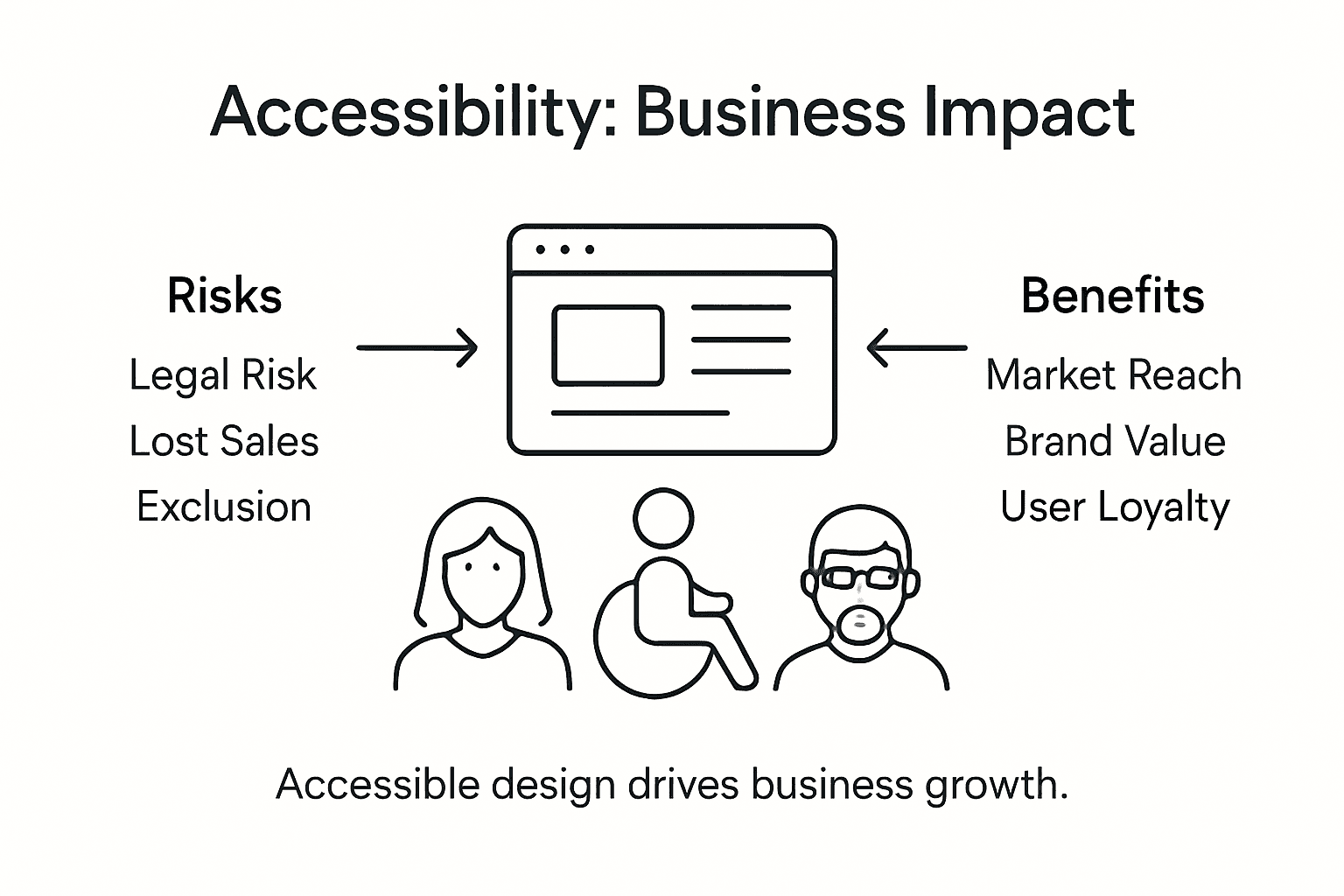
The potential risks of neglecting accessibility are significant and multifaceted. SMEs face substantial legal exposure, including potential discrimination lawsuits, reputational damage, and exclusion from entire market segments. Non-compliant websites not only risk financial penalties but also alienate a substantial customer base comprising individuals with disabilities and their networks. Moreover, inaccessible digital platforms can trigger negative word-of-mouth marketing and diminish brand perception among increasingly socially conscious consumers.
Beyond risk mitigation, accessible websites offer compelling business advantages. Enhanced digital experiences can expand market reach, improve search engine optimisation, and demonstrate corporate social responsibility. Small businesses that prioritise accessibility often discover unexpected benefits, such as improved user experience for all visitors, increased customer loyalty, and a competitive edge in demonstrating inclusive design practices. The marginal upfront investment in accessibility can translate into significant long-term business growth and customer engagement.
Pro tip: Conduct a comprehensive accessibility audit during initial website development to minimise retrofitting costs and integrate inclusive design principles from the outset.
The challenge of making websites accessible for all users is not just a legal obligation but a key opportunity to expand your reach and enhance user experience. This article highlights the critical need to incorporate perceivability, operability, understandability, and robustness into your digital platforms. At Kickass Online, we understand the importance of breaking down barriers by integrating these core accessibility principles into every website we create.
Accessibility is about more than technical compliance It is about connecting with real people who visit your site regardless of ability or device Our team specialises in creating bespoke websites that comply with legal standards while delivering smooth and engaging experiences for everyone. Ready to transform your digital presence and avoid costly pitfalls? Browse our Websites to see how we implement smart accessibility solutions.
Take control of your website’s accessibility now and unlock untapped market potential. Visit us at Kickass Online to book your personalised consultation. Discover tailored strategies and expert guidance in our Tutorials to ensure your business stands out as inclusive and forward-thinking.
Website accessibility refers to the practice of creating digital experiences that can be used effectively by all individuals, including those with disabilities or older adults, regardless of their physical or cognitive abilities.
Web accessibility is crucial for businesses because it ensures all users can navigate their websites. This inclusivity not only meets legal requirements but also enhances user experience, expands market reach, and demonstrates corporate social responsibility.
Common misconceptions include the belief that accessibility is an expensive add-on or that it compromises design quality. In reality, implementing accessible design can improve overall user experience and benefit a wider audience.
Businesses can improve their website’s accessibility by adding alternative text for images, ensuring keyboard navigation, using sufficient colour contrast, structuring content clearly, and conducting regular accessibility audits to identify barriers.
Nearly 60 percent of British small businesses experience website security breaches each year, putting customer trust and sales at risk. For business owners in Milton Keynes, keeping your online presence safe and running smoothly is crucial for credibility and growth. This guide explains what professional website maintenance involves, why it matters to British enterprises, and how you can avoid costly mistakes with smart, effective solutions.
| Point | Details |
|---|---|
| Website maintenance is essential for business success | Regular updates and monitoring help prevent technical issues and enhance online credibility. |
| Invest in comprehensive maintenance services | Focus on content management, security, and performance optimisation to protect your digital presence. |
| Proactive maintenance reduces costs | Establish a maintenance schedule to minimise risks and address issues before they escalate. |
| Understand legal obligations | Ensure compliance with data protection regulations to avoid penalties and safeguard your reputation. |
Website maintenance represents a comprehensive set of strategic activities designed to keep a business’s digital presence functional, secure, and optimised. At its core, this practice involves regular monitoring, updating, and managing various technical and content-related aspects of a website to ensure peak performance. Just like a vehicle requires routine servicing, websites demand consistent care to operate effectively and meet the evolving needs of businesses and their customers.
The scope of website maintenance encompasses multiple critical domains, including technical health, content management, security protocols, and performance optimisation. Regular website maintenance checks help businesses prevent potential issues before they escalate into significant problems. This proactive approach involves tasks such as:
For small and medium-sized enterprises (SMEs), website maintenance is not just a technical necessity but a strategic business investment. A well-maintained website acts as a powerful marketing tool, instilling confidence in potential customers and reflecting a professional, detail-oriented business approach. Neglecting website maintenance can lead to security vulnerabilities, poor user experience, and decreased search engine rankings - all of which can directly impact a company’s online credibility and revenue potential.
Pro tip: Schedule quarterly website maintenance reviews to systematically assess and address potential technical and content-related issues before they become critical problems.
Website maintenance services represent a comprehensive suite of technical and strategic interventions designed to keep digital platforms running smoothly and efficiently. Key website maintenance services encompass multiple critical domains that ensure a business’s online presence remains robust, secure, and continuously optimised.
These services typically fall into several essential categories:
For small and medium-sized enterprises, these maintenance services are not optional luxuries but fundamental business requirements. WordPress maintenance services offer specialised support for businesses using this popular content management platform, addressing platform-specific challenges and opportunities.
Additionally, comprehensive maintenance services go beyond technical upkeep. They involve strategic monitoring, proactive problem prevention, and continuous improvement of digital assets. By investing in professional website maintenance, businesses protect their online reputation, enhance customer trust, and create a resilient digital infrastructure capable of adapting to rapidly changing technological landscapes.
The following table summarises the main types of website maintenance services and their direct business benefits:
| Service Type | Primary Objective | Key Business Benefit |
|---|---|---|
| Content Management | Keep website content current | Increased audience engagement |
| Technical Updates | Maintain latest software and plugins | Reduced technical disruptions |
| Security Maintenance | Strengthen defences against online threats | Lower risk of data breaches |
| Performance Optimisation | Enhance speed and responsiveness | Improved customer satisfaction |
| Backup and Recovery | Ensure data can be restored if lost | Business continuity ensured |
| Compliance Management | Meet legal and regulatory standards | Avoid penalties and lawsuits |
Pro tip: Develop a structured maintenance schedule that includes monthly technical reviews and quarterly comprehensive assessments to stay ahead of potential digital challenges.
Website maintenance operates like a sophisticated digital health management system, requiring systematic and strategic approaches to keep online platforms functioning optimally. Maintaining a robust website involves a complex series of interconnected tasks designed to address technical, security, and performance challenges proactively.
The core maintenance workflow typically follows a structured approach:
Initial Assessment
Preventative Maintenance
Continuous Monitoring
Reactive Intervention
Small and medium-sized enterprises require particularly nuanced maintenance strategies. Unlike large corporations with extensive IT departments, SMEs need efficient, cost-effective maintenance solutions that address critical digital infrastructure needs without overwhelming technical complexity. This approach demands a balance between proactive management and strategic resource allocation.
Technical maintenance goes far beyond simple website updates. It encompasses a holistic approach to digital ecosystem management, integrating security protocols, performance optimisation, content relevance, and user experience design. Each maintenance cycle represents an opportunity to enhance digital resilience, protect business reputation, and create a more engaging online presence.

Pro tip: Create a detailed maintenance checklist with specific tasks, responsible team members, and completion timeframes to ensure consistent and comprehensive website care.
Website security and legal compliance represent critical responsibilities for businesses operating in the digital landscape. Website maintenance services play a crucial role in protecting organisations from potential legal and security risks that can emerge from digital vulnerabilities.
Cybersecurity Compliance involves multiple critical dimensions:
Data Protection Regulations
Security Infrastructure
Legal Obligations
Small and medium-sized enterprises face unique challenges in navigating these complex legal and security landscapes. Unlike large corporations with dedicated legal and technical teams, SMEs must develop strategic approaches that balance comprehensive protection with resource-efficient implementation.
The legal implications of website management extend beyond simple technical considerations. Businesses can face significant financial penalties and reputational damage for non-compliance, making proactive maintenance not just a technical requirement but a fundamental business strategy. This includes understanding sector-specific regulations, implementing appropriate consent mechanisms, and maintaining transparent communication about data usage and protection.
Pro tip: Consult with a specialised digital compliance expert annually to ensure your website meets the latest legal and security standards for your specific industry.
Website maintenance involves navigating a complex landscape of potential risks and financial considerations that can significantly impact small and medium-sized enterprises. WordPress maintenance services highlight the critical nature of understanding these potential challenges before they escalate into costly problems.
Key Risks for SMEs Include:
Financial Vulnerabilities
Operational Disruptions
Security Threats
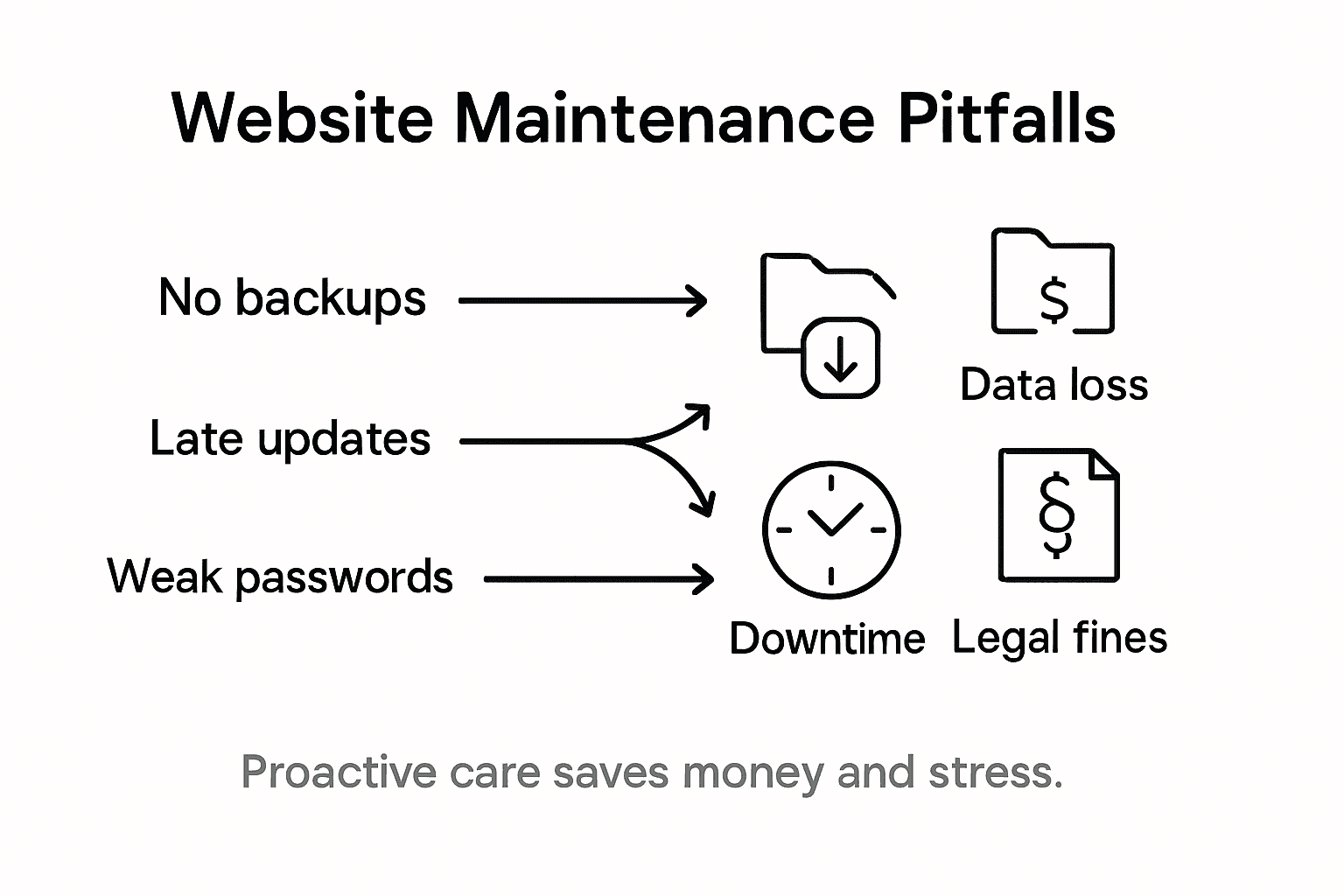
The financial implications of neglecting website maintenance can be profound. Small businesses often underestimate the cumulative costs of reactive maintenance, which can be substantially higher than proactive, consistent management. A single significant security breach or extended website downtime can result in thousands of pounds of lost revenue, damaged reputation, and potential client migration.
Common maintenance pitfalls typically stem from misconceptions about digital infrastructure. Many SMEs view website maintenance as an optional expense rather than a critical business investment. This approach frequently leads to compounding technical debt, where minor issues progressively transform into complex, expensive problems that require extensive resources to resolve.
Here is a quick comparison of proactive versus reactive website maintenance and the typical outcomes for businesses:
| Approach | Timing | Typical Result | Cost Implication |
|---|---|---|---|
| Proactive | Scheduled, ongoing | Fewer critical issues | Lower long-term expenditure |
| Reactive | After problems arise | Disruptive emergencies | Higher, unpredictable costs |
Pro tip: Allocate a dedicated budget for website maintenance that represents approximately 10-15% of your initial website development costs to ensure consistent, comprehensive digital health management.
Struggling to keep your website secure, fast and compliant as explained in the article Website Maintenance: Why It Matters for SMEs Your business deserves a partner who understands the critical importance of ongoing technical updates, security measures and content management to avoid costly downtime and reputational harm At Kickass Online we specialise in tailored website maintenance services designed specifically for small and medium-sized enterprises Our team delivers proactive support including regular audits, performance optimisation and compliance adherence so you can focus on growth with peace of mind
Discover how our dedicated specialists can transform your online presence by providing personalised care with limited client intake Browse our Websites | Kickass Online category to see how we maintain digital health and security for similar businesses Don’t wait for an emergency to address your website challenges Book your consultation now at Kickass Online and safeguard your digital investment today
Website maintenance for SMEs includes a set of strategic activities that ensure a business’s online presence is functional, secure, and optimised. It involves regular monitoring, updating, and managing technical and content-related aspects of a website to ensure peak performance.
Regular website maintenance is essential as it helps prevent potential issues from escalating into significant problems, ensures security against cyber threats, enhances user experience, and improves search engine rankings, thus maintaining your business’s credibility and enhancing customer trust.
Core tasks in website maintenance include content management, software and plugin updates, security checks, performance optimisation, data backups, and compliance management, all aimed at ensuring optimal website functionality.
Neglecting website maintenance can lead to security vulnerabilities, poor user experience, decreased search engine rankings, and ultimately, potential revenue loss, as customers may lose trust in businesses with poorly maintained websites.
Over 50 percent of british consumers rely on Google search to find local services before making a purchase. For Milton Keynes business owners, standing out online can mean the difference between steady growth and missed opportunities. This guide reveals practical SEO strategies that help you attract local customers, improve your online visibility, and nurture engagement in a competitive british market.
| Key Message | Explanation |
|---|---|
| 1. Claim and Optimise Your Google Business Profile | Ensure your profile is complete with accurate information to enhance visibility and attract more customers. |
| 2. Maintain Consistency in Local Citations | Regularly verify that your business details are identical across various online directories to build credibility. |
| 3. Encourage Genuine Customer Reviews | Collect authentic reviews from customers to enhance trust and improve local search rankings significantly. |
| 4. Integrate Local Keywords in Content | Use location-specific keywords in your website to increase relevance and connect with nearby customers effectively. |
| 5. Create Location-Specific Landing Pages | Develop unique pages focused on specific local areas to improve engagement and search visibility for your business. |
Your Google Business Profile represents your digital storefront in local search results. By claiming and optimising your profile, you unlock powerful visibility for your local business across Google Search and Maps.
This free tool allows you to control how your business appears online, providing potential customers with crucial information like contact details, opening hours, services, and customer reviews. Businesses that actively manage their profile see significant improvements in local search rankings and customer engagement.
To get started, visit Google Business Profile and verify your business location. You will need to confirm your physical address through a postcard or phone verification. Once verified, complete every section of your profile with accurate, comprehensive information.
Include high quality photographs of your business premises, products, and team. Visual content can increase profile engagement by up to 35% and helps potential customers understand your brand before visiting. Add detailed descriptions of your services, highlight unique selling points, and ensure all contact information is current.
Key Profile Optimisation Elements:
• Accurate business name
• Precise location and service area
• Current contact information
• Operating hours
• Comprehensive service descriptions
• Professional photographs
• Regular updates and posts
Pro tip: Update your Google Business Profile at least once per month with new photos, posts about promotions, or recent business achievements to signal active management and improve local search visibility.
Local citations are digital references to your business across online platforms that significantly impact your local search visibility. Consistent business information across directories helps search engines validate your business legitimacy and improve local search rankings.
Think of local citations as your business digital fingerprint. Every mention of your business name, address, and phone number (NAP) on websites like directories, social platforms, and review sites contributes to your local search credibility. Inconsistent information can confuse search algorithms and potentially harm your online visibility.
Start by identifying key online directories relevant to your industry and location. Platforms like Google Business Profile, Yelp, Yellow Pages, and industry specific directories are crucial. Ensure your business details are identical across all platforms including:
Key Citation Elements:
• Exact business name
• Complete physical address
• Local phone number
• Consistent website URL
• Matching business categories
• Precise geographical information
Manually audit your existing citations to eliminate discrepancies. Small variations like using Street vs St or different phone number formats can negatively impact your local search performance. Consider using citation management tools to streamline this process and track your listings.
Pro tip: Create a master document with your precise business information and use it as a reference when creating or updating online citations to maintain absolute consistency.
Customer reviews are the digital word of mouth that can dramatically influence your local search rankings and business reputation. Understanding how to ethically collect genuine customer feedback is crucial for building trust and improving local SEO performance.
Authentic customer reviews provide potential clients with real insights into your business quality and reliability. Search engines like Google prioritise businesses with consistent, positive reviews, considering them a key indicator of customer satisfaction and local relevance.
Effective Review Generation Strategies:
• Request reviews immediately after positive service experiences
• Make review submission easy and accessible
• Create personalised follow up communications
• Respond professionally to all reviews
• Demonstrate genuine appreciation for customer feedback
Avoid purchasing reviews or offering direct financial incentives for positive feedback. The most powerful reviews come from customers who voluntarily share their genuine experiences. Implement a systematic approach to review collection that feels natural and respectful.
Respond to every review with professionalism. Thank customers for positive feedback and address any concerns raised in negative reviews constructively. This demonstrates your commitment to customer satisfaction and helps potential clients see your business values transparency.
Utilise multiple platforms for review collection including Google Business Profile, industry specific review sites, and social media channels. Diversifying your review sources increases credibility and search engine visibility.
Pro tip: Create a simple review request template that you can personalise quickly after delivering an excellent service to make review collection seamless and efficient.
Local keywords are the secret weapon for businesses aiming to dominate local search results. Strategically incorporating location specific search terms helps search engines understand your business geographical relevance and connect you with nearby customers.
Think of local keywords as digital signposts that guide potential customers directly to your business. These specialised phrases combine your service offerings with specific geographical identifiers like city names, neighbourhoods, or regional descriptors.
Effective Local Keyword Strategies:
• Include city and region names naturally in content
• Integrate neighbourhood specific terminology
• Use service area descriptors
• Combine professional services with location names
• Create locally focused page titles and headings
Begin by researching the exact phrases local customers use when searching for services like yours. Tools like Google Keyword Planner can help identify precise local search terms. For example, instead of generic “web design”, use “web design in Milton Keynes” or “digital marketing services in Buckinghamshire”.
Focus on long tail local keywords that demonstrate specific user intent. These more detailed phrases often have lower competition and higher conversion potential. A plumber might target “emergency plumbing services in Milton Keynes” rather than just “plumber”.
Remember to maintain natural language flow. Keyword integration should feel organic and readable, not forced or awkward. Your content must provide genuine value while subtly signalling your local relevance to search engines.
Pro tip: Create a spreadsheet of location specific keywords and gradually integrate them into your website content, blog posts, and service descriptions to build local search authority.
Location-specific landing pages are precision targeted digital platforms designed to connect your business directly with local customers. Website localisation strategies enable businesses to create compelling, geographically relevant content that resonates with specific community audiences.
These specialised pages serve as dedicated entry points for customers from particular geographical areas, demonstrating your understanding of local market nuances and specific customer needs. By crafting unique pages for different locations, you significantly enhance your local search visibility and user engagement.
Key Location Landing Page Elements:
• Local geographical references
• Neighbourhood specific imagery
• Customised service descriptions
• Local contact information
• Testimonials from nearby customers
• Regionally relevant keywords
• Location specific calls to action
Each landing page should feel like a personalised invitation to local customers. Include specific details about your services in that area, highlight local team members, and showcase your understanding of community needs. For instance, a digital marketing agency might create separate pages for Milton Keynes, Buckinghamshire, and London, each with unique content reflecting local business landscapes.
Structure your pages to answer specific local search queries. What makes your business unique in this particular area? How do you solve problems specific to local customers? These targeted approaches signal to search engines that you are a genuinely local business committed to serving specific communities.
Avoid duplicating content across location pages. While templates can help streamline creation, each page must offer genuine, unique value. Use local landmarks, community references, and specific regional language to make each page feel authentic and engaging.
Pro tip: Create a content matrix mapping unique local attributes for each landing page to ensure your location specific content remains fresh, relevant, and compelling.
Mobile responsiveness and rapid website loading are now critical determinants of online success. Responsive web design principles ensure your digital presence adapts seamlessly across smartphones, tablets, and desktop devices.
Search engines like Google prioritise mobile friendly websites, making performance optimisation more than just a technical consideration. Your website must load quickly and display perfectly on every device to maintain competitive search rankings and user engagement.
Key Mobile Performance Factors:
• Image compression
• Minimised code
• Browser caching
• Reduced server response times
• Responsive design frameworks
• Streamlined content delivery
Start by measuring your current website performance using tools like Google PageSpeed Insights. These diagnostic resources provide granular recommendations for improving loading times and mobile responsiveness. Pay special attention to image sizes, which frequently cause significant loading delays.
Implement adaptive design techniques that automatically adjust layout, text size, and navigation based on screen dimensions. Prioritise content visibility and ensure touch friendly navigation elements for mobile users. Eliminate unnecessary scripts and plugins that might slow down your website performance.
Consider using content delivery networks to distribute website assets across multiple global servers. This approach reduces latency and improves loading speeds for users regardless of their geographical location. Compressed images, minified CSS and JavaScript, and efficient coding practices are essential for maintaining optimal website performance.
Pro tip: Regularly audit your website performance using free online tools and aim to maintain loading times under three seconds to prevent user drop off and maintain strong search engine rankings.
Social media platforms offer powerful channels for connecting with local customers and building community engagement. Strategic social media communication helps businesses create meaningful relationships that extend beyond traditional marketing approaches.
Your social media presence should reflect your local business identity, showcasing your understanding of community needs and demonstrating genuine local connections. Each platform offers unique opportunities to share your brand story and interact directly with potential customers.
Effective Local Social Media Strategies:
• Share location specific content
• Highlight local team members
• Engage with community events
• Use geotargeted advertising
• Showcase local customer testimonials
• Create neighbourhood focused posts
• Respond quickly to local comments
Utilise platform specific features like Instagram location tags, Facebook local business pages, and Twitter community hashtags. These tools help amplify your visibility and demonstrate your commitment to local audiences. Create content that resonates with local interests, challenges, and celebrations.
Develop a consistent posting schedule that balances professional information with personal insights. Share behind the scenes glimpses of your business, participate in local conversations, and highlight your team’s community involvement. Authenticity builds trust and encourages local customer engagement.
Monitor your social media metrics to understand which content generates the most local interaction. Track engagement rates, comment quality, and community response to refine your strategy continuously.
Pro tip: Allocate 20 minutes daily to genuine, thoughtful local social media engagement rather than sporadic, impersonal broadcasting.
Below is a comprehensive table summarising the key strategies for improving local search visibility and customer engagement discussed throughout the article.
| Strategy | Implementation | Benefits |
|---|---|---|
| Claim and Optimise Profile | Complete and verify your Google Business Profile; update regularly with accurate information and visuals. | Enhance visibility in local search; increase potential customer engagement. |
| Build Local Citations | Ensure consistent NAP information across all directories; audit existing entries for discrepancies. | Improve search engine validation and local credibility. |
| Encourage Reviews | Prompt customers for reviews; remain professional when responding. | Enhance business reputation and search engine trust. |
| Utilise Local Keywords | Integrate location-specific terms naturally in website content and metadata. | Promote business relevance within specific geographical areas. |
| Create Landing Pages | Develop unique, localised pages for different regions and include community-specific details. | Engage local audiences directly, enhancing search visibility. |
| Optimise Website Performance | Implement responsive design; improve loading speed adhering to optimised coding techniques. | Enhance user experience and maintain competitive search rankings. |
| Leverage Social Media | Share community-oriented content and engage actively with local audiences. | Foster meaningful relationships within the local community and increase reach. |
Struggling to optimise your local online presence despite following best practices like claiming your Google Business Profile and creating location-specific landing pages The challenges of maintaining consistent citations, gathering genuine reviews, and integrating local keywords can be overwhelming for any business owner. At Kickass Online, we understand these pain points and offer personalised digital marketing solutions tailored to help small and medium-sized businesses excel in local search visibility and customer engagement.
With our proven expertise in crafting high-converting Websites optimised for mobile and speedy loading alongside strategic SEO services we ensure your business stands out in your community. Partnering with us means dedicated attention to your unique needs plus continuous website maintenance and optimisation that drives real results. Discover how our team can relieve the burden of complex local SEO tasks and elevate your business profile.
Ready to transform your local presence and attract more nearby customers Visit Kickass Online now to book a consultation or explore insightful strategies in our Tips and Tricks section. Take the first step towards dominating your local market with a customised approach that truly delivers.
Claiming and optimising your Google Business Profile is essential for improving local visibility. Start by visiting the Google Business Profile site, verifying your business location, and completing all sections with accurate and comprehensive information.
Local citations are online mentions of your business name, address, and phone number across various platforms. They enhance your local search visibility, so ensure your business information is consistent on directories, social platforms, and review sites.
To encourage genuine customer reviews, ask for feedback immediately after positive interactions and make the review submission process straightforward. Respond to all reviews to show appreciation and commitment to customer satisfaction; this strategy can significantly boost your online reputation over time.
Local keywords are terms that combine your services with specific geographic indicators. Use these in your website content by naturally incorporating city or neighbourhood names, as this helps search engines connect your business with local customers searching for your services.
Creating location-specific landing pages allows you to tailor content directly to local audiences, improving engagement and search ranking. Ensure each page includes local references and unique content that addresses the needs of that specific community to enhance local connectivity.
To optimise your website for mobile devices, ensure it is responsive and loads quickly across all devices. Regularly measure your site’s performance and aim for loading times under three seconds to keep users engaged and reduce bounce rates.
Many british small businesses in Milton Keynes lose sales every year because customers abandon slow or unreliable websites. Securing trustworthy website hosting is critical for digital growth, yet myths and confusion often cloud the core concepts behind this service. This article breaks down the essentials and exposes common misconceptions, guiding you toward the hosting solutions that genuinely protect your reputation and drive results.
| Point | Details |
|---|---|
| Understanding Hosting Types | Recognise the differences between hosting types like Shared, VPS, Dedicated, and Cloud to select the appropriate solution for your business needs. |
| Importance of Security | Implement robust security measures and allocate a budget for cybersecurity to protect your digital assets and ensure business continuity. |
| Performance Metrics Matter | Prioritise hosting providers with high uptime guarantees and responsive support to enhance website performance and customer experience. |
| Regular Reviews Necessary | Conduct quarterly reviews of your website hosting performance and security protocols to adapt to evolving technological requirements and mitigate risks. |
Web hosting represents the fundamental infrastructure enabling businesses to establish a digital presence. At its core, hosting is the service that transforms static website files into a live, accessible online experience. Web hosting services provide physical or virtual servers that store and deliver website content to visitors worldwide.
Understanding web hosting requires recognising the critical technical components involved. Hosting servers differ dramatically from standard computers by prioritising continuous operation and stability. These specialised machines typically run robust Linux-based systems designed to maintain 24/7 website availability. The hosting process involves multiple technical steps: domain registration, server configuration, file uploading, and precise DNS management. Each element plays a crucial role in ensuring your website remains accessible, secure, and performant.
Multiple hosting types exist to accommodate diverse business requirements. Shared hosting represents the entry-level option, where multiple websites share server resources. Virtual Private Servers (VPS) offer more dedicated resources and greater control. Dedicated servers provide complete server allocation for businesses with high-traffic or complex websites. Cloud hosting emerged as a flexible alternative, enabling scalable resource allocation based on real-time demand. Businesses must carefully evaluate their specific needs, anticipated website traffic, and technical infrastructure requirements when selecting an appropriate hosting solution.
Pro tip: Always conduct thorough performance testing and have a backup hosting plan to ensure minimal downtime and optimal website reliability.
Navigating website hosting options can feel overwhelming for small businesses seeking the right digital infrastructure. Web hosting types range from basic shared platforms to sophisticated cloud solutions, each designed to meet specific performance and budgetary requirements. Understanding these options allows business owners to make informed decisions that align with their online strategy and growth objectives.
The primary hosting categories offer distinct advantages and limitations. Shared hosting represents the most economical option, where multiple websites occupy the same server resources. This approach works well for small businesses with limited traffic and basic website needs. Virtual Private Servers (VPS) provide a more robust intermediate solution, offering dedicated resources and enhanced performance without the full expense of a dedicated server. Businesses experiencing consistent growth often transition to VPS hosting to gain more control and reliability.

Dedicated hosting delivers the highest level of performance and customisation, providing an entire server exclusively for one organisation’s website. This option suits high-traffic websites, complex web applications, and enterprises requiring maximum security and control. Cloud hosting has emerged as a flexible alternative, distributing website resources across multiple interconnected servers. This approach enables dynamic scaling, improved uptime, and resilience against individual server failures. Small businesses benefit from cloud hosting’s ability to adjust resources rapidly in response to traffic fluctuations.
Here is a comparison of key website hosting types and their typical business use cases:
| Hosting Type | Ideal Business Size | Key Benefit | Main Limitation |
|---|---|---|---|
| Shared Hosting | Start-ups, micros | Lowest cost entry | Resource contention risk |
| VPS Hosting | Growing small firms | Dedicated resource share | Limited scalability |
| Dedicated Server | Large, high-traffic | Complete server control | Highest operational cost |
| Cloud Hosting | Any, scalable | Flexible, real-time scale | Complex configuration needed |
Pro tip: Conduct a thorough assessment of your current website traffic, anticipated growth, and technical requirements before selecting a hosting solution to ensure optimal performance and cost-effectiveness.
Website hosting serves as the digital foundation for modern businesses, enabling them to establish a robust online presence. Hosting providers offer scalable storage and technical infrastructure that transforms static website files into interactive, accessible digital experiences. This critical service allows businesses to publish websites, making their digital content available to customers worldwide through specialised server technologies.
The technical mechanics of website hosting involve complex data transmission processes. When a potential customer enters a business website address, their web browser sends a request to the hosting server. Server technologies then retrieve the specific website files, process them, and transmit the content back to the user’s device. These interactions happen in milliseconds, creating a seamless browsing experience. Different hosting environments provide varying levels of performance, security, and resource allocation, allowing businesses to select solutions matching their specific operational requirements.
Web hosting infrastructure supports business continuity and digital accessibility through sophisticated technical frameworks. Modern hosting solutions incorporate advanced security protocols, automated backup systems, and performance monitoring tools. Businesses can choose from shared, virtual private, dedicated, or cloud-based hosting models, each offering unique advantages in terms of cost, control, and scalability. The right hosting solution ensures websites remain available, responsive, and protected against potential technical disruptions or cybersecurity threats.
Pro tip: Regularly review your website hosting performance metrics and conduct periodic security audits to ensure your digital infrastructure continues meeting your business’s evolving technological needs.
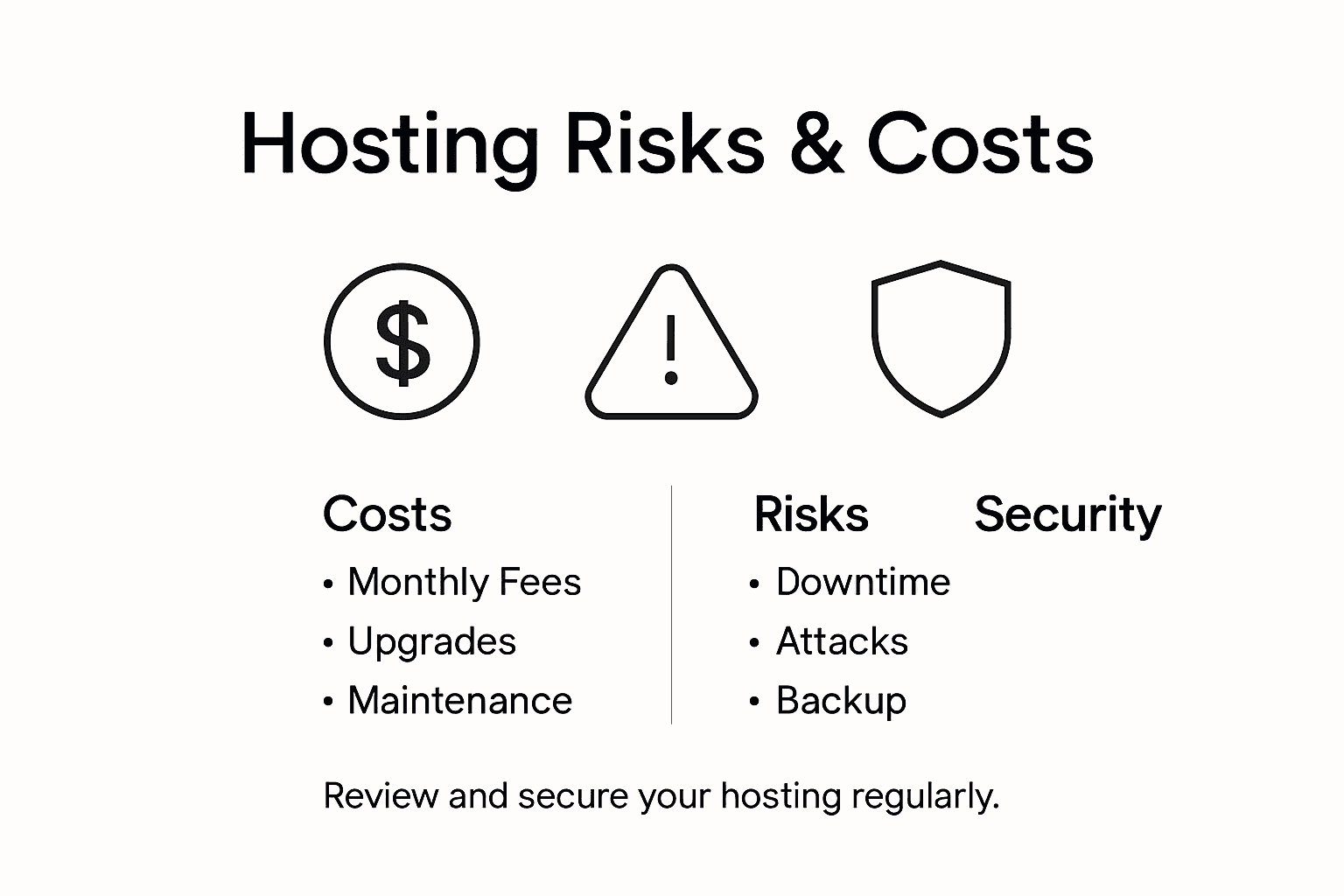
Navigating the complex landscape of website hosting requires a comprehensive understanding of potential financial and security challenges. Cybersecurity risks represent a significant consideration for businesses selecting hosting solutions, with potential consequences extending far beyond immediate technical disruptions. Small businesses must carefully evaluate hosting options that balance cost-effectiveness with robust security measures to protect their digital assets and customer data.
Transmission protocols play a critical role in mitigating online vulnerabilities. Businesses must prioritise secure HTTPS connections, implement robust authentication mechanisms, and conduct regular vulnerability assessments. The financial implications of potential data breaches can be substantial, potentially involving direct monetary losses, regulatory penalties, and long-term reputational damage. Hosting costs vary dramatically based on security features, with more comprehensive protection packages demanding higher investment but offering significantly reduced risk exposure.
The NIST Cybersecurity Framework provides a structured approach to managing digital security risks, emphasising five core functions: identify, protect, detect, respond, and recover. Small businesses should view cybersecurity not as an optional expense, but as a critical investment in their digital infrastructure. Implementing proactive security measures, such as regular software updates, comprehensive backup systems, and continuous monitoring, can significantly reduce potential financial and operational risks associated with website hosting.
Pro tip: Allocate at least 10% of your hosting budget specifically for security measures and conduct quarterly comprehensive security audits to stay ahead of emerging digital threats.
Selecting a reliable hosting provider represents a critical strategic decision for businesses seeking sustainable digital growth. The right hosting solution acts as the technological backbone supporting a company’s online presence, directly influencing website performance, customer experience, and ultimately, business credibility. Small businesses must carefully evaluate hosting options that provide robust infrastructure, scalability, and comprehensive support tailored to their evolving digital requirements.
Performance metrics play a crucial role in hosting selection. Businesses should prioritise providers offering high uptime guarantees, sufficient bandwidth, and flexible resource allocation. Critical evaluation criteria include server response times, ability to handle traffic fluctuations, integrated security features like SSL certificates, and responsive technical support. Scalability emerges as a key consideration, ensuring that hosting solutions can seamlessly accommodate business growth without requiring disruptive platform migrations or significant infrastructure redesigns.
The best hosting services balance affordability with advanced technological capabilities, recognising that digital infrastructure is an investment, not merely an expense. Comprehensive hosting packages should include tools for website management, robust security protocols, regular automated backups, and seamless integration with popular content management systems. Small businesses benefit from providers offering transparent pricing models, clear upgrade pathways, and proactive monitoring that allows entrepreneurs to focus on core business objectives rather than technical infrastructure management.
Below is a summary of fundamental performance and security factors impacting hosting decisions:
| Critical Factor | Business Impact | Consideration Example |
|---|---|---|
| Uptime Guarantee | Minimises customer disruption | 99.9% or higher preferred |
| Data Backup System | Safeguards against data loss | Daily or weekly backups |
| SSL Certificate | Secures sensitive information | HTTPS for e-commerce sites |
| Technical Support | Reduces lengthy downtime | 24/7 live chat assistance |
Pro tip: Schedule quarterly reviews of your hosting performance metrics and maintain an ongoing dialogue with your hosting provider to ensure your digital infrastructure continues meeting your business’s evolving technological requirements.
Choosing the right website hosting is a crucial step for small and medium enterprises aiming to build a strong online presence. This article highlights key challenges such as balancing cost, scalability, security and performance to avoid downtime and costly disruptions. If you want to eliminate technical stress and ensure your website runs smoothly with tailored hosting and ongoing support, Kickass Online specialises in creating personalised, high-converting websites with expert SEO optimisation and robust security measures.
Discover how our team of digital specialists can streamline your website hosting and maintenance needs while helping you focus on growing your business. Don’t wait until hosting issues impact your customers experience. Visit Kickass Online now to book a consultation and secure a hosting partner aligned with your unique goals and challenges. Get the dedicated attention your website deserves for lasting online success.
Web hosting is a service that allows businesses to store their website files on servers, making their content accessible online. It’s essential for SMEs to establish a digital presence and ensure their websites are operational 24/7.
The main types of web hosting include shared hosting, Virtual Private Servers (VPS), dedicated servers, and cloud hosting. Each type caters to different business needs, with varying levels of performance, resources, and costs.
SMEs should evaluate hosting providers based on performance metrics, such as uptime guarantees and load times, as well as scalability, security features, and customer support to ensure their chosen solution meets their evolving needs.
Businesses should prioritise hosting solutions that offer secure HTTPS connections, regular software updates, comprehensive backup systems, and proactive monitoring to safeguard against potential data breaches and cyber threats.
Most British small business websites miss out on over half their potential traffic simply due to basic SEO gaps. For Milton Keynes owners, understanding where your website stands is more than a technical task, it shapes your path to online growth. This practical guide unpacks each step to pinpoint strengths, address weak spots, and move towards a web presence that genuinely connects with your customers.
| Key Point | Explanation |
|---|---|
| 1. Regularly assess website performance | Conduct quarterly assessments of core metrics like loading speed and bounce rate to improve search engine readiness and user experience. |
| 2. Perform thorough keyword research | Identify both short and long tail keywords that reflect audience intent, helping to create relevant content that attracts traffic. |
| 3. Optimise on-page SEO elements | Focus on titles, meta descriptions, and headings with strategic keyword placement to enhance visibility and user engagement. |
| 4. Enhance technical SEO and speed | Regularly analyse loading speed and technical issues to improve search engine rankings and ensure a responsive design across devices. |
| 5. Monitor and refine SEO strategies | Use web analytics to track performance metrics continuously and adapt strategies based on data insights to optimise effectiveness. |
Understanding your website’s current performance is the foundational first step towards improving search engine rankings. This assessment provides a clear snapshot of where your digital presence stands and what strategic improvements you need to implement for better online visibility.
To begin, you’ll want to analyse your website’s core metrics using comprehensive tools. Start by examining your site’s loading speed performance, which is critical for user experience and search rankings. Google PageSpeed Tools offer an excellent starting point for evaluating your website’s technical performance. These tools automatically detect issues affecting your site’s speed, helping you understand potential bottlenecks that might be hindering your search engine positioning.
Beyond speed metrics, conduct a thorough examination of key performance indicators such as organic traffic, bounce rate, and conversion rates. Look closely at how users interact with your website using traffic analysis techniques that reveal user behaviour patterns. Pay special attention to which pages attract the most engagement and where potential visitors might be dropping off.
Top tip: Run your website performance assessment at least quarterly to stay ahead of potential technical issues and maintain optimal search engine readiness.
Keyword research is a critical strategy for understanding how potential customers search for services like yours online. This step will help you identify the precise language your target audience uses when seeking solutions your business provides.
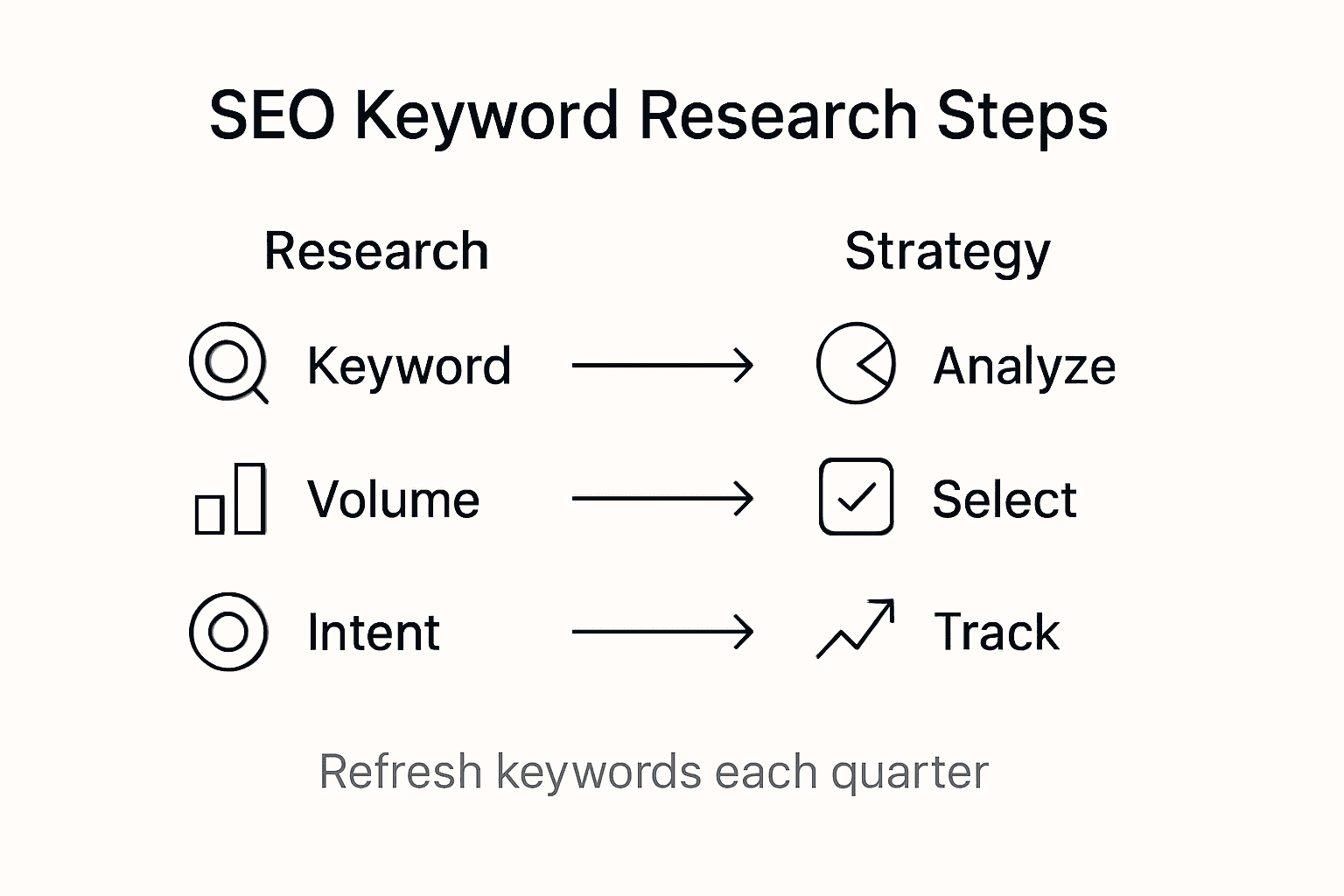
Begin by exploring both broad and specific search terms that relate to your business offerings. Analyse the different types of keywords ranging from short tail to highly specific long tail phrases. Understanding search intent becomes crucial here multiple customers might use different search terms to find similar services. Pay attention to the context and motivation behind each search query, which helps you create content that directly addresses user needs.
Here’s a concise comparison of short tail versus long tail keywords in SEO strategy:
| Keyword Type | Search Volume | Competition Level | Conversion Potential |
|---|---|---|---|
| Short tail | High | Very competitive | Often lower |
| Long tail | Moderate to low | Less competitive | Often higher |
This distinction helps clarify the strategic value of each approach in targeting audience intent.
Utilise professional keyword research tools to evaluate search volume, competition levels, and potential ranking opportunities. Focus on keywords that balance reasonable search frequency with manageable competition. Consider including location specific terms if your business serves a particular geographic area, as these can often provide more targeted traffic with higher conversion potential.
Expert suggestion: Periodically review and refresh your keyword strategy to ensure your content remains aligned with evolving search trends and user behaviours.
On-page search engine optimisation involves strategically refining your website’s content and HTML source code to improve visibility and ranking potential. Mastering key on-page elements requires a systematic approach to enhancing multiple website components that search engines evaluate.
Focus on optimising critical elements such as page titles, meta descriptions, headings, and content structure. Your page titles should include primary keywords while remaining clear and compelling. Create unique meta descriptions that accurately summarise page content and entice users to click. When structuring content, implement strategic keyword placement by incorporating target keywords naturally within headings, first paragraphs, and throughout your text without compromising readability.

Ensure your website’s technical structure supports search engine visibility by using clean, descriptive URLs, implementing appropriate header hierarchies, and adding alt text to images. Integrate semantically related keywords that expand on your primary search terms, helping search engines understand your content’s context and relevance. Remember that modern search algorithms prioritise content quality and user experience over mechanical keyword stuffing.
Below is a summary of key on-page elements and their SEO impact:
| On-Page Element | Description | SEO Benefit |
|---|---|---|
| Page Title | Main heading in browser tab | Improved keyword targeting |
| Meta Description | Brief content summary for search snippets | Higher click-through rates |
| Headers (H1-H3) | Structured subheadings within content | Enhanced content clarity |
| Alt Text | Describes website images for context | Greater accessibility, SEO |
Optimising these elements supports both visibility and user engagement.
Expert suggestion: Conduct regular content audits to maintain and improve your on-page SEO elements, ensuring they remain aligned with current search engine guidelines and user expectations.
Diagnosing and resolving technical SEO issues requires a comprehensive approach to improving your website’s performance and search engine visibility. Technical SEO encompasses multiple elements that directly impact your site’s ability to rank effectively and provide an exceptional user experience.
Begin by thoroughly analysing your website’s loading speed and mobile responsiveness. Google PageSpeed Tools offer sophisticated modules that automatically detect and suggest optimisations for CSS, JavaScript, images, and HTML structures. Focus on reducing server response times, compressing images, leveraging browser caching, and minimising render blocking resources. Implement responsive design principles to ensure your website functions seamlessly across different devices and screen sizes.
Conduct a comprehensive technical audit to identify potential issues that might impede search engine crawling and indexing. This includes checking your website’s XML sitemap, verifying robots.txt configurations, eliminating broken links, and ensuring proper canonical tag implementations. Pay special attention to mobile friendliness, site security through HTTPS protocols, and structured data markup that helps search engines better understand your content’s context and relevance.
Expert suggestion: Regularly monitor your website’s technical performance using professional SEO tools, addressing potential issues proactively to maintain optimal search engine rankings.
Developing online authority through strategic backlink strategies is crucial for improving your business’s search engine visibility and digital reputation. This process involves creating meaningful connections with reputable websites and establishing a strong local digital presence that signals credibility to search engines.
Begin by identifying high quality websites within your industry that could potentially link to your content. Focus on creating valuable, informative content that naturally encourages other websites to reference your work. Local SEO strategies become particularly important for small businesses looking to attract regional customers. Claim and optimise your Google Business Profile, ensure consistent business information across online directories, and encourage customer reviews that boost your local search visibility.
Utilise multiple strategies for acquiring backlinks including guest blogging, participating in industry forums, creating shareable infographics, and developing relationships with local business associations. Prioritise quality over quantity understanding that a single link from a highly respected website carries significantly more weight than numerous links from low quality sources. Always maintain ethical link building practices that align with search engine guidelines to avoid potential penalties.
Expert suggestion: Regularly audit your backlink profile to remove potentially harmful links and maintain a clean, authoritative online presence.
Continuous search engine optimisation demands systematic tracking and analysis of your website’s performance metrics. This critical stage involves transforming raw data into actionable insights that will progressively enhance your digital marketing effectiveness.
Utilise comprehensive web analytics tools to track key performance indicators such as organic traffic, keyword rankings, bounce rates, and conversion metrics. Web analytics platforms provide detailed insights into user behaviour, helping you understand which strategies are generating meaningful engagement. Pay close attention to how different content pieces perform, identifying patterns in user interaction that can inform future content and SEO approaches.
Develop a consistent review cycle where you assess your SEO performance monthly or quarterly. Compare current metrics against your initial benchmarks, looking for trends in search rankings, traffic sources, and user engagement. Be prepared to pivot your strategy based on these insights, whether that means adjusting keyword targeting, refreshing existing content, or exploring new content formats that resonate with your audience.
Expert suggestion: Create a living document tracking your SEO experiments and results, enabling data driven decision making and continuous improvement.
Struggling to improve your website’s search engine rankings despite following SEO basics like keyword research and on-page optimisation It can be frustrating when technical issues or weak backlink profiles hold you back from the traffic and conversions your business deserves. Our team at Kickass Online understands these challenges deeply. We specialise in comprehensive SEO and web development services tailored to small and medium-sized businesses to boost online visibility through expert performance audits, technical SEO fixes, and targeted local citation building. Discover proven strategies that align with the detailed steps in this guide by exploring valuable insights in our Tips and Tricks | Kickass Online collection.
Ready to transform your website into a high-ranking, high-converting asset Our personalised approach ensures your business receives dedicated attention and customised solutions for long-term growth. Visit Kickass Online to learn about our expert team and client success stories or explore our specialised Websites | Kickass Online services. Book a consultation today and start seeing measurable improvements from your SEO efforts now.
To assess your website’s performance, start by analysing loading speed using relevant performance tools. Aim to run this assessment at least quarterly to identify issues that could impact your search engine rankings.
Begin by identifying both broad and specific search terms relevant to your business. Utilise keyword research tools to evaluate search volume and competition levels, focusing on keywords that align well with user intent and have manageable competition.
Focus on optimising page titles, meta descriptions, headings, and content structure to improve visibility. Ensure that your content includes target keywords naturally while maintaining readability to enhance user engagement and search rankings.
To improve technical SEO, analyse your website’s loading speed and mobile responsiveness. Implement responsive design and address issues like broken links and improper canonical tags to enhance both user experience and search engine crawling.
Develop quality backlinks by creating valuable content that other reputable websites will reference. Engage in guest blogging and local SEO tactics to establish credibility and ensure your business is listed accurately in online directories.
Use web analytics tools to track key performance indicators such as organic traffic and conversion rates. Regularly review your metrics on a monthly or quarterly basis to identify trends and refine your SEO strategies accordingly.
Most british businesses underestimate how much a website’s loading speed shapes customer decisions in Milton Keynes. Studies show that over half of users abandon slow sites in just three seconds, costing businesses real revenue and trust. Understanding the facts and myths around website speed can help you pinpoint what really matters for user experience, search rankings, and daily operations, so you can turn your website into a true asset for customer engagement.
| Point | Details |
|---|---|
| Website speed is multi-faceted | Understanding website speed requires considering various performance metrics, not just milliseconds. Effective optimisation must consider user experience across different contexts and devices. |
| Impact on business outcomes | Slow loading times negatively affect user trust, engagement, and conversion rates, leading to significant potential revenue loss. Regular performance audits can help mitigate these issues. |
| SEO importance | Website speed is a critical ranking factor for search engines, with faster sites enjoying higher visibility and organic traffic. Implementing Google’s Core Web Vitals is essential for optimisation. |
| Avoid common optimisation mistakes | Implementing speed improvements without understanding their broader impact can harm functionality and user experience. A balanced and informed approach is essential for effective optimisation. |
Website speed represents the total time required for a web page to load and become fully interactive, involving multiple complex technical processes. Contrary to popular belief, speed isn’t just about a single metric but encompasses various performance indicators that collectively determine user experience and website effectiveness.
Many businesses mistakenly assume that website speed is a straightforward concept, but web performance involves nuanced misconceptions that can mislead decision makers. Speed measurement isn’t simply about milliseconds - it involves understanding how different elements interact, how content renders, and how users perceive loading time. Some technical myths suggest universal solutions like aggressive caching or massive JavaScript compression, but real-world performance requires a more sophisticated approach.
The most critical myths surrounding website speed include believing faster always means better, assuming all pages should load identically, and thinking technical optimisations guarantee improved performance. Debunking website speed myths reveals that context matters significantly. Different user segments, device types, and network conditions dramatically influence perceived performance. A strategy that works perfectly for one website might prove ineffective for another.
Pro tip: Regularly audit your website’s speed using multiple tools and perspectives to understand real-world performance variations across different devices and network conditions.
Measuring website speed goes far beyond a simple stopwatch approach. Website performance metrics encompass a comprehensive set of technical indicators that collectively reveal how quickly and effectively a website delivers content to users across different devices and network conditions.
Key performance metrics include Time to First Byte (TTFB), which measures server response time, and Largest Contentful Paint (LCP), which tracks how long the primary page content takes to load. These technical measurements help businesses understand nuanced performance aspects. Comprehensive site speed assessment requires evaluating multiple metrics including DNS lookup time, page load duration, and user interaction responsiveness.
The most critical speed metrics businesses should monitor include:
Each metric provides unique insights into website performance, revealing potential bottlenecks in loading, rendering, and interactivity that might negatively impact user experience and conversion rates.
Pro tip: Use multiple performance measurement tools to cross-reference metrics and gain a holistic understanding of your website’s speed across different platforms and network conditions.
Here’s a summary of key website speed metrics and their business significance:
| Metric | What It Measures | Business Impact |
|---|---|---|
| Time to First Byte (TTFB) | Server response speed | Affects initial user impression |
| Largest Contentful Paint (LCP) | Main content load time | Influences site engagement |
| Speed Index | Speed of visible content rendering | Impacts perceived performance |
| First Input Delay (FID) | Time to first user interaction | Determines interactivity |
| Total Blocking Time (TBT) | Duration of main thread blockages | Impacts responsiveness |
| Time to Interactive (TTI) | Time until page fully usable | Affects conversion rates |
Website speed is far more than a technical metric - it’s a critical factor in building and maintaining user trust. When visitors encounter a slow-loading website, their immediate psychological response is frustration, which rapidly translates into diminished confidence in the business’s professionalism and reliability.

Users make split-second judgments about a website’s credibility based on loading performance. Understanding user experience fundamentals reveals that websites taking longer than three seconds to load can experience bounce rates exceeding 50%. This means potential customers literally abandon sites before even viewing content, representing significant lost business opportunities. The connection between speed and trust is deeply psychological: slow websites subconsciously signal inefficiency, suggesting the business might be similarly unresponsive or outdated.
The impact of website speed extends beyond immediate user perception. Slow websites negatively influence multiple critical business metrics:
Moreover, in an era of instant digital gratification, users have become increasingly impatient. They expect seamless, rapid interactions that require minimal waiting. A millisecond delay can mean the difference between securing a sale and losing a potential customer permanently.
Pro tip: Conduct regular website speed audits using multiple devices and network conditions to identify and eliminate performance bottlenecks before they impact user experience.
The table below highlights how website speed can affect business outcomes and user perceptions:
| Speed Outcome | User Reaction | Business Effect |
|---|---|---|
| Fast loading | Trust and confidence | Higher conversion rates |
| Moderate delays | Mild frustration | Lower engagement |
| Slow loading (>3 sec) | High abandonment, distrust | Lost revenue, reduced ranking |
Search engine rankings are intrinsically linked to website performance, with speed serving as a critical ranking factor that can dramatically influence a website’s visibility and organic traffic potential. Comprehensive website performance guides reveal that Google’s algorithms explicitly prioritise websites demonstrating fast, responsive user experiences.
Google’s Core Web Vitals have transformed website speed from a peripheral consideration into a fundamental ranking criterion. These metrics measure crucial performance aspects like loading speed, interactivity, and visual stability, directly impacting how search engines evaluate and position websites. Slower websites not only frustrate users but also receive lower search result placements, effectively penalising businesses with suboptimal digital infrastructure.
The most significant SEO speed-related ranking factors include:
Businesses must recognise that search engine algorithms are increasingly sophisticated, using advanced machine learning techniques to assess website performance. A millisecond of additional load time can translate into meaningful ranking differences, potentially pushing a website several positions lower in search results and reducing organic traffic potential.
Pro tip: Regularly utilise Google’s PageSpeed Insights to identify and systematically eliminate technical performance barriers affecting your website’s search engine rankings.
Website performance is not merely a technical consideration but a critical business economic factor with profound financial implications. Professional studies reveal that businesses suffer significant revenue losses from poor website performance, with 67% of organisations experiencing direct economic consequences from suboptimal digital infrastructure.
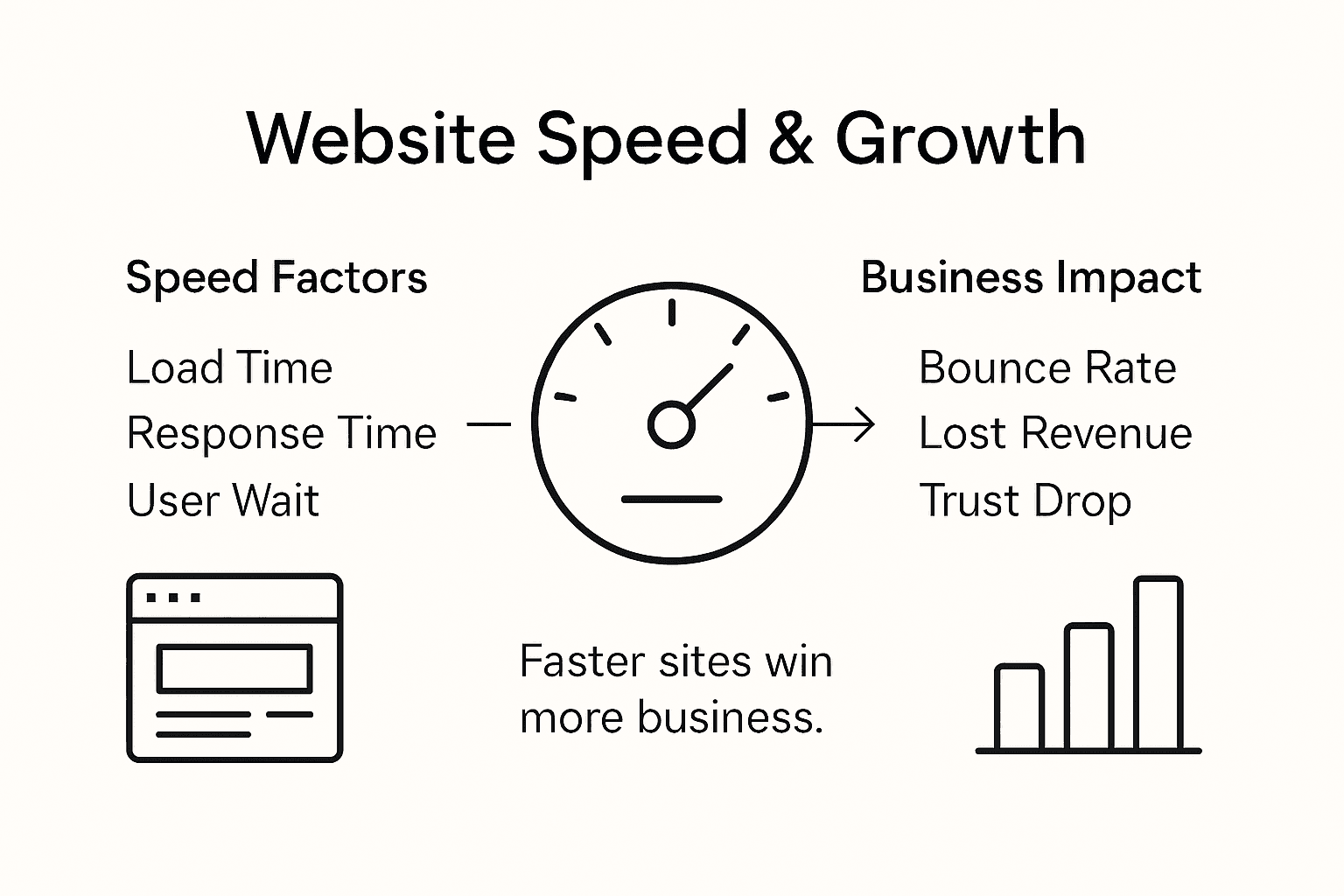
The financial impact of slow websites extends far beyond immediate transaction losses. Reduced website speed creates a cascading effect of operational inefficiencies, including increased customer acquisition costs, diminished conversion rates, and substantial marketing budget waste. Each second of loading delay can translate into measurable revenue reduction, with studies indicating potential losses ranging from 7% to 25% in potential sales conversions.
Key financial and operational costs associated with slow websites include:
Moreover, slow websites create hidden operational expenses through increased customer service interactions, higher bounce rates, and reduced employee productivity. The cumulative effect can represent thousands of pounds in lost potential and unnecessary operational overhead, making website performance a strategic business investment rather than a mere technical expense.
Pro tip: Conduct a comprehensive website performance audit quarterly to identify and quantify potential financial losses associated with slow loading times.
Website speed optimisation requires strategic and nuanced approaches, with many businesses inadvertently implementing counterproductive tactics that can compromise performance. Common website speed optimisation mistakes can significantly undermine technical improvements, creating unexpected bottlenecks that negate potential gains.
One of the most prevalent errors is implementing performance changes without comprehensive understanding. Businesses often pursue aggressive optimisation strategies like excessive image compression, indiscriminate plugin removal, or radical code minification without considering the holistic impact on user experience and functionality. These approaches can create more problems than they solve, potentially breaking critical website features or degrading visual quality.
Key mistakes to avoid during website speed improvement include:
Technical optimisation requires a balanced approach that considers performance, user experience, and functional integrity. Blindly following generic speed improvement guides without understanding their specific context can lead to diminished website effectiveness, reduced user engagement, and potential loss of critical website functionality.
Pro tip: Utilise professional performance testing tools and conduct thorough user experience testing before implementing any significant website speed modifications.
If you have read this article, you already understand that slow website speed can harm user trust, reduce conversions and damage your SEO rankings. Tackling complex concepts like Core Web Vitals, Time to First Byte and First Input Delay is no small feat, especially when these metrics directly influence how potential customers perceive your brand and engage with your services. At Kickass Online, we specialise in custom website solutions that prioritise speed without sacrificing performance or user experience.
Explore our Websites | Kickass Online services where our expert team crafts high-converting, fast-loading websites designed to boost your online visibility and trust instantly. Don’t let slow load times cost you revenue, visit Kickass Online today to book a consultation and start transforming your digital presence now. Unlock the full potential of your website by leveraging professional optimisation strategies shared in our Tutorials | Kickass Online section and make speed your competitive advantage.
Website speed refers to the total time it takes for a web page to load and become fully interactive. It’s crucial for businesses as it directly impacts user experience, trust, and conversion rates. A fast-loading website can enhance user satisfaction and encourage customers to stay longer, ultimately driving business growth.
Website speed is a critical ranking factor for search engines like Google. Slower websites may be penalised in search results, leading to reduced visibility and organic traffic. Optimising site speed can help improve rankings and attract more users, enhancing overall business growth.
Important metrics include Time to First Byte (TTFB), Largest Contentful Paint (LCP), First Contentful Paint (FCP), Time to Interactive (TTI), First Input Delay (FID), and Total Blocking Time (TBT). Each metric provides insights into different aspects of website performance, allowing businesses to identify and address potential issues affecting speed.
Businesses should avoid over-compressing images, neglecting proper caching, and using heavy or unoptimised themes. Additionally, making performance changes without understanding their impact on user experience can lead to more problems. A balanced approach to optimisation is necessary to ensure improved website speed without sacrificing functionality.
Nearly 60 percent of british small business websites fail basic security checks, leaving critical gaps in their online presence. For Milton Keynes business owners, understanding the reality behind website audits can be a game changer. This article challenges common myths, explains audit types, and gives practical advice to help you protect your website, improve search visibility, and attract more customers with confidence.
| Point | Details |
|---|---|
| Comprehensive Website Audit | A website audit is essential for assessing technical performance, user experience, and security, benefiting all businesses, regardless of size. |
| Common Myths Addressed | Misconceptions that audits are only for large corporations or overly complex are unfounded; all businesses should conduct regular assessments. |
| Types of Audits | Different types of audits (Technical, Content, SEO, Security, UX) each serve unique purposes and enhance overall digital performance. |
| Risks in Auditing | Incomplete audits can lead to missed vulnerabilities; regular audits and a follow-up process are crucial for effective outcomes. |
A website audit is far more than a simple technical checkup. It represents a comprehensive diagnostic process that examines every critical aspect of your online presence, from technical performance to user experience and security. Comprehensive website evaluations reveal potential issues that might be hindering your business’s digital effectiveness.
Many business owners harbour misconceptions about website audits, believing they are exclusively technical or expensive procedures reserved for large corporations. The reality could not be further from the truth. Small and medium-sized businesses benefit immensely from regular website assessments. These evaluations help identify performance bottlenecks, security vulnerabilities, and opportunities for improvement that directly impact customer engagement and conversion rates.
Common myths surrounding website audits include assumptions that small websites are not attractive targets for cybercriminals or that such assessments are prohibitively complex. Cybersecurity experts consistently debunk these misconceptions, emphasising that every website requires regular scrutiny. Audits help detect potential vulnerabilities, enhance site speed, improve search engine rankings, and ensure a seamless user experience across different devices and platforms.
Pro tip: Conduct a preliminary website audit every quarter to stay ahead of potential performance and security issues, treating your online presence like a living, breathing entity that requires consistent care and attention.
Website audits are not a one-size-fits-all process but rather a collection of specialised assessments targeting different aspects of digital performance. Comprehensive website evaluations reveal multiple distinct audit types, each serving a unique purpose in enhancing online effectiveness.
The primary types of website audits include Technical Audit, which examines site infrastructure and performance metrics; Content Audit, focusing on the quality and relevance of published materials; SEO Audit, which analyses search engine optimisation strategies; Security Audit, identifying potential cybersecurity vulnerabilities; and User Experience (UX) Audit, evaluating website design and interaction flow. These specialised assessments work together to provide a holistic view of a website’s strengths and potential improvement areas.
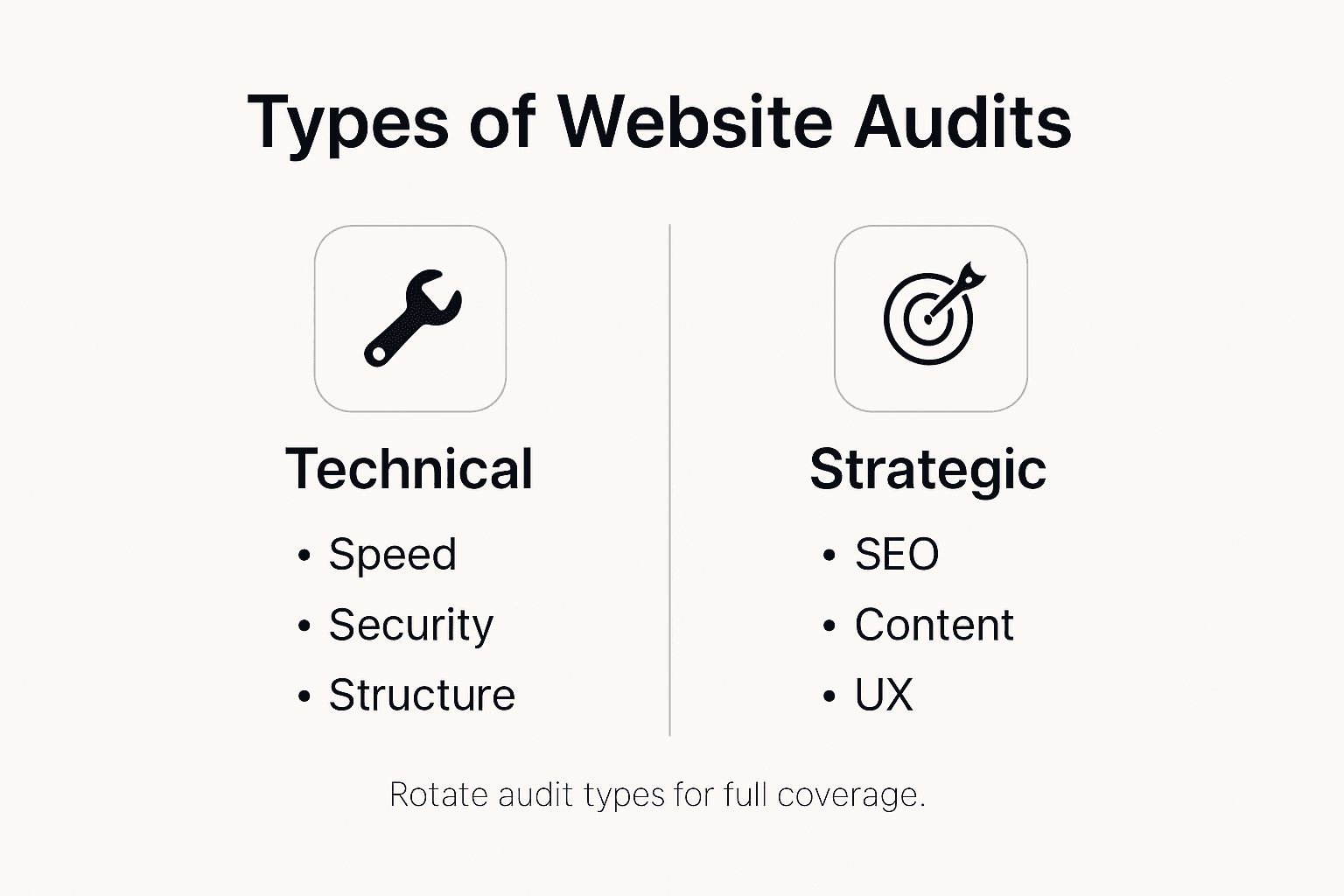
Each audit type offers specific insights crucial for digital strategy. A Technical Audit might uncover page load speed issues or broken links, while a Content Audit could highlight outdated information or content gaps. SEO Audits reveal keyword optimisation opportunities, Security Audits protect against potential breaches, and UX Audits ensure your website provides an intuitive, engaging user journey. By understanding and implementing findings from these different audit approaches, businesses can systematically enhance their digital presence and competitive positioning.
Here’s how the main types of website audits compare in focus and benefits:
| Audit Type | Primary Focus | Key Business Benefit |
|---|---|---|
| Technical Audit | Site infrastructure | Improves speed and reliability |
| Content Audit | Quality of information | Enhances relevance and engagement |
| SEO Audit | Search visibility | Increases website traffic |
| Security Audit | Cyber threat protection | Safeguards sensitive data |
| UX Audit | User interaction flow | Boosts customer satisfaction |
Pro tip: Rotate through different audit types quarterly to maintain a comprehensive and dynamic approach to your website’s health and performance.
A website audit is a systematic process that requires careful planning and execution. Information security audits follow a structured methodology designed to comprehensively assess digital infrastructure and performance. The initial stage involves understanding the current technological landscape of the website, establishing baseline metrics, and identifying potential areas of improvement.
The audit process typically unfolds through several critical stages. First, auditors define the precise scope and objectives, determining which aspects of the website will be examined. Next, they collect detailed evidence by conducting thorough system reviews, performance tests, and configuration analyses. Cybersecurity audit approaches emphasise the importance of gathering comprehensive data across multiple dimensions including technical infrastructure, user experience, security protocols, and content effectiveness.
After gathering evidence, auditors meticulously evaluate findings against established performance benchmarks and industry standards. This involves detailed analysis of technical configurations, content relevance, search engine optimisation strategies, security vulnerabilities, and user interaction patterns. The final stage involves compiling a comprehensive report that not only highlights identified issues but also provides actionable recommendations for improvement. These insights enable businesses to make informed decisions about website enhancements, prioritising changes that will deliver the most significant impact on overall digital performance.
Pro tip: Schedule your website audit during off-peak hours to minimise potential disruption to your online services and ensure the most accurate performance assessment.
Website audits offer transformative advantages for small businesses seeking to establish a robust digital presence. Cybersecurity audits provide critical insights that go beyond simple technical assessments, delivering strategic advantages that directly impact business growth and customer confidence.

Small business owners can expect multiple tangible benefits from comprehensive website audits. These include improved website performance, enhanced search engine visibility, and robust security protection. Performance evaluations help uncover technical limitations that might be hindering customer engagement, such as slow loading times, mobile responsiveness issues, or complex navigation structures. By addressing these elements, businesses can significantly improve user experience and increase the likelihood of converting website visitors into paying customers.
Beyond technical improvements, website audits provide strategic intelligence that enables small businesses to compete more effectively in digital marketplaces. The insights gained help identify potential security vulnerabilities, optimise content strategies, and align digital assets with business objectives. Audits reveal opportunities for targeted improvements, whether that involves refining SEO strategies, streamlining website architecture, or enhancing customer interaction points. This proactive approach transforms websites from passive online brochures into dynamic, high-performing business tools that actively drive growth and build customer trust.
Pro tip: Conduct website audits biannually to ensure your digital presence remains agile, secure, and aligned with evolving business goals.
Website audits can quickly become ineffective or counterproductive when businesses fail to understand potential pitfalls. Information security audits involve complex risk management that requires meticulous planning and comprehensive understanding to deliver meaningful insights.
One of the most significant risks is conducting an incomplete or superficial audit that overlooks critical aspects of digital infrastructure. This might involve neglecting emerging cybersecurity threats, failing to assess all technical components, or using outdated evaluation methodologies. Small businesses are particularly vulnerable when audits do not thoroughly examine security protocols, performance metrics, user experience, and compliance requirements. An audit that misses key elements can provide false confidence and leave critical vulnerabilities unaddressed.
Mitigation strategies demand systematic and thorough approaches to ensure meaningful outcomes. Common mistakes include treating audits as one-time events rather than ongoing processes, failing to communicate findings effectively with stakeholders, and most critically, not implementing recommended improvements. Businesses must view audit results as actionable intelligence, creating structured plans to address identified weaknesses and continuously monitor digital performance. The most effective audits result in tangible improvements that enhance website security, user experience, and overall digital strategy.
Common audit pitfalls and ways to avoid them:
| Risk or Mistake | Potential Impact | Mitigation Strategy |
|---|---|---|
| Incomplete scope | Missed vulnerabilities | Define comprehensive coverage |
| Neglecting follow-up | Unresolved website weaknesses | Create an implementation checklist |
| Using outdated methods | Ineffective analysis | Apply current industry standards |
| Treating audit as one-off | Lags in improvement | Schedule audits regularly |
Pro tip: Create a dedicated follow-up process immediately after each website audit to track and implement recommended changes within specific timeframes.
Understanding the importance of a thorough website audit is just the first step towards boosting your business performance online. The challenges highlighted in the article such as improving site speed, enhancing security, and refining user experience are exactly where expertise makes all the difference. At Kickass Online, we specialise in addressing these critical areas through personalised web development and optimisation services tailored specifically for small and medium-sized businesses.
Explore how our dedicated team can help you overcome common pain points including SEO optimisation, technical improvements, and robust security measures with our proven approach. Discover insightful strategies and practical solutions in our Websites | Kickass Online category to start transforming your website today.
Ready to turn your website audit insights into tangible business growth Seek expert assistance now to ensure your website is agile, secure and perfectly aligned with your business goals Visit Kickass Online to book a consultation and explore our comprehensive digital marketing and website services. For ongoing learning and tips, explore our Tutorials | Kickass Online to stay ahead in managing your online presence effectively.
A website audit is a comprehensive diagnostic process that examines all aspects of your online presence, including technical performance, user experience, and security, to uncover areas for improvement.
Website audits help small businesses identify performance bottlenecks, security vulnerabilities, and opportunities to enhance customer engagement and conversion rates, ultimately boosting their digital effectiveness.
It is recommended to conduct a website audit quarterly to stay ahead of potential performance and security issues, ensuring your online presence remains effective and secure.
The main types of website audits include Technical Audits, Content Audits, SEO Audits, Security Audits, and User Experience (UX) Audits, each serving a specific purpose in enhancing your website’s performance and security.
Most British businesses in Milton Keynes are surprised to learn that over 90 percent of potential customers search for local services online before making a choice. For local business owners, mastering local search means staying ahead in an increasingly competitive market. This guide clears up common myths about local search, outlines what search engines really look for, and shows how practical strategies can make your business more visible in the right places.
| Point | Details |
|---|---|
| Understand Local Search Dynamics | Local search is a dynamic process requiring continuous adaptation and optimisation to enhance visibility in specific geographic areas. |
| Optimise Google Business Profile | Regularly update and maintain your Google Business Profile to ensure accurate information and improve local search rankings. |
| Focus on Consistency | Maintain consistent business details (NAP) across all platforms to build credibility and enhance local search visibility. |
| Avoid Common Mistakes | Be aware of common pitfalls, such as neglecting customer reviews and outdated online profiles, to improve your digital presence. |
Local search represents a critical digital marketing strategy where businesses aim to attract customers searching for products or services within a specific geographic area. Businesses leverage digital tools to compete for local customers, targeting potential clients through platforms like Google Search and Google Maps.
Contrary to popular misconceptions, local search is not a static process but a dynamic approach requiring continuous adaptation and strategic innovation. Many business owners mistakenly believe that simply having an online presence guarantees visibility. In reality, successful local search strategies demand accurate and complete business profiles that provide comprehensive information about location, services, and customer experiences.
The core components of effective local search include:
Pro tip: Regularly update your Google Business Profile with current photos, accurate operating hours, and recent customer testimonials to improve local search visibility.
Local search engines employ sophisticated algorithms that systematically collect and analyse geographic data to deliver precise, location-specific results. Specialised search mechanisms consider multiple ranking factors including content relevance, geographical proximity, and user interaction patterns to determine the most appropriate business listings.
The identification process involves complex computational methods that evaluate several key criteria. These include the accuracy of business location information, the frequency and quality of customer reviews, website relevance to local search terms, and the consistency of business details across different digital platforms. Search engines like Google prioritise businesses that demonstrate reliable and comprehensive local information.
Crucial ranking elements that influence local search results encompass:
Businesses seeking to improve their local search visibility must understand these intricate algorithmic processes and strategically optimise their online presence accordingly. Local SEO strategies play a pivotal role in enhancing digital discoverability and attracting potential customers within specific geographic regions.
Pro tip: Regularly audit your online business listings across multiple platforms to ensure consistent and accurate location information, which significantly improves local search engine ranking potential.
Google Business Profiles represent a critical digital tool for local businesses seeking online visibility. These profiles aggregate comprehensive business information, combining official business details with user-generated content to create a dynamic online representation of a company’s local presence.

Local citations serve as digital validation mechanisms that strengthen a business’s online credibility. These mentions include the business’s name, address, and phone number (NAP) across various online platforms, directories, and social media channels. Consistent and accurate citations signal to search engines like Google that a business is legitimate and trustworthy, directly influencing local search rankings and discoverability.
Key components of effective Google Business Profiles and local citations include:
Local SEO strategies play a crucial role in managing these digital assets, ensuring that businesses maintain a strong and reliable online presence that attracts potential local customers.
Pro tip: Conduct a monthly audit of your online business listings to ensure all information remains accurate and consistent across different platforms.
Comprehensive local search ranking strategies encompass multiple sophisticated signals that search engines use to evaluate and prioritise business visibility. These intricate ranking mechanisms consider diverse elements that collectively determine a business’s prominence in local search results.
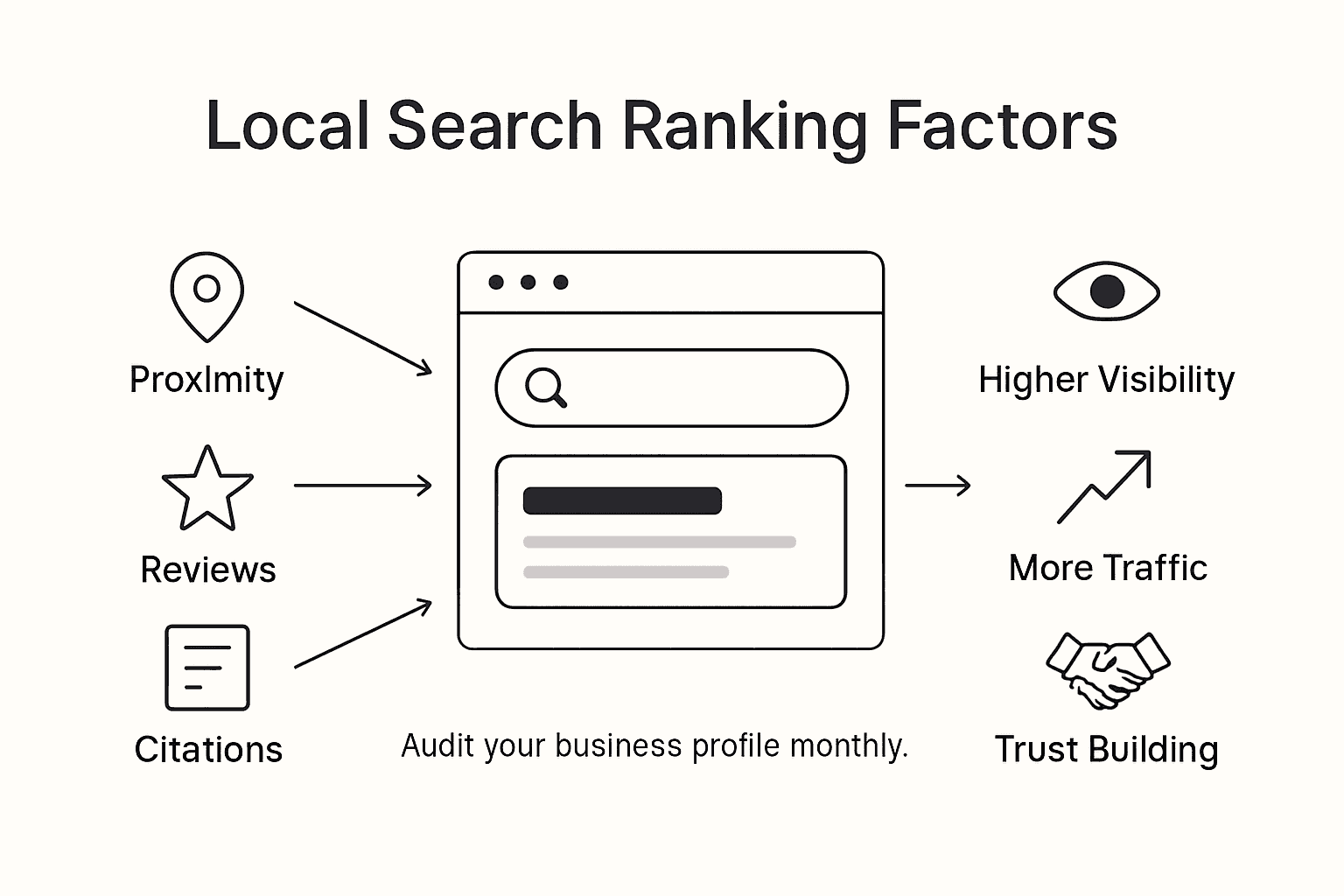
Google’s local search algorithm fundamentally evaluates three primary dimensions: relevance, proximity, and prominence. Relevance relates to how well a business matches a searcher’s specific query, determined through precise business categorisation and targeted keyword alignment. Proximity measures the physical distance between the searcher and the business location, while prominence reflects the business’s reputation and credibility through indicators like review quality, website authority, and consistent online mentions.
Key ranking factors that businesses must strategically optimise include:
Local business marketing strategies play a crucial role in improving these ranking signals, enabling businesses to enhance their digital visibility and attract more local customers.
Here is a quick reference comparing the impact of key local search ranking factors on business visibility:
| Ranking Factor | Influence on Visibility | Typical Business Benefit |
|---|---|---|
| Google Business Profile | High | Drives local search prominence |
| Customer Reviews | Moderate to High | Builds trustworthiness |
| Local Keyword Targeting | Moderate | Attracts relevant local traffic |
| Local Backlinks | Moderate | Boosts authority and reputation |
| Mobile Responsiveness | Essential | Improves customer engagement |
Pro tip: Conduct a monthly comprehensive audit of your online presence, systematically checking and updating all local search ranking factors to maintain optimal search engine performance.
Navigating local search requires understanding critical pitfalls that can dramatically impact a business’s online visibility. Many businesses unknowingly compromise their digital presence through seemingly minor oversights that accumulate into significant ranking challenges.
Businesses frequently encounter several fundamental local search mistakes that undermine their online performance. These include inconsistent business information across digital platforms, neglecting Google Business Profile optimisation, failing to manage online reviews strategically, and overlooking local keyword targeting. Each of these errors can substantially reduce a company’s chances of appearing prominently in local search results.
Key local search mistakes to avoid encompass:
Local business marketing strategies play a crucial role in mitigating these common errors and establishing a robust online presence.
The following table summarises common local search mistakes and their long-term business consequences:
| Common Mistake | Typical Consequence | Prevention Strategy |
|---|---|---|
| Inconsistent business details | Lower search ranking | Regular audit of listings |
| Neglecting customer reviews | Missed trust-building | Establish proactive review process |
| Outdated website/mobile design | Reduced customer interactions | Maintain responsive website design |
Pro tip: Implement a quarterly digital audit to systematically verify and update all online business listings, ensuring consistent and accurate information across all platforms.
Struggling to stand out in local search results despite having an online presence? This article highlights common challenges like inconsistent business information and incomplete Google Business Profiles that directly impact your local visibility and customer trust. At Kickass Online, we understand how crucial precise location details, consistent branding, and strategic local SEO are to attracting nearby customers and growing your business sustainably.
Partnering with a digital marketing agency that prioritises personalised solutions ensures your business avoids costly mistakes and thrives in local search rankings. Our team specialises in creating high-converting websites optimised for local keyword targeting, seamless mobile responsiveness, and robust online reputation management that aligns perfectly with your business goals.
Discover how our tailored web development and SEO services can transform your local online presence today. Don’t let overlooked local search factors hold your business back. Visit Kickass Online now and book your consultation to start dominating your local market.
Local search refers to a digital marketing strategy where businesses aim to attract customers searching for products or services within a specific geographic area, utilising platforms like Google Search and Google Maps.
An accurate Google Business Profile is crucial as it aggregates comprehensive business information, such as location, contact details, and customer reviews, enhancing a company’s visibility in local search results.
Common local search mistakes include inconsistent business information across platforms, neglecting Google Business Profile optimisation, failing to manage online reviews, and not targeting relevant local keywords, all of which can dramatically impact visibility.
Customer reviews significantly influence local search visibility by building trust and credibility for a business. A high quantity and quality of positive reviews can enhance a business’s prominence in local search results.
A single change in your british website’s SEO can mean the difference between being found by customers in Milton Keynes or being lost among competitors. With over 90 percent of people starting their searches on Google, understanding how Google ranking works is crucial for any small or medium-sized business. Discover what signals matter most and how focused SEO strategies can help your business rise higher in search results and stay visible to your target audience.
| Point | Details |
|---|---|
| Understanding Google Ranking | Google employs complex algorithms that assess multiple factors such as content quality, relevance, and user experience to rank websites. Businesses must optimise these elements to enhance visibility. |
| Diverse Ranking Types | Different Google ranking systems exist, including organic, local, and news search, each with distinct criteria tailored to specific search contexts. Marketers should adapt strategies accordingly. |
| Search Position Influencers | Key factors affecting search rankings include content quality, technical performance, and user engagement, necessitating a focus on both high-quality content and optimised website functionality. |
| SEO Strategy Importance | Implementing effective SEO strategies, including keyword research and technical optimisation, is crucial for enhancing online visibility and improving search rankings over time. |
Every business with an online presence wants to understand how Google determines which websites appear at the top of search results. Google Ranking represents a complex system where search engines evaluate and position web pages based on numerous signals and criteria. Google’s ranking systems continuously analyse hundreds of factors to determine the most relevant and valuable content for users.
The fundamental goal of Google’s ranking mechanism is delivering the most useful search results. This means websites are assessed across multiple dimensions, including content relevance, expertise, trustworthiness, and user experience. Technical aspects like page loading speed, mobile responsiveness, and site structure play critical roles in determining how prominently a website appears in search results. Businesses that understand these nuanced ranking criteria can strategically optimise their digital presence to improve visibility.
Businesses should recognise that Google’s ranking algorithms are sophisticated and dynamic. Search algorithms prioritise content that demonstrates genuine value to users, which means simply stuffing keywords or creating low-quality content will not achieve sustainable search performance. Successful digital strategies require consistently producing high-quality, authoritative content that directly addresses user needs and questions.
Pro tip: Invest time in understanding your target audience’s search intent and create content that comprehensively answers their most pressing questions, thereby naturally improving your Google ranking potential.
Online ranking systems have evolved into sophisticated platforms that serve diverse purposes across various digital landscapes. Search Rankings represent complex mechanisms that evaluate and categorise content based on multiple sophisticated criteria. Different ranking systems demonstrate unique methodologies for indexing and presenting information across academic, commercial, and research domains.
In the digital ecosystem, Google offers several distinct ranking approaches tailored to specific search contexts. These include organic search rankings, which prioritise website relevance and quality, local search rankings focusing on geographical proximity and business information, and specialised rankings like Google News, Shopping, and Academic Search. Each ranking system employs intricate algorithms that analyse factors such as content quality, user engagement, website authority, and contextual relevance.
Businesses and content creators must understand that ranking systems are not monolithic but nuanced platforms designed to match user intent with the most appropriate content. The algorithms continuously evolve, incorporating machine learning and artificial intelligence to refine search results. This dynamic nature means websites must consistently produce high-quality, relevant content that genuinely addresses user queries and provides meaningful value across multiple dimensions.
Pro tip: Develop a comprehensive content strategy that targets multiple ranking signals by creating in-depth, authoritative content that serves clear user intentions across different search contexts.
Here’s a summary of Google ranking types and their unique criteria:
| Ranking Type | Main Criteria | Best Used For |
|---|---|---|
| Organic Search | Relevance, quality, authority | General website visibility |
| Local Search | Location, business details | Attracting nearby customers |
| News Search | Timeliness, accuracy, engagement | Promoting news articles |
| Shopping Search | Product relevance, pricing | E-commerce product listings |
Search Engine Ranking involves a complex interplay of multiple critical factors that determine a website’s visibility and positioning. Google’s ranking systems meticulously evaluate websites across several key dimensions, with each factor contributing differently to the overall search performance. Understanding these elements is crucial for businesses seeking to improve their online presence and attract more targeted organic traffic.
The primary factors influencing search position include content quality, technical performance, and user engagement metrics. Content relevance remains paramount, requiring websites to produce high-quality, original material that directly addresses user queries. Technical aspects such as site speed, mobile responsiveness, and secure connections play increasingly significant roles in determining search rankings. Websites must demonstrate excellent performance across devices, with fast loading times and robust security protocols that signal reliability to search algorithms.

User experience metrics have become increasingly sophisticated in determining search rankings. Search engines now analyse complex signals like user interaction time, bounce rates, and content engagement to assess a website’s value. This means businesses cannot simply optimise for keywords but must create genuinely useful, compelling content that keeps visitors interested and encourages meaningful interactions. Factors such as internal linking, clear site structure, and intuitive navigation contribute substantially to how search algorithms perceive a website’s overall quality and relevance.
Pro tip: Conduct a comprehensive website audit quarterly to identify and address technical performance issues, ensuring your site remains optimised for both user experience and search engine requirements.
Search Engine Optimisation represents a comprehensive approach to enhancing online visibility and improving website performance across digital platforms. Strategic SEO techniques systematically address multiple interconnected aspects of digital presence, allowing businesses to climb search engine rankings through methodical and targeted improvements.
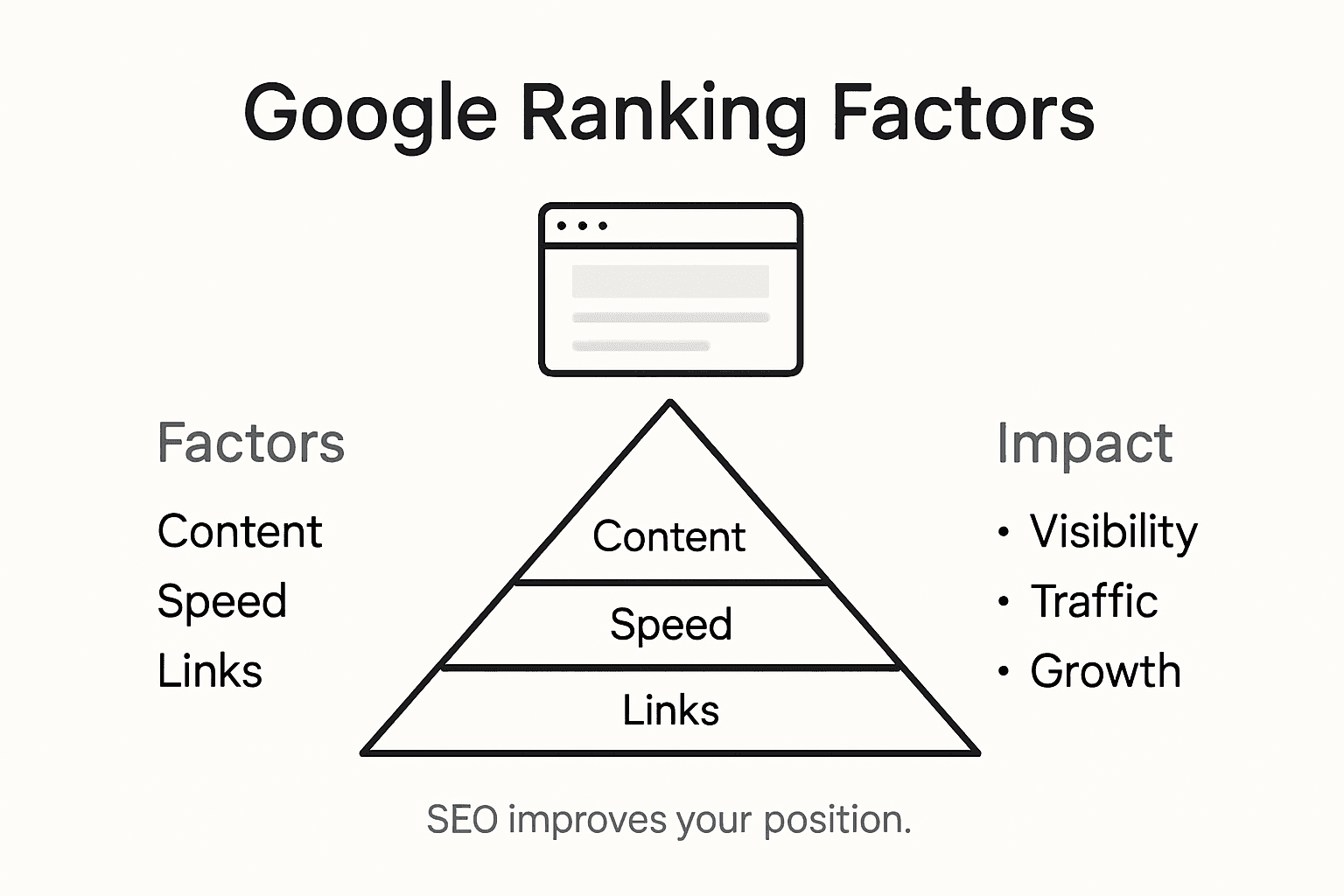
Keyword research forms the foundational element of effective SEO strategies, enabling businesses to understand and target specific user search patterns. By identifying precise search terms relevant to their industry, organisations can develop content that directly addresses user queries, signalling relevance to search algorithms. Technical optimisation complements content strategies by ensuring websites load quickly, function smoothly across devices, and provide secure, seamless user experiences. This includes optimising site architecture, improving page speed, implementing responsive design, and ensuring robust mobile compatibility.
Building online authority represents another critical dimension of SEO improvement. This involves developing high-quality backlinks from reputable websites, creating comprehensive and valuable content, and establishing digital credibility through consistent, trustworthy information sharing. Search engines increasingly prioritise websites that demonstrate expertise, authoritativeness, and reliability, meaning businesses must focus not just on technical performance but on genuine value creation for their target audiences.
Pro tip: Develop a quarterly content and technical performance audit to systematically identify and implement SEO improvements, ensuring your digital strategy remains dynamic and responsive to evolving search algorithm requirements.
See how key SEO strategies improve search rankings:
| SEO Strategy | Core Benefit | Example Impact |
|---|---|---|
| Keyword Research | Targets user intent | Higher qualified traffic |
| Technical Optimisation | Improves site performance | Faster load, less bounce rate |
| Authority Building | Enhances site credibility | More reputable backlinks |
Search Engine Ranking presents numerous challenges that can significantly impact a website’s online visibility and performance. Language bias in digital content indexing represents one of the most subtle yet pervasive obstacles businesses encounter when attempting to improve their search rankings across diverse digital landscapes.
One of the most common pitfalls involves keyword mismanagement, where businesses either overuse keywords or fail to understand their target audience’s genuine search intent. Keyword stuffing not only diminishes content quality but also triggers search engine penalties that can dramatically reduce website visibility. Technical challenges such as poor site architecture, slow loading speeds, and inadequate mobile responsiveness create additional barriers to achieving optimal search rankings. Websites must maintain a delicate balance between technical performance and content relevance, ensuring that both human users and search algorithms can easily navigate and understand their digital presence.
Competitive digital environments demand sophisticated content strategies that go beyond simple keyword placement. Search engines increasingly prioritise comprehensive, authoritative content that demonstrates genuine expertise and provides real value to users. This means businesses must invest in creating in-depth, original content that addresses complex user queries, establishes thought leadership, and builds meaningful engagement. Understanding the nuanced requirements of search algorithms requires continuous learning and adaptive strategies that respond to evolving digital marketing landscapes.
Pro tip: Conduct monthly comprehensive audits of your website’s technical performance and content strategy, identifying potential ranking obstacles and proactively addressing emerging challenges before they impact your search visibility.
Understanding how Google ranks your website is just the first step. Many businesses face challenges like navigating complex search algorithms, improving content quality, ensuring fast site performance, and building genuine online authority. These pain points can create frustration and stall your online growth despite your efforts to produce valuable content and optimise your site.
At Kickass Online, we specialise in bridging these exact gaps. Our team delivers personalised web development and SEO services crafted specifically to improve your site’s relevance, technical performance, and user engagement, all key factors that impact your Google ranking. By focusing on tailored, high-converting websites and ongoing maintenance, we ensure your digital presence not only attracts visitors but converts them into loyal customers.
Take control of your online visibility today and avoid common pitfalls like keyword mismanagement or poor site responsiveness that hold back your success. Explore how our experts can guide your growth with proven strategies that align perfectly with the needs outlined in “What Is Google Ranking? Impact On Your Online Growth”.
Ready to boost your search engine rankings and drive tangible business growth? Visit Kickass Online now to book a consultation and discover custom digital marketing solutions designed with your business goals in mind. Learn more about our professional website design services and start your journey towards lasting online success.
Google Ranking refers to the position of a webpage on search engine results pages (SERPs) based on various factors that determine its relevance and authority.
Google evaluates websites based on multiple signals, including content quality, technical performance, user engagement, and the overall user experience to determine ranking.
A higher Google Ranking increases a website’s visibility, attracting more organic traffic, which can lead to enhanced engagement, conversions, and overall online growth for businesses.
To improve Google Ranking, focus on creating high-quality content, optimising your website’s technical performance, conducting keyword research, and building credible backlinks.
Many british business owners in Milton Keynes are surprised to learn that over 90 percent of all online experiences begin with a search engine query. When your digital presence depends on reaching the right people at the right time, understanding keyword research becomes vital. Smart keyword choices bridge your brand with potential buyers, giving you the edge in a fiercely competitive market and transforming clicks into loyal customers.
| Point | Details |
|---|---|
| Importance of Keyword Research | Understanding user search terms enhances content relevance and improves online visibility for businesses. |
| Types of Keywords and User Intent | Classifying keywords into informational, navigational, commercial, and transactional aids in targeted marketing strategies. |
| Role of Metrics in Keyword Strategy | Analysing engagement metrics helps align content with user intent, refining digital marketing efforts. |
| Tools for Effective Keyword Research | Utilising advanced tools like Google Keyword Planner and SEMrush provides data-driven insights for keyword selection. |
Keyword research represents a strategic process of identifying and analysing search terms that people enter into search engines, enabling businesses to understand precisely what their target audience seeks online. At its core, keyword research connects the language of potential customers with the content businesses create, bridging communication gaps and improving digital visibility.
In academic and professional contexts, keywords act as critical navigation tools. Precise keyword selection supports comprehensive content discoverability across digital platforms. They function as digital signposts, guiding search engines and readers towards relevant content by matching user queries with appropriate information. Small and medium enterprises can leverage this technique to significantly enhance their online presence, transforming seemingly obscure search terms into powerful marketing opportunities.
Effective keyword research involves understanding search intent, analysing search volume, and evaluating competition levels. Businesses must look beyond simple word matching and dive into the psychological motivations behind search queries. By comprehending why potential customers search for specific terms, organisations can craft content that directly addresses user needs, thereby increasing engagement and conversion potential.
Pro tip: Start your keyword research by brainstorming terms your ideal customers would genuinely use when seeking solutions your business provides, not just technical industry jargon.
Keyword classification enables small and medium enterprises to develop nuanced digital marketing strategies that precisely target different audience segments. Systematic keyword categorisation supports strategic audience engagement by understanding the distinct intentions behind various search queries.
Fundamentally, keywords can be divided into four primary types based on user intent: informational, navigational, commercial, and transactional. Informational keywords represent users seeking knowledge or answers, such as “how to improve business visibility” or “SEO best practices”. Navigational keywords indicate users looking for specific websites or brands, like “Kickass Online digital marketing”. Commercial keywords signal potential buyers researching products, exemplified by phrases like “best digital marketing services in Milton Keynes”. Transactional keywords demonstrate immediate purchase intent, including terms like “hire SEO consultant” or “website design package”.
Beyond intent-based classifications, keywords can also be categorised by length and specificity. Short-tail keywords are broad, generic terms with high search volumes but intense competition, while long-tail keywords are more specific, detailed phrases with lower search volumes but higher conversion potential. Geo-targeted keywords further refine audience reach by incorporating location-specific terms, allowing businesses to target local markets with precision.

Here is a comparison of keyword types and their typical business impact:
| Keyword Type | User Intent | Example Phrase | Business Impact |
|---|---|---|---|
| Informational | Seeking knowledge | How to boost online sales | Builds brand authority, attracts new users |
| Navigational | Finding a specific site | OpenAI homepage | Drives direct website traffic |
| Commercial | Research before purchase | Best marketing tools UK | Generates qualified leads |
| Transactional | Ready to purchase | Buy SEO package Milton Keynes | Increases sales and conversions |
Pro tip: Develop a balanced keyword strategy by combining different keyword types, ensuring you capture audience segments across various stages of their digital journey.
Understanding search intent represents a critical foundation for effective digital marketing strategies, enabling businesses to align their content with precise user expectations. Comprehensive search intent analysis reveals critical insights into user behaviour and engagement patterns, transforming keyword research from a mechanical process into a strategic communication approach.
Search intent fundamentally categorises user queries into four primary types: informational, navigational, commercial, and transactional. Each type signals a distinct stage in the user’s decision-making journey. Informational intent indicates users seeking knowledge, navigational intent suggests seeking a specific website, commercial intent reveals research before potential purchase, and transactional intent demonstrates immediate purchasing readiness. By mapping these intent categories against key performance metrics like click-through rates, bounce rates, and conversion rates, businesses can develop more targeted and effective content strategies.
Metrics play a crucial role in validating search intent effectiveness. Key indicators include engagement duration, page views, conversion rates, and user interaction patterns. These metrics provide nuanced insights into how well content matches user expectations, helping businesses refine their approach. For instance, a high bounce rate might indicate misalignment between search intent and delivered content, while strong conversion rates suggest precise intent matching. Sophisticated digital marketers combine quantitative metrics with qualitative understanding to create comprehensive, user-centric content strategies.
Pro tip: Regularly analyse your website analytics to track how different content pieces perform against specific search intent categories, allowing continuous refinement of your keyword and content approach.
Advanced keyword research techniques enable small businesses to transform digital marketing strategies through systematic and strategic exploration of search behaviours. Modern digital tools have revolutionised how organisations approach keyword identification, moving beyond traditional guesswork to data-driven precision.
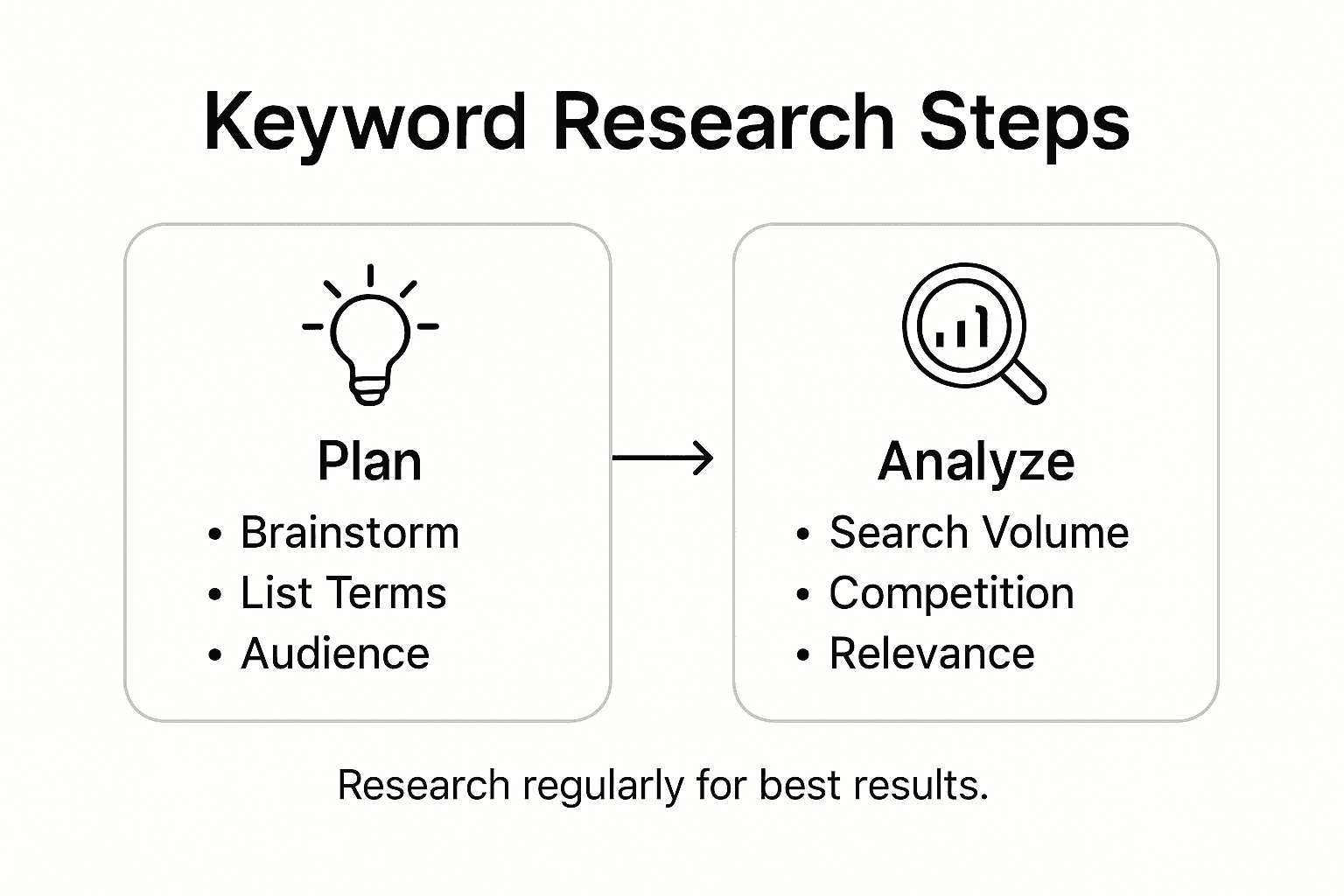
Several sophisticated tools stand out in the keyword research landscape. Google Keyword Planner provides foundational search volume and competition insights, while SEMrush offers comprehensive competitive analysis capabilities. Ahrefs delivers deep keyword difficulty assessments, helping businesses understand the potential challenge of ranking for specific terms. Google Trends enables understanding of seasonal keyword variations, allowing marketers to adapt strategies dynamically. These tools collectively transform keyword research from a speculative exercise into a structured, analytical process.
This table outlines key keyword research tools and their unique strengths:
| Tool Name | Main Functionality | Ideal Use Case |
|---|---|---|
| Google Keyword Planner | Estimates search volume/competition | Researching basic keyword opportunities |
| SEMrush | Competitive keyword analysis | Analysing rival strategies |
| Ahrefs | Keyword difficulty & backlink data | Assessing ranking challenge |
| Google Trends | Tracks keyword popularity over time | Identifying seasonal trends |
Effective keyword research involves multiple complementary techniques. Businesses should start by brainstorming seed keywords directly related to their products or services, then expand using tool-generated suggestions and related search queries. Competitor analysis provides crucial insights, revealing gaps and opportunities in existing keyword strategies. Semantic keyword exploration, identifying conceptually related terms, helps create more comprehensive content that addresses broader user intentions. Long-tail keyword identification allows targeting more specific, potentially less competitive search queries that often demonstrate higher conversion potential.
Pro tip: Create a systematic keyword research workflow that combines multiple tools and techniques, ensuring you capture a holistic view of potential search opportunities.
Understanding common keyword research mistakes helps businesses develop more sophisticated digital marketing strategies, preventing potential visibility and engagement challenges before they emerge. Keyword research is a nuanced process requiring strategic thinking and careful execution.
One of the most significant pitfalls is keyword stuffing, where businesses unnaturally overload content with repetitive search terms in an attempt to manipulate search rankings. This approach not only diminishes content quality but can also trigger search engine penalties that dramatically reduce online visibility. Another critical mistake involves selecting overly broad or generic keywords that fail to capture specific user intentions. Small businesses must prioritise precise, targeted keywords that reflect genuine user search behaviours and align closely with their unique service offerings.
Effective keyword strategy demands a balanced approach. Businesses should avoid extreme narrowness or excessive broadness, instead developing a strategic mix of short-tail and long-tail keywords that comprehensively represent their offerings. Semantic keyword research becomes crucial, exploring conceptually related terms that provide context and depth. Continuous monitoring and adaptation are essential, as search behaviours evolve rapidly. Regular keyword performance analysis allows businesses to refine their approach, identifying emerging trends and adjusting strategies to maintain optimal online visibility.
Pro tip: Conduct quarterly keyword audits to identify underperforming terms and emerging search trends, ensuring your digital content remains dynamically aligned with target audience behaviours.
The challenge of mastering keyword research to enhance your SME’s digital visibility is real. You want to move beyond guesswork and effectively connect with your target audience at every stage of their search journey. Whether it is honing in on transactional keywords to boost direct sales or balancing your approach with informational and commercial terms to build lasting engagement, getting this right drives measurable growth. At Kickass Online, we understand these pain points and the importance of a nuanced keyword strategy that makes your business stand out in a crowded marketplace.
Discover how tailored web development solutions combined with precise SEO tactics can amplify your search engine rankings and capture the right leads just when they are ready to act. Our team ensures your website not only attracts qualified traffic but also converts visitors into loyal customers through expertly optimised content and ongoing performance maintenance. Don’t let your SME get lost in digital noise. Visit Kickass Online today and explore our recommendations to start transforming your online presence. Take the next step now and book a consultation with professionals who prioritise your business growth.
Keyword research is the process of identifying and analysing search terms that potential customers use in search engines. It is crucial for SMEs as it helps connect their content with what their target audience is searching for, improving online visibility and engagement.
To determine search intent, categorise keywords into types: informational (seeking knowledge), navigational (looking for specific sites), commercial (researching products), and transactional (ready to purchase). Understanding these intents helps tailor your content to meet user needs.
Long-tail keywords are more specific phrases that typically have lower search volumes but higher conversion potential. They should be included in your strategy as they often target users further along in the buying process, leading to more qualified leads and increased sales.
Key tools for keyword research include Google Keyword Planner, SEMrush, Ahrefs, and Google Trends. Each of these tools provides valuable insights such as search volumes, keyword difficulty, and trends, helping to refine your keyword strategy effectively.
Most british businesses in Milton Keynes wonder how ethical SEO actually impacts their online reputation. With over 50 percent of search engine penalties linked to non-compliance with proper optimisation guidelines, choosing sustainable strategies has never mattered more. This guide uncovers what white hat SEO truly means, debunks persistent myths, and reveals what small and medium-sized businesses can gain by focusing on genuine, long-term approaches to online visibility.
| Point | Details |
|---|---|
| Focus on User Value | White hat SEO prioritises creating genuine value for users, ensuring adherence to search engine guidelines for sustainable growth. |
| Avoid Manipulative Techniques | Techniques like keyword stuffing and purchasing backlinks may yield temporary results but can result in severe long-term penalties. |
| Continuous Adaptation | Regular audits and performance tracking are essential to align with evolving search engine algorithms and user expectations. |
| Build Natural Link Profiles | Focus on creating high-quality, informative content that attracts organic backlinks from reputable sources, enhancing credibility and visibility. |
White hat SEO represents an ethical digital marketing approach focused on creating genuine value for users while strictly adhering to search engine guidelines. Unlike manipulative techniques, white hat SEO prioritises sustainable strategies that build long-term online credibility. As search engine experts explain, this methodology involves generating high-quality content, improving website performance, and ensuring a positive user experience.
At its core, white hat SEO challenges several persistent misconceptions. Many business owners believe ethical SEO strategies are slow or ineffective, presuming aggressive tactics yield faster results. However, search engines continuously evolve their algorithms to reward websites demonstrating authentic user value. Techniques like keyword stuffing, hidden text, or purchasing low-quality backlinks might offer temporary gains but ultimately risk substantial ranking penalties.
Successful white hat SEO requires a holistic approach centred on genuine user needs. This means creating informative, well-researched content, optimising website technical performance, building natural backlink profiles, and ensuring seamless user navigation. Businesses must focus on understanding their audience’s search intent, developing comprehensive resources, and providing clear, valuable information that genuinely addresses user queries.
Pro tip: Conduct regular content audits to ensure your website consistently meets user needs and aligns with current search engine best practices.
White hat SEO encompasses a comprehensive set of strategic approaches designed to improve search engine rankings through legitimate, user-focused methods. These techniques prioritise creating genuine value for website visitors while maintaining strict adherence to search engine guidelines. The fundamental goal is building sustainable online visibility through authentic, high-quality content and technical optimisation that genuinely serves user needs.
Key strategies include meticulous keyword research that goes beyond simple volume metrics. Successful practitioners analyse user intent, understanding the deeper motivations behind search queries. This means developing content that directly addresses specific user questions, provides comprehensive information, and demonstrates expertise. Technical optimisation plays an equally critical role, involving website performance improvements, mobile responsiveness, clear site architecture, and fast loading speeds that enhance overall user experience.

Natural link building represents another cornerstone of ethical SEO techniques. Instead of purchasing backlinks or engaging in manipulative link schemes, white hat practitioners focus on creating content so valuable that other reputable websites naturally want to reference it. This involves producing in-depth research, original insights, comprehensive guides, and multimedia resources that genuinely contribute to their industry’s knowledge base. Such an approach not only improves search rankings but also establishes brand credibility and thought leadership.
Pro tip: Conduct quarterly content audits to ensure your website continuously evolves, addressing emerging user questions and maintaining high-quality, relevant information.
Here is a quick reference table highlighting common white hat SEO strategies and their main business impact:
| White Hat Strategy | Example Action | Business Impact |
|---|---|---|
| Technical optimisation | Improving site load speed | Higher retention, better ranking |
| Content quality | Publishing expert guides | Builds audience trust, authority |
| Natural link building | Sharing original research | Increases referrals, organic traffic |
| User experience focus | Mobile-first website design | Enhanced engagement, reduced bounce |
The world of search engine optimisation presents a nuanced landscape of ethical practices, with distinct approaches that range from entirely compliant to overtly manipulative. White hat SEO represents the gold standard of ethical digital marketing, focusing on creating genuine value through high-quality content, user-centric design, and transparent optimisation techniques that align perfectly with search engine guidelines.
Black hat SEO stands in stark contrast, employing aggressive and deliberately deceptive tactics designed to trick search engine algorithms. These methods include hidden text, keyword stuffing, cloaking, and purchasing low-quality backlinks. While such techniques might generate temporary ranking improvements, they carry substantial risks. Search engines continuously refine their algorithms to detect and penalise such manipulative strategies, potentially resulting in complete website delisting or permanent ranking demotions.
Grey hat SEO occupies a complex middle ground, utilising techniques that skirt the edges of search engine guidelines without explicitly violating them. These approaches might involve more aggressive link-building strategies, automated content generation, or technical manipulations that push ethical boundaries. While less risky than black hat techniques, grey hat methods still pose potential long-term challenges, as search engines become increasingly sophisticated in identifying and neutralising attempts to game their ranking systems.
The following table summarises how white hat, black hat and grey hat SEO approaches differ in key areas:
| Approach | Guideline Compliance | Risk Level | Long-Term Outcome |
|---|---|---|---|
| White Hat | Fully follows guidelines | Minimal risk of penalty | Stable, lasting rankings |
| Black Hat | Ignores or breaks rules | High penalty likelihood | Sudden ranking loss likely |
| Grey Hat | Exploits loopholes | Moderate, not absolute | Uncertain, volatile results |
Pro tip: Always prioritise creating authentic, user-focused content that naturally attracts engagement and builds sustainable online credibility.
White hat SEO offers small businesses a sustainable pathway to digital visibility that transcends short-term marketing tactics. Investing in ethical search engine optimisation provides comprehensive advantages that compound over time, enabling smaller enterprises to compete effectively against larger competitors with significantly lower marketing budgets.
The long-term impact of white hat SEO extends far beyond simple search rankings. By consistently producing high-quality, user-focused content, small businesses build genuine credibility and trust within their target market. This approach creates a robust digital reputation that attracts organic traffic, establishes thought leadership, and nurtures potential customer relationships through valuable, informative resources that directly address audience needs and pain points.
Moreover, white hat SEO strategies deliver measurable, sustainable growth that protects businesses from potential algorithmic penalties. Unlike aggressive marketing techniques that risk sudden ranking collapses, ethical SEO builds a solid digital foundation. Small businesses benefit from improved website performance, enhanced user experience, and increased online visibility that generates consistent, reliable traffic. These organic growth strategies translate into more qualified leads, improved conversion rates, and a more predictable return on digital marketing investments.
Pro tip: Develop a consistent content strategy that genuinely serves your target audience, focusing on solving their specific problems and answering their most pressing questions.
Searching engines maintain stringent guidelines, and understanding common SEO mistakes can prevent catastrophic ranking penalties. Non-compliance with these protocols represents a significant risk for businesses, potentially resulting in dramatic drops in online visibility, reduced organic traffic, and long-term damage to digital reputation.
Perhaps the most critical errors involve technical optimisation and content quality. These mistakes include keyword stuffing, creating duplicate content, neglecting mobile responsiveness, and maintaining slow website loading speeds. Search engines increasingly prioritise user experience, meaning websites that fail to deliver seamless, high-quality interactions face immediate algorithmic consequences. Technical shortcomings not only frustrate potential customers but also signal to search algorithms that a website lacks credibility and professional standards.
Moreover, non-compliance extends beyond technical failures to encompass broader strategic missteps. Purchasing backlinks, using hidden text, cloaking content, or employing automated content generation techniques can trigger manual penalties from search engines. These actions demonstrate a fundamental disregard for user value and search platform guidelines. Such aggressive tactics might generate temporary ranking improvements, but they invariably lead to swift and severe ranking demotions that can take months or even years to recover from, effectively destroying carefully built online marketing investments.
Pro tip: Regularly audit your website’s technical performance and content quality, ensuring every element aligns with current search engine best practices and genuinely serves user needs.
Developing a comprehensive white hat SEO strategy requires a methodical approach that prioritises user experience and search engine guidelines. The process begins with thorough keyword research that goes beyond volume metrics, focusing instead on understanding genuine user intent and the specific questions your target audience seeks to answer.
On-page optimisation forms the cornerstone of effective white hat SEO implementation. This involves creating high-quality, original content that provides genuine value, structuring web pages with clear hierarchical headings, optimising metadata, and ensuring technical elements like page speed, mobile responsiveness, and crawlability are meticulously addressed. Each content piece should be crafted to directly address user queries, offering comprehensive, well-researched information that establishes your website as an authoritative resource in its domain.
Building a sustainable SEO strategy demands continuous monitoring and adaptation. This means regularly auditing your website’s performance, tracking keyword rankings, analysing user engagement metrics, and remaining adaptable to evolving search engine algorithms. Ethical link-building becomes crucial, focusing on earning high-quality backlinks through exceptional content rather than manipulative outreach techniques. Natural link acquisition occurs when other reputable websites genuinely find your content valuable enough to reference, which requires consistent investment in creating informative, unique, and compelling resources.
Pro tip: Create a quarterly content and technical SEO review process that systematically evaluates your website’s performance, identifying opportunities for improvement and alignment with current best practices.
Struggling to build safe and sustainable search rankings that truly last? The challenge many businesses face is navigating the complex world of SEO while staying fully compliant with search engine guidelines through white hat SEO techniques. From optimising website performance to crafting high-quality content and natural link building, these elements are crucial for long-term success without risking penalties or losing credibility.
Discover how Kickass Online specialises in tailored digital marketing solutions designed specifically for small and medium-sized businesses aiming to enhance their online visibility and user experience. Explore our range of services for expert website design in Websites | Kickass Online which includes not only professional development but also ongoing maintenance to keep your site fast, secure and search engine friendly.
Don’t let outdated or risky SEO tactics hold your business back. Take control of your digital future today by partnering with a team dedicated to creating ethical, high-impact SEO strategies that build trust and deliver lasting results. Visit our main site now Kickass Online to book a consultation and start transforming your website into a powerful, compliant growth engine.
White hat SEO refers to ethical digital marketing practices that focus on providing genuine value to users while complying with search engine guidelines. It prioritises long-term sustainability over short-term gains.
White hat SEO follows search engine guidelines and focuses on ethical practices, while black hat SEO employs aggressive, deceptive tactics aimed at tricking search engines. Black hat methods can lead to penalties and loss of online visibility.
Effective strategies include conducting thorough keyword research, creating high-quality, user-focused content, ensuring technical optimisation such as fast site speeds, and building natural backlinks through valuable resources.
White hat SEO is crucial for small businesses as it helps build trust and credibility, fosters sustainable growth, and protects them from potential penalties associated with manipulative SEO practices.
Most british business owners do not realise that over 90 percent of local customers use Google to find nearby services and products. In busy places like Milton Keynes, your online presence can make the difference between new foot traffic and missed opportunities. Discover how smart SEO strategies can help your business rank higher, connect with your community, and stand out among the competition.
| Key Message | Explanation |
|---|---|
| 1. Optimise Google Business Profile | Ensure accurate details and engaging visuals to attract local customers clearly. |
| 2. Build Local Citations | Consistent listings across platforms enhance your local search trustworthiness. |
| 3. Create Location-Specific Pages | Tailored content connects better with local customers and improves relevance. |
| 4. Encourage Customer Reviews | Actively gather and respond to reviews, enhancing your business’s credibility. |
| 5. Use Local Keywords Effectively | Integrate region-specific terms in content to boost local search visibility. |
Your Google Business Profile serves as the digital front door for local customers searching for businesses like yours. Getting this profile right can dramatically improve your online visibility and attract more potential clients to your business.
Optimising your Google Business Profile involves a strategic approach to presenting your business information. Accurate and comprehensive details are crucial for helping potential customers find and choose your business. By keeping your business information meticulously up to date, you signal to Google that your listing is reliable and relevant.
Start by claiming and verifying your business listing. This simple step ensures you have complete control over how your business appears in local search results. Add precise information including your exact business address, current operating hours, contact details, and a clear description of your services. Include high quality photographs that showcase your premises, products, or team to make your profile more engaging.
Regularly updating your profile is key. Post recent images, respond promptly to customer reviews, and add special offers or upcoming events. These actions not only improve your local search ranking but also demonstrate active engagement with your customer base.
Pro tip: Schedule a monthly review of your Google Business Profile to ensure all information remains current and accurate, reflecting any changes in your business operations or services.
Local citations are the digital breadcrumbs that help potential customers discover your business online. These mentions of your business name, address, and phone number across various websites play a critical role in establishing your local search credibility.
Local citations function as digital trust signals for search engines, verifying the legitimacy and location of your business. Understanding how citations impact local search rankings is crucial for any business seeking to improve their online visibility. They act like digital references that validate your business existence across multiple platforms.
To build effective local citations, start by identifying key online directories relevant to your industry and location. Websites like Google Business Profile, Yelp, Yellow Pages, and industry specific directories are prime targets. Ensure your business information is precisely consistent across all platforms. This means using identical business names, addresses, and phone numbers to prevent confusion for both search engines and potential customers.
There are two primary types of citations: structured and unstructured. Structured citations appear in formal business directories with consistent formatting, while unstructured citations might include mentions in blog posts, news articles, or social media platforms. Both contribute to your local search performance and help establish your business credibility.
Pro tip: Create a master document with your exact business name, address, and phone number to maintain consistency when submitting citations across different platforms.
Location-specific website pages are powerful tools for businesses targeting multiple geographical areas, enabling you to speak directly to local customers and improve search engine visibility. These tailored pages help search engines understand exactly where and how you serve different communities.
Customised local pages demonstrate your genuine connection to specific regions, allowing you to showcase your understanding of local markets. Strategically developing region-targeted website content involves more than simply changing place names.
When creating location pages, include specific details that prove your local presence. This means embedding your physical address, local phone numbers, unique regional service offerings, and testimonials from customers in that specific area. Consider adding staff bios, local landmarks, and area-specific imagery to enhance authenticity.
Each location page should feature unique, high-quality content that addresses local search intent. Use region-specific keywords naturally, highlight local community involvement, and provide information that would genuinely interest local customers. Ensure the page design feels personalised and reflects the character of that specific geographical area.
Pro tip: Create a consistent but flexible template for location pages that allows enough customisation to feel authentic while maintaining your overall brand identity.
Customer reviews serve as powerful social proof that can significantly influence potential clients’ purchasing decisions and boost your local search rankings. They represent more than just star ratings they are genuine conversations about your business.
Strategic review collection transforms customer feedback into a marketing asset. Implementing a systematic approach to gathering reviews requires thoughtful timing and a simple, accessible process for customers.
To effectively encourage reviews, create multiple easy pathways for feedback. This might include sending follow-up emails after service, displaying QR codes at your business location, or providing direct links on receipts and invoices. Always make the review process straightforward and quick, removing any potential barriers that might discourage customers from sharing their experiences.
Responding to reviews is equally important. For positive reviews, express genuine gratitude and highlight specific aspects of their feedback. With negative reviews, remain professional, apologise sincerely, and demonstrate your commitment to resolving their concerns. This approach shows potential customers that you value feedback and are dedicated to continuous improvement.
Pro tip: Create a standardised response template for different review scenarios that allows personalisation while maintaining a consistent, professional tone.
Local keywords are the secret weapon for businesses wanting to capture nearby customer attention and improve their search engine visibility. These geographically targeted phrases help search engines understand exactly where and how your business serves its community.
Strategic keyword integration transforms your website into a local visibility magnet. Understanding how to research and implement location-based search terms requires a nuanced approach that goes beyond simple geographical names.
Begin by identifying keywords that reflect how local customers actually search. This means including specific neighbourhood names, regional descriptors, and service area terms. For instance, instead of using generic phrases like “plumbing services,” opt for “emergency plumber in Milton Keynes” or “residential plumbing services in Buckinghamshire”.
Incorporate these local keywords naturally throughout your website content. This includes page titles, headings, main text, image alt text, and metadata. The goal is seamless integration that reads authentically while signalling your local relevance to search engines. Avoid keyword stuffing by focusing on creating genuinely helpful, informative content that answers local customers’ specific needs.
Pro tip: Create a spreadsheet of local keywords relevant to your business, categorising them by service type, location, and customer intent to ensure comprehensive and natural coverage.
Local business directories act as digital signposts that guide potential customers directly to your services. These online platforms are critical for establishing your business’s digital presence and improving local search visibility.
Strategic directory listings build credibility and online authority. Comprehensive local business directory management involves more than simply creating profiles across multiple platforms.
Focus on high quality, authoritative directories relevant to your specific industry and location. Essential platforms include Google Business Profile, Yelp, Bing Places, Yellow Pages, and industry specific directories. Ensure your business information remains identical across all listings: use the exact same business name, address, phone number, and website URL to maintain consistency and avoid confusing search engines.
When creating directory listings, provide comprehensive information that helps potential customers understand your business. Include detailed business descriptions, operating hours, service areas, pricing information, and high quality images. Some directories allow you to add additional details like specialisations, certifications, or unique service offerings that can help you stand out from competitors.
Pro tip: Create a standardised information document with your precise business details to streamline the process of completing directory listings and ensure absolute accuracy across platforms.
Local blog content transforms your website from a generic online brochure into a dynamic community resource that speaks directly to neighbourhood customers. These geographically targeted updates signal to search engines that your business is a genuine local entity.
Strategic local content creation builds authentic community connections. Developing locally relevant blog posts requires understanding your specific regional audience and their unique interests.
Focus on creating content that truly resonates with local customers. This might include covering neighbourhood events, sharing insights about local challenges, highlighting community achievements, or discussing issues specific to your region. Use local keywords naturally, reference nearby landmarks, and demonstrate your deep understanding of the local context.
Consider diversifying your local content strategy. Write about local business collaborations, showcase community projects your business supports, provide region specific tips, or create guides that address local customer needs. Include authentic local statistics, reference regional trends, and maintain a tone that feels genuinely connected to your community.
Pro tip: Develop a content calendar that balances promotional material with genuinely helpful local information, ensuring your blog remains an informative resource rather than just a sales platform.
Below is a comprehensive table summarising the key strategies and recommendations for optimising local business visibility and engagement as discussed throughout the article.
| Strategy | Implementation | Benefits |
|---|---|---|
| Google Business Profile Optimisation | Update and maintain precise business information including hours and description; engage with reviews and images. | Enhances visibility and builds customer trust. |
| Local Citations | Ensure consistent business data across online directories and platforms. | Establishes credibility and improves search rankings. |
| Location-Specific Website Pages | Create tailored content for different areas, incorporating local keywords and unique features. | Connects with regional customers and boosts relevance. |
| Customer Reviews and Feedback | Encourage and simplify the process for customers to review; respond constructively to feedback. | Builds trust and demonstrates responsiveness. |
| Local Keywords Integration | Use specific, geographically relevant terms naturally in website content. | Improves local search performance and customer alignment. |
| Local Business Directory Listings | List and maintain accurate information on relevant high-quality directories. | Expands reach and validates business presence. |
| Locally-Focused Blog Updates | Develop content that reflects community themes, challenges, and interests. | Fosters local engagement and enriches online resource value. |
Struggling to optimise your presence across Google Business Profiles or build consistent local citations that truly boost your visibility Your business deserves strategic support tailored to solve these local SEO challenges. With proven methods like creating location-specific website pages and engaging customer reviews, mastering local keywords and directory listings becomes less daunting and more rewarding.
At Kickass Online we specialise in delivering personalised digital marketing solutions designed for small and medium-sized businesses looking to sharpen their online edge. Our expert team focuses on building high-converting websites and enhancing search rankings through dedicated attention to your unique market needs. Discover practical, actionable insights in our Tips and Tricks and empower your growth with step-by-step advice found in Tutorials.
Don’t wait to transform your local SEO efforts into measurable business gains Visit Kickass Online now and book your personalised consultation. Let’s build your local presence with strategies that work and keep your website performing securely and flawlessly every step of the way.
To optimise your Google Business Profile, start by claiming and verifying your listing. This gives you full control over your business information, allowing you to accurately present your address, operating hours, and services.
To build local citations effectively, ensure your business information is consistent across all platforms. Identify relevant online directories and create listings that include the same business name, address, and phone number everywhere.
Include specific details like your physical address, local phone numbers, and region-specific offerings on location-specific website pages. Tailor these pages to address local customer needs, ensuring the content is unique and informative.
Encourage more customer reviews by providing simple pathways for feedback, such as follow-up emails or QR codes. Make the process quick and easy to maximise participation and enhance your online reputation.
Local keywords are phrases that reflect how local customers search for services. Incorporate these keywords naturally throughout your website content, including in titles, headings, and descriptions, to improve search engine visibility.
Focus on authoritative local directories relevant to your industry, such as Google Business Profile and Yelp. Ensure your business information is identical across all listings to maintain consistency and improve search credibility.