
Most british businesses mistakenly believe that basic keyword strategies are enough to satisfy modern search engines. Yet user behaviour has changed dramatically, with algorithms now relying on machine learning to decode what people actually want when they search. Getting search intent wrong can mean missing out on a huge share of organic traffic. Here you will uncover the real reasons behind user queries and why addressing intent directly leads to better ranking and deeper engagement.
Table of Contents
- Search Intent Explained And Common Misconceptions
- Four Types Of Search Intent In SEO
- How Search Intent Shapes User Journeys
- Aligning Business Content With Search Intent
- Pitfalls To Avoid When Interpreting Search Queries
Key Takeaways
| Point | Details |
|---|---|
| Understanding Search Intent | Recognising the four types of search intent (informational, navigational, commercial investigation, transactional) is essential for creating relevant content. |
| Alignment with User Needs | Businesses should focus on aligning their content strategies with user search intent to enhance engagement and improve search rankings. |
| Evolving Search Behaviours | Modern algorithms require a nuanced understanding of user intent, moving beyond basic keyword matching to grasp contextual subtleties. |
| Continuous Content Auditing | Regularly reviewing and adapting content to match evolving search intents is crucial for maintaining relevance and effectiveness in digital marketing. |
Search Intent Explained And Common Misconceptions
Search intent represents the underlying motivation driving a user’s online search query. At its core, it reveals why someone types specific words into a search engine. Understanding the nuanced categories of search intent helps digital marketers and website owners craft more targeted, relevant content that directly addresses user needs.
Traditionally, search intent falls into four primary categories: informational, navigational, commercial investigation, and transactional. Informational searches seek knowledge or answers, like “how to improve website traffic”. Navigational queries aim to locate a specific website or webpage. Commercial investigation searches indicate a potential buyer researching products before purchase. Transactional searches demonstrate clear intent to complete a purchase or action.
Many businesses misunderstand search intent, believing keyword density or basic optimisation techniques are sufficient. Advanced research suggests traditional methods of intent classification may be inadequate, highlighting the need for sophisticated approaches. Modern search algorithms increasingly use machine learning to understand contextual nuances, moving beyond simplistic keyword matching towards comprehending user purpose and expected outcomes.
Successful content strategy requires deep alignment with user search intent. This means creating material that genuinely answers user questions, provides clear value, and matches the specific purpose behind their search. By focusing on user needs rather than keyword manipulation, businesses can develop more engaging, relevant digital experiences that naturally improve search rankings.
Pro Tip: Search Intent Analysis: Regularly review your website analytics to understand which search queries are driving traffic, and systematically map your content to match those specific user intents.
Four Types Of Search Intent In SEO
Search intent is the foundational concept driving effective search engine optimisation strategies. Understanding the core categories of search intent enables digital marketers to craft precisely targeted content that meets specific user needs and expectations.

The four primary search intent categories represent distinct user objectives: informational, navigational, commercial investigation, and transactional searches. Informational searches seek knowledge or answers to specific questions, such as “how does SEO work” or “climate change impacts”. Navigational searches aim to locate a particular website or webpage, like searching for “Facebook login” or “Kickass Online website”. Commercial investigation searches indicate potential buyers researching products or services before making a purchase decision, involving comparisons and reviews. Transactional searches demonstrate clear purchasing intent, where users are ready to buy, book, or subscribe to a service.
Search behaviours continue evolving, suggesting traditional intent categories might require more nuanced understanding. Modern search algorithms increasingly recognise contextual subtleties, moving beyond rigid categorisations to comprehend complex user motivations. This means content creators must develop sophisticated strategies that anticipate and address multiple potential user intents within a single piece of content.
Successful SEO practitioners recognise that matching content precisely to user intent goes far beyond simple keyword inclusion. Each search intent requires a unique approach: informational content needs comprehensive explanations, navigational content requires clear pathways, commercial investigation content demands objective comparisons, and transactional content must facilitate immediate action.
Here is a summary comparing the four primary types of search intent and their optimal content approaches:
| Search Intent Type | Typical User Goal | Example Query | Best Content Approach |
|---|---|---|---|
| Informational | Find facts or knowledge | “How does SEO work” | In-depth guides and tutorials |
| Navigational | Reach a specific website | “Facebook login” | Direct, clear access links |
| Commercial Investigation | Evaluate or compare options | “Best running shoes” | Comparison reviews, pros/cons |
| Transactional | Complete a purchase | “Buy laptop online” | Clear calls-to-action, forms |
Pro Tip: Intent Mapping: Regularly audit your website content against these four search intent categories, identifying gaps and opportunities to create more targeted, user-focused material that naturally improves search rankings.
How Search Intent Shapes User Journeys
User journeys represent the complex pathways individuals navigate when seeking information, products, or solutions online. Understanding how search intent influences these journeys is crucial for businesses looking to create meaningful digital experiences that guide potential customers through their decision-making process.
Each stage of a user journey corresponds to a specific search intent, creating a dynamic progression from initial curiosity to final action. At the awareness stage, users typically conduct informational searches, seeking broad understanding about a topic or problem. As they move towards consideration, commercial investigation searches become prevalent, with users comparing options, reading reviews, and gathering detailed information. The final transactional stage involves searches demonstrating clear purchasing intent, where users are ready to commit to a specific solution.
Sophisticated search intent taxonomies reveal the intricate ways users interact with digital content, highlighting that user journeys are rarely linear. Modern consumers might cycle between different intent types, revisiting information, conducting additional research, and refining their understanding before making a decision. This non-linear progression requires businesses to create flexible, interconnected content strategies that anticipate and support multiple potential user pathways.
Successful digital strategies recognise that content must not only answer immediate user questions but also provide clear navigation between different intent stages. This means developing comprehensive resources that smoothly transition users from initial information gathering through detailed evaluation to final conversion. By understanding and mapping these intent-driven journeys, businesses can create more engaging, user-centric experiences that naturally guide potential customers towards their desired outcomes.
Pro Tip: Journey Mapping: Create a content matrix that aligns specific pieces of content with each search intent stage, ensuring you have comprehensive coverage that supports users throughout their entire decision-making process.
Aligning Business Content With Search Intent
Content alignment is the strategic process of matching digital material precisely to user expectations and search behaviours. Effective keyword research and content development depend on understanding user intent as the fundamental driver of successful digital communication and search engine optimisation strategies.
Businesses must approach content creation by first mapping their material to specific search intent categories. Informational content should provide comprehensive, authoritative answers to user questions. Navigational content requires clear, direct pathways to specific resources. Commercial investigation content demands objective, detailed comparisons and insights. Transactional content must facilitate immediate action, with clear calls-to-action and streamlined conversion processes.
Local businesses can particularly benefit from tailoring content to specific search intent types, especially when targeting regional audiences. This approach involves understanding not just the broad categories of search intent, but the nuanced contextual variations within each category. For instance, a local restaurant’s informational content might include detailed menu descriptions, chef backgrounds, and cooking techniques, while its transactional content focuses on reservation systems and online ordering.
Successful content alignment requires continuous analysis and refinement. Businesses must regularly review website analytics, track user engagement metrics, and adapt their content strategy to evolving user behaviours. This means creating flexible, interconnected content ecosystems that can guide users seamlessly through different stages of their decision-making journey, from initial research to final purchase.
Pro Tip: Intent Auditing: Conduct a quarterly review of your existing content, mapping each piece against specific search intent categories and identifying gaps or opportunities for more targeted, user-centric material.
Pitfalls To Avoid When Interpreting Search Queries
Search query interpretation represents a complex challenge for digital marketers and content creators, requiring sophisticated understanding beyond surface-level keyword analysis. Advanced research reveals significant challenges in accurately detecting user search tactics, highlighting the nuanced nature of understanding user intent through search queries.
One of the most common pitfalls involves over-simplifying or misinterpreting ambiguous search queries. Short, cryptic search terms can easily lead to incorrect assumptions about user intent. For instance, a two-word query like “laptop repair” could represent multiple intents: seeking repair services, understanding repair techniques, comparing repair costs, or finding replacement options. Businesses frequently make the mistake of creating content that addresses only one potential interpretation, potentially missing significant audience segments.
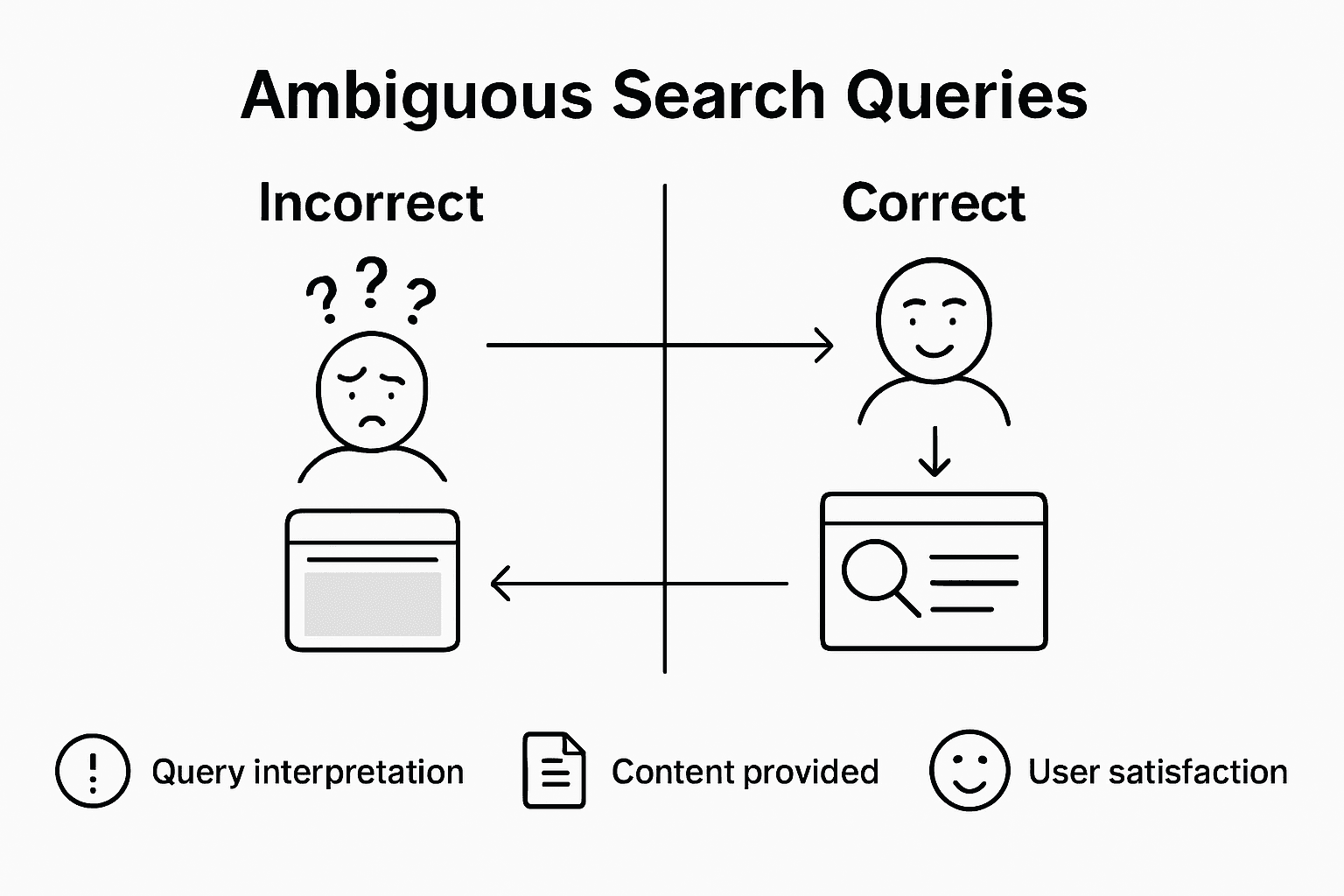
Deep learning models are increasingly being developed to solve complex query interpretation challenges, recognising that traditional keyword matching techniques are fundamentally limited. Modern search strategies must account for contextual nuances, including user location, previous search history, device type, and evolving semantic meanings. This means moving beyond rigid categorisation and developing more flexible, intelligent content approaches that can adapt to multiple potential user intentions within a single search query.
Successful query interpretation requires a multi-dimensional approach. Businesses must develop content ecosystems that can accommodate various potential user intents, create flexible navigation paths, and provide comprehensive information that addresses multiple levels of user understanding. This involves continuous analysis of user behaviour, regular content auditing, and a willingness to create interconnected, adaptable digital resources that can effectively serve diverse user needs.
Below is a table outlining common pitfalls in search query interpretation and recommended mitigation strategies:
| Pitfall | Consequence | Mitigation Strategy |
|---|---|---|
| Over-simplifying ambiguous queries | Missed user segments, irrelevant content | Analyse intent diversity, test pages |
| Relying solely on keyword matching | Outdated results, poor user experience | Incorporate machine learning signals |
| Ignoring contextual factors | Inaccurate content targeting | Use analytics and history insights |
| Failing to update content regularly | Reduced relevance, lost rankings | Continuous content auditing |
Pro Tip: Query Diversity Testing: Regularly conduct comprehensive search query analysis, mapping out all potential interpretations of your target keywords and creating content that addresses multiple user intent scenarios.
Unlock Your Website’s True Potential by Aligning with Search Intent
Understanding search intent is essential for crafting content that truly resonates with your audience and drives meaningful engagement. The article highlights key challenges such as over-simplifying user queries and the need for nuanced content tailored to informational, navigational, commercial investigation, and transactional intents. Many businesses struggle to match their web content to these distinct user goals, resulting in missed opportunities for conversions and poor search rankings.
Kickass Online specialises in bridging this gap by delivering expertly optimised websites designed around precise search intent strategies. With our personalised web development and SEO services, your business will benefit from content that not only attracts traffic but also guides users smoothly through their decision-making journey. Take advantage of our proven approach that aligns your digital presence with how modern search engines understand user motivation.
Ready to transform your online visibility and convert visitors into loyal customers? Discover how our professional website design and ongoing optimisation solutions can put your business ahead.

Start building a high-converting, search intent driven website today by booking a consultation with our team at Kickass Online. Don’t let your competitors capture the audience you deserve. Act now and experience tailored digital marketing that listens and responds to your customers’ true needs.
Frequently Asked Questions
What is search intent in SEO?
Search intent refers to the underlying motivation behind a user’s search query, indicating what a user aims to achieve with their search, whether it’s seeking information, navigating to a specific site, researching products, or making a purchase.
Why is understanding search intent important for content creation?
Understanding search intent is crucial for creating targeted content that meets user needs. By aligning content with the specific intent behind search queries, businesses can improve user engagement and search engine rankings.
What are the four main types of search intent?
The four main types of search intent are informational (seeking knowledge), navigational (looking for a specific site), commercial investigation (researching products), and transactional (ready to make a purchase).
How can I identify search intent from keywords?
To identify search intent from keywords, analyse the language used in queries. Informational queries often include ‘how’ or ‘what’, navigational queries contain brand names, commercial investigation queries use comparison terms, and transactional queries include phrases like ‘buy’ or ‘order’.