
Nearly 90 percent of customers trust online search to find local businesses, yet even small mistakes in your digital profiles can cost you valuable leads. The way your business appears on search engines and local directories not only shapes first impressions but also determines whether new clients ever find you. By tightening up your online presence and following clear, strategic steps, you can drive more local traffic and stand out in a crowded marketplace.
Table of Contents
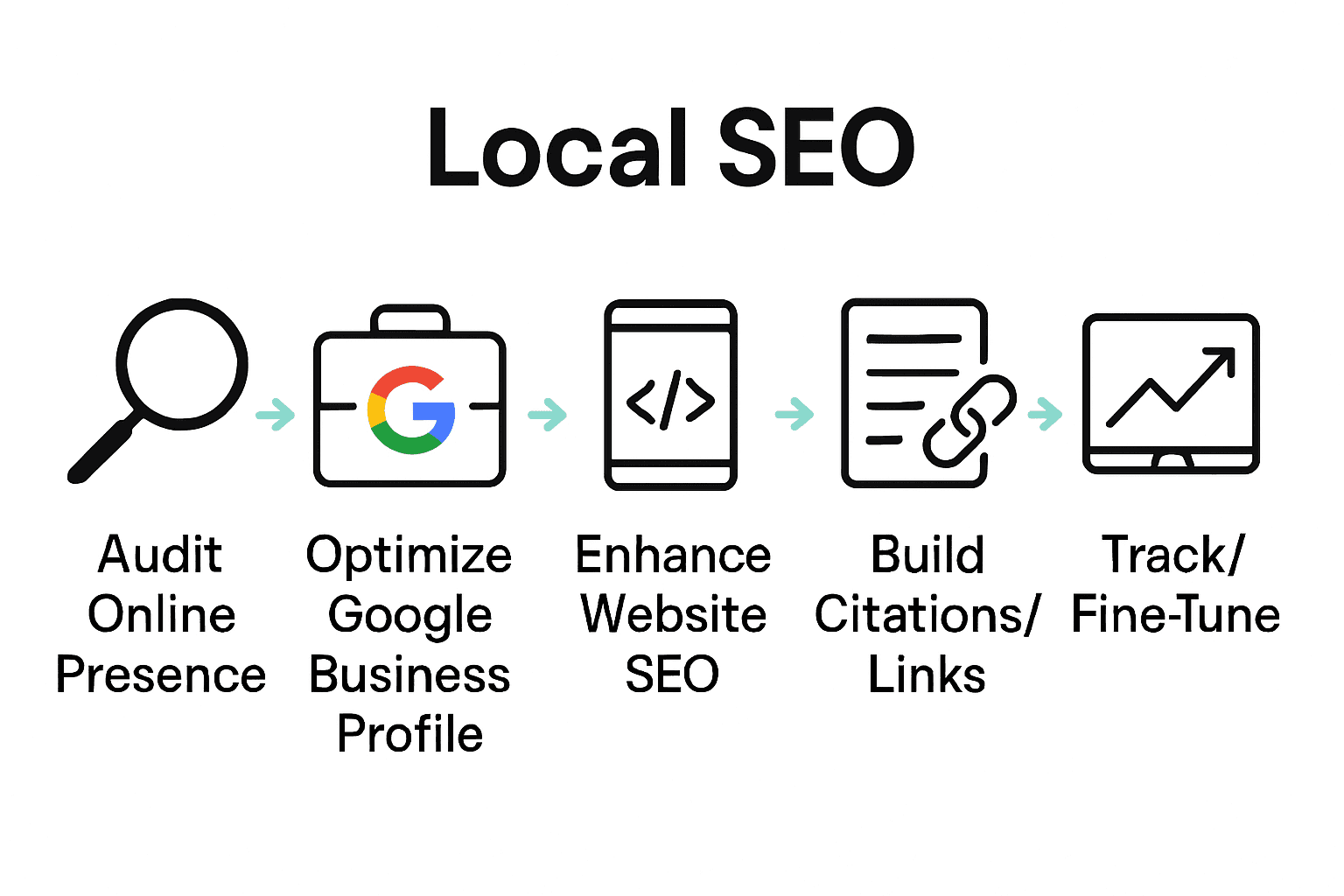
- Step 1: Audit Current Online Presence
- Step 2: Claim and Optimise Google Business Profile
- Step 3: Enhance Local Website SEO Elements
- Step 4: Build Quality Local Citations and Links
- Step 5: Track Results and Fine-Tune Strategy
Quick Summary
| Key Point | Explanation |
|---|---|
| 1. Audit Your Online Presence | Review and verify your business information across platforms for accuracy and consistency. |
| 2. Optimise Google Business Profile | Claim and regularly update your profile with correct details and engaging content to enhance visibility. |
| 3. Optimise Local SEO Elements | Improve your website’s SEO by using local keywords and ensuring it is mobile-friendly for better rankings. |
| 4. Build Quality Local Citations | List your business in reputable directories with consistent information to establish credibility and improve search rankings. |
| 5. Track Performance and Adjust | Use analytics tools to monitor SEO effectiveness, making data-driven adjustments for ongoing improvement. |
Step 1: Audit Current Online Presence
In this step, you will systematically review your current digital footprint and identify potential gaps or inconsistencies across online platforms. According to the Jurupa Valley Chamber of Commerce, auditing your online presence is a critical first move for local SEO success.
Start by conducting a comprehensive search of your business name across multiple search engines and digital platforms. Google your business name and examine the first three pages of results. Check major platforms like Google My Business, Yelp, Facebook, LinkedIn, and industry specific directories. Note any discrepancies in your business name, address, phone number (often called NAP information), website URL, and operating hours. Consistency is key for local search rankings.
Pro tip: Create a spreadsheet to track all your online listings. Document each platform where your business appears, and verify the accuracy of your core business information. Look for opportunities to claim unclaimed profiles, update outdated information, and ensure your business details are identical across all platforms. By methodically cleaning up your online presence, you set a strong foundation for improved local search visibility.

Once you have completed this audit, you will be ready to move on to the next phase of local SEO optimisation with a clear understanding of your current digital landscape.
Step 2: Claim and Optimise Google Business Profile
In this crucial step, you will secure and enhance your Google Business Profile to improve local search visibility and attract more potential customers. Big I New York highlights the importance of accurate information and consistent profile management for local businesses.
Begin by searching for your business on Google and selecting the option to claim or verify your existing profile. If no profile exists, create a new one by providing your exact business name, precise physical address, and local phone number. Ensure every detail matches your other online listings exactly. Upload high quality professional photos showcasing your business interior, exterior, products, and team. Write a compelling business description that includes relevant local keywords without sounding spammy or forced.
Pro tip: Regularly update your profile with fresh content like recent photos, current operating hours, special offers, and respond promptly to customer reviews. Authentic engagement signals to Google that your business is active and customer focused. The more complete and interactive your profile becomes, the higher your chances of appearing in local search results and Google Maps recommendations.
With your Google Business Profile now optimised, you are ready to advance to the next strategic phase of local SEO implementation.
Step 3: Enhance Local Website SEO Elements
In this critical step, you will transform your website into a powerful local SEO asset by strategically optimising its core elements. TechnologyHQ emphasises the importance of precise technical optimisation to improve local search rankings and attract potential customers.
Start by refining your website’s title tags and meta descriptions to include specific local keywords and your business location. Incorporate your city or region naturally into page titles, headings, and content. According to SDA Data, ensuring mobile friendly design is crucial for local SEO success. Verify that your website loads quickly and displays perfectly on smartphones and tablets. Create dedicated location specific pages if you serve multiple areas, using unique content that highlights local services, community involvement, and region specific information.
Pro tip: Include your full business name, address, and local phone number consistently across your website. Embed a Google Maps integration on your contact page to reinforce your local presence. Authentic local signals help search engines understand and prioritise your business for location based searches.
With your website now optimised for local search, you are prepared to advance to the next strategic phase of your local SEO implementation.
Step 4: Build Quality Local Citations and Links
In this crucial phase, you will strategically expand your online presence by creating consistent and authoritative local citations. Pomona Chamber of Commerce highlights the importance of maintaining uniform business information across multiple online platforms.
Begin by identifying reputable local directories and industry specific platforms where you can list your business. According to TechnologyHQ, consistent engagement with local online communities is key to building quality citations. Focus on platforms like Google My Business, Yelp, Yellow Pages, industry associations, local chamber of commerce websites, and niche directories relevant to your business sector. Ensure your Name, Address, and Phone number (NAP) are identical across all listings to build credibility with search engines.
Pro tip: Seek opportunities for local backlinks by participating in community events, sponsoring local organisations, or creating content that highlights your local involvement. Quality matters more than quantity when building citations. Avoid purchasing low quality links or using link farms, as these can harm your local search rankings.
With a robust network of quality local citations established, you are now ready to progress to the next strategic stage of your local SEO journey.
Step 5: Track Results and Fine-Tune Strategy
In this final stage, you will evaluate the effectiveness of your local SEO efforts and make data driven adjustments to continuously improve your online visibility. SDA Data emphasises the importance of systematic performance tracking and strategic refinement.
Set up Google Analytics and Google Search Console to monitor key performance indicators such as local search rankings, website traffic, click through rates, and conversion metrics. Pay close attention to which local keywords are driving the most traffic and engagement. Analyze your Google Business Profile insights to understand how customers are finding and interacting with your business listing. Track metrics like profile views, website clicks, direction requests, and phone call volumes to gauge the real world impact of your local SEO strategy.
Pro tip: Create a monthly tracking spreadsheet to document your progress and identify trends. Review your performance quarterly and be prepared to pivot your strategy based on data insights. Small consistent adjustments often yield more significant long term results than sporadic major changes.
 Remain patient and methodical in your approach.
With a robust tracking system in place, you now have a powerful framework for continuous local SEO improvement and sustainable business growth.
Elevate Your Local SEO with Expert Support
Struggling to make your small business stand out in local search results despite following all the steps like auditing your online presence or optimising your Google Business Profile You are not alone Many small business owners face challenges in keeping their website aligned with local SEO best practices while managing day to day operations This guide highlights the need for consistency clarity and ongoing maintenance, areas where expert help can make a real difference

Discover tailored solutions at Kickass Online, where we combine professional web development with targeted SEO strategies designed specifically for small and medium-sized businesses Facing complex website optimisation or needing a boost in your local citations Explore our Tips and Tricks | Kickass Online for actionable insights or learn more about our custom Websites | Kickass Online services crafted to improve your search rankings and customer engagement Act now to secure dedicated attention for your business growth journey and transform your online presence into a powerful local asset by booking a consultation today at Kickass Online
Frequently Asked Questions
What is the first step in improving my local SEO for small business growth?
To start improving your local SEO, conduct a thorough audit of your current online presence. Search for your business name across multiple platforms and make a note of any inconsistencies in your business information, primarily your name, address, and phone number.
How do I optimise my Google Business Profile?
Begin by claiming or verifying your Google Business Profile and ensuring every detail matches your other online listings. Upload high-quality images, write a compelling business description, and regularly update your profile with fresh content such as special offers and customer reviews.
What are local citations, and why are they important for my business?
Local citations are online mentions of your business’s name, address, and phone number on various platforms. They help build credibility with search engines and improve your local search rankings, so focus on maintaining consistent information across all listings.
How can I track the success of my local SEO efforts?
Use tools like Google Analytics and Google Search Console to monitor key performance indicators such as search rankings and website traffic. Create a monthly tracking spreadsheet to document your progress, analyze your data, and adjust your strategy as needed.
What local SEO elements should I enhance on my website?
Focus on optimising your title tags, meta descriptions, and ensuring mobile-friendly design on your website. Include local keywords naturally in your content and create specific pages highlighting your services for different locations, if applicable.
Recommended
- Harnessing Local SEO Strategies to Boost SMEs’ Presence in Local Markets | Kickass Online
- Enhance Your SME’s Visibility and Sales with Local SEO | Blog
- Why is SEO important for small businesses? | Kickass Online
- Harnessing the Power of Local SEO: A Comprehensive Guide for SMEs | Kickass Online
- dynamic-content-megamenu-menuitem1800 - LawSmiths
- Topic Clusters 101: How To Level Up Your SEO (with Examples) - Appture Digital ~ 855 Get Bizz