

How to Design a Business Website for Results
Learn how to design a business website with this step-by-step guide. Discover actionable steps to plan, create, and launch a high-performing business site.

Getting your website right can bring remarkable results for your business. In fact, businesses with clearly defined goals and a deep understanding of their audience are up to three times more likely to see online growth. Whether you want more sales, leads, or stronger brand presence, starting with a solid strategy sets you apart from the competition. This step-by-step guide walks you through every stage, making it easier to build a site that truly works for you.
Table of Contents
- Step 1: Define Your Business Goals And Target Audience
- Step 2: Plan Your Website Structure And Key Features
- Step 3: Select The Right Platform And Design Framework
- Step 4: Develop Engaging, Optimised Website Content
- Step 5: Test Functionality And Optimise For Performance
- Step 6: Launch Your Site And Monitor Ongoing Results
Quick Summary
| Key Point | Explanation |
|---|---|
| 1. Define Clear Business Goals | Specify 3-5 measurable goals that align with your broader strategy to enhance focus and direction. |
| 2. Understand Your Target Audience | Create detailed customer personas to better tailor your marketing efforts and solutions to potential customers’ needs. |
| 3. Plan Website Structure Effectively | Outline key pages and their purposes, ensuring intuitive navigation to enhance user experience and support business objectives. |
| 4. Choose the Right Platform and Framework | Select a platform that matches your capabilities while allowing for growth; prioritise responsiveness for various devices. |
| 5. Monitor and Adapt Post-Launch | Utilise analytics tools to track website performance and make ongoing improvements to better serve users and meet goals. |
Step 1: Define your business goals and target audience
Transforming your online presence starts with crystal clear business objectives and a razor sharp understanding of who you want to reach. According to Wikipedia, a business plan serves as a roadmap outlining your company’s core objectives and strategic approach.
Begin by asking yourself fundamental questions about what you want to achieve. Are you looking to generate more leads? Increase online sales? Build brand awareness? Write down 3-5 specific, measurable goals that align with your broader business strategy. For example, instead of saying “get more customers”, specify “increase online sales by 25% within six months”.
Next, define your target audience with precision. Wikipedia describes a target audience as the specific group of consumers intended to receive your marketing message. Create a detailed customer persona that includes demographics, interests, pain points, and online behaviour. Consider factors like age, location, income level, professional background, and specific challenges your business can solve.
Warning: Be specific but not restrictive. While detailed targeting helps focus your efforts, avoid creating such a narrow profile that you exclude potential customers.
By clearly defining your goals and audience, you set a strategic foundation that will guide every aspect of your website design and digital marketing approach.
Step 2: Plan your website structure and key features
Now that you understand your business goals, it is time to map out how your website will bring those objectives to life. According to Berkeley Open, planning your website involves defining its purpose and creating an effective information architecture that serves your target audience.
Start by sketching a basic site map that outlines your key pages. Most business websites will need core pages like Home, About Us, Services or Products, Contact, and potentially a Blog or Portfolio section. Consider the user journey and how visitors will navigate between these pages. Each page should have a clear purpose that supports your overall business goals. Think about the information visitors need and how to present it in a logical, intuitive manner.
When designing your website features, prioritise functionality that directly supports your business objectives. For service-based businesses, this might include clear service descriptions, booking forms, or client testimonials. For product businesses, focus on high-quality product images, detailed descriptions, and seamless purchasing options. Web design tools and prototyping software can help you visualise your layout before development.
Warning: Avoid cramming too many features onto your site. More is not always better. Each element should serve a specific purpose and contribute to a clean, user friendly experience.
A well planned website structure transforms your digital presence from a simple online brochure to a powerful business tool that attracts and converts potential customers.

Step 3: Select the right platform and design framework
Selecting the ideal platform and design framework is crucial for transforming your website vision into reality. Wikipedia describes a website wireframe as a visual guide representing the skeletal framework of a website, which helps you understand how functionality and content will come together.
Consider your technical skills, budget, and specific business requirements when choosing a platform. WordPress remains popular for its versatility and user friendliness, while Umbraco offers robust customisation for more complex websites. For ecommerce businesses, platforms like Shopify provide integrated solutions. Evaluate each platform based on factors such as ease of use, scalability, design flexibility, and ongoing maintenance requirements. Learn more about web design strategies that can enhance your marketing approach.
When exploring design frameworks, focus on responsive designs that work seamlessly across desktop, tablet, and mobile devices. According to Wikipedia, your platform selection is part of a broader go-to-market strategy that determines how you deliver value to customers.
Warning: Avoid getting trapped by overly complex platforms. The best solution is one that matches your current capabilities while allowing room for future growth.
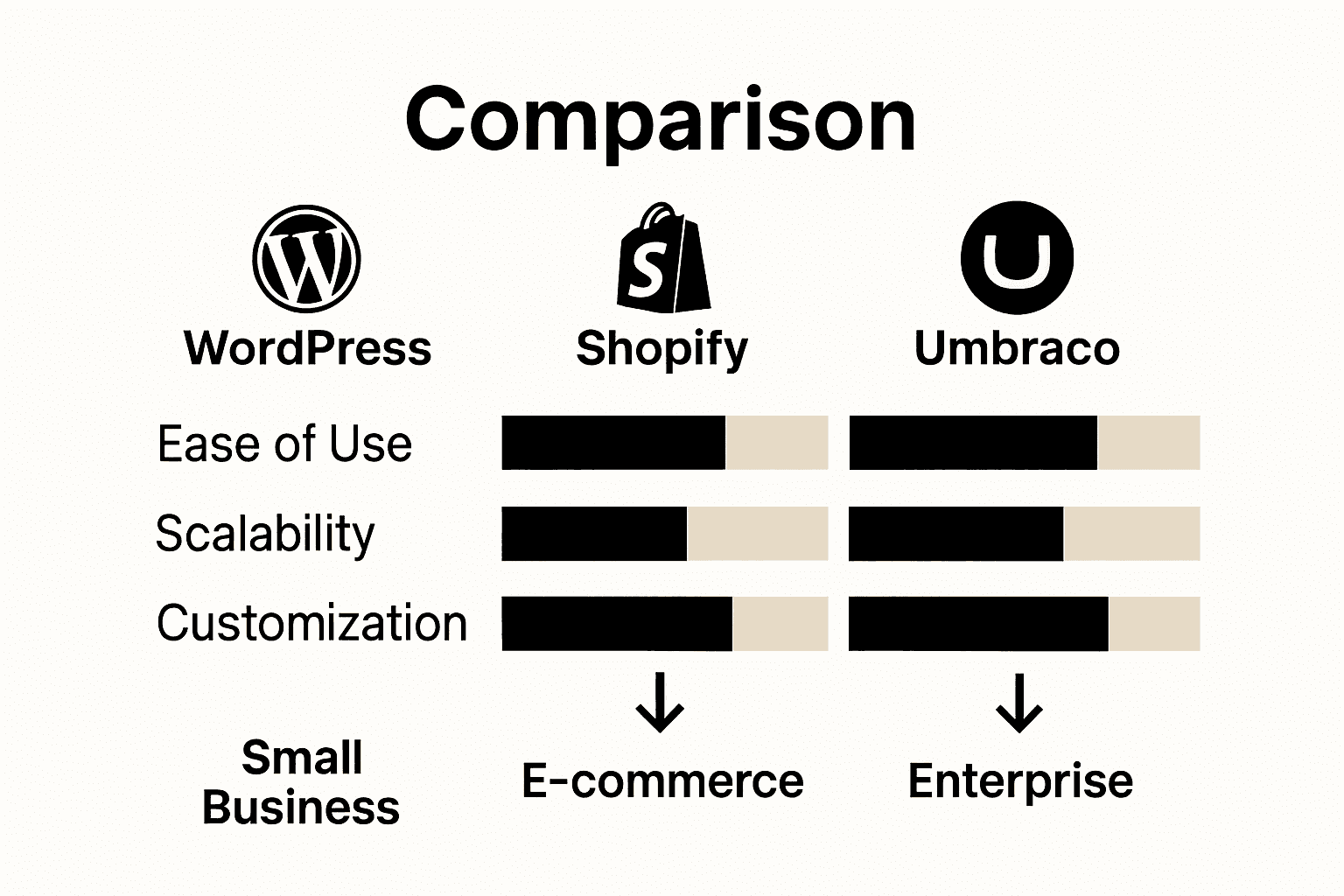
Your platform and design framework are the foundation of your digital presence. Choose wisely to create a website that not only looks professional but also effectively supports your business goals.
Step 4: Develop engaging, optimised website content
Creating compelling website content is about understanding and connecting with your audience. According to Oxford Academic, quality website development involves carefully planning design, layout, and content with a deep understanding of the audience’s information needs.
Start by crafting clear, concise content that speaks directly to your target audience’s challenges and aspirations. Write headlines that grab attention, use conversational language, and break up text with subheadings, bullet points, and short paragraphs. Focus on addressing customer pain points and demonstrating how your products or services provide solutions. Explore content optimisation strategies that can help your website get noticed.
Wikipedia highlights that web analytics plays a crucial role in content optimisation by helping you understand and track web usage. Use tools like Google Analytics to monitor which content resonates most with your audience. Pay attention to metrics like time on page, bounce rate, and user engagement to continuously refine your content strategy.
Warning: Avoid keyword stuffing or writing solely for search engines. Your primary goal is to create valuable, informative content that genuinely helps your potential customers.
Engaging website content is not just about what you say, but how you say it. Your words are your digital sales team working 24/7 to attract, inform, and convert potential clients.
Step 5: Test functionality and optimise for performance
Bringing your website to life means ensuring every element works flawlessly across different devices and browsers. According to UKRI, a website’s structure and navigation must be logical and user focused to deliver optimal functionality and performance.
Begin with comprehensive testing across multiple platforms. Check how your website performs on different browsers like Chrome, Firefox, Safari, and Edge. Test on various devices including desktop computers, tablets, and smartphones to ensure responsive design. Pay special attention to page load speeds, button functionality, form submissions, and navigation menus. Learn more about website performance optimisation tools.
As Case University recommends, create a hierarchical structure that allows for intuitive navigation. Use tools like Google PageSpeed Insights to identify and resolve performance bottlenecks. Focus on optimising image sizes, minimising code, and leveraging browser caching to improve overall website speed.
Warning: Performance testing is not a one time task. Regular monitoring and optimisation are crucial to maintaining an effective website.
A well tested website builds trust with your visitors, ensuring they have a smooth and professional experience that reflects the quality of your business.
Step 6: Launch your site and monitor ongoing results
With your website carefully crafted, it is time to introduce your digital presence to the world. Wikipedia highlights that web analytics provides crucial information about website visitors and page views, helping you understand and optimise site performance from the moment you launch.
Start by setting up comprehensive tracking tools like Google Analytics to monitor key performance indicators. Track metrics such as visitor numbers, time spent on site, bounce rates, and conversion rates. These insights will help you understand how users interact with your website and identify areas for improvement. Discover the essential digital marketing KPIs every small business needs to measure.
According to Wikipedia, understanding your target market is essential for monitoring and adjusting website strategies. Regularly review your analytics to see which content resonates most with your audience, which pages drive conversions, and where potential customers might be dropping off. Be prepared to make incremental improvements based on real user data.
Warning: Launching your website is not the end of the journey. Continuous monitoring and adaptation are key to maintaining a high performing online presence.
Your website is a living digital asset that grows and evolves with your business. Treat it as an ongoing project, always seeking ways to better serve your customers and achieve your business objectives.
Elevate Your Business Website to Drive Real Results
Designing a website that truly delivers requires more than just aesthetics. It demands a clear strategy that aligns with your business goals and speaks directly to your audience’s needs. If you find yourself struggling with how to plan your website structure or choosing the right platform, you are not alone. Many business owners face challenges such as creating engaging content, ensuring responsive design, and optimising site performance to convert visitors into customers.
At Kickass Online, we understand these critical pain points. Our team specialises in crafting bespoke websites that are not only visually compelling but engineered to boost conversions and improve search engine rankings. From developing user-friendly navigation to maintaining your site’s security and speed, we are your dedicated partner in transforming your digital presence.
Discover how our tailored approach can bring your website ambitions to life in our comprehensive Websites | Kickass Online section.
Don’t let uncertainty hold back your online growth. Visit Kickass Online today and book a consultation with our experts who will guide you step-by-step through creating a high-impact website custom-fit for your business. Explore informative Tutorials | Kickass Online for actionable insights and start turning your website into a powerful business asset now.
Frequently Asked Questions
How do I define my business goals for my website?
To define your business goals, start by identifying what you want to achieve, such as generating leads or increasing sales. Write down 3-5 specific, measurable goals, like “increase online sales by 25% within six months.”
What should I include in my target audience persona?
Your target audience persona should include details like demographics, interests, pain points, and online behaviour. Create a comprehensive profile that outlines age, location, income level, and challenges your business can solve.
How can I structure my website effectively?
A well-structured website should have a clear sitemap that includes pages like Home, About Us, Services, and Contact. Sketch your sitemap and ensure each page serves a specific purpose that aligns with your business goals and enhances user navigation.
What factors should I consider when choosing a website platform?
When choosing a website platform, consider your technical skills, budget, and specific business needs. Evaluate ease of use, scalability, and design flexibility to select a platform that will grow with your business and support ongoing maintenance.
How can I optimise my website content for engagement?
To optimise your website content, ensure it addresses your audience’s pain points and uses clear, conversational language. Craft headlines that grab attention and incorporate subheadings and bullet points to make the information easier to digest.
What steps should I take to test my website’s functionality?
To test your website’s functionality, check it across multiple browsers and devices to ensure responsive design. Pay special attention to page load speeds, button functionality, and navigation to ensure a seamless user experience.
Recommended
Related reading
Build an ecommerce digital marketing strategy: grow sales
Learn how to build an ecommerce digital marketing strategy that drives real growth for UK SMEs, covering SEO, email, social, and how to measure results.
Read article: Build an ecommerce digital marketing strategy: grow salesThe ultimate website redesign checklist for SMBs
Protect your rankings and traffic with our complete website redesign checklist for SMBs. Covering audits, redirects, technical SEO, and post-launch monitoring.
Read article: The ultimate website redesign checklist for SMBsWebsite audit checklist: Boost your business visibility
Follow our step-by-step website audit checklist to fix hidden issues, recover lost traffic, and boost your business visibility online in 2026.
Read article: Website audit checklist: Boost your business visibility



Need help with any of this?
Send the brief and we reply the same day with a price and a date.