
- Personalised marketing boosts SME revenue by 20 to 40% through relevant messaging.
- It improves customer loyalty, engagement, and email marketing ROI significantly.
- SMEs should start with quality first-party data and simple tactics like personalized emails.
Most SME owners know the frustration of putting effort into marketing campaigns that disappear into the noise. Customers are bombarded with hundreds of messages daily, and generic, one-size-fits-all promotions simply get ignored. Personalised marketing cuts through this clutter by delivering the right message to the right person at the right moment. Companies using personalisation see 20% more sales, 15% higher ROI, and up to 40% more revenue. In this article, you will learn exactly what personalised marketing is, the top benefits for SMEs, how to implement it step by step, and how to avoid the pitfalls that catch most businesses out.
| Point | Details |
|---|---|
| Boosts sales and ROI | Personalised marketing can increase SME sales by 20% and amplify campaign returns. |
| Enhances customer loyalty | Tailored experiences build stronger relationships, encouraging repeat business. |
| Cost-effective for SMEs | Simple tactics like personalised email offer high returns without large investments. |
| Requires ethical best practice | Respecting privacy and being transparent help avoid personalisation risks. |
| Start small, scale smart | Small, genuine personal touches outperform complex automation for many SMEs. |
Personalised marketing means tailoring your messages, offers, and content to individual customers based on their behaviour, preferences, and history with your business. It is not the same as general segmentation, where you split audiences into broad groups and send the same message to everyone in that group. True personalisation goes further. It adapts in real time to what a specific person has done, shown interest in, or purchased before.
Understanding digital marketing’s influence on buying decisions makes this distinction even clearer. When a customer lands on your website and sees products based on their last visit, that is personalisation. When you send an email using their first name with an offer based on their previous purchases, that is also personalisation. Broad targeting, by contrast, simply narrows down who sees an advert without customising the message itself.
It helps to differentiate personalisation from targeting using a simple analogy. Targeting is choosing which neighbourhood to post leaflets in. Personalisation is knocking on a specific door and saying something that is genuinely relevant to the person inside.
Why does this matter so much right now? Consumer expectations have shifted dramatically. 75% of consumers now expect personalised experiences from the brands they interact with. If your marketing feels generic, customers notice and they move on.
Here are the key differences between traditional and personalised approaches:
For SMEs, you do not need to start at the 1:1 level. Even moving from broadcast to basic personalisation creates measurable gains.
Pro Tip: Start with first-party data, information your customers willingly give you through sign-up forms, purchase history, and website behaviour. This is more accurate, more ethical, and less likely to cause the privacy backlash that third-party data can trigger.
Understanding the definition is useful, but what SMEs really care about is results. Here is what the evidence says about the concrete gains from adopting personalised marketing.
Higher sales and revenue growth. The numbers are hard to ignore. Personalisation consistently lifts revenue by 20 to 40% depending on implementation quality and channel. Customers who feel understood are simply more likely to buy.
Improved customer loyalty and retention. When customers receive relevant, timely messages, they feel valued. That feeling builds loyalty. Retained customers spend more over time and cost far less to maintain than acquiring new ones.
Greater marketing ROI from email. Personalised emails deliver six times higher conversion rates and $42 ROI for every £1 spent. That is a return few other channels can match. For SMEs with tight budgets, email personalisation offers outsized value.
More engaging customer experiences. Personalisation makes every touchpoint feel less like an advert and more like a conversation. Customers engage more, share more, and complain less when their experience feels relevant to them.
Better campaign performance across the board. Personalised calls to action outperform generic ones by 202%. That statistic alone should make any SME owner sit up straight. The difference between a button that says “Buy Now” and one that says “Continue where you left off” is enormous.
Here is a quick reference comparing these benefits:
| Benefit | Average uplift | Quick SME tip |
|---|---|---|
| Sales and revenue | 20 to 40% | Start with product recommendations |
| Customer retention | Up to 5x cheaper than acquisition | Use loyalty emails post-purchase |
| Email marketing ROI | £42 per £1 spent | Personalise subject lines first |
| Customer engagement | 6x higher conversions | Segment by purchase behaviour |
| Campaign performance | 202% better CTAs | Test personalised vs. generic buttons |
Explore how personalisation in email marketing can be your most cost-effective starting point. With very little technical investment, you can begin seeing measurable improvements in open rates and conversions within weeks.

Knowing the benefits is one thing. Actually building a personalisation strategy is where many SMEs stall. The good news is that you do not need a large team or a complicated tech stack to begin.
Gather quality first-party data. Ask customers directly for information through sign-up forms, preference centres, and post-purchase surveys. The data you collect with consent is far more valuable and reliable than anything bought from a third party.
Choose your easiest win channel. Email is the obvious starting point. It is low cost, measurable, and well suited to personalisation. A well-segmented email list alone can transform your results.
Tailor your messaging in small ways first. Use the customer’s name. Refer to their last purchase. Send birthday discounts. These small touches create a disproportionately large sense of personal connection.
Measure everything and optimise regularly. Run A/B tests on subject lines, body copy, and calls to action. Use the results to refine your approach. Personalisation is not set-and-forget. It improves with every cycle.
Build towards automation gradually. Tools like Mailchimp or Klaviyo let you set up automated sequences triggered by customer behaviour without needing a developer.
One of the biggest reasons personalisation programmes fail is poor data or unclear strategy. In fact, 63% of digital leaders admit to struggling with exactly this problem. Skipping the foundational data work and jumping straight to complex automation is a common and costly mistake.
Pro Tip: Before touching any automation, spend time on your email marketing strategy for SMEs. A well-planned strategy with basic personalisation will outperform a rushed automated system every single time.
Here is a useful overview of common SME personalisation tactics:
| Tactic | Difficulty | Expected ROI |
|---|---|---|
| Personalised email subject lines | Low | High |
| Behaviour-triggered email sequences | Medium | Very high |
| Website product recommendations | Medium to high | High |
| Dynamic landing pages | High | High |
| SMS personalisation | Low to medium | Medium to high |
For further guidance, explore strategies to boost email engagement that work particularly well for smaller businesses operating with lean resources.
No marketing strategy is risk-free. Here is what SMEs must watch out for and how to stay safe.
Personalisation carries a well-documented tension sometimes called the privacy paradox. Customers want relevant experiences, but they also resent feeling watched. Getting this balance wrong can result in backlash, lost trust, and churn. These are not theoretical risks. They happen regularly to businesses that push too far or rely on data customers never knowingly shared.
Common mistakes SMEs make include:
“63% of digital leaders struggle with poor data or weak strategy” when implementing personalisation programmes, making robust data governance a non-negotiable first step.
Here is a simple ethical checklist to follow:
Following these practices protects your reputation and keeps you on the right side of UK data protection law. Ethical personalisation is not a competitive disadvantage. It is a long-term trust-builder.
Here is a perspective that most marketing advice misses: the most effective personalisation for SMEs rarely comes from the most sophisticated technology. It comes from genuine customer understanding.
Think about your favourite local shop or independent service provider. The reason you return is often because someone remembers your preferences, asks the right questions, or sends a note that feels genuinely considered. That is personalisation at its purest. And it is something larger competitors struggle to replicate at scale.
As an SME, this is your advantage. You can afford to actually know your customers rather than just model them. Rather than chasing expensive marketing technology, focus first on the SME email engagement strategies and simple data practices that build real relationships.
The businesses that win at personalisation are not always the ones with the best tools. They are the ones that understand their customers well enough to say something genuinely useful at exactly the right moment. Master the basics, and you will outperform many larger rivals who are still relying on outdated broadcast marketing.
If this article has shown you anything, it is that personalised marketing is not reserved for big brands with large budgets. SMEs that start small, focus on quality data, and build genuine customer relationships can see real, measurable results without needing to overhaul everything at once.
At Kickass Online, we work with small and medium-sized businesses to build digital marketing strategies for SMEs that are genuinely tailored to your goals and your audience. Whether you are looking for small business growth tips or a professionally designed, high-converting website, our team is ready to help. Explore our SME website design service and take the next step towards marketing that actually connects with your customers.
Personalised marketing matches relevant offers to each customer’s specific interests, which lifts engagement and pushes conversion rates higher. Businesses using personalisation see 20% more sales on average compared to those using generic approaches.
Not at all. Basic tactics like personalised email subject lines and behaviour-triggered sequences are accessible on modest budgets. Personalised emails return £42 for every £1 spent, making them one of the most cost-efficient tools available.
The biggest traps are using data without proper consent and automating before your data is reliable. Since 63% of digital leaders struggle with weak strategy, always build your data foundations before adding complexity.
Yes, crossing the line into intrusive messaging can seriously damage customer trust and retention. Transparent data practices, easy opt-outs, and regular audits are essential to avoid the privacy paradox that catches many businesses out.
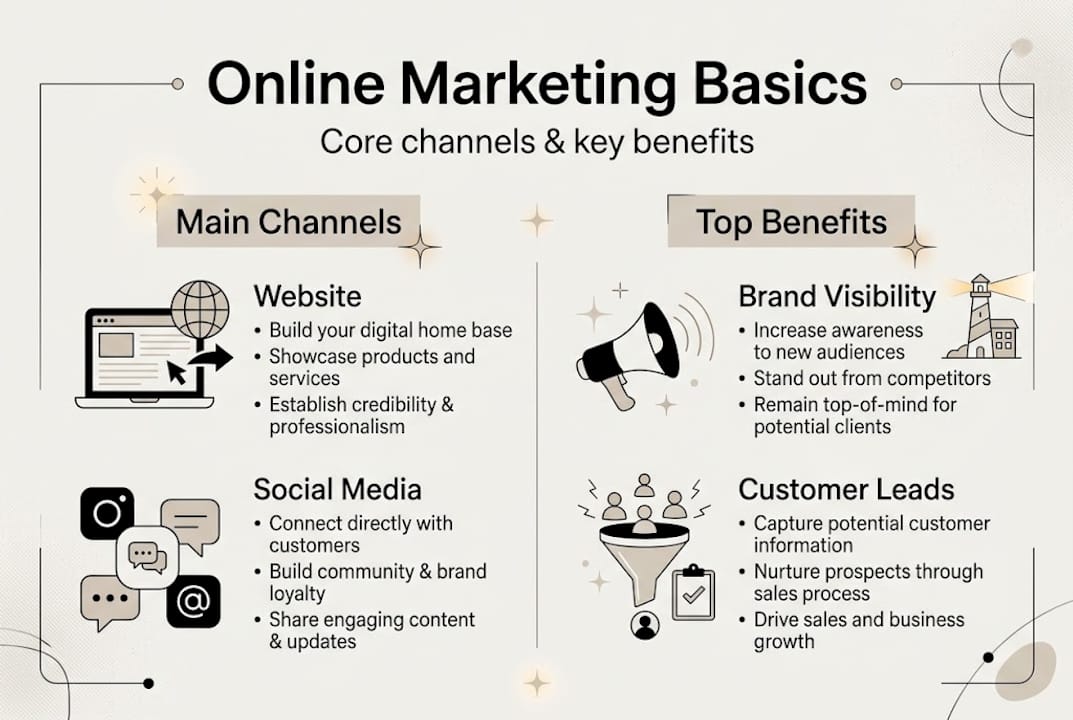
- Online marketing involves promoting your business through various digital channels like SEO, social media, and email.
- Building a strong, mobile-friendly website is essential as it serves as the core of all online marketing efforts.
- Focus on a few targeted channels, measure results regularly, and consider professional support for growth.
If you run a small or medium-sized business, you have probably been told to “get online,” “build your brand,” or “grow your digital presence” without anyone explaining what that actually means in plain terms. The jargon is everywhere: SEO, PPC, funnels, content marketing, organic reach. It can feel overwhelming. This guide cuts through the noise. By the end, you will know exactly what online marketing is, which methods matter most for businesses like yours, how to build a solid foundation, and how to measure whether any of it is actually working.
Security note: if online protection matters for this workflow, readers can compare practical options in this internet security suites.
| Point | Details |
|---|---|
| Clear definition | Online marketing leverages digital channels like websites, search, and social to reach and engage audiences efficiently. |
| Focus matters | For SMEs, prioritising just a few channels delivers better results than trying to do everything online. |
| Website is core | A strong, mobile-friendly business website is the essential foundation for all online marketing efforts. |
| Measure and adapt | Successful online marketing means tracking what works and regularly improving based on data. |
Let’s start with clarity. Online marketing, also known as digital or internet marketing, is the practice of promoting products, services, or brands using digital channels such as search engines, social media, email, websites, and paid advertising. That is it. No mystery.
You will often hear the terms “online marketing,” “digital marketing,” and “internet marketing” used interchangeably, and for most practical purposes they mean the same thing. The key distinction is that online marketing specifically refers to activity that happens over the internet, whereas “digital marketing” can technically include offline digital channels like SMS or digital billboards. For small business owners, this difference rarely matters day to day.
What does matter is understanding why this shift is so significant. Buyer behaviour has changed fundamentally. Most people now research a product, read reviews, and compare options online before ever speaking to a business. If you are not visible in those digital moments, you are missing opportunities constantly.
Online marketing is also not just social media or Google Ads. That is one of the most common misconceptions we hear from business owners. Digital marketing for small business spans a much wider set of channels, including:
“The most important thing to recognise is that online marketing is a system, not a single tactic. Each channel feeds into the others, and the businesses that treat it as a whole are the ones that grow consistently.”
Ignoring any one of these channels entirely may not be a disaster, but understanding how they fit together is the first step to making smart decisions for your business.
Now that the basics are clear, let’s explore the main digital marketing methods and how they actually work together for small businesses.
Effective channels for SMBs include SEO for organic visibility, PPC for immediate traffic, content marketing to attract and nurture leads, social media for engagement and community building, email marketing for retention (with the highest ROI), and local marketing via Google Business Profile. Here is a breakdown of the six most impactful:
These channels are not isolated. A strong blog post improves your SEO, gets shared on social media, and can be repurposed into an email newsletter. That is the power of thinking about online marketing as an interconnected system rather than separate activities.
| Channel | Strength | Cost level | Time to results | Ease of use |
|---|---|---|---|---|
| SEO | Long-term visibility | Low to medium | 3 to 6 months | Moderate |
| PPC | Immediate traffic | Medium to high | Immediate | Moderate |
| Social media | Engagement and brand awareness | Low to medium | 1 to 3 months | Easy |
| Content marketing | Trust and lead nurturing | Low | 3 to 12 months | Moderate |
| Email marketing | Retention and highest ROI | Very low | Immediate | Easy |
| Local SEO | Nearby customer discovery | Low | 1 to 3 months | Easy |
For a broader overview of internet marketing channels and how they interact, HubSpot’s resource library is particularly useful for business owners getting started.
Pro Tip: Resist the urge to be active on every channel at once. Pick two or three that align with where your customers actually spend time and go deep on those first. Breadth without depth rarely produces results for small teams. You can find proven marketing strategies for SMBs to help you make that choice wisely.
Once these methods are clear, it is vital to address the most critical asset driving all your digital marketing: your business website.

Your website is not just a digital brochure. It is the centrepiece of your entire online marketing effort. Every channel, whether it is an Instagram post, a Google Ad, or an email campaign, ultimately directs people back to your website. If that destination is slow, confusing, or unprofessional, all your other marketing spend is wasted.
A strong business website must be mobile-friendly, fast-loading, and built with consistent branding before you scale any other tactic. Here is what that looks like in practice:
Understanding how web design boosts sales is not a luxury consideration. It is directly connected to how much revenue your online marketing generates.
Pro Tip: Prioritise “owned assets” above all else. Your website and email list are assets you control completely. Social media platforms change their algorithms, ad costs fluctuate, and third-party tools come and go. Your website and mailing list remain yours regardless of what happens elsewhere.
Free or outdated websites hold businesses back more than most owners realise. A site built on a free platform with limited functionality often cannot be properly optimised for SEO, loads slowly, and lacks the credibility that converts visitors into customers. The digital marketing for small business landscape in 2026 is competitive enough that a professional, well-maintained website is no longer optional. It is the price of entry.
A solid foundation sets you up to take action. Here is how to choose your strategies, put them into practice, and measure what matters.
The biggest mistake small business owners make is choosing channels based on what sounds impressive rather than what aligns with their actual goals. Before you invest time or money, follow these steps:
| Channel | Typical goal | Top success metric |
|---|---|---|
| SEO | Organic visibility | Organic traffic growth |
| PPC | Immediate leads or sales | Cost per conversion |
| Social media | Brand awareness and engagement | Reach and engagement rate |
| Email marketing | Customer retention | Open rate and click-through rate |
| Local SEO | Foot traffic or local enquiries | Google Business Profile views |
For guidance on what good results actually look like, explore measuring marketing ROI so you can set realistic benchmarks from the start.
Pro Tip: Install Google Analytics and Google Search Console from day one. Both are free, both provide essential data, and both will tell you clearly what is working and what is not. Without them, you are making decisions based on gut feeling rather than evidence.
For further reading on building an effective plan, internet marketing best practices from Salesforce offers practical frameworks that translate well for smaller teams. You can also explore digital strategies for SMEs that are specifically tailored to businesses with limited budgets and resources.
Most online marketing advice tells you to “be everywhere.” Post daily on five platforms, run ads, write blogs, send emails, do podcasts, and somehow grow your business at the same time. For a small team managing actual client work, that advice is not just impractical. It is actively harmful.
The businesses we have seen grow consistently are not the ones doing the most. They are the ones doing a few things exceptionally well and building owned audiences they control. An email list of 1,000 engaged subscribers is worth more than 10,000 social media followers on a platform that can throttle your reach overnight.
There is also an uncomfortable truth about digital marketing’s returns: in resource-constrained settings with high network capital, marginal returns from digital marketing can diminish, and service-based businesses tend to see stronger impact than manufacturers.
What this means in practice is that not every channel will work equally well for every business. You have to test, track, and challenge your assumptions regularly. Invest where you can see the return, and stop funding what you cannot measure. The proven SME strategies that work are almost always the ones built on controlled, measurable foundations rather than trend-chasing.
Once you have clarity and a plan, expert support can make all the difference in achieving your goals.
At Kickass Online, we work exclusively with small and medium-sized businesses that are serious about growing through digital channels. Whether you need a high-converting website built from scratch or a structured SEO optimisation workflow that generates consistent organic traffic, we bring the expertise and the focus that generic agencies cannot. Our website design experts create professional, fast, and conversion-focused websites that become the foundation for everything else you do online. We keep our client list deliberately small so every business we work with gets dedicated attention. Book a consultation and find out what is actually possible for your business.
Online marketing uses digital channels like websites, social media, and email to reach customers, while traditional marketing relies on print, radio, and television. The key advantage of online marketing is that results can be tracked in real time.
Email marketing for retention consistently provides the highest return on investment for small businesses because the cost is low and communication is direct. Unlike paid advertising, email reaches an audience you already own.
Start with a modest budget to test which channels deliver results, then scale what works. Prioritising 2 to 3 channels prevents wasted spend and helps you build clear evidence before committing further.
Absolutely. A mobile-friendly, well-branded website is the non-negotiable foundation for any effective online marketing strategy. Without it, you cannot properly leverage SEO, run credible ad campaigns, or convert visitors into customers.
Use free tools like Google Analytics and Google Search Console to track traffic, behaviour, and conversions. Measure everything and optimise monthly by comparing your results against the specific goals you set for each channel.
- Choosing the right website layout is crucial for usability and business goals.
- Mobile responsiveness and clear content hierarchy are essential for effective layouts.
- Expertise can enhance design effectiveness and ensure layout aligns with user needs.
Choosing the wrong website layout is one of the most costly mistakes a small business can make. Your layout is not just a visual decision. It directly shapes how users navigate your site, how quickly they find what they need, and whether they convert into paying customers. Layout influences usability and conversion rates in ways that go far beyond aesthetics. This guide walks you through how to select the right layout, what the main options are, how they compare for different business goals, and which layout suits each page type on your site.
| Point | Details |
|---|---|
| Layout affects conversions | Choosing the right layout can significantly increase leads and sales for your business. |
| Mobile-first is essential | Prioritising layouts that work across all devices ensures better accessibility and engagement. |
| Match layout to business goals | Select layouts based on your website’s core purpose, such as sales, information, or lead capture. |
| Simplicity wins | Simple, clear layouts often outperform complex designs for user experience and conversion. |
Before you even look at design inspiration, you need to get clear on what your website is actually supposed to do. Is it there to inform visitors, generate leads, or sell products directly? That single question should drive every layout decision you make. A site built to capture leads has completely different structural needs from one designed to showcase a service portfolio.
Once you know your goal, consider how your audience behaves. Are most of your visitors browsing on a phone during their lunch break, or sitting at a desktop researching a considered purchase? Mobile traffic now accounts for the majority of web visits across most industries, so this is not a minor concern. A layout that looks brilliant on a large screen but collapses awkwardly on a phone will cost you customers every single day.
Navigation clarity is equally important. When a visitor lands on your homepage, they should know within seconds where to go next. Layouts that bury key information, create confusing menus, or use too many competing sections pull attention in too many directions at once. Prioritising content hierarchy, which means placing your most important message and call to action at the top, is essential for keeping users on track.
Here are the core criteria to evaluate before choosing a layout:
For responsive website performance, your layout must adapt fluidly across screen sizes. Responsive design is not optional in 2026. It is a baseline requirement. Single-column and Z-pattern layouts are particularly strong for home and landing pages where conversion is the primary goal.
Pro Tip: If you are building a dedicated landing page for a campaign or offer, use a single-column layout. It removes all sidebar distractions and guides the visitor straight to your call to action. Pair this with strong tips to improve conversion rate and you will see a measurable difference.
Not all layouts are created equal, and each serves a distinct purpose. Understanding your options means you can make an informed choice rather than defaulting to whatever your web theme offers. Common website layouts include single-column, multi-column, grid/card-based, Z-pattern, F-pattern, split-screen, asymmetrical, full-screen, magazine, and content-focused styles.
Here is a quick overview of the most relevant layout types for small and medium-sized businesses:
For inspiration, explore examples of website designs that demonstrate these layouts in action across real business contexts.
| Layout type | Best for | Key strength | Potential weakness |
|---|---|---|---|
| Single-column | Landing pages, mobile | High conversion focus | Limited for complex sites |
| Multi-column | Info-heavy desktop sites | Organises complex content | Can overwhelm on mobile |
| Grid/card | E-commerce, portfolios | Visual and modular | Requires consistent imagery |
| Z-pattern | Homepages, promotions | Guides eye to CTA naturally | Less suited to long content |
| F-pattern | Blogs, service pages | Matches natural reading habits | May miss right-side content |
| Magazine | Media, news, blogs | Rich editorial feel | Complex to maintain |
| Split-screen | Dual audience or offer | Clear visual choice | Can confuse on smaller screens |
Understanding these differences helps you align layout to purpose. Review web design elements for business to see how layout interacts with colour, typography, and imagery.
Knowing what layouts exist is useful. Knowing which one to use for your specific business goal is what actually moves the needle. Let us compare them across the outcomes that matter most to small business owners.
For conversion-focused pages such as homepages and promotional landing pages, single-column and Z-pattern layouts perform best. They minimise distraction and guide the visitor through a deliberate sequence ending in your call to action. Learn how web design and conversion rates are directly connected before finalising your approach.

For content engagement on blogs, service pages, and educational resources, F-pattern and magazine layouts align with natural reading behaviour. F-pattern and grid layouts are highly effective for service pages and blogs due to their fit with user scanning habits.
For product display, grid and card layouts are the clear winner. Grid/card layouts are modular, mobile-friendly, and ideal for small business e-commerce and portfolios.
Here is a ranked breakdown of layouts by business goal:
| Business goal | Top layout choice | Secondary option |
|---|---|---|
| Lead generation | Single-column | Z-pattern |
| Product display | Grid/card | Split-screen |
| Content engagement | F-pattern | Magazine |
| Service showcase | Z-pattern | Multi-column |
| Brand storytelling | Full-screen | Asymmetrical |
Pro Tip: If you sell products or services with strong visual appeal, use a grid layout for your main listing pages. It makes browsing intuitive on mobile and allows customers to compare options at a glance. Pair it with high-converting landing pages to close the sale once they click through.
Let us bring this into real-world scenarios. Different pages on your site serve different purposes, and your layout should reflect that. Using the same structure across every page is a missed opportunity.
“Always design mobile-first, especially for conversions.”
Mobile-first design is not a trend. For SMEs targeting everyday consumers, single-column layouts are the most reliable starting point for landing and home pages to streamline conversions.
Here are situational layout recommendations by page type:
For ideas on how these recommendations look in practice, review examples of SME websites that apply these principles effectively. You can also explore guidance on effective landing page layouts for campaign-specific pages.
The overarching lesson is this: match your layout to the job that page needs to do. When form follows function, the result is a site that feels intuitive to use and drives the outcomes your business needs.
After working with dozens of small and medium-sized businesses, we have seen the same mistake repeated: choosing a layout because it looks impressive rather than because it works. Business owners fall in love with full-screen video backgrounds, elaborate animations, and asymmetrical grids that look stunning in a portfolio but confuse real customers trying to find a phone number or a price.
The most common pitfalls are ignoring mobile responsiveness until it is too late, creating no clear content hierarchy, and placing too many calls to action on a single page so that none of them stand out. Simple layouts with a clear visual path consistently outperform complex ones in our experience.
As the saying goes, layout is about guiding users, not impressing designers. That is not a knock on creativity. It is a reminder that your website exists to serve your customers, not to win design awards. Why design matters for conversions goes deeper on this topic if you want to explore the data behind it. The businesses we see succeed online are those that embrace clarity, prioritise mobile, and resist the temptation to over-complicate their structure.
Understanding layout theory is a solid start, but putting it into practice for your specific business takes experience and skill. If you want a site that is both visually strong and built to convert, expert guidance makes a real difference.
At Kickass Online, we specialise in professional website design for small and medium-sized businesses, matching layout strategy to your goals from the ground up. Whether you need a full redesign or targeted improvements, our team is ready to help. Explore our easy web design tips for quick wins, or stay ahead with the latest web development trends shaping how customers experience your brand online. Book a consultation and let us build something that actually works for your business.
Single-column and Z-pattern layouts are most effective for conversion-focused pages, as they remove distractions and guide visitors directly toward your call to action.
Single-column and grid/card layouts are the most mobile-friendly options, offering readable stacked content and modular browsing that works well on smaller screens.
Yes. Responsive layouts improve user engagement signals such as time on site and bounce rate, both of which influence how search engines assess your page quality.
Review your layout at least once a year, or whenever you make significant changes to your business model, audience, or services, as user behaviour and device preferences evolve quickly.
- Multi-channel marketing helps UK SMEs improve visibility and drive consistent sales.
- Focusing on 2-3 effective channels like SEO and social video yields better results.
- Consistent measurement and small incremental improvements sustain ecommerce growth.
Standing out in the UK’s online marketplace is harder than it sounds. With thousands of ecommerce businesses competing for the same customers, a scattered approach to digital marketing simply will not cut it. The good news is that multi-channel marketing gives UK SMEs a proven framework to win visibility and drive consistent sales. In this article, we walk you through every stage of building a results-driven ecommerce digital marketing strategy, from auditing your current position to scaling what actually works. Whether you are just starting out or refining an existing approach, you will leave with a clear, actionable plan.
Security note: if cleanup planning matters for this workflow, readers can compare practical options in this malware removal tools.
| Point | Details |
|---|---|
| Know your business | Audit your strengths, weaknesses and customer needs before launching new marketing campaigns. |
| Choose effective channels | Select marketing channels based on where your audience spends time and the ROI potential. |
| Integrate for impact | Combining SEO, PPC, Email and Social gives the best chance of ecommerce growth. |
| Track, adapt, repeat | Measure results regularly and refine your strategy to scale what works. |
With an understanding of what’s at stake, you must first know where you stand digitally. Before spending a single penny on ads or content, you need an honest picture of your strengths, weaknesses, and opportunities. This audit stage saves you from wasting budget on channels that do not suit your business or your customers.
Start by clarifying your core business goals. Are you trying to grow revenue, increase repeat purchases, or break into a new UK region? Each goal points to a different set of tactics. Alongside your goals, document your unique selling proposition clearly. What makes you genuinely different from competitors? If you cannot answer that in one sentence, your marketing will struggle to land.
Next, build out your customer personas. Think beyond basic demographics. Consider your customers’ locations across UK regions, their preferred devices, and whether they need multilingual support strategies if you serve diverse communities. Regional nuances matter enormously in the UK, from language preferences in Wales to distinct buying habits in Scotland versus London.
Now audit your current digital assets: your website, social profiles, email list, and content library. Score each one honestly.
| Digital asset | Current state | Priority action |
|---|---|---|
| Website | Slow, not mobile-friendly | Improve speed and UX |
| Email list | Small but engaged | Grow and segment |
| Social profiles | Active on Instagram only | Expand to relevant channels |
| Content library | Blog posts, no video | Add short-form video |
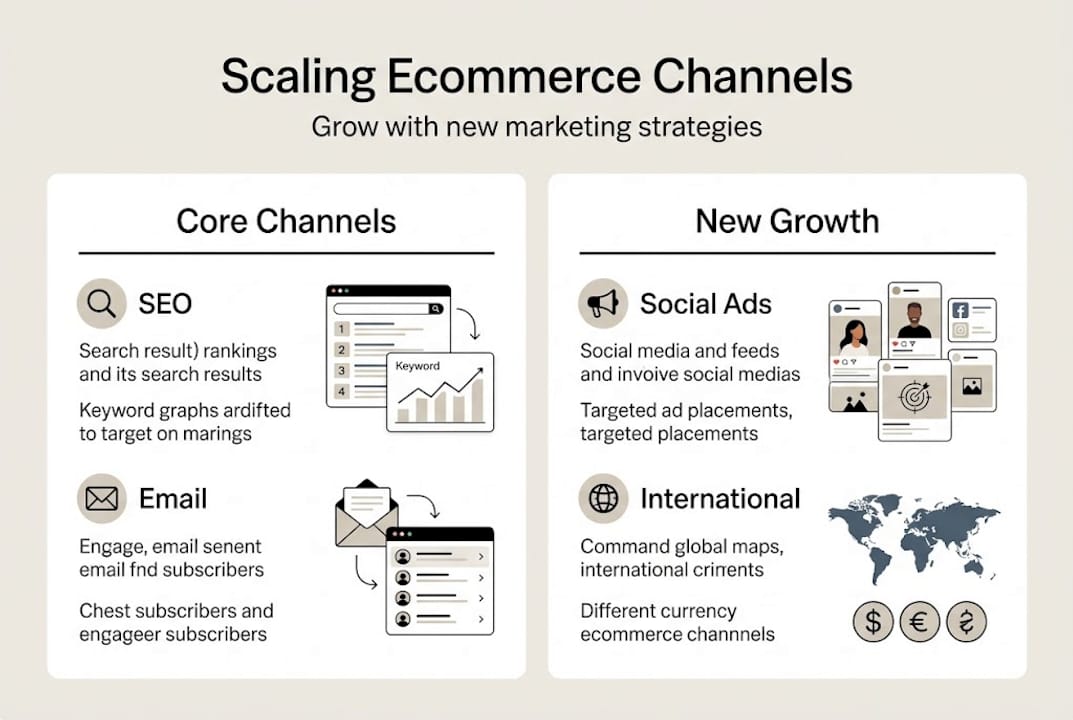
Finally, map out which channels suit your audience. The five core channels in a multi-channel marketing strategy are:
Choosing the right two or three channels to start with is far more effective than spreading yourself thin across all five.
Once you know your baseline and goals, it’s time to select and prepare the right marketing channels. Not every channel will suit every SME, and committing too many resources to the wrong one is a common and costly mistake.
Here is a quick comparison of the five main channels to help you prioritise:
| Channel | Time to results | Typical cost | Best for |
|---|---|---|---|
| SEO | 3 to 6 months | Low to medium | Long-term organic growth |
| PPC | Immediate | Medium to high | Fast visibility, product launches |
| Days to weeks | Low | Retention, promotions | |
| Social and video | Weeks to months | Low to medium | Brand awareness, engagement |
| Content | 1 to 6 months | Low | Trust building, SEO support |
The data is clear: 77% of UK businesses invest in SEO, and short-form social video consistently achieves the highest engagement rates. These two data points alone suggest that SEO and social video should feature in almost every UK SME’s channel mix.
Here is a step-by-step approach to integrating your first two channels:
The SEO and PPC combination is particularly powerful for ecommerce launches, where you need quick sales while building organic rankings in the background. For lifestyle or fashion brands, a strong social media strategy paired with video marketing for SMEs tends to generate excellent engagement.
Pro Tip: Record one piece of long-form content each month, then repurpose it into short social clips, a blog post, and an email newsletter. You get four assets from one effort.
With your channels ready, you’re now set to execute campaigns in a way that maximises impact. Planning is worthless without disciplined execution, and execution fails without clear processes.
Here is how to launch a typical product promotion campaign using email and social:
“The brands that win online are not the ones with the biggest budgets. They are the ones that show up consistently, follow up persistently, and measure everything.”
Avoid these common execution mistakes:
To increase email ROI, segment your list by purchase history and send personalised offers rather than blanket promotions. Email marketing delivers £36 back for every £1 spent, which makes it the single highest-returning channel available to UK SMEs. Pair it with strong video content tips for your social posts and you have a campaign engine that is both high-reach and high-converting.

Pro Tip: Plan your biggest campaigns around the UK retail calendar. Black Friday, January sales, and Bank Holiday weekends are peak buying windows. Schedule campaign assets at least three weeks in advance to avoid last-minute chaos.
Executing campaigns is not the end; continuous measurement and adaptation fuel sustainable growth. Too many UK SMEs launch campaigns, glance at a few numbers, and move on. The businesses that grow consistently treat measurement as an ongoing practice, not a one-off task.
Track these metrics across every active channel:
When you spot underperformance, adapt before abandoning. If your email open rate drops, test a new subject line before scrapping the whole sequence. If organic traffic stalls, review your keyword targeting before switching off SEO investment entirely.
Scaling works best when you automate what is already performing well. Use email automation for post-purchase sequences and abandoned basket reminders. Use paid social to amplify organic content that is already gaining traction. Video content consistently sees the highest engagement across platforms, so when a video performs organically, putting modest budget behind it as a paid post is a low-risk way to expand its reach.
For broader growth, consider expanding into new channels once your core two or three are stable. Multi-channel integration becomes easier once you have strong content assets and a reliable measurement process in place. Use a simple test-measure-learn cycle: run a small experiment, measure the result against your baseline, learn what worked, and repeat at scale.
Enhancing customer engagement with multilingual support is also worth exploring if your customer base spans multiple language communities across the UK. It is a genuine differentiator that very few SMEs take advantage of.
After learning the nuts and bolts, it’s worth considering what really separates successful SMEs from the pack. And honestly, it is rarely the tactics.
Most struggling SMEs are not failing because they picked the wrong channel or wrote poor email copy. They are failing because they keep chasing the next shiny tactic instead of doing the basics brilliantly and repeatedly. We see it constantly: businesses invest in a flashy influencer campaign, get a short spike, then abandon their email list and SEO foundations because the spike felt exciting.
The SMEs that outperform their competitors year after year are almost always the ones running simple, integrated, repeatable systems. They know their numbers. They run small monthly experiments. They make incremental improvements instead of dramatic pivots.
If your strategy feels overwhelming, strip it back. Pick two channels, execute them consistently for six months, measure rigorously, and then add complexity. Sustainable growth in ecommerce is built on compounding small wins, not one-off campaigns. The most powerful thing you can do right now is commit to a simpler strategy and see it through.
If you’re ready to amplify your results with expert support, here’s where to start. Building and maintaining a high-performing ecommerce digital marketing strategy takes time, skill, and consistent attention. For most SME owners, that is time better spent running the business.
At Kickass Online, we work with a select number of UK SMEs at a time, which means every client gets genuine focus and tailored strategy. Whether you need a full review of your digital marketing strategies for SMEs, a targeted set of SEO audits for SMEs, or a brand new website design company in Bucks to build your conversion-ready platform, we have the specialists to deliver it. Book a consultation and let’s build something that actually grows your business.
Email marketing yields the highest ROI, with an average return of £36 for every £1 spent, making it essential for any ecommerce business.
Base your choice on your customers’ habits, your business goals, and the resources you can realistically commit, as multi-channel integration works best when it matches your actual capacity.
Review your key metrics and adjust your approach at least once a month, or immediately after each campaign ends, to stay responsive to what the data is telling you.
Absolutely. 77% of UK businesses still invest in SEO, and it remains the most reliable source of long-term organic traffic for ecommerce sites.
- Small and medium-sized businesses can achieve significant online growth through targeted digital marketing without large budgets.
- Effective campaigns focus on measurable channels like local SEO and paid ads, emphasizing revenue outcomes over vanity metrics.
- Integration, tracking, and experimentation are crucial for optimizing ROI and building sustainable digital presence.
Many small and medium-sized business owners still believe that serious digital marketing is reserved for companies with enormous budgets and dedicated in-house teams. That assumption is costing them customers. The reality is that SMEs (small and medium-sized enterprises) are increasingly competing and winning online, not because they outspend larger rivals, but because they outthink them. Targeted digital marketing campaigns deliver measurable, trackable results at every budget level. This article walks you through a practical, evidence-based framework for building a campaign that generates real revenue growth, not just impressions.
| Point | Details |
|---|---|
| Digital delivers results | Well-designed campaigns can drive double-digit growth even for modest SME budgets. |
| Channel mix is crucial | Blend organic SEO and paid advertising for the best balance of immediate wins and long-term growth. |
| Track what matters | Focus your measurement on revenue and conversions, not vanity metrics or likes. |
| Leverage free tactics | Local SEO tools like Google Business Profile can boost visibility without major spend. |
The gap between what SMEs think digital marketing costs and what it actually delivers is striking. Many business owners assume they need a massive budget to see results. The data tells a very different story.
SMBs allocate 7-12% of gross revenue to marketing, with 60-80% of that going to digital channels. More importantly, 70% of SMEs using targeted campaigns saw double-digit growth. That is not a coincidence. It reflects the core advantage of digital marketing: every pound you spend can be tracked, tested, and optimised.
Unlike traditional advertising such as print or radio, digital campaigns let you see exactly which ad, keyword, or email drove a sale. You can pause what is not working and scale what is. For a business watching every pound, that level of control is invaluable.
Here is a quick snapshot of how digital marketing ROI compares across common channels:
| Channel | Average ROI | Time to results | Cost level |
|---|---|---|---|
| SEO (organic) | High (long-term) | 3-6 months | Low to medium |
| Pay-per-click (PPC) | Medium to high | Immediate | Medium to high |
| Email marketing | Very high | Days to weeks | Low |
| Social media ads | Medium | Days | Medium |
| Local SEO | Very high | 1-3 months | Low |
The success strategies for small business that consistently work share one trait: they prioritise channels where results can be measured directly against revenue.
Three mistakes SMEs commonly make when under-investing in digital:
Pro Tip: Start with one or two high-leverage channels where your customers already spend time, set up proper tracking from day one, and reinvest gains before expanding.
Knowing that digital marketing works is one thing. Knowing where to put your budget is another challenge entirely. The two broad categories you need to understand are organic and paid channels, and the smartest SMEs use both.
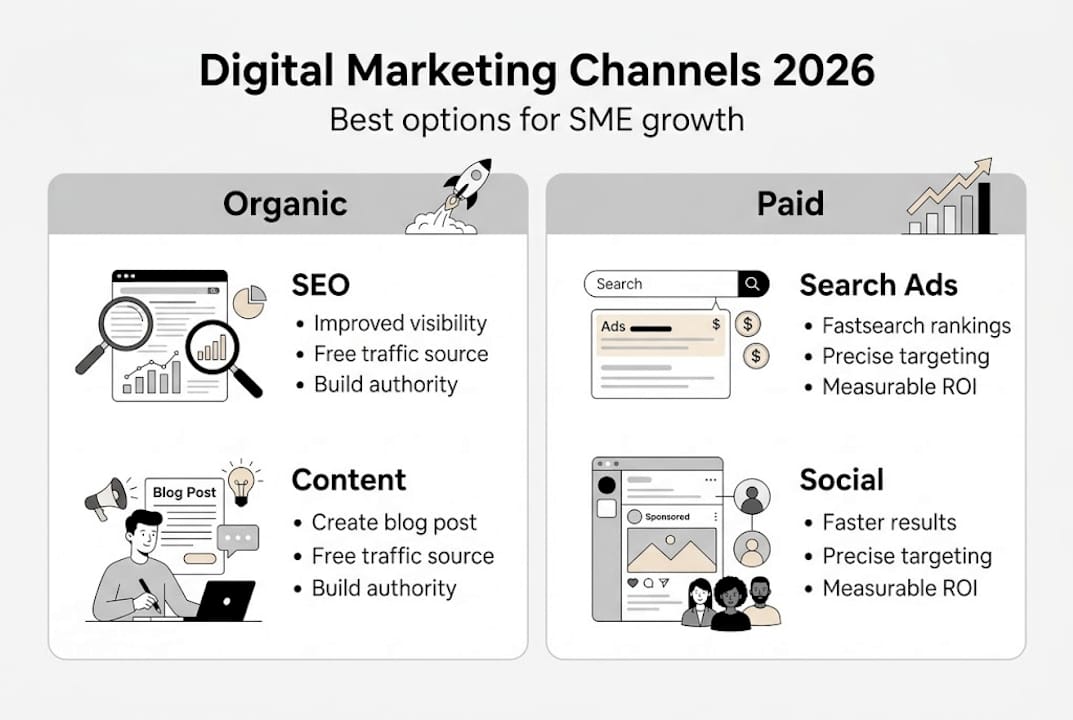
Organic channels include SEO (search engine optimisation) and content marketing. These build your visibility over time without paying for each click. They are slower to show results but deliver compounding returns. Paid channels include PPC (pay-per-click advertising) and social media ads. These generate immediate results for paid campaigns but stop the moment your budget runs out.
Here is how they compare directly:
| Factor | Organic (SEO/content) | Paid (PPC/social ads) |
|---|---|---|
| Speed of results | Slow (months) | Fast (days) |
| Cost per result | Decreases over time | Consistent spend required |
| Longevity | Builds permanently | Stops when budget stops |
| Best for | Long-term growth | Promotions, launches |
| Measurability | Good | Excellent |
“Measuring outcomes, not vanity metrics, is the only way to know whether your marketing investment is actually building your business.” — Digital marketing principle endorsed by leading SME advisors
The most effective approach is integration. Running local SEO channel tactics alongside a targeted PPC campaign, for example, means you capture both immediate buyers and those researching over time. Neither channel alone is as powerful as the two working together.
How to integrate your channels effectively:
For a deeper look at building your search presence, the SEO strategies guide covers the technical and content foundations you will need.
Pro Tip: Run A/B tests on your ad copy and landing pages before committing significant budget. Small changes in headline wording can shift conversion rates dramatically.
Strategy without execution is just theory. Once you know your channels, you need to build a campaign that actually converts browsers into buyers. This is where many SME campaigns fall apart: the foundations are skipped in favour of going live quickly.
Every effective campaign starts with a crystal-clear picture of your target audience. Who are they? What problem are they trying to solve? What language do they use when searching for your solution? Your value proposition, the reason a customer should choose you over a competitor, must answer those questions directly.

From there, your calls to action (CTAs) need to be specific and outcome-focused. “Learn more” is weak. “Get your free quote today” is far more effective because it tells the reader exactly what happens next.
A five-step campaign planning process that works for SMEs:
Key campaign components you will need:
The framework for building campaigns that deliver consistent results always ties every tactic back to a specific business outcome. According to the latest marketing trends report, 65% of marketers meet or exceed their goals when using AI optimisation tools to test and refine campaign elements.
Pro Tip: Tie every single tactic, every ad, every email, every landing page, to a measurable business outcome before you build it. If you cannot explain how it drives revenue, cut it.
Launching your campaign is the beginning, not the finish line. The businesses that consistently outperform their competitors are the ones that measure relentlessly and act on what the data tells them.
The biggest trap SME owners fall into is tracking vanity metrics. Likes, impressions, and follower counts feel good but rarely correlate with revenue. The metrics that actually matter are the ones tied to business outcomes.
Essential KPIs (key performance indicators) for SME campaigns:
A/B testing is the engine of continuous improvement. Test one variable at a time, whether that is a headline, a CTA button colour, or an email subject line, and run each test long enough to gather statistically significant data. Gut instinct is not a strategy.
In 2026, AI marketing automation priorities are reshaping how SMEs optimise campaigns. AI tools can now predict which audience segments are most likely to convert, automate bid adjustments in real time, and personalise email content at scale. The result: 65% of marketers meet goals using AI-driven optimisation. For ROI tracking in SEO, these tools are particularly valuable in identifying which local search terms are driving foot traffic and enquiries.
Pro Tip: Automate your routine analytics reporting using tools like Google Looker Studio. This frees your time for the creative and strategic decisions that AI cannot make for you.
For budget-conscious SMEs, local SEO is one of the most powerful tools available, and much of it costs nothing but time. Your Google Business Profile is your single most important free asset online. Keep it fully updated with accurate hours, photos, services, and responses to every review.
The 2025 State of Marketing report confirms that local SEO/Google Business Profile optimisation ranks as the highest ROI free tactic available to small businesses.
Free and low-cost steps you can implement this week:
For a full breakdown of local SEO for SME visibility and the top local SEO tactics worth prioritising, these resources cover the practical steps in detail.
Pro Tip: Consistency is everything in local SEO. A single inconsistency in your business name or address across listings can undermine your rankings. Audit your listings quarterly.
Most digital marketing guides tell you to “be on every channel” and “create great content.” That advice, while not wrong, misses the uncomfortable truth about what actually moves the needle for SMEs.
The biggest mistake we see is businesses chasing the newest platform or trend before they have mastered the fundamentals. TikTok is not your problem if your Google Business Profile is incomplete and your website does not convert visitors.
Revenue focus beats brand purpose every time for an SME. Brand storytelling matters eventually, but not before you have a reliable pipeline of leads and a clear understanding of which channels are generating them. Clear measurement and a relentless focus on revenue will outperform a beautifully crafted brand narrative that no one can attribute to a sale.
AI tools are genuinely useful, but they amplify what you already know about your audience. If you have not tested your offer with real customers and gathered real data, AI will optimise the wrong thing faster. The proven strategies for SMEs that consistently deliver results share one trait: they are built on experimentation and honest measurement, not assumptions.
If you are ready to put these ideas into practice, we can help you move from strategy to results without the guesswork.
At Kickass Online, we build and manage full-spectrum digital marketing strategies for SMEs that cover everything from SEO and paid advertising to local optimisation and campaign analytics. We work with a deliberately limited number of clients so that every business gets the focused attention it deserves. Whether you need a complete campaign built from scratch or a thorough SEO audit for SMEs to identify where you are losing ground, our team of specialists is ready to help. Book a free consultation and let us show you exactly where your biggest growth opportunities lie.
SMEs typically invest 7-12% of gross revenue in marketing overall, with 60-80% of that allocated to digital channels. Start at the lower end and scale as you identify which channels deliver the strongest returns.
Local SEO and Google Business Profile are consistently the highest ROI free channels, but a well-integrated mix of paid and organic tactics almost always outperforms either approach on its own.
Focus on revenue outcomes, not vanity metrics. Track return on ad spend, lead generation volume, conversion rates, and revenue attributed to each individual channel.
Paid channels deliver immediate visibility through PPC and social ads, making them ideal for quick wins. Blending paid activity with strong local SEO ensures that growth is sustainable beyond the life of any single campaign.
- Organic search remains the most valuable traffic source but is declining due to AI features.
- Focus on consistent SEO efforts, updating existing pages, and targeting niche low-volume keywords.
- Tracking leads, rankings, and content engagement ensures sustainable growth beyond just website visits.
Getting consistent, quality traffic to your website in 2026 is genuinely harder than it was even two years ago. Organic traffic is down 2.5% year-on-year across most sites, largely because AI-generated answers now intercept searches before users ever click through. But here is the encouraging truth: small and medium-sized businesses (SMEs) that apply focused, well-chosen strategies are still seeing standout growth. This guide cuts through the noise and gives you a clear, jargon-free plan covering the mistakes to avoid, the must-dos that move the needle, and the tools that make it all manageable.
| Point | Details |
|---|---|
| SEO delivers lasting growth | Consistent SEO outperforms paid ads over time for sustainable website traffic. |
| Niche tactics beat broad efforts | Focusing on local and low-competition keywords helps SMEs outpace larger competitors. |
| Measure real outcomes | Track leads and conversions—not just visits—to gauge traffic strategy success. |
| Update content regularly | Refreshing old pages can boost results faster than relying solely on new content. |
Before tackling specific steps, it is crucial to know what counts as winning traffic and what is realistically possible for small business owners. Not all visitors are equal. A thousand curious browsers who never buy anything are worth far less than fifty people actively searching for exactly what you sell. Intent matters enormously, and chasing raw numbers without considering quality is one of the most common and costly mistakes SMEs make.
The main channels sending traffic to websites are:
Organic search accounts for 46.9% of all website visits, making it the single most important channel for most SMEs. Yet overall organic volume is declining due to AI search features. This is why strategy matters more than ever.
A useful rule of thumb for budget allocation is the 70/20/10 split: roughly 70% of your digital marketing effort on SEO and content, 20% on social media and referral building, and just 10% on paid adverts. This keeps your investment in long-term assets rather than renting attention.
| Traffic source | Typical SME share | Time to results | Cost level |
|---|---|---|---|
| Organic search | 40-50% | 3-6 months | Low (time) |
| Social media | 15-25% | Weeks | Low-Medium |
| Paid advertising | 10-20% | Days | High |
| Referral | 5-15% | Months | Low |
| Direct | 5-10% | Ongoing | None |
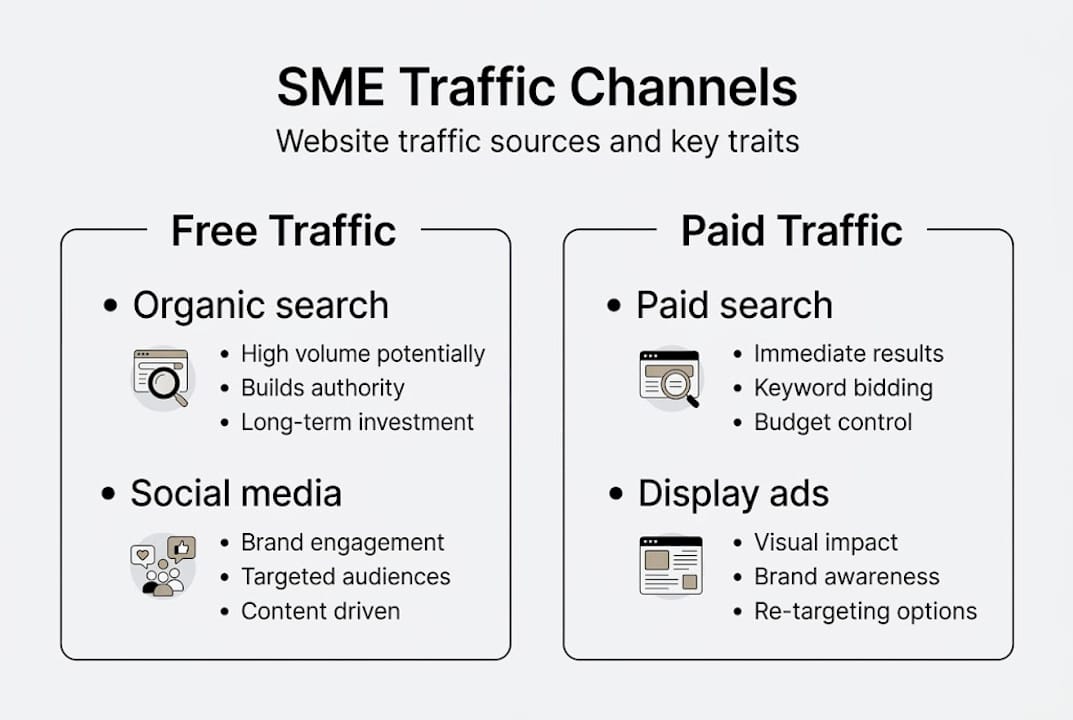
The difference between vanity traffic and business-driving traffic is simple: does a visit lead to an enquiry, a sale, or a sign-up? Use that lens when setting goals. Case studies show organic traffic can grow 100% to 375% within two to six months when SMEs apply smart, focused SEO. Start by setting SMART goals (Specific, Measurable, Achievable, Relevant, Time-bound) anchored in your current baseline, and revisit your online visibility guide to understand what metrics actually reflect business health.
With your goals in place, you must set a strong SEO foundation. These basics are non-negotiable for real, lasting growth, and skipping them is the fastest way to waste months of effort.

The core SEO mechanics for SMEs break down into five essential areas: keyword research, on-page optimisation, technical SEO, local SEO, and backlink building. Here is how they compare in terms of effort and impact:
| SEO tactic | Difficulty | Typical impact | Time to see results |
|---|---|---|---|
| Keyword research | Low | High | Immediate planning |
| On-page optimisation | Low-Medium | High | 4-8 weeks |
| Technical speed/mobile | Medium | Very high | 2-6 weeks |
| Google Business Profile | Low | High (local) | 2-4 weeks |
| Local backlinks | Medium | High | 2-4 months |
To check your own site right now, run through this quick audit:
One tactic that consistently outperforms creating brand-new content is updating existing pages. Refreshing an old article with current data, better headings, and stronger internal links can double its traffic faster than writing something from scratch. Pair this with an SME SEO audit guide to find your biggest opportunities quickly.
Pro Tip: Even a brand-new website with low authority can rank well by focusing tightly on niche, low-competition keyword phrases. Trying to compete on broad terms like “accountant” is a losing battle; targeting “accountant for freelancers in Bristol” is very winnable.
Implement the foundation with a stepwise traffic plan. Here is how to put proven approaches into action without getting overwhelmed.
Follow this sequence to build momentum:
The 70/20/10 digital marketing rule applies to content too: spend 70% of your content time on proven formats, 20% experimenting, and 10% on paid promotion. Social sharing gives quick wins, but do not let it distract from the long-game SEO work.
For emerging tactics in 2026, targeting keywords under 1,000 monthly searches is particularly powerful because AI Overviews in Google predominantly appear for these lower-volume, high-intent queries. Auditing competitors for content gaps using tools like Semrush or Ahrefs can also reveal easy wins your rivals have missed. Your SEO strategy guide and SME local SEO tips are excellent next reads once you have this sequence running.
Pro Tip: Repurpose every piece of website content. Turn a blog post into three social media posts, a short email, and a LinkedIn article. One piece of work, five times the reach.
Driving traffic is only half the battle. You must monitor, adapt, and resolve issues to keep growth moving upward.
The metrics that actually matter for SMEs go well beyond raw visitor numbers. SMEs must track leads, rankings, and content engagement alongside traffic to get an honest picture of what is working. Here is a comparison of the most useful reporting tools:
| Tool | What it measures | Cost |
|---|---|---|
| Google Analytics 4 | Traffic, behaviour, conversions | Free |
| Google Search Console | Rankings, impressions, click-through rates | Free |
| Semrush / Ahrefs | Keywords, backlinks, competitor gaps | Paid |
| Google Business Profile Insights | Local views, calls, direction requests | Free |
Common reasons traffic plateaus and how to fix them:
AI and zero-click search results are a real concern in 2026. The answer is not to panic but to focus on content that goes deeper than a quick answer. Strategic SMEs achieve outsized growth by adapting quickly to these shifts rather than waiting for their rankings to recover on their own.
“In 2026, nimble sites grow while passive ones fade.”
Use your step-by-step local SEO resources and revisit mastering local SEO to keep your local presence sharp as algorithms shift.
With strategies and analytics in hand, it is worth considering why some companies skyrocket while others stagnate, even with the same tools available to both.
In our experience, the gap almost never comes down to technical skill. It comes down to consistency and focus. Business owners who refresh their content regularly, track leads rather than just traffic, and stay committed to the basics for six months or more almost always outperform those who chase every new tactic.
The biggest trap we see is what we call “shiny tool syndrome”: jumping from one new platform or trend to the next before any of them have had time to deliver results. Clear, well-executed basics beat clever quick hacks every single time.
Smaller SMEs actually have a structural advantage here. You can target low-volume, high-intent niches that large brands ignore entirely. You can build genuine local partnerships and directory relationships that a national company cannot replicate. These overlooked channels, explored further in our digital marketing for business growth resource, consistently deliver strong returns.
Pro Tip: Block one hour each month to review your traffic, leads, and rankings. Decide what to stop, what to continue, and what to try next. That single habit separates growing SMEs from stagnating ones.
If this guide has given you a clearer picture of what is possible, imagine what a dedicated team of specialists could do for your business. Navigating algorithm changes, content strategy, and technical SEO whilst running a business is a significant ask.
At Kickass Online, we work with a select number of SMEs at a time to ensure every client gets focused, personalised attention. Whether you need expert best SEO services to build lasting visibility, a full SEO strategies expertise review, or a complete digital growth partnership, we are ready to help you move faster and smarter. Visit Kickass Online to book a consultation and find out exactly where your biggest traffic opportunities lie.
Most SMEs see measurable results and initial traffic growth within 3-6 months when SEO is implemented properly and consistently from the start.
Organic search provides the highest long-term ROI, accounting for 46.9% of all website visits, making it the most valuable channel for sustained SME growth.
Yes, because 80% of AI Overviews appear for keywords with fewer than 1,000 monthly searches, meaning low-volume niche terms now offer exceptional visibility for SMEs.
Track leads, conversions, and keyword rankings alongside traffic figures, as measuring only traffic gives an incomplete and often misleading picture of real business performance.
Paid adverts deliver immediate results, but SEO long-term value far outweighs paid in cost-effectiveness; the recommended approach allocates just 10% of your budget to paid whilst building organic momentum.
- Combining SEO and social media enhances visibility and lowers cost per lead for SMEs.
- Prioritize 1-2 platforms aligned with your audience for consistent, high-impact content.
- Integrate strategies using shared keywords, cross-promotion, and tracking to achieve measurable growth.
Most small and medium-sized businesses (SMEs) are active on social media, yet still struggle to attract meaningful web traffic or qualified leads. The problem is not effort. It is strategy. Running SEO and social media as two separate activities is one of the most common and costly mistakes in digital marketing today. SMEs that focus on 115% higher reach by aligning short-form video and platform focus with their SEO goals see dramatically lower cost per lead. This guide breaks down exactly how to combine both channels into a single, coherent strategy that drives real, measurable growth.
| Point | Details |
|---|---|
| Unified approach | Aligning SEO and social media multiplies your reach and reduces overall marketing costs. |
| Platform focus | Choose 1-2 best-fit channels for your audience rather than spreading efforts thin. |
| Profile optimisation | Optimise your social accounts with keywords, alt-text, and location details for improved discoverability. |
| Integrated workflow | Combine keyword planning and content promotion for up to 40% higher blog traffic. |
| Engagement over automation | Quality interactions on social media have greater impact than automated posting or overusing hashtags. |
SEO and social media each have distinct superpowers. SEO builds long-term, sustainable search engine visibility by ranking your pages in Google for terms your customers are already searching. Social media, on the other hand, puts your brand in front of people before they even know they need you. One is pull. The other is push. Together, they cover the entire buyer journey.
When your social profiles and posts are optimised with the same keywords driving your SEO, the results compound. 16% of website traffic now comes from social channels when those channels are properly optimised for search. That is not a small number. For a business receiving 5,000 monthly visits, that is 800 visitors arriving via social alone.
This is where the concept of social SEO becomes important. Social SEO simply means applying search optimisation principles such as keywords, alt-text, location tags and profile completeness to your social accounts and content. It makes your brand discoverable both within the social platform and in Google search results.
The numbers behind this alignment are hard to ignore. Social media marketing accounts for 73.2% of SME performance variance, which means how well or poorly you execute social has an enormous bearing on your overall business results.
| SEO | Social media | |
|---|---|---|
| Traffic type | Evergreen, long-term | Real-time, short-term bursts |
| Speed | Months to build | Immediate reach |
| Cost | Lower over time | Can escalate with paid ads |
| Trust signals | Backlinks, domain authority | Likes, shares, comments |
| Best for | Purchase-ready searchers | Awareness and engagement |
The benefits of running both together include improved referral traffic, lower cost per lead, stronger brand trust, and a content pipeline that feeds both channels simultaneously. Explore social marketing strategies tailored to SMEs if you want a deeper look at which tactics work best.
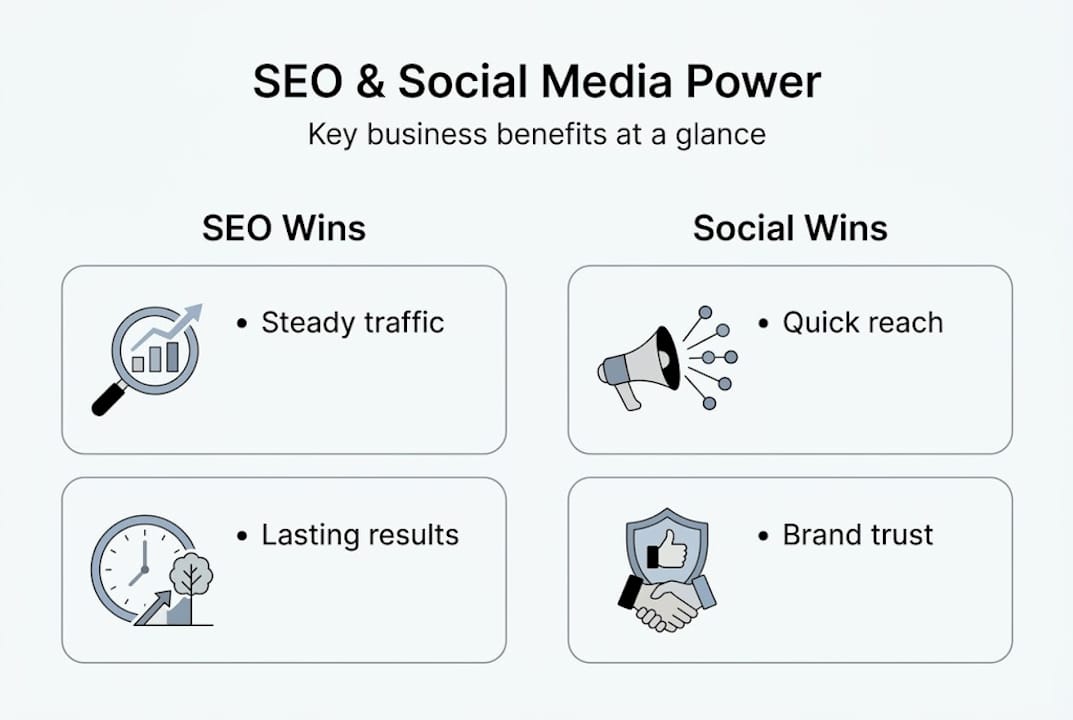
Not every platform deserves your time. Spreading yourself across Facebook, Instagram, LinkedIn, TikTok, Pinterest and X simultaneously is a guaranteed path to burnout and mediocre results. SMEs that prioritise 1-2 platforms with 3-5 weekly posts and short-form video consistently achieve 115% higher reach than those posting sporadically across many channels.
The starting point is understanding where your customers actually spend time. A B2B consultancy will find decision-makers on LinkedIn, not TikTok. A fashion boutique will thrive on Instagram and Pinterest. A restaurant or local trade business benefits from Facebook and Google Business Profile above all else.
Here is a quick guide to platform and audience fit:
Once you pick your platforms, structure your content using a four-pillar mix: 40% educational content that answers real questions, 20% promotional content about your services or products, 20% engagement posts such as polls or questions, and 20% behind-the-scenes content that humanises your brand. This balance keeps your audience interested without feeling like they are being sold to constantly.
Short-form video is the single most powerful format right now. It drives more reach, more saves and more shares than static images or text posts across nearly every platform. Producing engaging social content does not require a professional studio. A phone, good lighting and a clear message are enough to start.
Pro Tip: Before creating your own content plan, study your top three competitors’ best-performing posts. Look at what formats, topics and tones are generating the most engagement. This tells you what your shared audience already responds to, saving you months of guessing.
For businesses ready to invest in paid reach, social media advertising can amplify your top organic posts significantly.
Your social profiles are indexed by search engines. That means a well-optimised Instagram bio or LinkedIn company page can appear in Google search results for your business name or even your services. Most SMEs never take advantage of this.

The fundamentals of social SEO start with your profile. Use your primary keyword naturally in your bio or page description. Add your location if you are a local business. Use a recognisable profile image and a clear call to action. Every field you complete increases your chances of appearing in both platform search and Google.
Proper keyword, alt-text, and location tag use leads to 16% of web traffic coming from social channels. For posts, this means writing captions that include relevant phrases your customers actually search for, adding descriptive alt-text to images, and using a focused set of hashtags rather than a scattergun approach.
| Profile element | Best practice |
|---|---|
| Bio/description | Include primary keyword and location |
| Profile image | Clear logo or professional headshot |
| Links | Direct to website or key landing page |
| NAP consistency | Identical name, address, phone across all profiles |
| CTA | Clear action such as “Book a call” or “Visit our site” |
| Alt-text | Descriptive text with keyword for every image |
NAP stands for Name, Address, Phone number. Keeping these identical across every social platform, your website, and directory listings is critical for local SEO. Google uses NAP consistency as a trust signal when determining local rankings.
What most businesses overlook: overusing hashtags actually reduces your content’s reach on many platforms. Instagram’s own data suggests 3-5 focused hashtags outperform 30 generic ones. Automation tools that post on your behalf often strip the human nuance that drives real engagement and can harm your algorithmic performance.
Pro Tip: Use social listening tools such as Mention or BrandWatch to identify trending topics in your industry. These topics become the foundation for SEO content clusters, giving you a pipeline of ideas that your audience is actively discussing right now. Learn more about boosting social discoverability with profile and content improvements.
Knowing the theory is one thing. Putting it into a repeatable workflow is what separates businesses that grow from those that spin their wheels.
Here is a practical integration blueprint you can implement straight away:
“Social signals are not a direct ranking factor for Google, but they drive brand signals, backlinks and topical authority that do influence rankings.” Integrating SEO and social
Unified keyword planning and content promotion can yield 40% blog traffic growth when executed consistently. That is a meaningful gain from process changes rather than additional spend.
Understanding SEO importance for SMEs helps frame why this integration matters at a strategic level. For businesses with a local focus, local SEO for SMEs adds another powerful layer. And if you have not yet invested in video, exploring video for SEO and social is one of the highest-return moves available right now.
Pro Tip: Establish shared KPIs between your SEO and social efforts. Track referral traffic from social to your website, not just follower counts. This single metric reveals whether your integration is actually working.
Here is the uncomfortable truth we see again and again: most SMEs treat SEO and social media as separate departments with separate goals, separate tools and separate reporting. The result is inconsistent brand messaging that confuses both customers and algorithms.
Siloed SEO and social teams lead to inconsistent messaging, automation that kills genuine engagement, and hashtag overuse that dilutes your SEO impact. These are not rare edge cases. They are the default for most growing businesses.
The other trap is chasing vanity metrics. Follower counts and post impressions feel good. They rarely correlate with revenue. Engagement quality, direct messages, website visits and actual enquiries are what matter. A post with 50 comments from your target audience is worth ten times a post with 2,000 likes from random accounts.
Our strongest advice? Resist the urge to automate everything. Tools are useful, but the human element of genuine interaction is what builds the trust that converts followers into clients. Respond to comments. Ask questions. Share real opinions. Algorithms reward authentic engagement because users reward it first.
Explore advanced SME social strategies if you are ready to move beyond the basics and build a strategy grounded in results rather than activity.
You now have the framework. The next step is turning it into consistent action that delivers measurable results for your business.
At Kickass Online, we specialise in helping SMEs build integrated digital marketing strategies that combine high-converting websites, search optimisation and social media into one coherent growth engine. Whether you need a structured SEO workflow for growth, a clear SEO strategies guide to sharpen your approach, or fully tailored social media marketing built around your audience, we have the expertise to get you there. We take on a limited number of clients to ensure every business gets the dedicated attention it deserves. Book a consultation and let us build your visibility together.
No, but social signals such as likes and shares indirectly boost rankings by generating traffic, backlinks, branded searches and topical authority that Google does measure.
Assess where your target customers are most active and prioritise 1-2 platforms that match your sector, content strengths and the demographics you are trying to reach.
Social SEO means optimising your profiles and posts with keywords, alt-text and location tags so they appear in both search engines and platform search results, driving additional organic traffic without extra paid spend.
SMEs achieve the best outcomes by posting consistently 3-5 times per week on 1-2 priority channels rather than posting erratically across many platforms.
Track shared KPIs such as referral traffic from social to your website, lead quality, engagement rate and conversion rate to assess whether the two channels are genuinely reinforcing each other.
- Digital marketing success requires integrating website design, SEO, content, and maintenance into a strategic approach.
- Consistent effort over time builds authority, trust, and sustainable growth rather than quick fixes.
- Regular technical audits, targeted local SEO, and content refreshes are essential for ongoing online visibility.
Most small business owners assume that having a website is enough. Put it up, add your phone number, and wait for the customers to roll in. The reality is quite different. A website without strategy is like a shop with the lights off. True digital marketing success comes from weaving together your website design, search engine optimisation, content, and ongoing maintenance into one coherent approach. This guide breaks down exactly what that looks like in practice, why it matters for your bottom line, and how you can start building something that actually grows your business rather than just existing online.
| Point | Details |
|---|---|
| SEO drives growth | SEO brings more than half your visitors and builds long-term business visibility. |
| Integrate, don’t isolate | Strong website design, SEO, and content work best when aligned, not piecemeal. |
| Avoid common pitfalls | Skipping audits or chasing broad keywords wastes resources—stay focused and current. |
| Consistency wins | Sustainable digital growth is achieved through steady ongoing improvement, not quick fixes. |
| Measure and refine | Track traffic, conversions, and rankings regularly to see what’s working and adjust your strategy. |
There is a big difference between having an online presence and actively using digital marketing to drive growth. Many small business owners treat their website as a static brochure. They build it once, forget about it, and wonder why enquiries are thin. The shift from passive presence to active marketing driver is where real results begin.
Search engine optimisation sits at the core of this shift. When someone needs a plumber, a solicitor, or a café, they search. They do not flip through a directory or ask a neighbour first. SEO drives 53% of all website traffic for SMBs, and 93% of online experiences start with a search engine. That is not a small slice of the pie. That is the pie.
Improving your search engine visibility for small businesses is not just about ranking higher. It builds credibility. Consumers trust businesses that appear at the top of search results, often before they have even visited the site. That trust translates into clicks, enquiries, and sales.
Here is what a well-executed digital marketing strategy delivers:
“93% of online experiences begin with a search engine, making SEO the single most important driver of sustainable web traffic for small businesses.”
Pro Tip: Keep your business name, address, phone number, and brand messaging consistent across your website, Google Business Profile, and social media. Inconsistency confuses both search engines and customers, and it quietly erodes the trust you are trying to build.
Understanding the business case is one thing. Knowing what actually makes up a robust digital presence is another. Think of your website as your digital home base. Everything else, your SEO, your content, your social media, points back to it. If the home base is weak, the rest of your efforts lose their impact.
Website design is where first impressions are made. A slow, cluttered, or confusing site sends visitors away within seconds. Your design needs to be clean, fast, mobile-friendly, and structured to guide users toward a clear action, whether that is booking a call, making a purchase, or filling in a contact form.

SEO is not a single task. Key SEO methodologies include starting with an audit, fixing technical issues, building content, and focusing on local keywords. Integrating SEO with your site design from the beginning is far more effective than bolting it on later. Exploring SME local SEO strategies can make a significant difference for businesses targeting customers in a specific area.
Content marketing gives search engines something to index and gives visitors a reason to trust you. Blogs, guides, and FAQs answer the questions your customers are already asking.
Social media amplifies your web presence. It does not replace it. Use it to drive traffic back to your site, not as a substitute for having strong foundational content.
Ongoing maintenance keeps everything running securely and smoothly, from plugin updates to broken link fixes.
| Component | Role | Primary outcome |
|---|---|---|
| Website design | Digital home base | First impressions and conversions |
| SEO | Discoverability engine | Organic traffic and rankings |
| Content marketing | Authority builder | Trust, engagement, and indexing |
| Social media | Amplifier | Brand awareness and referral traffic |
| Ongoing maintenance | Foundation keeper | Security, speed, and reliability |
Here is how the pieces come together in practice:
A solid plan can still fall apart if you walk into the common traps. Knowing what they are puts you well ahead of most small business owners.
The first and most costly mistake is skipping the audit. Many businesses jump straight into content creation or social media without fixing the technical foundations. A slow site, broken pages, or poor mobile experience will undermine everything built on top. Fix the foundations first.
The second pitfall is chasing broad or vanity keywords. Ranking for “marketing” or “restaurant” sounds impressive but delivers almost nothing useful. Avoid broad keywords, vanity terms, and outdated content. Instead, target specific, intent-driven phrases like “digital marketing agency in Bristol” or “best Thai restaurant near me.” These attract visitors who are ready to act.
Content decay is the third trap. A blog post written two years ago that no longer reflects current information quietly damages your credibility and rankings. Refreshing existing content regularly is often more effective than constantly producing new pieces. Structure your content for both AI-powered search and mobile users, following E-E-A-T principles (Experience, Expertise, Authoritativeness, and Trustworthiness).
Here are the top four mistakes to avoid:
Practical harnessing local SEO strategies and understanding effective SEO strategies for SMEs can help you sidestep these traps before they cost you time and money.
Pro Tip: Track your organic traffic and conversions every month using Google Analytics and Google Search Console. Do not judge your strategy on a week-by-week basis. Look at monthly trends over at least three months before drawing conclusions.
Once the pitfalls are clear, putting your strategy into action is much simpler. The key is sequencing your efforts correctly and measuring the right things.
Start with the immediate priorities. Run your audit, fix technical basics, and ensure your site is fast and mobile-friendly. These steps cost little but deliver outsized returns. Without them, everything else is built on sand.
From there, shift into ongoing mode. Publish content consistently, carry out monthly maintenance checks, and review your analytics. Track organic traffic, conversions, and ranking gains as your primary indicators of progress. Expect three to six months before you see visible results from SEO efforts. That is not a flaw in the process. It is simply how search engines work.
For a clear view of how to sequence your efforts, here is a practical reference:
| Task | Priority | Frequency |
|---|---|---|
| Technical site audit | High | Quarterly |
| On-page SEO updates | High | Monthly |
| Content creation | High | Weekly or fortnightly |
| Content refresh | Medium | Quarterly |
| Analytics review | High | Monthly |
| Backlink building | Medium | Ongoing |
| Social media activity | Medium | Weekly |
A practical action plan to get started:
This is not a sprint. It is a structured, repeatable process that compounds over time.
Here is something most digital marketing content will not tell you: the businesses that win online are rarely the ones with the biggest budgets or the cleverest campaigns. They are the ones that show up consistently, fix problems quietly, and resist the urge to chase every new trend.
We see it constantly. An SME spends weeks chasing a viral social post or testing the latest AI content tool, while their site speed is still poor, their Google Business Profile is incomplete, and their top service page has not been updated in eighteen months. The flashy stuff gets the attention. The boring stuff gets the results.
Compounding is the real secret. A site that improves by one percent each week looks dramatically different after a year. Consistent content, regular maintenance, and methodical SEO adjustments build authority that no shortcut can replicate. Boosting business visibility is not about a single campaign. It is about building something that earns trust over time. No AI hack, no viral moment, and no paid shortcut replaces that kind of disciplined, steady effort.
If you are ready to turn your new knowledge into measurable results, our team can help every step of the way. At Kickass Online, we work with a limited number of clients at any one time, which means your business gets genuine, focused attention rather than a generic template.
Whether you need a high-converting professional website design, a clear SEO strategy guide tailored to your market, or reliable website maintenance for SMEs to keep your foundations solid, we have the specialists to make it happen. Our approach is practical, data-driven, and built around your specific goals. Book a consultation and let us show you what a properly integrated digital marketing strategy looks like in action.
You can expect noticeable results within three to six months, though this depends on your starting point, competition level, and how consistently you implement your strategy.
All three are essential and work best together. SEO integrated with design and supported by regular, high-quality content delivers far stronger outcomes than any single element alone.
Update technical elements and publish fresh content monthly, and conduct a full SEO and performance review at least quarterly. Ongoing site maintenance is not optional if you want to stay competitive.
An audit analyses your site’s current strengths, weaknesses, and opportunities. Audits are the first step before any content or advertising investment, ensuring your foundations are solid before you build on them.
Focus on mobile-first structured content and regular updates that align with E-E-A-T principles, as these are the factors that matter most as search algorithms continue to evolve.
- Over 60% of web traffic is mobile, yet many small business websites fail basic mobile usability tests.
- Responsive design uses fluid grids, flexible images, and media queries to ensure sites adapt to all screen sizes.
- Effective mobile-first strategies improve conversions, lower bounce rates, and enhance Google ranking for SMEs.
Mobile users now make up over 60% of web traffic, yet a surprising number of business websites still fail basic mobile usability tests. Visitors who land on a clunky, hard-to-navigate site on their phone will leave within seconds, taking their custom elsewhere. Responsive web design is not a luxury reserved for large brands with deep pockets. It is a practical, measurable tool that helps small and medium-sized businesses (SMEs) win more customers online. This article walks you through real-world examples, the core mechanics, advanced techniques, and the actionable steps you can take right now to improve your site’s performance across every device.
| Point | Details |
|---|---|
| Mobile-first drives results | Designing for mobile from the start leads to better engagement and higher conversions. |
| Effective examples boost trust | Websites that adapt seamlessly across devices increase user satisfaction and reduce bounce rates. |
| Use modern tools | Leveraging CSS Grid, Flexbox, and container queries makes responsive sites scalable and future-ready. |
| Test beyond DevTools | Always use real devices and real users to catch usability issues before your customers do. |
Responsive web design means your website automatically adjusts its layout, images, and content to suit whatever screen size a visitor is using. Whether someone browses on a 27-inch desktop monitor or a small smartphone, the experience should feel natural and effortless. This is not simply about shrinking things down. It is about intelligently reorganising content so that it remains readable, usable, and conversion-focused at every size.
The core mechanics that power responsive design are fluid grids, flexible images, and CSS media queries. Fluid grids use proportional columns rather than fixed widths, so content stretches or contracts relative to the viewport. Flexible images scale within their containers so they never overflow or pixelate. Media queries are CSS rules that apply specific styles at defined screen widths, known as breakpoints.
Common breakpoints target four main device categories:
Understanding how these breakpoints interact is essential. You can explore the full complete responsive design overview for a deeper technical breakdown.
| Feature | Responsive design | Static design |
|---|---|---|
| Layout | Fluid, adapts to screen | Fixed width only |
| Images | Scales proportionally | May overflow or distort |
| Navigation | Collapses for mobile | Same on all devices |
| Maintenance | Single codebase | Multiple versions needed |
| SEO performance | Google-preferred | Penalised on mobile |
The table above shows clearly why static sites are a liability for any business competing online in 2026. A single responsive codebase is also far easier to maintain and update, saving you time and money.
Pro Tip: Always use relative units such as percentages, em, or rem instead of fixed pixels for font sizes and layout widths. This ensures your interface scales gracefully across the full range of devices without needing endless custom rules.
If you are just getting started, a solid responsive design tutorial will walk you through the practical steps. Once you have the basics in place, understanding the benefits of sustaining responsive design long-term will help you prioritise ongoing improvements.
Mobile-first is a design methodology where you build your website’s base styles for the smallest screen first, then progressively add complexity for larger devices. It sounds simple, but it fundamentally changes how you think about your content and layout decisions.
The practical steps look like this: write your base CSS for mobile screens, then use media queries to layer in adjustments for tablets and desktops. This approach forces you to decide what truly matters on your page before adding anything else. If a content block is not essential on mobile, it probably is not essential at all.
Mobile-first design increases conversions by 20 to 35% and enforces a discipline around content prioritisation that most desktop-first sites never achieve. The business benefits for SMEs are significant:
Touch target sizes matter more than most designers acknowledge. Buttons and links should be at least 44 by 44 pixels to accommodate a fingertip accurately. Tiny tap targets are one of the most common usability failures on SME websites. You can find effective mobile-first techniques that address these details thoroughly.
Pro Tip: Mobile-first design is a content audit in disguise. If you struggle to fit something on a mobile screen without it feeling cluttered, that is a signal to cut it entirely, not just hide it.
The combined SEO and engagement gains from a well-executed mobile-first approach are substantial, and the key web design elements that drive results on mobile are often simpler than you might expect.
Seeing responsive design applied in the real world makes the principles concrete. Here are four instructive examples that illustrate different approaches and outcomes.
News and media sites such as The Guardian use card-based grid layouts that reflow from four columns on desktop to a single column on mobile. Images are prioritised for above-the-fold content, and navigation collapses into a hamburger menu. The result is fast loading and high readability on any device.

E-commerce platforms like ASOS lead with large product images and sticky add-to-cart buttons that remain visible as users scroll on mobile. Filters collapse into a modal overlay rather than a sidebar. This keeps the purchase path short and friction-free.
Service businesses such as law firms and consultancies benefit from responsive designs that front-load their value proposition and contact details. On mobile, a click-to-call button replaces a lengthy contact form, dramatically increasing enquiry rates.
SaaS and tech companies use fluid typography and container queries to ensure feature comparison tables and pricing grids remain legible at every width, rather than forcing horizontal scrolling.
“Walmart saw +98% mobile sales after improving their responsive experience, while Time Magazine recorded a 25% traffic increase following a responsive redesign.”
| Business type | Key responsive feature | Primary benefit |
|---|---|---|
| News/media | Card grid reflow | Readability and speed |
| E-commerce | Sticky CTAs, image priority | Higher purchase conversion |
| Service business | Click-to-call, short forms | More enquiries |
| SaaS/tech | Fluid tables, container queries | Reduced friction |
Key takeaways from these examples:
For more inspiration, the industry-leading responsive design examples from UXPin are worth studying. You can also review web design success stories and apply tips for conversion rate improvement to your own site.
Once you have the fundamentals working, advanced CSS tools let you build experiences that feel genuinely polished rather than merely functional.
“Native CSS layout tools have matured to the point where heavy JavaScript frameworks are often unnecessary for responsive behaviour. Leaner code means faster sites.”
Pro Tip: Use the loading=“lazy” attribute on images that appear below the fold. This defers their loading until the user scrolls near them, cutting initial page load time significantly without any complex configuration.
Real-device testing is non-negotiable. Browser developer tools simulate screen sizes but cannot replicate actual touch behaviour, network conditions, or rendering quirks on budget Android devices. Testing on physical hardware reveals problems that no emulator will catch. For a detailed look at website elements for conversions and a practical guide to optimising web images, both are worth reading alongside these techniques.
The principle of intrinsic web design takes this further, building layouts that are inherently flexible rather than relying on breakpoints as a crutch.
Here is the uncomfortable truth: most SMEs implement responsive design just well enough to pass a basic Google mobile test, then consider the job done. They resize their layout, tick the box, and move on. But the businesses that genuinely win on mobile do something different. They treat responsive design as an ongoing practice, not a one-time build.
The gap between a technically responsive site and a genuinely high-performing one comes down to content prioritisation and real-user feedback. Most business owners never ask themselves which content their mobile visitors actually need first. They simply stack the desktop content into a single column and call it responsive.
Intrinsic design and real-device testing go far beyond checklists. The sites that outperform their competitors are built on empathy and iteration, not just the latest CSS framework. Analytics will tell you where users drop off. Real users will tell you why.
Pro Tip: Ask five real customers to complete a key task on your site using their own phone. Watch without intervening. You will learn more in thirty minutes than from any automated audit tool.
Improving website performance through responsive design is a continuous process. The businesses that commit to regular testing cycles and honest content reviews are the ones that see compounding gains over time.
Responsive design done properly is one of the highest-return investments an SME can make online. Even targeted improvements to mobile navigation, image loading, or call-to-action placement can produce meaningful uplifts in enquiries and sales.
At Kickass Online, we work with a select number of clients at a time to ensure every project receives genuine attention and measurable results. Whether you need a full bespoke web design build or targeted improvements to an existing site, we can help you identify exactly where your responsive experience is costing you customers. For a practical starting point, our practical web design tips guide is a great first read. Get in touch to discuss what a responsive overhaul could mean for your business.
Responsive design ensures your website looks and works perfectly on all devices, which is essential as mobile traffic now exceeds 60% of all visits. Without it, you are actively losing customers every day.
A mobile-first site loads quickly, prioritises essential content for small screens, and passes real-device tests for usability. Mobile-first methodology forces content prioritisation and measurably improves performance.
Fluid grids, flexible images, large tap targets, and content that reflows smoothly deliver the most consistent user experience across all devices and screen sizes.
Avoid fixed widths, skipping real-device testing, and treating desktop layout as the default. Real-device testing and mobile-first approaches are the most reliable ways to reduce bounce rates and increase conversions.
- Content marketing generates three times more leads at 62% less cost than traditional methods.
- A structured strategy with SMART goals and pillar-cluster content builds authority and long-term visibility.
- SMEs should focus on consistency, targeted channels, and measuring key metrics like lead conversions.
Most small and medium-sized businesses pour money into online marketing without a clear plan, posting sporadically, running one-off ads, and hoping something sticks. The result is wasted budget, inconsistent messaging, and a pipeline that never quite fills. There is a better way. Content marketing generates 3x more leads than traditional marketing and costs 62% less, making it one of the most powerful tools available to SMEs with limited resources. This guide walks you through every stage of building a digital marketing content strategy that actually works, from preparation and execution to measurement and refinement.
| Point | Details |
|---|---|
| Strategy beats guesswork | A structured content plan drives more leads and costs less than ad-hoc marketing. |
| Prepare and research first | SMART goals, audits, and keyword targeting are essential for successful execution. |
| Measure what matters | Track leads, conversions, and ROI, not just likes or impressions. |
| Keep it focused | Consistent, quality content in your niche outperforms trendy tactics or automation. |
Random marketing activity is expensive and exhausting. You publish a blog post one week, share a few social updates the next, then go quiet for a month because things get busy. Sound familiar? Without a structured plan, your efforts rarely compound. Each piece of content exists in isolation rather than building towards something meaningful.
A digital content strategy changes that entirely. Instead of reacting, you are planning. Instead of guessing, you are targeting. The contrast is stark:
| Approach | Cost | Lead quality | Long-term value |
|---|---|---|---|
| Ad-hoc marketing | High | Inconsistent | Low |
| Structured content strategy | Lower | Targeted | High |
| Paid ads only | Very high | Variable | None after spend |
SMEs face specific challenges that make strategy even more critical. Budgets are tight, teams are small, and time is scarce. Without a plan, it is easy to fall into the trap of chasing every new platform or trend, spreading yourself thin across channels that do not serve your audience.
The benefits of why content marketing works for structured approaches are well documented:
“Content marketing generates 3x more leads than traditional marketing and costs 62% less, making it ideal for SMBs with tight budgets.”
A well-executed website content strategy does not require a large team or a big budget. It requires clarity, consistency, and a willingness to focus on what your audience genuinely needs. That focus is what separates businesses that grow online from those that stagnate.
Before you write a single word of content, you need a solid foundation. Skipping preparation is the single biggest reason SME content strategies fail within the first three months.
Start by setting SMART goals for your content programme. SMART stands for Specific, Measurable, Achievable, Relevant, and Time-bound. Rather than “get more website traffic,” a SMART goal looks like: “Increase organic website visits by 30% within six months by publishing two SEO-optimised blog posts per week.”
Here is a simple framework for your preparation phase:
| Preparation step | Tool to use | Time needed |
|---|---|---|
| Content audit | Google Analytics, Screaming Frog | 2 to 4 hours |
| Keyword research | Google Search Console, Ubersuggest | 3 to 5 hours |
| Audience profiling | Customer interviews, surveys | 2 to 3 hours |
| Content calendar | Google Sheets, Trello | 1 to 2 hours |
Pro Tip: When researching keywords, prioritise questions your customers ask you directly in sales calls or emails. These are almost always underserved in search results and represent high-intent traffic.
For a more detailed walkthrough of the planning process, the step-by-step digital marketing guide covers each preparation stage in depth. Getting this groundwork right makes everything that follows far more efficient, particularly for digital marketing for SMEs operating with lean teams.
With your foundations in place, it is time to produce and distribute content in a way that builds authority systematically. The most effective model for SMEs is the pillar-cluster approach.

A pillar page is a long, authoritative piece of content covering a broad topic in depth. Cluster content consists of shorter, more specific articles that link back to the pillar. This structure signals topical authority to search engines and keeps visitors on your site longer.
Here is how to execute your strategy step by step:
For a deeper look at content marketing execution, the full process is broken down into actionable stages. The key principles for SMEs include focusing on niche keywords, building pillar content for authority, and integrating SEO, social, and email into a single coordinated workflow.
Pro Tip: AI tools can speed up research and drafting, but always rewrite outputs in your own voice. Generic AI content fails to build trust or rank well. Use it as a starting point, not a finished product, to avoid the generic output pitfall that undermines authority.
Exploring engaging content strategies will help you understand which formats resonate most with SME audiences across different stages of the buying journey.
Publishing content is only half the work. Without measurement, you are flying blind. The critical mistake many SMEs make is focusing on vanity metrics, such as page views and social likes, rather than the numbers that actually indicate business growth.
The metrics that matter most for SMEs are:
Tracking leads and ROI rather than surface-level engagement figures gives you a far clearer picture of what is working. Set up goal tracking in Google Analytics so you can attribute conversions directly to specific content pieces.
Pro Tip: Review your top five performing pages every month. Ask yourself why they convert well, then apply those same characteristics (format, topic depth, call to action placement) to underperforming pages.
Common pitfalls to avoid:
When a piece of content underperforms, do not delete it immediately. Update it with fresh data, improve the headline, add internal links, and strengthen the call to action. Refreshing existing content is often faster and more effective than creating something new from scratch.
Exploring the 7 essential types of content marketing can help you diversify your formats intelligently, while robust social media strategies will ensure your distribution efforts are as targeted as your creation process.
Here is something most marketing guides will not tell you: the businesses that achieve the best long-term results from content marketing are rarely the ones doing the most. They are the ones doing the right things consistently.
We see SMEs fall into the same trap repeatedly. They launch a content strategy with enormous enthusiasm, try to maintain five channels simultaneously, chase every algorithm update, and burn out within 90 days. The strategy collapses, and they conclude that content marketing does not work.
It does work. But it works best when you choose two or three core content pillars, publish on a schedule you can actually sustain, and measure results that connect directly to revenue rather than reach. Consistency over six months will outperform intensity over six weeks every single time.
The businesses that grow steadily online are not the ones with the flashiest tools or the largest content teams. They are the ones following proven strategies for SMEs with discipline and patience. Simplicity, focus, and sustainability are not limitations. They are your competitive advantage.
A well-built content strategy is only as powerful as the platform it sits on. If your website is slow, hard to navigate, or poorly optimised for search, even the best content will underperform.
At Kickass Online, we help SMEs build websites and SEO workflow for growth that turn content into consistent leads. Whether you need a high-converting website design and development overhaul or a structured plan to amplify your digital marketing strategies, we work with a select number of clients to deliver focused, results-driven solutions. Book a consultation and let us help you build a digital presence that works as hard as you do.
It is a coordinated plan for creating, publishing, and promoting content online to achieve specific business objectives. A strong strategy uses SMART goals and keyword research to build topical authority through a pillar-cluster model.
It generates more leads at a lower cost while building long-term authority and online visibility. Structured content marketing costs 62% less than traditional marketing and produces three times the leads.
Start with Google Analytics for performance tracking, Google Search Console or Ubersuggest for keyword research, and a simple content calendar in Google Sheets or Trello to manage your publishing schedule.
Review performance monthly and update your strategy at least every quarter to ensure your topics, keywords, and formats remain relevant to your audience and aligned with your business goals.
Yes, but use it selectively. AI tools assist with research and drafting, but over-reliance leads to generic output that fails to build trust or rank well in search results.
- Small businesses need structured strategies linking goals, tactics, and measurable results.
- Prioritize focused channels like SEO and email for cost-effective growth.
- Regular measurement and iteration are essential for sustainable digital marketing success.
Most small businesses know digital marketing matters, yet 72% rate it high-impact while 40% still fail to optimise their approach. The gap is not effort. It is the absence of a repeatable, structured strategy that connects goals to tactics to measurable results. Too many SME owners jump straight into posting on social media or running paid ads without a clear plan, burning through budget with little to show for it. This guide walks you through a proven, step-by-step framework, with practical examples and real benchmarks, so you can build a digital marketing strategy that actually delivers growth.
Video workflow note: for planning short-form video production, this CapCut video editor features is a useful related reference.
| Point | Details |
|---|---|
| Follow a clear framework | A structured 4-7 step strategy boosts your chances of digital marketing success. |
| Align goals with channels | Set measurable objectives and match them to the right audience and marketing channels. |
| Measure and adapt continually | Regularly track your key performance indicators and adjust tactics for steady growth. |
| Prioritise high-ROI tactics | Focus your limited marketing budget on channels proven to deliver leads and conversions efficiently. |
A strategy without structure is just a list of tasks. Before you spend a single pound on ads or content, you need a repeatable process that guides every decision. A standard digital marketing strategy for SMBs follows a 4 to 7 step framework, depending on the complexity and maturity of the business.
Here is how a full 7-step framework breaks down:
Not every business needs all seven steps from day one. A freelancer or micro-business might start with a simplified 4-step version. Here is a quick comparison:
| Approach | Best for | Key focus | Risk |
|---|---|---|---|
| 4-step framework | Early-stage or micro-businesses | Goals, audience, one channel, one KPI | Narrow reach |
| 7-step framework | Established SMEs with multiple channels | Full strategic alignment | Complexity overload |
| Hybrid (5-6 steps) | Growing SMEs scaling from one channel | Balanced depth and agility | Requires regular review |
| Agency-led model | SMEs without in-house expertise | Outsourced execution with oversight | Cost and dependency |
Exploring proven small business strategies can help you decide which approach suits your current stage. The digital strategy framework you choose should match your resources, not your ambitions.
Pro Tip: If you are unsure which framework to use, count your active marketing channels. One or two channels? Start with 4 steps. Three or more? Build out the full 7-step model to avoid strategic drift.
Once you understand the framework, the first real task is defining what you want to achieve and who you are trying to reach. These two elements shape every decision that follows.
SMART goals are Specific, Measurable, Achievable, Relevant, and Time-bound. For a small business, that might look like: “Increase website enquiries by 30% within 90 days by improving our Google search ranking for three local keywords.” That is a SMART goal. “Get more leads” is not.
Here is a simple process for building goals that connect to real business outcomes:
Aligning your goals to common digital marketing KPIs from the start prevents the common mistake of measuring vanity metrics like page views instead of actual business impact.
Your audience definition is equally critical. A basic persona template includes: age range, job role or life situation, primary pain points, preferred content formats, and where they spend time online. For example, a local landscaping company might target homeowners aged 35 to 55 who are time-poor, research services on mobile, and respond to before-and-after imagery on Instagram and Google.
“The businesses that grow fastest online are not the ones with the biggest budgets. They are the ones who know exactly who they are talking to and what that person needs to hear.” — Forbes Small Business Marketing
Pro Tip: Before choosing any channel, ask yourself: where does my ideal customer actually spend their time online? Build your channel strategy around their behaviour, not your personal preferences.
With goals and audience defined, the next challenge is selecting which channels will deliver the best return for your budget. This is where many SMEs go wrong, spreading spend too thin across too many platforms.

SMBs prioritise social media (68%), email (41%), and SEO as their top three channels, with most allocating 53 to 72% of their total marketing budget to digital. Here is a practical breakdown of each main channel:
| Channel | Best use case | Average SME cost | Key metric |
|---|---|---|---|
| SEO | Long-term organic traffic and local visibility | £500 to £2,000/month | Organic rankings, traffic |
| Social media | Brand awareness and community engagement | £300 to £1,500/month | Reach, engagement rate |
| Email marketing | Nurturing leads and retaining customers | £100 to £500/month | Open rate, click-through rate |
| PPC (Google Ads) | Fast traffic and direct conversions | £500 to £3,000/month | CPC, ROAS, conversion rate |
For most SMEs with limited budgets, SEO and email marketing offer the lowest cost per acquisition. PPC delivers faster results but requires ongoing spend. Social media builds brand presence but rarely converts cold audiences directly.
To decide which channels to prioritise, ask yourself:
Explore social media strategies and our SEO strategy guide for deeper guidance on each. For budget and channel statistics, the data consistently shows that focused investment in two or three channels outperforms scattered spend across five or six.
Quick wins for limited budgets: Claim and optimise your Google Business Profile (free), build an email list from existing customers (low cost), and publish one well-researched blog post per month targeting a local or niche keyword. These three actions alone can meaningfully improve visibility within 60 to 90 days.
Running campaigns without measuring them is the equivalent of driving with your eyes closed. Once your channels are active, the work shifts to tracking, interpreting, and improving.
Real businesses are seeing significant results when they commit to measurement. Tracking KPIs like CAC, ROAS, and conversion rates has driven revenue growth ranging from 44% to 320% in documented SME case studies. Here are three examples:
A practical measurement framework follows three steps:
Automation and AI tools can accelerate this process. Email platforms like Mailchimp or Klaviyo automate follow-up sequences based on user behaviour. Google’s Smart Bidding adjusts PPC bids in real time based on conversion likelihood. These tools reduce manual workload and improve consistency.
“Measurement without action is just data collection. The businesses that grow are the ones that review results and make decisions every single month.”
Pro Tip: Monitor your lifetime value to customer acquisition cost ratio (LTV:CAC). If LTV is less than three times CAC, your strategy needs adjusting before you scale. For deeper guidance, read about measuring digital ROI and essential digital KPIs. For marketing plan budgeting, Harvard Business School’s framework is particularly useful for SMEs allocating across multiple channels.
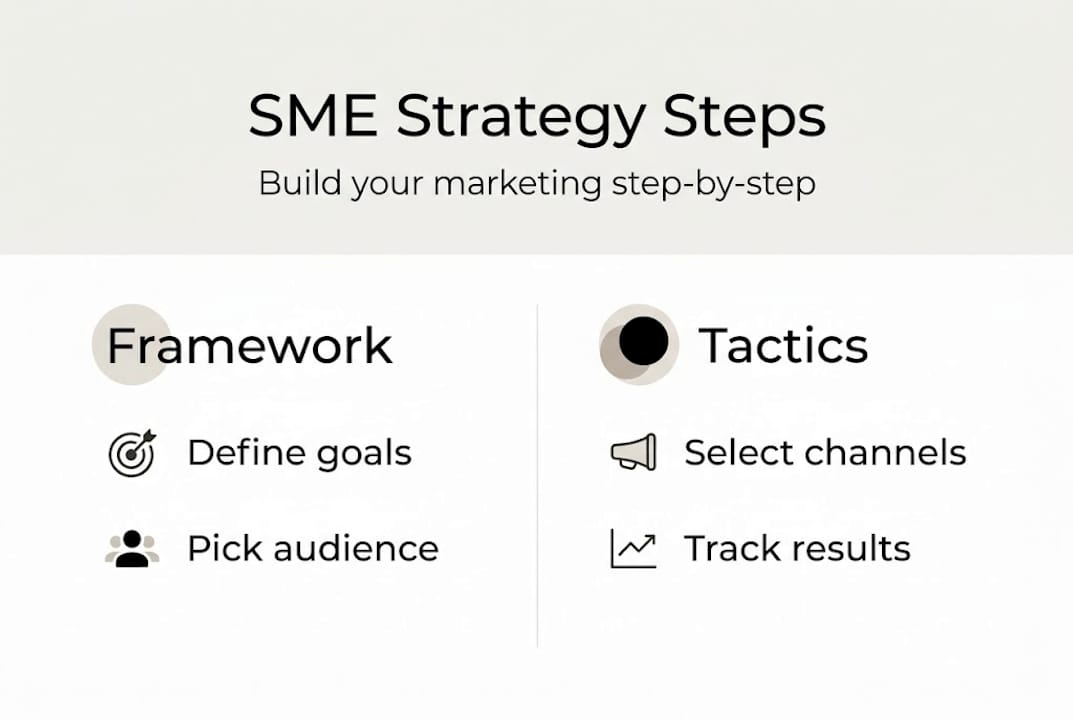
Here is the uncomfortable truth most digital marketing content will not tell you: the majority of small businesses that struggle online are not failing because they are using the wrong platform. They are failing because they have no plan at all.
Every few months, a new tactic emerges. Short-form video. AI-generated content. Threads. Influencer micro-campaigns. And every time, SME owners feel pressure to pivot. The result? Budget fragmented across half-finished experiments, no channel given enough time to compound, and no clear data to learn from.
Goal-aligned budget allocation consistently outperforms trend-chasing. The businesses we see succeed long-term are the ones that master two or three channels deeply, review performance monthly, and make incremental improvements based on real data. They are not the ones with the most creative campaigns. They are the ones with the most disciplined process.
The fundamentals, clear goals, defined audience, focused channels, and regular measurement, compound over time in a way that no single viral moment can replicate. Explore effective SME strategies that prioritise this compounding approach over short-term noise.
Building a strategy from scratch is demanding, especially when you are also running a business. The framework in this guide gives you the foundation, but execution is where most SMEs need support.
At Kickass Online, we work with a carefully selected group of small and medium-sized businesses to build digital strategies that are grounded in data and designed for sustainable growth. From website design for small businesses that converts visitors into enquiries, to SEO strategies for SMEs that build long-term visibility, every solution is tailored to your goals. If you are ready to move from guesswork to a structured approach, explore our SME digital strategies service and book a consultation today.
Setting SMART goals linked to your desired business outcomes is the essential starting point, whether that means growing leads, increasing online sales, or improving brand visibility.
SEO and email marketing typically deliver the lowest cost per acquisition for small businesses, as limited budgets benefit most from low-CAC channels before scaling into paid media.
Track KPIs like CAC, ROAS, and conversion rates for each active channel, reviewing paid channels weekly and organic channels monthly to identify what is working.
Most SMEs invest 7 to 8% of annual revenue on marketing. Forbes data suggests this typically translates to £2,000 to £10,000 per month in digital spend for established small businesses.
40% of small businesses fail to optimise their strategy because they launch tactics without aligning them to measurable goals or committing to regular performance reviews.
- Investing in UX can generate up to £100 return per £1 spent and increase conversions significantly.
- Applying user-first principles and usability heuristics quickly identifies key areas for improvement.
- Mobile optimization, fast load speeds, clear navigation, and accessibility are crucial for higher SME website conversions.
For every £1 invested in UX, businesses can see up to £100 in return, with conversion rates lifting by as much as 400% in certain sectors. That is not a figure reserved for enterprise brands with six-figure design budgets. Small and medium-sized businesses stand to gain just as much, often more, because the baseline for improvement is frequently so much higher. The good news is that most meaningful UX improvements do not require a complete redesign. They require clarity, focus, and a willingness to see your website through your customers’ eyes. This article walks you through practical, step-by-step UX design tips you can act on immediately.
Related homepage: https://nodewire.net/
| Point | Details |
|---|---|
| User-first design | Prioritising your users’ real needs drives the best results for engagement and sales. |
| Usability quick wins | Small changes guided by proven heuristics solve most major UX problems rapidly. |
| Mobile speed matters | Fast, responsive websites earn more traffic and drastically higher conversion rates. |
| Consistency & accessibility | Clear navigation, strong branding, and accessible design are essential for trust and reach. |
| Continuous improvement | Testing and regular updates keep your website performing and growing over time. |
With the impact of UX clearly established, let us start by rethinking your website from your users’ perspective. Most SME websites are built around what the business wants to say, not what the customer needs to do. That gap is where conversions are lost.
User-centred design means organising your site around real journeys, not feature lists. A visitor landing on your homepage is not browsing a brochure. They have a specific goal, a question to answer, a problem to solve. Your job is to remove every obstacle between them and that outcome. Prioritising speed and clarity delivers rapid conversion lifts, and it starts well before any visual design decision.
The most reliable way to understand what your users actually need is to ask them. Short customer interviews, even five or six conversations, surface patterns you would never spot in analytics alone. From these conversations, you can build simple user personas, fictional but evidence-based profiles of your typical customers. Interviews and personas drive actionable insights that help you prioritise which journeys to fix first and which visual clutter to remove.
Here is what user-first thinking looks like in practice:
Understanding UX and conversion rates together is essential, because every design decision either supports or undermines the path to a sale.
“Design is not just what it looks like and feels like. Design is how it works.” — Steve Jobs
Pro Tip: Ask three existing customers to describe what they were trying to do the first time they visited your website. Their answers will tell you more than any heatmap tool.
After understanding user-centred strategy, put structure in place with established usability heuristics. Heuristics are broad principles of good design, and the ten developed by Jakob Nielsen at the Nielsen Norman Group remain the gold standard for evaluating any website.
Applying usability heuristics can catch 75 to 90% of all major website usability issues, often with just three to five reviewers. You do not need a professional UX agency to run a basic heuristic check. You need a printed list of the ten principles, a few hours, and honest eyes.
Here are the ten heuristics with fast improvement tips:
For a broader look at web design approaches that complement these principles, it is worth exploring how structure and aesthetics work together. Applying these UX-driven conversion tips alongside a heuristic review gives you a structured path to measurable improvement.
A heuristic evaluation is not about finding perfection. It is about eliminating the friction that costs you customers every single day.
Robust usability alone does not guarantee a positive experience if your site is slow or awkward on mobile. This is where many SME websites quietly haemorrhage revenue without the owner ever realising it.
Over 60% of traffic is mobile today, and a site that loads in one second can bring three times more conversions than one that takes five seconds. That is not a marginal difference. That is the gap between a business that grows online and one that stagnates.
Here is what you need to do:
Pro Tip: Use your phone to navigate your own website as if you were a first-time visitor. If anything feels fiddly or slow, your customers are experiencing the same thing.
| Area | Do | Do not |
|---|---|---|
| Images | Compress and use modern formats like WebP | Upload raw photos from a camera |
| Buttons | Make tap targets at least 44px tall | Use tiny text links as primary actions |
| Layout | Use a single-column layout on mobile | Force desktop layouts onto small screens |
| Font size | Set body text to at least 16px | Use 12px text to fit more content |
| Load speed | Lazy-load images below the fold | Load all assets at once on page entry |
Building high-converting page strategies into your mobile experience from the start saves significant rework later. If you are working on specific pages, reviewing effective landing page techniques will sharpen your approach further.
Mobile and speed enhancements mean little if users cannot find what they need or doubt your reliability. Navigation is the skeleton of your website, and brand consistency is the skin. Both need to be right.

The three-click rule is a useful guideline: any piece of information on your site should be reachable within three clicks from the homepage. It is not a rigid law, but it is a practical test. If a visitor has to hunt, they will leave. Clear navigation and consistent branding are essential for scannability and trust, particularly for first-time visitors who are still deciding whether you are credible.
Here is how to tighten your navigation and branding quickly:
Branding consistency extends beyond visuals. If your homepage sounds confident and warm but your product pages read like a legal document, users notice. That inconsistency erodes trust quietly. Exploring branding in design projects can give you a clearer sense of how cohesive identity translates into user confidence.
Pro Tip: Try card sorting with five or ten customers. Give them index cards labelled with your main pages and ask them to group and name the categories themselves. Their logic will almost certainly differ from yours, and that difference is exactly what you need to fix.
Understanding the elements influencing conversions on each page will help you align navigation decisions with actual business outcomes.
Even with flawless branding, an inaccessible or static website quickly loses visitors and opportunities. Accessibility is not a technical checkbox. It is a commercial decision.
Accessible design enhances conversions and reach, and ongoing A/B testing with analytics helps sustain those improvements over time. When you make your site easier for people with disabilities to use, you almost always make it easier for everyone.
Start with these accessibility essentials:
For a practical starting point, digital accessibility services can help identify gaps you might miss in a self-audit.
Once accessibility is in order, testing becomes your engine for continuous improvement. Run A/B tests on headlines, button copy, and page layouts. Use tools like Google Analytics or Microsoft Clarity to identify where users drop off. The goal is to increase website conversions through evidence, not guesswork. Pairing this with a plan to optimise content for conversions makes each iteration more targeted. If you want a structured framework, the guide to conversion rate optimisation is a solid place to start.
Pro Tip: Set up a monthly review session where you look at your top five exit pages and ask one question: what stopped this visitor from taking the next step?
Having explored these actionable strategies, let us tackle a common misconception about what good UX actually looks like for smaller businesses. The biggest mistake we see is SME owners looking at large brand websites and trying to replicate them. That instinct is understandable but almost always counterproductive.
Big brands spend millions testing micro-interactions, animated transitions, and feature-rich interfaces. They can afford to experiment at scale. For an SME, copying those patterns without the same budget or user base usually results in a slow, confusing site that impresses no one and converts even fewer.
The SMEs with the strongest UX results we have seen are the ones who resisted the urge to add more. They stripped their sites back to the essentials, tested those essentials rigorously, and iterated quickly. Practical UX agility beats perfection every time. A clean, fast, easy-to-navigate site built around real user needs will always outperform a visually impressive one that confuses visitors.
Avoid the mistakes when designing a landing page that come from chasing trends rather than solving real user problems. Real engagement comes from simplicity, not sophistication.
With a fresh perspective on practical UX, now is the time to turn insight into higher conversions. Knowing what good UX looks like is one thing. Implementing it consistently across your website is another challenge entirely, especially when you are running a business at the same time.
At Kickass Online, we work with a deliberately small number of clients so that every website gets the focused attention it deserves. Whether you need a full professional website design built on UX best practice, or you are looking for easy website design tips to improve what you already have, we can help. Book a consultation and let us look at your site together, identify the quick wins, and build a plan that turns visitors into customers.
Run a basic heuristic evaluation using Nielsen Norman Group’s principles and fix the most obvious friction points first. Even a single afternoon of structured review can surface issues that have been costing you conversions for months.
Over 60% of visits come from mobile devices, and sites loading in one second convert up to three times better than those taking five seconds. Ignoring mobile performance is one of the most expensive mistakes an SME can make.
Use free tools like the WebAIM Contrast Checker and WAVE to audit colour contrast and screen reader compatibility, then try navigating your site using only a keyboard. Accessible design consistently improves reach and conversions for businesses of all sizes.
Every £1 spent on UX can return up to £100, with conversion lifts of up to 400% reported in some sectors. For SMEs, that return is often achieved through relatively modest, targeted improvements rather than large-scale redesigns.