
Most small business owners believe search engine optimisation is a luxury reserved for corporations with deep pockets and dedicated marketing teams. The reality flips this assumption entirely. Search engine visibility drives 53% of all website traffic for small and medium-sized businesses, converting leads at rates that dwarf traditional outbound marketing. This article reveals why search visibility is your competitive advantage, how to implement core SEO disciplines without overwhelming your resources, and practical steps to measure results that directly impact your bottom line.
Table of Contents
- Key takeaways
- Understanding the importance of search engine visibility for SMBs
- Core SEO disciplines to improve search visibility effectively
- Navigating the evolving SEO landscape: traditional methods and AI integration
- Measuring success and applying SEO for lasting business growth
- Get professional website optimisation to improve your search visibility
- Frequently asked questions
Key Takeaways
| Point | Details |
|---|---|
| SMB traffic share | Search engine optimisation drives 53% of SMB website traffic and offers cost effective, long term growth. |
| Lead conversion advantage | SEO generated leads convert at 14.6% compared with 1.7% for traditional outbound marketing. |
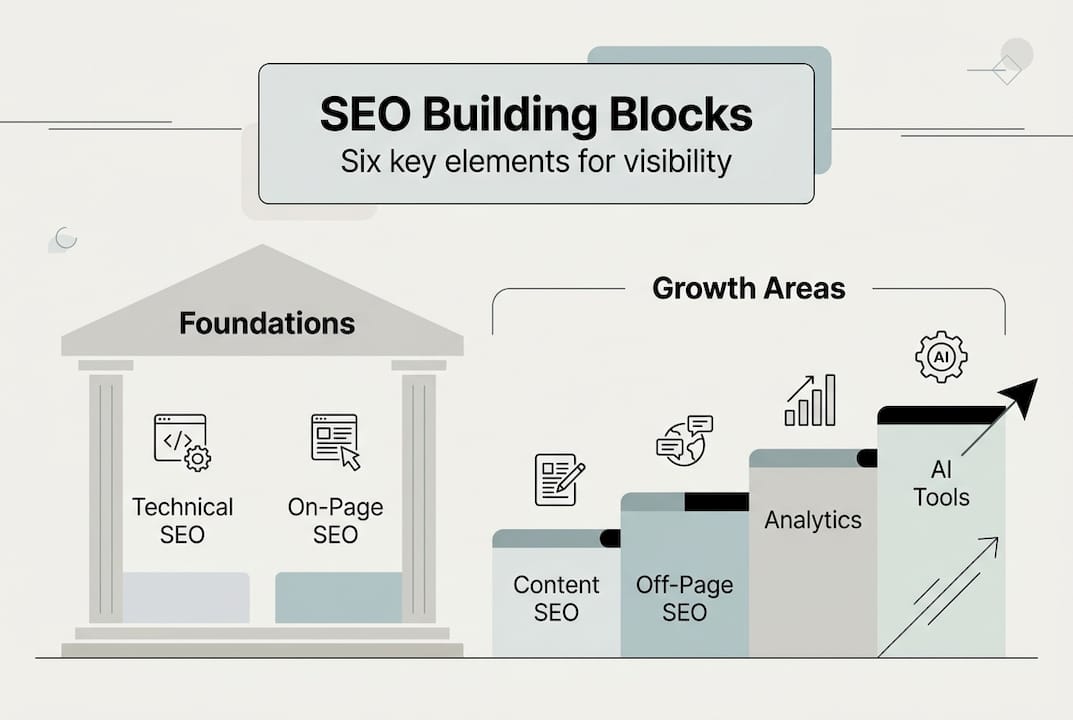
| Core SEO disciplines | Effective optimisation relies on six interconnected disciplines including technical SEO, on page optimisation, local SEO, content and off page SEO. |
| Measurement and ROI | Focus on measuring leads and revenue rather than rankings alone to assess true impact on the bottom line. |
Understanding the importance of search engine visibility for SMBs
Your potential customers are searching for solutions right now. When your business appears prominently in search results, you intercept buyers at the exact moment they need what you offer. This visibility advantage transforms how small businesses compete.
Organic search delivers the majority of qualified traffic to small business websites. Unlike paid advertising that stops the moment you pause spending, search engine visibility provides cost-effective, long-term growth that compounds over time. You build an asset rather than rent attention.
The conversion advantage is substantial. SEO-generated leads close at 14.6% compared to just 1.7% for traditional outbound methods. Why? Because these prospects actively sought information about their problem. They’re further along the buying journey and more receptive to solutions.
Search visibility levels the competitive playing field in ways traditional marketing never could:
- Local businesses can outrank national chains for location-specific searches
- Niche specialists can capture highly targeted audiences large generalists miss
- Smaller budgets compete effectively when strategy replaces spending power
- Authority builds through helpful content rather than advertising volume
Beyond direct conversions, strong search presence builds brand credibility. Appearing on page one signals legitimacy and expertise to potential customers. They assume businesses ranking prominently must be established and trustworthy. This perception advantage is particularly valuable for newer companies building market recognition.
“SMBs that invest in expert SEO strategies consistently report visibility as their primary driver of sustainable growth, outperforming paid channels in both cost efficiency and lead quality over 12-month periods.”
The cumulative effect creates momentum. Each piece of optimised content, each earned backlink, each positive review strengthens your overall domain authority. This compounds your visibility across all search terms related to your business, creating a virtuous cycle of discovery and engagement.
Core SEO disciplines to improve search visibility effectively
Effective SEO isn’t a single tactic but a coordinated system of six interconnected disciplines. Understanding each component helps you prioritise efforts and build visibility systematically.
Technical SEO forms your foundation. Search engines must crawl and index your pages before they can rank them. This discipline ensures your site architecture supports discovery. Core Web Vitals and site speed under 2.5 seconds directly impact rankings. Mobile responsiveness, secure HTTPS connections, and clean URL structures all contribute to technical health.

On-page SEO optimises individual pages for target search terms. Title tags, header hierarchy, meta descriptions, and schema markup tell search engines what each page offers. Strategic keyword placement in content, image alt text, and internal linking creates relevance signals. Each element works together to establish topical authority.
Local SEO connects you with nearby customers searching for services in your area. Optimising your Google Business Profile is essential. Consistent name, address, and phone number across directories, location-specific content, and customer reviews all boost local visibility. For businesses serving specific geographic areas, local optimisation often delivers the highest ROI.
Implementing these disciplines follows a logical sequence:
- Audit technical foundations using free tools like Google Search Console
- Optimise existing pages with proper on-page elements and schema markup
- Claim and complete your Google Business Profile with accurate information
- Create 5-10 high-intent service pages targeting specific customer needs
- Develop content clusters around core topics relevant to your audience
- Build quality backlinks through partnerships, guest content, and digital PR
- Monitor performance metrics and refine based on actual results
Content SEO matches your pages to user search intent. Creating pillar content around core topics, supported by related cluster pages, establishes comprehensive coverage. Quality matters more than quantity. One thoroughly researched guide answering all aspects of a customer question outperforms ten superficial posts.
Off-page SEO builds your site’s authority through external signals. Quality backlinks from reputable sites in your industry act as votes of confidence. Guest contributions, partnerships, and earned media coverage all contribute. Focus on relevance over volume. Ten links from industry-specific sources outweigh one hundred from unrelated directories.
Pro Tip: Start with technical and on-page optimisation before investing heavily in content creation or link building. A technically sound, well-optimised site amplifies the impact of every subsequent SEO effort.
Analytics close the loop by measuring what works. Track organic traffic, conversion rates, and revenue generated from search. These insights guide resource allocation and strategy refinement. The comparison below shows how different SEO disciplines contribute to overall visibility:
| Discipline | Primary Impact | Time to Results | Difficulty Level |
|---|---|---|---|
| Technical SEO | Crawlability and indexing | 2-4 weeks | Medium |
| On-page SEO | Relevance signals | 4-8 weeks | Low |
| Local SEO | Geographic visibility | 6-12 weeks | Low |
| Content SEO | Topical authority | 3-6 months | Medium |
| Off-page SEO | Domain authority | 6-12 months | High |
| Analytics | Performance insight | Ongoing | Medium |
These disciplines work synergistically. Effective SEO strategies for SMEs integrate all six areas rather than focusing narrowly on one or two. Your technical foundation supports on-page optimisation, which makes content more discoverable, which attracts backlinks, which boosts authority across all pages.
Navigating the evolving SEO landscape: traditional methods and AI integration
The SEO landscape is shifting as artificial intelligence reshapes how people search and how search engines deliver results. Small businesses must adapt without abandoning proven fundamentals.
Traditional SEO methods build credibility and rankings through sustained effort. Creating helpful content, earning quality backlinks, and optimising technical elements compound over time. Results arrive slowly but prove durable. This approach aligns with how search engines fundamentally evaluate and rank content.
AI-powered SEO tools promise acceleration. They generate content outlines, suggest optimisations, and identify opportunities faster than manual analysis. These capabilities help resource-constrained small businesses compete more efficiently. However, purely AI-generated content often lacks the depth, nuance, and experience signals that build trust.
The search landscape itself remains dominated by traditional engines. Google commands 91% market share, making SEO fundamentals as relevant as ever. While AI overviews and generative engine optimisation emerge, they supplement rather than replace traditional search results.
A hybrid approach delivers optimal results for small businesses:
- Use AI tools for research, competitor analysis, and content ideation
- Apply human expertise to create depth, add experience, and build authority
- Leverage AI for technical audits and opportunity identification
- Rely on human judgement for strategy, messaging, and relationship building
- Combine AI speed with traditional quality for sustainable visibility
The risk of over-relying on either extreme is real. Pure traditional methods miss efficiency gains and competitive speed advantages. Pure AI approaches sacrifice the expertise, authoritativeness, and trustworthiness signals that Google explicitly prioritises in its quality guidelines.
“The most successful SMB SEO strategies in 2026 blend AI acceleration with human insight. Tools handle repetitive analysis and optimisation tasks, freeing experts to focus on strategy, relationship building, and creating genuinely helpful content that AI cannot replicate.”
Emerging search behaviours require attention. Voice search, visual search, and conversational AI queries are growing. Optimising for these formats means focusing on natural language, question-based content, and comprehensive answers. Your SEO strategy guide should account for multiple search modalities.
The fundamental principle remains unchanged. Search engines reward content that genuinely helps people solve problems. Whether you create that content with AI assistance or traditional methods matters less than whether it delivers substantive value. Focus on user intent, comprehensive coverage, and practical utility.
Adaptation beats resistance. Small businesses that experiment with AI tools while maintaining quality standards will outpace competitors stuck in purely traditional approaches. Simultaneously, those who chase every AI trend without grounding in SEO fundamentals will waste resources on tactics that don’t drive business results.
Measuring success and applying SEO for lasting business growth
Measuring SEO success requires focusing on metrics that directly impact your business rather than vanity numbers that look impressive but don’t drive revenue.
Begin with a technical foundation audit. Free tools like Google Search Console reveal crawl errors, indexing issues, and mobile usability problems. Address these barriers before investing in content or backlinks. A technically sound site amplifies every subsequent optimisation effort.
Your Google Business Profile deserves immediate attention. Complete every section, add high-quality photos, and actively collect customer reviews. For local businesses, this single asset often generates more qualified leads than any other SEO element. Update it regularly with posts, offers, and current information.
Create 5-10 high-intent service pages targeting specific customer needs. These pages should address the exact problems your ideal clients search to solve. Include clear descriptions, benefits, process explanations, and conversion paths. Quality beats quantity at this stage.
Scale content creation and backlink acquisition gradually:
- Publish one comprehensive guide monthly rather than multiple thin posts weekly
- Prioritise topics where you have genuine expertise and can add unique insights
- Build relationships with complementary businesses for natural link opportunities
- Focus backlink efforts on industry-relevant, authoritative sources
- Document your process and results to refine your approach continuously
Revenue and lead generation matter more than keyword rankings. Track how many enquiries, consultations, or sales originate from organic search. Calculate customer acquisition cost from SEO compared to other channels. Measuring SEO ROI through business outcomes keeps efforts aligned with growth objectives.
Pro Tip: Set up conversion tracking in Google Analytics to attribute revenue to specific organic landing pages. This reveals which content types and topics drive actual business results versus just traffic.
The hybrid AI-traditional approach accelerates results without sacrificing quality. Use AI tools to identify content gaps, analyse competitor strategies, and generate initial outlines. Apply human expertise to add depth, incorporate experience, and ensure accuracy. This combination delivers speed and substance.
Key performance indicators for SMB SEO success:
| Metric | Target Range | Measurement Frequency | Primary Value |
|---|---|---|---|
| Organic traffic growth | 10-20% quarterly | Monthly | Visibility trend |
| Conversion rate | 2-5% for SMBs | Weekly | Lead quality |
| Revenue from organic | 30-50% of total | Monthly | Business impact |
| Average order value | Industry dependent | Monthly | Customer quality |
| Customer acquisition cost | Below lifetime value | Quarterly | Efficiency |
| Pages indexed | 90%+ of published | Monthly | Technical health |
Avoid common measurement pitfalls. Ranking for your brand name doesn’t indicate SEO success. High traffic to blog posts that never convert wastes resources. Backlinks from irrelevant sites provide minimal value. Focus measurement on metrics that correlate with business growth.
Understanding SEO ROI metrics helps justify continued investment and refine strategy. Calculate the customer lifetime value of SEO-generated clients. Compare this to your total SEO investment over the same period. This ratio reveals true return and guides budget allocation.
Sustainable growth comes from consistent effort rather than sporadic campaigns. Allocate regular time for content creation, technical maintenance, and relationship building. Small weekly investments compound more effectively than irregular bursts of activity followed by neglect.
Get professional website optimisation to improve your search visibility
Implementing comprehensive SEO whilst running your business stretches already limited time and resources. Professional support accelerates results and avoids costly mistakes that waste months of effort.
Our SEO audit services identify exactly what’s holding back your visibility. We analyse technical foundations, on-page optimisation, content gaps, and competitive positioning. You receive a prioritised action plan focused on changes that drive measurable business results.
Bespoke website design and development builds visibility into your site from the ground up. We create technically sound, conversion-optimised websites that rank well and turn visitors into customers. Every element serves both search engines and human users.
Our SEO strategies guide approach combines proven fundamentals with emerging opportunities. We handle the complexity whilst you focus on serving customers. Limited client intake ensures you receive dedicated attention and customised solutions that fit your specific business model and goals.
Frequently asked questions
Why is search engine visibility important for small businesses?
Search visibility connects you with customers actively seeking your solutions, generating higher-quality leads than interruptive advertising. It provides cost-effective, sustainable growth that compounds over time whilst building brand credibility and competitive advantage against larger firms.
How does SEO differ from paid advertising?
SEO builds a lasting asset that generates traffic without ongoing spend, whilst paid ads stop delivering the moment you pause campaigns. SEO leads convert at 14.6% versus 1.7% for outbound methods because prospects are actively searching rather than being interrupted.
What quick wins can small businesses achieve with SEO?
Claim and optimise your Google Business Profile, fix critical technical errors in Search Console, and create 5-10 service pages targeting high-intent local searches. These foundational steps often generate measurable results within 6-12 weeks.
How important is local SEO for small businesses?
Local SEO is often the highest ROI channel for small businesses serving specific geographic areas. Optimising for local search captures customers in your service area exactly when they need what you offer, with strong purchase intent.
What common SEO misconceptions should small businesses avoid?
Avoid believing SEO is only for large companies, that results happen overnight, or that rankings alone indicate success. Also avoid thinking you must rank first for every keyword or that more content always beats better content. Focus on business outcomes, not vanity metrics.