
Many business owners in Milton Keynes believe an SEO audit is a single technical check, but this is a major misconception. Effective SEO audits are actually ongoing strategic assessments that keep up with evolving search algorithms and competitor moves. If you want to strengthen your online presence and outpace local rivals, understanding what a real SEO audit covers and the myths to avoid could mean the difference between climbing search rankings or missing out on valuable customers.
Table of Contents
- Defining Seo Audits And Common Misconceptions
- Types Of Seo Audits For Business Websites
- Key Elements Assessed During An Seo Audit
- Risks And Missed Opportunities Without Audits
- How Seo Audits Drive Business Growth
Key Takeaways
| Point | Details |
|---|---|
| SEO Audits are Ongoing | Treat SEO audits as continuous assessments rather than one-time tasks to adapt to algorithm changes and competition. |
| Focus on Quality Content | Prioritise high-quality, relevant content to enhance user satisfaction and improve rankings. |
| Multiple Audit Types Exist | Different types of audits target specific aspects; start with technical and content audits before branching out. |
| Neglecting Audits Has Costs | Regular audits prevent cumulative SEO issues that can severely impact traffic and revenue over time. |
Defining SEO Audits and Common Misconceptions
An SEO audit is far more than a technical health check. It’s a comprehensive evaluation of your website’s search engine optimisation performance, examining all factors that influence visibility and ranking in search results.
Many business owners treat SEO audits as a one-time box-ticking exercise. That’s the first misconception you need to forget. Effective SEO audits are ongoing strategic assessments that evolve alongside search algorithms and your competitors’ strategies.
What a Real SEO Audit Actually Covers
When you conduct an audit, you’re examining multiple layers of your website:
- Technical foundation: Website structure, speed, mobile responsiveness, and page loading times
- Content quality: Relevance, depth, and whether content actually addresses user intent
- Keyword strategy: Not just density, but whether your keywords match what people are actually searching for
- Backlink profile: Quality and relevance of sites linking to you
- User experience: How visitors interact with your site and whether they stay or bounce
This isn’t a task you delegate and forget. Rather, ongoing website audits reveal gaps that require continuous attention and refinement.
Five Common SEO Misconceptions Killing Your Rankings
Here’s what most Milton Keynes business owners believe, and why they’re wrong.
Misconception 1: SEO is purely technical. You can have perfect site speed and flawless code, but without high-quality, relevant content that solves real problems, you won’t rank. Google cares about user satisfaction first.
Misconception 2: Build backlinks and you’re done. Effective SEO involves continuous updates to website speed, content, and user experience as algorithms evolve. Links matter, but they’re one piece of a larger puzzle.
Misconception 3: Stuff keywords everywhere. Keyword stuffing damages your credibility and frustrates readers. Search engines punish this outdated tactic immediately.
Misconception 4: Google is all that matters. Local search visibility, voice search optimisation, and social signals all influence your online presence. Ignoring these channels means missing potential customers.
Misconception 5: SEO is a set-it-and-forget-it investment. Your competitors are moving. Algorithms change. User behaviour shifts. Without ongoing audits and adjustments, your rankings will decline.
A genuine SEO audit isn’t a report to file away, it’s a blueprint for continuous improvement that directly impacts your bottom line.
Pro tip: Schedule quarterly SEO audits rather than annual ones to catch algorithm shifts and competitive movements before they impact your rankings.
Types of SEO Audits for Business Websites
SEO audits are not one-size-fits-all. Different business challenges require different audit types, each targeting specific areas of your website’s performance and search visibility.
Think of audits like a health check-up. A doctor doesn’t just measure your blood pressure; they examine different systems to find what needs attention. SEO works the same way.
The Main Audit Types You’ll Encounter
Different SEO audit types address specific optimisation areas, from site structure to backlinks and user experience. Here’s which ones matter most for your business:
Technical SEO Audit
This examines your website’s foundation. Site crawlability, indexation, XML sitemaps, robots.txt, page speed, and mobile responsiveness all fall here. If search engines can’t access or crawl your site properly, nothing else matters.

Content Audit
Your content is doing heavy lifting. This audit evaluates whether your pages answer what people actually search for. It identifies thin, outdated, or duplicate content that weakens your rankings.
On-Page SEO Audit
Title tags, meta descriptions, heading structure, keyword placement, and internal linking all get reviewed. These elements signal relevance to search engines and influence click-through rates from results pages.
Off-Page SEO Audit
Your backlink profile gets scrutinised here. Quality matters far more than quantity. A few links from authoritative, relevant sites beat hundreds of spammy ones.
Competitive Audit
What are your competitors doing? Which keywords rank them? What’s their content strategy? Understanding this landscape helps you identify gaps and opportunities your rivals are missing.
Local SEO Audit
If you serve customers in Milton Keynes and surrounding areas, this audit is critical. Google Business Profile optimisation, local citations, reviews, and location-specific content all factor in.
Here’s a summary of key SEO audit types and the main business outcomes they drive:
| Audit Type | Focus Area | Main Outcome for Business |
|---|---|---|
| Technical Audit | Site infrastructure | Improved indexation, fewer errors |
| Content Audit | Page value and relevance | More relevant site traffic |
| On-Page Audit | Metadata and structure | Higher click-through rates |
| Off-Page Audit | Backlink quality | Increased site authority |
| Competitive Audit | Rival performance | Better informed strategy |
| Local SEO Audit | Local presence | Enhanced local visibility |
Most SMEs benefit most from starting with technical and content audits, then expanding into competitive analysis once foundations are solid.
Which Audit Type Should You Choose?
Don’t attempt everything at once. Start with what’s hurting most:
- Traffic dropped recently? Technical audit first.
- Rankings stagnating despite traffic? Content audit.
- Barely appearing in local search? Local SEO audit.
- Don’t know how you compare? Competitive audit.
Pro tip: Begin with a technical audit, it identifies must-fix issues before investing time and resources into content creation or link building strategies.
Key Elements Assessed During an SEO Audit
An effective SEO audit examines multiple layers of your website. Without understanding what auditors actually look for, you won’t know whether you’re making real progress or just ticking boxes.
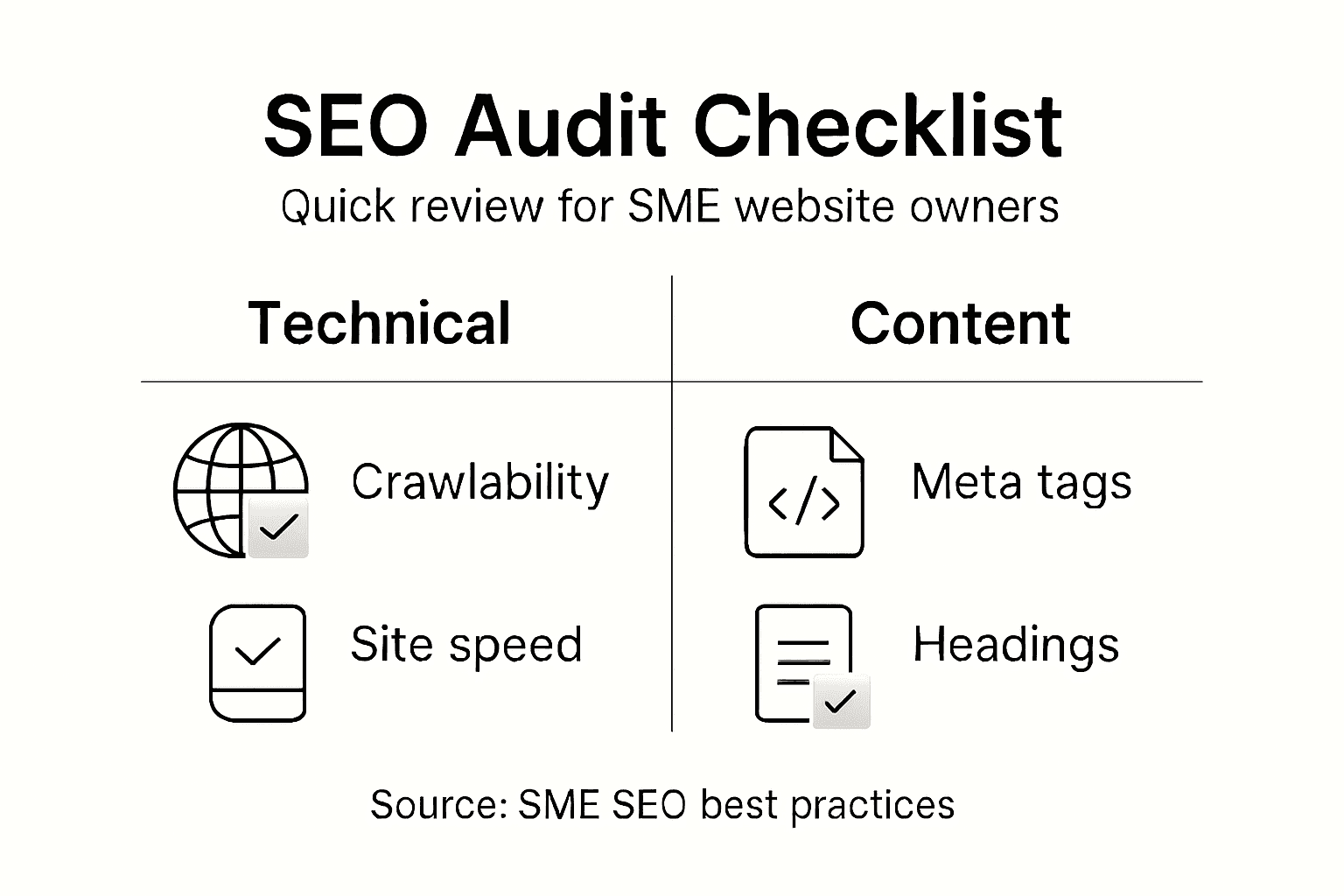
Think of it this way: a mechanic inspects your car’s engine, brakes, suspension, and electrics. Each system matters. Miss one, and the whole vehicle suffers. Your website operates the same way.
Technical Foundation
Search engines need to access and understand your site. Crawlability ensures Google’s bots can navigate every page without hitting dead ends.
Site speed directly affects rankings. Pages taking five seconds to load lose visitors and ranking positions to faster competitors. Mobile responsiveness matters equally, most searchers use phones, and Google ranks mobile versions first.
Other technical checks include:
- XML sitemaps and robots.txt configuration
- Structured data markup for rich snippets
- HTTPS security and SSL certificates
- Broken internal links and redirect chains
- Duplicate content issues across pages
On-Page Content Elements
Meta tags tell searchers what your page offers. Title tags and meta descriptions influence click-through rates from search results. Content optimisation tips include ensuring headings use proper hierarchy and keyword placement feels natural, not forced.
Headings structure your content logically. H1 tags should match page intent. H2s and H3s organise supporting information. This structure helps both readers and search engines understand what matters most.
Internal linking connects related pages, distributing authority and keeping visitors engaged longer. This signals page relationships to Google.
Backlink Profile and Authority
Quality backlinks act as votes of confidence. Thorough backlink assessment identifies whether your links come from authoritative, relevant sources or spammy domains that damage credibility.
Auditors check for toxic links pointing to your site. High-quality sites link naturally. Suspicious patterns, sudden link spikes or links from unrelated industries, raise red flags.
Content Quality and Freshness
Older content ranks well if it remains relevant. Outdated information, thin articles lacking depth, and duplicate content across pages all weaken rankings. Auditors identify which pages need updates or consolidation.
An SEO audit isn’t about perfection, it’s about finding fixable gaps between your current state and what search engines reward.
Pro tip: Focus first on fixing technical issues and duplicate content, then move to on-page improvements, these foundational changes often produce faster ranking gains than backlink building alone.
Risks and Missed Opportunities Without Audits
Skipping SEO audits doesn’t mean your website is fine, it means you’re flying blind. Competitors are auditing, optimising, and capturing market share while you remain invisible in search results.
Without regular audits, problems compound silently. By the time you notice ranking drops, you’ve already lost months of potential traffic and revenue.
The Hidden Costs of Inaction
Ignoring SEO audits creates cascading problems. A slow website loses visitors before they even read your content. Broken links frustrate users and confuse search engines about which pages matter most.
Duplicate content dilutes your authority across multiple pages. Unoptimised meta tags mean fewer clicks from search results, even when you rank. Technical issues prevent Google from indexing your newest pages entirely.
Each problem individually costs you visibility. Together, they destroy your online presence.
To demonstrate the hidden financial risks of neglecting SEO audits, consider these potential losses:
| Missed Audit Area | Typical Business Impact | Long-Term Cost Potential |
|---|---|---|
| Slow site speed | Visitors leave before engaging | Lost sales opportunities |
| Broken internal links | Search engines get confused | Declining search rankings |
| Duplicate content | Diluted ranking power | Wasted content investment |
| Unoptimised metadata | Fewer clicks from search results | Reduced inbound enquiries |
| Neglected backlinks | Lower domain trust | Harder to recover credibility |
Missing Competitive Advantages
Your competitors likely understand what they’re doing right. Without audits, you never learn what they’re doing differently.
They might rank for keywords you’ve never considered. Their content might answer questions your pages ignore. Their site speed might be three times faster than yours. You’ll never know unless you audit.
This knowledge gap widens monthly. As they optimise based on audit insights, they pull further ahead.
Specific Risks SMEs Face
Small businesses operate on tight margins. Wasted marketing spend on ineffective SEO hurts more than it hurts larger companies with bigger budgets.
- Traffic plateau: Rankings stagnate whilst competitors climb
- Lead quality decline: Potential customers visit competitors instead
- Algorithm vulnerability: Algorithm updates hit unprepared sites hardest
- Credibility loss: Slow, broken sites damage brand perception
- Resource wastage: Money spent on content creation without audit-driven strategy
The Opportunity Cost
Every month without an audit is a month your competitors gain ground. A business in Milton Keynes ignoring SEO whilst their local rival audits and optimises will lose local search visibility steadily.
The cost isn’t just lost traffic. It’s lost customers, lost revenue, and damaged market position that becomes harder to recover as time passes.
Without audits, you’re investing in SEO blind. You might be spending money effectively, or you might be throwing it away. You simply won’t know until it’s too late.
Pro tip: Schedule your first audit now rather than waiting for rankings to drop, preventing problems costs far less than recovering from them once they’ve damaged your search visibility.
How SEO Audits Drive Business Growth
SEO audits aren’t just about fixing technical problems. They’re strategic investments that directly translate into increased traffic, leads, and revenue for your business.
When you understand what’s blocking your rankings, you can remove those barriers systematically. The result? Measurable business growth tied directly to improved search visibility.
From Visibility to Revenue
SEO audits identify technical barriers and content gaps that prevent your website from ranking higher and attracting organic traffic. Fix these issues, and your visibility improves almost immediately.
Better visibility means more clicks. More clicks mean more qualified visitors. These visitors are actively searching for what you offer, they’re already interested. Converting them to customers becomes far easier than cold outreach.
The Growth Roadmap Audits Create
Without an audit, you’re guessing at what matters. You might spend months optimising the wrong pages or chasing keywords your audience doesn’t search for.
Audits reveal your actual priorities. They show you:
- Quick wins: Easy fixes producing immediate ranking improvements
- High-impact opportunities: Pages with ranking potential you’re currently missing
- Content gaps: Search terms your competitors rank for but you don’t address
- Technical blockers: Issues preventing Google from indexing or ranking your site
- Authority opportunities: Backlink sources and internal linking strategies
This roadmap aligns every effort with business outcomes. You’re not just improving SEO, you’re driving leads and sales.
Sustainable Growth Through Continuous Audits
One audit helps. Continuous audits create lasting competitive advantage. Search algorithms evolve. Competitors adjust strategies. User behaviour shifts. Your optimisation approach must adapt accordingly.
Companies conducting quarterly audits stay ahead of algorithm changes. They spot ranking losses before they become severe. They identify new opportunities competitors miss. This consistency compounds over time, creating wider gaps in search visibility.
Real Business Outcomes
The connection between audits and growth is measurable. Businesses that audit and optimise see:
- Higher click-through rates from search results
- More qualified organic traffic
- Improved conversion rates from visitors to leads
- Reduced customer acquisition costs
- Stronger competitive positioning in local searches
For a Milton Keynes business, this means capturing local search traffic your competitors currently own. It means being the obvious choice when potential customers search for your services.
SEO audits convert hidden ranking potential into actual business results by removing obstacles and highlighting high-impact opportunities worth pursuing first.
Pro tip: Link your audit findings directly to business metrics, track not just ranking improvements but actual leads and revenue generated from organic traffic to prove ROI to stakeholders.
Unlock Your Business Potential with Expert SEO Audits and Tailored Solutions
If you recognise the challenges of stagnant rankings, technical glitches, or missed local opportunities highlighted in the article SEO Audits: Enhancing Search Rankings for SMEs, it is time to take decisive action. At Kickass Online, we specialise in providing personalised, ongoing SEO audits that go beyond ticking boxes. Our focus is on uncovering critical technical issues, optimising content relevance, and enhancing backlink authority to drive meaningful growth for your business.

Discover how our team transforms audit insights into a powerful growth roadmap tailored for your SME. Don’t let competitors outpace you while you remain in the dark about your website’s hidden risks and opportunities. Visit Kickass Online to explore our comprehensive web development and search engine optimisation services. Take the first step now and book a consultation to secure your place among the businesses benefiting from expert technical and content audits today.
Learn more about the value of ongoing website audits and why every Milton Keynes business should prioritise continuous SEO improvements with Kickass Online.
Frequently Asked Questions
What is an SEO audit?
An SEO audit is a comprehensive evaluation of a website’s search engine optimisation performance, examining factors that influence visibility and ranking in search results, including technical aspects, content quality, backlink profiles, and user experience.
Why are ongoing SEO audits important for SMEs?
Ongoing SEO audits are crucial because search algorithms and competitor strategies evolve constantly. Regular audits help identify gaps and areas for improvement, ensuring that a website remains competitive in search rankings.
What common misconceptions about SEO audits should I avoid?
Common misconceptions include treating SEO as purely technical, believing that building backlinks is sufficient, and assuming that keyword stuffing helps. SEO requires a balanced approach that includes quality content, user experience, and adapting to algorithm changes.
How do SEO audits help improve website visibility?
SEO audits identify technical barriers and content gaps that hinder a website from ranking higher. Addressing these issues can lead to increased organic traffic, better click-through rates, and ultimately, improved business performance.
Recommended
- Boost Your SME’s Visibility with Expert SEO Strategies | Kickass Online
- Maximising Your SME’s Online Visibility with Local SEO: How to Improve Rankings and Drive Targeted Traffic | Kickass Online
- Effective Local SEO Strategies for SMEs: Boost Visibility and Dominate Your Market | Kickass Online
- Local SEO for SMEs: Guide to Boost Search Visibility and Drive Local Traffic | Kickass Online
- Miks valida SEO – Kuidas kasvatada ettevõtte müüki