
More than 80 percent of consumers say a brand’s online presence shapes their trust and buying decisions. Digital branding now sits at the core of business success, building more than just logos or websites. It creates authentic, memorable connections that set brands apart in a crowded digital world. This guide unpacks the fundamentals of digital branding and reveals how strong online strategies drive recognition, customer loyalty, and measurable business growth.
| Point | Details |
|---|---|
| Digital Branding Overview | Digital branding strategically builds and manages a company’s online identity through consistent messaging and visual identity across various digital platforms. |
| Core Elements | Essential components like visual identity, brand voice, content strategy, and digital touchpoints form the foundation of a strong digital brand presence. |
| Strategic Approaches | Successful brands focus on creating audience-centric content, leveraging multi-channel engagement, and using data-driven personalisation to strengthen connections. |
| Common Challenges | Businesses must avoid inconsistencies in messaging and neglecting audience research to maintain an authentic and effective digital brand identity. |
Digital branding represents a strategic approach to building and managing a company’s online identity and reputation. According to en.wikipedia.org, it is a brand management technique that leverages internet branding and digital marketing to develop brand recognition across multiple digital platforms.
Digital branding goes beyond traditional marketing by creating meaningful connections between consumers and products through diverse digital channels. This approach encompasses several key strategies:
The core objective of digital branding is transforming passive digital interactions into compelling brand experiences. arxiv.org introduces the concept of E-Semiotics, which provides a framework for designing and managing digital information products by focusing on structural, contextual, and narrative organisation of online brand communication.
Successful digital branding requires businesses to understand their unique value proposition and communicate it effectively across digital platforms. This means crafting a cohesive narrative that connects with audiences emotionally while delivering clear, authentic messaging that differentiates the brand from competitors. By integrating strategic visual design, consistent messaging, and targeted digital engagement, companies can build strong, recognisable digital brand identities that drive customer loyalty and business growth.
Digital brand identity is a comprehensive framework that goes beyond visual aesthetics, encompassing multiple strategic components that define how a business communicates and connects with its audience online. Understanding these essential elements is crucial for creating a memorable and impactful digital presence.
Key components of a robust digital brand include:
Here’s a summary of the essential elements of a digital brand:
| Element | Description | Key Considerations |
|---|---|---|
| Visual Identity | Consistent logo, colours, and design language | Professional design Brand recall |
| Brand Voice | Unique tone and communication style | Authenticity Clarity |
| Content Strategy | Targeted, aligned messaging across platforms | Audience relevance Consistency |
| Digital Touchpoints | Cohesive experiences on all digital platforms | User experience Accessibility |
The most successful digital brands focus on developing a strategic narrative that differentiates them from competitors.
 This involves creating compelling storytelling that connects emotionally with consumers while maintaining authenticity and clarity. Check out our comprehensive guide on digital branding strategies to explore how businesses can craft a distinctive digital identity that drives engagement and loyalty.
Building a strong digital brand requires continuous adaptation and monitoring. This means regularly assessing digital performance, gathering audience feedback, and evolving brand elements to stay relevant. Businesses must invest in understanding their target audience’s preferences, technological trends, and changing digital consumption habits to maintain a dynamic and responsive digital brand that speaks directly to their customers’ needs and aspirations.
Digital brand building is a strategic process that requires a comprehensive and intentional approach to creating a compelling online presence. Successful businesses understand that digital branding goes far beyond simple marketing tactics, demanding a holistic strategy that connects authentically with target audiences.
Key strategies for effective digital brand development include:
Learn how to plan a comprehensive digital strategy for business success that transforms your digital brand from generic to extraordinary. Effective digital brand strategies require businesses to think beyond traditional marketing approaches, focusing instead on creating meaningful connections that resonate with modern consumers.
Building a robust digital brand is an ongoing process of adaptation and refinement. Businesses must remain agile, continuously monitoring digital performance, gathering audience feedback, and evolving their strategies to stay relevant in a rapidly changing digital landscape. This means investing in understanding emerging technologies, shifting consumer behaviours, and innovative ways to communicate your brand’s unique value proposition across digital touchpoints.
Digital branding has transformed how businesses connect with their audiences, offering substantial strategic advantages in an increasingly competitive marketplace. According to 202digitalrep.com, digital branding delivers multiple critical benefits including increased brand visibility, enhanced customer engagement, and improved brand loyalty.
The tangible benefits of a robust digital branding strategy include:
Tapflare.com highlights that user experience (UX) is now an integral element of brand design, emphasising that well-designed digital interactions reinforce brand credibility and encourage deeper customer engagement. Successful businesses are increasingly recognising that digital branding is not just about visibility, but about creating meaningful, personalised experiences that resonate with their target audience.
Real-world applications demonstrate digital branding’s transformative potential across industries. Small businesses can now compete with larger competitors by crafting compelling digital narratives, startups can rapidly build global recognition, and established companies can reinvent their brand image through strategic digital positioning. The key is understanding that digital branding is an ongoing conversation – a dynamic process of listening, adapting, and continuously evolving to meet changing customer expectations and technological landscapes.
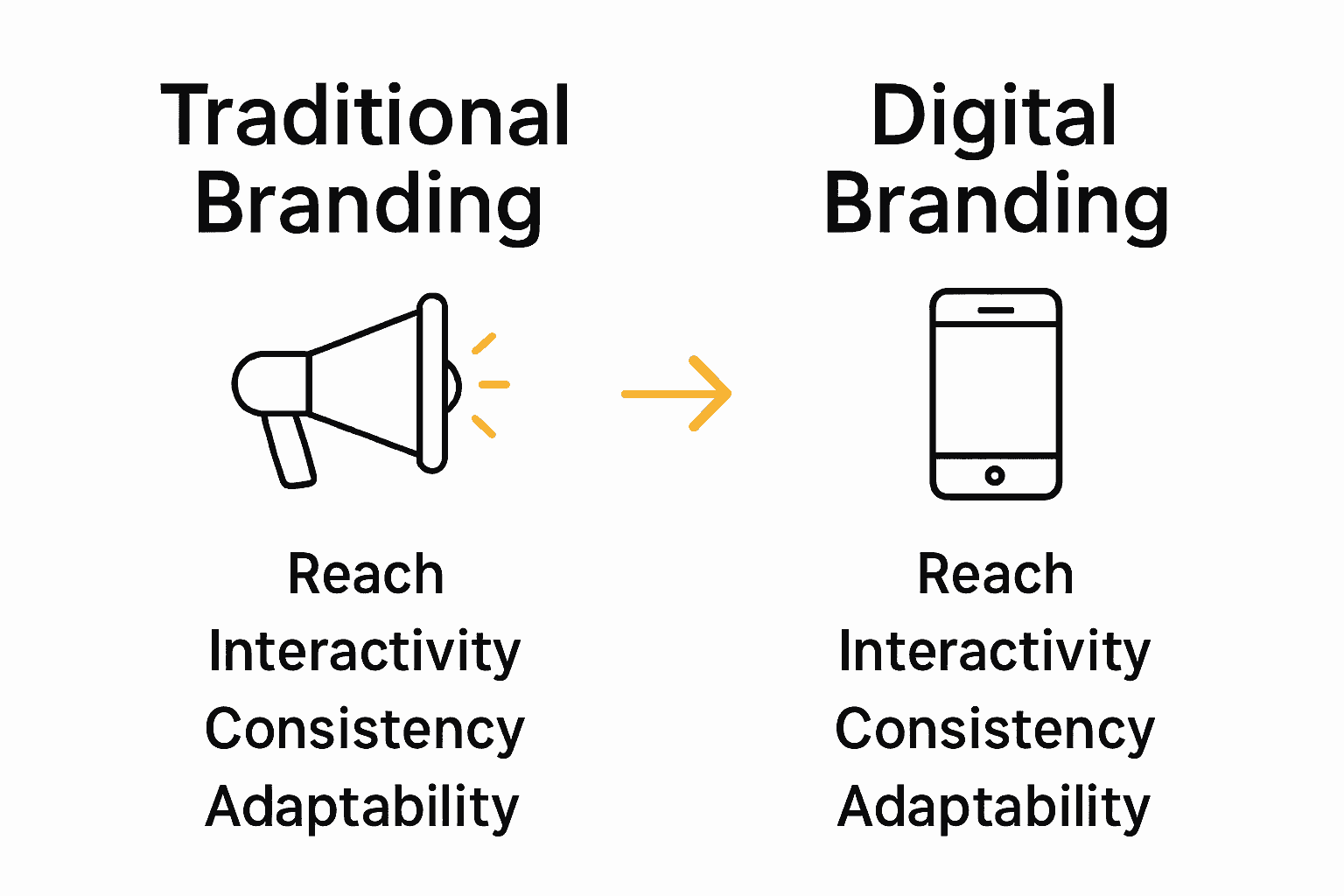
Digital branding is a complex landscape fraught with potential pitfalls that can derail even the most well-intentioned marketing efforts. Businesses often encounter significant challenges that can compromise their online brand identity and effectiveness if not carefully navigated.
The most common mistakes in digital branding include:
Learn how to develop a robust social media strategy that helps avoid these common digital branding traps. Many businesses struggle with maintaining a cohesive and genuine digital identity, often falling into the trap of chasing trends instead of building a sustainable brand narrative.
Successful digital branding requires a strategic, nuanced approach that balances consistency with adaptability. Businesses must remain vigilant about potential missteps, continuously monitoring their digital presence, gathering authentic customer insights, and being prepared to evolve their strategy. The most resilient digital brands are those that can authentically communicate their core values while remaining flexible enough to respond to changing market dynamics and customer expectations.
Building a powerful digital brand means overcoming challenges like inconsistent messaging, unclear audience understanding, and weak online presence. If you are striving for a cohesive digital identity that truly connects with your customers, you need proven strategies and personalised solutions tailored to your unique business goals. From crafting a consistent brand voice to designing seamless digital touchpoints, every detail matters to make your brand stand out and foster loyalty.
Discover how Kickass Online can help you tackle these challenges head-on with professional web development, SEO optimisation, and ongoing website maintenance designed specifically for small and medium-sized businesses. Visit our Tips and Tricks | Kickass Online page for actionable insights and start building your distinct digital brand today. Do not wait for opportunities to slip away - take the first step toward elevating your business at Kickass Online and explore trusted Recommendations | Kickass Online from clients who transformed their online presence. Your strong digital brand starts here.
Digital branding refers to the strategic management of a company’s online identity and reputation, leveraging internet branding and digital marketing techniques.
The key components include visual identity, brand voice, content strategy, and digital touchpoints to create a cohesive online presence.
Businesses can build their digital brand by maintaining consistent messaging, creating audience-centric content, engaging through multiple digital channels, and leveraging data-driven insights.
Common mistakes include inconsistent messaging, neglecting audience research, overcomplicating digital experiences, ignoring analytics, and presenting an inauthentic brand image.
More than 80 percent of businesses now consider digital marketing crucial for their growth. Today, building a strong online presence goes far beyond running ads or posting on social media. Many still believe digital marketing is simply about being visible online, but the reality involves targeted strategies, in-depth analysis, and real connections with customers. Unpacking the facts helps you understand why digital marketing is an essential force shaping successful brands in every industry.
| Point | Details |
|---|---|
| Digital Marketing is Essential | Beyond social media posts and ads, it’s a critical strategy that builds connections and drives measurable results. |
| Diverse Digital Channels | Effective digital marketing includes SEM, social media, and PPC, allowing for precise targeting and enhanced engagement. |
| Cost Efficiency and Data Utilisation | Digital marketing offers lower costs and insights for better decision-making on customer behaviour and market trends. |
| Real-Time Performance Measurement | Continuous tracking of KPIs enables businesses to optimise strategies and demonstrate clear ROI from marketing efforts. |
Digital marketing represents the strategic promotion of products, services, and brands using digital channels and technologies. According to journalofbusiness.org, digital marketing represents a profound transformation from traditional marketing methods, leveraging information technology to reach and engage potential customers through online platforms.
Contrary to popular belief, digital marketing is far more nuanced than simply posting content on social media or running a few online advertisements. It encompasses a comprehensive approach that involves:
Many businesses mistakenly view digital marketing as an optional add-on rather than a critical business strategy. This misconception can lead to missed opportunities and ineffective online presence. Digital marketing isn’t just about being present online it’s about creating meaningful connections, understanding customer behaviour, and delivering value through precisely targeted digital experiences.
Digital marketing encompasses a diverse range of online channels that enable businesses to connect with potential customers effectively. According to journalofbusiness.org, these channels include search engine marketing (SEM), social media marketing, and pay-per-click (PPC) advertising, each offering unique opportunities for enhancing online presence and engagement.
Search Engine Marketing (SEM) represents a critical digital channel that helps businesses increase visibility through strategic online advertising. This approach includes two primary strategies:
Social media platforms have revolutionized how businesses interact with their target audiences. Social Media Marketing allows companies to:
Pay-Per-Click (PPC) Advertising offers another powerful digital marketing channel, enabling businesses to display targeted ads across search engines and social media platforms. This method allows precise audience targeting and provides immediate visibility, with advertisers only paying when potential customers click on their advertisements.
Discover more about leveraging multi-channel marketing strategies for your business.
Digital marketing offers transformative advantages for businesses seeking to thrive in the contemporary competitive landscape. According to journalofbusiness.org, digital strategies provide enhanced customer engagement, improved brand visibility, and the critical ability to track and measure campaign effectiveness.
Cost-Effective Marketing represents a significant strategic benefit for modern businesses. Unlike traditional marketing channels, digital platforms enable precise targeting and budget optimisation:
Data-Driven Decision Making emerges as another crucial advantage. Digital marketing generates comprehensive insights that allow businesses to:
The scalability of digital marketing ensures that businesses of all sizes can leverage these powerful strategies. Whether you’re a small local enterprise or a growing medium-sized company, digital channels provide flexible, measurable, and efficient ways to connect with your target audience.
Discover how digital marketing can specifically help your small business grow.
Tracking digital marketing performance is essential for businesses seeking to optimise their online strategies. According to journalofbusiness.org, continuous monitoring and analysis of key performance indicators (KPIs) plays a crucial role in improving marketing outcomes and understanding campaign effectiveness.
Key Performance Indicators (KPIs) provide the foundation for measuring digital marketing success. The most critical metrics businesses should track include:
Effective ROI Calculation requires a systematic approach to evaluating marketing investments. This involves comparing the financial investment in digital marketing campaigns against the revenue generated, enabling businesses to:
Modern digital marketing tools and analytics platforms have simplified performance tracking, providing real-time insights and comprehensive dashboards that transform raw data into actionable intelligence. By consistently monitoring these metrics, businesses can make data-driven decisions that continuously improve their marketing effectiveness.

Learn more about calculating ROI for your digital marketing campaigns.
The marketing landscape has dramatically transformed with the emergence of digital platforms, offering businesses more sophisticated approaches to reaching potential customers. According to bemsreports.org, digital marketing provides remarkable flexibility and broader reach compared to traditional marketing’s broad but less targeted methodologies.
Traditional Marketing Methods typically encompass:
In contrast, Digital Marketing Approaches offer:
Research from jsr.org reveals that digital marketing strategies frequently demonstrate superior return on investment (ROI) due to their targeted nature and cost-efficient mechanisms.
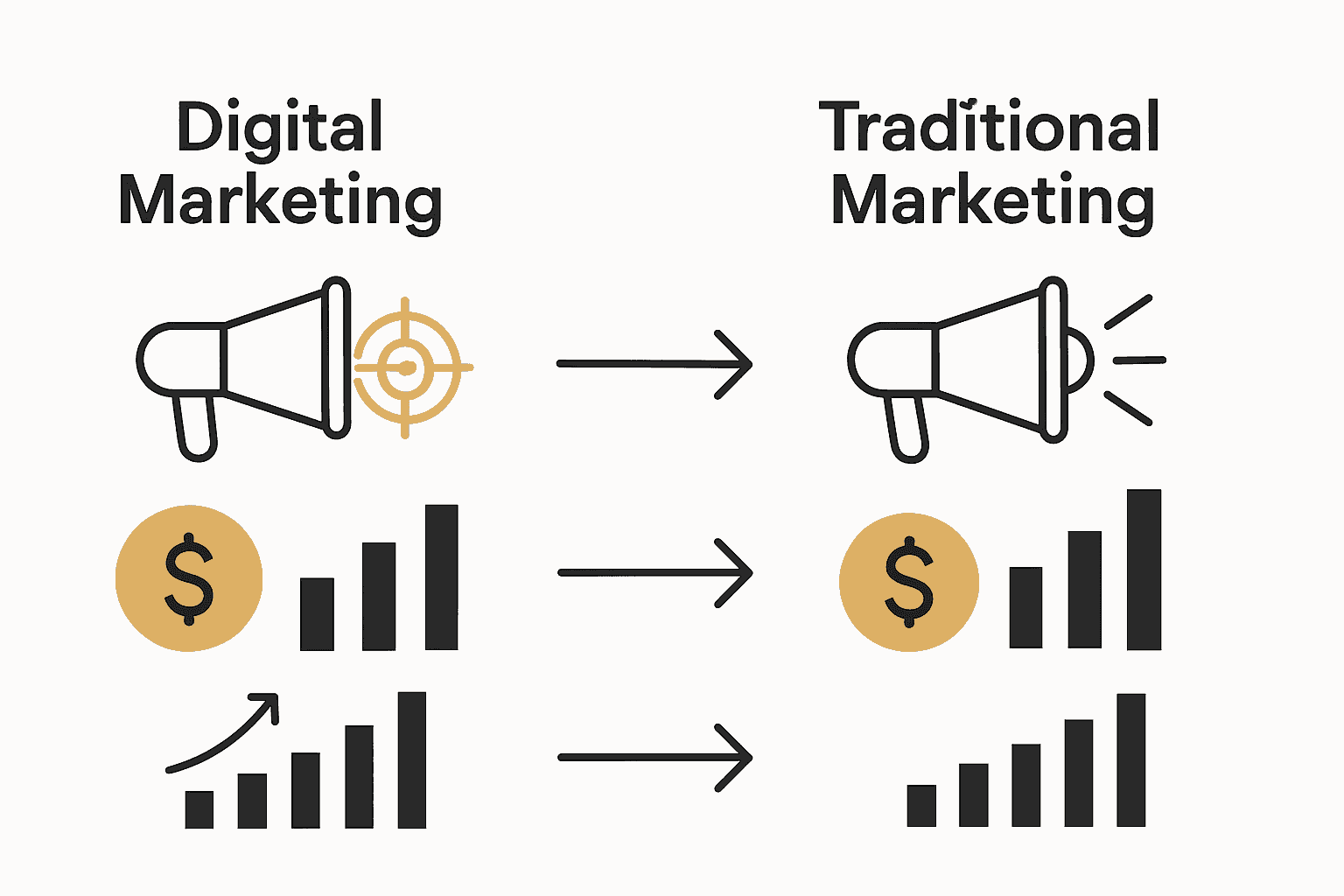 The ability to track, measure, and quickly adapt digital campaigns provides businesses with unprecedented marketing intelligence and strategic flexibility.
Here’s a comparison of digital marketing and traditional marketing methods:
| Feature | Digital Marketing | Traditional Marketing |
|---|---|---|
| Audience Targeting | Highly precise | Broad, less targeted |
| Cost per Acquisition | Lower | Higher |
| Performance Tracking | Real-time, data-driven | Delayed, limited insights |
| Engagement | Interactive, two-way communication | One-way communication |
| Adjustability of Campaigns | Immediate adjustments | Slow, costly changes |
| Geographic Reach | Global and local | Mainly local/regional (expensive for global) |
| ROI Measurement | Detailed, accurate | Difficult, often approximate |
Explore the comprehensive differences between digital and traditional marketing approaches.
If you have read “Why Invest in Digital Marketing: Complete Guide” you already understand the importance of strategic content creation and precise audience targeting to boost your online presence. Many businesses struggle with optimising budget allocation and measuring real-time performance, leading to missed opportunities and ineffective campaigns. At Kickass Online, we specialise in solving these exact challenges through personalised web development, SEO optimisation, and dedicated ongoing website maintenance designed specifically for small and medium enterprises.
Benefit from dedicated attention and proven strategies:
Explore our expert recommendations to start making informed decisions today.
Step confidently into the future of digital marketing with Kickass Online. Visit our main site at Kickass Online and discover personalised strategies backed by a team committed to your success. For practical advice and insider tips, see our Tips and Tricks to keep your digital marketing efforts sharp and effective. Don’t wait until your competitors do, take control of your online growth now.
Digital marketing refers to the strategic promotion of products, services, and brands using various digital channels and technologies to reach and engage potential customers online.
Digital marketing offers precise audience targeting, real-time performance tracking, and interactive engagement, while traditional marketing methods typically have broader but less targeted approaches, often with delayed insights and a higher cost per acquisition.
Key performance indicators for digital marketing include click-through rates (CTR), conversion rates, cost per acquisition (CPA), return on ad spend (ROAS), customer lifetime value, and website traffic.
Data-driven decision making allows businesses to understand customer behaviour, predict market trends, and personalise marketing strategies effectively, leading to improved campaign effectiveness and measurable return on investment.
Choosing the right tools to grow your business online is not always simple. Each solution brings its own mix of features and advantages that can transform the way you connect with customers, manage your brand, and drive sales. Some focus on personal attention and custom strategies while others promise all in one power or data driven insights. With so many options and bold promises it is easy to wonder which approach truly fits your goals and resources. Exploring how these services work and what makes them stand out can reveal new ways to work smarter, gain visibility, and achieve better results.
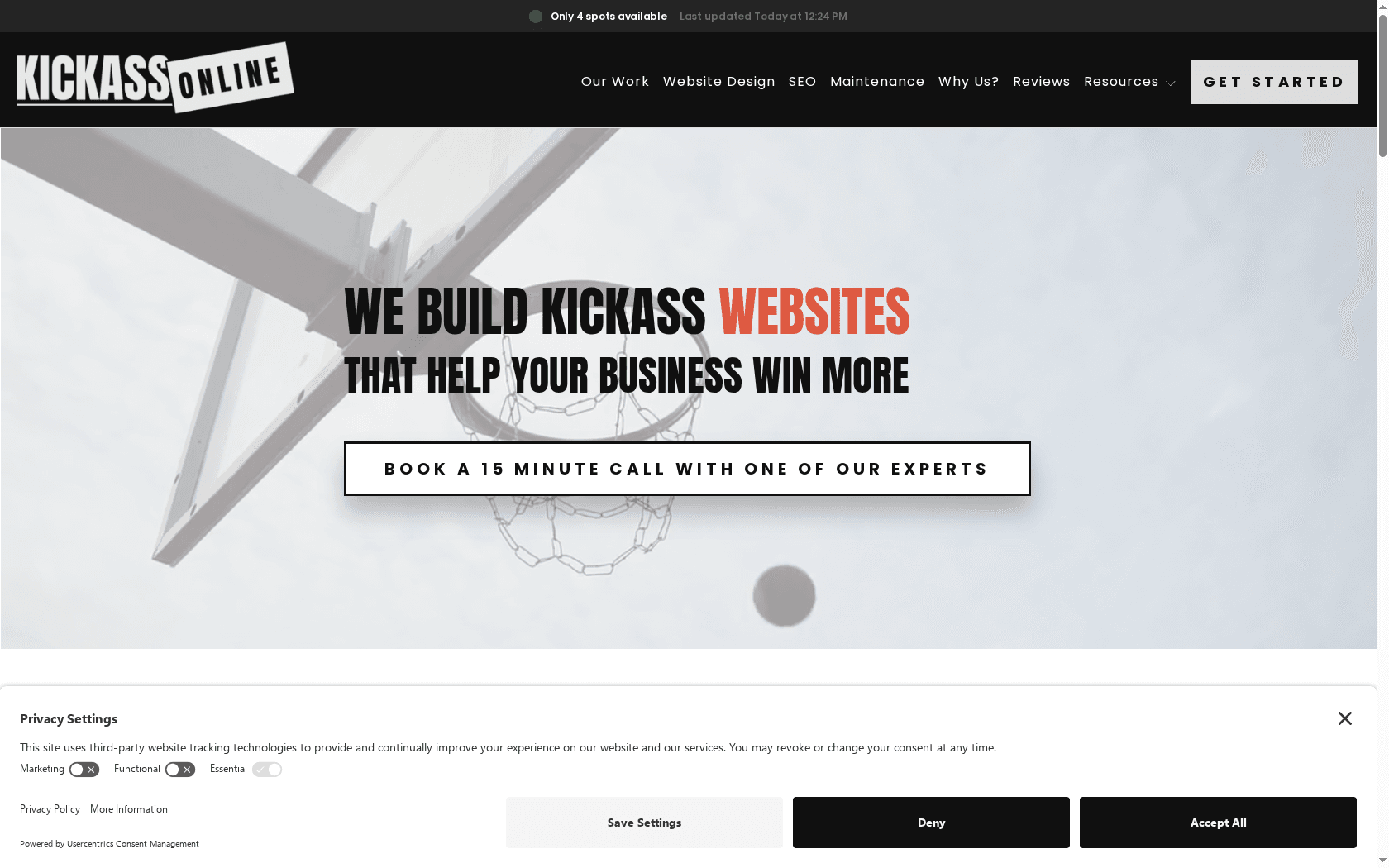
Kickass Online is a results-driven digital marketing agency in Milton Keynes, UK, focused on helping small and medium-sized businesses grow online through tailored website design, SEO, and ongoing website maintenance. They combine bespoke web development with measurable SEO strategies and a steady maintenance cadence to boost visibility, drive traffic and increase conversions. With a limited client intake and a dedicated team of specialists, Kickass Online positions itself as a partner for businesses that want personalised attention and measurable outcomes.
Kickass Online delivers custom website design and development, a full spectrum of Search Engine Optimisation (SEO) services, and proactive website maintenance and security. Their offering also includes strategic digital marketing solutions guided by a dedicated team of digital experts. The agency emphasises websites that not only look great but convert well, and packages are custom-built to business goals and budgets. The site showcases selected successful projects, glowing client reviews, and promotes booking consultations alongside informative resources to help you make confident decisions.
Kickass Online is ideal for small to medium-sized businesses in Milton Keynes, London and surrounding areas that want a partner to craft a bespoke online presence and sustain it reliably. It’s particularly suited to retailers, local service providers and organisations aiming for measurable SEO gains, a high-converting website, and ongoing maintenance without the overhead of managing multiple suppliers.
Kickass Online’s unique value lies in its combination of bespoke web development, hands-on SEO expertise and an intentional limit on client intake to protect service quality. Rather than scaling thinly, the agency chooses depth: personalised plans, a tightly focused team of digital experts and a process orientated around measurable gains, more traffic, higher search rankings and improved conversion rates. That design choice, limited clients to ensure dedicated attention, is a deliberate advantage over competitors that prioritise volume. Kickass Online also supports decisions with case studies and client testimonials and actively promotes booking consultations and informative resources, making the onboarding and planning phase both transparent and strategic.
A local retailer in Milton Keynes hires Kickass Online to build a new e-commerce site, optimise its Google search rankings and establish ongoing maintenance and security. Within months the store benefits from improved search visibility, fewer technical issues and a steadier conversion rate thanks to targeted design and SEO adjustments.
Not specified, contact for a quote.
Website: https://kickassonline.com
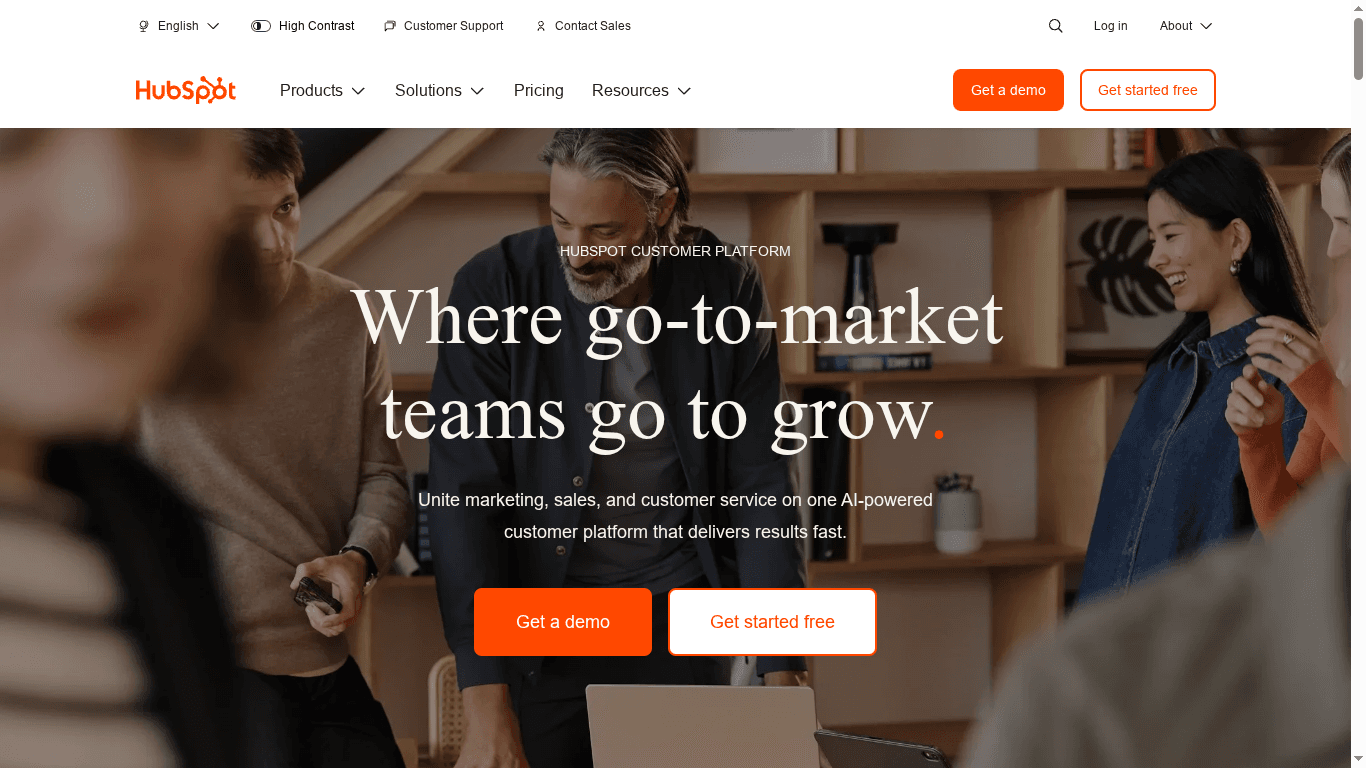
HubSpot is an integrated customer platform that brings marketing, sales and customer service tools together with a central CRM and AI-powered assistants. In short: it connects data, automates repetitive work and scales from small teams to enterprise operations. It’s powerful for growth-oriented businesses, but expect meaningful onboarding and higher costs as you expand. Bottom line: excellent breadth and scalability, but not the cheapest or simplest option for every small business.
HubSpot combines multiple specialised hubs, Marketing, Sales, Service, Content, Data and Commerce, with a smart CRM at the core that centralises customer records and interactions. AI tools such as Breeze aim to boost productivity and insight, while native integrations with over 1,900 apps and web services let you connect email, analytics and much more. The platform focuses on automated lead management, content creation, customer support workflows and cross-channel campaign tracking, all within a single ecosystem.
HubSpot is best suited to small to mid-sized businesses and enterprises that want a single platform to manage marketing, sales and customer service while leveraging AI to inform decisions. If you plan to scale, require integrated data across teams, and are prepared to invest in onboarding, HubSpot will reward you with streamlined processes and central visibility.
HubSpot’s unique value is the combination of a central CRM, modular specialised hubs and AI assistance within one connected platform. That combination reduces friction between marketing, sales and service teams, letting you automate end-to-end customer journeys without stitching together disparate systems.
A mid-sized eCommerce company uses HubSpot’s Marketing Hub to automate email campaigns and personalise customer journeys, while the Sales Hub manages pipelines and automations; the result is improved campaign measurement, faster lead follow-up and higher sales efficiency.
Starting at $800/month for the Professional plan; Enterprise from $3,600/month, excluding additional onboarding and add-on costs.
Website: https://hubspot.com
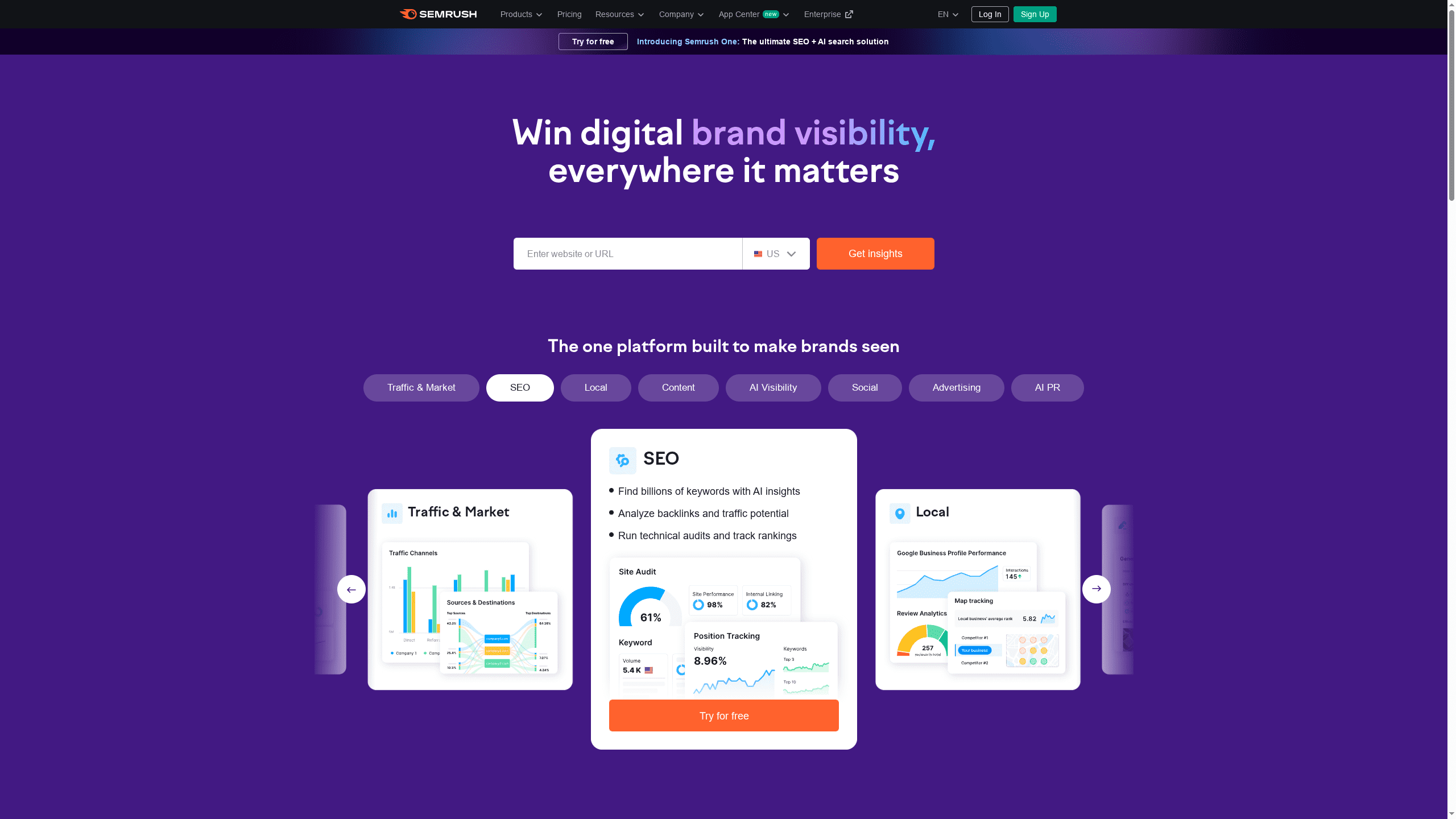
SEMrush is a data-driven, all-in-one marketing platform that combines SEO, content, social and advertising toolsets into a single interface. Its strength lies in broad competitive intelligence and AI-powered insights that help you find opportunities and monitor rivals. For small and medium businesses the depth can be a real advantage, provided you have time or support to unlock it. Expect powerful data; expect a learning curve.
SEMrush bundles keyword research, backlink analysis, technical site audits and rank tracking with content creation and optimisation tools that include AI insights. Beyond SEO it offers traffic and market analysis for competitor benchmarking, local marketing features such as Google Business Profile optimisation, social media scheduling and monitoring, advertising tools for Google and Meta campaigns, AI visibility analysis and PR/media monitoring. The platform is positioned as a single source for insights, automation and competitive intelligence across multiple digital channels.
SEMrush suits marketing professionals, SEO specialists, content creators, digital agencies and medium to enterprise businesses that need an integrated platform for discovery, optimisation and competitor intelligence. If you run a small business with limited time or budget, SEMrush can still help, but plan for training or support to get value quickly.
SEMrush’s unique value is its breadth and integration: it centralises SEO, content, social and advertising intelligence with AI-enhanced data that supports strategy across channels. That consolidation makes it easier to turn research into action without stitching separate tools together.
A client used SEMrush to identify untapped keywords, improve on-page optimisation and monitor competitor strategies; this led to improved rankings and a significant rise in organic traffic and brand visibility, demonstrating how insight-driven changes can translate into measurable growth.
Pricing details are not specified on the website; a free trial is available for interested users.
Website: https://semrush.com
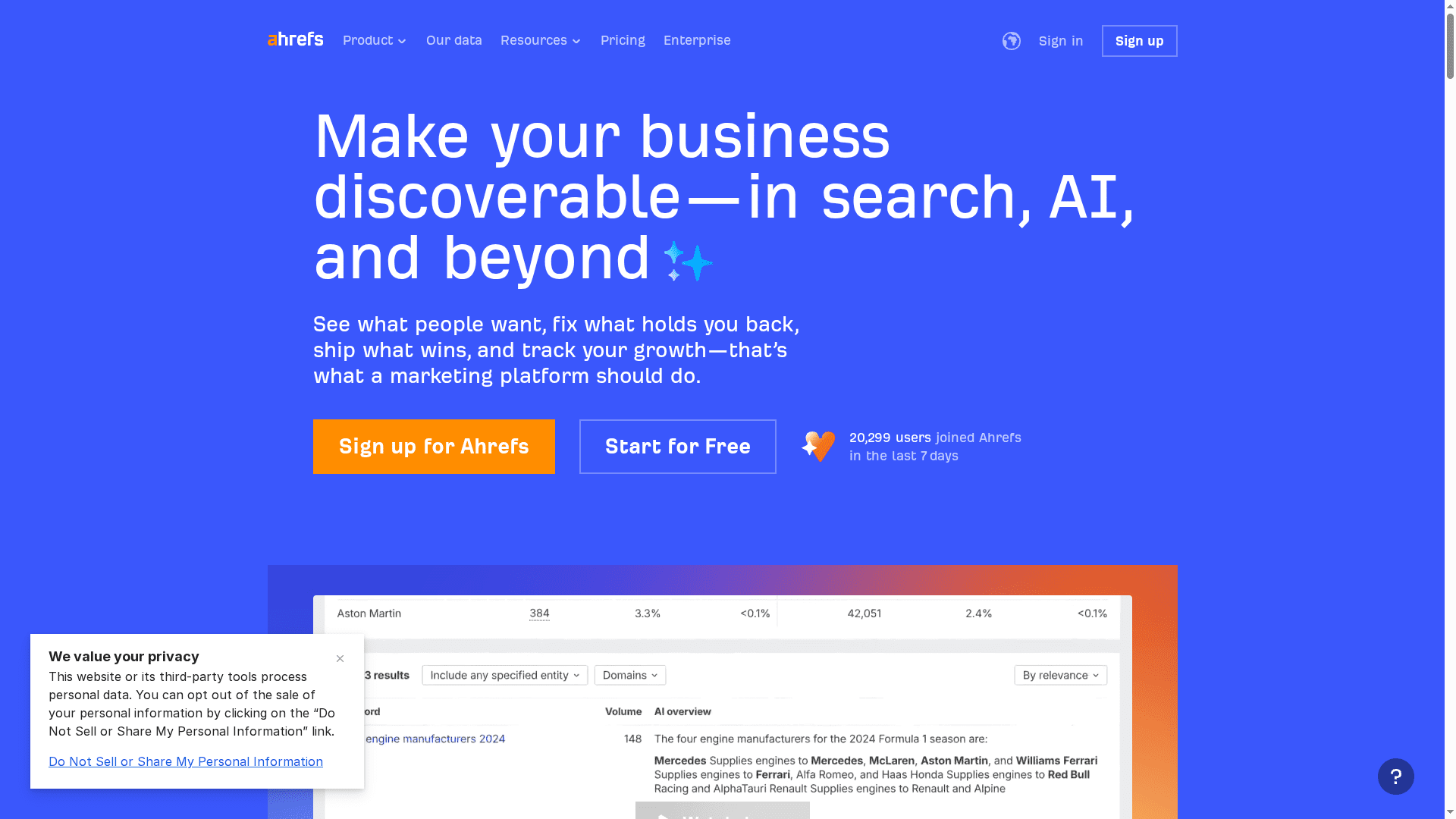
ahrefs is an AI marketing platform built on big data that focuses on giving marketers deep, actionable insights for SEO and wider digital marketing. It combines keyword research, site auditing, content discovery and rank tracking with enterprise-friendly API access and custom reporting. If you need a data-first toolkit for competitive analysis and content optimisation, ahrefs delivers powerful capabilities, though smaller teams may find the cost and learning curve challenging. Use it when you want rigorous, measurable SEO outcomes.
ahrefs centres on a core suite of SEO and marketing tools: Site Explorer for analysing website data, Keywords Explorer for keyword research, Content Explorer to find popular content, Rank Tracker for monitoring rankings and Site Audit for health checks with advanced options. The platform also includes virtual assistant tools for content and SEO optimisation, competitor analysis, local SEO and social media management, plus API access and custom reporting for integration and automation at scale.
ahrefs suits digital marketers, SEO professionals, content creators, marketing agencies and enterprise businesses that prioritise data-driven insights and scalability. If you manage multiple clients, run national or international campaigns, or need API-driven automation, ahrefs is designed for your workflow. Not ideal if you’re on a shoestring budget and need a simple, lightweight tool.
ahrefs combines AI and a vast dataset to deliver comprehensive SEO and marketing intelligence, with enterprise-ready reporting and integration features. Its strength lies in turning big data into practical actions, from pinpointing keyword opportunities to revealing competitor link strategies, all inside one unified platform.
A marketing agency uses ahrefs to monitor client rankings, identify backlink opportunities, analyse competitors’ strategies, optimise local search presence and compile custom reports. The result is clearer prioritisation of tactics, measurable client gains and more compelling performance reporting.
Starting at $129/month for the Lite plan, with higher tiers at $249 and $449, and custom enterprise options; annual billing offers discounts up to 17%.
Website: https://ahrefs.com
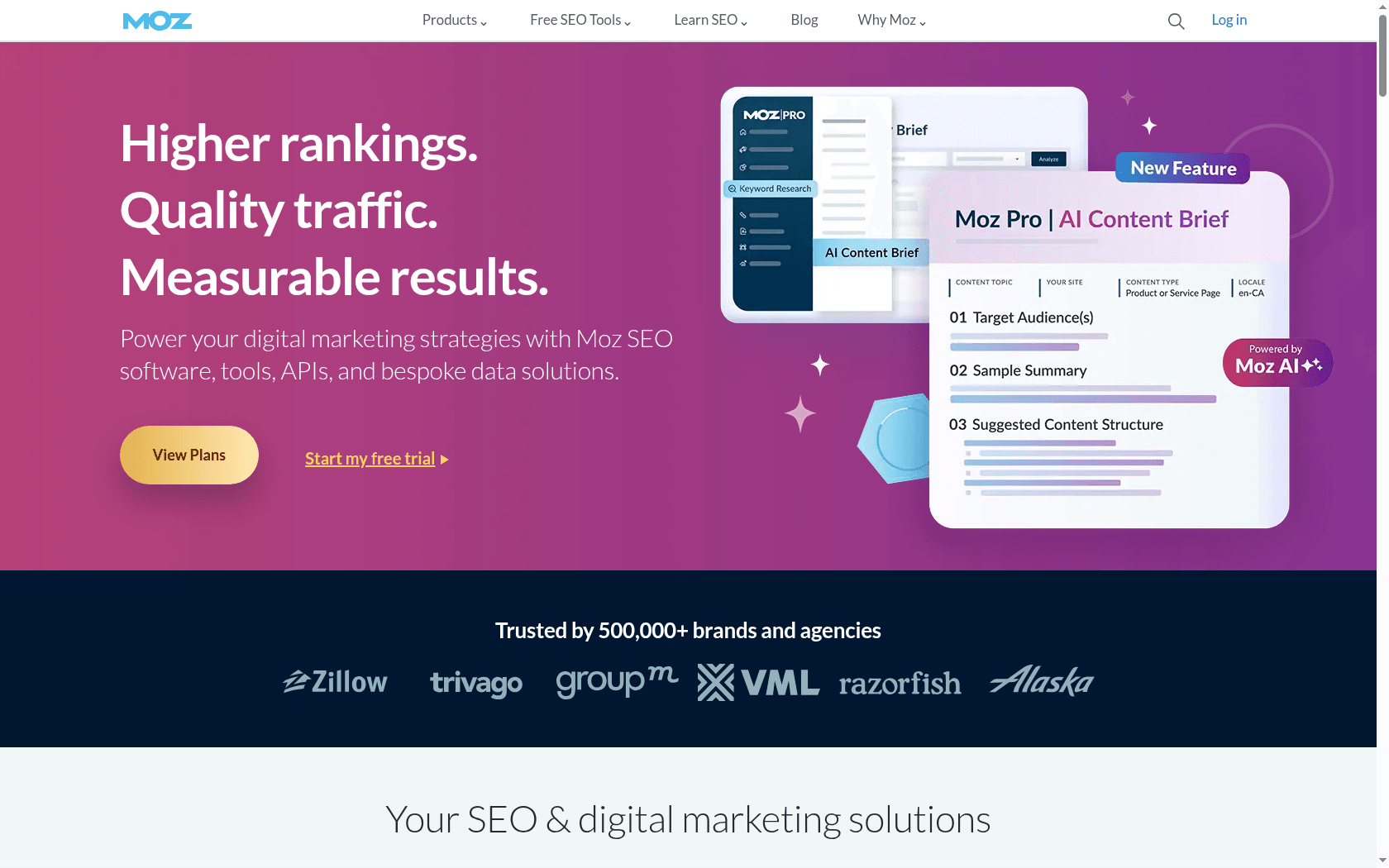
Moz Pro is an all-in-one SEO toolkit aimed at helping you rank higher, drive qualified traffic and run measurable SEO campaigns. Trusted by over 500,000 brands and agencies, it combines keyword research, competitive analysis, link research, rank tracking and site audits in a single dashboard. For businesses wanting a centralised SEO workflow with AI-assisted content and data insights, Moz Pro is a compelling option, though costs and advanced feature learning curves deserve consideration.
Moz Pro provides a broad set of capabilities: keyword research with AI suggestions, competitive gap analysis, link research and domain authority insights, rank tracking across search engines, and site crawls for technical audits. It also offers local SEO tools for listings and review monitoring, API access for custom integrations, and customisable reporting for clients or stakeholders. The toolkit is consolidated in a user-friendly dashboard designed for both beginners and experienced SEOs.
Moz Pro suits digital marketers, SEO professionals, agencies and businesses of all sizes that want an integrated SEO platform. It is especially useful if you manage multiple client sites, need reliable rank tracking, or require repeatable audits and reporting. If you’re a solo business owner with a very limited budget, consider whether the Starter features match your immediate needs.
Moz Pro’s strength lies in combining approachable usability with robust SEO analytics and AI-assisted content workflows. It lowers the barrier to structured SEO work while providing the depth necessary for advanced competitive and technical analysis.
A small marketing agency uses Moz Pro to monitor client rankings, identify competitor keyword gaps, produce AI-generated content briefs for writers, and run monthly site audits to demonstrate SEO-driven improvements and ROI.
Starting at $39/month (billed annually) for the Starter plan, with Standard, Medium and Large tiers offering increased limits and features; custom enterprise plans are available.
Website: https://moz.com
Mailchimp is an all-in-one marketing, automation and email platform designed to help businesses grow through data-driven campaigns and AI tools. It combines email and SMS marketing with predictive segmentation, automation flows and content creation features to boost engagement and revenue. For small to medium businesses seeking a single platform to run campaigns, it offers breadth and depth, though the learning curve and costs can rise as your contact list grows.
Mailchimp’s core capabilities centre on email marketing and automation, supplemented by SMS campaigns, predictive segmentation and AI-powered content creation. The platform unifies data through integrations, enabling lead-generation tools such as pop-up forms and landing pages, while analytics and reporting provide insight into campaign performance. Multiple plan tiers unlock progressively advanced features, making it flexible for different business sizes.
Mailchimp suits small to medium-sized businesses and marketers who want an integrated platform for email and SMS campaigns, automation and basic ecommerce integration. If you need ready-made templates, AI assistance and predictive segmentation without stitching multiple tools together, Mailchimp is a strong candidate, particularly for teams prepared to invest time learning its capabilities.
Mailchimp’s unique value is its combination of user-friendly campaign creation and progressively advanced marketing automation within one platform. The inclusion of AI-powered content tools and predictive segmentation helps you personalise at scale without building complex infrastructure.
A retail business can use Mailchimp to send personalised email and SMS campaigns triggered by purchase behaviour, employing automation workflows and predictive segments to recover abandoned baskets, recommend products and increase customer retention.
Starts with a free plan with basic features; paid plans begin at $13/month for Essentials, $20/month for Standard and $350/month for Premium, with discounts for large contact lists and annual billing.
Website: https://mailchimp.com
Hootsuite is a comprehensive social media management platform that centralises scheduling, publishing, monitoring and analytics across multiple accounts. Its AI-powered content tools, branded as OwlyGPT, and built-in integrations with Canva templates and stock images accelerate content creation and iteration. For teams that need collaboration, approval workflows and social listening, Hootsuite delivers a single dashboard to measure and act on performance. Bottom line: powerful and feature-rich, but its depth can feel costly and complex for very small businesses.
Hootsuite’s core lies in multi-account content scheduling and publishing paired with reporting and social listening. The platform offers analytics and performance tracking, team collaboration with customised permissions and workflow approvals, and AI-assisted content creation that suggests captions, hashtags and post ideas from trending topics. Integration with design resources (Canva templates and stock imagery) and extensive third-party connections supports a streamlined end-to-end social workflow from idea to post to insight.
Hootsuite suits businesses and organisations that need an all-in-one social management solution, from small firms aiming to centralise social activity to larger enterprises coordinating multiple teams. It’s especially relevant for social media managers, marketing teams and customer support teams who require scheduling, listening and analytics within one environment.
Hootsuite’s distinguishing strength is its combination of extensive social management features with AI-assisted content generation and deep integrations. That mix enables teams to speed up content production, monitor brand mentions and quantify impact without stitching together numerous separate tools.
A retail brand uses Hootsuite to schedule posts across multiple channels, analyse engagement metrics to optimise posting times, monitor brand mentions and emerging trends, and coordinate internal approvals so campaigns go live without bottlenecks.
Multiple plans available starting from the Standard plan with a 30-day free trial, followed by monthly or annual billing options; tiered plans include Standard, Plus, Advanced and Enterprise, with custom solutions for large organisations.
Website: https://hootsuite.com
This table provides a comprehensive comparison of various digital marketing and SEO tools, highlighting their core features, pros, cons, typical users, and pricing.
| Product | Core Features | Pros | Cons | Typical Users | Pricing |
|---|---|---|---|---|---|
| Kickass Online | Custom web design, SEO, web maintenance | Personalised strategies, measurable results, comprehensive service, dedicated team | Pricing not specified; requires contact for a quote | SMEs in Milton Keynes; those needing bespoke online presence | Contact for a quote |
| HubSpot | Marketing, Sales, Service hubs, AI-enabled CRM | All-in-one platform, extensive integrations, AI tools, scalable, user-friendly | High cost, steep onboarding, limited customisation at lower tiers | SMEs to enterprises seeking an integrated growth platform | Starting at $800/month |
| SEMrush | SEO, content, social, advertising tools | Comprehensive coverage, AI insights, trusted by brands, strong competitive analysis | Complexity for new users, pricing not transparent, learning curve | Marketing pros; SEOs seeking integration and intelligence | Not specified, contact for details |
| ahrefs | SEO insights, keyword research, rank tracking, content optimisation | Extensive data, AI acceleration, robust reporting, enterprise integration | High pricing for small businesses, complex interface, advanced features require higher tiers | Digital marketers; those needing data-driven insights | Starting at $129/month |
| Moz Pro | Keyword research, competitive analysis, link research, rank tracking | Comprehensive toolset, user-friendly, AI insights, trusted by many, scalable plans | Can be costly, learning curve for advanced features | SEO professionals; agencies needing reliable tools | Starting at $39/month |
| Mailchimp | Email/SMS marketing, automation, content creation, AI tools | Comprehensive platform, strong automation, extensive integrations, user-friendly AI tools, varied pricing plans | Complexity for new users, expensive for large lists, limited features on lower plans | SMBs needing campaign management and automation | Starts with a free plan |
| Hootsuite | Social media scheduling, publishing, monitoring, analytics | Comprehensive management, AI content generation, extensive integrations, robust analytics, team support | High pricing, steep learning curve, overwhelming interface | Social media managers; larger teams requiring integration | Starts from a Standard plan |
Navigating the complex world of digital marketing tools can be overwhelming, especially when trying to balance SEO, web development and ongoing site maintenance. This expert comparison highlights the challenges businesses face such as choosing the right platforms and achieving measurable results under limited budgets. At Kickass Online, we understand these pain points. Our personalised strategies focus on creating high-converting websites backed by targeted SEO and reliable maintenance that grow your online presence and traffic steadily. If you are seeking tailored solutions that prioritise your unique goals rather than generic, one-size-fits-all approaches, you are in the right place.
Discover proven insights and actionable advice in our Recommendations | Kickass Online category to help you make confident decisions about your digital strategy.
Ready to move beyond tool comparisons and see real growth through a dedicated partner? Visit Kickass Online today and book a consultation with our expert team. Let us craft a bespoke plan tailored specifically to your business needs that transforms your digital presence with measurable outcomes and ongoing support. Your path to effective online marketing starts here.
Look for tools that offer comprehensive functionality, such as SEO capabilities, social media management, analytics, and automation features. Choose tools that can integrate various marketing channels and provide actionable insights to enhance your campaigns.
Start by identifying your specific marketing goals and budget. Evaluate the features of each tool against your objectives, and consider conducting trials to assess their usability and effectiveness before making a commitment.
Compare the pricing structures, including monthly subscriptions, tiered pricing based on features, and any hidden costs like add-ons or operational fees. Aim for transparency in pricing, and ensure you can project your costs as your marketing needs grow.
Typically, you can expect to see initial results within 30–60 days, depending on the complexity of your campaigns and the tools you are using. Focus on establishing measurable goals to ensure you can track your progress effectively.
Yes, many digital marketing tools offer collaboration features that facilitate teamwork, such as shared dashboards, task assignments, and communication tools. Look for tools that support multiple users and enhance workflow efficiency to streamline your marketing processes.
Digital marketing tools provide analytics and insights that allow you to track performance metrics, optimise campaigns in real-time, and make data-driven decisions. Start by setting clear KPIs to monitor the impact of your campaigns and adjust strategies based on the data you gather.
Did you know over 90 percent of online experiences begin with a search engine? Yet many businesses still misunderstand how SEO really works and why it matters. Misconceptions often cause missed opportunities, holding back growth and visibility. Clarity on what SEO actually involves opens the door to smarter digital strategies, helping you sidestep common errors and make informed decisions that drive real results.
| Point | Details |
|---|---|
| SEO is an Ongoing Process | Businesses must engage in continuous content creation, technical optimisation, and performance monitoring to achieve lasting results. |
| SEO Benefits Small Businesses | A well-implemented SEO strategy empowers small and medium enterprises to compete effectively in the digital space against larger competitors. |
| Focus on User Experience | Successful SEO revolves around creating high-quality content that meets user needs while ensuring an exceptional website experience. |
| Avoid Common Mistakes | Businesses should avoid pitfalls like keyword stuffing, poor mobile optimisation, and neglecting page speed to enhance their SEO performance. |
Search Engine Optimisation (SEO) is a strategic digital marketing approach designed to enhance a website’s visibility and positioning in search engine results pages (SERPs). According to Salford University, SEO involves a comprehensive set of strategies aimed at improving how search engines like Google perceive and rank your online content.
At its core, SEO is about understanding how search engines evaluate and display web pages. Newcastle University explains that search engines scour the internet to provide users with the most relevant results, and SEO helps websites strategically climb these rankings. This means creating content that not only meets user needs but also aligns with search engine algorithms.
Common misconceptions about SEO often prevent businesses from fully leveraging its potential. Many believe SEO is a one-time task or simply about cramming keywords into content. In reality, SEO is an ongoing process that requires:
Some businesses mistakenly think SEO is too complex or only beneficial for large corporations. However, for small and medium-sized businesses, SEO can be a game-changing strategy that levels the playing field, allowing smaller enterprises to compete effectively in digital spaces.
Successful SEO isn’t about tricking search engines but creating genuine value for your audience. It involves understanding user intent, producing high-quality content, and ensuring your website provides an exceptional user experience. By focusing on these elements, businesses can improve their online visibility and attract more potential customers.
Ready to demystify SEO for your business? Learn about common SEO errors to avoid and start optimising your digital presence strategically.
Search Engine Optimisation (SEO) offers a comprehensive suite of strategic advantages that can transform how businesses attract and engage potential customers. According to Innovation Research, SEO delivers multiple critical benefits including enhanced business visibility, increased website traffic, and improved conversion rates.
Visibility and Brand Credibility are perhaps the most immediate advantages of a well-executed SEO strategy. Cornell Blogs highlights that improved search engine rankings directly contribute to strengthening a company’s public image and credibility. When your business appears prominently in search results, potential customers perceive you as a more authoritative and trustworthy option.
The core benefits of SEO for businesses can be categorically broken down into several key areas:
Understanding that SEO isn’t just about technical manipulation but creating genuine value is crucial. It’s about crafting high-quality content that truly serves your audience’s needs while simultaneously meeting search engine algorithms’ requirements. Learn more about strategic SEO benefits for your business marketing to unlock your digital potential.
Small and medium-sized businesses particularly stand to gain from a robust SEO strategy.
 By leveling the digital playing field, SEO allows smaller enterprises to compete effectively against larger competitors, turning online visibility into a powerful growth mechanism.
Ready to transform your online presence? Discover why starting SEO now is critical and take the first step towards digital marketing success.
Search Engine Optimisation encompasses multiple sophisticated strategies designed to improve a website’s visibility and performance in search results. According to Tuambia Research, effective SEO approaches include keyword research, on-page optimisation, quality content creation, local SEO, and strategic link building.
On-Page SEO represents the foundation of any robust digital marketing strategy. EICOM emphasises the critical importance of optimising headlines, titles, and images to help search engines comprehend content quality. This approach involves meticulously crafting website elements to communicate relevance and value to search algorithms.
Key SEO strategies can be categorised into several primary types:
Here’s a structured overview comparing key types of SEO strategies:
| SEO Strategy | Main Focus | Key Benefits |
|---|---|---|
| Keyword Optimisation | Relevant search term targeting | Higher ranking potential |
| Content Marketing | Quality, engaging content | Satisfies user intent |
| Technical SEO | Site performance, mobile use | Faster, more accessible site |
| Local SEO | Geographic search results | Attracts local customers |
| Link Building | Internal & external links | Boosts authority, credibility |
Successful SEO isn’t about manipulating search engines but genuinely serving user needs. Each strategy requires careful implementation and continuous refinement. Discover content optimisation techniques to elevate your digital presence and connect more effectively with your target audience.
For small businesses, understanding and implementing these strategies can level the competitive landscape. By focusing on targeted, intelligent SEO approaches, even businesses with limited resources can achieve significant online visibility and attract quality traffic.
SEO strategies for startups offer a roadmap for businesses looking to maximise their digital marketing potential with smart, resource-efficient techniques.
Website growth is fundamentally powered by strategic search engine optimisation that transforms digital visibility and audience engagement. According to Essex University, over 60% of web traffic originates through search engines, making SEO a critical mechanism for reaching target audiences and expanding online presence.
Organic Traffic Generation represents the primary engine of website growth through SEO. Loopo Research highlights that effective SEO strategies directly enhance user experience and site performance, leading to improved search rankings and increased conversion rates. This means businesses can attract high-quality visitors genuinely interested in their products or services.
The key mechanisms through which SEO drives website growth include:
Understanding SEO as a dynamic, ongoing process is crucial for sustainable growth. It’s not just about technical optimisation but creating genuine value for your audience. Discover strategies to improve your website’s SEO metrics and unlock your digital potential.
Small and medium-sized businesses particularly benefit from intelligent SEO approaches. By focusing on targeted, data-driven strategies, even organisations with limited resources can significantly enhance their online visibility and attract quality traffic.
Boost your SME’s visibility by implementing these powerful growth-driving techniques and transforming your digital marketing approach.
Marketing channels vary significantly in their approach, effectiveness, and long-term value for businesses. According to Web Tech Solution, SEO stands out as a uniquely cost-effective strategy that provides substantial return on investment by directly targeting users actively searching for specific products or services.
Strategic Targeting differentiates SEO from traditional marketing approaches. Social Media Magazine emphasises that SEO enhances website traffic while simultaneously reducing marketing expenses, creating a more sustainable and efficient promotional strategy compared to conventional advertising methods.
Key differences between SEO and other marketing channels include:
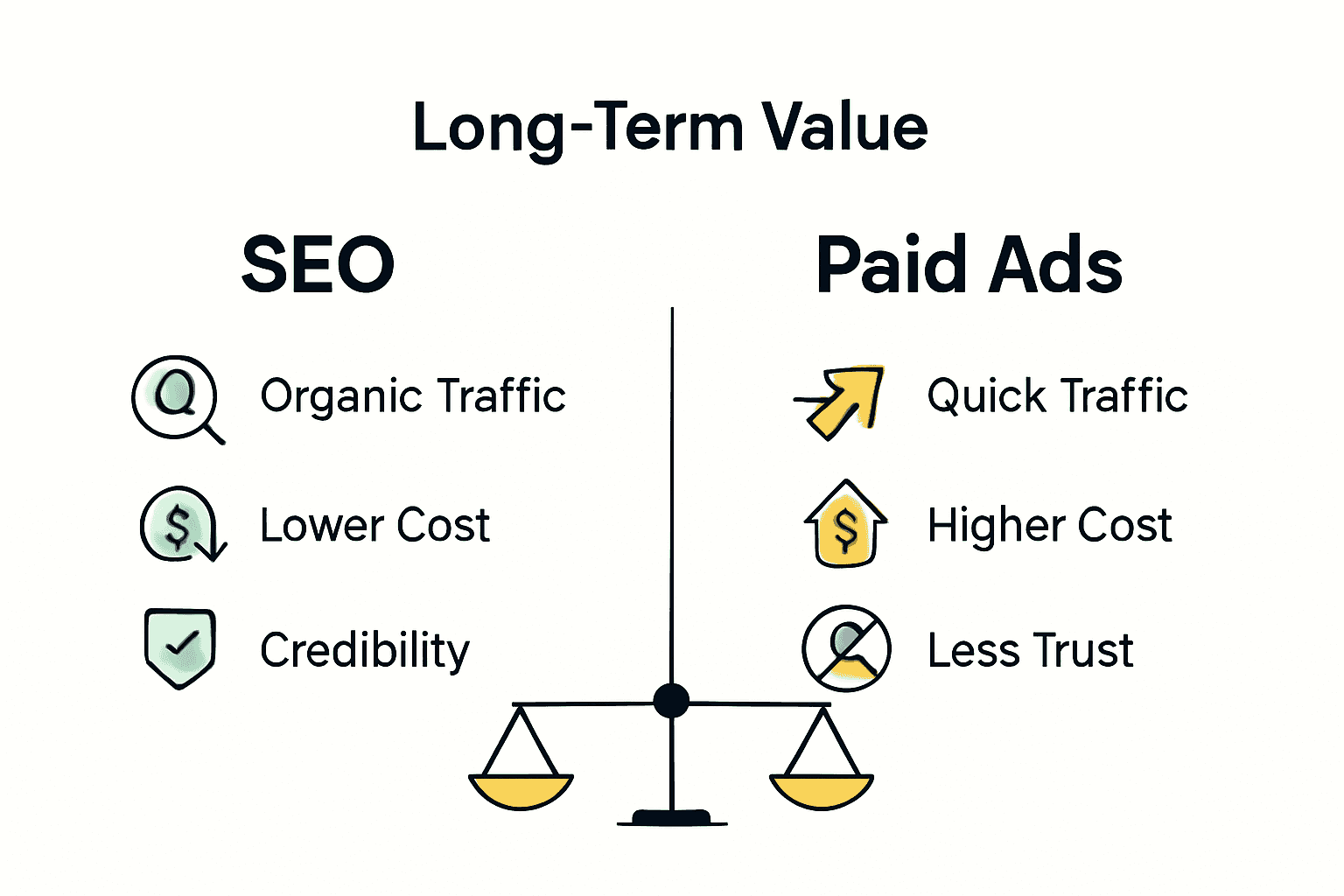
Understanding the nuanced landscape of digital marketing requires a comprehensive approach. Explore how SEO and PPC can work together to create a more robust marketing strategy that leverages multiple channel strengths.
While traditional marketing channels rely on broad, often interruptive techniques, SEO focuses on being present when potential customers are actively seeking solutions. This fundamental shift represents a more intelligent, user-centric approach to business growth.
Discover multi-channel marketing strategies that can help small and medium enterprises maximise their digital marketing potential across various platforms.
Navigation through the complex landscape of Search Engine Optimisation requires strategic awareness and proactive problem prevention. According to Newcastle University, creating high-quality, unique content and optimising on-page elements are fundamental strategies for avoiding critical SEO errors.
Strategic Content Development represents the cornerstone of effective SEO performance. EICOM Research highlights that businesses frequently stumble by neglecting crucial technical aspects like mobile-friendliness, website security, and consistent performance monitoring.
Common SEO mistakes that can significantly impact your digital presence include:
Understanding these pitfalls is only half the battle. Implementing strategic solutions requires continuous learning and adaptation. Discover how to maximise your digital marketing efforts by avoiding these common technical and strategic errors.
Successful SEO is not about perfection but consistent improvement. Small businesses can level the playing field by focusing on user experience, creating genuine value, and staying informed about evolving digital marketing strategies.
Learn about the biggest mistakes digital marketers make and transform your approach to online visibility.
Choosing SEO as your path to business growth means facing challenges like ongoing optimisation, targeted traffic generation and building credible online presence. The article highlights common pain points such as the need for consistent content creation, technical website optimisation and user experience improvements. These goals align closely with what many small and medium-sized businesses experience when trying to boost visibility and compete effectively against larger rivals.
At Kickass Online, we understand these challenges and provide personalised digital marketing solutions tailored to your unique needs. From expert website design and development to strategic SEO services, our dedicated team delivers results that increase your search engine rankings while ensuring your site remains secure and high-performing. Let us handle the technical and creative complexities so you can focus on growing your business.
Ready to move beyond SEO confusion and make lasting improvements to your online presence? Begin your journey with trusted advice in our Tips and Tricks and discover real success stories in Recommendations.
Discover how our expert team can transform your digital marketing strategy today.
Take the next step now by visiting Kickass Online to book your personalised consultation and start converting clicks into loyal customers.
SEO, or Search Engine Optimisation, is a strategic approach to improve a website’s visibility in search engine results. It enhances online visibility, increases web traffic, and can lead to higher conversion rates, making it essential for business growth.
Unlike traditional marketing that often relies on broad advertising tactics, SEO targets users with genuine intent actively searching for specific products or services. This results in more cost-effective and sustainable traffic generation.
Many believe SEO is a one-time task or focused solely on keyword stuffing. In reality, it involves ongoing optimisation, consistent content creation, user experience improvements, and performance monitoring to be effective.
Key SEO strategies include keyword optimisation, content marketing, technical SEO, local SEO, and link building. Each plays a vital role in enhancing website visibility and performance in search engine results.
Did you know that 94 percent of first impressions about a website are design-related? The way your site looks and functions can shape how people view your brand and even determine if they stick around or leave for a competitor. Web design does more than make things look good. The right choices in design, branding, and usability work together to create a digital space that draws in visitors and encourages them to take action.
| Point | Details |
|---|---|
| Strategic Role of Web Design | Web design is essential for conveying a brand’s message and engaging customers through thoughtful visual and functional elements. |
| Impact on Conversion Rates | Effective design directly influences user behaviour, enhancing satisfaction and guiding visitors towards desired actions. |
| Connection with SEO | Well-structured web design plays a crucial role in improving search engine visibility by ensuring a positive user experience and technical compliance. |
| Common Design Pitfalls | Avoid cluttered layouts, slow performance, and poor mobile responsiveness to prevent negative impacts on user engagement and conversions. |
Web design is far more than aesthetic beauty, it’s a strategic communication tool that bridges your brand’s message with potential customer engagement. According to visualidentity.co.uk, web design encompasses the creation and organisation of a website’s visual elements, including layout, typography, and colour schemes that directly influence user perception and interaction.
At its core, web design serves multiple critical marketing functions. It’s not just about creating a visually pleasing interface, but constructing a digital environment that effectively communicates your brand’s value proposition. As en.wikipedia.org explains, web design involves planning and creating websites that focus on aesthetics, user interface, and overall user experience while aligning with specific marketing objectives.
The strategic components of web design that support marketing goals include:
Successful web design transforms your website from a mere online presence into a powerful marketing tool. By thoughtfully integrating design elements that resonate with your target audience, you create a digital platform that not only attracts visitors but actively converts them into engaged customers. Web Design Strategies for Building a Strong Brand Identity can provide deeper insights into crafting a compelling online brand experience.
Web design and branding are intrinsically connected, forming a powerful visual language that communicates your business’s core identity. According to en.wikipedia.org, digital branding utilises internet-based platforms to develop a brand’s identity, emphasising the critical importance of consistent visual elements, messaging, and user experience across digital channels.
The visual architecture of your website serves as a critical storytelling mechanism. visualidentity.co.uk highlights that consistent use of colour schemes, typography, and imagery in web design reinforces brand identity, creating a cohesive visual experience that strengthens brand recognition and trust among users.
Key brand-defining elements in web design include:
Effective web design transforms abstract brand concepts into tangible visual experiences. How Typography and Web Design Can Improve Website Conversion delves deeper into how design elements can strategically enhance your brand’s digital presence, turning visual communication into a powerful marketing tool that resonates with your target audience.

Web design is not just about aesthetics, it’s a powerful driver of user behaviour and business outcomes. According to arxiv.org, User Experience (UX) design significantly influences user retention and conversion rates, particularly highlighting how intuitive navigation, appealing visuals, and performance optimisation directly enhance user satisfaction and engagement.
The conversion funnel begins with visual first impressions. visualidentity.co.uk emphasises that strategic elements like clear navigation, thoughtful colour usage, and optimised typography can substantially increase conversion rates by guiding users toward desired actions and creating seamless interaction pathways.
Critical web design elements that drive conversions include:
Understanding these conversion principles is crucial for businesses seeking to transform website visitors into customers. How Web Design Affects Conversion Rates: What the Data Says provides deeper insights into translating design strategies into measurable business growth, helping you create a website that not only looks great but actively drives conversions.
Here’s a comparison of how key web design elements impact marketing, branding, conversions, and SEO:
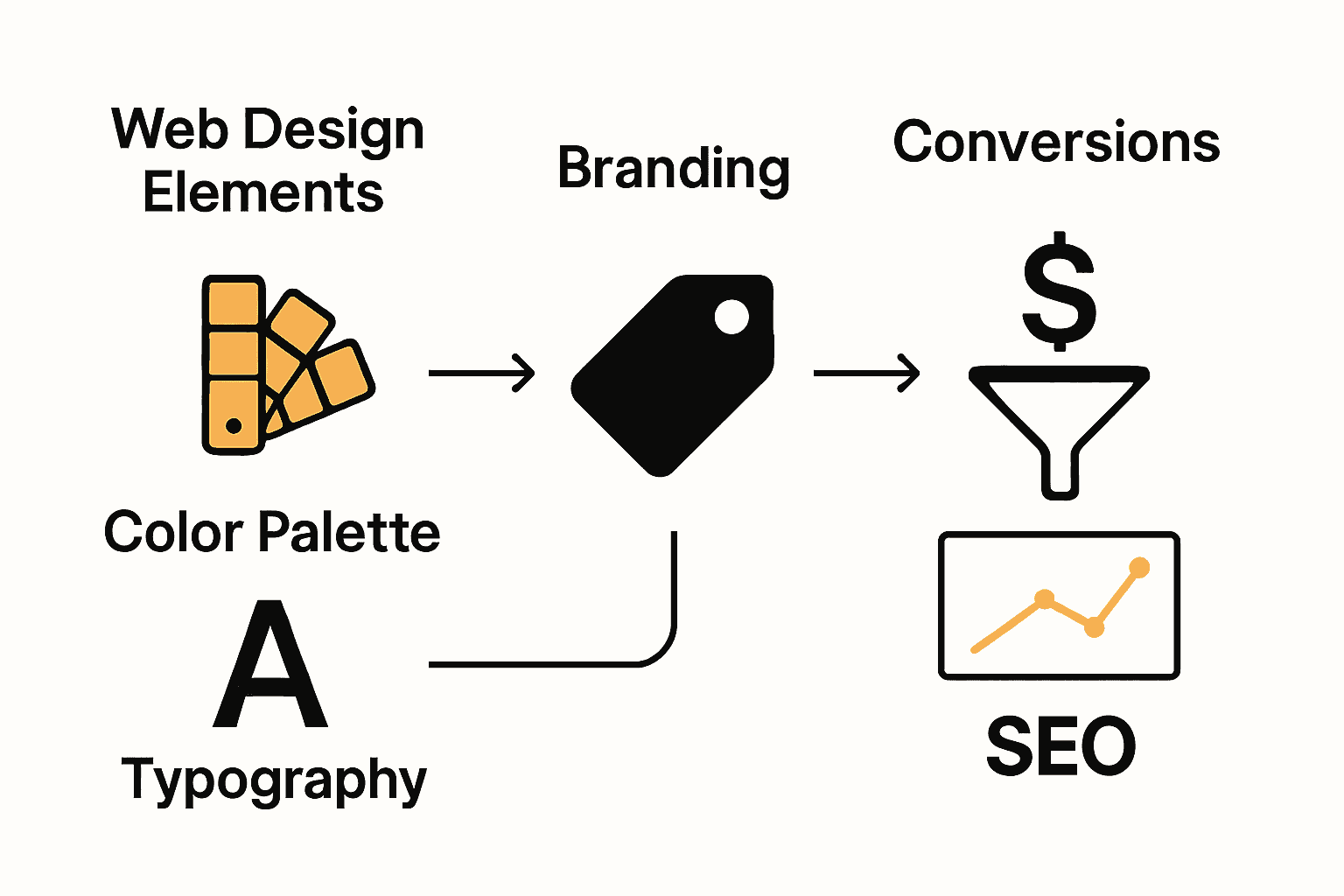
| Web Design Element | Marketing & Branding Impact | Conversion Rate Impact | SEO Performance Impact |
|---|---|---|---|
| Colour Palette | Strengthens brand identity | Directs user attention | Aids consistency across pages |
| Typography | Communicates professionalism | Improves readability | Enhances content clarity |
| Mobile Responsiveness | Ensures brand coherence on devices | Reduces bounce rates | Vital for search rankings |
| Page Load Speed | Maintains positive perception | Minimises visitor drop-off | Improves site ranking |
| Visual Hierarchy | Guides storytelling | Focuses user on CTAs | Clarifies content structure |
| Navigation Structure | Reinforces brand organisation | Simplifies user journey | Improves crawlability |
| Logo Placement | Promotes instant recognition | Builds user trust | Contributes to professional appeal |
Search engine optimisation is deeply intertwined with web design, creating a symbiotic relationship that directly impacts online visibility and search rankings. Modern search algorithms evaluate websites holistically, considering design elements as critical indicators of user experience and content quality.
Technical design factors play a pivotal role in SEO performance. Websites must be structured with search engine crawlability in mind, ensuring that navigation is intuitive, page loading is swift, and content is easily discoverable by search engine algorithms. This means implementing responsive design, optimising image sizes, creating clean HTML structures, and establishing clear site hierarchies.
Key web design elements that significantly influence SEO include:
Understanding the intricate connection between design and search performance is crucial for businesses seeking online visibility. How Web Design Impacts SEO and How to Improve It offers comprehensive strategies for aligning your website’s design with search engine optimisation best practices, helping you create a digital presence that both looks impressive and ranks effectively.
In the competitive digital landscape, web design can make or break your marketing effectiveness. visualidentity.co.uk highlights that common web design mistakes including cluttered layouts, confusing navigation, and slow loading times can dramatically deter users and negatively impact conversion rates.
Understanding these critical design pitfalls is essential for businesses seeking to create compelling online experiences. According to ranktracker.com, overcomplicated designs and lack of mobile optimisation are frequent errors that can significantly hinder user experience and reduce potential conversions.
Most prevalent web design mistakes include:
Addressing these design challenges requires a strategic approach to digital marketing. 5 Common Mistakes to Avoid When Designing a Landing Page provides practical insights into transforming potential design weaknesses into powerful marketing opportunities, helping businesses create websites that not only look professional but effectively convert visitors into customers.
Understanding the pivotal role of web design in marketing involves recognising the challenges small and medium-sized businesses face. From ensuring seamless mobile responsiveness to creating captivating visual branding and optimising user experience for higher conversion rates, the journey can be complex and overwhelming. Common pain points include slow loading times, inconsistent branding, and unclear navigation that harm your online presence and limit customer engagement. Embracing strategic design elements like clean typography, intuitive layouts, and trust signals are essential for turning your website into a powerful marketing asset.
At Kickass Online, we specialise in tailored web development solutions that align perfectly with your business goals. Our team focuses on delivering high-converting websites with enhanced SEO performance and ongoing maintenance, ensuring your site not only looks stunning but performs consistently across all devices. Whether you want to refine your brand identity or boost your conversion rates, discover how our expert services in the Websites category can elevate your digital marketing results.
Ready to overcome common web design challenges and position your business for growth?
Explore personalised strategies that deliver measurable success by visiting Kickass Online. Start today with trusted recommendations from Recommendations and take the first step towards a website that truly works for your marketing ambitions.
Web design plays a crucial role in marketing as it serves as a strategic communication tool that enhances user engagement, reflects brand identity, and drives conversions through intuitive layouts and aesthetic appeal.
Effective web design impacts user experience by creating intuitive navigation, appealing visuals, and responsive designs, which all contribute to user satisfaction and retention, ultimately leading to higher conversion rates.
Key elements for effective branding in web design include a consistent colour palette, appropriate typography, strategic logo placement, and visual imagery that aligns with your brand’s narrative, all of which strengthen brand recognition and trust.
Web design influences conversion rates by incorporating elements like fast page load speed, clear call-to-action buttons, simplified navigation, and visual hierarchy, which together optimise user engagement and guide visitors toward desired actions.
Did you know that brands with consistent presentation across all platforms can increase revenue by up to 23 percent? In a digital world crowded with choices, your brand identity needs to be more than just a logo or catchy slogan. Standing out means connecting with people at every touchpoint, from your website design to the voice in each social media post. Crafting a strong digital brand is about building trust, sparking engagement, and making your business truly unforgettable.
| Takeaway | Explanation |
|---|---|
| 1. Define Your Brand Voice | Establish a unique communication style that resonates with your audience’s values and emotions. |
| 2. Optimise Website User Experience | Ensure your website is user-friendly, visually appealing, and responsive across devices for better engagement. |
| 3. Leverage Social Media for Engagement | Use social media strategically to share your brand story and foster authentic connections with your audience. |
| 4. Maintain Visual Consistency | Create cohesive visual branding across all channels to enhance recognition and trust among customers. |
| 5. Analyze and Adapt Branding Strategies | Regularly track performance metrics to refine your brand strategies and stay aligned with audience needs. |
Your brand identity is the personality and narrative that sets you apart in a crowded marketplace. According to research from academic sources, crafting a distinctive brand voice involves strategically developing a tone that authentically reflects your organisation’s core values and personality.
Think of your brand voice like a human character. Just as people have unique ways of speaking and expressing themselves, your business needs a consistent communication style that resonates with your target audience. Developing this unique voice means understanding three key elements:
To create your brand voice, start by answering fundamental questions. What makes your business different? What values drive your work? What emotional experience do you want to create for customers? Our guide on personal branding can help you dig deeper into these foundational elements.
Practically, this means developing clear communication guidelines. Document your brand voice characteristics. Create a style guide that outlines acceptable language, tone, and messaging across all platforms. This ensures consistency whether you are writing website copy, social media posts, or customer emails.
Remember: an authentic, well-defined brand voice transforms generic communication into a memorable brand experience that connects genuinely with your audience.
Your website serves as the digital front door to your business and plays a crucial role in shaping customer perception. Research suggests that website design is not just about aesthetics but about creating an emotional connection with users through strategic visual and interactive elements.
User experience goes far beyond simple navigation. It encompasses how visitors feel when interacting with your digital platform. Academic research highlights that integrating emotional design principles can significantly enhance website usability and user satisfaction.
To create a compelling user experience that reinforces your brand, focus on these key strategies:
A gradual approach to web design can help balance visual intensity and user conversion. This means incrementally adjusting interface elements and carefully tracking user behaviour to understand what resonates with your audience.
Our guide to improving user experience provides deeper insights into creating websites that not only look great but also connect emotionally with visitors. By thoughtfully designing your digital presence, you transform your website from a mere information portal into a powerful brand storytelling platform.
Remember that exceptional user experience is about anticipating and meeting user needs before they even realise what they want. It is a delicate dance of intuitive design, brand consistency, and emotional intelligence.
Social media is no longer just a communication channel it is a powerful platform for storytelling and brand building. Your digital presence can transform from a simple online profile to a dynamic narrative that connects with your target audience.
Brand recognition thrives on consistent and authentic communication. Research shows that businesses who maintain a unique voice across social platforms create stronger emotional connections with their audience. This means going beyond generic posts to share content that truly reflects your brand personality.
To effectively leverage social media for brand awareness, consider these strategic approaches:
Authenticity matters more than polished perfection. Audiences want to see the human side of your business. They are looking for real experiences, genuine interactions, and transparent communication.
Our guide on harnessing social media advertising can help you develop a more nuanced approach to digital brand building. By treating each social media post as an opportunity to tell your brand story, you transform casual followers into loyal brand advocates.
Remember that building brand awareness is a marathon, not a sprint. Consistency, creativity, and genuine connection are your most powerful tools in the digital landscape.
Visual branding is the silent language of your business. It communicates your story, values, and personality without saying a single word. Creating a consistent visual identity across all channels is not just about looking good it is about building instant recognition and trust.
Brand cohesiveness transforms casual interactions into memorable experiences. When customers see your logo, colour palette, or design style, they should immediately connect it with your unique brand narrative. This visual consistency acts like a digital fingerprint that distinguishes you from competitors.
To build a robust visual branding strategy, focus on these fundamental elements:
Research highlights that brand guidelines ensure all stakeholders maintain visual standards across various materials and channels. This means your website, social media, printed materials, and email templates should feel like they belong to the same cohesive family.
Our guide on web design strategies provides deeper insights into creating a visually compelling brand presence. By thoughtfully curating your visual elements, you transform scattered design choices into a powerful, unified brand story.
Remember that consistency does not mean monotony. It means creating a flexible visual system that can adapt while maintaining its core identity.
Search engine optimisation is not just a technical exercise it is your digital megaphone for attracting potential customers. Think of SEO as a strategic roadmap that guides online users directly to your business by making your website more visible and appealing to search engines.
Modern SEO goes beyond keyword stuffing and focuses on creating genuine value for users. Search engines reward websites that provide relevant, high quality content and deliver exceptional user experiences. This means your SEO strategy must balance technical optimisation with meaningful engagement.
To build a robust SEO approach, consider these foundational strategies:
Research indicates that optimising website elements can positively impact user engagement and conversion rates. By applying user centred design approaches, you can enhance website usability and potentially improve search engine rankings.
Our guide on boosting SME visibility provides deeper insights into developing a comprehensive SEO strategy. Remember that effective SEO is an ongoing process of refinement and adaptation.
Your goal is not just to rank higher but to create a digital presence that genuinely serves your target audience’s needs and questions.
Content marketing is your strategic storytelling platform where you transform information into connection. It is about crafting narratives that do not just inform but truly resonate with your target audience, establishing your business as a trusted resource.
Powerful content goes beyond selling it builds relationships and demonstrates expertise. By sharing valuable insights, you position your brand as a thought leader who genuinely understands customer challenges and provides meaningful solutions.
To develop a compelling content marketing strategy, focus on these core principles:
Research indicates that sharing valuable information helps establish expertise and builds thought leadership. This approach fosters trust by showing your deep understanding of industry challenges and your commitment to solving them.
Our content marketing strategies article provides deeper insights into creating content that truly connects. Remember that great content is not about broadcasting messages but about starting meaningful conversations.
Your goal is to become a go to resource that audiences seek out, not just another voice competing for attention.
Sustainable digital branding is not a one time project but a continuous journey of learning and adaptation. Your brand strategy should be a living document that evolves based on real world performance and changing market dynamics.
Data driven insights are the compass that guides your branding evolution. By systematically measuring and analysing your digital performance, you transform guesswork into strategic decision making.
To effectively track and refine your branding strategies, implement these key practices:
Research suggests a gradual approach to tracking website elements can help identify the optimal balance between user experience and visual intensity. This means making incremental adjustments and observing their impact.
Our blueprint for long term brand recognition provides deeper strategies for continuous brand improvement. Remember that successful branding is not about perfection but about persistent, thoughtful evolution.
Your goal is to remain agile adaptive and always aligned with your audience’s changing needs and perceptions.
Below is a comprehensive table summarising the key strategies and concepts for effective digital branding discussed throughout the article.
| Strategy | Implementation | Expected Results |
|---|---|---|
| Define Brand Identity | Develop unique voice reflecting core values; use style guides for consistent communication | Memorable brand experience, stronger audience connection |
| Optimise Website | Ensure consistent visual identity, intuitive navigation, mobile responsiveness | Enhanced user experience, emotional connection with visitors |
| Leverage Social Media | Choose platforms strategically; create original content; engage authentically | Stronger brand awareness, loyal audience engagement |
| Create Visual Branding | Develop brand guidelines; use consistent colour palette and typography | Instant recognition, cohesive brand narrative |
| Utilise SEO | Conduct keyword research; optimise content; improve performance; build quality backlinks | Increased visibility, improved user engagement and conversion rates |
| Engage with Content Marketing | Understand audience; diversify content formats; maintain quality; tell authentic stories | Established thought leadership, trusted brand resource |
| Track and Refine Branding Strategies | Set measurable goals; use analytics tools; conduct surveys; monitor competitors | Continuous improvement, alignment with audience needs |
Struggling to create a unique brand voice or optimise your online presence effectively? Many small and medium businesses face challenges such as ensuring consistent visual branding, improving user experience, and harnessing SEO to attract the right audience. This article perfectly outlines how a focused digital branding strategy can transform your customer connections and boost your business growth. Tackling issues like authentic storytelling and measurable branding success requires specialised knowledge and a partner who understands your goals.
At Kickass Online, we offer personalised solutions that address these exact pain points:
Our limited client intake policy means each business receives dedicated attention from our expert team, ensuring strategies are aligned with your evolving brand narrative. To discover practical tips and tailored approaches, explore our Tips and Tricks page.
Ready to move beyond generic digital marketing and build a sustainable brand identity? Visit Kickass Online today and connect with professionals who can help you implement the 7 essential branding strategies effectively. Don’t wait to transform your online presence and secure your competitive edge, schedule your consultation now and start your brand’s growth journey.
For real success stories and additional insights, check our curated Recommendations to see how we have empowered businesses like yours.
Creating a unique brand identity involves defining your brand’s personality, language, and the emotional connection you want to establish with your audience. Start by answering questions about what makes your business distinct and what values you want to communicate, and document these elements for consistency across all platforms.
To optimise your website, focus on consistent visual identity, intuitive navigation, and mobile responsiveness. Begin by reviewing your site’s layout and making adjustments to enhance user satisfaction within 30 days, ensuring it aligns with your brand values.
Choose social media platforms based on where your target audience is most active, and create original, authentic content that reflects your brand values. Plan to engage actively with your audience by responding to comments and messages regularly, aiming to build genuine relationships over the next few months.
Develop comprehensive brand guidelines that include your colour palette, typography, and logo specifications. Implement these across all your materials to ensure cohesion, and review them quarterly to adjust as needed, keeping your branding fresh and relevant.
Start by conducting keyword research to find the terms your audience uses, then optimise your website content to include these keywords naturally. Focus on improving site performance and building quality backlinks, tracking your progress to enhance visibility within three months.
Set clear, measurable goals such as engagement rates or conversion percentages, and use analytics tools to monitor your performance regularly. Conduct audience surveys and competitor analysis to gather insights, making iterative adjustments based on this data to improve your branding strategy over time.
Did you know that over 90 percent of customers check a business’s digital presence before making a purchase decision? Your online performance can make or break new opportunities. Knowing where your business stands online gives you a real edge in a crowded market. By uncovering patterns in your website analytics, social media, and customer behaviour, you lay the groundwork for smarter goals, better channel choices, and measurable results.
| Key Point | Explanation |
|---|---|
| 1. Assess Your Online Performance | Conduct a digital audit to analyze website analytics, social media metrics, and SEO rankings for a comprehensive understanding of your digital presence. |
| 2. Define Specific Digital Goals | Use the OGSM framework to create clear, measurable, and achievable digital goals that align with your overall business objectives. |
| 3. Select Appropriate Digital Channels | Identify where your target audience is most active online and choose digital channels that facilitate engagement and align with your strategic goals. |
| 4. Develop Actionable Digital Initiatives | Break down goals into specific actions, including timelines and responsibilities, to guide your strategy toward achieving the set objectives. |
| 5. Measure and Refine Outcomes | Regularly evaluate your digital strategy using KPIs and performance metrics to ensure continuous improvement and strategic alignment. |
To create an effective digital strategy, you need a clear understanding of your current online performance. According to Business Queensland, conducting a digital audit involves evaluating your business’s digital readiness by assessing your online presence and comparing it against industry benchmarks.
Start by gathering comprehensive data about your digital channels. This means examining your website analytics, social media engagement metrics, search engine rankings, and overall online visibility. Look beyond surface level numbers and dig into meaningful insights that reveal how potential customers interact with your digital platforms.
Utilise tools like Google Analytics to track key performance indicators such as website traffic, bounce rates, average session duration, and conversion rates. These metrics provide concrete evidence of how well your digital presence is performing. Arxiv Research suggests using a Balanced Scorecard approach to measure and enhance your information systems’ performance systematically.
Create a structured assessment checklist that covers critical areas

Here’s an overview of critical areas for assessing digital readiness:
| Assessment Area | Description | Key Metrics |
|---|---|---|
| Website Experience | Usability and design quality | Bounce rate Session duration |
| Mobile Responsiveness | Performance on mobile devices | Mobile traffic Load speed |
| SEO Ranking | Visibility in search results | Keyword ranking Organic visits |
| Social Media Engagement | Interaction on social platforms | Likes Shares Comments |
| Conversion Rate Performance | Visitor actions leading to outcomes | Conversion rate Leads generated |
| Content Relevance and Quality | Value and consistency of content | Page views Time on page |
Don’t just collect data. Interpret it critically. Identify patterns that indicate strengths and weaknesses in your current digital strategy. Are visitors leaving your website quickly? Do your social media posts generate meaningful interactions? Understanding these nuances will guide your strategic improvements.
The insights you gather now will become the foundation for targeted digital enhancements. In the next steps, you will transform these findings into a robust action plan that elevates your online presence and drives business growth.
In this crucial stage, you will transform your digital performance insights into concrete, actionable objectives. According to Business Queensland, outlining digital business goals involves specifying desired achievements such as streamlining costs, enhancing customer communication, or implementing new technologies.
To craft meaningful digital goals, adopt a structured approach. Wikipedia recommends the OGSM framework, Objectives, Goals, Strategies, and Measures, which provides a systematic method for defining strategic digital goals. This framework helps you set qualitative ambitions, quantitative targets, key approaches, and tracking metrics.
Start by answering fundamental questions about your business objectives. What do you want to achieve online? Are you looking to increase website traffic, improve conversion rates, expand your social media presence, or reduce customer acquisition costs? Be specific and measurable in your goal setting.
Create goals that are
For instance, instead of a vague goal like “improve online presence,” define a precise objective such as “increase website conversion rate by 20% within six months by optimising landing page design and implementing targeted marketing campaigns.”
Focus on aligning your digital goals with broader business objectives. This ensures your online efforts directly contribute to your overall growth strategy. Digital Marketing Roadmap for SMEs can provide additional guidance in creating a cohesive digital strategy.
Remember that goal setting is an iterative process. Remain flexible and willing to adjust your objectives as you gather more data and insights about your digital performance.
Choosing the right digital channels is critical for reaching your target audience effectively. According to ResearchGate, selecting appropriate digital channels involves understanding various online platforms and data to implement communication objectives that align with organizational goals.
Start by mapping out where your target audience spends their online time. Different demographics prefer different platforms social media sites, professional networks, industry forums, and content sharing platforms each have unique characteristics and audience demographics.
Consider the strengths of various digital channels
Analyse your previous digital performance data to identify which channels generated the most meaningful interactions. Look beyond vanity metrics like follower counts and focus on engagement rates, conversion potential, and alignment with your strategic goals.
Pro Tip: Not all channels are created equal. Quality trumps quantity every time.
To refine your channel selection, Multi Channel Marketing for SMEs offers insights into creating a balanced digital presence. Consider your resources realistic budget, content creation capabilities, and team expertise when choosing platforms.
Remember that digital channel selection is not a one time decision. Remain adaptable and willing to experiment. As your business evolves and digital landscapes shift, your channel strategy should remain dynamic and responsive to emerging opportunities.
With your digital goals and channels identified, it is time to transform strategy into concrete actions. According to Business Queensland, developing a digital action plan involves listing all necessary actions to achieve digital goals, assigning priority rankings, and integrating these actions into a comprehensive strategy.
Break down your overarching digital objectives into specific tactical initiatives. Each initiative should be precise measurable, time bound, and directly linked to your strategic goals. Consider creating a structured roadmap that outlines key activities, required resources, responsible team members, and expected outcomes.
Key components of actionable digital initiatives include
Prioritise your initiatives based on potential impact and feasibility. Some actions will deliver immediate results while others represent longer term investments in your digital infrastructure. Be strategic about sequencing these initiatives to maintain momentum and adaptability.
Pro Tip: Start with high impact low complexity initiatives to build early momentum and team confidence.
To help track your progress and measure the effectiveness of your digital initiatives, Measuring the ROI of Your Digital Marketing Campaigns provides comprehensive insights into performance evaluation.
Remember that crafting actionable initiatives is an iterative process. Stay flexible and prepared to adjust your approach based on emerging insights and changing business landscapes. Your digital strategy should be a living document that evolves with your organisation.
The final step in your digital strategy involves continuous evaluation and strategic refinement. According to Arxiv Research, the Balanced Scorecard approach offers a framework to evaluate information systems agility through perspectives like business contribution and user orientation.
Wikipedia highlights that the OGSM framework emphasises defining clear measures to track progress, ensuring digital strategies are effectively monitored and refined based on performance metrics. This means moving beyond simple data collection to meaningful performance analysis.
Establish a comprehensive measurement system that tracks
Regular performance reviews are crucial. Schedule monthly or quarterly assessments to analyse your digital strategy’s effectiveness. Look for patterns trends and unexpected outcomes that might require strategic adjustments.
Pro Tip: Data without context is just noise. Always interpret metrics through the lens of your broader business objectives.
To support your measurement efforts, Digital Marketing KPIs Every SME Needs provides essential insights into tracking the most relevant performance indicators for small businesses.
Remember that refinement is an ongoing process. Be prepared to pivot quickly adapt your strategy and experiment with new approaches based on your performance data. Your digital strategy should be a dynamic living document that evolves with your business landscape.
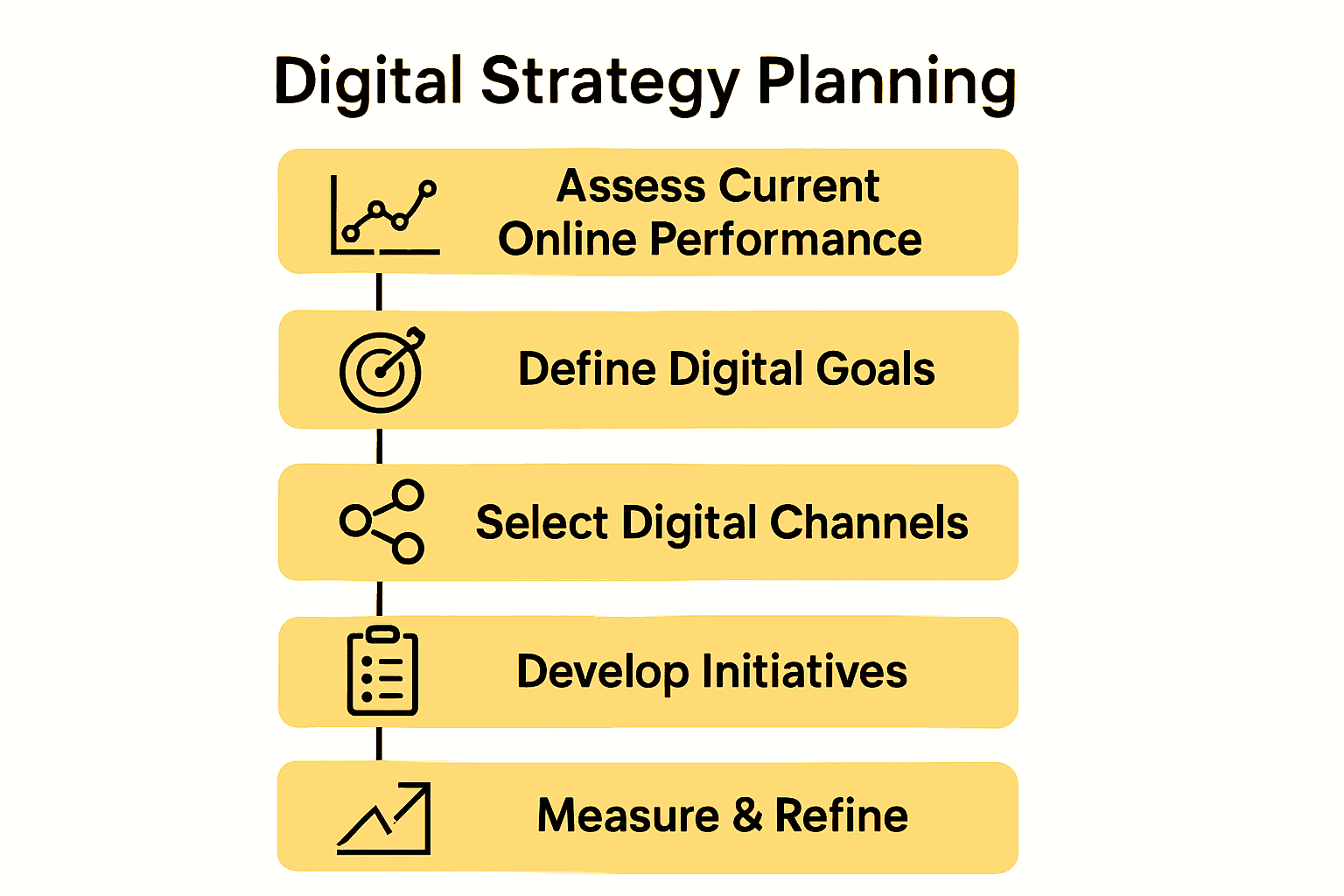
Struggling to transform overwhelming digital data into clear, measurable goals that drive success? This article highlights the challenge of assessing digital readiness and defining specific, actionable objectives essential for business growth. At Kickass Online, we understand how daunting it can be to select the right digital channels and craft initiatives that truly convert visitors into customers.
Discover expert guidance on website design, SEO optimisation, and ongoing maintenance that ensure your digital strategy is not just a plan but a proven pathway to results. Whether you need to improve your website’s usability, boost search engine rankings, or measure campaign success effectively, our personalised solutions provide the support you need.
Explore practical advice and proven tactics in our Tips and Tricks | Kickass Online section to start making meaningful improvements today.
Take control of your digital future now by partnering with Kickass Online. Book a consultation to receive dedicated attention from our team of specialists who prioritise your unique business needs. Don’t let unclear digital activities hold your growth back. Visit our Recommendations | Kickass Online page and begin crafting a high-impact online presence with expert help today.
To assess your current online performance, collect data from your website analytics, social media metrics, and search engine rankings. Start by reviewing key performance indicators like bounce rates and conversion rates to identify strengths and weaknesses in your digital presence.
Set specific digital goals that are clear, measurable, achievable, relevant, and time-bound (SMART). For example, aim to increase website traffic by 25% within three months through targeted content creation and marketing efforts.
Identify which digital channels your target audience uses most frequently and evaluate their effectiveness based on past performance data. Focus on engaging platforms that align with your business goals, such as social media for brand awareness or email marketing for direct communication.
Actionable digital initiatives should include specific tasks, realistic timelines, assigned responsibilities, and measurable outcomes. For instance, create a timeline for optimising your website’s landing pages to improve the conversion rate by 15% within four months.
Measure the success of your digital strategy by establishing a set of key performance indicators (KPIs) tailored to your goals, such as customer engagement metrics and conversion rates. Schedule regular reviews, such as quarterly assessments, to update your strategy based on performance data.
Refine your digital strategy by continuously analyzing performance data and adjusting your initiatives based on insights gained. Regularly assess what’s working and what’s not, and be prepared to pivot your approach to adapt to changes in the digital landscape.
Did you know that over 60 percent of the world’s population is now online, shaping the way businesses connect with people every day? As users spend more time browsing and searching for solutions, the digital space has become a busy market for brands to grow and reach new audiences. Understanding digital marketing gives everyone from small businesses to large companies the knowledge to build stronger connections, deliver real value, and compete where it matters most.
| Point | Details |
|---|---|
| Digital Marketing Overview | Digital marketing utilises online platforms to promote products and connect with customers, focusing on driving sales and brand awareness. |
| Core Strategies | Key strategies include SEO, content marketing, social media, email marketing, and PPC, all working together to achieve marketing objectives. |
| Business Growth Drivers | Digital marketing enhances customer relationships through precise targeting, cost-effective strategies, and personalised experiences, leading to business growth. |
| Common Pitfalls | Avoid pitfalls like undefined audiences, inconsistent branding, and neglecting analytics to ensure effective digital marketing efforts. |
Digital marketing represents a comprehensive strategy of promoting products, services, and brands through digital platforms and online technologies. According to research from Coursera, digital marketing utilises internet technologies to connect with customers, aiming to increase brand awareness and drive sales through strategic online approaches.
At its core, digital marketing encompasses multiple strategic channels designed to reach potential customers where they already spend significant time - online. These strategies include:
By leveraging these digital channels, businesses can create precise, measurable marketing campaigns that deliver significant advantages over traditional marketing methods. How Can Digital Marketing Help A Small Business? demonstrates how even smaller organisations can compete effectively by using strategic online approaches.
The ultimate purpose of digital marketing goes beyond mere promotion - it’s about creating meaningful connections, understanding customer needs, and delivering personalised experiences that resonate with target audiences. By using data-driven insights and interactive platforms, businesses can build stronger, more responsive relationships with their customers in ways traditional marketing never allowed.
According to research from Coursera, digital marketing encompasses several core strategies designed to help businesses effectively engage and convert potential customers across online platforms. These strategies are not standalone tactics but interconnected approaches that work synergistically to achieve comprehensive marketing objectives.
The primary digital marketing strategies include:
As How Digital Marketing Is Changing The Way We Do Business highlights, successful implementation requires a strategic approach. Research from Monash University suggests that effective digital marketing involves setting clear goals, understanding target audiences, and continuously monitoring and optimising campaign performance.
Each strategy serves a unique purpose in the digital ecosystem, working together to create a comprehensive marketing approach that reaches potential customers through multiple touchpoints.

Here’s a summary comparison of the core digital marketing strategies:
| Strategy | Primary Purpose | Typical Channels/Tools |
|---|---|---|
| SEO | Boost organic search visibility | Google, Bing, Website |
| Content Marketing | Attract and inform audiences | Blogs, Articles, Videos |
| Social Media | Direct engagement with users | Facebook |
| Email Marketing | Personalised communication | Newsletters, Promotions |
| PPC Advertising | Rapid reach via paid visibility | Google Ads, Social Ads |
| By integrating these strategies thoughtfully, businesses can create more dynamic, responsive, and effective marketing campaigns that adapt to changing consumer behaviours and technological landscapes |
.
According to research from the University of Sussex, digital marketing enables businesses to enhance customer relationships and optimise communication strategies in the dynamic online environment. By leveraging technological capabilities, companies can transform traditional growth approaches into more targeted, efficient marketing strategies.
Key ways digital marketing drives business growth include:
How to Increase Sales with Digital Marketing demonstrates how strategic online approaches can directly impact revenue generation. Research from Oxford University’s business school highlights that digital marketing allows businesses to adapt to technological disruptions by effectively analyzing and leveraging data for strategic decision-making.
The transformative power of digital marketing lies in its ability to create value through intelligent, data-driven strategies.
By understanding customer behaviours, preferences, and interactions across digital platforms, businesses can develop more responsive, innovative approaches that not only drive growth but also build long-term customer loyalty and competitive advantage.
According to research from the University of York, successful digital marketing demands a comprehensive understanding of strategic planning and execution across digital channels. This requires professionals to critically analyse the digital landscape and develop sophisticated marketing initiatives that align with broader business objectives.
Key responsibilities in digital marketing include:
Staffordshire University’s research highlights that implementing digital marketing capabilities involves assessing digital landscape impacts and creating strategic recommendations that achieve specific business goals. 10 ChatGPT Prompts for Entrepreneurial Self-Discovery illustrates how professionals can leverage innovative tools to enhance strategic thinking and digital marketing approaches.
Ultimately, success in digital marketing requires a dynamic, adaptable approach. Professionals must blend analytical skills with creative thinking, continuously learning and adjusting strategies to meet evolving digital consumer behaviours and technological advancements. By maintaining a holistic view of digital marketing’s complex ecosystem, marketers can develop targeted, effective campaigns that drive meaningful business results.
According to research from Durham University, one of the most significant challenges in digital marketing is understanding the strategic relevance of digital technologies and avoiding misalignment with organizational objectives. Recognising potential risks early can prevent costly mistakes and ensure more effective marketing campaigns.
Common digital marketing pitfalls include:
Staffordshire University’s research emphasises the importance of evaluating digital disruptive challenges to develop practical marketing plans. 10 ChatGPT Prompts for Entrepreneurial Self-Discovery offers insights into strategic thinking that can help businesses avoid common digital marketing mistakes.
Risk mitigation requires a proactive approach. Businesses must continuously assess their digital marketing strategies, remain agile in their approach, and be willing to pivot when current methods are not delivering desired results. By maintaining a critical perspective and staying informed about emerging trends and technologies, organisations can transform potential pitfalls into opportunities for growth and innovation.
Struggling to navigate the complex world of digital marketing strategies such as SEO, content marketing and personalised campaigns? The challenge of reaching the right audience while maintaining consistent branding and leveraging data insights often overwhelms many businesses. If you want tailored, results-driven support to overcome these hurdles and see measurable growth, Kickass Online is here to help. Our experts specialise in creating high-converting websites, optimising search engine rankings and delivering ongoing website maintenance designed specifically for small and medium-sized businesses.
Discover proven approaches and actionable advice in our Recommendations | Kickass Online while exploring personalised digital marketing strategies that boost your online visibility and build meaningful customer connections.
Take control of your digital presence today by partnering with a dedicated team focused on your success. Visit Kickass Online to book a consultation and learn how our comprehensive services can help you implement the digital marketing techniques discussed in this guide. For additional insights and tips to sharpen your approach, explore our Tips and Tricks | Kickass Online for expert guidance tailored to your growth journey.
Digital marketing is a strategy that promotes products, services, and brands through digital platforms. It helps businesses connect with customers online, increasing brand awareness and driving sales through targeted strategies.
The core digital marketing strategies include Search Engine Optimisation (SEO), Content Marketing, Social Media Marketing, Email Marketing, and Pay-Per-Click (PPC) Advertising, each working together to engage potential customers effectively.
Digital marketing drives growth by enabling precise audience targeting, reducing marketing costs, providing real-time performance tracking, and offering global access to markets while creating personalised customer experiences that enhance engagement and loyalty.
Common pitfalls include failing to define the target audience, inconsistent branding, neglecting analytics, overextending resources across too many channels, and sticking to outdated strategies. Recognising these can help prevent costly misalignments with business objectives.
Article generated by BabyLoveGrowth
Over 80 percent of brands now rely on digital agencies to help shape their online strategies. As businesses compete for attention in a crowded digital world, expert guidance makes all the difference. A strong partnership with the right agency can turn online confusion into opportunity, giving companies the tools and insights to connect with customers, build lasting brands, and achieve real growth.
| Point | Details |
| Digital Agencies as Strategic Partners | Digital agencies bridge technology and marketing, providing expert services crucial for online brand development and strategic advantage. |
| Comprehensive Service Offerings | They offer a range of services including SEO, digital marketing, and web analytics to help businesses enhance their online presence and performance. |
| Agency vs. In-House Teams | Partnering with digital agencies provides specialised expertise and flexible resources compared to the fixed costs and limited scope of in-house teams. |
| Potential Benefits and Challenges | While agencies offer significant advantages in expertise and scalability, businesses must also navigate communication complexities and alignment with brand messaging. |
A digital agency serves as a strategic partner transforming how businesses navigate the complex online landscape. According to academic research, these specialised organisations operate within the digital economy, providing expert services that bridge technology, marketing, and strategic consulting. They function as crucial intermediaries, leveraging digital platforms and advanced data analytics to facilitate communication and brand development for organisations.
At their core, digital agencies combine three critical elements: digital competence, digital confidence, and digital accountability. These agencies go beyond simple service provision - they actively help businesses make meaningful digital choices that drive tangible outcomes. Whether you’re a small local business or a growing enterprise, a digital agency acts as an extension of your team, translating technical capabilities into strategic advantages.
The roles of a digital agency are multifaceted and comprehensive. Typical services include:
Website Design and Development: Creating responsive, user-friendly digital platforms
Search Engine Optimisation (SEO): Improving online visibility and search rankings
Digital Marketing: Crafting targeted campaigns across multiple online channels
Content Strategy: Developing compelling digital narratives that engage audiences
Analytics and Reporting: Providing insights into digital performance and user behaviour
For businesses seeking to understand potential digital marketing partnerships, 7 questions to ask before hiring a digital marketing agency can provide additional guidance in making an informed decision.
Digital agencies provide a comprehensive suite of strategic digital solutions designed to help businesses thrive in the online ecosystem. According to research from digital marketing experts, these agencies leverage advanced digital platforms and data analytics to facilitate communication, commerce, and brand building for organisations across various industries.
The core services offered by digital agencies are typically multi-dimensional and tailored to meet specific business objectives. Digital marketing services form the backbone of their offering, which includes:
Search Engine Optimisation (SEO): Improving website visibility and search rankings
Digital Advertising: Creating targeted campaigns across multiple online channels
Content Marketing: Developing engaging digital narratives that attract and convert audiences
Social Media Management: Building and maintaining brand presence across digital platforms
Web Analytics: Tracking and interpreting online performance metrics
To maximise the potential of these services, businesses must understand how digital marketing can transform their growth strategy. How can digital marketing help a small business provides deeper insights into the tangible benefits these services can deliver. Digital agencies essentially act as strategic partners, translating complex digital landscapes into actionable, result-driven marketing approaches that generate leads, increase visibility, and ultimately drive positive return on investment.

Digital agencies are transformative partners that systematically accelerate online business growth through strategic digital interventions. According to research, these agencies leverage sophisticated digital platforms and data analytics to facilitate communication, commerce, and brand building for organisations across diverse industries.
The enhancement of online growth happens through multiple strategic approaches. Targeted digital strategies enable businesses to expand their reach, engage potential customers more effectively, and convert digital interactions into tangible business outcomes. Key growth mechanisms include:
Precision Targeting: Using advanced analytics to identify and reach ideal customer segments
Performance Optimisation: Continuously refining digital marketing strategies based on real-time data
By implementing comprehensive digital marketing techniques, agencies help businesses navigate the complex online landscape. How digital marketing is changing the way we do business highlights the profound impact of these strategic digital interventions.
Ultimately, digital agencies transform online potential into measurable business growth by creating intelligent, data-driven strategies that align technological capabilities with specific business objectives. They bridge the gap between digital complexity and business success, ensuring that every online interaction contributes to the organisation’s broader growth and visibility goals.
The decision between building an in-house digital marketing team and partnering with a digital agency is complex, with significant implications for a business’s online strategy. According to research, digital agencies function as specialised intermediaries that can either complement or strategically replace internal marketing resources, depending on an organisation’s specific needs and capabilities.
Key differences emerge when comparing these two approaches:
Here’s a comparison of in-house digital marketing teams versus partnering with a digital agency:
| Aspect | In-House Team | Digital Agency |
| Expertise | Limited to internal skills | Broad, specialised experience |
| Cost | Fixed salaries & ongoing training | Flexible, project-based pricing |
| Technology | Often limited by budget | Access to advanced tools |
| Scalability | Slower resource adjustment | Rapid resource flexibility |
| Perspective | Deep company integration | Objective external insights |
| Focus | Aligned with company culture | Fresh, trend-driven strategies |
Expertise: Agencies bring diverse, specialised skills across multiple digital disciplines
Cost: In-house teams involve ongoing salary and training expenses, while agencies offer flexible, project-based pricing
Technology: Agencies typically have access to advanced marketing tools and analytics platforms
Scalability: Digital agencies can quickly adapt resources to changing business requirements
Focus: Internal teams are deeply integrated with company culture, while agencies provide objective external perspectives
For businesses seeking deeper insights into making this critical decision, Six benefits of collaborating with a digital marketing agency provides a comprehensive overview of potential strategic advantages.
Ultimately, the choice depends on understanding your organisation’s unique digital marketing needs, budget constraints, and long-term growth objectives.
Partnering with a digital agency presents a strategic opportunity with both significant advantages and potential challenges for businesses seeking to enhance their online presence. According to research, these specialised partnerships offer unique opportunities for maximising digital visibility while simultaneously introducing complex dynamics that require careful consideration.
The key benefits of working with a digital agency are substantial:
Specialised Expertise: Access to advanced digital marketing skills and cutting-edge technologies
Scalable Resources: Flexible capacity to adjust marketing efforts quickly
Cost-Effectiveness: Reduced overhead compared to maintaining full-time internal teams
Objective Perspective: Fresh, external insights into marketing strategies
Comprehensive Solutions: Integrated approach to digital marketing challenges
However, potential drawbacks demand strategic evaluation. Organisations must navigate challenges such as potential misalignment with internal brand messaging, communication complexities, and the ongoing investment required to maintain an effective partnership. How to avoid low-quality digital marketers offers critical guidance for businesses seeking to mitigate risks and maximise the potential of their digital agency collaboration.
Ultimately, the decision hinges on a nuanced understanding of your specific business objectives, technological requirements, and capacity for external collaboration. Successful partnerships emerge from clear communication, aligned goals, and a mutual commitment to driving measurable digital growth.
The article highlights common challenges such as navigating complex online landscapes and making strategic digital choices that truly drive growth. If you recognise the struggle to balance SEO optimisation, high-converting website design, and maintaining digital accountability, you are not alone. Many businesses find it difficult to access specialised expertise that delivers clear results without overwhelming cost or internal resource strain. At Kickass Online, we understand these key pain points and focus on offering personalised, comprehensive digital solutions from website development to ongoing online visibility enhancement.
Discover how partnering with a dedicated agency can transform your digital journey today. Explore expert insights and proven strategies in our Recommendations | Kickass Online to see real examples of success. Don’t settle for uncertainty when professional help is just a click away. Visit Kickass Online and access practical Tips and Tricks | Kickass Online to empower your business now. Book a consultation to start crafting your tailored digital marketing plan focused on growth and measurable results.
Digital agencies play multifaceted roles, including website design and development, search engine optimisation (SEO), digital marketing, content strategy, and analytics and reporting to enhance a business’s online presence.
Digital agencies use targeted digital strategies and advanced analytics to reach ideal customer segments, optimise performance, and turn digital interactions into tangible business outcomes, significantly accelerating online growth.
Hiring a digital agency offers specialised expertise, cost-effectiveness, access to advanced technology, and scalable resources, compared to in-house teams, which may have limited skills and slower adaptability.
Businesses should evaluate their specific digital marketing needs, budget constraints, and long-term growth objectives, as well as the agency’s expertise, communication practices, and alignment with their brand messaging.
7 Questions to Ask before Hiring a Digital Marketing Agency | Kickass Online
Six Benefits of Collaborating with a Digital Marketing Agency
Running a business in 2025 often means juggling multiple responsibilities at once. From customer service to marketing, operations to finance, the workload can quickly become overwhelming. The good news is that artificial intelligence (AI) has matured to a point where it can now handle a large share of these tasks, saving both time and money. By automating up to 70% of your business activities, you can focus more on growth and strategy rather than repetitive, day-to-day operations.
This blog will guide you through the main areas where AI can take over, the tools available, and how to integrate them effectively into your workflow.
Businesses today face an increasingly competitive online environment. Customers expect fast responses, personalised experiences, and seamless digital interactions. For many small and medium-sized enterprises (SMEs), meeting these demands while keeping costs under control can be challenging. According to McKinsey, companies that have adopted AI-driven automation report a 20% improvement in efficiency and a reduction of up to 30% in operational costs. These figures highlight why more businesses are choosing to integrate AI into their processes.
AI-powered chatbots and virtual assistants can answer questions, process simple requests, and guide users to the right resources. This reduces the pressure on human support teams and ensures customers get quick answers 24/7. Tools such as Intercom and Zendesk have built-in AI features that make setup straightforward.
Digital marketing has become one of the most powerful areas for AI. A modern digital marketing agency would find it hard to work efficiently without automation. AI can handle:
By allowing AI to run much of the heavy lifting, marketing teams can focus on creativity and strategic direction.
Manual data collection and reporting take significant time. AI tools such as Tableau and Google Analytics Intelligence can process vast amounts of data, spot trends, and generate reports in seconds. This gives business owners better insights without requiring hours of manual work.
AI-driven accounting software can categorise expenses, generate invoices, and predict cash flow trends. Tools like Xero and QuickBooks now have built-in automation features, making financial management more efficient and less error-prone.
Websites are often the first interaction a potential customer has with your business. AI can help with website maintenance services, mobile optimisation, and even design. Platforms such as Wix ADI use AI to build user-friendly websites in minutes, while plugins can run constant security checks and performance monitoring in the background.
These examples show that AI automation is not only accessible but already reshaping industries at every level.
The key to success is identifying which tasks take up most of your time but do not necessarily need a human touch. Once you have listed them, you can find AI tools to handle those tasks. Here are some practical steps:
While AI can handle repetitive work, human input remains essential for creativity, relationship-building, and decision-making. Automation should not replace your team but support them. By freeing staff from time-consuming tasks, you give them space to focus on higher-value work, whether that is developing a new SEO strategy for SMEs, improving customer relationships, or brainstorming new services.
The adoption of AI is expected to grow even faster over the next five years. Gartner predicts that by 2027, more than 70% of organisations will21 rely on AI-driven decision-making across core business functions. Those who adopt early will not only cut costs but also deliver better customer experiences.
Businesses that view AI as a long-term partner rather than a short-term fix are the ones that will see the most benefit. Automation is no longer about replacing jobs but about working smarter and scaling faster.
Automating 70% of your business tasks is achievable with the right tools and approach. From customer support to marketing, finance, and website management, AI can transform the way you run your company. The time saved allows you to focus on growth, strategy, and building stronger connections with your customers.
If you are ready to explore how automation can boost your business and want expert guidance in areas like SEO services, PPC campaign management, and website maintenance, visit Kickass Online Ltd at https://kickassonline.com. Take the first step towards a smarter, more efficient business today.
The world of search engine optimisation is constantly changing, with algorithms evolving and new technologies emerging. The most disruptive force today is Artificial Intelligence (AI). From keyword research to content creation, AI is reshaping how we approach SEO and raising a big question: Can AI truly replace human expertise, or is the future a mix of both?
This is not just theory; it is a critical consideration for any business that wants to stand out in search engine results pages (SERPs). AI offers speed and powerful data analysis, but human SEO professionals bring creativity, strategy, and a deep understanding of user intent. Machines are still learning to replicate that.
In this article, we will explore the strengths and weaknesses of both AI and human-led SEO, compare how they handle core optimisation tasks, and share how businesses can best use both to build a strong digital presence.
AI has quickly moved from being futuristic to being a practical tool in digital marketing. AI-powered platforms can analyse massive datasets, find patterns, and automate repetitive tasks with impressive efficiency. This brings major advantages in several areas of SEO.
Data Analysis and Speed: AI can process vast amounts of data in minutes, identifying keyword trends, monitoring competitors, and analysing backlink profiles. What would take humans weeks can now be done instantly, allowing faster adjustments to SEO strategies.
Technical SEO Audits: AI tools excel at site crawls, spotting broken links, duplicate content, crawl errors, and speed issues. Automating these checks saves time and lets experts focus on strategy.
Keyword Research: AI-powered platforms can uncover long-tail keywords and semantic variations often missed by humans. Tools like SEMrush and Ahrefs provide detailed keyword insights, making content planning stronger and more data-driven.
Predictive Analytics: By analysing historical data, AI can forecast trends and prepare businesses for algorithm changes, making strategies more proactive.
Despite the strengths of AI, SEO is ultimately about people. Human intuition, creativity, and strategic thinking are irreplaceable. Machines can follow rules, but humans understand the “why” behind them.
Understanding Nuance and Intent: Humans interpret cultural context, tone, and emotion to create content that resonates with audiences. This is key to building trust and loyalty.
Strategic Thinking and Creativity: SEO is more than checklists. Humans connect SEO to broader business goals, build creative backlink strategies, and craft compelling narratives.
Adapting to Algorithm Updates: Humans can read between the lines when Google rolls out updates, drawing on experience and community insights to adapt.
Building Relationships: Earning quality backlinks requires networking, trust, and communication skills that AI cannot replace.
On-Page SEO
Off-Page SEO
Content Creation
PPC and SEO Synergy
The debate of AI versus human SEO is a false choice. The real power comes when they work together. AI handles the heavy lifting of analysis and automation, while humans focus on strategy, creativity, and building relationships.
Think of AI as a co-pilot. It provides insights and tools, but the human SEO professional is in the pilot’s seat, steering the strategy. This collaboration makes businesses more efficient and effective, whether it is website design, e-commerce optimisation, or ongoing site maintenance.
So, how do you create a strategy that blends AI and human expertise?
By combining the strengths of both, you can stay ahead of change and build a sustainable online presence.
The team at Kickass Online specialises in creating custom digital marketing strategies that combine AI technology with human expertise. We help your business rank higher, attract the right audience, and grow online.
Book a free 15-minute call with one of our SEO experts in Milton Keynes today and start building your winning strategy.
Is your website struggling to attract traffic or generate leads? You’re not alone. Many business owners face this challenge, often unaware of the underlying issues causing their websites to underperform. The good news? Most of these problems are fixable with the right insights and targeted solutions.
This guide will help you uncover why your website might be falling short, and how to transform it into a high-performing asset for your business. Let’s dive into the most common pitfalls and how to overcome them.
Your website is often the first impression your business makes. If it looks outdated or cluttered, it could be turning visitors away.
Solution:
Invest in professional website design services to create a modern, visually appealing, and user-friendly site. Clean layouts, intuitive navigation, and mobile responsiveness are crucial for keeping visitors engaged.
Without proper SEO, your website will be buried in search results, making it difficult for potential customers to find you.
Solution:
Implement a tailored SEO Strategy for SMEs that includes keyword optimisation, meta tags, high-quality content, and authoritative backlinks to improve your visibility and rankings.
Content drives engagement and builds trust. Outdated, sparse, or irrelevant content can damage your credibility.
Solution:
Partner with a reputable content marketing agency to produce high-quality blog posts, videos, and infographics. Consistently fresh and relevant content boosts both SEO and user retention.
Over half of website visitors will leave if a page takes more than three seconds to load. A slow site results in high bounce rates and missed opportunities.
Solution:
Use expert website maintenance services to improve load times. Optimise images, streamline code, and ensure your hosting provider offers reliable speed and uptime.
With more than 60% of web traffic coming from mobile devices, a poor mobile experience can drive potential customers away.
Solution:
Invest in Mobile Optimisation Services to ensure your site is responsive, fast, and easy to navigate on smartphones and tablets.
Without clear CTAs, visitors won’t know what to do next, resulting in lost conversions.
Solution:
Place bold, action-driven CTAs throughout your site. Phrases like “Sign up for our PPC Advertising Services” or “Shop Now for E-commerce Website Design” provide clear direction and encourage engagement.
If your business serves a local area, ignoring local SEO can severely limit your reach.
Solution:
Use Local SEO Services to optimise your Google Business Profile, target location-specific keywords, and create geo-focused landing pages that attract nearby customers.
Poorly targeted or unoptimised pay-per-click ads can drain your budget without delivering results.
Solution:
Partner with a professional PPC Campaign Management team to fine-tune your ads, target the right audience, and maximise your return on investment.
Backlinks are essential for building authority and boosting search rankings. Without them, your site may struggle to compete.
Solution:
Collaborate with a Backlink Building Services provider to develop a strategic outreach plan, including guest posting, content syndication, and influencer partnerships.
Even with decent traffic, a low conversion rate can sabotage your success. This could be due to poor user experience (UX), lack of trust signals, or weak messaging.
Solution:
Focus on Conversion Rate Optimisation (CRO) by improving design, adding trust badges, using persuasive copy, and conducting A/B testing to find what truly works.
Fixing a failing website isn’t about using a one-size-fits-all solution. It requires an expert approach tailored to your business’s unique goals. That’s where Kickass Online Ltd comes in.
We specialise in:
With proven results and a highly skilled team, we’re here to help your business succeed online.
Why settle for a website that doesn’t deliver? Contact Kickass Online Ltd today for a comprehensive website audit. We’ll identify key issues, implement tailored solutions, and turn your website into the powerful business tool it was meant to be.