
Over 90 percent of online experiences begin with a search, yet most sites never reach the first page of results. Strong SEO is the deciding factor between getting noticed or being overlooked in crowded markets. Understanding every crucial step, from setting clear goals to analyzing competitors and tracking your progress, can set your website apart. In this guide, you will discover practical ways to strengthen your digital presence and drive meaningful growth.
| Key Point | Explanation |
|---|---|
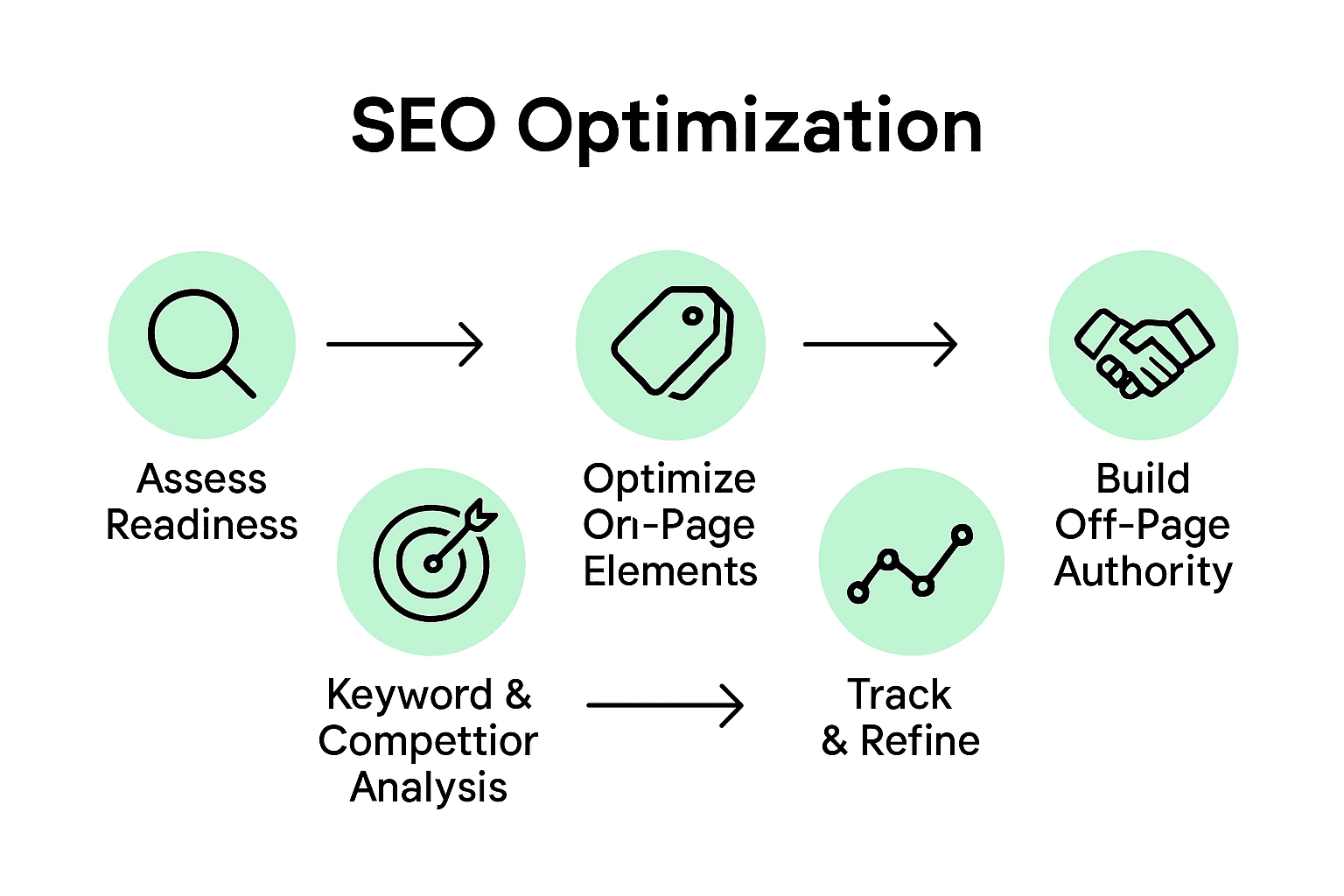
| 1. Assess Website Readiness Thoroughly | Conduct a detailed website audit focusing on loading speed, content relevance, and mobile responsiveness to identify areas for improvement. |
| 2. Perform Comprehensive Keyword Analysis | Identify primary and long-tail keywords that resonate with user intent to enhance strategic visibility and competitive positioning. |
| 3. Optimise On-Page Elements Effectively | Refine title tags, meta descriptions, and content structure to improve search visibility and user engagement through targeted SEO techniques. |
| 4. Enhance Off-Page SEO and Authority | Build high-quality backlinks and authoritative content while engaging with industry influencers to boost credibility and search rankings. |
| 5. Track Results for Continuous Improvement | Implement a robust tracking system to monitor SEO performance metrics, allowing for data-driven adjustments to strategies over time. |
In this critical first stage of SEO optimisation, you will systematically evaluate your website’s current performance and establish precise, measurable goals that align with your business growth objectives. According to research from ijarsct, investing in advanced SEO tools and thoroughly understanding your digital landscape is fundamental to success.
To begin, conduct a comprehensive website audit that examines multiple performance dimensions. The 8C model highlighted in arxiv offers an excellent framework for this assessment, focusing on key areas like content quality, user experience, and technical functionality. Start by reviewing your current website through these critical lenses: assess your site’s loading speed, mobile responsiveness, content relevance, keyword optimisation, and overall user navigation experience.
Key steps in your website readiness assessment include:
As you progress, set specific, measurable SEO goals that are realistic and time bound. These might include improving organic search rankings for specific keywords, increasing website traffic by a defined percentage, or reducing bounce rates. By establishing clear objectives, you create a roadmap for strategic SEO improvements that directly support your broader business growth ambitions.
In this critical stage of SEO optimisation, you will dive deep into understanding the keyword landscape and analyzing your competitors strategic positioning. According to research from arxiv, effective keyword analysis goes beyond simple ranking metrics and requires sophisticated extraction techniques that evaluate keyword significance through advanced centrality measures.
Your keyword and competitor analysis should encompass a comprehensive approach that combines multiple strategic elements. Begin by identifying primary and long-tail keywords relevant to your business using tools that provide search volume, competition level, and user intent insights. Using long-tail keywords can offer significant strategic advantages, particularly for businesses targeting specific market segments.
Key steps in your keyword and competitor analysis include:
Research from arxiv highlights the importance of integrating multiple business aspects into your analytical approach, suggesting that successful keyword strategy requires more than just technical metrics. By combining quantitative data with qualitative insights, you can develop a nuanced understanding of your competitive landscape and create a targeted SEO strategy that drives meaningful business growth.

In this crucial stage of SEO optimisation, you will transform your website into a search engine magnet by strategically refining every on-page element to boost visibility and user engagement. According to research from iiste, understanding and implementing targeted on-page optimisation techniques is fundamental to capturing your desired market segments.
Begin by conducting a comprehensive audit of your website’s core on-page elements. SEO elements play a critical role in effective web design, so focus on optimising key components such as title tags, meta descriptions, header structures, and content relevance. Ensure each page has a unique, keyword-rich title that accurately describes the content while maintaining natural readability. Craft meta descriptions that not only include target keywords but also entice users to click through from search results.
Key steps in optimising on-page elements include:
Research from Wikipedia highlights that superior knowledge of your competitive landscape provides a legitimate advantage. By meticulously optimising your on-page elements, you can strategically position your website to exploit potential weaknesses in competitors’ approaches, ultimately improving your search engine visibility and user engagement.
In this critical stage of SEO optimisation, you will strategically expand your website’s digital influence and establish powerful external signals that boost your search engine credibility. According to research from Similarweb, understanding and implementing a comprehensive off-page SEO strategy is fundamental to building your online authority and outperforming competitors.
Your off-page SEO efforts should focus on creating a robust network of high-quality backlinks and developing authoritative content that attracts natural external references. Understanding the power of high-quality backlinks is crucial for SEO success, so prioritise building relationships with reputable websites in your industry. Start by identifying potential link-building opportunities through guest posting, collaborative content creation, expert interviews, and strategic partnerships that align with your brand’s expertise.
Key steps in enhancing off-page SEO and building authority include:
Research from Yahini emphasises the importance of identifying content and keyword gaps in your market. By strategically positioning your content to address these gaps and consistently delivering high-value, authoritative information, you can progressively build your website’s reputation and domain authority in your specific industry niche.
In this crucial final stage of SEO optimisation, you will transform raw data into actionable insights that continuously improve your digital performance. According to research from Increv, measuring the impact of your content marketing requires a comprehensive approach that goes beyond surface level metrics to understand true business value.
Improving your website’s SEO metrics requires strategic tracking and analysis, so implement a robust monitoring system that captures multiple performance dimensions. Begin by establishing a baseline of key performance indicators including organic traffic, keyword rankings, conversion rates, bounce rates, and average session duration. Utilise advanced analytics tools to create customised dashboards that provide real time insights into your SEO performance.
Key steps in tracking results and refining SEO strategies include:
Research from Direction highlights the importance of evaluating competitor performance as part of your ongoing SEO refinement process. By continuously measuring, analyzing, and adapting your strategies based on concrete data, you can create a dynamic SEO approach that responds quickly to market changes and maintains your competitive edge.
Struggling to turn your SEO efforts into real business growth could leave your website unseen and your goals unmet. This article reveals essential steps like thorough website readiness evaluation, strategic keyword analysis, and building authoritative backlinks that can transform your online presence. You need more than just knowledge, you need tailored action that addresses issues such as poor keyword positioning, weak content relevance, and missed opportunities in off-page SEO.
At Kickass Online, we understand the frustration of navigating complex SEO workflows without clear results. Our focused team specialises in crafting personalised digital strategies that boost search engine visibility and drive measurable traffic growth. From outstanding Websites built for conversions to proven optimisation techniques documented in our Recommendations section, every solution is created with your business goals in mind.
Take control of your digital success today by partnering with Kickass Online. Don’t wait for your competitors to outpace you with better SEO. Visit Kickass Online to explore how our dedicated approach delivers results that matter now. Book a consultation and start turning your SEO optimisation workflow into a powerful growth engine.
Begin by conducting a comprehensive website audit that evaluates content quality, user experience, and technical functionality. Focus on aspects like loading speed, mobile responsiveness, and navigation to identify improvement areas.
Set clear and measurable SEO goals that align with your business objectives, such as improving keyword rankings or increasing website traffic by a specific percentage. Aim for targets like boosting organic search traffic by 25% within six months.
Conduct a thorough keyword analysis by identifying primary and long-tail keywords relevant to your business and assessing their search volume and competition. Look for long-tail opportunities that can drive more targeted traffic and lead to higher conversion rates.
Focus on optimising title tags, meta descriptions, header structures, and content relevance to improve on-page SEO. Ensure each page contains unique, keyword-rich titles and engaging meta descriptions that encourage users to click through.
Enhance your off-page SEO by creating high-quality backlinks and engaging in content marketing strategies like guest posting or industry partnerships. Regularly produce exceptional content, aiming to gain at least five backlinks from reputable sources within three months.
Set up comprehensive tracking using analytics to monitor key performance indicators such as organic traffic and keyword rankings. Regularly review this data to identify areas for improvement and adjust your SEO strategies accordingly, aiming for continuous enhancements every quarter.
Most visitors form an opinion about a business website in less than five seconds. That snap judgment rarely comes down to colours or logos alone. Branding in web design goes much deeper, shaping how people feel, trust, and connect with your brand online. Clear, consistent digital branding design turns your website into a memorable experience, helping you stand out, share your story, and win customer loyalty.
| Point | Details |
|---|---|
| Branding is More Than Aesthetics | Effective branding in web design communicates a business’s core identity and values through cohesive visual identity, brand messaging, and user experience. |
| Emotional Engagement is Key | Branding elements create emotional resonance and build trust, enhancing user experience and driving meaningful connections. |
| Integration is Essential | Successful web design requires a holistic approach, aligning every visual and functional element with the brand’s identity. |
| Avoid Common Mistakes | Brands should maintain consistent visuals, prioritise user experience, and effectively communicate their unique value proposition to avoid confusion and build credibility. |
Branding in web design represents far more than a mere visual aesthetic - it’s a strategic framework for communicating your business’s core identity through digital platforms. According to stan.vision, digital branding involves creating and maintaining a cohesive brand identity that captures a company’s essence, values, personality, and core messaging.
At its core, branding in web design is about crafting a consistent digital experience that resonates with your target audience. Bizango highlights that this process encompasses three critical elements: visual identity, brand messaging, and user experience. These components work together to create an engaging online presence that authentically reflects a company’s unique personality and professional standards.
Key aspects of effective web design branding include:
Successful web branding transforms your digital platform from a simple website into a powerful communication tool. It’s not just about looking good - it’s about creating meaningful connections that help potential customers understand who you are, what you stand for, and why they should choose your business over competitors.
Building a compelling website requires understanding the fundamental core branding elements that transform a generic online presence into a powerful digital representation of your business. These elements work together to create a cohesive, memorable brand experience that connects with your target audience and differentiates you from competitors.
Visual identity stands as the cornerstone of website branding. This encompasses your colour palette, typography, logo placement, and overall design aesthetic. Your visual elements should tell a consistent story - from the moment a visitor lands on your homepage to their interactions across different pages.
 For businesses looking to refine their approach, our guide to web design strategies offers comprehensive insights into creating a harmonious visual language.
Key core branding elements include:
Beyond aesthetics, effective website branding requires a deep understanding of your target audience’s expectations and emotional triggers. Your website should not just look good - it must communicate your unique value proposition, build trust, and create an intuitive user experience that guides visitors toward meaningful engagement with your business.
Successful web design is a strategic dance between visual aesthetics and brand storytelling. According to stan.vision, integrating branding into web design involves ensuring that every visual and functional element reflects the brand’s unique identity, creating a cohesive digital experience that resonates with your target audience.
Bizango emphasises that incorporating branding requires a holistic approach that aligns visual identity, messaging, and user experience. This means your website should be more than a collection of pages - it’s a living, breathing representation of your brand’s personality, values, and promise to your customers. For businesses seeking to refine their approach, our digital branding strategies guide provides comprehensive insights into creating a powerful online presence.
Key steps in integrating branding into web design include:
Ultimately, integrating branding into web design is about creating an immersive digital environment that doesn’t just showcase your business, but tells your unique story. It’s a powerful way to transform your website from a simple online presence to a compelling brand experience that captures attention, builds trust, and drives meaningful connections with your audience.
User experience goes far beyond simple website functionality - it’s an emotional journey that transforms how potential customers perceive and interact with your brand. Branding elements play a crucial role in shaping this journey, creating intuitive, engaging digital environments that speak directly to your audience’s needs and expectations.
The psychological impact of branding on user experience is profound. When users land on a website, they unconsciously form immediate impressions based on visual design, colour psychology, typography, and overall aesthetic coherence. For businesses seeking to understand these nuanced interactions, our guide to improving user experience offers comprehensive insights into creating meaningful digital connections.
Key ways branding influences user experience include:
Ultimately, exceptional user experience is about creating a seamless, emotionally intelligent digital environment. Your website should not just inform or sell - it should make users feel understood, valued, and inspired to engage with your brand on a deeper level.
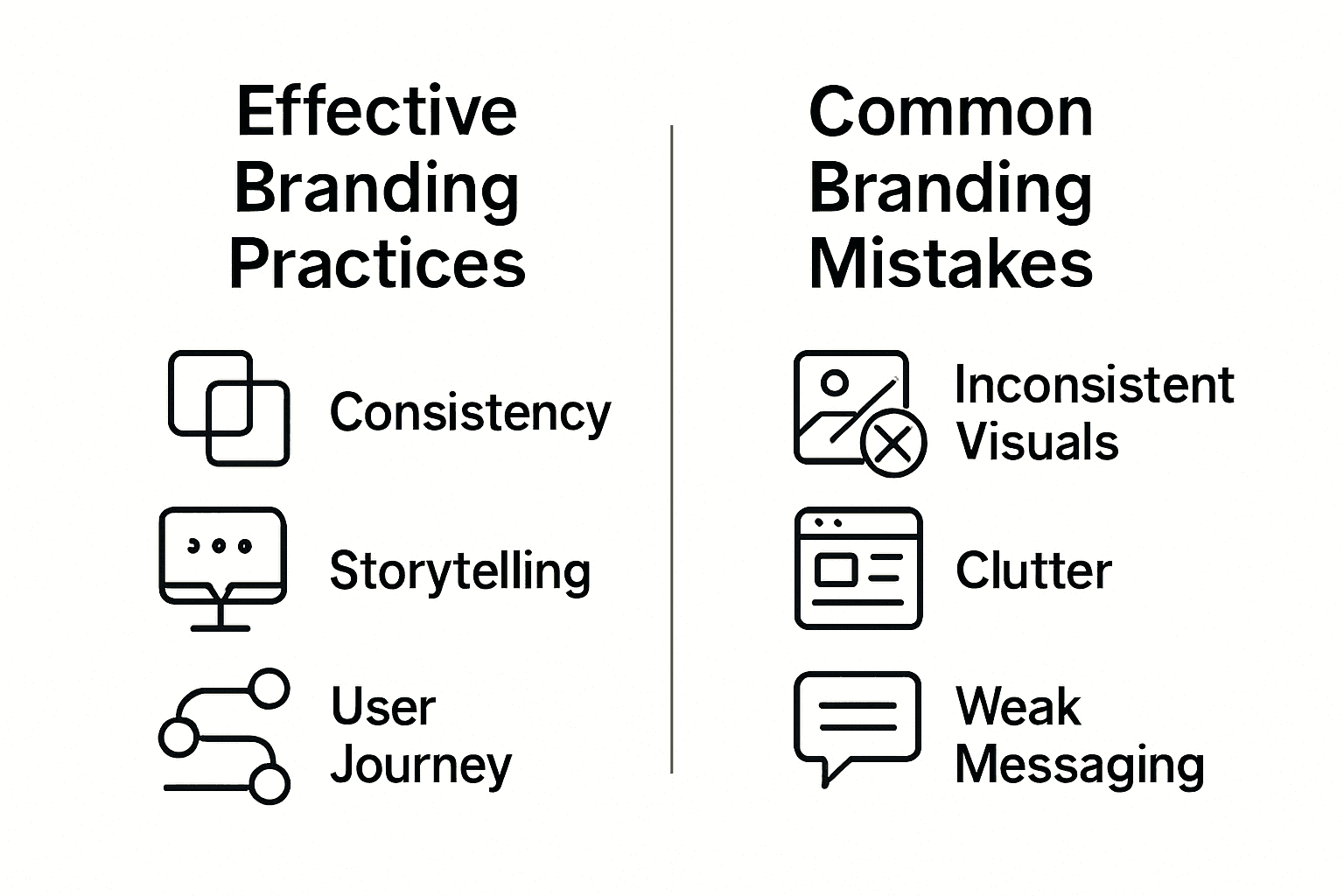
Navigating the complex landscape of web design requires strategic awareness of potential pitfalls that can derail your brand’s digital presence. According to stan.vision, one of the most critical branding mistakes is maintaining inconsistent visuals and messaging across different platforms, which can dramatically confuse users and weaken your brand’s core identity.
Bizango emphasises that failing to align visual identity, brand messaging, and user experience can fundamentally undermine a brand’s credibility. For businesses looking to avoid these common pitfalls, our guide to digital branding provides comprehensive strategies for maintaining a cohesive online presence.
Common branding mistakes in web design include:
Successful web design is about creating a harmonious, authentic digital environment that speaks directly to your audience. By understanding and avoiding these common mistakes, you can develop a powerful online presence that not only looks professional but also builds genuine connections with your potential customers.
Struggling to create a cohesive brand identity that truly connects with your audience can hold your business back in the digital world. This guide reveals how essential elements like colour schemes, typography, and intuitive user experience come together to craft a memorable online presence. If you want to move past common pitfalls such as inconsistent messaging or weak storytelling, professional support can make all the difference.
Discover how our team at Kickass Online transforms websites into powerful brand experiences that build trust and emotional resonance. Explore tailored strategies for enhancing your visual language and user journey with our Websites services. Ready to strengthen your digital identity now Visit https://kickassonline.com to book a consultation and learn more about our comprehensive digital marketing solutions crafted specifically for small and medium-sized businesses.
Branding in web design is a strategic framework that communicates a business’s core identity through digital platforms. It goes beyond visual aesthetics to create a cohesive brand identity that captures a company’s essence, values, and core messaging.
The core branding elements essential for a website include a consistent colour scheme, typography, logo integration, relevant imagery and graphics, and a clear tone of voice. These elements should work together to create a memorable brand experience.
Branding significantly impacts user experience by creating an emotional journey for visitors. Elements such as visual design, colour psychology, and intuitive navigation help shape users’ perceptions and interactions with the brand, enhancing trust and engagement.
Common branding mistakes in web design include inconsistent visual language, overcomplicated design, neglecting mobile responsiveness, weak brand storytelling, and ignoring user experience. Avoiding these pitfalls is crucial for maintaining a cohesive and professional online presence.
Most people judge a business within seconds of landing on its website. In a world where nearly every customer starts online, design choices mean much more than just colours or fonts. Web design now shapes how brands communicate, build trust, and drive results. This article unpacks what modern web design really involves and explains how the right approach can make any website stand out, connect, and convert.
| Point | Details |
|---|---|
| Evolving Role of Web Design | Web design is now a strategic communication tool that enhances user experience and brand identity while facilitating business interactions. |
| Responsive vs. Adaptive Design | Understanding the key differences between responsive and adaptive web design can empower businesses to create optimised digital experiences across devices. |
| Core Elements of Effective Design | Successful web design integrates aesthetic appeal with functionality, focusing on visual hierarchy, intuitive navigation, and engaging imagery. |
| Impact on SEO and Conversion | Effective web design is crucial for SEO and conversion rates, influencing search rankings and guiding users towards desired actions on the site. |
Web design has dramatically transformed from a purely aesthetic discipline into a sophisticated strategic communication channel for businesses. According to Online Masters, web design now plays a pivotal role in communications by enhancing user experience, reinforcing brand identity, and facilitating critical business interactions.
Modern web design transcends visual decoration. It serves as a comprehensive strategic tool that bridges communication between businesses and their target audiences. As detailed by EBSCO Research, web designers are responsible for creating the entire visual ecosystem of a website, which includes:
The contemporary web design landscape demands a holistic approach that integrates aesthetic appeal with functional performance. Know Why SEO and Web Design Must Work Together represents this critical intersection, highlighting how design elements directly impact digital visibility and user engagement. Web design is no longer just about making websites look good, it’s about creating intelligent, responsive digital experiences that communicate, convert, and connect with audiences instantaneously.
Web design has evolved significantly, presenting multiple approaches to creating digital experiences. Two primary methodologies have emerged as fundamental strategies: Responsive Web Design and Adaptive Web Design, each offering unique approaches to solving cross-device presentation challenges.
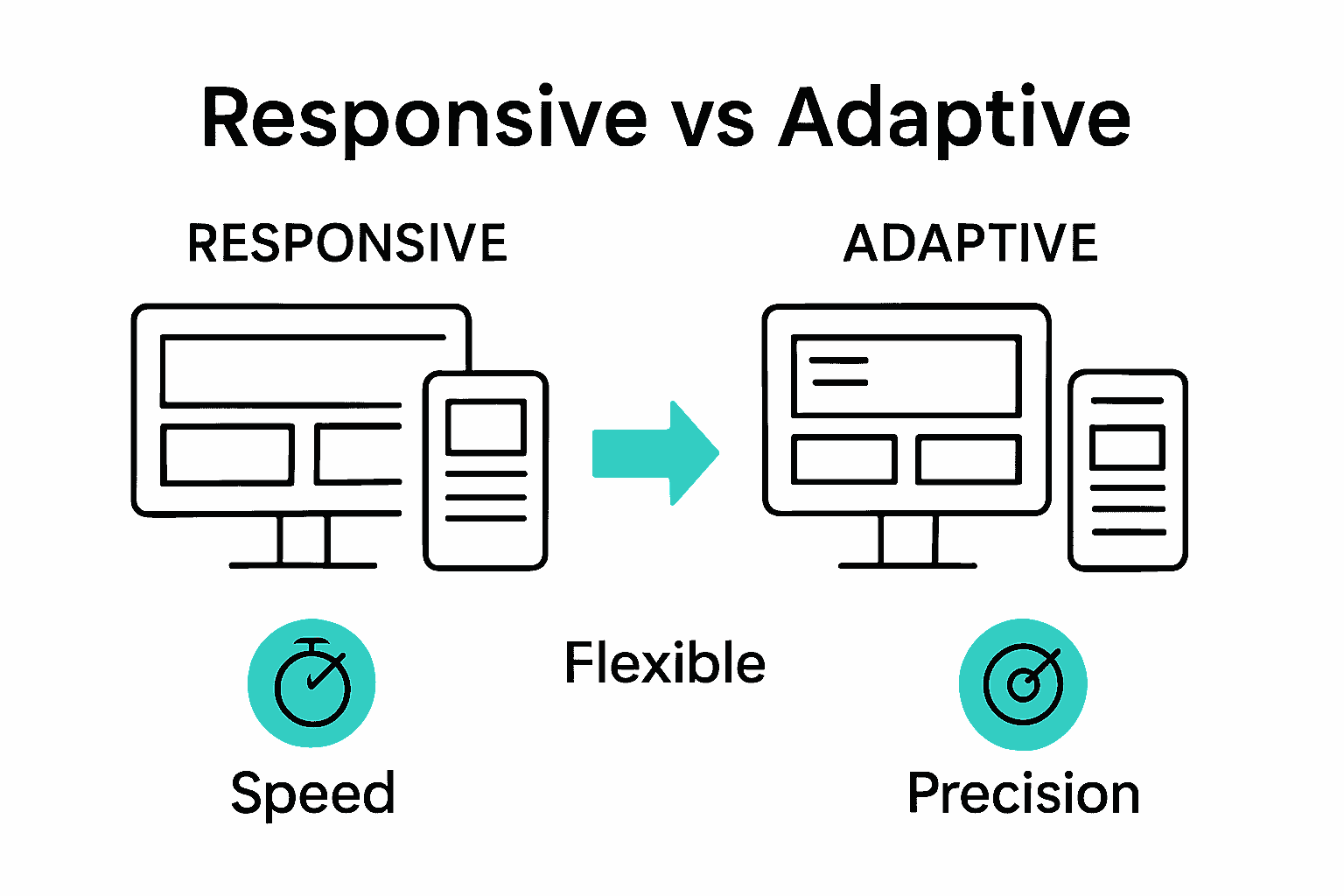
Wikipedia defines Responsive Web Design (RWD) as an innovative approach that enables web pages to render seamlessly across diverse devices and screen sizes. This technique utilises:
In contrast, Wikipedia explains that Adaptive Web Design (AWD) takes a different strategy, creating multiple tailored versions of web pages specifically optimised for different device types. This approach ensures more precise user experiences by crafting distinct layouts for various screen dimensions.
To help businesses navigate these design strategies, Web Design, Easy Tips for Making a Website That Stands Out provides critical insights into selecting the most appropriate design methodology. The key difference lies in implementation: responsive design uses a single flexible layout, while adaptive design generates multiple fixed layouts targeted to specific device characteristics.
 Understanding these nuanced approaches empowers businesses to create digital experiences that look stunning and function perfectly across smartphones, tablets, and desktop computers.

Effective web design is a delicate balance between aesthetic appeal and functional performance. Wikipedia reveals an intriguing aesthetic-usability effect, where people perceive more visually pleasing designs as significantly more intuitive and user-friendly.
The core elements of exceptional web design encompass several critical components:
Designing with Web Standards emphasises the importance of creating accessible, user-friendly websites through pragmatic implementation of design principles. This approach ensures that websites not only look attractive but also provide seamless user experiences across different devices and platforms.
To maximise the impact of these design elements, businesses can leverage insights from 5 Web Design Elements Guaranteed to Boost Conversions. The most successful web designs strike a perfect balance between visual storytelling and functional clarity, transforming websites from mere digital placeholders into powerful communication and conversion tools that engage, inform, and inspire visitors.
Web design is no longer just about aesthetics, it’s a critical driver of search engine performance and user conversion. According to Online Masters, web design is crucial to a site’s search engine rankings, directly influencing how websites appear in search results and attract organic traffic.
The technical elements that connect web design with SEO and conversion include:
EBSCO Research highlights that Search Engine Optimisation has become an integral aspect of web design, with keywords strategically embedded to drive search engine visibility. This means every design decision, from layout to content placement, impacts a website’s ability to attract and retain potential customers.
Businesses seeking to maximise their online potential can gain deeper insights from How Web Design Affects Conversion Rates: What the Data Says. The most successful websites understand that design is not just about looking good, but about creating a seamless, intuitive journey that guides visitors effortlessly from first click to final conversion.
Web design is an intricate process where seemingly minor mistakes can dramatically undermine a website’s effectiveness. Online Masters emphasises that a professionally designed website enhances a company’s credibility, making it crucial to avoid common design errors that could erode user trust.
The most prevalent web design pitfalls include:
EBSCO Research highlights the dynamic nature of web design, noting that trends like responsive design and enhanced scrolling are continuously evolving. This means designers must stay agile and avoid getting stuck in outdated design paradigms that no longer serve modern user expectations.
For businesses looking to refine their digital presence, 5 Common Mistakes to Avoid When Designing a Landing Page offers targeted insights. The key is understanding that great web design isn’t about perfection, but about creating intuitive, user-friendly experiences that guide visitors seamlessly towards their desired outcomes.
Understanding the vital role web design plays in user engagement and SEO is the first step to transforming your business website. If you are facing challenges with creating a seamless, responsive, and visually captivating site that truly communicates your brand’s value and drives conversions, you are not alone. The guide’s focus on responsive and adaptive design, aesthetic-usability balance, and the impact of layout on SEO and conversions highlights common hurdles businesses like yours encounter.
At Kickass Online, we specialise in crafting high-converting websites tailored to small and medium-sized businesses seeking to stand out in a crowded digital landscape. Our dedication to personalised, results-driven digital solutions means your website will not only look stunning but also perform flawlessly across all devices while boosting your search engine ranking. Discover how we blend creativity with technical expertise in our Websites | Kickass Online section.
Ready to stop losing visitors to slow or confusing websites? Take control of your digital communication now with Kickass Online. Visit us at Kickass Online to book your personalised consultation and explore practical insights in our Tutorials | Kickass Online. This is your chance to build a website designed to engage, convert and grow your business with expert support by your side.
Web design plays a pivotal role in enhancing user experience, reinforcing brand identity, and facilitating critical business interactions, making it a strategic communication channel for businesses.
Responsive web design adapts to different screen sizes using a single flexible layout, while adaptive web design offers multiple fixed layouts optimised for specific devices. Each approach provides unique user experiences across various devices.
Core elements of effective web design include visual hierarchy, intuitive navigation, consistent branding, responsive layout, clear typography, strategic colour palette, and engaging imagery, all contributing to an aesthetically pleasing and functional website.
Web design significantly impacts SEO and conversion rates by influencing page loading speed, mobile responsiveness, navigation intuitiveness, and the overall user experience. Good design practices enhance search engine visibility and facilitate smoother conversions.
More than 85 percent of consumers research online before making a purchase decision. Online visibility shapes how people find and interact with your business across digital platforms. Without a strong and consistent digital presence, even top-quality products or services can go unnoticed. Understanding the core concepts behind online visibility gives you the power to connect with new audiences, strengthen your brand reputation, and turn digital spaces into real growth opportunities.
| Point | Details |
|---|---|
| Importance of Online Visibility | Effective online visibility is crucial for businesses to engage with digital audiences and enhance their credibility across various platforms. |
| Strategic Online Positioning | Businesses should develop a cohesive strategy that integrates multiple channels to maximise their digital presence and foster meaningful interactions. |
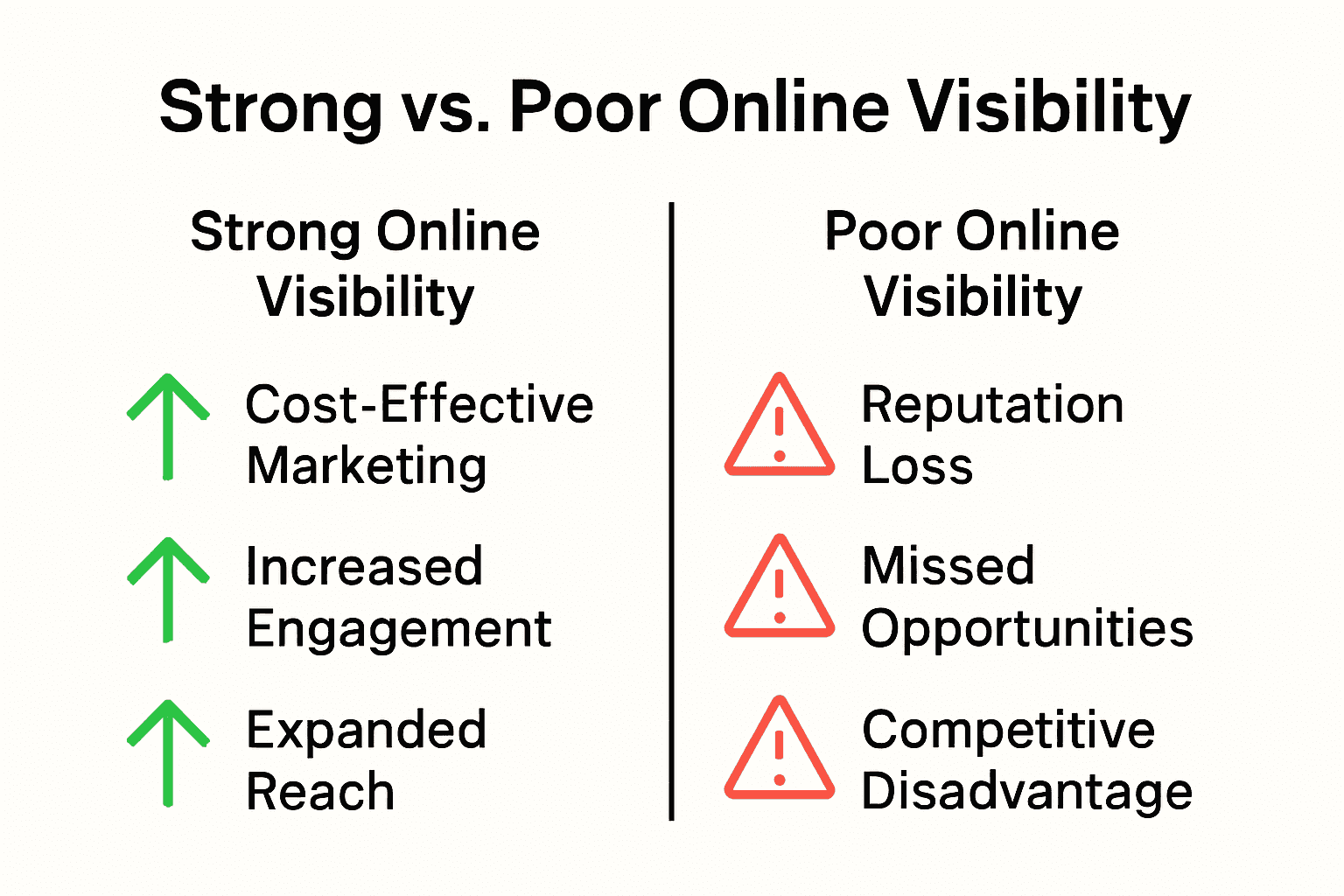
| Benefits for Small and Medium Businesses | Improved online visibility offers cost-effective marketing, broader market reach, and enhanced customer engagement, leveling the playing field against larger competitors. |
| Risks of Neglected Presence | A poor online presence can damage reputation, limit customer acquisition, and give competitors an advantage, leading to significant market share loss. |
Online visibility represents how businesses present themselves and engage with digital audiences across various online platforms. According to Wikipedia, online identity encompasses the ways individuals and businesses establish their social presence in digital spaces, directly influencing their visibility and reach.
At its core, online visibility involves strategic positioning of your business across multiple digital channels. This means creating a cohesive digital footprint that allows potential customers to discover, understand, and interact with your brand seamlessly. As Wikipedia explains, effective website governance plays a crucial role in maintaining a coherent online presence that builds credibility and attracts potential clients.
Key elements of online visibility include:

Understanding online visibility goes beyond simple digital marketing. It’s about creating an authentic digital identity that resonates with your target audience and communicates your brand’s unique value proposition. By developing a strategic approach to your online presence, you can transform digital platforms from mere communication tools into powerful business growth engines.
For a comprehensive strategy to enhance your online visibility, check out our guide on how to improve online visibility.
Businesses today have multiple channels to establish and enhance their online visibility, each offering unique opportunities for digital engagement. Wikipedia highlights the importance of social translucence, which involves creating digital systems that make participants and their activities transparent and coherent across online platforms.
The primary types of online visibility include:
According to Wikipedia, businesses can leverage internet universality principles to expand their online visibility. These principles emphasise human rights, openness, accessibility, and multi-stakeholder participation, creating a comprehensive approach to digital presence.
Strategic online visibility goes beyond mere presence. It requires creating meaningful, authentic interactions that resonate with your target audience. By understanding and implementing diverse visibility strategies, businesses can transform their digital footprint from passive to powerful.
For more insights on boosting your brand’s online recognition, explore our guide on ways to get your brand noticed online.
Educba highlights that building strong online visibility requires a multifaceted approach combining several digital marketing techniques. Businesses must develop a comprehensive strategy that integrates multiple channels to maximise their digital presence and reach potential customers effectively.
Key strategies for enhancing online visibility include:
Appmaster emphasises the power of paid advertising as a critical strategy for boosting online visibility. Techniques like pay-per-click advertising, Google Ads, display advertising, and remarketing can rapidly increase a business’s digital footprint and attract targeted traffic.
Successful online visibility isn’t about implementing individual tactics, but creating a cohesive digital strategy that connects multiple channels. Businesses must think holistically, ensuring consistent messaging, brand voice, and value proposition across all digital platforms.
To dive deeper into developing a robust online presence, check out our guide on SEO strategies for business growth.
Online visibility has become a game-changer for small and medium businesses, offering unprecedented opportunities to compete with larger corporations. Calhoun Companies highlights that strategic online positioning can significantly transform a business’s growth trajectory through targeted digital strategies.
Key direct benefits for small and medium businesses include:
GoSite emphasises the importance of local community connections, suggesting that small businesses can strengthen their online presence by collaborating with local influencers and businesses. This approach not only expands visibility but also builds trust and credibility within their immediate market.
Successful online visibility transforms small businesses from local players to competitive market participants. By investing in digital strategies, businesses can level the playing field, attract new customers, and create sustainable growth opportunities that were previously unavailable.
To understand how digital marketing can specifically benefit your small business, explore our guide on digital marketing strategies.
A neglected online presence can be devastating for modern businesses. Academic Publishing reveals that businesses providing limited or basic online information risk dramatically reducing customer trust and engagement, potentially creating long-lasting negative perceptions.
Key risks of poor online visibility include:
Wikipedia highlights that businesses failing to engage with digital citizens risk becoming irrelevant in an increasingly connected marketplace. The inability to connect meaningfully through digital channels can lead to significant market share erosion and reduced customer interaction.
Neglecting your online presence isn’t just about missing opportunities, it’s about actively pushing potential customers towards competitors who understand digital engagement. In today’s digital ecosystem, an invisible business is effectively a non-existent business.
To protect your brand’s reputation and avoid these pitfalls, explore our guide on reputation marketing strategies.
Online visibility requires strategic planning and consistent effort. Many businesses inadvertently sabotage their digital presence by making fundamental mistakes that can significantly limit their potential reach and impact.
Common online visibility mistakes include:
Online Biz Booster emphasises that neglecting online community engagement is a critical error. Businesses that fail to interact, collaborate, and build relationships within digital spaces severely restrict their potential to expand visibility and attract new customers.
The most damaging mistake is treating online visibility as a one-time task rather than an ongoing, dynamic process. Successful digital presence requires continuous learning, adaptation, and strategic refinement of your online approach.
To avoid these pitfalls and develop a robust digital strategy, explore our guide on digital marketing mistakes to avoid.
Struggling to stand out in the crowded digital world is a challenge many businesses face when their online visibility does not match their ambitions. This guide highlights critical pain points such as inconsistent branding, missed customer engagement, and poor search engine rankings that can hold your business back. Understanding terms like “search engine optimisation” and “digital reputation management” is just the start. What really matters is taking focused action to transform your digital presence into a powerful growth tool.
Boost your understanding with practical advice and Tips and Tricks to improve your brand’s exposure.
Take control of your digital future today with Kickass Online, where we specialise in personalised web development and SEO solutions designed exclusively for small and medium businesses. Our dedicated team ensures your website not only looks professional but also performs impeccably across search engines and devices. Do not let poor online visibility hold you back any longer. Explore our expert services at Kickass Online and discover how our customised strategies can turn your online presence into your strongest asset. Visit our Websites category to see how we bring this to life for clients just like you. Act now to secure your spot with our limited client intake and start growing with confidence.
Online visibility refers to how businesses present themselves and engage with audiences across digital platforms. It’s crucial as it influences customer perception, brand credibility, and ultimately drives traffic and sales.
You can enhance online visibility through various strategies, including search engine optimisation (SEO), content marketing, active social media engagement, and effective website performance optimisation.
A poor online presence can lead to reputation damage, missed business opportunities, and a competitive disadvantage as potential customers may choose competitors with stronger digital engagement.
Common mistakes include inconsistent branding, poor content strategy, technical SEO oversights, and neglecting community engagement, which can limit your potential reach and impact.
A business website has just seconds to capture attention before most visitors decide to leave or explore further. That first impression drives whether potential customers stick around or look elsewhere for solutions. Investing in a high-converting business website means creating more than a good-looking page, it means building trust and gently leading each visitor toward action. You will discover proven methods to craft a site that motivates, reassures, and turns casual visits into real business results.
| Takeaway | Explanation |
|---|---|
| 1. Optimise for Fast Loading Speed | Websites should load within 2-3 seconds to prevent bounce rates. Speed is essential for user retention and satisfaction. |
| 2. Create Intuitive Navigation | Clear menus and pathways help users find information easily, leading to improved user experience and conversion rates. |
| 3. Implement Compelling Call-to-Action Buttons | Strategically placed buttons with action-oriented text encourage user engagement and drive conversions effectively. |
| 4. Leverage SEO for Visibility | Optimise content beyond keywords to include valuable, comprehensive information that meets user needs and boosts rankings. |
| 5. Personalise Email Marketing Campaigns | Use segmentation and automation to deliver targeted, timely messages that enhance customer relationships and drive conversions. |
Your business website serves as the digital storefront for your brand and can make or break first impressions with potential customers. A high-converting website goes beyond mere aesthetics, focusing on strategic design that guides visitors towards taking specific actions.
According to Site123, successful websites integrate key elements that transform casual browsers into committed customers. The fundamental goal is creating an intuitive digital experience that builds trust, communicates value, and simplifies user journeys.
Key Components of a High-Converting Website:
Research from Jivochat emphasises the importance of trust signals like customer testimonials, industry credentials, and social proof. These elements reassure potential clients about your business reliability and expertise.
When designing your website, prioritise user experience. This means creating responsive designs that work seamlessly across mobile and desktop devices, using clean layouts, readable fonts, and colour schemes that reflect your brand identity. Remember, your website is often the first interaction potential customers have with your business.
How to Design a Business Website for Results can provide additional insights into crafting a website that not only looks professional but drives genuine business growth.
Search Engine Optimisation (SEO) remains a powerful strategy for businesses seeking to increase online visibility and attract potential customers. With digital competition intensifying, understanding how to optimise your online presence can mean the difference between being discovered or remaining invisible.
Recent research from arxiv.org highlights a significant shift towards Generative Search Engine Optimisation (GSEO), which recognises the evolving landscape of AI-powered search technologies. Modern SEO is no longer just about keywords but about creating authoritative, comprehensive content that answers user queries effectively.
Core SEO Strategies for Improved Rankings:
The comparative analysis from arxiv.org emphasises the importance of content engineering and establishing digital authority. This means producing content that not only includes relevant keywords but provides genuine value and demonstrates expertise in your field.
Practical implementation involves consistently publishing high-quality, original content that addresses your audience’s specific challenges and questions. Regular updates, engaging writing, and strategic keyword usage will signal to search engines that your website provides valuable information.
Boost Your SEO with These Content Optimisation Tips can provide additional strategies for improving your search rankings and online visibility.
Content marketing represents a strategic approach to attracting and engaging potential customers by creating valuable, relevant information that solves their problems and addresses their specific needs. Instead of traditional advertising, this method focuses on building trust and establishing your business as an authoritative resource within your industry.
According to research from the International Journal of Frontier Management Research, the evolution of digital marketing emphasises the critical role of high-quality content in attracting and retaining customer attention. This approach goes beyond simple promotional messaging by providing genuine value to your target audience.
Key Components of Effective Content Marketing:
Strategic Content Types:
Successful content marketing requires a deep understanding of your audience’s pain points and the ability to address them authentically. Your content should position your business as a trusted advisor rather than a pushy salesperson.
Mobile optimisation and user experience are crucial elements in content strategy. Ensure your content is easily readable across different devices and provides immediate value to the reader.
Why Content Marketing Works: Complete Guide for SMEs offers additional insights into developing a robust content marketing strategy that drives meaningful business results.
Social media marketing transforms how businesses connect with potential customers by creating interactive, engaging digital experiences that go beyond traditional advertising. It provides an unprecedented opportunity to build relationships, showcase your brand personality, and directly communicate with your target audience.
According to research from Jivochat, social proof plays a critical role in building trust and engaging audiences. Customer reviews, testimonials, and authentic interactions can significantly influence potential customers’ perceptions and buying decisions.
Strategic Social Media Approaches:
Content Types for Maximum Engagement:
Successful social media marketing requires a blend of authenticity, strategic planning, and genuine audience understanding. Your content should spark conversations, provide value, and reflect your brand’ unique personality.
Developing a Robust Social Media Strategy for SMEs can help you refine your approach and create more impactful social media campaigns.
Local SEO is a powerful strategy for businesses seeking to attract customers within their specific geographic area. By optimising your online presence for local searches, you can significantly increase your visibility to potential customers who are actively looking for services in their immediate community.
Research from arxiv.org highlights the evolving landscape of search technologies, emphasising the need for strategic content engineering and authority building to improve visibility in AI-driven search results.
Key Local SEO Strategies:
Critical Local SEO Elements:
The emerging field of Generative Search Engine Optimisation (GSEO) suggests businesses must adapt their content strategies to remain discoverable in increasingly intelligent search environments. This means creating highly relevant, location targeted content that directly answers local customer queries.
Successful local SEO requires ongoing attention and strategic refinement. Your goal is to become the most relevant and trustworthy local option for potential customers searching for your services.
Improving Online Visibility and Attracting Local Customers with Local SEO provides additional insights into mastering local search strategies.
Pay Per Click (PPC) advertising offers businesses a strategic method to drive targeted traffic and generate immediate visibility in search engine results. Unlike organic marketing strategies, PPC allows you to place targeted advertisements directly in front of potential customers who are actively searching for your products or services.
Research from the International Journal of Frontier Management Research emphasises the critical role of user experience in digital marketing, which applies directly to creating successful PPC campaigns that convert visitors into customers.
Essential PPC Strategy Components:
Key PPC Performance Metrics:
The comparative analysis from arxiv.org suggests businesses must continuously adapt their content strategies to remain competitive in evolving digital landscapes. This means regularly refining your PPC approach based on performance data and emerging search technologies.
Successful PPC advertising requires a blend of technical skill, creative messaging, and constant optimisation. Your goal is to create ads that not only attract clicks but also drive meaningful business results.
The Ultimate Guide to PPC: Frequently Asked Questions can help you dive deeper into mastering PPC strategies.
Email marketing automation transforms how businesses communicate with potential and existing customers by delivering personalised, timely messages without constant manual intervention. This strategic approach allows you to nurture leads, build relationships, and drive conversions more efficiently than traditional marketing methods.
According to research from Jivochat, social proof plays a crucial role in building trust through digital communications. Email marketing provides an ideal platform to showcase customer testimonials, success stories, and industry credentials.
Key Email Marketing Automation Strategies:
Essential Automated Email Sequences:
Successful email marketing automation requires a delicate balance between technological efficiency and genuine human connection. Your emails should feel personal, provide real value, and guide subscribers through a meaningful journey with your brand.
Unlock Your SME’s Full Potential with Email Marketing Automation: Strategies and Best Practices can help you develop a more sophisticated email marketing approach.
Below is a comprehensive table summarising the key strategies for building an effective digital presence as discussed in the article.
| Topic | Description | Key Considerations |
|---|---|---|
| Building a High-Converting Website | Focus on fast loading speeds, clear navigation, and strong call-to-action buttons to turn visitors into customers. | Ensure trust signals like testimonials and responsive design are in place. |
| Leveraging SEO | Use keyword research, quality content, and backlinks to enhance search engine rankings. | Consider the shift to Generative SEO and content engineering. |
| Content Marketing | Attract and retain customers with valuable and consistent content suited to their needs. | Utilise storytelling and understand audience personas for effective engagement. |
| Social Media Marketing | Engage audiences through interactive and brand-consistent posts on selected platforms. | Incorporate social proof and maintain authentic interactions. |
| Enhancing Visibility with Local SEO | Optimise for local searches with Google Business profiles and customer reviews. | Focus on location-specific content and mobile-friendly design. |
| Running Effective PPC Advertising | Use targeted keywords and compelling ad copy to drive search visibility. | Regularly refine PPC strategies and monitor key metrics for success. |
| Email Marketing Automation | Automate personalised communications with segmentation and triggered campaigns. | Balance technology with personalised, value-driven content. |
The challenges highlighted in the article “7 Key Examples of Digital Marketing for Business Growth” reveal how vital it is for small and medium-sized businesses to master key elements like high-converting website design, SEO optimisation, and authentic audience engagement. Many businesses struggle with making their online presence both compelling and effective. Common pain points include slow website performance, low search rankings, and fragmented marketing efforts that fail to connect with potential customers. By focusing on terms like trust signals, content engineering, and local SEO, the article underscores the need for a cohesive, professional digital strategy that builds authority and drives conversions.
At Kickass Online, we understand these hurdles and offer personalised solutions tailored to your unique business goals. With a team of specialists dedicated to delivering high-converting websites, expert SEO services, and ongoing website maintenance, we help you transform casual visitors into loyal clients. Our limited client intake ensures you receive the focused attention your business deserves.
Ready to put these strategies into action with expert guidance? Discover practical advice and proven techniques in our Recommendations | Kickass Online resource hub.
Take control of your digital future today by partnering with Kickass Online. Visit our homepage to book a consultation and start your journey towards improved web performance and online visibility. For practical tips and tricks that complement your marketing efforts, explore our Tips and Tricks | Kickass Online section now.
A high-converting business website should include fast loading speeds, clear navigation, and compelling call-to-action buttons. Focus on optimising these elements to improve user experience and increase conversion rates within 30–60 days.
Implementing effective SEO strategies, like keyword research and quality content creation, can significantly improve your business’s online visibility. Start by creating comprehensive, keyword-rich content tailored to your audience’s needs to enhance search rankings.
Effective types of content for content marketing include informative articles, educational videos, and case studies. Create a diverse content strategy that provides value to your audience, aiming to publish at least one piece weekly to build trust and authority.
Select social media platforms based on where your target audience is most active. Analyze engagement metrics and demographics for your content to ensure you invest time on platforms that yield higher interaction rates.
Key strategies for optimising local SEO include creating a complete Google Business Profile and using location-specific keywords in your content. Regularly update your listings and encourage customer reviews to boost your local search visibility significantly.
To set up an effective automated email marketing campaign, segment your audience and personalise content for different personas. Create triggered campaigns based on user behaviours, aiming for at least a 20% increase in open and engagement rates over 60 days.
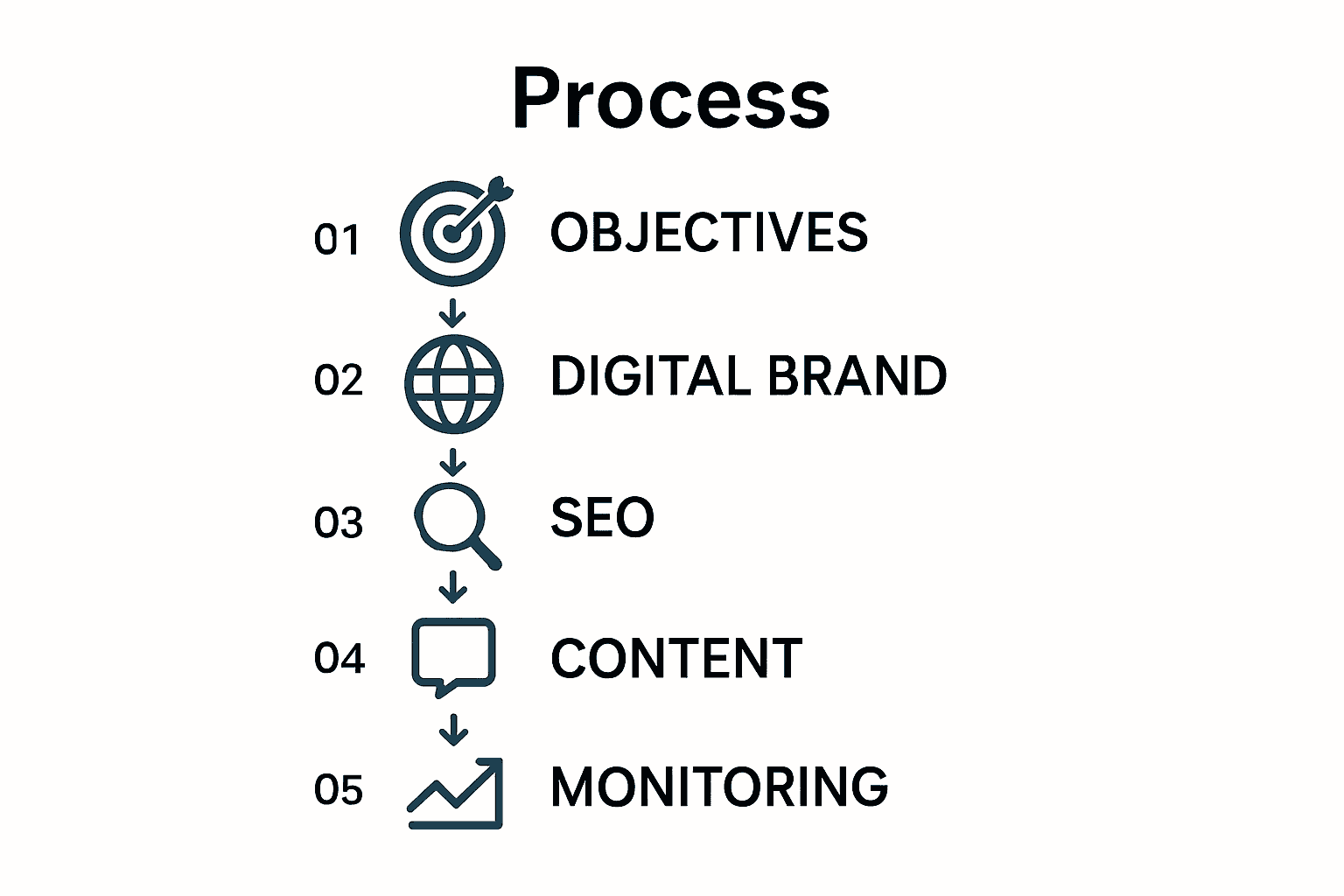
More than half of small businesses report that pinpointing their ideal customers is the single toughest step in building an effective marketing strategy. Without a clear direction and targeted approach, brands often waste time and money chasing the wrong audience. If you want to attract loyal customers and grow your business, understanding how to define your objectives and shape your online presence is crucial. This guide outlines practical steps that help you sidestep common mistakes and connect with people who truly value what you offer.
| Key Point | Explanation |
|---|---|
| 1. Define clear business objectives | Identify your goals and target customers to guide marketing efforts effectively. |
| 2. Create a consistent digital brand | Develop a compelling online presence that reflects your business identity across all platforms. |
| 3. Implement targeted SEO strategies | Optimise for local search by using specific keywords that match customer queries in your area. |
| 4. Engage through content and social media | Produce valuable content and connect with audiences on relevant social media channels to build trust. |
| 5. Monitor and refine your marketing strategy | Regularly analyze data to adapt marketing efforts and improve performance continuously. |
Before launching your marketing strategy, you need crystal clear understanding of who you are and who you want to serve. This step is about mapping out your business direction and pinpointing exactly which customers will get the most value from what you offer.
According to Portland Community College, creating detailed customer profiles requires a data-driven approach. Start by answering fundamental questions about your business: What problems do you solve? What makes your service unique? Then shift focus to understanding your potential customers. Break down their characteristics including age, income level, professional background, and specific challenges they face.
Research from Nolo recommends developing a comprehensive customer profile that goes beyond basic demographics. Consider these key elements:
One practical tip: Don’t try to appeal to everyone. The most successful businesses understand that trying to serve everyone means effectively serving no one. Get specific about who your ideal customer is and build your marketing strategy around their precise needs.
Once you’ve developed a clear picture of your business objectives and target customers, you’re ready to move into crafting a marketing strategy that speaks directly to their requirements and desires.
In this step, you will transform your business vision into a compelling online presence that attracts and engages your ideal customers. Your digital brand is more than just a logo or website its the strategic representation of your business personality and core values across all online platforms.
Research from arXiv highlights the critical importance of maintaining brand consistency across digital channels. This means ensuring your visual elements colour schemes typography and messaging create a unified experience that builds trust with potential customers. Start by defining your brand personality are you professional and authoritative or friendly and approachable? Choose visual elements that communicate this identity.
According to Wikipedia, establishing a solid digital foundation requires creating a comprehensive plan that outlines your business goals and methods for achieving them. Your website should clearly communicate:
A practical tip: Invest time in developing high quality professional imagery and content that reflects your brands authentic personality. Potential customers will judge your credibility within seconds of landing on your website.

With your digital brand and website foundation established youre now prepared to develop targeted marketing strategies that will help you connect with your ideal customers and grow your business online.
This step transforms your online visibility by strategically positioning your business to attract local customers through intelligent search engine optimisation. Your goal is to become the go-to solution when potential customers search for services like yours in your specific geographic area.
According to Wikipedia, successful search optimisation starts with understanding market segmentation. This means breaking down your potential customer base into specific groups with distinct characteristics and search behaviours. Identify the precise keywords and phrases your ideal customers use when searching for services in your industry.
Research from Wikipedia emphasises the importance of targeting specific customer groups through your SEO efforts. Key strategies include:
A practical tip: Focus on long tail keywords that combine your service type with your local area. Instead of just targeting broad terms like marketing services use specific phrases like marketing services in Milton Keynes that capture local search intent.
By implementing these targeted SEO strategies youll increase your chances of appearing in local search results and attracting customers who are actively seeking your specific services in your geographic area.
In this step you will transform your marketing strategy into action by creating compelling content and targeted social media campaigns that connect directly with your ideal customers. Your goal is to craft messages that resonate with your audience and drive meaningful engagement.
Research from arXiv suggests developing a cognitive approach to content strategy that links customer expectations with your business messaging. This means understanding the psychological triggers that motivate your target audience to take action. Start by mapping out content themes that address your customers specific needs pain points and aspirations.
According to Wikipedia, successful campaign deployment relies on precise audience identification. Your content and social media strategy should focus on:
A practical tip: Aim for an 80 20 content mix. Spend 80% of your content providing genuine value to your audience through insights tips and helpful information. Reserve 20% for direct promotional messaging to maintain audience trust and interest.
With your content and social media campaigns strategically deployed youre now positioned to build meaningful connections with potential customers and establish your brand as a trusted authority in your industry.
In this critical step youll transform raw marketing data into actionable insights that continuously improve your business performance. Your goal is to understand what strategies are working developing the ability to adapt and optimise your marketing approach in real time.
Research from arXiv emphasises the power of customer data clustering as a strategic tool for identifying high value market segments. This means diving deep into your analytics to uncover patterns in customer behaviour conversion rates and engagement levels. Pay close attention to metrics that reveal which content campaigns and channels are generating the most meaningful results for your business.
According to Wikipedia, strategic refinement involves systematically evaluating and selecting the most promising market opportunities. Key monitoring strategies include:
A practical tip: Schedule monthly review sessions where you critically examine your marketing data.
 Be prepared to pivot quickly if certain strategies are not delivering expected results. Successful marketing is about continuous learning and adaptation.
By consistently monitoring and refining your strategy youll develop a dynamic marketing approach that evolves with your business and stays ahead of changing market dynamics.
Building a successful online presence requires clear objectives, targeted digital branding, and expert SEO and content strategies as outlined in “Small Business Marketing Step by Step”. If you feel overwhelmed by defining your ideal customers or unsure how to translate your business vision into a high-converting website that attracts local clients, you are not alone. The challenges of maintaining consistent branding, capturing local search traffic, and delivering engaging content can stall growth without tailored guidance.
At Kickass Online, we specialise in turning these marketing essentials into results. With personalised web design, proven SEO techniques focused on your specific market, and ongoing maintenance to keep your site performing at its best, we ensure your efforts translate into real business growth. Gain the confidence to put your digital strategy into action. Explore practical advice in our Tips and Tricks and discover tailored solutions that meet your unique needs at Kickass Online.
Ready to transform your marketing strategy into measurable success? Visit our site now and book a consultation to start building your online success story today.
To define your ideal customer, identify their characteristics such as age, income, and specific challenges they face. Create a detailed customer profile by researching their pain points and purchasing behaviours to tailor your marketing efforts effectively.
Key elements for building a digital brand include defining your brand personality, creating a consistent visual identity, and clearly communicating your unique value proposition on your website. Focus on maintaining a cohesive look and feel across all platforms to build trust with potential customers.
To optimise your website for local search, incorporate local keywords into your content, create location-specific pages, and ensure your Google Business Profile is complete. Aim to generate local customer reviews to enhance your visibility in search results.
Share a mix of educational, informative, and promotional content to keep your audience engaged. Aim for an 80/20 content mix where 80% provides value and insights while 20% focuses on direct promotions.
You can measure the success of your marketing strategy by tracking website traffic, conversion rates, social media engagement metrics, and overall return on investment. Schedule monthly reviews to analyze this data and adjust your strategies based on what is working.
If a marketing tactic is not delivering results, be prepared to pivot your approach quickly. Analyze the data to understand the lack of performance and adjust your strategy accordingly, aiming to implement changes within a month.
Choosing a digital partner can feel like a maze with so many promises and specialties on offer. You might find quick design fixes or big agencies with every skill under one roof. Some teams promise hands-on attention while others focus on speed or deep expertise in making ads work. The right fit comes down to balance between personal service, technical skill and results you can actually see. Take a closer look at what sets each provider apart and discover what suits your business best.
Kickass Online is a results-driven digital marketing agency operating out of Milton Keynes and London, UK, that specialises in web design, SEO and ongoing website maintenance. They combine customised strategies with a limited client intake to deliver measurable improvements in traffic, conversions and site security. If you want a high-touch partner that treats your site like a business asset, not a template, Kickass Online is built for you.
Kickass Online offers website design that converts and looks professional, SEO optimisation aimed at improving search engine rankings, and proactive website maintenance to keep sites secure and performing at peak speed. Their offering includes fully customised digital marketing plans tailored to each business’s objectives and budget, plus a focused onboarding process with limited spots to ensure each client receives dedicated attention from their specialist team.
Kickass Online is ideal for small and medium-sized businesses in Milton Keynes, London and surrounding areas that want a professional, measurable approach to their online presence. It suits local retailers, service providers and medium-sized firms seeking a website refresh or reliable maintenance, plus companies that prefer a strategic partner who will prioritise their account.
Kickass Online differentiates itself through focused exclusivity and tangible results. By limiting client intake, they guarantee priority access to experienced specialists and faster implementation cycles, a design choice that trades scale for superior execution. Their core strength is translating web design into conversions: pages built to sell, combined with technical SEO and continuous maintenance, create a closed loop of improvement. Where many agencies fragment design, optimisation and upkeep, Kickass Online bundles them into a single relationship, removing finger-pointing and accelerating ROI. They also emphasise measurable outcomes and customised plans, so you get clear targets, regular reporting and practical steps to reach them. In short: fewer clients, more attention, better results.
A local retailer needed a new e-commerce site plus SEO and ongoing upkeep. Kickass Online delivered a conversion-focused store, implemented on-page and technical SEO, and provided scheduled maintenance. Over subsequent months the retailer saw improved organic visibility, reduced downtime and a measurable uplift in sales and customer engagement.
Quote-based, pricing is not specified on the site; prospective clients are encouraged to contact Kickass Online for a tailored quote and to book a consultation.
Website: https://kickassonline.com
Blue Frontier is a UK-based specialist digital agency that provides end-to-end services across design, development, marketing and technical IT support. Their offering includes medtech consultancy for healthcare technology alongside standard digital products, making them a versatile partner for businesses seeking tailored solutions. If you want a single supplier to manage creative, technical and compliance elements, Blue Frontier positions itself to fill that role. Expect client-focused project management with an emphasis on delivering to agreed timelines and budgets.
Blue Frontier’s capabilities span creative and technical domains: website, graphic and brand design plus video and animation; full-stack web and mobile development including portals and ecommerce; marketing services covering SEO, paid advertising, social media and content; and technical IT services such as hosting, cyber security, managed IT and cloud. They also provide consultancy for efficiency and compliance, ISO, GDPR, AI and digital transformation strategies, with particular attention to medtech and healthcare applications. In short, they combine creative production, engineering and regulatory-aware consultancy under one roof.
Blue Frontier suits businesses and organisations seeking a comprehensive digital partner in the UK, particularly those that need design, development, marketing and IT support bundled together. It is a good match for companies that value tailored strategy, require regulatory or compliance-aware consultancy (for example in healthcare), and prefer a single agency to coordinate multi-disciplinary projects.
Blue Frontier’s USP is its breadth: a single agency delivering creative design, engineering, marketing and technical IT services, combined with consultancy for compliance and digital transformation. This reduces fragmentation across projects and helps maintain consistency from concept through to maintenance.
A business could hire Blue Frontier to replace an ageing corporate website, commission a new mobile app, and simultaneously run a targeted digital marketing campaign to lift visibility and leads, while relying on the same team for hosting, cyber security and compliance advice throughout the project.
Quote-based; pricing is not specified on the website and interested parties need to contact Blue Frontier for a tailored proposal.
Website: https://bluefrontier.co.uk
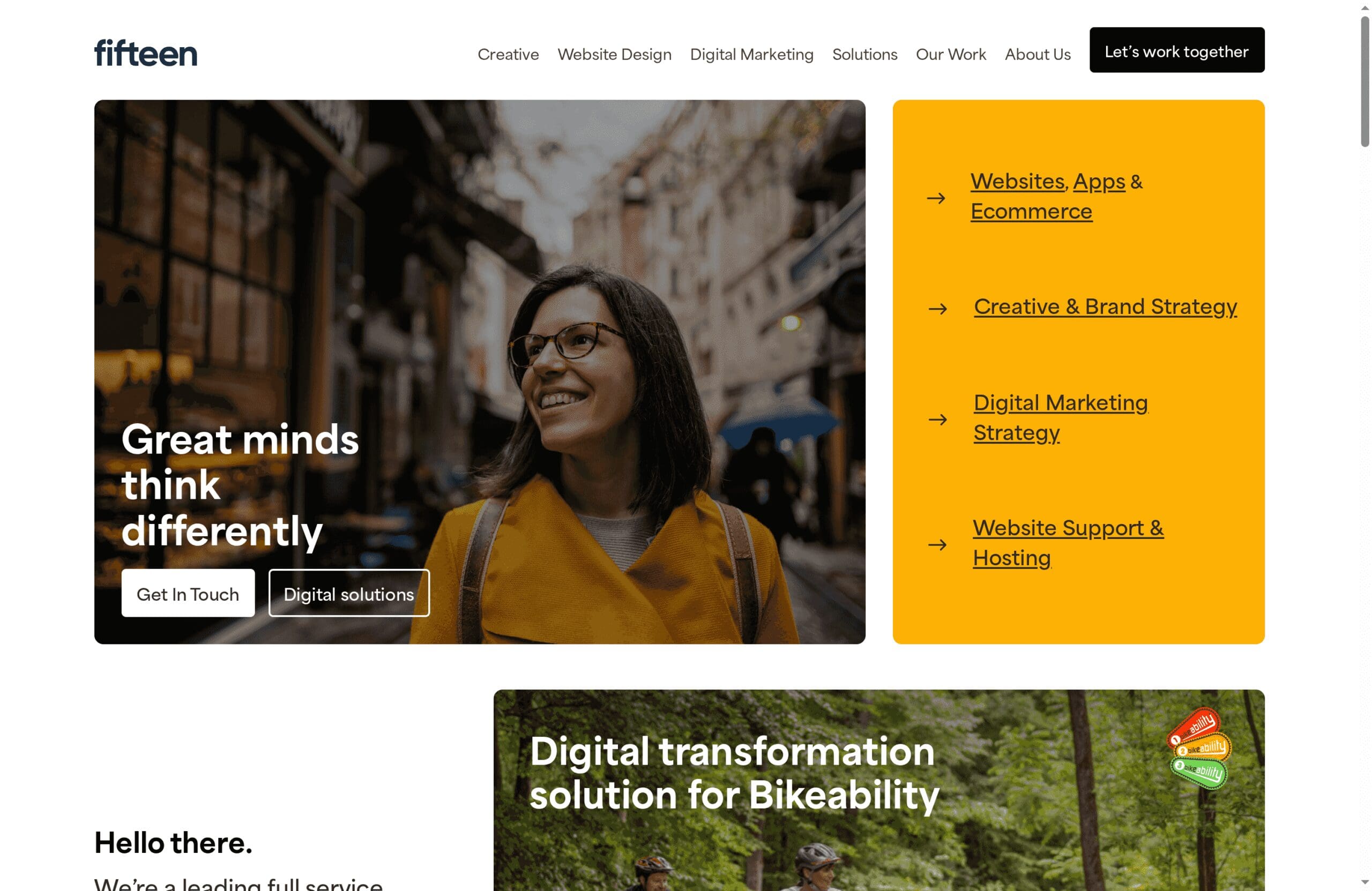
Fifteen Design is a full-service digital agency based in Nottingham that combines UX, brand thinking and modern technology to deliver tailored digital solutions. They position themselves as a partner for growth, offering website build, e-commerce, CRM integration and marketing services under one roof. For businesses seeking a results-focused agency that handles both creative and technical work, Fifteen Design is a solid, pragmatic choice, though you should be prepared to discuss requirements directly to get accurate costs.
Fifteen Design’s offering centres on website design and development with dedicated e-commerce capabilities and UX strategy to improve conversion and user satisfaction. They also list CRM and API integration, which supports data-driven commerce and marketing workflows, and a full suite of digital marketing services including SEO, PPC, social media and content. The combination of brand, UX and technical integration means they can move from strategy to execution without handing work between multiple providers.
Fifteen Design suits small to medium-sized businesses that need a single agency to handle brand, site build, e-commerce and ongoing digital marketing. It’s particularly apt for organisations that value UX-led design and require technical integrations such as CRM or bespoke APIs as part of their digital transformation.
The agency’s strength lies in joining creative brand work with technical delivery, UX-led design paired with CRM and API integration, enabling projects that are both visually compelling and operationally connected to sales and marketing systems.
A retail business commissions Fifteen Design to build a new e-commerce platform integrated with their CRM, then implements a digital marketing plan (SEO and PPC) to drive traffic and convert sales, allowing the retailer to measure and optimise return on ad spend.
Quote-based; pricing details are not explicitly listed and potential clients are encouraged to contact the agency for bespoke quotations.
Website: https://fifteendesign.co.uk
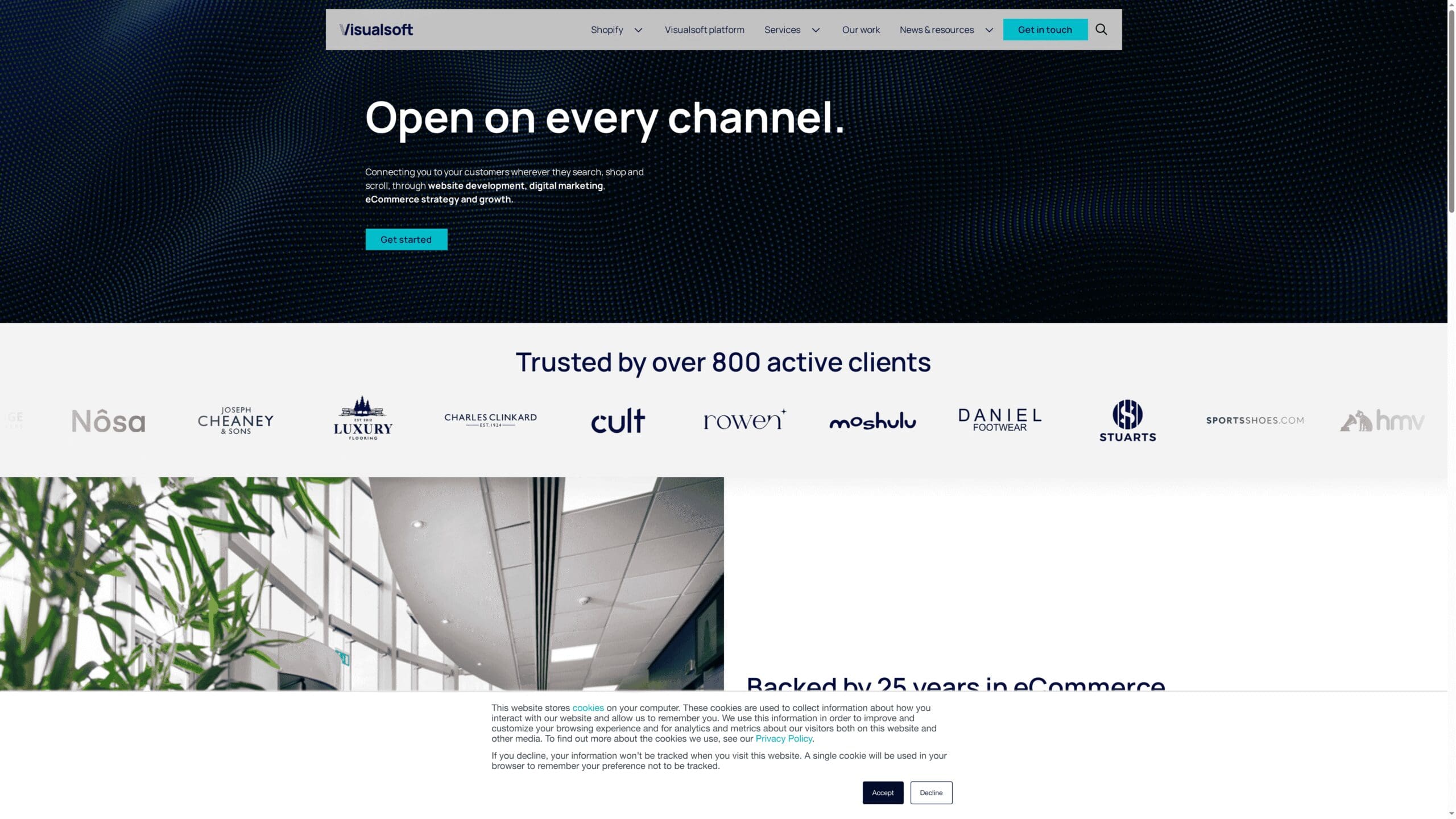
Visualsoft is a UK-based ecommerce performance agency that combines a proprietary platform with hands-on digital marketing and development services. With over 25 years’ experience supporting more than 800 active clients and powering 850+ ecommerce sites, it’s built as an all-in-one solution for retailers who want speed, compliance and continual optimisation without stitching together multiple vendors. If you value UK support, fast page loads (site speed score of 92) and an integrated marketing stack, Visualsoft is worth a close look.
The platform offers a fully integrated ecommerce stack with bespoke storefronts and built-in marketing tools covering paid media, SEO and email marketing, alongside advanced analytics and reporting. It includes conversion rate optimisation (CRO) and customer-journey tools, plus scalable UK-hosting with real-time analytics, speed optimisation and carbon-neutral hosting support. Compliance is baked in, with platform-as-a-service (PaaS) architecture and support for GDPR and PCI DSS standards.
Visualsoft is best suited to UK-based retailers and brands who want a turnkey ecommerce solution combined with dedicated digital marketing support. It’s ideal for businesses launching new stores, migrating existing sites into a single platform, or scaling sales with data-led optimisation, especially if you value responsive, UK-centred support.
The platform’s strength is its integration: technology, marketing and compliance are delivered as a single managed service backed by decades of ecommerce experience. That combination reduces vendor management, accelerates time-to-market and centralises accountability for performance and conversion improvements.
A long-standing footwear retailer used Visualsoft to refresh its storefront and deploy integrated email campaigns, which improved purchase rates and strengthened brand loyalty; another client increased purchase rates by 42% after adopting the platform’s email and optimisation tools.
Transparent monthly fee, details available upon request.
Website: https://visualsoft.co.uk
Bamboo Nine is a Brighton-based, strategy-first digital marketing agency that emphasises tailored plans over one-size-fits-all tactics. With an in-house omnichannel team and more than a decade of experience, they promise measurable outcomes across PPC, SEO, content and web development. The agency is particularly strong for businesses that want coordinated campaigns rather than disconnected activity. Bottom line: expect strategic thinking and close collaboration, though pricing clarity is limited.
Bamboo Nine offers a strategy-led approach supported by an in-house multidisciplinary team that covers PPC, paid and organic social, SEO, content, digital PR, branding, creative campaigns, web design and ecommerce. They pair that service range with custom tracking and analytics solutions so results are measurable, and they emphasise learning the client’s industry and goals before proposing tactics. The combined skillset allows them to deliver integrated campaigns and website work without repeatedly outsourcing core functions.
Bamboo Nine is best suited to small and medium-sized businesses that value strategic partnership and integrated delivery. If you want a single agency to handle paid media, organic search, content and website work with a view to long-term growth, this agency fits well. It’s particularly relevant for brands that need a coordinated omnichannel presence rather than piecemeal tactics.
The agency’s differentiator is its strategy-first ethos combined with an in-house omnichannel team and bespoke analytics. That mix lets Bamboo Nine design campaigns that link brand, performance and product experience, and then measure those links with custom tracking rather than standard reporting templates.
A retail brand engages Bamboo Nine to lift Google rankings, grow social followings and convert more online sales. The agency combines SEO, content marketing, organic and paid social, plus a website refresh to create a unified customer journey that drives traffic and improves conversion rates.
Not specified on the website.
Website: https://bamboonine.co.uk
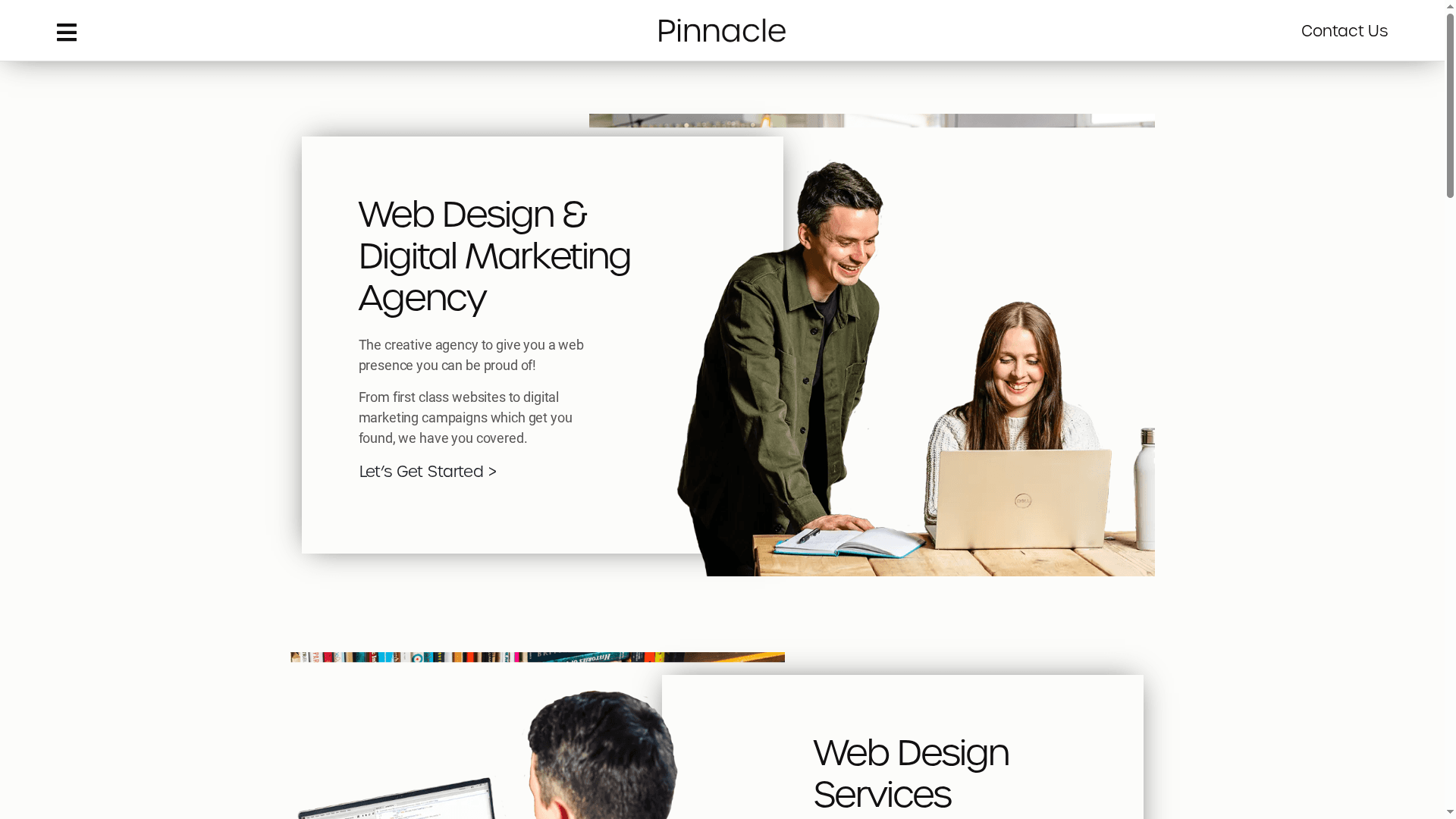
Pinnacle Digital is a compact web design and digital marketing agency established in 2018, with a stated team experience of over 10 years. They combine bespoke web design with ongoing digital marketing services, SEO, paid search and social media, with a clear focus on building sites that convert visitors into customers. The agency positions itself as a practical partner for businesses that want both an attractive website and the campaigns to drive traffic to it.
Pinnacle Digital offers custom web design and development paired with integrated digital marketing campaigns. Core capabilities listed include search engine optimisation (SEO), paid search advertising (explicitly Google Ads and Microsoft Ads), and social media management and advertising. The package is structured around delivering visual design that supports customer acquisition, plus ongoing support and advice to sustain digital performance across channels.
Pinnacle Digital is best suited to small and medium-sized businesses looking for a single partner to design a new website and manage ongoing digital marketing campaigns. If you need a project that blends bespoke design with SEO, paid search and social media management, and you value ongoing advisory support, this agency fits that brief.
The agency’s core value lies in combining conversion-first website design with active digital marketing services, reducing the coordination burden for clients who prefer a single supplier for site builds and campaign management. In short: design that’s built to perform, backed by ongoing optimisation.
A typical scenario is a small UK business that needs a website rebuild and a coordinated campaign to increase local visibility and enquiries: Pinnacle Digital would design a conversion-focused site, set up SEO foundations and run targeted paid search and social ads to drive local traffic and leads.
Not specified in the provided content.
Website: https://pinnacledigital.co.uk
One PPC Ltd is a UK-based PPC management agency focused on paid advertising across Google, Microsoft, Facebook, and LinkedIn. They combine audits, data-driven reporting and hands-on optimisation to increase ROI, and they highlight testing and case studies as proof points. If you need a specialist partner to run and refine paid campaigns, One PPC offers experienced, certified support, though the hourly cost and narrow focus on paid channels may not suit every small business.
One PPC delivers comprehensive PPC management covering search, display and social channels, with certified specialists for Google Ads, LinkedIn, Facebook and Microsoft Ads. Their service includes a free, non-obligation Google Ads audit, flexible pricing models (hourly or packaged hours), and detailed reporting with data analysis to guide optimisation. The agency emphasises testing and case studies to validate tactics and iteratively improve campaign performance.
One PPC is best suited to businesses willing to invest in professional PPC management to drive leads, sales and measurable ROI. That includes small to medium-sized enterprises, e-commerce merchants seeking improved ROAS, and organisations with existing ad activity that require focused optimisation and reporting.
One PPC’s strength lies in specialist, certified PPC expertise combined with rigorous reporting and a testing-led mindset. They position themselves as a results-focused partner: audits to identify quick wins, ongoing optimisation to reduce wasted spend, and case studies that demonstrate repeatable outcomes.
A small e-commerce store engaged One PPC to optimise its Google Ads campaigns; through audits, bid adjustments and creative testing the store saw a notable improvement in ROAS and doubled the number of qualified leads within a few months.
From £90/hour. Fixed packages start at £360/month (Small Business: 4 hours), £630/month (Growing Business: 7 hours) and £1,350/month (Rapid Scaling: 15 hours).
Website: https://oneppcagency.co.uk
This table provides a comparison of various digital marketing agencies based in the UK, highlighting their core features, targeted clients, pros, cons, and pricing to help you make an informed decision.
| Agency | Core Features | Pros | Cons | Pricing |
|---|---|---|---|---|
| Kickass Online | Web design, SEO, maintenance | Personalised services, high client satisfaction | Limited client intake | Quote-based |
| Blue Frontier | Design, development, marketing, IT support | Comprehensive services, tailored solutions | Limited case study details | Quote-based |
| Fifteen Design | Web design, e-commerce, CRM integration | Results-driven, strong UX focus | Pricing not transparent | Quote-based |
| Visualsoft Ecommerce | Integrated platform, marketing tools | All-in-one solution, UK-based support | More suited for UK retailers | Quote-based |
| Bamboo Nine | PPC, SEO, web development | Personalised strategies, in-house team | No explicit pricing | Not specified |
| Pinnacle Digital | Web design, SEO, paid search | Experienced team, conversion-focused | Limited pricing transparency | Not specified |
| One PPC Ltd | PPC management, multi-platform | Experienced, transparent reporting | Pricing may be high for small budgets | From £90/hour |
Navigating the evolving landscape of digital marketing platforms can feel overwhelming when your primary aim is to boost online visibility and convert visitors into loyal customers. This expert comparison highlights common challenges such as selecting the right combination of web design, SEO optimisation and ongoing site maintenance to achieve lasting business growth. At Kickass Online, we understand these pain points and focus on crafting bespoke solutions that treat your website as a valuable asset rather than just another project.
Our dedicated team delivers tailored strategies designed to improve your search engine rankings, increase site security and maximise conversions through high-impact website design. Discover actionable insights and trusted recommendations that align perfectly with your business goals in our Recommendations | Kickass Online section.
Boost your digital success today with Kickass Online
Ready to transform your online presence with expert support from specialists who prioritise you? Book a consultation now at Kickass Online and explore practical tips and strategies tailored for your business in our Tips and Tricks | Kickass Online. Act now to secure your spot in our limited client roster and begin driving measurable results without delay.
Look for platforms that offer integrated analytics, automation tools, and customisable reporting. Evaluate how these features will enhance your marketing efforts and streamline your workflows, as they can significantly improve campaign performance and resource management.
To compare ROI, track key performance indicators (KPIs) like conversion rates, customer acquisition costs, and overall revenue growth attributed to each platform. Gather this data over a 30–60 day period to understand which platform delivers the best financial return on your marketing investments.
Start by defining your marketing goals and budget. Then, conduct research on various platforms, focusing on their features, user reviews, and case studies. Create a shortlist based on your findings to facilitate a side-by-side comparison of their strengths and weaknesses.
Maximise effectiveness by utilising all available features, including analytics and automation tools, to streamline your campaigns. Regularly review performance data to identify trends and adjust your strategies accordingly, aiming for continuous improvement within each campaign cycle.
Businesses of all sizes can benefit, but small to medium-sized enterprises often find digital marketing platforms particularly helpful for scaling their operations and optimising their budgets. Assess your specific industry requirements to determine which platform features can best support your growth objectives.
Aim to review your digital marketing platform strategy every 3–6 months to adapt to market changes and evolving business needs. Use this time to reassess the tools’ effectiveness and to explore any new features that could enhance your marketing efforts.
Getting your website right can bring remarkable results for your business. In fact, businesses with clearly defined goals and a deep understanding of their audience are up to three times more likely to see online growth. Whether you want more sales, leads, or stronger brand presence, starting with a solid strategy sets you apart from the competition. This step-by-step guide walks you through every stage, making it easier to build a site that truly works for you.
| Key Point | Explanation |
|---|---|
| 1. Define Clear Business Goals | Specify 3-5 measurable goals that align with your broader strategy to enhance focus and direction. |
| 2. Understand Your Target Audience | Create detailed customer personas to better tailor your marketing efforts and solutions to potential customers’ needs. |
| 3. Plan Website Structure Effectively | Outline key pages and their purposes, ensuring intuitive navigation to enhance user experience and support business objectives. |
| 4. Choose the Right Platform and Framework | Select a platform that matches your capabilities while allowing for growth; prioritise responsiveness for various devices. |
| 5. Monitor and Adapt Post-Launch | Utilise analytics tools to track website performance and make ongoing improvements to better serve users and meet goals. |
Transforming your online presence starts with crystal clear business objectives and a razor sharp understanding of who you want to reach. According to Wikipedia, a business plan serves as a roadmap outlining your company’s core objectives and strategic approach.
Begin by asking yourself fundamental questions about what you want to achieve. Are you looking to generate more leads? Increase online sales? Build brand awareness? Write down 3-5 specific, measurable goals that align with your broader business strategy. For example, instead of saying “get more customers”, specify “increase online sales by 25% within six months”.
Next, define your target audience with precision. Wikipedia describes a target audience as the specific group of consumers intended to receive your marketing message. Create a detailed customer persona that includes demographics, interests, pain points, and online behaviour. Consider factors like age, location, income level, professional background, and specific challenges your business can solve.
Warning: Be specific but not restrictive. While detailed targeting helps focus your efforts, avoid creating such a narrow profile that you exclude potential customers.
By clearly defining your goals and audience, you set a strategic foundation that will guide every aspect of your website design and digital marketing approach.
Now that you understand your business goals, it is time to map out how your website will bring those objectives to life. According to Berkeley Open, planning your website involves defining its purpose and creating an effective information architecture that serves your target audience.
Start by sketching a basic site map that outlines your key pages. Most business websites will need core pages like Home, About Us, Services or Products, Contact, and potentially a Blog or Portfolio section. Consider the user journey and how visitors will navigate between these pages. Each page should have a clear purpose that supports your overall business goals. Think about the information visitors need and how to present it in a logical, intuitive manner.
When designing your website features, prioritise functionality that directly supports your business objectives. For service-based businesses, this might include clear service descriptions, booking forms, or client testimonials. For product businesses, focus on high-quality product images, detailed descriptions, and seamless purchasing options. Web design tools and prototyping software can help you visualise your layout before development.
Warning: Avoid cramming too many features onto your site. More is not always better. Each element should serve a specific purpose and contribute to a clean, user friendly experience.
A well planned website structure transforms your digital presence from a simple online brochure to a powerful business tool that attracts and converts potential customers.

Selecting the ideal platform and design framework is crucial for transforming your website vision into reality. Wikipedia describes a website wireframe as a visual guide representing the skeletal framework of a website, which helps you understand how functionality and content will come together.
Consider your technical skills, budget, and specific business requirements when choosing a platform. WordPress remains popular for its versatility and user friendliness, while Umbraco offers robust customisation for more complex websites. For ecommerce businesses, platforms like Shopify provide integrated solutions. Evaluate each platform based on factors such as ease of use, scalability, design flexibility, and ongoing maintenance requirements. Learn more about web design strategies that can enhance your marketing approach.
When exploring design frameworks, focus on responsive designs that work seamlessly across desktop, tablet, and mobile devices. According to Wikipedia, your platform selection is part of a broader go-to-market strategy that determines how you deliver value to customers.
Warning: Avoid getting trapped by overly complex platforms. The best solution is one that matches your current capabilities while allowing room for future growth.
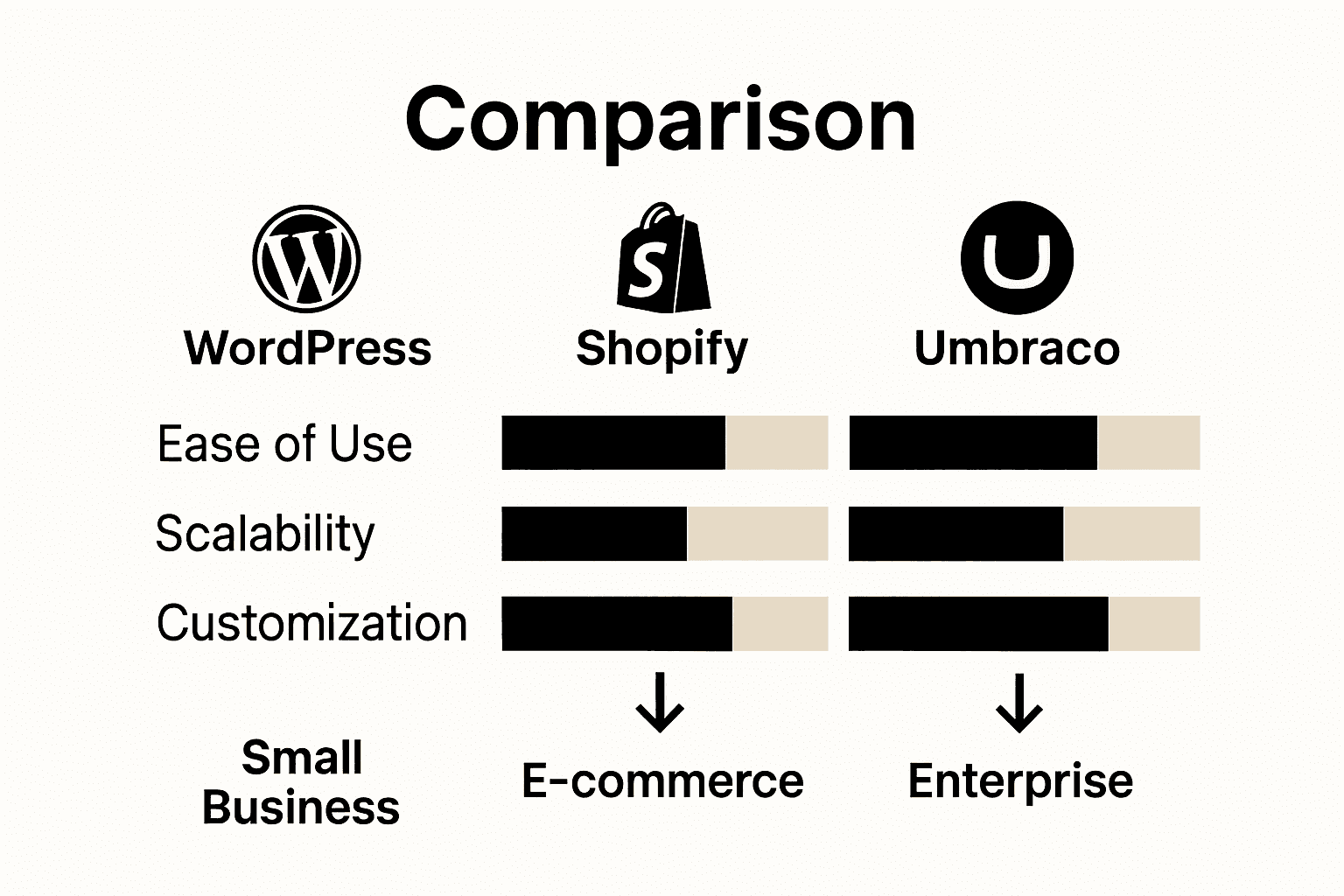
Your platform and design framework are the foundation of your digital presence. Choose wisely to create a website that not only looks professional but also effectively supports your business goals.
Creating compelling website content is about understanding and connecting with your audience. According to Oxford Academic, quality website development involves carefully planning design, layout, and content with a deep understanding of the audience’s information needs.
Start by crafting clear, concise content that speaks directly to your target audience’s challenges and aspirations. Write headlines that grab attention, use conversational language, and break up text with subheadings, bullet points, and short paragraphs. Focus on addressing customer pain points and demonstrating how your products or services provide solutions. Explore content optimisation strategies that can help your website get noticed.
Wikipedia highlights that web analytics plays a crucial role in content optimisation by helping you understand and track web usage. Use tools like Google Analytics to monitor which content resonates most with your audience. Pay attention to metrics like time on page, bounce rate, and user engagement to continuously refine your content strategy.
Warning: Avoid keyword stuffing or writing solely for search engines. Your primary goal is to create valuable, informative content that genuinely helps your potential customers.
Engaging website content is not just about what you say, but how you say it. Your words are your digital sales team working 24/7 to attract, inform, and convert potential clients.
Bringing your website to life means ensuring every element works flawlessly across different devices and browsers. According to UKRI, a website’s structure and navigation must be logical and user focused to deliver optimal functionality and performance.
Begin with comprehensive testing across multiple platforms. Check how your website performs on different browsers like Chrome, Firefox, Safari, and Edge. Test on various devices including desktop computers, tablets, and smartphones to ensure responsive design. Pay special attention to page load speeds, button functionality, form submissions, and navigation menus. Learn more about website performance optimisation tools.
As Case University recommends, create a hierarchical structure that allows for intuitive navigation. Use tools like Google PageSpeed Insights to identify and resolve performance bottlenecks. Focus on optimising image sizes, minimising code, and leveraging browser caching to improve overall website speed.
Warning: Performance testing is not a one time task. Regular monitoring and optimisation are crucial to maintaining an effective website.
A well tested website builds trust with your visitors, ensuring they have a smooth and professional experience that reflects the quality of your business.
With your website carefully crafted, it is time to introduce your digital presence to the world. Wikipedia highlights that web analytics provides crucial information about website visitors and page views, helping you understand and optimise site performance from the moment you launch.
Start by setting up comprehensive tracking tools like Google Analytics to monitor key performance indicators. Track metrics such as visitor numbers, time spent on site, bounce rates, and conversion rates. These insights will help you understand how users interact with your website and identify areas for improvement. Discover the essential digital marketing KPIs every small business needs to measure.
According to Wikipedia, understanding your target market is essential for monitoring and adjusting website strategies. Regularly review your analytics to see which content resonates most with your audience, which pages drive conversions, and where potential customers might be dropping off. Be prepared to make incremental improvements based on real user data.
Warning: Launching your website is not the end of the journey. Continuous monitoring and adaptation are key to maintaining a high performing online presence.
Your website is a living digital asset that grows and evolves with your business. Treat it as an ongoing project, always seeking ways to better serve your customers and achieve your business objectives.
Designing a website that truly delivers requires more than just aesthetics. It demands a clear strategy that aligns with your business goals and speaks directly to your audience’s needs. If you find yourself struggling with how to plan your website structure or choosing the right platform, you are not alone. Many business owners face challenges such as creating engaging content, ensuring responsive design, and optimising site performance to convert visitors into customers.
At Kickass Online, we understand these critical pain points. Our team specialises in crafting bespoke websites that are not only visually compelling but engineered to boost conversions and improve search engine rankings. From developing user-friendly navigation to maintaining your site’s security and speed, we are your dedicated partner in transforming your digital presence.
Discover how our tailored approach can bring your website ambitions to life in our comprehensive Websites | Kickass Online section.
Don’t let uncertainty hold back your online growth. Visit Kickass Online today and book a consultation with our experts who will guide you step-by-step through creating a high-impact website custom-fit for your business. Explore informative Tutorials | Kickass Online for actionable insights and start turning your website into a powerful business asset now.
To define your business goals, start by identifying what you want to achieve, such as generating leads or increasing sales. Write down 3-5 specific, measurable goals, like “increase online sales by 25% within six months.”
Your target audience persona should include details like demographics, interests, pain points, and online behaviour. Create a comprehensive profile that outlines age, location, income level, and challenges your business can solve.
A well-structured website should have a clear sitemap that includes pages like Home, About Us, Services, and Contact. Sketch your sitemap and ensure each page serves a specific purpose that aligns with your business goals and enhances user navigation.
When choosing a website platform, consider your technical skills, budget, and specific business needs. Evaluate ease of use, scalability, and design flexibility to select a platform that will grow with your business and support ongoing maintenance.
To optimise your website content, ensure it addresses your audience’s pain points and uses clear, conversational language. Craft headlines that grab attention and incorporate subheadings and bullet points to make the information easier to digest.
To test your website’s functionality, check it across multiple browsers and devices to ensure responsive design. Pay special attention to page load speeds, button functionality, and navigation to ensure a seamless user experience.
More than 80 percent of small businesses struggle to stand out against larger competitors. The difference often comes down to how well they connect with their audience. Content marketing offers a smarter way for small business owners to attract attention and build trust without relying on heavy sales tactics. This guide helps you understand how strategic content can grow your reach, deepen connections, and turn everyday browsers into loyal customers.
| Point | Details |
|---|---|
| Valuable Content Creation | Focus on producing relevant, high-quality content that addresses customer needs, rather than direct sales pitches. |
| Audience Understanding | Develop detailed audience personas to tailor content and meet specific customer challenges effectively. |
| Set Clear Goals | Establish measurable objectives for content marketing efforts to align them with overall business strategies. |
| Avoid Common Pitfalls | Maintain consistency in content delivery and ensure that each piece serves a strategic purpose related to your marketing goals. |
Content marketing represents a strategic approach that transforms how small and medium enterprises (SMEs) communicate with their potential customers. Fundamentally, it’s about creating valuable, relevant content that attracts and engages your target audience, rather than directly selling to them. According to APC Research, content marketing is “a strategic approach focused on creating and distributing relevant content to attract a defined target audience and drive profitable customer action”.
At its core, content marketing differs dramatically from traditional advertising. While typical marketing interrupts consumers with sales pitches, content marketing provides genuine value. Think of it like this: instead of shouting “Buy my product!” you’re offering helpful information that solves real problems. For SMEs, this means creating resources like how-to guides, industry insights, case studies, and informative blog posts that demonstrate your expertise without directly selling.
The purpose of content marketing goes beyond mere promotion. It serves multiple critical objectives for small businesses:
With the right content marketing strategy for SMEs, businesses can transform how they connect with their audience, moving from interruptive sales tactics to becoming a trusted source of information and solutions.
Content marketing success hinges on understanding and implementing strategic core elements that transform generic content into powerful business tools. Hofstra Research highlights that effective content marketing strategies are built on four fundamental pillars: audience research and segmentation, clear and measurable goals, high-quality content creation, and engagement and community building.
Audience Understanding sits at the heart of content marketing effectiveness. This means going beyond basic demographics to truly comprehend your target audience’s pain points, aspirations, and information consumption habits. Successful SMEs develop detailed audience personas that guide content creation, ensuring every piece of content speaks directly to specific customer segments. By mapping out customer journeys and understanding their challenges, businesses can craft content that feels personally tailored and genuinely helpful.

The second critical element involves establishing Clear and Measurable Goals. Content marketing isn’t about producing content for content’s sake. Each piece should align with specific business objectives such as:
Lastly, Content Quality and Consistency determine long-term content marketing success. This means producing authoritative, well-researched content that provides genuine value. SMEs should focus on creating in-depth resources that solve real problems, answer specific questions, and demonstrate deep industry expertise. With the right content marketing strategy for SMEs, businesses can transform their online presence from mere noise to meaningful conversation.
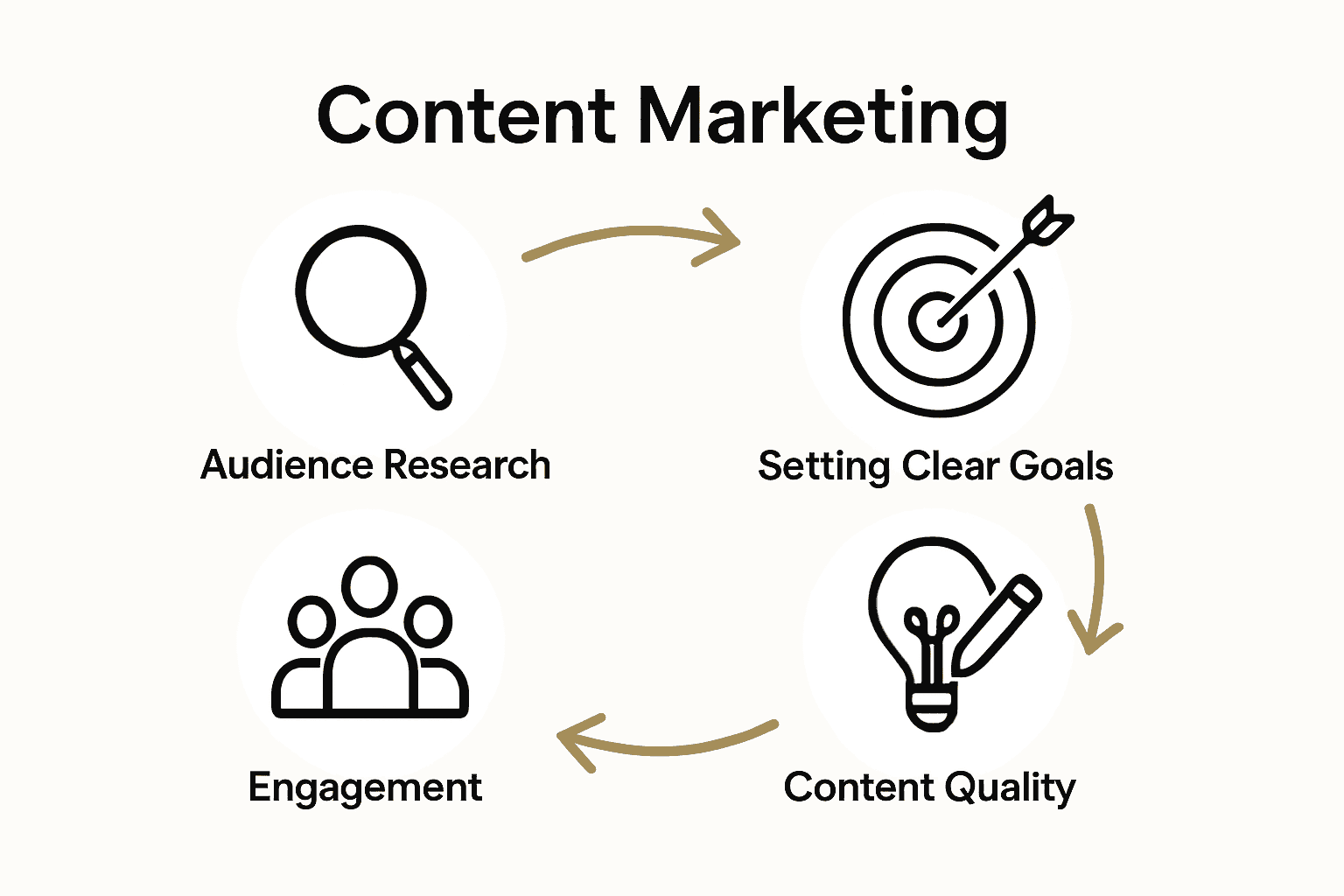
Content diversity is the cornerstone of an effective marketing strategy. As Coursera explains, content marketing involves creating and distributing useful, relevant content across various formats to attract and engage a target audience. According to Wikipedia, these formats range from traditional written content to multimedia experiences, including news, videos, white papers, e-books, infographics, email newsletters, case studies, podcasts, and how-to guides.
Strategic content selection requires understanding your audience’s preferences and consumption habits. Small and medium enterprises (SMEs) should focus on creating content that not only informs but also entertains and solves specific problems. Different content types serve unique purposes in your marketing funnel:
The key to successful content marketing lies in strategic storytelling. By unlocking the power of strategic storytelling, SMEs can transform their content from mere information to compelling narratives that drive business growth. Each content type should be carefully crafted to address specific audience needs, creating a cohesive narrative that guides potential customers through their decision-making journey.
Content marketing transforms how small businesses compete in a crowded marketplace. Coursera highlights that effective content marketing can attract customers, drive brand awareness, and establish expertise in a particular area, providing small businesses with a powerful tool to increase visibility and customer engagement.
According to Wikipedia, content marketing goes beyond traditional advertising by creating sustainable brand loyalty and providing valuable information that generates a willingness to purchase from the company. For small businesses operating with limited marketing budgets, this approach offers several critical advantages:
Small businesses can leverage content marketing to punch above their weight. Digital marketing strategies enable SMEs to compete with larger competitors by creating targeted, meaningful content that resonates directly with their ideal customer base. The key is consistent, high-quality content that addresses specific customer pain points and demonstrates genuine understanding of their challenges.
Content marketing can quickly become ineffective if small businesses fall into predictable traps. Hofstra Research emphasises that avoiding common pitfalls requires setting clear, measurable goals, understanding the target audience, and consistently creating high-quality content.
One of the most significant mistakes small businesses make is creating content without a strategic purpose. Many entrepreneurs produce random blog posts or social media content without considering how each piece connects to their broader marketing objectives. This scattergun approach leads to wasted resources and minimal impact. Successful content marketing demands a deliberate strategy that:
Another critical pitfall is inconsistency and lack of commitment. Content marketing is not a one-off activity but a long-term investment. Strategic content marketing for SMEs requires patience, regular publishing, and continuous refinement. Businesses must resist the temptation to abandon their strategy after minimal initial results. The most successful content marketing campaigns build momentum over months, gradually establishing trust and credibility with their target audience.
Are you struggling to create a clear content marketing strategy that builds trust, generates leads, and boosts your online visibility? This article highlights the common challenges SMEs face, such as inconsistent content and lack of measurable goals. At Kickass Online, we understand how vital it is to align your content with specific business objectives and to maintain a high standard of quality and consistency. Discover practical Tips and Tricks that help you turn your content into a powerful tool for growth.
Take control of your digital presence today by partnering with Kickass Online. Our expert team specialises in creating high-converting websites, optimising SEO, and providing ongoing maintenance tailored to your unique needs. Do not let untargeted content hold your business back. Book a consultation now and transform your content marketing strategy into a lasting business asset.
Content marketing is a strategic approach that focuses on creating valuable, relevant content to attract and engage a target audience instead of directly selling products. It’s important for SMEs because it builds trust, improves online visibility, generates leads, and nurtures customer relationships.
SMEs can generate leads through content marketing by creating high-quality resources such as blog posts, how-to guides, and case studies that solve specific problems for their audience. This valuable content attracts potential customers who are actively seeking solutions, encouraging them to engage with the brand.
Common types of content used in content marketing include blog posts, podcasts, infographics, videos, email newsletters, research papers, and case studies. Each format serves unique purposes and helps SMEs connect with their audience in different ways.
A successful content marketing strategy for SMEs includes understanding the target audience, establishing clear and measurable goals, producing high-quality content consistently, and fostering engagement and community. These elements ensure that the content resonates with the audience and aligns with business objectives.
Over 60% of marketers say their content strategies fail when goals are unclear from the start. When your content lacks direction, it wastes time and resources without delivering real results for your business. Clear goals act like a roadmap, guiding every step from creation to distribution. This article shows how defining focused content objectives helps you shape strategies that actually drive growth and connect with your audience.
| Takeaway | Explanation |
|---|---|
| 1. Define SMART content goals. | Establish Specific, Measurable, Achievable, Relevant, and Time-bound objectives to guide your content efforts effectively. |
| 2. Create detailed buyer personas. | Develop comprehensive profiles of your ideal customers to tailor content that meets their specific needs and interests. |
| 3. Produce engaging, value-driven content. | Focus on delivering actionable insights that genuinely address audience pain points and foster trust and credibility. |
| 4. Optimise for SEO to enhance visibility. | Implement keyword research and on-page optimisation to ensure your content reaches a broader audience effectively. |
| 5. Utilise a content calendar for consistency. | Organise and plan content ahead of time to maintain a steady flow and alignment with overall business goals. |
Successful content marketing begins with strategic goal setting. Without clear objectives, your content becomes aimless wandering rather than purposeful communication.
According to SCORE, identifying specific content goals is fundamental to developing an effective marketing strategy. This means understanding precisely what you want to achieve through your content efforts.
Why Content Goals Matter:
To define meaningful content goals, start by asking yourself critical questions. What does your business ultimately want to accomplish? Are you seeking to build brand awareness, generate leads, establish thought leadership, or drive direct sales? Each goal requires a different content approach.
For instance, if your goal is lead generation, your content should include clear calls to action, downloadable resources, and information that demonstrates your expertise. A brand awareness goal might prioritise storytelling and sharing your company’s unique value proposition.
Pro Tip: Make your content goals SMART
By establishing precise content marketing objectives, you transform random content creation into a strategic, results-driven approach that directly supports your business growth.
Knowing your audience is like having a compass in the complex world of content marketing. Without understanding who you are speaking to, your messaging will miss the mark.
According to Coursera, successful marketing hinges on deeply comprehending your audience through demographics, psychographics, and behavioural insights. The American Marketing Association reinforces this by highlighting that targeted understanding leads to increased engagement and higher conversion rates.
Key Aspects of Audience Understanding:
To truly understand your audience, you need to go beyond surface level data. Create detailed buyer personas that represent your ideal customers. These fictional yet data driven profiles help you craft content that speaks directly to their needs, aspirations, and pain points.
Start by gathering information through surveys, analytics, customer interviews, and social media insights. Look for patterns in how your most valuable customers interact with your content and what problems they are trying to solve.
Pro Tip: Map out your audience’s journey
By developing a nuanced understanding of your target audience, you transform generic content into precisely targeted communication that resonates and drives meaningful engagement.
Content is the heartbeat of digital marketing. But not just any content will do the trick. You need material that genuinely connects with your audience and provides real value.
According to the Content Marketing Institute, creating engaging content requires a deep understanding of your audience’s interests and challenges. Your goal is to deliver information that solves problems and builds trust.
What Makes Content Truly Valuable:
To craft compelling content, start by thinking like your audience. What questions are they asking? What challenges keep them up at night? Develop content that feels like a personalised conversation rather than a generic broadcast.
Content Creation Strategies:
Research thoroughly before writing. Use credible sources, current statistics, and real world examples that illustrate your points. Mix different content formats like blog posts, videos, infographics, and podcasts to keep your approach dynamic and interesting.
Remember that valuable content is not about selling. It is about educating, inspiring, and empowering your audience. When you consistently provide insights that help your readers solve problems or improve their lives, you build credibility and trust.
Do not be afraid to show your personality. Authentic voice and genuine expertise will always stand out in a crowded digital landscape.
Search Engine Optimisation is not just a technical exercise. It is your content’s ticket to visibility in a crowded digital marketplace.
Moz emphasises that SEO is about optimising website content to increase visibility and attract organic traffic. Similarly, Search Engine Land highlights key techniques that can transform your content’s reach.
Effective SEO starts with understanding what your audience is searching for. Use keyword research tools to identify terms your potential customers are using. These insights help you craft content that directly answers their questions and meets their needs.
Practical SEO Implementation:
Focus on creating high quality content that naturally incorporates relevant keywords. Avoid keyword stuffing. Instead, write comprehensive articles that provide genuine value while strategically using search terms. Optimise your headings, meta descriptions, and image alt texts to improve search engine understanding of your content.
Remember that search engines reward content that demonstrates expertise, authoritativeness, and trustworthiness. Consistently producing valuable content that serves your audience will ultimately improve your search rankings.
Include internal links to your other relevant content and seek opportunities for quality external backlinks. These signals help search engines recognise your website as a credible source of information.
Your fantastic content deserves more than a single platform. Multichannel distribution is about spreading your message where your audience actually lives and engages.
MarketingProfs highlights the critical importance of diversifying content distribution across different platforms. The Content Marketing Institute reinforces this by emphasising the need to tailor content while maintaining a consistent brand message.
Key Distribution Channels:
Think of your content like a versatile performer. Each channel is a different stage requiring a unique performance style. A lengthy blog post might become an infographic on Instagram, a series of tips on Twitter, or a short video summary on YouTube.
Adapt your core message to suit each platform’s unique audience and consumption habits. LinkedIn audiences might prefer professional insights, while Instagram users want visually compelling, concise information.
Do not just broadcast. Engage. Respond to comments, participate in discussions, and use each channel to build genuine connections. Your multichannel strategy should feel like a conversation, not a monologue.
Remember that consistency is key. Your brand voice and core message should remain recognisable across all platforms, even as the format and presentation change.
Data transforms guesswork into strategy. Without measuring your content performance, you are essentially navigating without a map.
The Content Marketing Institute emphasises the critical importance of continuous monitoring and strategic adjustment based on performance data.
Key Performance Metrics to Track:
Think of your content metrics like a health checkup for your digital marketing strategy. Each number tells a story about what is working and what needs improvement. Do not get overwhelmed by raw data. Focus on understanding the narrative behind the numbers.
Start by setting clear benchmarks for success. What does good performance look like for your specific business goals? Is it increased website visitors? More email sign ups? Higher consultation requests?
Utilise analytics tools that provide comprehensive insights. Google Analytics, social media platform insights, and specialised marketing dashboards can help you track performance across multiple channels.
Remember that measurement is not a one time event. Treat it as an ongoing process of refinement. Review your metrics monthly, identify trends, and be prepared to pivot your content strategy based on what the data reveals.
A content calendar transforms random content creation into a strategic, organised marketing approach. Think of it as your content roadmap that keeps your marketing efforts focused and purposeful.
Consistency is the silent hero of content marketing. Without a structured plan, your content becomes sporadic and ineffective.
Content Calendar Essentials:
Start by mapping out your content themes for the next quarter. Consider key business milestones, seasonal events, and audience interests. Your calendar should provide a bird’s eye view of your content strategy while allowing flexibility for timely or trending topics.
Digital tools can simplify calendar management. Google Sheets, Trello, or specialised content planning platforms can help you visualise and track your content pipeline. The goal is to create a living document that guides your team and keeps everyone aligned.
Do not just plan. Create buffers for unexpected opportunities or challenges. A good content calendar provides structure without feeling restrictive. It should inspire creativity while maintaining a consistent publishing rhythm.
Remember that your content calendar is a dynamic tool. Review and adjust it monthly based on performance metrics and emerging business objectives. Flexibility combined with strategic planning is the key to content marketing success.
Below is a comprehensive table summarising the key concepts and strategies for effective content marketing as discussed in the article.
| Strategy | Implementation | Expected Results |
|---|---|---|
| Define Content Goals | Set SMART objectives based on business aims such as brand awareness, lead generation, etc. | Clear direction and measurable content success. |
| Understand Audience | Develop buyer personas and map the audience journey using surveys and data insights. | Increased engagement and targeted communication. |
| Create Valuable Content | Address audience needs, provide insights, and use diverse formats like blogs and videos. | Enhanced trust and credibility. |
| Leverage SEO | Use keyword research and on-page optimisation including quality content creation. | Improved visibility and organic traffic. |
| Use Multiple Channels | Tailor content for platforms like social media, blogs, and emails, ensuring consistent messaging. | Broader reach and audience engagement. |
| Measure Performance | Track metrics such as engagement rates and conversion percentages, adjusting strategies as needed. | Data-driven refinement and strategic adjustments. |
| Build Consistency | Use a content calendar to schedule and plan topics across channels with flexibility for trends. | Consistent publishing rhythm and aligned marketing efforts. |
Struggling to turn content marketing tips into real business growth? Many businesses face challenges like defining clear goals, reaching their ideal audience, and maintaining consistent, engaging content. This article highlights the importance of strategic planning, targeted messaging, and performance measurement to achieve success. At Kickass Online, we understand these pain points and offer personalised digital marketing solutions designed to build high-converting websites, optimise your SEO, and keep your online presence performing at its best.
Discover valuable insights and proven tactics through our Tips and Tricks | Kickass Online section that complements the guidance from this article.
Ready to transform your content marketing journey into measurable results? Visit Kickass Online today and get tailored strategies that align with your business goals. Explore our Recommendations | Kickass Online for real success stories and book a consultation to start growing your online visibility now.
To define clear content goals, start by identifying what you want to achieve, such as building brand awareness or generating leads. Create a list of specific, measurable outcomes you can track over a defined timeframe, like increasing website traffic by 25% within six months.
Begin by researching your audience demographics, such as age and location, alongside their interests and challenges. Create detailed buyer personas that reflect this information and map out their content consumption habits to tailor your messaging effectively.
Focus on addressing your audience’s specific needs and challenges through research and unique insights. Use various formats like blog posts and videos, and ensure your content provides actionable advice that resonates with readers and encourages engagement.
A successful SEO strategy includes keyword research, on-page optimisation, quality content creation, and link building. Start by identifying relevant keywords and integrating them naturally into your content, ensuring it aligns with what your audience is actively searching for.
Diversify your content distribution by sharing it on several platforms like social media, email newsletters, and professional networks. Tailor your messaging to suit each platform’s audience, and actively engage with your followers to foster genuine connections.
To measure content performance, track metrics such as website traffic and engagement rates. Establish benchmarks for success, analyze trends monthly, and adjust your content strategies based on the data you gather to continually improve your effectiveness.
More than 80 percent of consumers look up businesses online before making a purchase. In a world where your digital footprint speaks louder than traditional marketing, the way your business builds its brand online can make or break your reputation. Understanding business branding online means learning how to craft a distinct identity that stands out across websites, social media, and digital marketplaces. Discover how a strong online brand opens doors to trust, visibility, and long-term growth.
| Point | Details |
|---|---|
| Holistic Online Branding | A successful online business brand requires consistent visual identity, clear messaging, and strategic use of digital channels to engage target audiences. |
| Critical Brand Identity Components | Digital brand identity involves both visual and verbal elements, including logo, colour palettes, brand voice, and storytelling to create a cohesive personality. |
| Reputation Management is Essential | Building and maintaining online reputation necessitates delivering quality, engaging with customer feedback, and actively managing digital sentiments. |
| Avoid Branding Mistakes | Key pitfalls include inconsistent messaging, neglecting audience research, and failing to evolve, which can erode customer trust and brand equity. |
Business branding online is a comprehensive digital strategy that transforms how companies present themselves in the virtual marketplace. Internet branding represents much more than a simple digital presence - it’s about creating a cohesive, memorable identity that resonates across multiple online channels.
According to Wikipedia, internet branding is a brand management technique that leverages the World Wide Web and social media to strategically position a brand in the marketplace. This means using search engines, social media platforms, online press releases, and digital marketplaces to establish strong consumer connections and build widespread brand awareness.
The core elements of successful online business branding include:
Beyond mere visibility, online branding is about crafting a digital narrative that authentically represents your business. It’s how you communicate your values, showcase your expertise, and differentiate yourself from competitors in an increasingly crowded digital landscape.
Learn more about effective digital branding strategies to elevate your online presence and connect meaningfully with your target market.
Digital brand identity is the strategic framework that defines how businesses present themselves online, creating a memorable and consistent digital persona. This multifaceted approach goes beyond visual aesthetics to encompass a comprehensive representation of a company’s core essence.
According to joeyswindle, brand identity consists of three critical components: brand foundations, visual identity system, and verbal identity system. The brand foundations include defining the company’s mission, vision, values, purpose, and market positioning - essentially the strategic core that guides all digital communication.
The visual and verbal elements are equally crucial in crafting a compelling digital brand identity:
Visual Identity Components:
Verbal Identity Components:
Research from Atom Accelerator highlights the importance of maintaining brand consistency across all digital touchpoints, including interpersonal interactions, digital platforms, and physical representations. This holistic approach ensures that every interaction reinforces your brand’s unique identity and value proposition.
 Explore our guide on web design strategies for building a strong brand identity to understand how these elements work together to create a powerful digital presence.
Online branding is a dynamic landscape with multiple strategic approaches that businesses can leverage to establish their digital presence. Each type of online branding offers unique opportunities for companies to connect with their target audiences and differentiate themselves in the digital marketplace.
According to Wikipedia, brand extension is a powerful marketing strategy where businesses use their existing brand name to enter different product categories. This approach allows companies to expand their digital footprint while leveraging the established brand equity and customer recognition they’ve already built.
Key types of online branding include:
Corporate Branding:
Product Branding:
Personal Branding:
As Wikipedia notes, individual branding (or multibranding) allows companies to target different market segments by giving each product a unique brand name. This strategy enables businesses to create tailored marketing approaches that resonate with specific audience groups. Learn more about effective ways to get your brand noticed online to understand how these branding approaches can elevate your digital presence.
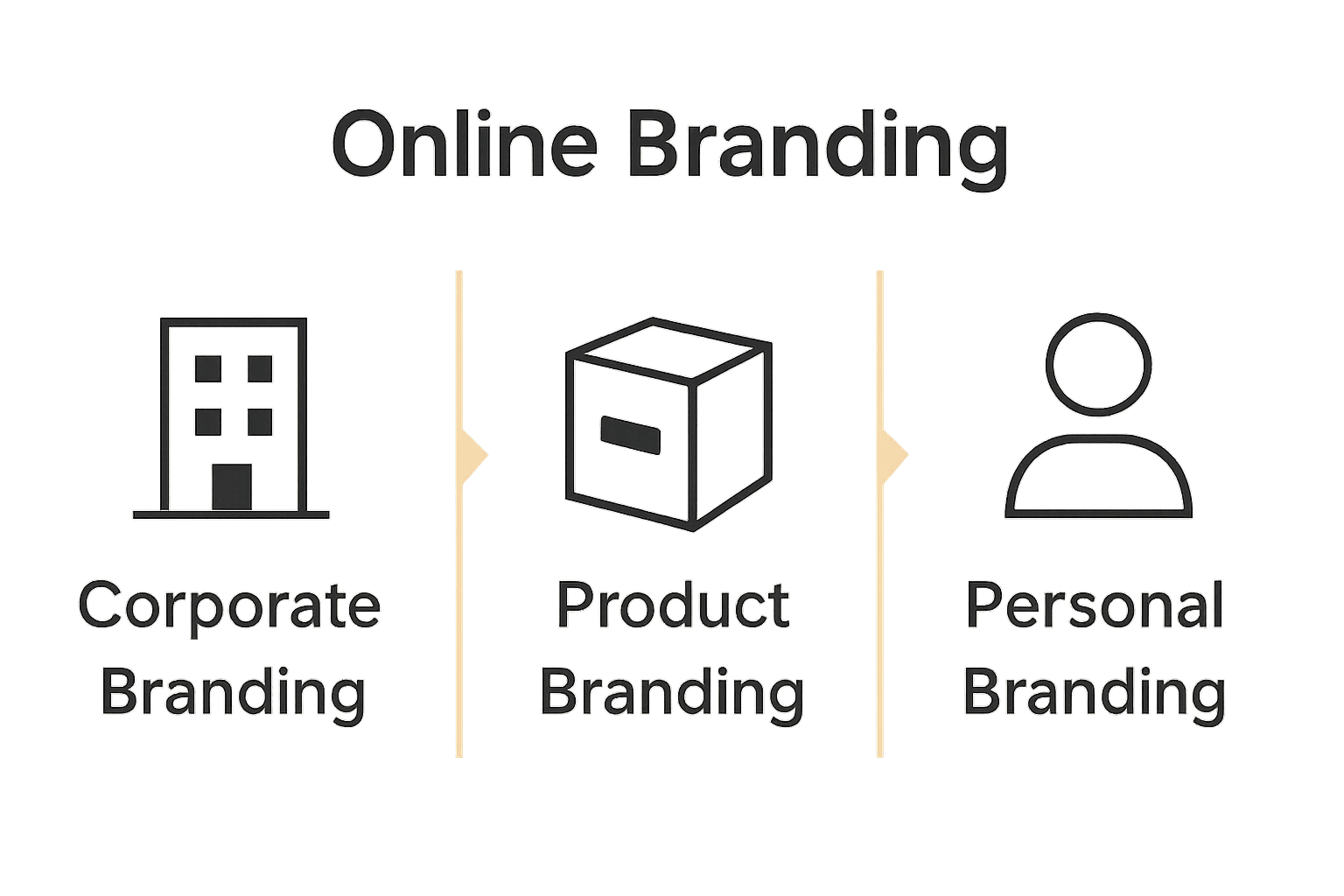
Online reputation is the digital reflection of a business’s credibility, trustworthiness, and perceived value in the marketplace. It’s a delicate ecosystem of customer perceptions, digital interactions, and brand messaging that requires strategic management and continuous monitoring.
Businesses must be vigilant about protecting their digital identity. According to Wikipedia, brandjacking represents a significant risk, where malicious actors might attempt to exploit a brand’s online identity, particularly on social media and Web 2.0 platforms. This underscores the critical importance of proactive reputation management strategies.
Key strategies for building and maintaining a stellar online reputation include:
Reputation Building Tactics:
Reputation Monitoring Techniques:
Building trust is a continuous process that requires genuine commitment to customer satisfaction and transparent communication. Learn more about why you should pay attention to reputation marketing to understand how strategic reputation management can transform your digital presence and drive business growth.
Digital branding is a nuanced art that can quickly unravel with even minor missteps. Businesses often find themselves trapped in common pitfalls that can significantly undermine their online presence and brand perception.
According to FasterCapital, successful branding hinges on maintaining consistency across platforms and ensuring a unified brand voice and aesthetic. The most critical mistakes often stem from a lack of strategic alignment and thoughtful execution.
Most Prevalent Branding Mistakes:
Inconsistent Brand Messaging:
Strategic Branding Pitfalls:
The consequences of these mistakes can be profound, potentially eroding customer trust and diminishing brand equity. Understanding and proactively addressing these common missteps is crucial for maintaining a robust and compelling digital brand presence. Discover more about digital branding strategies to help you navigate the complex landscape of online brand management.
Defining your business branding online involves more than just a logo or website. It is about creating a consistent digital identity that reflects your values, connects emotionally with your audience, and stands out in a crowded marketplace. If you have struggled with crafting a clear brand message, maintaining visual consistency, or managing your online reputation, you are not alone. Many businesses face these challenges while trying to build trust and gain visibility online.
At Kickass Online, we understand the importance of a strategic and authentic brand presence. Our personalised web development and SEO services are designed to help you establish a powerful digital brand that resonates deeply with your customers. Whether you need expert website design that aligns perfectly with your identity or ongoing support to ensure your site stays secure and performs optimally, our dedicated team is here to help.
Discover practical Tips and Tricks for enhancing your digital branding journey and explore how our tailored solutions can transform your online presence.
Dont let inconsistent messaging or weak visuals hold your business back. Take the next step in building a compelling online brand with Kickass Online today. Visit Kickass Online to book a consultation and start crafting your digital narrative that truly connects and converts. Your brand deserves expert care and a strategy that drives real results.
Business branding online is a digital strategy that focuses on creating a memorable and cohesive identity for companies across various online channels, including websites and social media.
The core elements of digital brand identity include brand foundations (mission, vision, values), visual identity components (logo, colour palette, typography), and verbal identity components (brand voice, communication tone).
Businesses can build their online reputation by delivering high-quality products, actively engaging with customer feedback, responding to reviews, and showcasing genuine customer testimonials. Regular monitoring of brand mentions is also crucial.
Common mistakes in digital branding include inconsistent messaging across platforms, neglecting audience research, copying competitors, and failing to evolve the brand in response to customer feedback.
Nearly 90 percent of customers trust online search to find local businesses, yet even small mistakes in your digital profiles can cost you valuable leads. The way your business appears on search engines and local directories not only shapes first impressions but also determines whether new clients ever find you. By tightening up your online presence and following clear, strategic steps, you can drive more local traffic and stand out in a crowded marketplace.
| Key Point | Explanation |
|---|---|
| 1. Audit Your Online Presence | Review and verify your business information across platforms for accuracy and consistency. |
| 2. Optimise Google Business Profile | Claim and regularly update your profile with correct details and engaging content to enhance visibility. |
| 3. Optimise Local SEO Elements | Improve your website’s SEO by using local keywords and ensuring it is mobile-friendly for better rankings. |
| 4. Build Quality Local Citations | List your business in reputable directories with consistent information to establish credibility and improve search rankings. |
| 5. Track Performance and Adjust | Use analytics tools to monitor SEO effectiveness, making data-driven adjustments for ongoing improvement. |
In this step, you will systematically review your current digital footprint and identify potential gaps or inconsistencies across online platforms. According to the Jurupa Valley Chamber of Commerce, auditing your online presence is a critical first move for local SEO success.
Start by conducting a comprehensive search of your business name across multiple search engines and digital platforms. Google your business name and examine the first three pages of results. Check major platforms like Google My Business, Yelp, Facebook, LinkedIn, and industry specific directories. Note any discrepancies in your business name, address, phone number (often called NAP information), website URL, and operating hours. Consistency is key for local search rankings.
Pro tip: Create a spreadsheet to track all your online listings. Document each platform where your business appears, and verify the accuracy of your core business information. Look for opportunities to claim unclaimed profiles, update outdated information, and ensure your business details are identical across all platforms. By methodically cleaning up your online presence, you set a strong foundation for improved local search visibility.

Once you have completed this audit, you will be ready to move on to the next phase of local SEO optimisation with a clear understanding of your current digital landscape.
In this crucial step, you will secure and enhance your Google Business Profile to improve local search visibility and attract more potential customers. Big I New York highlights the importance of accurate information and consistent profile management for local businesses.
Begin by searching for your business on Google and selecting the option to claim or verify your existing profile. If no profile exists, create a new one by providing your exact business name, precise physical address, and local phone number. Ensure every detail matches your other online listings exactly. Upload high quality professional photos showcasing your business interior, exterior, products, and team. Write a compelling business description that includes relevant local keywords without sounding spammy or forced.
Pro tip: Regularly update your profile with fresh content like recent photos, current operating hours, special offers, and respond promptly to customer reviews. Authentic engagement signals to Google that your business is active and customer focused. The more complete and interactive your profile becomes, the higher your chances of appearing in local search results and Google Maps recommendations.
With your Google Business Profile now optimised, you are ready to advance to the next strategic phase of local SEO implementation.
In this critical step, you will transform your website into a powerful local SEO asset by strategically optimising its core elements. TechnologyHQ emphasises the importance of precise technical optimisation to improve local search rankings and attract potential customers.
Start by refining your website’s title tags and meta descriptions to include specific local keywords and your business location. Incorporate your city or region naturally into page titles, headings, and content. According to SDA Data, ensuring mobile friendly design is crucial for local SEO success. Verify that your website loads quickly and displays perfectly on smartphones and tablets. Create dedicated location specific pages if you serve multiple areas, using unique content that highlights local services, community involvement, and region specific information.
Pro tip: Include your full business name, address, and local phone number consistently across your website. Embed a Google Maps integration on your contact page to reinforce your local presence. Authentic local signals help search engines understand and prioritise your business for location based searches.
With your website now optimised for local search, you are prepared to advance to the next strategic phase of your local SEO implementation.
In this crucial phase, you will strategically expand your online presence by creating consistent and authoritative local citations. Pomona Chamber of Commerce highlights the importance of maintaining uniform business information across multiple online platforms.
Begin by identifying reputable local directories and industry specific platforms where you can list your business. According to TechnologyHQ, consistent engagement with local online communities is key to building quality citations. Focus on platforms like Google My Business, Yelp, Yellow Pages, industry associations, local chamber of commerce websites, and niche directories relevant to your business sector. Ensure your Name, Address, and Phone number (NAP) are identical across all listings to build credibility with search engines.
Pro tip: Seek opportunities for local backlinks by participating in community events, sponsoring local organisations, or creating content that highlights your local involvement. Quality matters more than quantity when building citations. Avoid purchasing low quality links or using link farms, as these can harm your local search rankings.
With a robust network of quality local citations established, you are now ready to progress to the next strategic stage of your local SEO journey.
In this final stage, you will evaluate the effectiveness of your local SEO efforts and make data driven adjustments to continuously improve your online visibility. SDA Data emphasises the importance of systematic performance tracking and strategic refinement.
Set up Google Analytics and Google Search Console to monitor key performance indicators such as local search rankings, website traffic, click through rates, and conversion metrics. Pay close attention to which local keywords are driving the most traffic and engagement. Analyze your Google Business Profile insights to understand how customers are finding and interacting with your business listing. Track metrics like profile views, website clicks, direction requests, and phone call volumes to gauge the real world impact of your local SEO strategy.
Pro tip: Create a monthly tracking spreadsheet to document your progress and identify trends. Review your performance quarterly and be prepared to pivot your strategy based on data insights. Small consistent adjustments often yield more significant long term results than sporadic major changes.
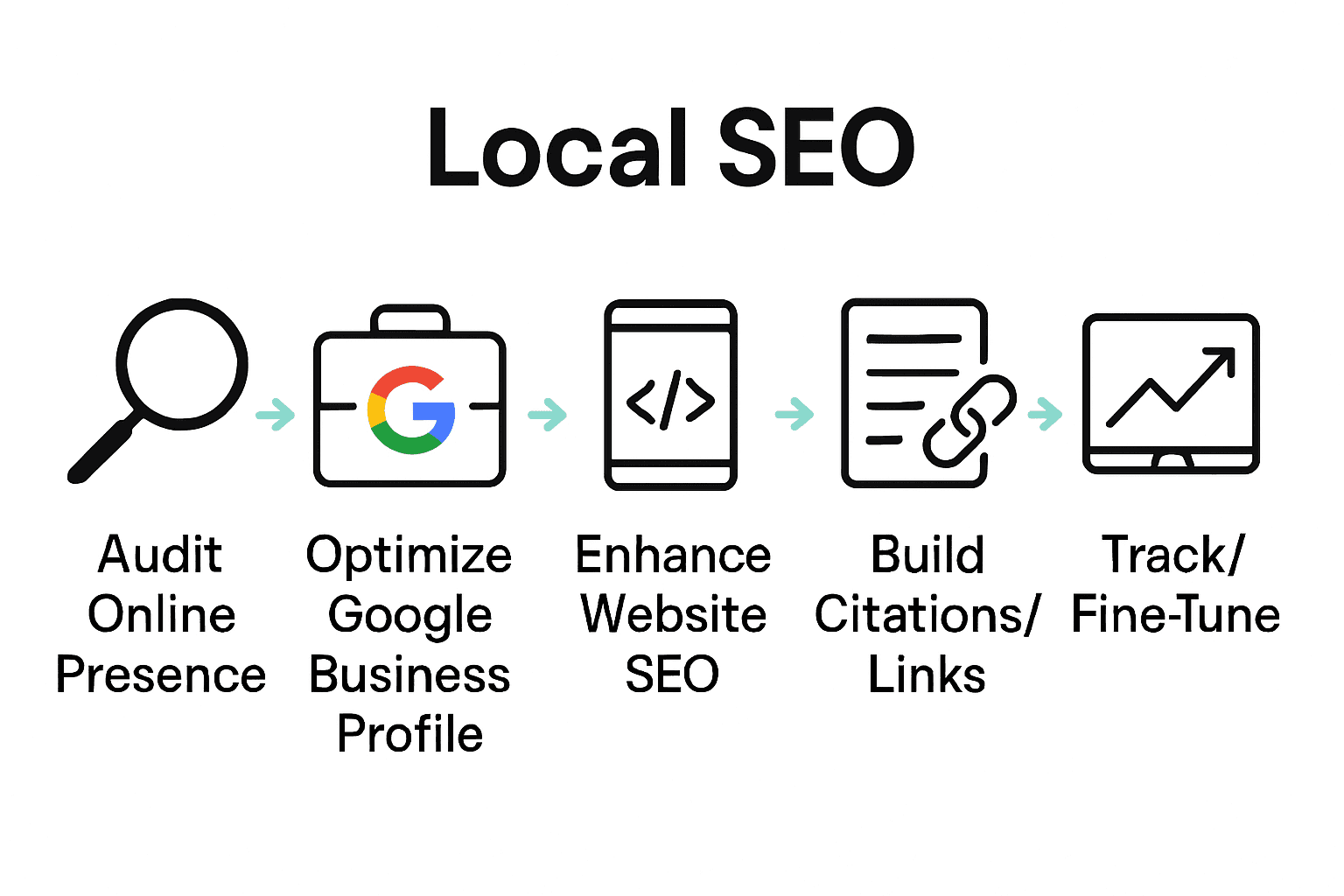 Remain patient and methodical in your approach.
With a robust tracking system in place, you now have a powerful framework for continuous local SEO improvement and sustainable business growth.
Struggling to make your small business stand out in local search results despite following all the steps like auditing your online presence or optimising your Google Business Profile You are not alone Many small business owners face challenges in keeping their website aligned with local SEO best practices while managing day to day operations This guide highlights the need for consistency clarity and ongoing maintenance, areas where expert help can make a real difference
Discover tailored solutions at Kickass Online, where we combine professional web development with targeted SEO strategies designed specifically for small and medium-sized businesses Facing complex website optimisation or needing a boost in your local citations Explore our Tips and Tricks | Kickass Online for actionable insights or learn more about our custom Websites | Kickass Online services crafted to improve your search rankings and customer engagement Act now to secure dedicated attention for your business growth journey and transform your online presence into a powerful local asset by booking a consultation today at Kickass Online
To start improving your local SEO, conduct a thorough audit of your current online presence. Search for your business name across multiple platforms and make a note of any inconsistencies in your business information, primarily your name, address, and phone number.
Begin by claiming or verifying your Google Business Profile and ensuring every detail matches your other online listings. Upload high-quality images, write a compelling business description, and regularly update your profile with fresh content such as special offers and customer reviews.
Local citations are online mentions of your business’s name, address, and phone number on various platforms. They help build credibility with search engines and improve your local search rankings, so focus on maintaining consistent information across all listings.
Use tools like Google Analytics and Google Search Console to monitor key performance indicators such as search rankings and website traffic. Create a monthly tracking spreadsheet to document your progress, analyze your data, and adjust your strategy as needed.
Focus on optimising your title tags, meta descriptions, and ensuring mobile-friendly design on your website. Include local keywords naturally in your content and create specific pages highlighting your services for different locations, if applicable.