
Nearly 60 percent of british small business websites fail basic security checks, leaving critical gaps in their online presence. For Milton Keynes business owners, understanding the reality behind website audits can be a game changer. This article challenges common myths, explains audit types, and gives practical advice to help you protect your website, improve search visibility, and attract more customers with confidence.
Table of Contents
- Website Audit Explained And Common Myths
- Types Of Website Audits And Their Uses
- How A Website Audit Works Step By Step
- Key Benefits For Small Business Owners
- Risks And Mistakes To Avoid In Audits
Key Takeaways
| Point | Details |
|---|---|
| Comprehensive Website Audit | A website audit is essential for assessing technical performance, user experience, and security, benefiting all businesses, regardless of size. |
| Common Myths Addressed | Misconceptions that audits are only for large corporations or overly complex are unfounded; all businesses should conduct regular assessments. |
| Types of Audits | Different types of audits (Technical, Content, SEO, Security, UX) each serve unique purposes and enhance overall digital performance. |
| Risks in Auditing | Incomplete audits can lead to missed vulnerabilities; regular audits and a follow-up process are crucial for effective outcomes. |
Website audit explained and common myths
A website audit is far more than a simple technical checkup. It represents a comprehensive diagnostic process that examines every critical aspect of your online presence, from technical performance to user experience and security. Comprehensive website evaluations reveal potential issues that might be hindering your business’s digital effectiveness.
Many business owners harbour misconceptions about website audits, believing they are exclusively technical or expensive procedures reserved for large corporations. The reality could not be further from the truth. Small and medium-sized businesses benefit immensely from regular website assessments. These evaluations help identify performance bottlenecks, security vulnerabilities, and opportunities for improvement that directly impact customer engagement and conversion rates.
Common myths surrounding website audits include assumptions that small websites are not attractive targets for cybercriminals or that such assessments are prohibitively complex. Cybersecurity experts consistently debunk these misconceptions, emphasising that every website requires regular scrutiny. Audits help detect potential vulnerabilities, enhance site speed, improve search engine rankings, and ensure a seamless user experience across different devices and platforms.
Pro tip: Conduct a preliminary website audit every quarter to stay ahead of potential performance and security issues, treating your online presence like a living, breathing entity that requires consistent care and attention.
Types of website audits and their uses
Website audits are not a one-size-fits-all process but rather a collection of specialised assessments targeting different aspects of digital performance. Comprehensive website evaluations reveal multiple distinct audit types, each serving a unique purpose in enhancing online effectiveness.
The primary types of website audits include Technical Audit, which examines site infrastructure and performance metrics; Content Audit, focusing on the quality and relevance of published materials; SEO Audit, which analyses search engine optimisation strategies; Security Audit, identifying potential cybersecurity vulnerabilities; and User Experience (UX) Audit, evaluating website design and interaction flow. These specialised assessments work together to provide a holistic view of a website’s strengths and potential improvement areas.
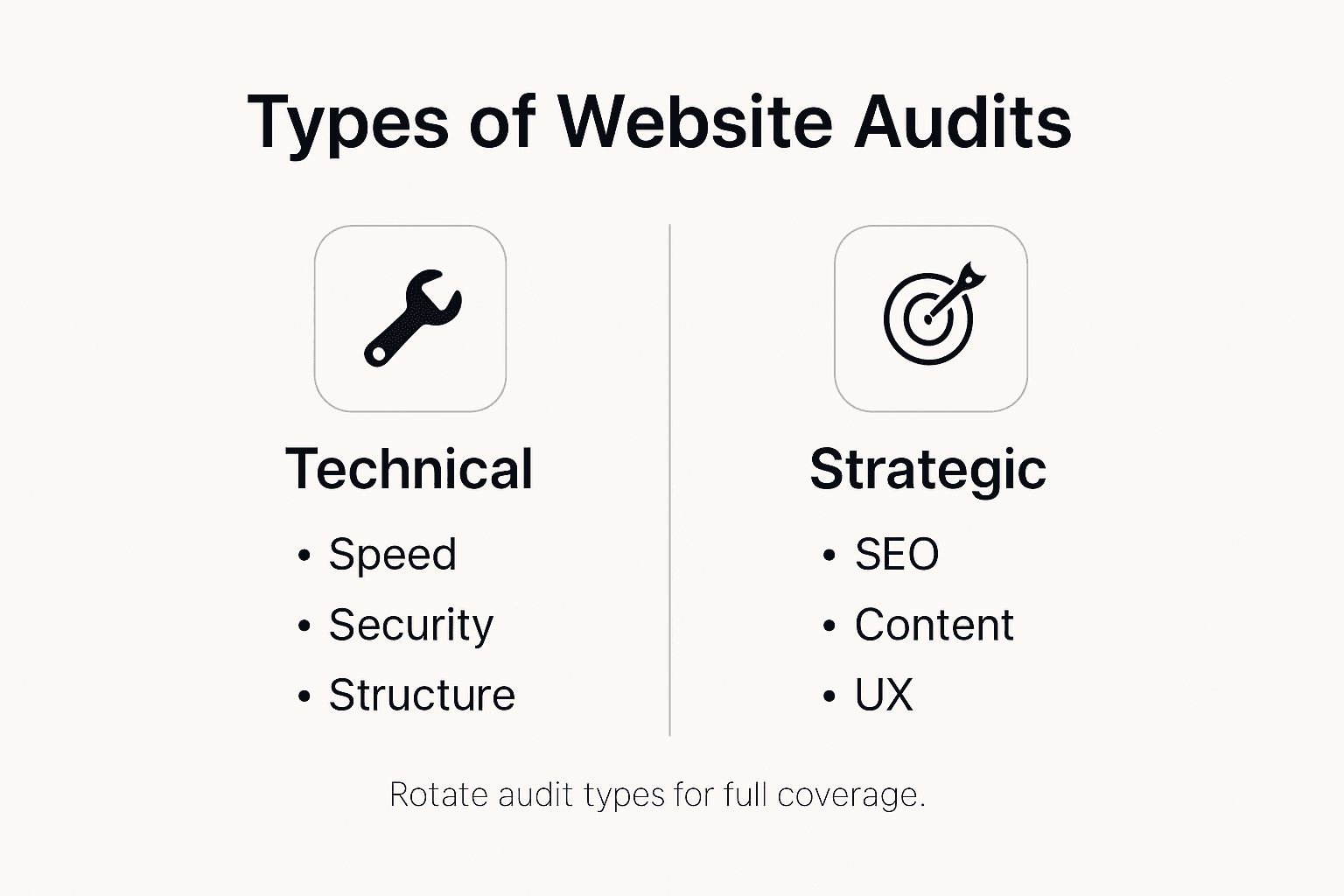
Each audit type offers specific insights crucial for digital strategy. A Technical Audit might uncover page load speed issues or broken links, while a Content Audit could highlight outdated information or content gaps. SEO Audits reveal keyword optimisation opportunities, Security Audits protect against potential breaches, and UX Audits ensure your website provides an intuitive, engaging user journey. By understanding and implementing findings from these different audit approaches, businesses can systematically enhance their digital presence and competitive positioning.
Here’s how the main types of website audits compare in focus and benefits:
| Audit Type | Primary Focus | Key Business Benefit |
|---|---|---|
| Technical Audit | Site infrastructure | Improves speed and reliability |
| Content Audit | Quality of information | Enhances relevance and engagement |
| SEO Audit | Search visibility | Increases website traffic |
| Security Audit | Cyber threat protection | Safeguards sensitive data |
| UX Audit | User interaction flow | Boosts customer satisfaction |
Pro tip: Rotate through different audit types quarterly to maintain a comprehensive and dynamic approach to your website’s health and performance.
How a website audit works step by step
A website audit is a systematic process that requires careful planning and execution. Information security audits follow a structured methodology designed to comprehensively assess digital infrastructure and performance. The initial stage involves understanding the current technological landscape of the website, establishing baseline metrics, and identifying potential areas of improvement.
The audit process typically unfolds through several critical stages. First, auditors define the precise scope and objectives, determining which aspects of the website will be examined. Next, they collect detailed evidence by conducting thorough system reviews, performance tests, and configuration analyses. Cybersecurity audit approaches emphasise the importance of gathering comprehensive data across multiple dimensions including technical infrastructure, user experience, security protocols, and content effectiveness.
After gathering evidence, auditors meticulously evaluate findings against established performance benchmarks and industry standards. This involves detailed analysis of technical configurations, content relevance, search engine optimisation strategies, security vulnerabilities, and user interaction patterns. The final stage involves compiling a comprehensive report that not only highlights identified issues but also provides actionable recommendations for improvement. These insights enable businesses to make informed decisions about website enhancements, prioritising changes that will deliver the most significant impact on overall digital performance.
Pro tip: Schedule your website audit during off-peak hours to minimise potential disruption to your online services and ensure the most accurate performance assessment.
Key benefits for small business owners
Website audits offer transformative advantages for small businesses seeking to establish a robust digital presence. Cybersecurity audits provide critical insights that go beyond simple technical assessments, delivering strategic advantages that directly impact business growth and customer confidence.

Small business owners can expect multiple tangible benefits from comprehensive website audits. These include improved website performance, enhanced search engine visibility, and robust security protection. Performance evaluations help uncover technical limitations that might be hindering customer engagement, such as slow loading times, mobile responsiveness issues, or complex navigation structures. By addressing these elements, businesses can significantly improve user experience and increase the likelihood of converting website visitors into paying customers.
Beyond technical improvements, website audits provide strategic intelligence that enables small businesses to compete more effectively in digital marketplaces. The insights gained help identify potential security vulnerabilities, optimise content strategies, and align digital assets with business objectives. Audits reveal opportunities for targeted improvements, whether that involves refining SEO strategies, streamlining website architecture, or enhancing customer interaction points. This proactive approach transforms websites from passive online brochures into dynamic, high-performing business tools that actively drive growth and build customer trust.
Pro tip: Conduct website audits biannually to ensure your digital presence remains agile, secure, and aligned with evolving business goals.
Risks and mistakes to avoid in audits
Website audits can quickly become ineffective or counterproductive when businesses fail to understand potential pitfalls. Information security audits involve complex risk management that requires meticulous planning and comprehensive understanding to deliver meaningful insights.
One of the most significant risks is conducting an incomplete or superficial audit that overlooks critical aspects of digital infrastructure. This might involve neglecting emerging cybersecurity threats, failing to assess all technical components, or using outdated evaluation methodologies. Small businesses are particularly vulnerable when audits do not thoroughly examine security protocols, performance metrics, user experience, and compliance requirements. An audit that misses key elements can provide false confidence and leave critical vulnerabilities unaddressed.
Mitigation strategies demand systematic and thorough approaches to ensure meaningful outcomes. Common mistakes include treating audits as one-time events rather than ongoing processes, failing to communicate findings effectively with stakeholders, and most critically, not implementing recommended improvements. Businesses must view audit results as actionable intelligence, creating structured plans to address identified weaknesses and continuously monitor digital performance. The most effective audits result in tangible improvements that enhance website security, user experience, and overall digital strategy.
Common audit pitfalls and ways to avoid them:
| Risk or Mistake | Potential Impact | Mitigation Strategy |
|---|---|---|
| Incomplete scope | Missed vulnerabilities | Define comprehensive coverage |
| Neglecting follow-up | Unresolved website weaknesses | Create an implementation checklist |
| Using outdated methods | Ineffective analysis | Apply current industry standards |
| Treating audit as one-off | Lags in improvement | Schedule audits regularly |
Pro tip: Create a dedicated follow-up process immediately after each website audit to track and implement recommended changes within specific timeframes.
Elevate Your Website Performance with Expert Guidance
Understanding the importance of a thorough website audit is just the first step towards boosting your business performance online. The challenges highlighted in the article such as improving site speed, enhancing security, and refining user experience are exactly where expertise makes all the difference. At Kickass Online, we specialise in addressing these critical areas through personalised web development and optimisation services tailored specifically for small and medium-sized businesses.
Explore how our dedicated team can help you overcome common pain points including SEO optimisation, technical improvements, and robust security measures with our proven approach. Discover insightful strategies and practical solutions in our Websites | Kickass Online category to start transforming your website today.

Ready to turn your website audit insights into tangible business growth Seek expert assistance now to ensure your website is agile, secure and perfectly aligned with your business goals Visit Kickass Online to book a consultation and explore our comprehensive digital marketing and website services. For ongoing learning and tips, explore our Tutorials | Kickass Online to stay ahead in managing your online presence effectively.
Frequently Asked Questions
What is a website audit?
A website audit is a comprehensive diagnostic process that examines all aspects of your online presence, including technical performance, user experience, and security, to uncover areas for improvement.
Why are website audits important for small businesses?
Website audits help small businesses identify performance bottlenecks, security vulnerabilities, and opportunities to enhance customer engagement and conversion rates, ultimately boosting their digital effectiveness.
How often should I conduct a website audit?
It is recommended to conduct a website audit quarterly to stay ahead of potential performance and security issues, ensuring your online presence remains effective and secure.
What are the main types of website audits?
The main types of website audits include Technical Audits, Content Audits, SEO Audits, Security Audits, and User Experience (UX) Audits, each serving a specific purpose in enhancing your website’s performance and security.
Recommended
- How to Boost Google Rankings for Your Business Website | Kickass Online
- How to Analyse Website Traffic for Business Growth | Kickass Online
- Benefits of SEO for Your Business Marketing | Kickass Online
- Why Your Business Website is Failing – and How to Fix It | Kickass Online
- Improving Diagnostic Accuracy for Diesel Injection Specialists – My WordPress