
Most British small business websites miss out on over half their potential traffic simply due to basic SEO gaps. For Milton Keynes owners, understanding where your website stands is more than a technical task, it shapes your path to online growth. This practical guide unpacks each step to pinpoint strengths, address weak spots, and move towards a web presence that genuinely connects with your customers.
Table of Contents
- Step 1: Assess Website Performance And Seo Readiness
- Step 2: Research Target Keywords And Audience Intent
- Step 3: Optimise On-Page Elements For Search Engines
- Step 4: Enhance Technical Seo And Website Speed
- Step 5: Build Quality Backlinks And Local Citations
- Step 6: Monitor Results And Refine Seo Strategies
Quick Summary
| Key Point | Explanation |
|---|---|
| 1. Regularly assess website performance | Conduct quarterly assessments of core metrics like loading speed and bounce rate to improve search engine readiness and user experience. |
| 2. Perform thorough keyword research | Identify both short and long tail keywords that reflect audience intent, helping to create relevant content that attracts traffic. |
| 3. Optimise on-page SEO elements | Focus on titles, meta descriptions, and headings with strategic keyword placement to enhance visibility and user engagement. |
| 4. Enhance technical SEO and speed | Regularly analyse loading speed and technical issues to improve search engine rankings and ensure a responsive design across devices. |
| 5. Monitor and refine SEO strategies | Use web analytics to track performance metrics continuously and adapt strategies based on data insights to optimise effectiveness. |
Step 1: Assess website performance and SEO readiness
Understanding your website’s current performance is the foundational first step towards improving search engine rankings. This assessment provides a clear snapshot of where your digital presence stands and what strategic improvements you need to implement for better online visibility.
To begin, you’ll want to analyse your website’s core metrics using comprehensive tools. Start by examining your site’s loading speed performance, which is critical for user experience and search rankings. Google PageSpeed Tools offer an excellent starting point for evaluating your website’s technical performance. These tools automatically detect issues affecting your site’s speed, helping you understand potential bottlenecks that might be hindering your search engine positioning.
Beyond speed metrics, conduct a thorough examination of key performance indicators such as organic traffic, bounce rate, and conversion rates. Look closely at how users interact with your website using traffic analysis techniques that reveal user behaviour patterns. Pay special attention to which pages attract the most engagement and where potential visitors might be dropping off.
Top tip: Run your website performance assessment at least quarterly to stay ahead of potential technical issues and maintain optimal search engine readiness.
Step 2: Research target keywords and audience intent
Keyword research is a critical strategy for understanding how potential customers search for services like yours online. This step will help you identify the precise language your target audience uses when seeking solutions your business provides.
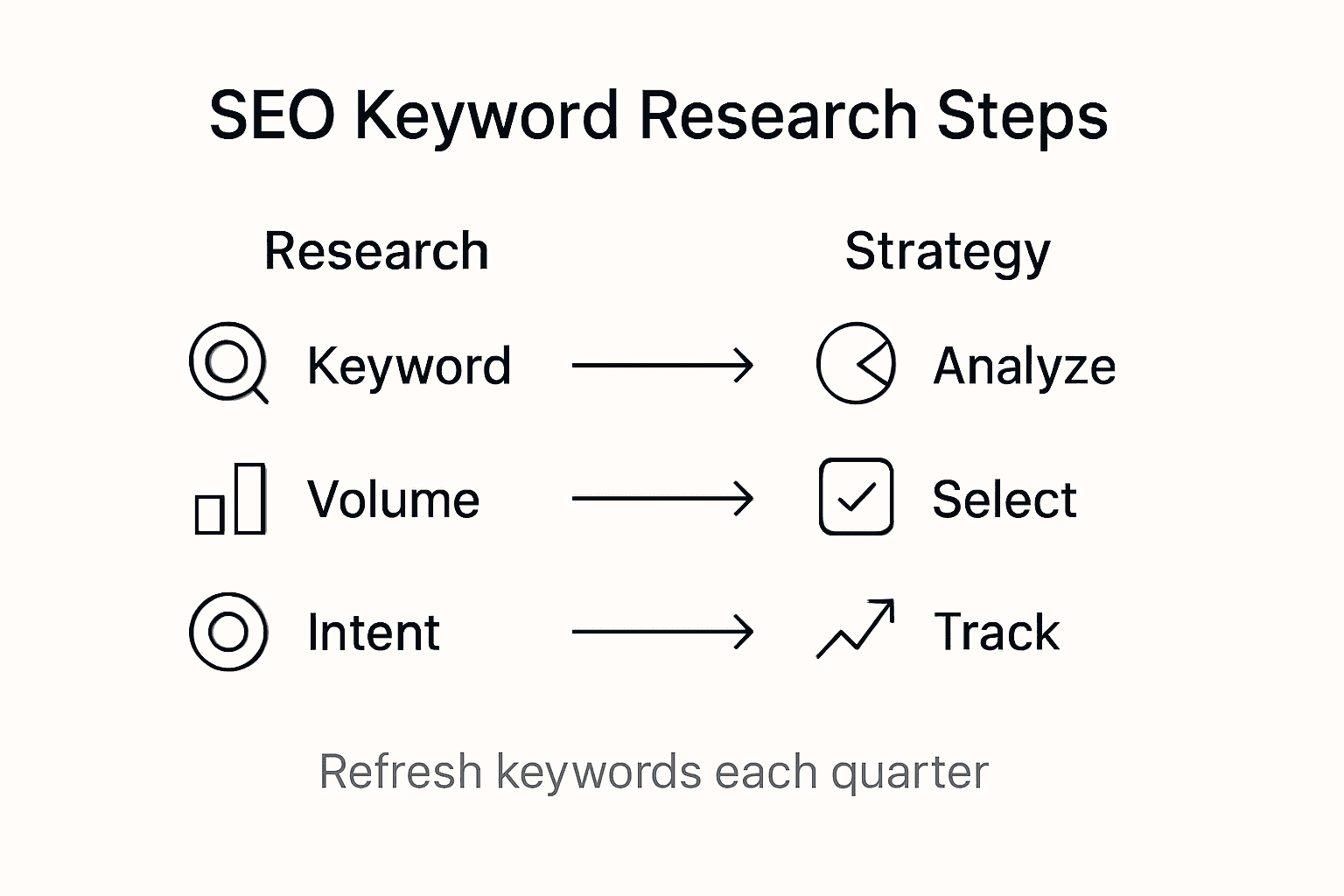
Begin by exploring both broad and specific search terms that relate to your business offerings. Analyse the different types of keywords ranging from short tail to highly specific long tail phrases. Understanding search intent becomes crucial here multiple customers might use different search terms to find similar services. Pay attention to the context and motivation behind each search query, which helps you create content that directly addresses user needs.
Here’s a concise comparison of short tail versus long tail keywords in SEO strategy:
| Keyword Type | Search Volume | Competition Level | Conversion Potential |
|---|---|---|---|
| Short tail | High | Very competitive | Often lower |
| Long tail | Moderate to low | Less competitive | Often higher |
This distinction helps clarify the strategic value of each approach in targeting audience intent.
Utilise professional keyword research tools to evaluate search volume, competition levels, and potential ranking opportunities. Focus on keywords that balance reasonable search frequency with manageable competition. Consider including location specific terms if your business serves a particular geographic area, as these can often provide more targeted traffic with higher conversion potential.
Expert suggestion: Periodically review and refresh your keyword strategy to ensure your content remains aligned with evolving search trends and user behaviours.
Step 3: Optimise on-page elements for search engines
On-page search engine optimisation involves strategically refining your website’s content and HTML source code to improve visibility and ranking potential. Mastering key on-page elements requires a systematic approach to enhancing multiple website components that search engines evaluate.
Focus on optimising critical elements such as page titles, meta descriptions, headings, and content structure. Your page titles should include primary keywords while remaining clear and compelling. Create unique meta descriptions that accurately summarise page content and entice users to click. When structuring content, implement strategic keyword placement by incorporating target keywords naturally within headings, first paragraphs, and throughout your text without compromising readability.

Ensure your website’s technical structure supports search engine visibility by using clean, descriptive URLs, implementing appropriate header hierarchies, and adding alt text to images. Integrate semantically related keywords that expand on your primary search terms, helping search engines understand your content’s context and relevance. Remember that modern search algorithms prioritise content quality and user experience over mechanical keyword stuffing.
Below is a summary of key on-page elements and their SEO impact:
| On-Page Element | Description | SEO Benefit |
|---|---|---|
| Page Title | Main heading in browser tab | Improved keyword targeting |
| Meta Description | Brief content summary for search snippets | Higher click-through rates |
| Headers (H1-H3) | Structured subheadings within content | Enhanced content clarity |
| Alt Text | Describes website images for context | Greater accessibility, SEO |
Optimising these elements supports both visibility and user engagement.
Expert suggestion: Conduct regular content audits to maintain and improve your on-page SEO elements, ensuring they remain aligned with current search engine guidelines and user expectations.
Step 4: Enhance technical SEO and website speed
Diagnosing and resolving technical SEO issues requires a comprehensive approach to improving your website’s performance and search engine visibility. Technical SEO encompasses multiple elements that directly impact your site’s ability to rank effectively and provide an exceptional user experience.
Begin by thoroughly analysing your website’s loading speed and mobile responsiveness. Google PageSpeed Tools offer sophisticated modules that automatically detect and suggest optimisations for CSS, JavaScript, images, and HTML structures. Focus on reducing server response times, compressing images, leveraging browser caching, and minimising render blocking resources. Implement responsive design principles to ensure your website functions seamlessly across different devices and screen sizes.
Conduct a comprehensive technical audit to identify potential issues that might impede search engine crawling and indexing. This includes checking your website’s XML sitemap, verifying robots.txt configurations, eliminating broken links, and ensuring proper canonical tag implementations. Pay special attention to mobile friendliness, site security through HTTPS protocols, and structured data markup that helps search engines better understand your content’s context and relevance.
Expert suggestion: Regularly monitor your website’s technical performance using professional SEO tools, addressing potential issues proactively to maintain optimal search engine rankings.
Step 5: Build quality backlinks and local citations
Developing online authority through strategic backlink strategies is crucial for improving your business’s search engine visibility and digital reputation. This process involves creating meaningful connections with reputable websites and establishing a strong local digital presence that signals credibility to search engines.
Begin by identifying high quality websites within your industry that could potentially link to your content. Focus on creating valuable, informative content that naturally encourages other websites to reference your work. Local SEO strategies become particularly important for small businesses looking to attract regional customers. Claim and optimise your Google Business Profile, ensure consistent business information across online directories, and encourage customer reviews that boost your local search visibility.
Utilise multiple strategies for acquiring backlinks including guest blogging, participating in industry forums, creating shareable infographics, and developing relationships with local business associations. Prioritise quality over quantity understanding that a single link from a highly respected website carries significantly more weight than numerous links from low quality sources. Always maintain ethical link building practices that align with search engine guidelines to avoid potential penalties.
Expert suggestion: Regularly audit your backlink profile to remove potentially harmful links and maintain a clean, authoritative online presence.
Step 6: Monitor results and refine SEO strategies
Continuous search engine optimisation demands systematic tracking and analysis of your website’s performance metrics. This critical stage involves transforming raw data into actionable insights that will progressively enhance your digital marketing effectiveness.
Utilise comprehensive web analytics tools to track key performance indicators such as organic traffic, keyword rankings, bounce rates, and conversion metrics. Web analytics platforms provide detailed insights into user behaviour, helping you understand which strategies are generating meaningful engagement. Pay close attention to how different content pieces perform, identifying patterns in user interaction that can inform future content and SEO approaches.
Develop a consistent review cycle where you assess your SEO performance monthly or quarterly. Compare current metrics against your initial benchmarks, looking for trends in search rankings, traffic sources, and user engagement. Be prepared to pivot your strategy based on these insights, whether that means adjusting keyword targeting, refreshing existing content, or exploring new content formats that resonate with your audience.
Expert suggestion: Create a living document tracking your SEO experiments and results, enabling data driven decision making and continuous improvement.
Take Your SEO Strategy to the Next Level with Kickass Online
Struggling to improve your website’s search engine rankings despite following SEO basics like keyword research and on-page optimisation It can be frustrating when technical issues or weak backlink profiles hold you back from the traffic and conversions your business deserves. Our team at Kickass Online understands these challenges deeply. We specialise in comprehensive SEO and web development services tailored to small and medium-sized businesses to boost online visibility through expert performance audits, technical SEO fixes, and targeted local citation building. Discover proven strategies that align with the detailed steps in this guide by exploring valuable insights in our Tips and Tricks | Kickass Online collection.

Ready to transform your website into a high-ranking, high-converting asset Our personalised approach ensures your business receives dedicated attention and customised solutions for long-term growth. Visit Kickass Online to learn about our expert team and client success stories or explore our specialised Websites | Kickass Online services. Book a consultation today and start seeing measurable improvements from your SEO efforts now.
Frequently Asked Questions
How can I assess my website’s current performance for SEO?
To assess your website’s performance, start by analysing loading speed using relevant performance tools. Aim to run this assessment at least quarterly to identify issues that could impact your search engine rankings.
What steps should I take to conduct keyword research for my SEO strategy?
Begin by identifying both broad and specific search terms relevant to your business. Utilise keyword research tools to evaluate search volume and competition levels, focusing on keywords that align well with user intent and have manageable competition.
What on-page elements should I optimise to improve my search engine rankings?
Focus on optimising page titles, meta descriptions, headings, and content structure to improve visibility. Ensure that your content includes target keywords naturally while maintaining readability to enhance user engagement and search rankings.
How do I enhance my website’s technical SEO?
To improve technical SEO, analyse your website’s loading speed and mobile responsiveness. Implement responsive design and address issues like broken links and improper canonical tags to enhance both user experience and search engine crawling.
What are effective strategies for building quality backlinks for SEO?
Develop quality backlinks by creating valuable content that other reputable websites will reference. Engage in guest blogging and local SEO tactics to establish credibility and ensure your business is listed accurately in online directories.
How can I monitor my SEO performance effectively?
Use web analytics tools to track key performance indicators such as organic traffic and conversion rates. Regularly review your metrics on a monthly or quarterly basis to identify trends and refine your SEO strategies accordingly.