Why use professional web design: Boost conversions 200%

Professional web design isn’t just about making your website look pretty. Studies show that expertly crafted sites can boost conversion rates by up to 200% compared to DIY alternatives. Yet many UK SMBs still underestimate how professional design impacts SEO performance, customer trust, and bottom-line business results. This guide reveals why partnering with web design experts is essential for sustainable growth in 2026.
Table of Contents
- Understanding Professional Web Design
- How Professional Web Design Drives Higher Conversions
- SEO And Online Visibility Benefits Of Professional Web Design
- Common Misconceptions And Pitfalls Of DIY And Template Web Design
- Professional Design Enhances Brand Credibility
- Ongoing Website Maintenance And Security Importance
- Case Studies: Real-World Impact Of Professional Web Design
- Comparison Framework: Evaluating Professional Vs. DIY Web Design
- Transform Your Business With Expert Web Design Services
- Why Use Professional Web Design? Frequently Asked Questions
Key takeaways
| Point | Details |
|---|---|
| Professional design integrates UX, SEO, branding, and technical excellence | It’s a strategic process, not just visual styling |
| Conversion rates can increase up to 200% versus DIY solutions | Data-driven design optimises user journeys and trust signals |
| Mobile optimisation and security are critical differentiators | DIY sites suffer 50% higher mobile bounce rates |
| Ongoing maintenance protects your investment and performance | Regular updates ensure security, speed, and search rankings |
| Professional sites build brand credibility and customer loyalty | Expert design signals reliability and quality to your audience |
Understanding professional web design
Professional web design goes far beyond choosing colours and fonts. It’s a holistic approach that combines user experience (UX), search engine optimisation (SEO), branding, and technical performance into one cohesive strategy. For UK SMBs, this means creating a website tailored to specific business goals, target customers, and competitive positioning.
The process includes responsive design that adapts seamlessly to any device, intuitive navigation that guides visitors effortlessly, lightning-fast load times, and accessible content that serves all users. These elements work together to create a powerful sales tool, not just an online brochure.
Here’s what sets professional design apart from template-based DIY solutions:
- Customised layouts that reflect your unique brand identity and value proposition
- Strategic content placement based on visitor behaviour data and conversion psychology
- Technical optimisation for search engines, speed, and security from day one
- Scalable architecture that grows with your business needs
- Professional support and maintenance to protect your investment
Whilst DIY platforms offer convenience, they lack the strategic planning and customisation that convert casual browsers into paying customers. Professional web development benefits for SMEs extend far beyond aesthetics, directly impacting revenue and market position.
How professional web design drives higher conversions
Optimised user experience forms the foundation of conversion success. When visitors land on a professionally designed site, they encounter clear pathways to their goals, whether that’s making a purchase, booking a consultation, or requesting a quote. Navigation feels intuitive, information appears exactly where users expect it, and every element guides them towards meaningful action.

Trust signals embedded throughout professional design dramatically increase customer confidence. SSL certificates, professional imagery, client testimonials strategically placed, and polished visual presentation all communicate that your business is legitimate and reliable. These subtle cues matter enormously when visitors decide whether to share contact details or payment information.
Research demonstrates conversion rates can increase up to 200% with professional design compared to DIY alternatives. The difference stems from data-driven methods that professional designers employ:
- Heat mapping and analytics to understand exactly how visitors interact with your site
- A/B testing different layouts, calls-to-action, and content arrangements
- Conversion funnel optimisation that removes friction from the customer journey
- Strategic use of white space, visual hierarchy, and colour psychology
- Fast-loading pages that keep impatient users engaged
Professional designers continuously refine these elements based on real performance data. They identify where visitors drop off, which pages convert best, and what design changes will increase website conversions most effectively.
Pro Tip: Request conversion tracking setup as part of your web design project. Measuring results from day one lets you quantify ROI and make informed optimisation decisions as your site evolves.
SEO and online visibility benefits of professional web design
Search engine optimisation starts at the design phase, not as an afterthought. Professional designers integrate SEO best practices during the design phase, building keyword research, meta tag optimisation, and clean semantic code into the site’s foundation. This approach ensures your website ranks well from launch rather than requiring expensive retrofitting later.
Mobile optimisation represents a critical SEO ranking factor in 2026. Google’s mobile-first indexing means your site’s mobile version determines search rankings. Professional design guarantees flawless performance across smartphones and tablets, whilst mobile optimisation reduces bounce rates by approximately 50% compared to DIY sites that often render poorly on smaller screens.
Site speed directly impacts both SEO rankings and user satisfaction. Professional developers optimise images, minimise code, leverage browser caching, and implement content delivery networks to achieve lightning-fast load times. These technical improvements boost your position in search results whilst keeping impatient visitors engaged.
The compounding benefits of strong organic rankings include:
- Increased qualified traffic from users actively searching for your services
- Reduced dependence on expensive paid advertising campaigns
- Higher credibility since users trust organic results more than ads
- Sustainable long-term visibility that builds over time
- Better local search performance for location-based businesses
Professional design also ensures proper site structure, internal linking, and technical SEO elements that DIY builders often miss. These SEO benefits for SMEs translate directly into more enquiries, sales, and revenue. Investing in SEO ranking improvements through professional design pays dividends for years, making it one of the highest-ROI marketing investments available.
Common misconceptions and pitfalls of DIY and template web design
Many business owners believe DIY website builders offer a good-enough solution for establishing online presence. This misconception costs UK SMBs thousands in lost revenue and missed opportunities. The reality is that professional web design integrates UX, SEO, branding, and technical performance, whilst template sites merely provide basic page layouts.
Template platforms create several hidden problems. Most templates lack proper mobile responsiveness, displaying broken layouts or requiring excessive zooming on smartphones. Security updates depend on the platform’s schedule, leaving your site vulnerable to breaches. SEO optimisation remains superficial, missing the deep technical improvements that drive rankings.
The data reveals stark differences in performance. DIY sites suffer 50% higher mobile bounce rates than professionally designed responsive websites. Visitors immediately recognise amateur design, damaging trust before they even read your content. This first impression proves nearly impossible to overcome.
Consider these critical risks of DIY approaches:
- Limited customisation forces your brand into generic templates
- Slow load times from unoptimised code and bloated plugins
- Security vulnerabilities that expose customer data and damage reputation
- Poor scalability when you need advanced features or integrations
- No professional support when technical issues arise
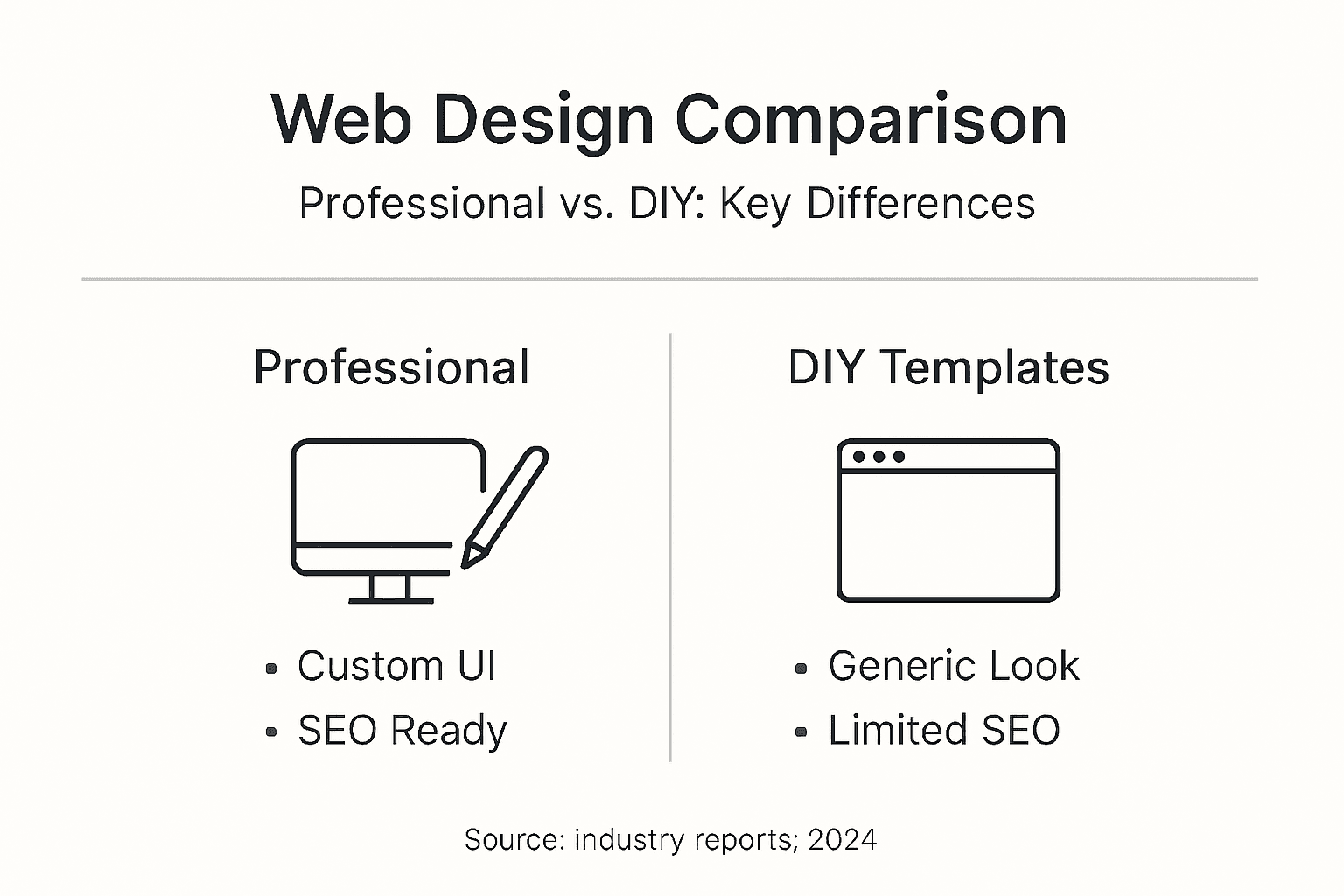
The following comparison highlights why professional web design advantages justify the investment:
| Aspect | Professional Design | DIY Templates |
|---|---|---|
| Mobile Performance | Flawless responsive design | 50% higher bounce rates |
| SEO Integration | Built-in from foundation | Basic, limited optimisation |
| Security | Regular updates, monitoring | Platform-dependent, reactive |
| Customisation | Fully tailored to brand | Constrained by template |
| Support | Ongoing expert assistance | Self-service only |
Pro Tip: Calculate the cost of lost conversions from poor design. If template limitations cost you just two sales monthly, professional design pays for itself within months whilst continuing to generate returns for years.
Businesses that start with DIY solutions often spend more long-term. They eventually require professional redesigns anyway, essentially paying twice. Understanding common misconceptions explained by industry experts helps avoid these expensive mistakes from the start.
Professional design enhances brand credibility
Customised, professional design immediately signals reliability and quality to potential customers. Within seconds of landing on your site, visitors form judgements about your business competence and trustworthiness. Polished design communicates that you invest in quality and take your business seriously, encouraging visitors to do the same.
Surveys consistently show professionally designed sites are perceived as more credible than DIY alternatives. This perception translates into tangible business outcomes. Visitors spend more time exploring your offerings, feel more comfortable sharing contact information, and convert at significantly higher rates.
Brand-aligned design helps your business stand out in competitive UK markets. Rather than looking like every other company using the same template, your site reflects your unique value proposition, personality, and market positioning. This differentiation proves crucial when prospects compare multiple providers.
Key credibility factors delivered through professional design include:
- Consistent visual identity that reinforces brand recognition across all touchpoints
- Professional photography and graphics that elevate perceived quality
- Sophisticated layout and typography that demonstrate attention to detail
- Seamless functionality that builds confidence in your operational capabilities
- Strategic content presentation that establishes thought leadership
Stronger brand credibility generates higher customer loyalty and repeat business. Clients who trust your brand return for additional services, refer colleagues, and provide positive reviews that attract new customers. This virtuous cycle starts with the professional first impression your professional website branding creates.
Research indicates that 75% of consumers judge a company’s credibility based on website design quality, making professional presentation essential for business success in digital markets.
The investment in professional design pays ongoing dividends through enhanced reputation, customer confidence, and competitive positioning. These intangible benefits compound over time, establishing your business as an industry leader rather than just another option.
Ongoing website maintenance and security importance
Launching your website marks the beginning of its lifecycle, not the end. Professional maintenance protects against hacking attempts, malware infections, and data breaches that could devastate your business reputation and legal standing. Cybercriminals constantly develop new attack methods, making regular security updates absolutely essential.
Regular updates ensure fast load times, fix broken links, address compatibility issues, and maintain compliance with evolving privacy regulations like GDPR. Neglecting these tasks leads to visitor frustration from error messages, slow pages, and security warnings that drive potential customers straight to competitors.
The importance of website maintenance extends beyond security to search engine performance. Google penalises sites with technical errors, slow load times, or security vulnerabilities. Regular maintenance keeps your rankings strong and protects the SEO investment you made during design and launch.
Critical maintenance tasks include:
- Security patches and software updates to close vulnerabilities
- Performance monitoring and optimisation to maintain speed
- Backup systems that protect against data loss
- Uptime monitoring to catch and resolve outages immediately
- Content updates to keep information current and relevant
Pro Tip: Budget for ongoing website support as part of your total cost of ownership from the start. Monthly maintenance typically costs far less than emergency repairs after a security breach or major technical failure.
Professional maintenance packages provide peace of mind through proactive monitoring and expert support. Rather than discovering problems when customers complain, issues get identified and resolved before impacting your business. This preventative approach delivers regular website maintenance benefits that protect your revenue stream and brand reputation.
Case studies: real-world impact of professional web design
UK small businesses across industries have documented remarkable results after investing in professional web design. A Manchester-based legal firm saw revenue increase by 180% within six months of launching their professionally designed site. The improvement stemmed from enhanced credibility, clearer service explanations, and optimised contact forms that captured more qualified leads.
A Bristol retail business doubled its online conversion rate after professional redesign focused on mobile optimisation and simplified checkout processes. Their bounce rate dropped by 45%, whilst average order value increased by 30%. The investment paid for itself within three months through increased sales alone.
Conversion metrics across multiple UK SMB case studies show consistent patterns. Professionally designed sites typically achieve 150-200% improvement in goal completions compared to their previous DIY versions. These gains reflect better user journeys, stronger trust signals, and technical optimisation working together.
Long-term website strategies deliver sustained competitive advantages beyond immediate conversion improvements. Businesses report:
- Improved search rankings that compound over time, driving more organic traffic
- Enhanced brand perception that supports premium pricing strategies
- Reduced customer service costs from clearer information architecture
- Better data insights enabling smarter marketing decisions
- Scalable platforms that accommodate business growth without rebuilding
A Birmingham professional services firm calculated their ROI at 450% over two years. Beyond direct revenue attribution, they valued improved efficiency, reduced advertising costs, and competitive positioning gains their professional site enabled. The transformation extended across their entire business operations.
These success stories share common themes: strategic planning, expert execution, and ongoing optimisation. Initial investment concerns quickly fade when businesses experience the tangible impact of professional web design on revenue, efficiency, and market position.
Comparison framework: evaluating professional vs. DIY web design
Making informed decisions between professional and DIY web design requires evaluating five critical pillars. The framework includes assessing UX design quality, SEO, branding, security, and support to understand long-term implications of your choice.
The following comparison clarifies trade-offs across these essential criteria:
| Criterion | Professional Design | DIY Approach |
|---|---|---|
| UX Quality | Data-driven, conversion-optimised journeys | Template-constrained, generic paths |
| SEO Integration | Strategic, technical, ongoing optimisation | Basic features, limited control |
| Branding | Fully customised, differentiated identity | Generic templates, limited uniqueness |
| Security | Proactive monitoring, expert updates | Reactive, platform-dependent |
| Support | Ongoing expert assistance available | Self-service resources only |
Follow these steps to evaluate your specific business needs and project goals:
- Define your revenue goals and calculate how many additional conversions you need to achieve them
- Assess your target audience’s expectations for online experience in your industry
- Evaluate your internal technical capabilities and available time for website management
- Research competitor websites to understand the minimum standard in your market
- Calculate total cost of ownership including maintenance, not just initial build costs
- Consider your growth plans and whether your website can scale accordingly
The long-term ROI perspective reveals DIY limitations clearly. Initial cost savings disappear when factoring in lost conversions, security risks, and eventual professional redesign needs. Most businesses using DIY solutions for over a year eventually invest in professional rebuilds, essentially paying twice.
Scalability represents another critical consideration. As your business grows, you’ll need advanced features like customer portals, integrations with business systems, or e-commerce capabilities. DIY platforms impose strict limitations that force expensive migrations later. Professional sites build on solid foundations that accommodate expansion seamlessly.
Using this professional web design evaluation framework, you can align your website investment with budget constraints, growth ambitions, and customer expectations. The right choice depends on honestly assessing whether your business can afford the ongoing cost of poor design or whether professional expertise delivers better value.
Transform your business with expert web design services
Partnering with experienced UK web design professionals transforms your online presence from a basic information placeholder into a powerful revenue-generating asset. The right partner takes time to understand your business goals, target customers, and competitive landscape before recommending solutions tailored to your specific needs.
Our customised design approach aligns every element with your business objectives and SEO best practices. We don’t use templates or cookie-cutter solutions. Instead, we build websites that reflect your unique value proposition whilst incorporating the conversion optimisation, mobile responsiveness, and technical excellence that drive results.
Ongoing website maintenance packages protect and grow your investment through regular security updates, performance optimisation, and strategic improvements. You gain peace of mind knowing experts monitor your site continuously, resolving issues before they impact customers or search rankings.
Staying current with latest web development trends ensures your site remains competitive as technology and user expectations evolve. Our team continuously implements emerging best practices so your website maintains its edge in crowded markets.
Pro Tip: Starting with a consultation clarifies your options and helps plan a successful website strategy without obligation. Discuss your goals, challenges, and budget to receive expert recommendations tailored to your situation.
Explore our professional website design services to discover how strategic design investment delivers measurable growth for UK SMBs like yours.
Why use professional web design? Frequently asked questions
What are the benefits of professional web design over DIY solutions?
Professional design delivers higher conversion rates, better SEO rankings, enhanced security, and stronger brand credibility. DIY sites often suffer from poor mobile performance, limited customisation, and lack the strategic optimisation that converts visitors into customers effectively.
How does ongoing website maintenance impact security and performance?
Regular maintenance protects against cyber attacks, fixes technical errors, maintains fast load times, and ensures search engine compliance. Neglected sites face security breaches, broken functionality, and search ranking penalties that damage business reputation and revenue.
Can professional web design improve my site’s Google rankings?
Yes, professional design integrates SEO best practices from the foundation, including mobile optimisation, site speed improvements, proper code structure, and strategic content placement. These technical factors significantly influence search rankings and organic traffic quality.
Is mobile optimisation really that important for my business website?
Absolutely critical in 2026. Mobile users represent the majority of web traffic, and Google uses mobile performance for rankings. Sites without proper mobile optimisation suffer 50% higher bounce rates and dramatically lower conversion rates compared to responsive professional designs.
How soon can I expect to see results after investing in professional web design?
Many businesses notice immediate improvements in user engagement and conversion rates upon launch. SEO benefits build over 3-6 months as search engines index optimised content. Full ROI typically materialises within 6-12 months through increased leads, sales, and reduced marketing costs.
Recommended
- Web Design Conversion: How to Achieve Optimisation? | Kickass Online
- 5 Helpful Web Design Tips to Improve Conversion Rates | Kickass Online
- Why Your Website Design Matters in Light of Conversions
- How Web Design Affects Conversion Rates: What the Data Says | Kickass Online
- Effective Sign Design Principles: Boosting Business Impact -


Book A Discovery Call
Stay Connected