
- Organic search remains the most valuable traffic source but is declining due to AI features.
- Focus on consistent SEO efforts, updating existing pages, and targeting niche low-volume keywords.
- Tracking leads, rankings, and content engagement ensures sustainable growth beyond just website visits.
Getting consistent, quality traffic to your website in 2026 is genuinely harder than it was even two years ago. Organic traffic is down 2.5% year-on-year across most sites, largely because AI-generated answers now intercept searches before users ever click through. But here is the encouraging truth: small and medium-sized businesses (SMEs) that apply focused, well-chosen strategies are still seeing standout growth. This guide cuts through the noise and gives you a clear, jargon-free plan covering the mistakes to avoid, the must-dos that move the needle, and the tools that make it all manageable.
Table of Contents
- Understand traffic sources and set realistic goals
- Lay the groundwork: Key SEO fundamentals for SMEs
- Take action: Step-by-step strategies to boost traffic
- Track, troubleshoot, and sustain your growth
- Why most SME sites miss out: The real traffic unlock
- Ready to supercharge your website traffic?
- Frequently asked questions
Key Takeaways
| Point | Details |
|---|---|
| SEO delivers lasting growth | Consistent SEO outperforms paid ads over time for sustainable website traffic. |
| Niche tactics beat broad efforts | Focusing on local and low-competition keywords helps SMEs outpace larger competitors. |
| Measure real outcomes | Track leads and conversions, not just visits, to gauge traffic strategy success. |
| Update content regularly | Refreshing old pages can boost results faster than relying solely on new content. |
Understand traffic sources and set realistic goals
Before tackling specific steps, it is crucial to know what counts as winning traffic and what is realistically possible for small business owners. Not all visitors are equal. A thousand curious browsers who never buy anything are worth far less than fifty people actively searching for exactly what you sell. Intent matters enormously, and chasing raw numbers without considering quality is one of the most common and costly mistakes SMEs make.
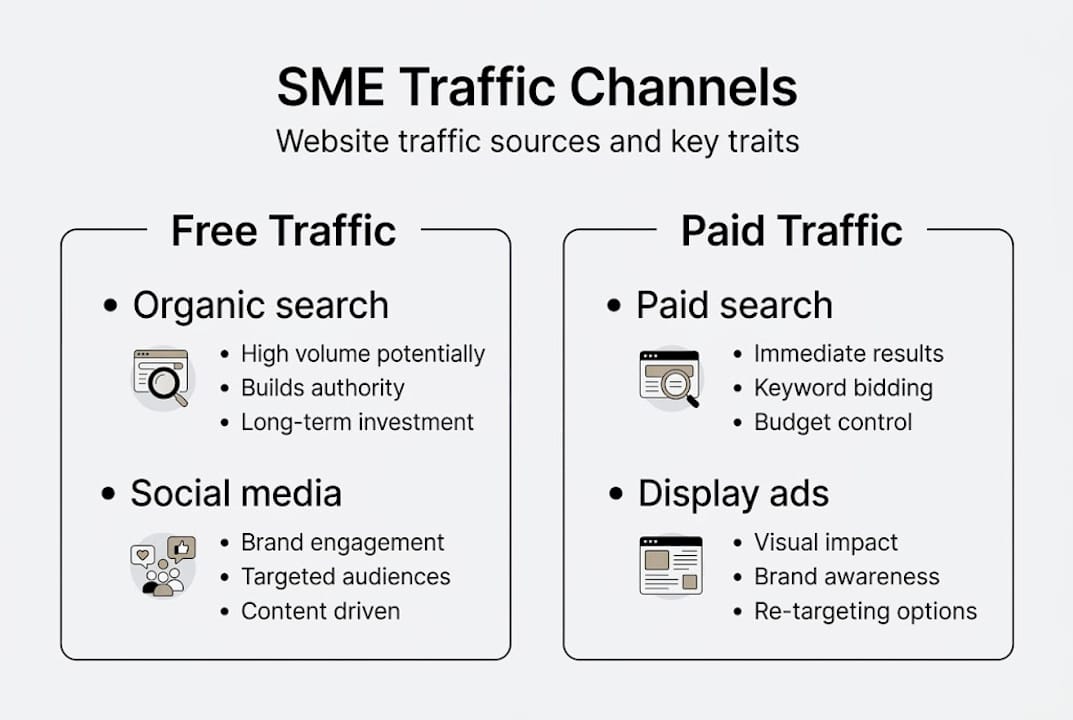
The main channels sending traffic to websites are:
- Organic search: Visitors who find you through Google or Bing without paid promotion
- Social media: Traffic from platforms like Facebook, Instagram, and LinkedIn
- Paid advertising: Pay-per-click (PPC) campaigns such as Google Ads
- Referral: Visitors arriving via links on other websites
- Direct: People typing your URL directly into their browser
Organic search accounts for 46.9% of all website visits, making it the single most important channel for most SMEs. Yet overall organic volume is declining due to AI search features. This is why strategy matters more than ever.
A useful rule of thumb for budget allocation is the 70/20/10 split: roughly 70% of your digital marketing effort on SEO and content, 20% on social media and referral building, and just 10% on paid adverts. This keeps your investment in long-term assets rather than renting attention.
| Traffic source | Typical SME share | Time to results | Cost level |
|---|---|---|---|
| Organic search | 40-50% | 3-6 months | Low (time) |
| Social media | 15-25% | Weeks | Low-Medium |
| Paid advertising | 10-20% | Days | High |
| Referral | 5-15% | Months | Low |
| Direct | 5-10% | Ongoing | None |
The difference between vanity traffic and business-driving traffic is simple: does a visit lead to an enquiry, a sale, or a sign-up? Use that lens when setting goals. Case studies show organic traffic can grow 100% to 375% within two to six months when SMEs apply smart, focused SEO. Start by setting SMART goals (Specific, Measurable, Achievable, Relevant, Time-bound) anchored in your current baseline, and revisit your online visibility guide to understand what metrics actually reflect business health.
Lay the groundwork: Key SEO fundamentals for SMEs
With your goals in place, you must set a strong SEO foundation. These basics are non-negotiable for real, lasting growth, and skipping them is the fastest way to waste months of effort.

The core SEO mechanics for SMEs break down into five essential areas: keyword research, on-page optimisation, technical SEO, local SEO, and backlink building. Here is how they compare in terms of effort and impact:
| SEO tactic | Difficulty | Typical impact | Time to see results |
|---|---|---|---|
| Keyword research | Low | High | Immediate planning |
| On-page optimisation | Low-Medium | High | 4-8 weeks |
| Technical speed/mobile | Medium | Very high | 2-6 weeks |
| Google Business Profile | Low | High (local) | 2-4 weeks |
| Local backlinks | Medium | High | 2-4 months |
To check your own site right now, run through this quick audit:
- Search your main service plus your town on Google. Does your business appear?
- Open your site on a mobile phone. Does it load in under three seconds and look clean?
- Check that every page has a unique title tag and meta description.
- Confirm your Google Business Profile is claimed, verified, and fully filled out.
- Identify your top three pages and ensure each targets one clear keyword phrase.
One tactic that consistently outperforms creating brand-new content is updating existing pages. Refreshing an old article with current data, better headings, and stronger internal links can double its traffic faster than writing something from scratch. Pair this with an SME SEO audit guide to find your biggest opportunities quickly.
Pro Tip: Even a brand-new website with low authority can rank well by focusing tightly on niche, low-competition keyword phrases. Trying to compete on broad terms like “accountant” is a losing battle; targeting “accountant for freelancers in Bristol” is very winnable.
Take action: Step-by-step strategies to boost traffic
Implement the foundation with a stepwise traffic plan. Here is how to put proven approaches into action without getting overwhelmed.
Follow this sequence to build momentum:
- Fix technical issues first. Run a free crawl using tools like Screaming Frog or Google Search Console. Fix broken links, slow pages, and missing meta tags before anything else.
- Update your highest-traffic pages. Refresh content, add new data, improve headings, and strengthen internal links. This is your fastest win.
- Optimise your Google Business Profile. Add photos, post weekly updates, and actively collect reviews. Local visibility is often the quickest traffic boost for SMEs.
- Build topic clusters. Group related articles around a central pillar page. This signals authority to Google and keeps visitors on your site longer.
- List your business in reputable directories. Yell, Thomson Local, and industry-specific directories send both referral traffic and SEO signals.
- Launch a simple email newsletter. Even a monthly roundup drives repeat visits and keeps your audience warm.
The 70/20/10 digital marketing rule applies to content too: spend 70% of your content time on proven formats, 20% experimenting, and 10% on paid promotion. Social sharing gives quick wins, but do not let it distract from the long-game SEO work.
For emerging tactics in 2026, targeting keywords under 1,000 monthly searches is particularly powerful because AI Overviews in Google predominantly appear for these lower-volume, high-intent queries. Auditing competitors for content gaps using tools like Semrush or Ahrefs can also reveal easy wins your rivals have missed. Your SEO strategy guide and SME local SEO tips are excellent next reads once you have this sequence running.
Pro Tip: Repurpose every piece of website content. Turn a blog post into three social media posts, a short email, and a LinkedIn article. One piece of work, five times the reach.
Track, troubleshoot, and sustain your growth
Driving traffic is only half the battle. You must monitor, adapt, and resolve issues to keep growth moving upward.
The metrics that actually matter for SMEs go well beyond raw visitor numbers. SMEs must track leads, rankings, and content engagement alongside traffic to get an honest picture of what is working. Here is a comparison of the most useful reporting tools:
| Tool | What it measures | Cost |
|---|---|---|
| Google Analytics 4 | Traffic, behaviour, conversions | Free |
| Google Search Console | Rankings, impressions, click-through rates | Free |
| Semrush / Ahrefs | Keywords, backlinks, competitor gaps | Paid |
| Google Business Profile Insights | Local views, calls, direction requests | Free |
Common reasons traffic plateaus and how to fix them:
- Stale content: Refresh pages every three to six months with updated data and improved headings
- Thin pages: Add depth, examples, and internal links to pages with fewer than 500 words
- Zero-click losses: Target question-based keywords and structure answers clearly to capture featured snippets
- Poor mobile experience: Use Google’s PageSpeed Insights and act on every recommendation
- No backlink growth: Reach out to local partners, suppliers, and press contacts for mentions
AI and zero-click search results are a real concern in 2026. The answer is not to panic but to focus on content that goes deeper than a quick answer. Strategic SMEs achieve outsized growth by adapting quickly to these shifts rather than waiting for their rankings to recover on their own.
“In 2026, nimble sites grow while passive ones fade.”
Use your step-by-step local SEO resources and revisit mastering local SEO to keep your local presence sharp as algorithms shift.
Why most SME sites miss out: The real traffic unlock
With strategies and analytics in hand, it is worth considering why some companies skyrocket while others stagnate, even with the same tools available to both.
In our experience, the gap almost never comes down to technical skill. It comes down to consistency and focus. Business owners who refresh their content regularly, track leads rather than just traffic, and stay committed to the basics for six months or more almost always outperform those who chase every new tactic.
The biggest trap we see is what we call “shiny tool syndrome”: jumping from one new platform or trend to the next before any of them have had time to deliver results. Clear, well-executed basics beat clever quick hacks every single time.
Smaller SMEs actually have a structural advantage here. You can target low-volume, high-intent niches that large brands ignore entirely. You can build genuine local partnerships and directory relationships that a national company cannot replicate. These overlooked channels, explored further in our digital marketing for business growth resource, consistently deliver strong returns.
Pro Tip: Block one hour each month to review your traffic, leads, and rankings. Decide what to stop, what to continue, and what to try next. That single habit separates growing SMEs from stagnating ones.
Ready to supercharge your website traffic?
If this guide has given you a clearer picture of what is possible, imagine what a dedicated team of specialists could do for your business. Navigating algorithm changes, content strategy, and technical SEO whilst running a business is a significant ask.
At Kickass Online, we work with a select number of SMEs at a time to ensure every client gets focused, personalised attention. Whether you need expert best SEO services to build lasting visibility, a full SEO strategies expertise review, or a complete digital growth partnership, we are ready to help you move faster and smarter. Visit Kickass Online to book a consultation and find out exactly where your biggest traffic opportunities lie.
Frequently asked questions
How long does it take to see results from SEO for a small business?
Most SMEs see measurable results and initial traffic growth within 3-6 months when SEO is implemented properly and consistently from the start.
Which traffic source drives the highest ROI for small business websites?
Organic search provides the highest long-term ROI, accounting for 46.9% of all website visits, making it the most valuable channel for sustained SME growth.
Should I focus on keywords with low search volume?
Yes, because 80% of AI Overviews appear for keywords with fewer than 1,000 monthly searches, meaning low-volume niche terms now offer exceptional visibility for SMEs.
How can I measure if my web traffic strategy is working?
Track leads, conversions, and keyword rankings alongside traffic figures, as measuring only traffic gives an incomplete and often misleading picture of real business performance.
Is paid advertising or SEO better for fast traffic?
Paid adverts deliver immediate results, but SEO long-term value far outweighs paid in cost-effectiveness; the recommended approach allocates just 10% of your budget to paid whilst building organic momentum.
Recommended
- Local SEO for SMEs: Guide to Boost Search Visibility and Drive Local Traffic | Kickass Online
- Mastering Local SEO for SMEs: Tips to Attract Organic Traffic | Kickass Online
- Guide to SEO Strategies: Boost Online Visibility and Drive Organic Traffic | Kickass Online
- Effective Local SEO Strategies for SMEs: Boost Visibility and Dominate Your Market | Kickass Online
- Estrategias para captar nuevos clientes: guía para viajeros y profesionales