Searching for new customers can feel frustrating when your business seems hidden online despite your best efforts. Voice search technology is changing this by making online queries faster and more natural for people in Milton Keynes. As more customers ask lengthy, conversational questions through their phones and smart speakers, businesses that understand this shift are being discovered first. Learn what makes voice search different, and how you can use it to improve your visibility and attract more local customers.
Table of Contents
- What Is Voice Search Technology?
- Major Voice Search Devices And Variations
- How Voice Search Works For Businesses
- SEO Impact And Local Optimisation Strategies
- Risks, Privacy And Cost Implications
Key Takeaways
| Point | Details |
|---|---|
| Importance of Voice Search | Voice search significantly changes customer interaction by favouring conversational queries, impacting SEO strategies. |
| Device Fragmentation | Businesses must recognise the diverse range of voice search platforms and optimise content accordingly. |
| Local SEO Advantage | Local businesses can capitalise on voice search by ensuring accurate location details and addressing common query types. |
| Data Privacy Concerns | Understanding data handling and providing transparent privacy policies are essential to maintain customer trust in voice technology. |
What Is Voice Search Technology?
Voice search technology fundamentally changes how people interact with the internet. Instead of typing a search query, users speak their questions directly into a device, whether that’s a smartphone, smart speaker, or tablet. The technology uses speech recognition combined with natural language processing to understand what someone is saying, then converts that spoken command into a searchable query. The process feels instantaneous to users, but behind the scenes, complex AI algorithms are working to interpret meaning, context, and intent from natural speech patterns.
What makes voice search particularly powerful for your business is how it changes customer behaviour. When people speak rather than type, they naturally ask longer, more conversational questions. Instead of typing “plumber Milton Keynes,” a voice user might ask “Where can I find a reliable plumber near me who does emergency repairs?” This shift means voice search technology leverages natural language processing to capture more detailed search descriptions, which typically results in higher customer satisfaction and more qualified leads. The technology has become increasingly accurate, modern voice recognition systems now achieve around 95% accuracy rates, making them genuinely reliable for everyday use.
The growth of voice search isn’t accidental. Integration with AI has driven significant improvements in how these systems understand context and meaning. Users appreciate voice search because it enables multitasking, you can search while driving, cooking, or working without taking your hands away from what you’re doing. This accessibility factor means voice search appeals to a broader audience, including older customers who might find traditional typing cumbersome. For small to medium-sized businesses in Milton Keynes, this represents a genuine opportunity. Your customers are already using voice search; the question is whether your business appears in those results.
Pro tip: Start auditing your website content now to identify questions your customers actually ask aloud, these conversational phrases will become gold when you optimise for voice search.
Major Voice Search Devices and Variations
Voice search isn’t a single technology controlled by one company. Instead, it’s fragmented across several major players, each with distinct approaches to how they capture and process voice commands. The three dominant platforms you need to know about are Google Assistant, Amazon Alexa, and Apple’s Siri, with Microsoft’s Cortana serving a smaller but meaningful segment. Understanding these differences matters for your business because each platform has unique user bases, search behaviours, and optimisation requirements. Your customers might ask the same question on Google Home one day and an Echo device the next, yet these assistants process and rank results differently.
The key distinctions lie in how these assistants handle connectivity, privacy, and device compatibility. Voice recognition technologies vary significantly in their speech recognition approaches, which directly affects accuracy and user experience. Google Assistant works seamlessly across Android phones, Google Home speakers, and smart displays, prioritising quick answers and local business information. Amazon Alexa dominates the smart home space with the Echo ecosystem, making it ideal for customers searching while managing their homes. Apple’s Siri operates within the Apple ecosystem, iPhones, iPads, HomePods, and appeals to privacy-conscious users because more processing happens on the device itself rather than in the cloud. Each platform also differs in how it handles internet connectivity. Some assistants struggle with latency issues when network access is disrupted, whilst others maintain basic functionality offline.
For small to medium-sized businesses in Milton Keynes, this device fragmentation creates both challenge and opportunity. You cannot optimise for voice search by focusing on just one platform. Instead, you must understand that your potential customers are distributed across multiple devices, each with different technical requirements and user behaviours. A homeowner searching for “local electricians” on Google Home gets different results than someone asking Alexa the same question. The good news? The fundamental optimisation principles work across all platforms. When your website content answers common questions in natural, conversational language, you improve your visibility across all major voice assistants simultaneously.
Pro tip: Audit which voice assistants your existing customers use, then prioritise optimisation for the platforms where your target audience is most active rather than spreading yourself thin across all four.
Here’s a comparison of the four main voice search platforms and their unique characteristics:
| Platform | Device Ecosystem | Privacy Approach | Key Business Advantage |
|---|---|---|---|
| Google Assistant | Android phones, smart displays | Cloud processing, strong safeguards | Local results accuracy |
| Amazon Alexa | Echo devices, smart homes | Data stored remotely, smart home focus | Voice shopping integration |
| Apple Siri | iPhones, iPads, HomePods | On-device processing, strict privacy | Appeals to privacy-conscious users |
| Microsoft Cortana | Windows PCs, enterprise apps | Data sync across devices, basic privacy | Enterprise productivity tasks |
How Voice Search Works for Businesses
Voice search fundamentally shifts how your business appears in front of customers. When someone uses voice search, they’re not just typing keywords, they’re asking questions in the way they naturally speak. Your business succeeds in voice search when your content answers those conversational questions directly. The process starts with a customer speaking a query into their device. The voice assistant captures that audio, processes it through speech recognition, and converts it into searchable text. But here’s where it differs from traditional search: the assistant then interprets intent, context, and location to deliver results. If a Milton Keynes resident asks “Where’s the nearest accountant open now?”, the assistant doesn’t just search for “accountant”, it considers their location, business hours, and urgency to provide one specific answer.
For your business, this means optimising content to cater to natural language queries and local intents becomes essential. Voice search heavily favours local businesses because most voice queries include location-based intent. Someone searching by voice is typically looking for something nearby and ready to act immediately. Your Google Business Profile becomes more critical than ever, because voice assistants pull business information directly from there, hours, location, phone number, reviews. The assistant also considers whether the query is transactional (someone ready to buy), informational (someone researching), or navigational (someone looking for a specific business). Your content needs to address all three types. A plumber in Milton Keynes benefits from having answers to “How much does a boiler service cost?” (informational), “Book an emergency plumber” (transactional), and “Find Smith’s Plumbing” (navigational).

What makes voice search powerful for small businesses is that it rewards specificity and clarity. Voice assistants typically provide one answer, not ten. This means you’re either the chosen result or you’re invisible. Unlike traditional search where you might rank tenth and still get clicks, voice search is binary. Your website content must be exceptionally clear, well-organised, and directly answer the questions your customers ask aloud. Structured data markup helps voice assistants understand your content better. When you properly mark up your business information, opening hours, prices, and service areas, voice search systems can find and recommend you more easily.
Pro tip: Create a list of ten questions your customers commonly ask when calling you, then craft dedicated content sections answering each one in conversational language without jargon.
SEO Impact and Local Optimisation Strategies
Voice search has fundamentally altered how search engine optimisation works. Traditional SEO focused on matching keywords to search queries. Voice search demands something different: your content must answer the questions people actually ask when they speak. This shift means embracing conversational, long-tail keywords rather than single-word terms. Instead of optimising for “plumber Milton Keynes,” you now need content addressing “What should I do if my pipes are frozen?” or “How much does an emergency plumber cost near me?” The reason is simple. Voice queries tend to be longer, more natural, and more specific than typed searches. When someone speaks, they ask complete questions. Your SEO strategy must reflect this reality.
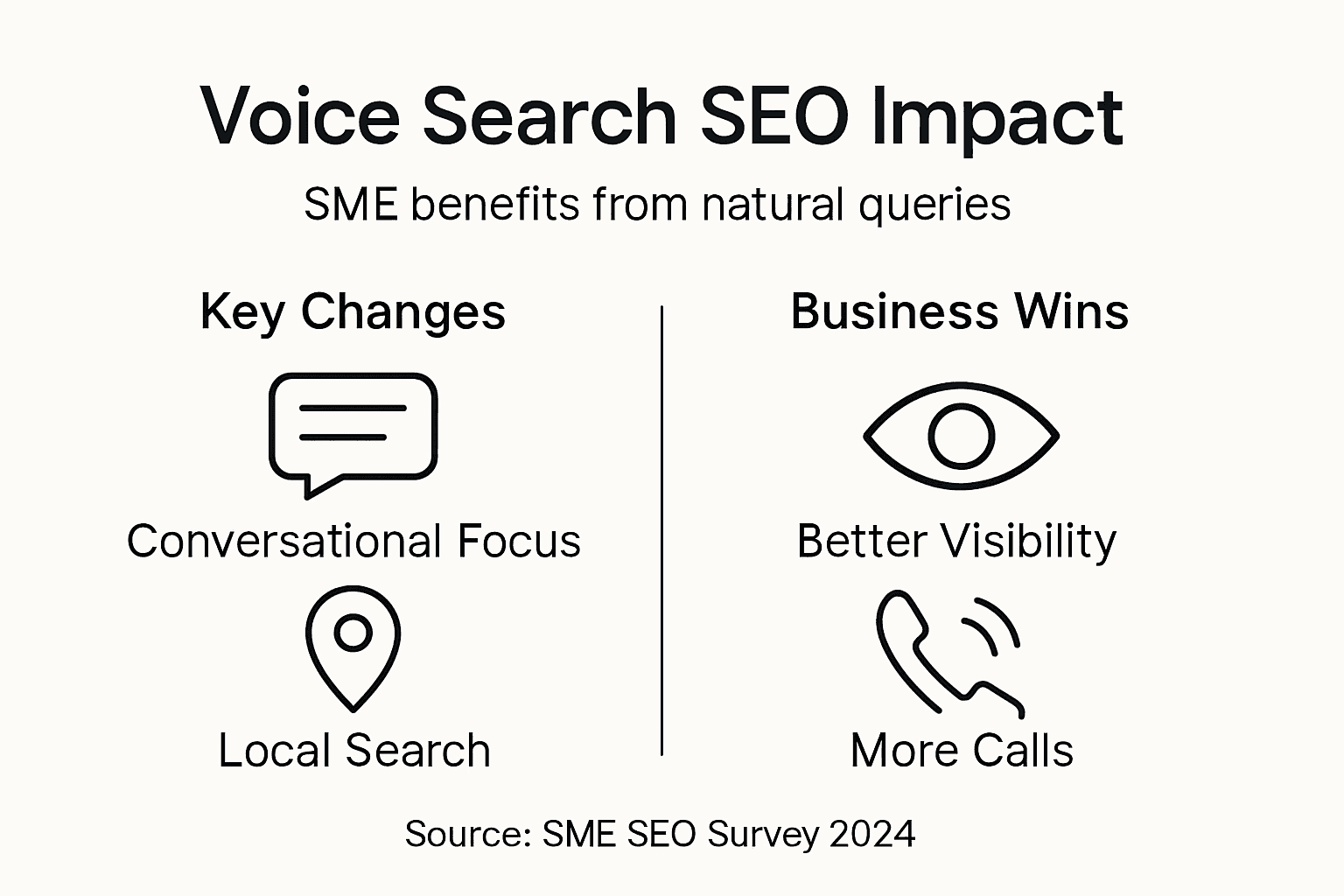
Local SEO becomes absolutely critical for voice search success, and this is where Milton Keynes businesses have a genuine advantage. Voice search requires businesses to embrace conversational queries and question-based content to optimise effectively, with local SEO proving essential due to the high volume of “near me” queries users perform. Think about it: when someone uses voice search, they’re usually looking for something nearby and ready to take action immediately. Your Google Business Profile accuracy matters more than ever. Ensure your business name, address, phone number, and hours are identical across all platforms. Encourage customer reviews because voice assistants use these signals to determine which local businesses to recommend. Schema markup and structured data also play a crucial role. When you properly tag your business information using schema markup, search engines understand your content better and can more easily feature you in voice search results.
Technical optimisation rounds out the voice search equation. Mobile optimisation and page performance significantly impact voice search rankings because users searching by voice expect instant answers. A slow website loses voice search traffic to faster competitors. Mobile responsiveness matters because most voice searches happen on smartphones. Fast-loading pages, clean site architecture, and clear heading structures all contribute to better voice search visibility. Your website must work flawlessly on mobile devices, not just render acceptably, but actually deliver an excellent experience. The combination of conversational content, accurate local information, structured data markup, and technical excellence creates the foundation for voice search success.
Pro tip: Review your FAQ or knowledge base section and rewrite answers to match how customers actually speak these questions aloud, then use those conversational versions as your primary content structure.
The table below summarises essential elements for voice search optimisation success:
| Optimisation Area | Why It Matters | Practical Benefit for Businesses |
|---|---|---|
| Conversational content | Matches natural speech | Higher chance of being selected result |
| Accurate local details | Powers location queries | Increased visibility in “near me” searches |
| Structured data markup | Enables assistant parsing | Improved business info display |
| Mobile optimisation | Most users search by voice on phones | Faster customer engagement |
Risks, Privacy and Cost Implications
Voice search technology brings genuine opportunities for your business, but it also introduces real concerns you need to understand. The most pressing issue centres on data privacy and security. Voice devices are constantly listening, capturing fragments of conversations and transmitting them to remote servers for processing. Voice assistant applications face significant security attacks and privacy threats including data breaches, unauthorised access, and information theft. These risks stem from the always-on nature of voice devices and the transmission of sensitive voice data across networks. Your customers’ voice recordings are stored somewhere, and that storage creates vulnerability. A data breach could expose personal information from conversations happening in people’s homes or offices. For your business, this matters because customer trust depends on understanding how their data is handled when they interact with voice search results.
The implications extend beyond simple data storage. Synthetic voice technologies enable voice cloning and misuse of vocal identities without consent, raising ethical and legal challenges around impersonation scams and misinformation. Imagine someone creating a deepfake of your business owner’s voice to advertise fraudulent services. This emerging threat highlights why businesses need to monitor their online reputation carefully and take swift action if someone misuses their identity. Privacy concerns also involve improper data handling and insufficient user consent. Many people don’t fully understand what information voice assistants collect or how companies use that data. As a business owner, you inherit some responsibility for protecting customer privacy when they access your information through voice search. Ensure your privacy policy clearly explains what happens when voice assistants access your content.
From a cost perspective, optimising for voice search requires investment, though not necessarily massive expenditure. You’ll need to audit and potentially rewrite website content to match conversational search patterns. Mobile optimisation may require website updates if your site isn’t currently performing well on smartphones. Structured data markup and schema implementation might require technical assistance. Unlike paid advertising where costs are predictable, voice search optimisation is more about smart allocation of resources. The good news is that improvements you make for voice search simultaneously benefit traditional SEO and mobile user experience, so the investment serves multiple purposes. Most small to medium-sized businesses find the effort manageable, especially when prioritised thoughtfully.
Pro tip: Audit your privacy policy and data handling procedures now, then communicate transparently to customers about how their voice interactions are protected, turning a compliance issue into a competitive advantage.
Boost Your Small Business Visibility with Voice Search Expertise
Voice search technology changes how customers find your business by favouring conversational, local, and clear answers. If you have struggled with making your website speak the language your customers use aloud or wondered how to stand out as the only voice search result, you are not alone. The challenge lies in adapting your content to match natural speech patterns and ensuring your local details are accurate and easy to access. Voice assistants do not show lists of options but one definitive answer, which means precise optimisation is critical for your business growth.
At Kickass Online, we specialise in helping small and medium-sized businesses in Milton Keynes and beyond bridge this exact gap. Our tailored digital marketing services include creating bespoke website content that answers your customers’ spoken questions directly, implementing structured data markup to enhance voice assistant recognition, and optimising your site’s mobile performance to deliver instant results. If you want to be the one business voice assistants recommend when customers say “near me” or ask for help now, start with a proven partner who understands both SEO and voice search intricacies.
Explore our expert web development and SEO solutions and discover how a personalised strategy can transform your online presence.
Book a consultation today to make sure your business is visible where it counts.
Learn more about our complete digital marketing approach and turn voice search into a powerful channel for attracting ready-to-act customers.
Frequently Asked Questions
What is voice search technology?
Voice search technology allows users to speak their search queries rather than type them. It uses speech recognition and natural language processing to understand spoken commands and delivers relevant search results based on context and intent.
How can SMEs optimise their website for voice search?
SMEs can optimise their website for voice search by creating content that answers common conversational questions, ensuring their business information is accurate on Google Business Profiles, implementing structured data markup, and focusing on mobile optimisation for better user engagement.
Why is local SEO important for voice search?
Local SEO is critical for voice search because many voice queries are location-based. Users often search for businesses nearby, so having accurate and up-to-date local information ensures better visibility in voice search results.
What are the risks associated with voice search technology for businesses?
The main risks include data privacy and security concerns, as voice devices continuously listen and may capture sensitive information. Businesses must be transparent about how they handle customer data and ensure robust security measures are in place.
Recommended
- Voice Search Rise: SMEs Adapting Marketing Strategies | Blog
- 7 Essential Digital Marketing Trends 2025 for SMEs | Kickass Online
- Harnessing the Power of Video Marketing for SMEs: Creating and Promoting Engaging Video Content | Kickass Online
- Leveraging Video Marketing for SMEs: Boost Brand Engagement and Drive Business Growth | Kickass Online