
Many business owners in Milton Keynes struggle to get their websites noticed, often thinking page indexing is just a technical task that search engines handle automatically. In reality, indexing requires careful human judgement, not simply algorithmic processing, as highlighted by systematic document organisation. Understanding the art behind page indexing unlocks better search visibility and higher traffic. This guide reveals the true process, debunks misconceptions, and offers practical strategies for lasting online success.
| Point | Details |
|---|---|
| Page Indexing is Crucial for Digital Discovery | Effective indexing organises content, enhancing visibility and retrieval efficiency across web pages. |
| Indexing Requires Human Insight | Many believe indexing is purely automated; however, it involves strategic human curation to reflect user search patterns. |
| Modern Indexing is Advanced and Contextual | Current methods leverage AI and machine learning for semantic analysis, improving how content is categorised and retrieved. |
| Optimisation is Key to Visibility | Regular audits and site structure improvements are essential to maximise indexing effectiveness and online visibility. |
Page indexing represents a systematic process of organising digital content to enhance discoverability and retrieval efficiency. At its core, it’s about creating a strategic map that helps search engines and users quickly locate specific information within web pages and digital documents.
Contrary to popular misconceptions, page indexing is far more nuanced than many realise. Systematic document organisation requires thoughtful curation and human intervention, not just algorithmic processing. It involves carefully selecting and categorising terms that reflect the most likely search patterns and user intentions.
Key characteristics of effective page indexing include:
Many businesses mistakenly believe page indexing is a purely technical task that can be fully automated. However, navigation and content retrieval actually demand sophisticated decision-making and contextual understanding.
Page indexing is an art as much as a science, requiring intelligent interpretation of content beyond simple keyword matching.
The process involves multiple strategic considerations, such as understanding user search intent, mapping content hierarchies, and ensuring information can be found intuitively. Search engines like Google employ complex algorithms that go far beyond basic keyword indexing, analyzing context, relevance, and user experience signals.
Pro tip: Regularly audit and update your page indexing strategy to ensure your most valuable content remains easily discoverable and aligned with evolving search behaviours.
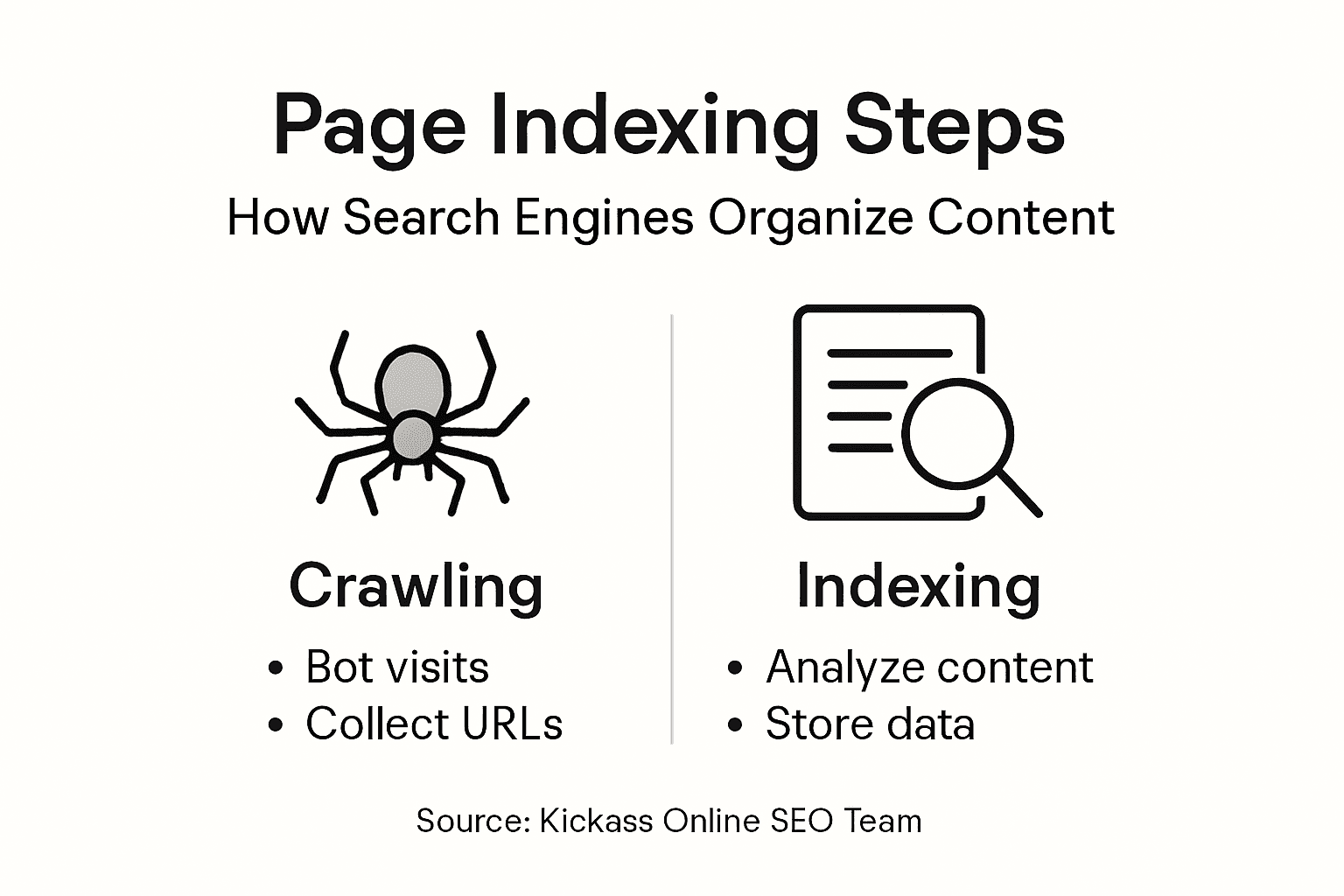
Search engines employ a sophisticated multi-stage process to discover, analyse, and organise digital content across the internet. This complex system begins with web crawling, where automated bots systematically navigate through websites by following hyperlinks and discovering new pages.
Automated crawlers scan distributed web content using intricate algorithms that map the interconnected network of digital information. These digital explorers collect and process vast amounts of data, extracting critical elements such as:
Once a page is discovered, search engine bots perform an in-depth analysis to understand its context, meaning, and potential value to users. Internet indexing involves comprehensive document organisation that goes beyond simple keyword matching.
Search engine indexing transforms raw web content into a structured, searchable database that enables rapid information retrieval.
The indexing process involves several critical steps, including content parsing, semantic analysis, and relevance scoring. Modern search engines use advanced machine learning techniques to understand not just the words on a page, but their deeper contextual meaning and potential user intent.

Pro tip: Optimise your website’s crawlability by maintaining a clear site structure, using descriptive metadata, and ensuring fast page load speeds to help search engine bots efficiently index your content.
The landscape of digital indexing has dramatically transformed, driven by sophisticated technological advancements that go far beyond traditional keyword-based search mechanisms. Intelligent indexing systems now leverage cutting-edge technologies to deliver increasingly precise and contextually relevant information retrieval.
Citation searching techniques have evolved to complement traditional approaches, incorporating complex algorithmic frameworks that analyse document relationships and semantic connections. These modern methods integrate multiple sophisticated strategies to enhance search precision and comprehensive information discovery.
Key components of contemporary indexing technologies include:
Academic indexing systems leverage sophisticated architectures that combine multiple intelligent processing techniques. These systems now employ intricate approaches such as citation network analysis, contextual understanding, and dynamic relevance ranking to manage the exponential growth of digital information.
Modern indexing is not just about finding information, but understanding the complex relationships between different pieces of digital content.
The integration of artificial intelligence and machine learning has fundamentally transformed how digital content is discovered, categorised, and presented. Search technologies now adapt in real-time, learning from user interactions and continuously refining their understanding of context and relevance.
Pro tip: Invest in robust metadata strategies and implement structured data markup to help advanced indexing systems more accurately understand and categorise your digital content.
Here is a comparison of traditional versus modern digital indexing approaches:
| Aspect | Traditional Indexing | Modern Digital Indexing |
|---|---|---|
| Mechanism | Manual curation by humans | Automated algorithms and AI |
| Adaptability | Fixed structure, static updates | Dynamic, learns from users |
| Scale | Limited to individual documents | Handles vast web environments |
| Context Awareness | Keyword-centric, basic context | Semantic and intent analysis |
| Example Application | Printed book indices | Real-time web searching |
Indexing serves as the critical backbone of digital visibility, transforming obscure online content into discoverable, searchable resources that can reach global audiences. Digital visibility depends entirely on how effectively search engines can understand, categorise, and present your web content to potential users.
Inclusion in reputable search indexes dramatically increases content credibility and worldwide recognition. When search engines thoroughly index a website, they create multiple pathways for potential visitors to discover its information, significantly expanding the digital footprint and potential audience reach.
Key factors that demonstrate indexing’s impact on online visibility include:
Academic search engines enable global content dissemination by providing sophisticated mechanisms for content categorisation and retrieval. These systems analyse multiple dimensions of digital content, including metadata, context, and relevance, to determine its visibility and accessibility.
Effective indexing transforms digital content from invisible to irresistible, creating pathways for global discovery.
Modern search technologies employ complex algorithms that go beyond simple keyword matching. They assess content quality, user engagement signals, and contextual relevance to determine how prominently a webpage should be displayed in search results.
Pro tip: Continuously optimise your website’s metadata, implement structured data markup, and ensure clean, crawlable site architecture to maximise your chances of comprehensive and high-ranking indexing.
Page indexing challenges can significantly hinder a website’s online visibility and search engine performance. Technical indexing barriers represent complex obstacles that prevent search engines from effectively discovering, understanding, and ranking web content.
Delayed indexing and content accessibility are critical issues that website owners must proactively address. These problems can emerge from multiple technical and strategic limitations that restrict search engine crawlers’ ability to interpret and catalogue web pages effectively.
Common page indexing problems include:
Technical errors preventing page indexing often stem from intricate configuration mistakes that block search engine bots. These challenges require systematic diagnosis and strategic resolution to ensure comprehensive website visibility.
Effective indexing demands a holistic approach that balances technical precision with content quality.
Resolving indexing challenges requires a multi-dimensional strategy that encompasses technical optimisation, content refinement, and continuous monitoring. Website owners must develop a proactive approach to identify and mitigate potential barriers that could limit their digital discoverability.
The table below summarises common indexing issues and effective solutions:
| Issue | Impact on Visibility | Recommended Solution |
|---|---|---|
| Incorrect metadata | Content not identified | Audit and correct all meta tags |
| Slow page loading speeds | Crawling is delayed | Optimise images and server response |
| Poor site structure | Pages difficult to index | Simplify navigation, clear hierarchy |
| Duplicate content | Ranking diluted, confusion | Use canonical tags, remove duplicates |
| Complex JavaScript rendering | Content missed by crawlers | Use server-side rendering, test output |
Pro tip: Regularly utilise Google Search Console to diagnose indexing issues, submit updated sitemaps, and monitor your website’s crawl health to ensure maximum search engine visibility.
Understanding what page indexing truly involves and why it matters is key to overcoming common challenges like incorrect metadata, poor site structure, and content invisibility discussed in the article. Many businesses struggle with digital discoverability because their websites are not properly organised or efficiently crawled by search engines. At Kickass Online, we specialise in precise website design and SEO optimisation that ensures your content is thoroughly indexed, making your site easier to find and more appealing to search engines.
We go beyond basic keyword strategies by applying advanced indexing methods and improving crawlability alongside fast load speeds and clean site architecture. Our personalised solutions help you avoid technical issues such as duplicate content or complex JavaScript rendering while maximising your organic traffic potential.
Ready to transform your website into a powerful digital asset that ranks higher and attracts more visitors?

Discover how our expert team at Kickass Online can elevate your site with tailored web development and ongoing SEO services. Take the first step towards boosting your digital footprint by booking a consultation today. Visit our homepage to learn more about our hands-on approach and proven results.
Page indexing is the process of organising digital content to enhance its discoverability and retrieval efficiency, enabling search engines and users to quickly locate specific information on the internet.
Search engines index web pages through a multi-stage process that begins with web crawling, where automated bots navigate websites, discover new pages, and analyse page content, metadata, links, and site architecture to create a searchable database.
Indexing is crucial for online visibility as it transforms obscure content into easily discoverable resources, increasing search engine rankings, content discoverability, audience reach, and the likelihood of generating organic traffic.
Common issues affecting page indexing include incorrect metadata configuration, slow page loading speeds, poor site structure, duplicate content, and complex JavaScript rendering, all of which can hinder a website’s visibility in search results.
For many business owners in Milton Keynes, understanding why one website ranks higher than another can feel confusing and frustrating. Online success depends on more than just having a well-designed website. Domain authority stands out as a critical factor that influences whether your site earns trust with search engines and your customers. By clearing up misconceptions and learning how domain authority truly works, you can take control of your digital reputation and start seeing better visibility where it matters most.
| Point | Details |
|---|---|
| Understanding Domain Authority | Domain authority is a crucial metric that reflects a website’s trustworthiness and credibility online. |
| Myths about Domain Authority | Common misconceptions include believing that domain age or high-cost domains solely dictate authority. |
| Calculation Factors | Domain authority scores are determined by factors such as link quality, content relevance, and site performance. |
| Improvement Strategies | Incremental efforts, including high-quality content and technical optimisation, are essential for enhancing domain authority. |
Domain authority represents a critical metric for businesses seeking to establish credibility and visibility online. At its core, it measures how trustworthy and relevant a website appears to search engines, determining your potential ranking in digital search results. Unlike simplistic metrics, domain authority requires strategic understanding and nuanced management.
The concept of domain authority goes beyond basic website ownership. Effective domain management involves maintaining consistent security, establishing user trust, and demonstrating authoritative digital presence. Businesses must recognise that domain authority isn’t just a technical score, but a comprehensive representation of their online reputation.
Several common misconceptions often mislead business owners about domain authority:
In reality, domain authority is a complex ecosystem involving multiple interconnected factors. Search engines evaluate websites through sophisticated algorithms that consider technical performance, content quality, user experience, and digital reputation. Security domain principles underscore the importance of consistent, secure domain management in building digital trust.
Pro tip: Invest time in understanding your current domain authority score and develop a strategic, multi-faceted approach to improving your digital credibility gradually and consistently.
Domain authority scores emerge from sophisticated algorithms designed to quantify a website’s digital credibility and search engine potential. These complex computational models analyse multiple interconnected factors, transforming raw data into a nuanced representation of online trustworthiness and visibility. Understanding these calculations helps businesses strategically improve their digital performance.
Domain management techniques play a crucial role in calculating these scores. Search engines evaluate websites through intricate weighted formulas that consider numerous technical and qualitative elements. The scoring process isn’t a simple point-based system, but a dynamic assessment of digital reputation.
Key components contributing to domain authority calculations include:
The scoring mechanism resembles sophisticated rating systems, where individual metrics are aggregated and weighted to produce a comprehensive score. Algorithmic complexity means no single factor determines your entire domain authority, but rather the holistic interaction of multiple digital signals.
Most domain authority scoring systems use a scale from 1-100, with higher scores indicating greater online credibility. Websites scoring between 40-60 are considered average, while scores above 70 represent exceptional digital performance. Critically, these scores are not permanent and can be strategically improved through consistent, targeted digital marketing efforts.

Pro tip: Regularly audit your website’s technical performance and content quality to systematically improve your domain authority score over time.
Domain authority is a complex ecosystem of interconnected digital signals that search engines use to evaluate a website’s credibility and relevance. Understanding these multifaceted factors enables businesses to strategically enhance their online presence and improve their search engine rankings. The most successful websites recognise that authority is not a static attribute, but a dynamic characteristic requiring continuous improvement.
Domain management protocols play a crucial role in establishing site authority. These protocols encompass multiple technical and content-related aspects that collectively contribute to a website’s perceived trustworthiness and digital reputation. Search engines employ sophisticated algorithms to assess these complex interactions.
Key factors influencing site authority include:
Credibility markers are particularly significant in determining a site’s authority. Research integrity guidelines suggest that trustworthiness stems from consistent, high-quality content created by knowledgeable contributors. This principle applies equally to digital platforms, where expertise and authenticity are paramount.
Search engines analyse these factors holistically, creating a comprehensive score that reflects a website’s overall digital reputation. Websites demonstrating consistent quality across multiple dimensions will naturally achieve higher authority ratings. Critically, improvement is an ongoing process requiring sustained strategic effort and continuous refinement of digital assets.
Pro tip: Conduct quarterly audits of your website’s technical performance and content strategy to systematically identify and address potential authority improvement opportunities.
In the complex world of digital marketing, understanding the nuanced differences between various SEO metrics is crucial for developing a comprehensive online strategy. Domain authority stands apart from other metrics by offering a holistic view of a website’s digital credibility, rather than focusing on isolated performance indicators. This comprehensive approach provides businesses with a more sophisticated understanding of their online potential.
Domain management techniques reveal that different SEO metrics serve distinct purposes in evaluating digital performance. While some metrics provide narrow insights, domain authority offers a panoramic assessment of a website’s overall digital reputation and search engine potential.
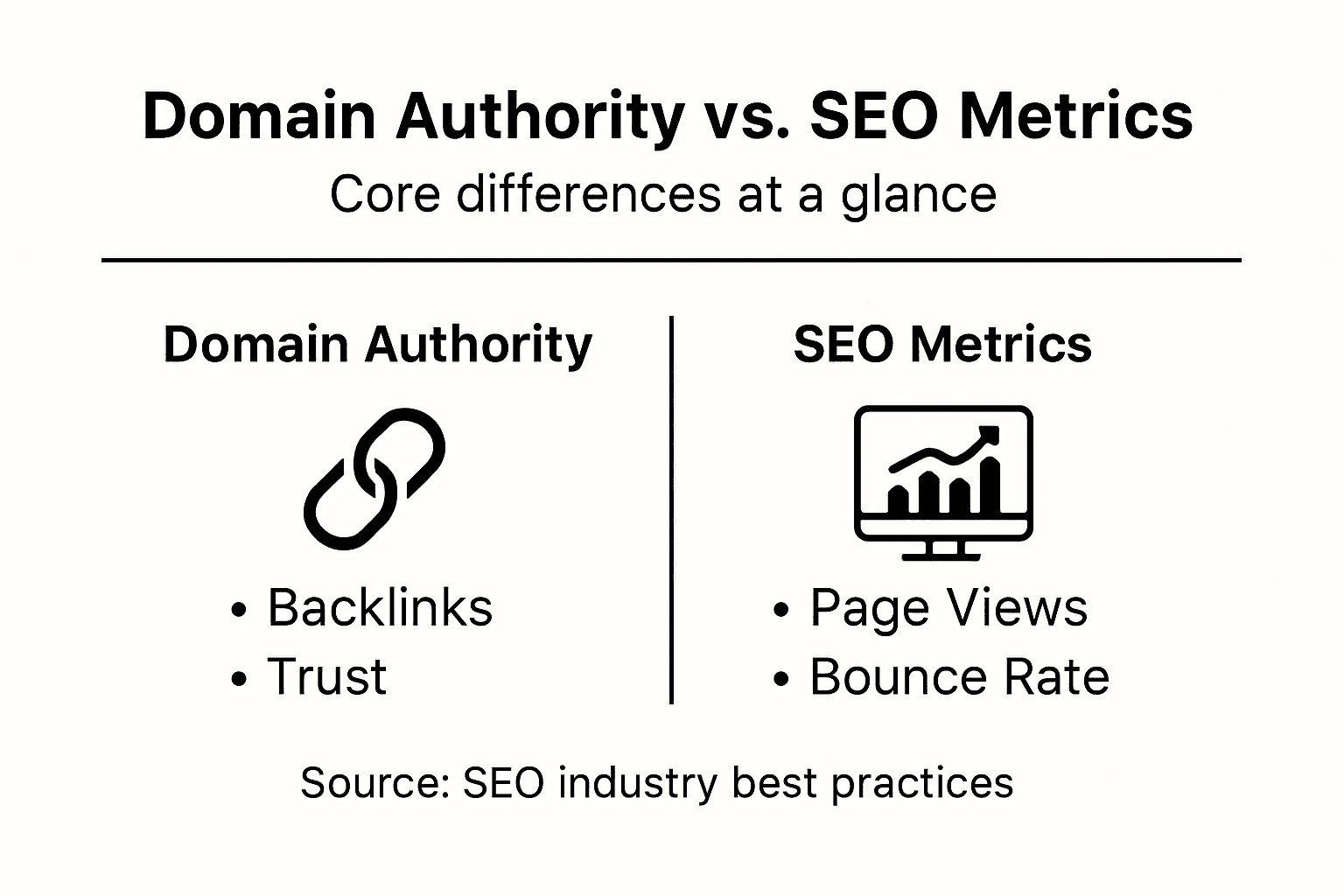
Key differences between domain authority and other SEO metrics include:
Here is a comparison of domain authority with other common SEO metrics for quick reference:
| Metric | Primary Focus | Scope |
|---|---|---|
| Domain Authority | Overall website credibility | Whole site |
| Page Authority | Individual page performance | Single page |
| Keyword Rankings | Search term position | Per keyword |
| Traffic Volume | Number of site visitors | Whole site |
| Conversion Rate | Visitor actions taken | Whole site |
| Bounce Rate | Single-page visit percentage | Whole site |
Technical credibility markers play a significant role in distinguishing domain authority from other metrics. Security certificate validation demonstrates how deeper technical factors contribute to overall digital trustworthiness beyond simple numerical rankings. These nuanced elements separate domain authority from more superficial performance indicators.
Search engines employ sophisticated algorithms that weigh multiple factors differently. Domain authority provides a more integrated perspective, considering long-term digital reputation rather than momentary performance spikes. Businesses should view these metrics as complementary tools, each offering unique insights into their online presence.
Pro tip: Develop a comprehensive SEO strategy that considers multiple metrics holistically, using domain authority as your primary indicator of overall digital health and potential.
Building and maintaining a robust domain authority requires strategic, consistent effort across multiple digital channels. Businesses must approach domain authority as a comprehensive digital reputation management strategy, understanding that incremental improvements compound over time to create significant online credibility.
Domain management techniques demonstrate that improving authority is not a one-time task, but an ongoing process of digital refinement. Successful businesses recognise that their online presence requires continuous investment and strategic attention to technical and content-related factors.
Key strategies for improving domain authority include:
The following table summarises strategies for improving domain authority and their primary business impacts:
| Strategy | Main Benefit |
|---|---|
| High-quality content creation | Boosts trust and engagement |
| Technical website optimisation | Enhances user experience |
| Secure site infrastructure | Increases digital trust |
| Genuine backlink building | Improves search visibility |
| Mobile responsiveness | Expands audience reach |
| Regular content updates | Maintains digital relevance |
Technical credibility plays a crucial role in domain authority improvement. Domain registration standards highlight the importance of maintaining accurate, verified information and protecting your digital identity. Businesses should treat their domain as a critical asset requiring ongoing management and protection.
Search engines continuously evolve their algorithms, rewarding websites that demonstrate consistent quality, technical excellence, and genuine user value. Domain authority is not about quick fixes, but about building a sustainable, trustworthy digital presence that provides real value to users and search engines alike.
Pro tip: Conduct monthly audits of your website’s technical performance and content strategy, systematically addressing any identified weaknesses to incrementally improve your domain authority.
Boosting your domain authority is essential for building trust and achieving higher search engine rankings as detailed in the article. Many businesses face challenges with technical website optimisation, backlink quality, and maintaining consistent content updates, all critical to developing a strong digital reputation. At Kickass Online, we understand these pain points and provide personalised strategies that address your unique domain management needs, ensuring your website not only performs exceptionally but also reflects credibility and authority.
Our dedicated team specialises in creating high-converting websites, enhancing security infrastructure, and implementing proven SEO techniques that improve your domain authority over time. By partnering with us, you gain ongoing support to keep your website fast, secure, and engaging, perfectly aligned with the complex factors that search engines consider for ranking.
Ready to transform your business’s online presence with strategic SEO and expert web development? Discover how our tailored digital marketing services at Kickass Online can help you climb search rankings and build sustained authority.
Take action now by booking a consultation to receive a customised plan designed to target core authority factors and propel your brand forward. Visit our homepage to learn more about our comprehensive web development and SEO solutions that empower small and medium-sized businesses to shine online.
Domain authority is a metric that measures how trustworthy and relevant a website appears to search engines. It plays a critical role in determining your website’s ranking in search results, affecting your online visibility and credibility.
Domain authority is calculated using a complex algorithm that assesses various factors, including link quality, website security, content relevance, site speed, and user engagement metrics. These factors are weighted to produce a comprehensive score that reflects your website’s overall digital credibility.
To improve domain authority, focus on creating high-quality content, optimising technical website performance, building genuine backlinks from reputable sites, ensuring website security, and maintaining a mobile-responsive design. Regular content updates also help in maintaining digital relevance.
You should regularly audit your domain authority score, ideally on a monthly or quarterly basis. This allows you to identify areas for improvement and ensure that your ongoing strategies are helping to enhance your website’s credibility and search engine ranking.
Selecting the right analytics solution can feel overwhelming when every decision affects your online results. For business owners in Milton Keynes, tracking website analytics is the starting point for improving visibility and driving more conversions. By focusing on platform features like interactive dashboards, data integration, and usability, you can choose tools that reveal what works for your customers and help turn web visits into real growth.
| Key Takeaway | Explanation |
|---|---|
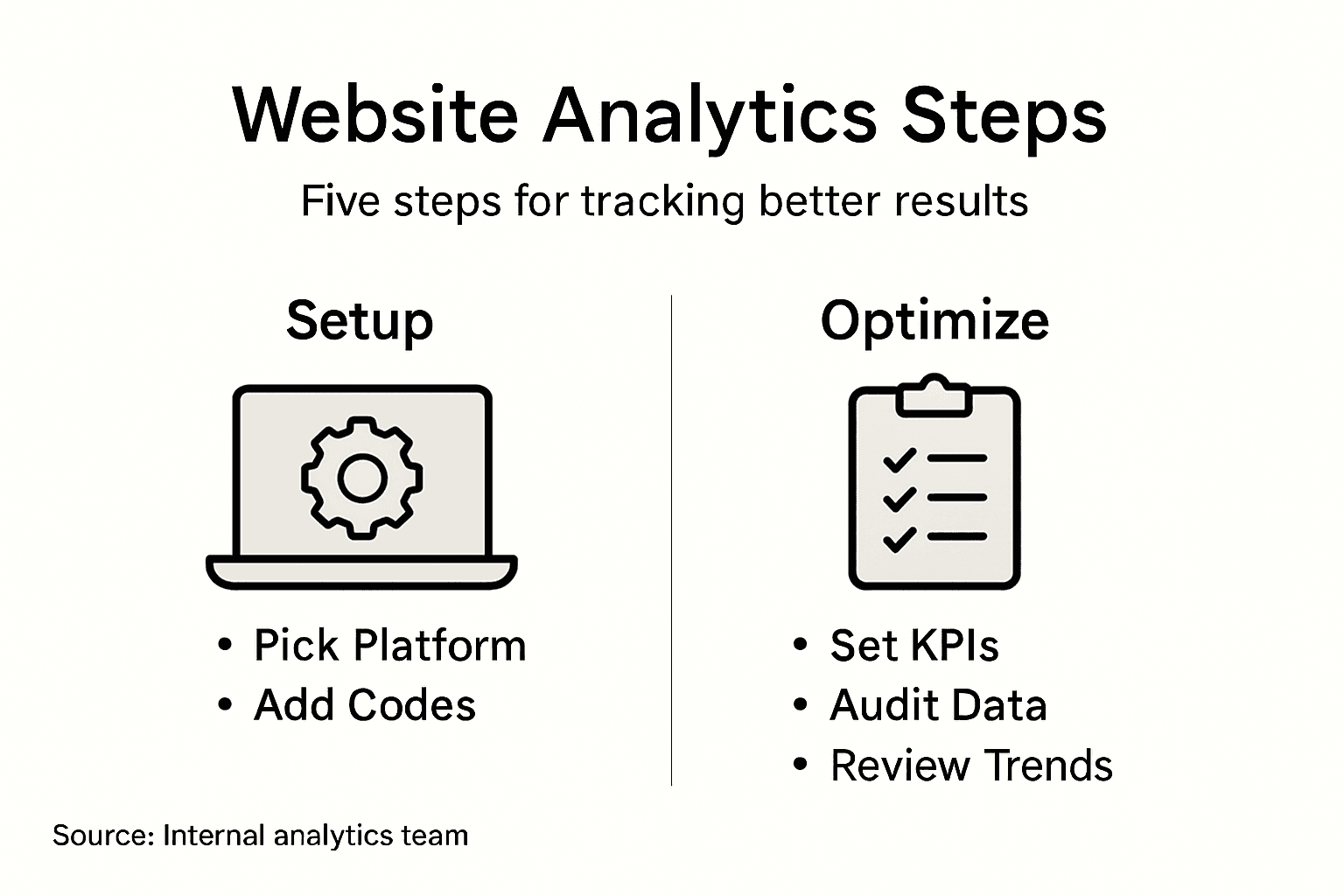
| 1. Choose the right analytics platform | Evaluate platforms based on data visualisation, reporting, integration, scalability, and user-friendliness to meet specific needs. |
| 2. Ensure proper tracking code installation | Install tracking codes precisely on all pages to accurately collect visitor interaction data across your website. |
| 3. Configure relevant KPIs | Select key performance indicators that align with business objectives to gain valuable insights from website analytics. |
| 4. Verify data collection accuracy | Regularly audit and cross-reference data sources to ensure reliability and integrity of collected analytics data. |
| 5. Interpret analytics for optimisation | Analyse visitor behaviour and metrics systematically to develop recommendations for enhancing online performance. |
Choosing the most suitable web analytics platform can transform how you understand and improve your online performance. This step involves evaluating multiple platforms to find the best match for your business’s specific needs and technical capabilities.
To select the right analytics platform, you’ll want to consider several critical factors. Global analytics platforms offer diverse features that can help you make informed decisions about your website’s performance. Here are key considerations:
When evaluating platforms, examine detailed user reviews and independent assessments. User feedback from analytics platforms can provide crucial insights into real-world performance and potential limitations.
Here’s a helpful comparison of popular analytics platforms and their strengths:
| Platform | Best For | Unique Advantage | Potential Limitation |
|---|---|---|---|
| Google Analytics | SMEs & large brands | Free and robust dashboards | Data privacy controls |
| Adobe Analytics | Enterprises | Advanced segmentation tools | Complex setup process |
| Matomo | Privacy-focused teams | Open-source with full control | Fewer integrations |
| Mixpanel | Product analytics | Powerful event-based tracking | Customisation learning curve |
The right analytics platform turns raw data into actionable business intelligence.
Pro tip: Start with a free trial of your top two platform choices to understand their practical functionality before making a final commitment.
Tracking codes are the essential bridge between your website and your analytics platform, enabling comprehensive data collection about visitor interactions. Your goal in this step is to seamlessly integrate tracking snippets across your entire digital presence.
Installing tracking codes requires precision and attention to detail. Website tracking code implementation involves strategically placing JavaScript snippets that capture crucial visitor data. Here are the key steps to ensure effective installation:
When installing codes, you’ll typically have two primary placement options. Tracking code placement methods recommend either inserting the snippet in the section or just before the closing tag, depending on your platform’s specifications.
Precise tracking code installation transforms raw website visits into meaningful business insights.
Pro tip: Create a spreadsheet to document each tracking code’s location and installation date, helping you maintain a clear record of your analytics setup.
Configuring key performance indicators (KPIs) is crucial for transforming website data into meaningful business insights. Your objective is to select and set up metrics that directly align with your specific business goals and provide actionable intelligence about your online performance.
Website analytics KPIs help you understand how effectively your digital presence is performing. These indicators fall into several critical categories that provide comprehensive insights:
When defining KPIs, focus on metrics that provide genuine value. Strategic KPI configuration requires understanding your unique user journey and translating that into quantifiable data points that reflect your business objectives.

This table outlines KPI categories and their typical business impact:
| KPI Category | Example Metric | Common Business Use |
|---|---|---|
| Acquisition | New users by channel | Identify traffic investments |
| Engagement | Average session duration | Gauge site appeal |
| Conversion | Purchase rate | Assess sales effectiveness |
| Retention | Repeat visit frequency | Measure loyalty |
| Performance | Bounce rate vs standard | Benchmark against industry |
Effective KPI configuration transforms raw data into strategic business intelligence.
Pro tip: Review and recalibrate your KPIs quarterly to ensure they remain relevant to your evolving business strategy.
Ensuring the accuracy of your website analytics data is critical for making informed business decisions. Your primary goal in this step is to implement rigorous verification processes that validate the integrity and reliability of your data collection mechanisms.
Data validity in web analytics requires a systematic approach to identifying and mitigating potential collection errors. Here are key strategies to verify your data collection accuracy:
Managing data collection involves more than just technical implementation. Data accuracy practices demand consistent monitoring and proactive error correction to maintain reliable insights about your digital performance.
Accurate data collection is the foundation of meaningful business intelligence.
Pro tip: Schedule monthly data accuracy audits to catch and correct potential tracking discrepancies before they impact your strategic decision-making.
Transforming raw website analytics data into strategic insights is crucial for driving meaningful business improvements. Your objective is to develop a systematic approach that translates complex metrics into actionable recommendations for enhancing your online performance.
Web analytics interpretation requires a structured method of examining visitor behaviour and performance indicators. Key areas of focus include:
Data-driven optimisation strategies demand more than just numerical analysis. You need to contextualise your metrics, identifying not just what happened, but why it occurred and how to improve future performance.
Effective analytics interpretation turns data points into strategic business opportunities.
Pro tip: Create a monthly dashboard that highlights key performance trends, making complex data easily digestible for your entire team.
Tracking website analytics effectively is essential for unlocking meaningful business insights that drive growth. If you find the process of choosing the right analytics platform, installing tracking codes precisely, and interpreting KPIs overwhelming, you are not alone. Many business owners struggle to fully harness these analytics to optimise their online results and boost conversions. With Kickass Online, you gain a dedicated partner experienced in creating high-converting websites, strategic SEO, and ongoing performance optimisation tailored for small and medium-sized businesses.
Explore our Tutorials for actionable guidance on analytics and beyond. Don’t let inaccurate data or unclear metrics hold back your business potential. Connect with our experts at Kickass Online to get personalised digital solutions designed to enhance your online visibility and ensure your website delivers measurable results. Ready to transform your website data into powerful business growth? Start your journey today by visiting our Websites page and booking your consultation for dedicated expert support.
Selecting the right analytics platform involves evaluating your specific business needs and capabilities. Look for features such as data visualisation, reporting capabilities, and scalability to ensure the platform can grow with your business. Start by reviewing user feedback from multiple platforms to gather insights on their effectiveness.
To install tracking codes effectively, first locate the tracking snippet provided by your analytics platform. Then, determine the optimal placement within your website’s code, preferably in the section or before the closing tag, and verify that it appears on every page to ensure comprehensive data collection.
Focus on KPIs that align with your business goals, such as acquisition metrics for tracking traffic sources, conversion metrics for assessing visitor-to-customer transitions, and retention metrics to monitor repeat visitor behaviour. Set up these metrics to provide actionable insights regarding your website’s performance.
To verify data collection accuracy, cross-reference data from multiple sources and check the implementation of tracking codes on all pages. Regularly validate event tracking and monitor traffic sources to ensure accurate attribution, which will help maintain the integrity of your analytics data.
Transform raw website analytics into actionable insights by systematically analysing visitor behaviour and performance indicators. Focus on understanding traffic patterns, user engagement, and conversion rates, and use this information to implement changes that enhance your online effectiveness. Aim to create a monthly dashboard highlighting key performance trends for easy tracking.
Standing out in the crowded digital space of Milton Keynes means more than just having a smart-looking website. Many business owners quickly discover that confusing navigation or slow-loading pages can lead to lost customers. A solid understanding of user experience can set your website apart by making each interaction feel useful, engaging, and enjoyable. This guide offers practical insights to help you create digital experiences that not only draw in visitors but also turn them into loyal customers.
| Point | Details |
|---|---|
| Understanding User Experience (UX) | UX design is essential for creating meaningful interactions that are intuitive and emotionally engaging. It requires a multidisciplinary approach focusing on user needs and perceptions. |
| Diverse Research Methods | Combining qualitative and quantitative UX research methods provides a comprehensive understanding of user behaviour and preferences, leading to more effective design solutions. |
| Core Elements of Design | Successful web design integrates strategy, structure, and aesthetic elements, ensuring that user experience aligns with both business goals and user satisfaction. |
| Impact on Performance | A well-optimised user experience significantly improves conversion rates and search engine visibility, illustrating the connection between user behaviour and website performance. |
User experience (UX) represents the comprehensive emotional and functional journey a person undergoes when interacting with digital platforms. Modern websites require sophisticated understanding of how users perceive, navigate, and engage with online interfaces.
At its core, UX design is a multidisciplinary approach focused on creating meaningful digital interactions that centre human needs and perceptions. The discipline transcends traditional usability metrics, diving deeper into emotional responses and individual experiences.
Key characteristics of effective user experience include:
Website UX encompasses multiple dimensions beyond visual design. It involves understanding user psychology, anticipating needs, and creating digital environments that feel both functional and enjoyable. Successful UX design requires continuous research, testing, and refinement to align technological capabilities with human expectations.
Pro tip: Conduct regular user testing and gather feedback to continuously improve your website’s user experience and address potential friction points.
User experience encompasses a diverse range of interaction types that extend far beyond simple website navigation. Mobile application user experiences represent a particularly complex and dynamic domain, integrating multiple technological and psychological dimensions.
Primary categories of user experience research and design include:
These research approaches provide complementary insights into how users interact with digital platforms. Qualitative methods delve into emotional responses and individual experiences, while quantitative techniques offer measurable, data-driven understanding of user behaviour.
Here’s a quick comparison of qualitative and quantitative UX research approaches:
| Aspect | Qualitative UX | Quantitative UX |
|---|---|---|
| Focus | Explores emotions and motives | Analyses user behaviour patterns |
| Data Type | Descriptive, subjective feedback | Numerical, statistically significant data |
| Methods Used | Interviews, observations, diary studies | Surveys, analytics, A/B testing |
| Outcome | In-depth user insight | Measurable trends and benchmarks |
Different contexts demand unique UX approaches. For instance, e-commerce platforms require different interaction design compared to educational websites or healthcare applications. Successful UX design demands sophisticated understanding of user psychology, technological capabilities, and contextual requirements.

Pro tip: Combine multiple UX research methods to develop a comprehensive understanding of your target audience’s digital interaction preferences.
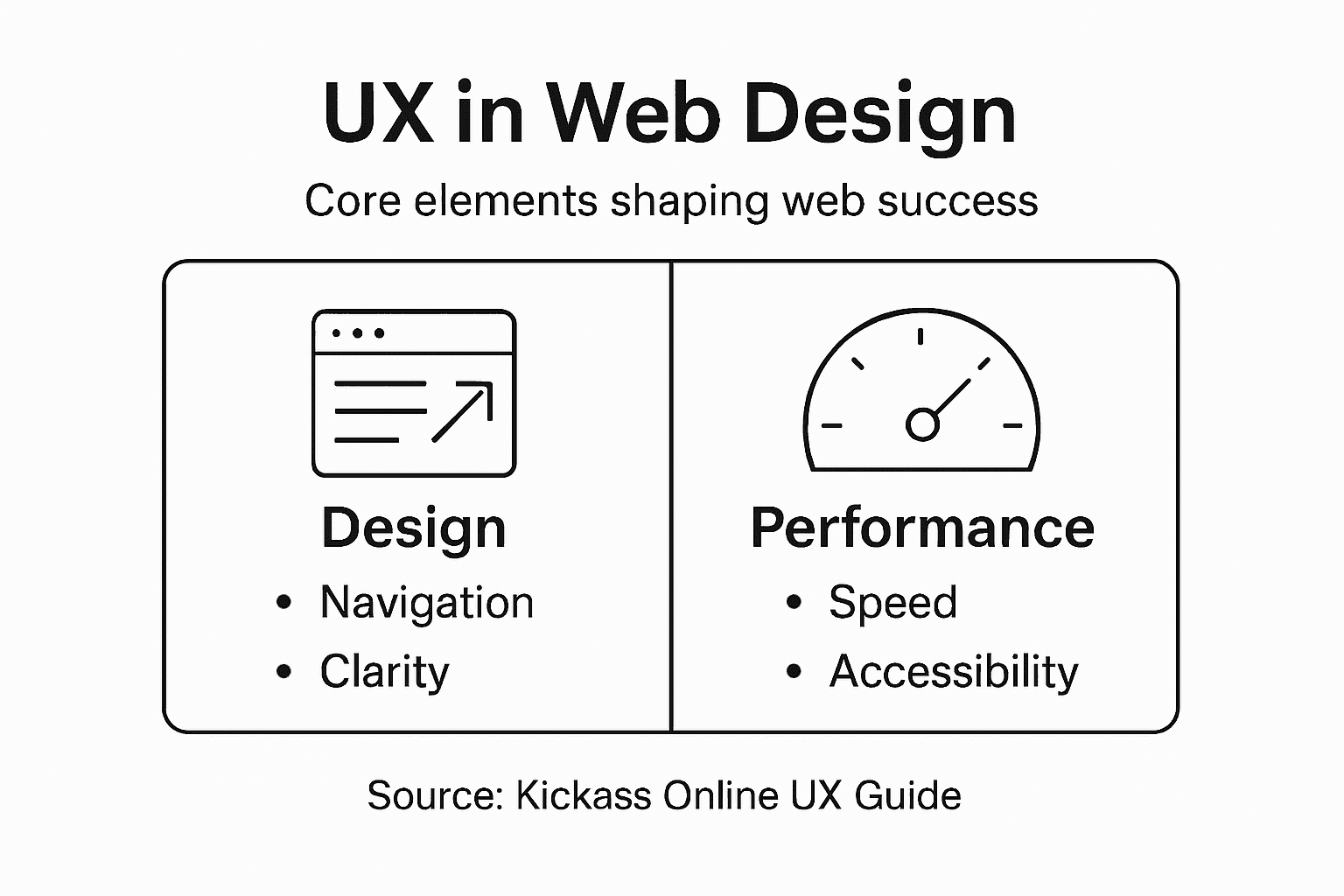
Web design has evolved into a sophisticated discipline that balances technical functionality with human-centred experiences. Five critical elements shape modern UX design, creating digital environments that are both intuitive and engaging.
The core components driving exceptional user experience include:
Each element plays a crucial role in creating digital experiences that resonate with users. Strategy ensures the design serves both organisational and user objectives, while structural elements determine how information is accessed and processed. The skeleton of a website determines navigational ease, and surface design creates emotional connections through visual language.
Successful web design requires a holistic approach that integrates technical performance with psychological understanding. Modern websites must balance speed, accessibility, and aesthetic appeal to create meaningful interactions that keep users engaged and satisfied.
Pro tip: Conduct regular user testing to validate how each design element contributes to overall user satisfaction and adjust your approach accordingly.
User experience represents a critical intersection between website performance and search engine visibility. UX and SEO are intricately connected, with search engines increasingly using user interaction data to determine ranking algorithms.
Key metrics that demonstrate UX’s impact on conversions and search performance include:
Search engines analyse these behavioural signals to assess website quality, making UX a fundamental component of organic search success. Websites that provide intuitive navigation, relevant content, and smooth user journeys are more likely to achieve higher search rankings and increased conversion rates.
Designing with both user needs and search engine requirements in mind creates a symbiotic relationship between technical performance and human experience. Successful digital strategies recognise that optimising for users simultaneously optimises for search engines, driving both visibility and engagement.
Pro tip: Regularly analyse user behaviour metrics to continuously refine your website’s user experience and search engine performance.
Digital experiences can quickly unravel when designers overlook critical user interaction principles. Common UX design mistakes significantly undermine website effectiveness, creating frustrating barriers between users and their intended goals.
Principal UX mistakes that compromise digital experiences include:
Each mistake represents a potential point of user disengagement. Cluttered interfaces increase cognitive load, making users work harder to find information. Confusing navigation creates frustration, prompting users to abandon websites before achieving their objectives. Mobile unresponsiveness alienates a significant portion of digital users who predominantly access content through smartphones.
This table summarises how common UX mistakes affect user engagement and web outcomes:
| Mistake Type | Impact on Users | Business Consequence |
|---|---|---|
| Cluttered design | Increases cognitive overload | Higher abandonment rates |
| Poor mobile support | Frustrates mobile users | Loss of mobile traffic |
| Inconsistent visuals | Reduces trust and clarity | Lower brand credibility |
Successful UX design requires continuous iteration, rigorous testing, and genuine empathy for user needs. Designers must prioritise simplicity, consistency, and intuitive interactions that guide users seamlessly through digital experiences.
Pro tip: Conduct regular user testing with diverse participant groups to identify and address potential UX friction points before they impact user satisfaction.
The article highlights key challenges such as cluttered interfaces, confusing navigation, and poor mobile responsiveness that can hurt your website’s performance and user satisfaction. If your goal is to create an intuitive navigation structure, enhance emotional engagement, and improve metrics like bounce rates and dwell time you need a partner who understands these UX fundamentals and can translate them into effective design and SEO strategies.
At Kickass Online, we specialise in developing high-converting websites tailored to your business objectives while ensuring seamless and engaging user experiences across all devices. Our approach focuses on the five critical elements of UX design discussed in the article from strategy to surface to deliver digital solutions that resonate with your audience and improve your search rankings.
Ready to overcome UX pitfalls and unlock your website’s full potential? Explore how our web development services can transform your online presence. Book a consultation today at Kickass Online and partner with a team dedicated to your long-term digital growth.
User experience (UX) refers to the overall emotional and functional journey users have when interacting with digital platforms. It is important because a positive UX can lead to increased user engagement, satisfaction, and ultimately, conversions on a website.
UX design affects website conversions and SEO because search engines use user interaction data, such as click-through rates and bounce rates, to assess website quality. A well-designed UX can improve search engine rankings and enhance the likelihood of users completing desired actions.
The main types of UX research methods include qualitative UX, which explores user motivations and emotions; quantitative UX, which uses numerical data to analyse behaviour; attitudinal UX, focusing on user perceptions; and behavioural UX, examining actual user interactions.
Common mistakes to avoid in UX design include cluttered interfaces, confusing navigation, poor mobile responsiveness, inconsistent design language, and limited user feedback. These errors can lead to user frustration and decreased engagement.
Finding new ways to keep customers engaged online can feel challenging when competition is fierce. Many British businesses discover that relying on outdated websites or limited native apps leads to missed opportunities. Progressive Web Apps (PWAs) offer a practical solution by providing offline functionality, app-like interfaces, and cross-platform compatibility using standard technologies supported by Chrome, Safari, Firefox, and Edge. This approach empowers business owners with smoother customer experiences and improved efficiency across devices.
| Point | Details |
|---|---|
| Progressive Web Apps (PWAs) offer unique advantages | PWAs combine the functionality of websites and mobile apps, enabling offline access and cross-platform compatibility. |
| User experience is paramount | Prioritising performance optimisation and responsive design leads to better engagement and satisfaction across devices. |
| Implementation requires careful planning | Attention to factors like service worker setup and security protocols is crucial for effective PWA deployment. |
| Cost efficiency is a significant benefit | A single codebase for multiple platforms reduces development costs, but thorough testing is essential to avoid pitfalls. |
A Progressive Web App (PWA) represents a sophisticated web application that bridges the gap between traditional websites and native mobile applications. First introduced in 2016, these innovative digital solutions provide users with a seamless, app-like experience directly through their web browsers.
PWAs leverage modern web technologies to deliver remarkable functionality across multiple platforms. Key characteristics include:
Browser compatibility plays a critical role in PWA effectiveness. Modern browsers like Chrome, Safari, Firefox, and Edge offer varying levels of support for PWA technologies, enabling developers to create versatile web experiences that feel like native applications.
The underlying technology stack for PWAs typically involves standard web programming languages, including HTML, CSS, JavaScript, and WebAssembly. These technologies enable developers to construct robust, responsive applications that can be accessed from virtually any device with a compatible web browser.
User experience remains paramount in PWA design. Leveraging advanced browser features such as service workers and web app manifests, PWAs can provide intuitive, engaging interfaces that feel remarkably similar to native mobile applications.
Pro tip: When developing a PWA, prioritise performance optimisation and responsive design to ensure a consistently smooth user experience across different devices and network conditions.
Progressive Web Apps (PWAs) represent a revolutionary approach to web application development, combining multiple advanced technologies to create powerful, versatile digital experiences. These sophisticated applications leverage cutting-edge web technologies to deliver seamless functionality across various devices and platforms.
The core features that distinguish PWAs from traditional web applications include:
Service workers play a critical role in PWA architecture. These background scripts enable offline support by implementing sophisticated caching strategies that allow applications to function smoothly even with intermittent internet connectivity.

Security remains paramount in PWA development. By requiring HTTPS protocols, these applications ensure robust data protection and provide users with a secure browsing experience. The web app manifest further enhances functionality by enabling standalone window launch, OS integration, and customised home screen presence.
Web technologies empower PWAs to merge the best attributes of traditional websites and native mobile applications. Developers can create responsive, performant applications using standard web programming languages like HTML, CSS, and JavaScript, significantly reducing development complexity and maintenance overhead.
Pro tip: Prioritise implementing service workers and creating a comprehensive web app manifest to maximise your Progressive Web App’s performance and user engagement capabilities.
Progressive Web Apps (PWAs) have transformed digital business strategies across multiple industries, demonstrating remarkable real-world applications that drive significant user engagement and operational efficiency.
Several leading businesses have successfully implemented PWAs to enhance their digital experiences:
Performance metrics reveal compelling advantages for businesses adopting PWA technologies. Top companies leverage PWAs for enhanced user engagement by creating more responsive, accessible, and efficient digital platforms that significantly reduce development and maintenance costs.
The strategic implementation of PWAs allows businesses to overcome traditional limitations of native mobile applications. By providing seamless cross-platform experiences, these web applications enable companies to reach broader audiences while maintaining high-performance standards and minimising development complexities.
Customer interaction becomes more streamlined through PWA technologies, which offer intuitive interfaces, faster loading times, and improved accessibility across various devices and network conditions. This approach represents a sophisticated solution for businesses seeking to modernise their digital engagement strategies.
Pro tip: Conduct a comprehensive user experience audit before implementing a PWA to ensure the technology aligns precisely with your specific business requirements and target audience expectations.
Progressive Web Apps (PWAs) represent a sophisticated digital solution that offers unique advantages and challenges when compared to traditional web and native mobile applications. Comprehensive studies reveal nuanced performance characteristics that highlight both the potential and constraints of this innovative technology.
Key benefits of PWAs include:
Browser support remains a critical consideration for PWA implementation. While modern browsers increasingly accommodate PWA technologies, inconsistencies can still pose challenges for developers seeking uniform user experiences across different platforms.
The limitations of PWAs become particularly evident when comparing them to native mobile applications. Certain advanced device-specific functionalities, such as complex hardware integrations or platform-specific features, may remain challenging to implement fully within the PWA framework. This technological trade-off requires businesses to carefully evaluate their specific requirements before committing to a PWA approach.
Despite these limitations, PWAs continue to offer a compelling alternative for businesses seeking flexible, cost-effective digital solutions that prioritise broad accessibility and user engagement across multiple platforms.
Here is a comparison showing how Progressive Web Apps differ from traditional web and native apps:
| Aspect | PWA Strengths | Native App Traits | Standard Web App Traits |
|---|---|---|---|
| Installation Process | Instant via browser | Requires app store | No installation needed |
| Offline Functionality | Reliable with caching | Full hardware access | Typically limited |
| Platform Coverage | Cross-platform | Platform-specific | Cross-browser support |
| Update Mechanism | Automatic updates | Store approval needed | Direct publishing |
| Storage Usage | Minimal footprint | Higher device storage | Low browser dependency |
Pro tip: Conduct a thorough technical audit of your specific platform requirements before transitioning to a Progressive Web App to ensure compatibility and optimal user experience.
Implementing a Progressive Web App (PWA) requires strategic planning and careful consideration of technical and financial factors. Effective development strategies emphasise performance and security to ensure a seamless user experience across multiple platforms.
Critical implementation considerations include:
Cost considerations play a significant role in PWA development. While the single-codebase approach reduces multi-platform development expenses, technological barriers can introduce unexpected complexities that impact overall project investment.
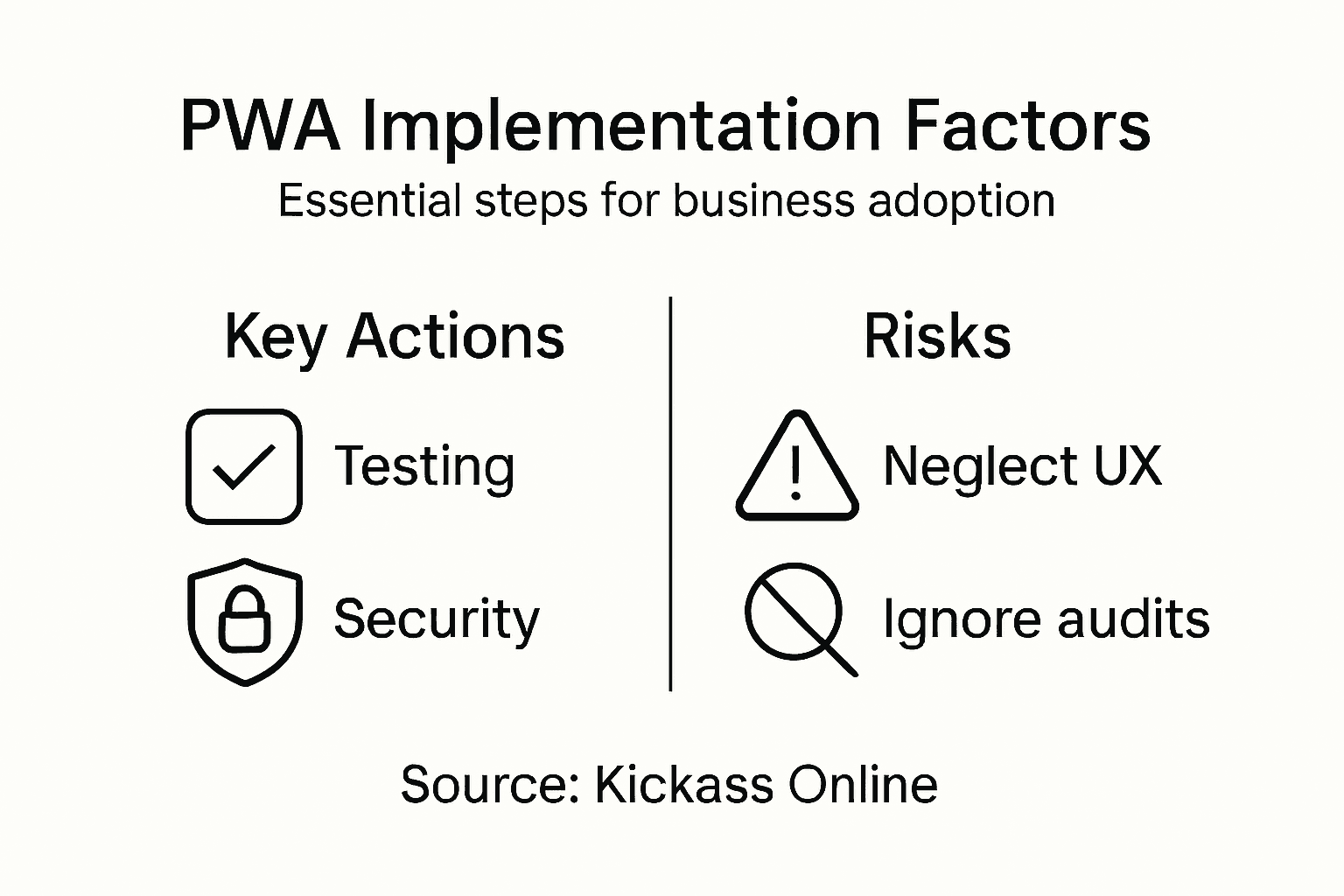
Businesses must be vigilant about potential implementation mistakes. Common pitfalls include neglecting user interface design, inadequate performance testing, and failing to provide clear installation instructions. These oversights can significantly diminish the potential benefits of PWA technologies and reduce user adoption rates.
Successful PWA implementation demands a holistic approach that balances technical sophistication with user-centric design principles. Organisations must invest time in understanding their specific technological requirements and user expectations to develop truly effective progressive web applications.
For businesses considering PWAs, these implementation checks are essential:
| Implementation Factor | Why It’s Essential | Potential Risk If Neglected |
|---|---|---|
| Service worker setup | Enables reliable offline use | Poor functionality in low connectivity |
| HTTPS enforcement | Secures data and builds user trust | Vulnerable to security breaches |
| Responsive interfaces | Ensures device adaptability | Inconsistent experience across devices |
| Performance audits | Identifies speed bottlenecks | Users may abandon slow apps |
Pro tip: Conduct comprehensive user experience testing and performance audits throughout the PWA development process to identify and address potential implementation challenges early.
Understanding what a Progressive Web App is and why it matters reveals common challenges businesses face like limited cross-platform compatibility, offline functionality, and costly app development. If your goal is to deliver high-performance, secure, and responsive digital experiences that truly engage your customers, embracing a PWA strategy might be the solution. With features such as instant installation, background updates, and minimised device storage needs, PWAs reduce complexity while substantially enhancing user satisfaction and reach.
At Kickass Online, we specialise in transforming these complex technological demands into customised, results-driven solutions. Our expert team focuses on building high-converting websites with outstanding online visibility that align perfectly with your business goals. Whether you want to optimise your site for better performance or explore the seamless integration of PWAs, our personalised approach ensures dedicated attention and tangible growth outcomes for your business.
Ready to elevate your digital presence with cutting-edge Progressive Web App capabilities? Visit our website design services to discover how we can craft a tailored solution for you. Don’t wait; book a consultation today and start turning the advantages of PWAs into your business success story.
A Progressive Web App (PWA) is a type of web application that combines the best features of traditional websites and native mobile applications, providing users with an app-like experience directly in their web browsers.
PWAs offer enhanced performance, offline functionality, cross-platform compatibility, reduced development costs, and instant updates. These advantages contribute to improved user engagement and operational efficiency for businesses.
PWAs utilise service workers, which are scripts that run in the background to manage caching strategies. This allows the application to function reliably without an active internet connection, enabling users to access content when offline.
PWAs are built using standard web programming languages, including HTML, CSS, JavaScript, and WebAssembly. These technologies enable the development of responsive and performant applications that work across various devices and platforms.
Struggling to turn more website visitors into actual customers is a challenge many British business owners face daily. Conversion rate is more than a buzzword, it is a measurable indicator of how well your online efforts work to increase sales and grow revenue. By focusing on tracking and improving this vital percentage, you gain clear insights into where your digital marketing and web design can deliver real business results.
| Point | Details |
|---|---|
| Understanding Conversion Rates | Conversion rates measure the percentage of website visitors who complete a desired action, guiding businesses to refine their digital strategies. |
| Types of Conversions | Macro conversions are high-value actions contributing to immediate business goals, while micro conversions indicate user interest and potential future actions. |
| Track and Optimise | Regularly track conversion metrics to identify patterns and opportunities for improvement, using A/B testing and user behaviour analysis. |
| Avoid Common Pitfalls | Focus on user experience and clear messaging to avoid common mistakes that undermine conversion rates, ensuring a smooth pathway for user engagement. |
A conversion rate represents the critical percentage of website visitors who complete a specific desired action, such as making a purchase or submitting a contact form. Digital marketing metrics reveal this performance indicator tracks how effectively your online presence transforms casual browsers into engaged customers.
Understanding conversion rates requires breaking down the fundamental calculation:
These metrics aren’t merely statistical abstractions - they’re direct indicators of marketing effectiveness. Conversion rates demonstrate how compelling your website design, content, and user experience are at motivating potential customers to take meaningful actions.

For small and medium enterprises (SMEs), tracking conversion rates provides invaluable insights into digital strategy performance. Website conversion performance helps businesses understand which marketing channels, landing pages, and promotional strategies generate the most tangible results.
Pro tip: Track your conversion rates monthly and identify patterns in customer behaviour to continuously refine your digital marketing approach.
Conversion actions in digital marketing are strategically categorised into two essential types: macro and micro conversions. Business objectives distinguish these different user engagement levels, providing a nuanced approach to understanding customer interactions.
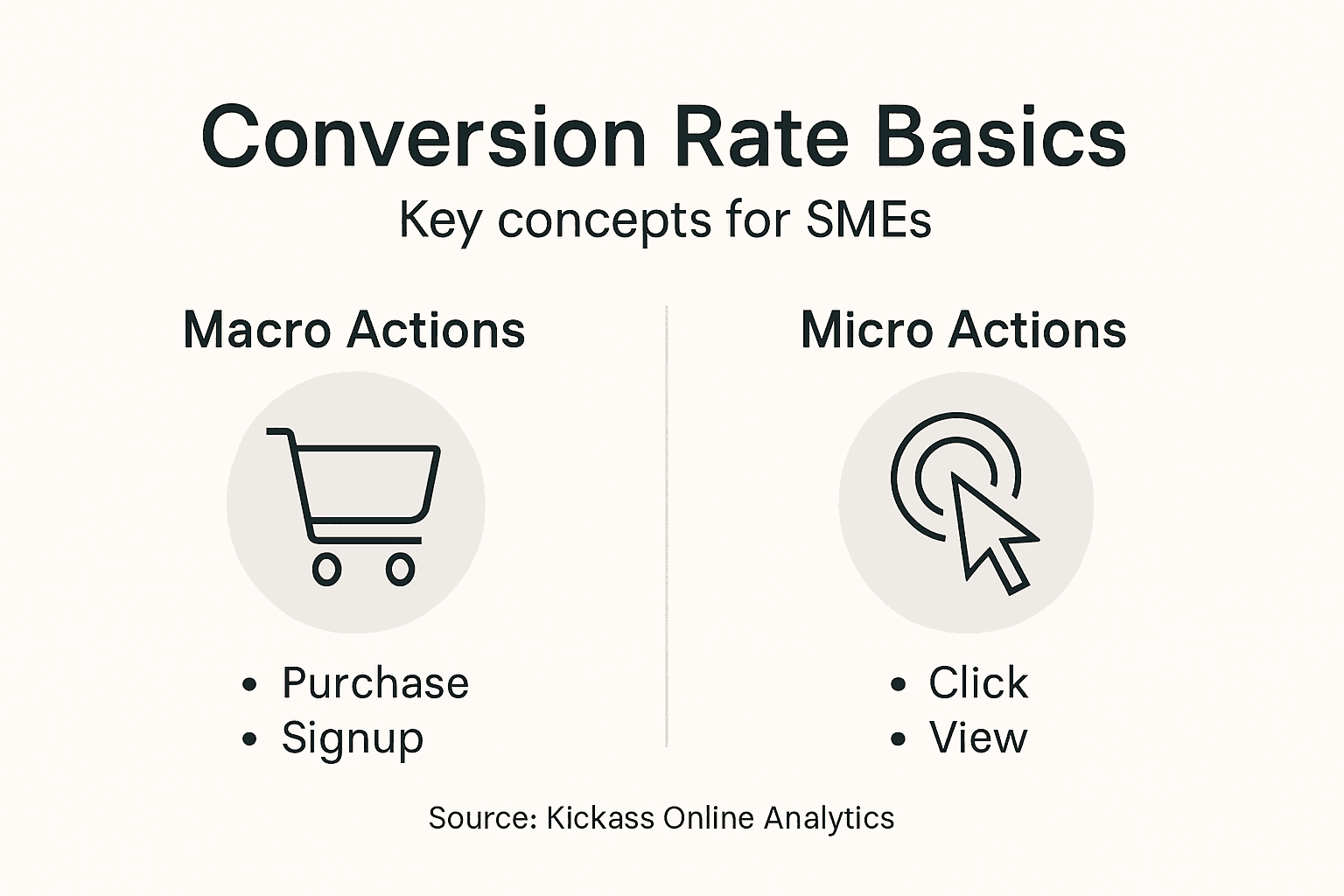
Macro conversions represent the primary, high-value actions that directly contribute to business goals:
Micro conversions, by contrast, are smaller supporting interactions that demonstrate user interest and potential future engagement:
Understanding the relationship between macro and micro conversions allows businesses to create more sophisticated tracking and nurturing strategies. These incremental interactions provide crucial insights into customer behaviour, helping organisations design more effective conversion pathways.
By mapping both macro and micro conversion points, small and medium enterprises can develop a comprehensive view of their customer journey, identifying potential friction points and optimising each stage of user interaction.
The following table contrasts macro and micro conversions for a clearer strategic overview:
| Conversion Type | Core Focus | Impact on Business Goals |
|---|---|---|
| Macro Conversion | Direct revenue actions | Immediate contribution to growth |
| Micro Conversion | Supporting engagement | Signals interest for future opportunities |
Pro tip: Track micro conversions as leading indicators of potential macro conversion opportunities, using these smaller interactions to refine your marketing approach.
Calculating conversion rates is a straightforward yet powerful method for understanding digital marketing performance. Digital marketing analytics provide businesses with a precise formula to measure user engagement: (Number of Conversions ÷ Total Visitors) × 100 = Conversion Rate Percentage.
To effectively track conversion rates, small and medium enterprises should focus on several key metrics:
Most businesses utilise web analytics platforms to monitor these crucial metrics. Marketing experimentation strategies enable continuous improvement through systematic testing, including:
Understanding your specific conversion rate helps diagnose website performance issues and provides actionable insights for targeted improvements. By consistently monitoring these metrics, businesses can make data-driven decisions that directly impact revenue and growth.
Companies should aim to benchmark their conversion rates against industry standards while recognising that optimal rates vary significantly across different sectors and business models.
Pro tip: Set up conversion tracking in your analytics platform and review performance monthly, focusing on incremental improvements rather than dramatic overnight changes.
Conversion rate optimisation demands a strategic approach that goes beyond simple campaign modifications. Marketing campaign effectiveness relies on understanding and avoiding common strategic mistakes that can undermine digital marketing performance.
Key conversion rate pitfalls for small and medium enterprises include:
Businesses frequently make critical errors in their conversion strategies that dramatically impact performance. These mistakes often stem from:
Understanding these pitfalls requires a holistic approach to digital marketing. Successful conversion rate optimisation involves continuous testing, refinement, and a deep understanding of user behaviour patterns. Small businesses must remain adaptable, using data-driven insights to make incremental improvements.
Conversion rate success depends more on understanding user experience than implementing complex marketing tactics.
Pro tip: Conduct monthly user experience audits, focusing on simplifying conversion paths and addressing potential friction points in your website design.
Conversion rate optimisation requires a sophisticated, multi-disciplinary approach that goes far beyond simple marketing tactics. Advanced optimisation strategies integrate psychology, technology, and data analytics to transform digital marketing performance.
For small and medium enterprises, effective conversion optimisation involves several critical strategies:
Digital marketing touchpoints play a crucial role in driving conversion success. SMEs must focus on:
Successful conversion rate optimisation demands a holistic approach that balances technological innovation with deep psychological understanding. By combining data-driven insights with strategic user experience design, businesses can create more effective digital marketing ecosystems.
Here is a summary of advanced strategies and their influence on conversion rates:
| Strategy | Description | Expected Business Impact |
|---|---|---|
| Personalised User Experiences | Tailoring content to user profiles | Higher engagement rates |
| Behavioural Economics Insights | Using decision triggers and nudges | Increased conversion rates |
| Cross-Channel Consistency | Unified messaging across platforms | Improved brand trust |
| Trust-Building Elements | Adding reviews, certifications | Enhanced customer confidence |
Sustainable business growth emerges from understanding and addressing customer needs at every interaction point.
Pro tip: Implement a continuous experimentation framework, testing one strategic element at a time to incrementally improve conversion performance.
Understanding the vital role of conversion rates is the first step towards growing your small or medium-sized business effectively. If you are facing challenges such as low engagement, complicated conversion paths, or poor website performance, as highlighted in the article, it is crucial to address these pain points with professional guidance. Concepts like optimising macro and micro conversions, improving user experience, and personalised marketing strategies are essential for turning website visitors into loyal customers.
Kickass Online specialises in building high-converting websites and delivering tailored services such as expert website design, robust SEO optimisation, and reliable ongoing website maintenance to enhance your digital presence. Our limited client intake means we provide dedicated attention to your unique business needs, helping you overcome common pitfalls like slow loading times and weak calls to action.
Ready to elevate your conversion rate and unlock sustained growth? Discover how our comprehensive digital marketing solutions at Kickass Online can transform your customer journey. Book a consultation now and take the confident step towards a website that truly converts visitors into customers.
A conversion rate is the percentage of website visitors who complete a desired action, such as making a purchase or signing up for a newsletter. It is calculated by dividing the number of conversions by the total number of visitors and multiplying by 100.
Tracking conversion rates allows small and medium enterprises to understand the effectiveness of their marketing strategies and website performance. It provides insights into which channels and tactics drive meaningful customer engagement and revenue growth.
Macro conversions are high-value actions, such as completed purchases or service subscriptions, that directly contribute to business goals. Micro conversions are smaller interactions like newsletter sign-ups or product page views that indicate user interest and potential future engagement.
SMEs can optimise conversion rates by personalising user experiences, implementing targeted messaging, reducing website friction points, and continuously testing and refining their marketing strategies based on user behaviour patterns.
Struggling to guide visitors smoothly through your website can feel like a constant headache for business owners in Milton Keynes. When content is scattered or hard to find, users quickly lose interest and search engines fail to recognise your site’s value. By mastering a structured information architecture, you set the foundation for a more enjoyable browsing experience and improved online visibility. This article reveals how clear content hierarchy can simplify navigation, strengthen usability, and enhance your search results.
| Point | Details |
|---|---|
| Effective Content Hierarchy | A well-structured content hierarchy enhances user navigation and comprehension, leading to improved user engagement. |
| On-Page vs. Sitewide Hierarchies | Understanding the differences between on-page and sitewide hierarchies is crucial for designing intuitive digital experiences. |
| Usability and SEO Integration | A clear content hierarchy not only optimises user experience but also improves search engine visibility and rankings. |
| Avoid Common Pitfalls | Regular audits and usability testing can help prevent common missteps that hinder the effectiveness of content hierarchy. |
Content hierarchy represents a strategic approach to organising digital information that enables users to navigate websites efficiently and intuitively. At its core, this concept transforms complex website structures into logical, easily comprehensible systems that guide visitors through content seamlessly.
The fundamental principles of content hierarchy involve creating a structured information architecture that prioritises user experience. Systematic website organisation helps users understand where specific content resides and how different sections relate to each other. This approach supports cognitive processing by establishing clear pathways and reducing mental effort required to find information.
Key components of an effective content hierarchy include:
Content categorisation plays a critical role in establishing hierarchy. By systematically breaking down information into meaningful segments, websites can create more accessible and user-friendly experiences. This process involves understanding audience needs, mapping content relationships, and designing intuitive information structures.
Pro tip: Regularly audit and refine your website’s content hierarchy to ensure it remains user-friendly and aligned with your audience’s evolving navigation preferences.
Content hierarchy is not a one-dimensional concept, but rather a multifaceted approach that operates at different levels of a website’s structure. Understanding the nuanced differences between on-page and sitewide hierarchies is crucial for creating comprehensive and user-friendly digital experiences.
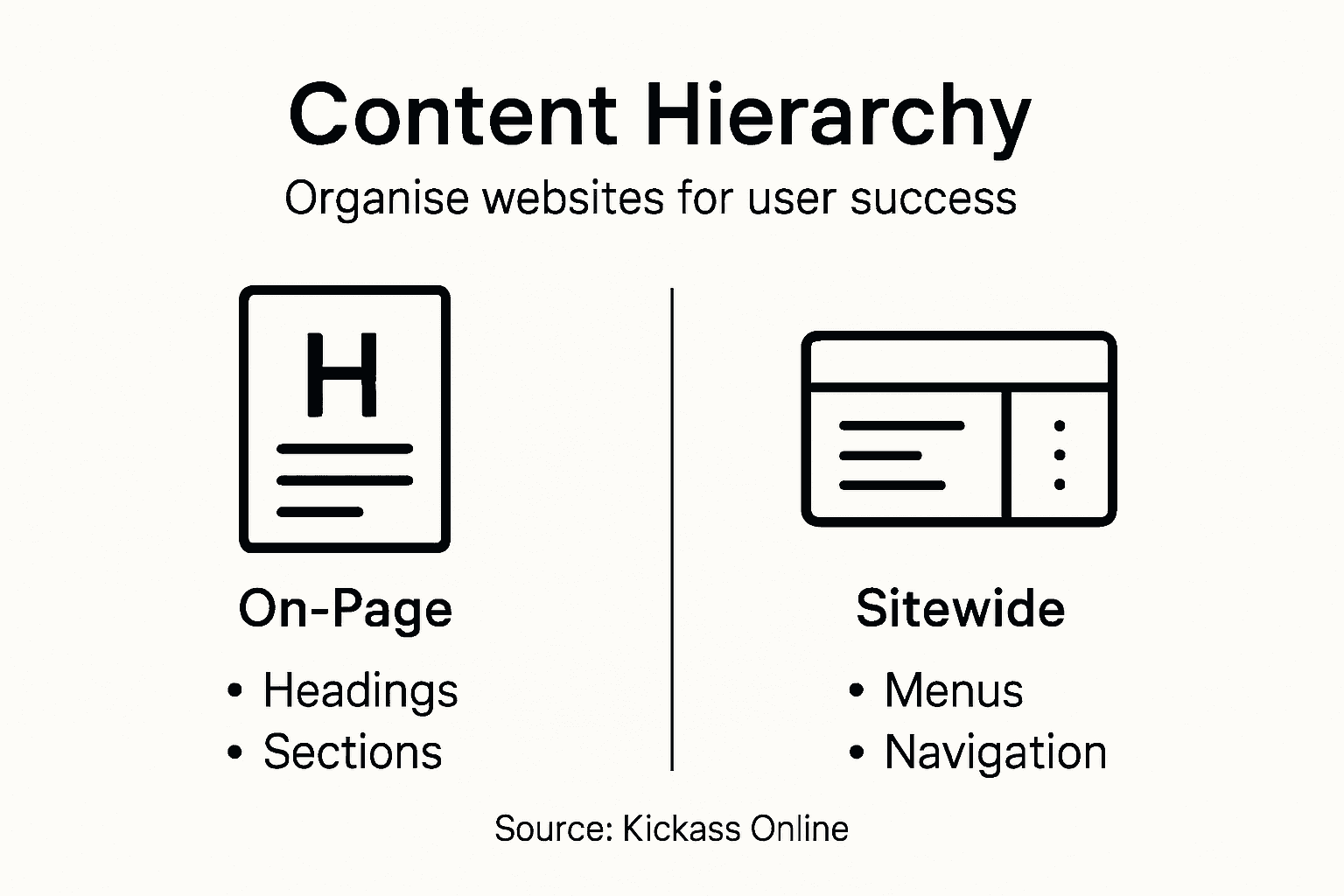
Site structure organisation encompasses two primary dimensions of content hierarchy: on-page and sitewide. Each plays a distinct yet interconnected role in guiding user navigation and comprehension. On-page hierarchy focuses on the internal structure of individual pages, while sitewide hierarchy addresses the broader architectural framework of the entire website.
On-page hierarchy characteristics include:
Sitewide hierarchy, by contrast, involves structuring multiple pages into a coherent navigational ecosystem. This broader approach encompasses:
Effective content hierarchy transforms complex information into an easily digestible and navigable user experience.
The symbiotic relationship between on-page and sitewide hierarchies ensures that users can seamlessly move through a website while maintaining context and understanding. By implementing robust hierarchical structures, websites can significantly enhance user engagement, reduce cognitive load, and improve overall digital accessibility.
Pro tip: Conduct regular user testing to validate and refine your website’s hierarchical structure, ensuring it meets evolving user expectations and navigation preferences.
Here’s a consolidated summary of the differences and advantages of on-page versus sitewide content hierarchy:
| Aspect | On-Page Hierarchy | Sitewide Hierarchy |
|---|---|---|
| Focus | Individual page structure | Whole website architecture |
| User Benefit | Enhanced content clarity | Streamlined site navigation |
| Design Consideration | Effective headings, formatting | Logical menu, cross-page links |
| Impact on Experience | Smooth reading flow per page | Context retention across pages |
Content hierarchy serves as a critical bridge between user experience and search engine performance, transforming complex digital landscapes into navigable, intuitive environments. By strategically organising information, websites can simultaneously enhance user engagement and improve their search engine visibility.

Web design hierarchy plays a pivotal role in reducing cognitive load for users while providing clear signals to search engine algorithms. This dual functionality means that well-structured content simultaneously addresses human comprehension and technological indexing requirements.
Key usability benefits of effective content hierarchy include:
From an SEO perspective, visual hierarchy principles directly impact search engine rankings by:
Intelligent content hierarchy transforms complex information into an easily navigable user experience that search engines can readily interpret.
The symbiotic relationship between usability and SEO becomes evident when websites prioritise clear, logical content structures. By creating intuitive pathways that guide both human users and search engine crawlers, organisations can dramatically improve their digital performance and online visibility.
Pro tip: Conduct quarterly content hierarchy audits to ensure your website’s structure remains optimised for both user experience and search engine performance.
Below is a reference table highlighting how content hierarchy strengthens user experience and SEO:
| Benefit | User Experience Impact | SEO Improvement |
|---|---|---|
| Faster information access | Quick content discovery | Efficient search engine crawling |
| Reduced confusion | Simple, logical navigation | Stronger keyword relationships |
| Greater satisfaction | Intuitive pathways | Improved site relevance |
| Increased engagement | Motivates exploration | Longer user visit times |
Creating a compelling content flow requires strategic planning and deliberate structural choices that guide readers seamlessly through complex information. Successful content structure transforms potentially overwhelming material into an engaging, easily digestible narrative that maintains reader interest and comprehension.
Content strategy principles provide a robust framework for developing coherent communication pathways. By defining clear objectives and understanding audience needs, writers can craft content that systematically addresses user expectations and delivers information with precision and clarity.
Key techniques for optimising content flow include:
Structural approaches to content organisation involve:
Effective content flow transforms information from a collection of facts into a compelling, meaningful narrative.
Scientific writing strategies emphasise the importance of systematic information presentation. By adopting structured approaches like the IMRaD format, content creators can ensure logical progression, maintain reader engagement, and communicate complex ideas with remarkable clarity.
Pro tip: Create a detailed content outline before writing to map your narrative flow and ensure coherent information delivery.
Content hierarchy, while powerful, can quickly become a double-edged sword when implemented without strategic consideration. Understanding potential pitfalls is crucial for creating a robust, user-friendly digital experience that supports rather than hinders information navigation.
Website structural vulnerabilities can emerge from seemingly innocuous design choices that dramatically impact user comprehension and site usability. Poorly conceived hierarchical structures create cognitive barriers that frustrate users and undermine the fundamental purpose of digital communication.
Common hierarchy missteps include:
Significant risks associated with hierarchy mismanagement involve:
Effective content hierarchy acts as a navigational compass, guiding users seamlessly through complex digital landscapes.
Security configuration challenges underscore the importance of maintaining a well-structured, intentional content approach. Neglecting hierarchy can expose websites to risks beyond mere user frustration, potentially compromising data integrity and user trust.
Pro tip: Conduct regular usability testing and hierarchy audits to identify and rectify potential navigational obstacles before they impact user experience.
Struggling with complex site navigation or unclear content flow can frustrate your visitors and harm your search engine rankings. This article highlights how mastering content hierarchy — from on-page headings to sitewide structure, is key to reducing user confusion and boosting engagement. If your website suffers from hidden information or inconsistent labelling, you are risking lost customers and diminished online visibility.
At Kickass Online, we specialise in designing high-converting websites that implement strategic content hierarchies tailored for your audience. We take the guesswork out of your site’s organisation by creating logical, intuitive navigation pathways and optimised user experiences that engines love.
Ready to transform your website into a clear, user-friendly platform that drives growth? Partner with our dedicated team to get personalised web development, expert SEO, and ongoing site maintenance that keeps you ahead. Visit Kickass Online today and schedule your consultation to start building a website that truly reflects your business potential.
Content hierarchy refers to the structured organisation of information on a website that enhances user navigation and comprehension. It enables users to easily find relevant content by establishing clear pathways and logical groupings.
Effective content hierarchy improves user experience by reducing cognitive load, facilitating quicker information discovery, and providing straightforward navigation pathways. It helps users understand where to find specific content and encourages engagement with the site.
Content hierarchy optimises SEO by improving website crawlability, enhancing keyword relevance, and creating logical relationships between content. A well-structured hierarchy informs search engines about the content’s importance and relevance, potentially improving rankings.
Common mistakes include overcomplicated menu structures, inconsistent labelling, hidden critical information, and excessive nesting of categories. These pitfalls can lead to user frustration, increased bounce rates, and negatively affect site usability.
Video workflow note: for editing and delivery, this DaVinci Resolve workflow guide is a useful related reference.
Trying to make your business stand out on social media often feels confusing and overwhelming. You want to reach the right people, but it can be hard to know where to begin or which steps will actually get results. When your strategy is unclear, your efforts can easily get lost in the noise.
The good news is that there are practical steps you can take to turn things around. This guide will help you set clear objectives, pick the right platforms, and create content that genuinely connects with your audience. You will discover straightforward actions that remove the guesswork and build real engagement, so you can finally see the results you want from your social media marketing.
| Takeaway | Explanation |
|---|---|
| 1. Define SMART Objectives | Establish clear, measurable social media goals to guide your strategy effectively. |
| 2. Select Appropriate Platforms | Choose social media channels that resonate with your target audience’s preferences and behaviours. |
| 3. Create Engaging Content | Consistently produce meaningful content that connects with your audience through storytelling and varied formats. |
| 4. Utilise Scheduling Tools | Use scheduling tools to manage posts efficiently, enabling consistent content delivery without daily stress. |
| 5. Regularly Monitor Performance | Continuously track your social media metrics to adapt strategies based on audience engagement and content effectiveness. |
Successful social media marketing begins with crystal-clear objectives that align with your business goals. Without well-defined targets, your digital strategy will drift aimlessly like a ship without a compass.
To create impactful social media objectives, you need a strategic approach that transforms vague aspirations into measurable milestones. This means developing precise communication strategies that focus on specific, actionable outcomes.
When defining your social media objectives, consider these critical elements:
The key is creating objectives that are Specific, Measurable, Achievable, Realistic, and Time-phased (SMART).
Business owners should approach social media objectives by breaking down broader marketing goals into granular, trackable targets. For instance, instead of saying “increase social media presence,” specify “grow Instagram followers by 25% within six months” or “generate 50 quality leads per month through LinkedIn advertising”.
Your objectives must directly connect with your overall business strategy. Are you aiming to boost sales? Enhance brand recognition? Establish thought leadership? Each goal requires a tailored approach and distinct key performance indicators.
Pro tip: Map out your social media objectives using a quarterly planning framework, allowing for regular review and nimble adjustments based on real-world performance data.
Navigating the digital landscape requires strategic platform selection that aligns perfectly with your target demographic. Not all social media channels are created equal and understanding where your potential customers spend their time is crucial.
Choosing the right social media platforms involves deep audience understanding that goes beyond surface-level demographics. Businesses must map their ideal customer’s online behaviour and preferences meticulously.
Key considerations for platform selection include:
Your social media strategy must reflect where your audience naturally congregates online.
Different platforms attract distinct user profiles. LinkedIn serves professional networking, Instagram appeals to younger visual audiences, Facebook supports broad demographic reach, and Twitter facilitates rapid information exchange. Strategic platform selection means matching your business objectives with platform strengths.
Analyse your current customer base. Which platforms do they predominantly use? What content formats resonate most with them? Understanding these nuances helps narrow your social media focus and maximise engagement potential.
Pro tip: Create audience personas documenting platform preferences before launching any social media marketing campaign, ensuring laser-focused targeting and resource allocation.
Content is the lifeblood of social media marketing. Without compelling storytelling and strategic communication, your digital presence will struggle to capture and maintain audience attention.
Creating consistent and engaging content requires more than just posting randomly. It demands a structured approach to content development that resonates with your target audience’s preferences and expectations.
Key principles for effective content creation include:
Engaging content is not about frequency but about meaningful connection.
Successful social media content balances informative material with entertainment. Your audience wants substance packaged in an accessible, visually appealing manner. This means mixing educational posts with interactive elements such as polls, behind-the-scenes glimpses, and user-generated content.
Understand your audience’s content consumption habits. Some prefer short video clips whilst others enjoy long-form written posts. Visual storytelling matters immensely. Experiment with infographics, short videos, carousel posts, and narrative-driven content that sparks genuine conversation.
Consistency extends beyond posting schedule. It encompasses visual design, tone of voice, messaging philosophy, and brand personality. Your content should feel like a cohesive narrative that builds trust and familiarity.
Pro tip: Develop a content calendar that balances different content types and themes, ensuring your social media presence remains dynamic yet recognisably yours.
Social media marketing demands consistent content delivery without consuming every waking moment of your workday. Strategic scheduling tools can transform your digital marketing approach from chaotic to controlled.
Time management is crucial for small business owners who must balance multiple responsibilities. Effective scheduling techniques can dramatically reduce administrative overhead and boost productivity.
Benefits of social media scheduling tools include:
Scheduling tools are not about working harder but working smarter.
Choosing the right scheduling platform involves assessing your specific business needs. Popular tools like Hootsuite Buffer and Sprout Social offer comprehensive features that allow you to plan weeks of content in a single focused session.
Your scheduling strategy should involve creating a content calendar that maps out posts across different platforms. This approach helps you visualise your social media narrative and ensure a balanced mix of content types.
Professional social media management requires thinking beyond immediate posting. Analyse your audience’s peak engagement times and schedule content accordingly to maximise visibility and interaction.
Pro tip: Dedicate one focused afternoon each month to bulk-creating and scheduling your social media content, freeing up daily time for real-time engagement and strategic planning.
In the fast-scrolling world of social media, visual content is your secret weapon for capturing audience attention. Static text simply cannot compete with the engaging power of compelling imagery and video.
Modern audiences consume information through visual communication strategies that prioritise immediate, dynamic content. Your social media presence must reflect this visual-first approach.
Key visual content strategies include:
Visual storytelling transforms passive scrollers into engaged followers.
Video content reigns supreme in digital marketing. Short-form videos between 30-90 seconds perform exceptionally well across platforms. These bite-sized narratives allow businesses to showcase personality, demonstrate products, and connect emotionally with viewers.
Effective visual content requires thoughtful design. Consider your brand’s colour palette, maintain consistent visual styling, and ensure technical quality. Grainy or poorly lit videos will undermine your professional image faster than ineffective text.
Platform-specific visual strategies matter. Instagram and TikTok demand different visual approaches compared to LinkedIn. Understanding each platform’s visual language helps maximise your content’s impact.
Pro tip: Invest in basic video editing skills or affordable editing tools that can transform raw footage into polished, engaging social media content.
Social media is not a broadcast platform but a dynamic conversation space where genuine interactions transform casual followers into loyal brand advocates. Passive posting is a recipe for digital invisibility.
Building meaningful connections requires strategic community engagement that goes beyond superficial interactions. Your audience craves authentic communication that makes them feel valued and heard.
Effective engagement strategies include:
True engagement means treating followers as collaborators, not just consumers.
Beyond basic responses, successful engagement involves creating a two-way communication ecosystem. This means not just answering queries but proactively sparking conversations, celebrating your community’s contributions, and showing the human side of your brand.
Consider allocating dedicated time each day for social media interactions. Quick, personalised responses demonstrate that you genuinely value your audience’s input. Authenticity trumps polished corporate messaging every single time.
Different platforms demand different engagement approaches. LinkedIn requires professional discourse, while Instagram thrives on more casual, emoji-laden interactions. Understanding these nuances helps craft platform-specific engagement strategies.
Pro tip: Develop a 15-minute daily engagement routine where you systematically respond to comments, like follower posts, and participate in relevant conversations across your chosen platforms.
Successful social media marketing is not a set-and-forget endeavour. It requires continuous monitoring, strategic analysis, and nimble adaptation to changing audience behaviours and platform dynamics.
Understanding how to measure and interpret marketing performance transforms guesswork into precision-driven strategy.
Key metrics to track include:
Data without interpretation is just noise. Strategic insights drive growth.
Performance tracking tools like Google Analytics, native platform insights, and social media dashboards offer comprehensive data visualisation. These resources help businesses understand which content resonates and where improvements are needed.
Regular performance reviews should be scheduled monthly or quarterly. During these sessions, analyse your key performance indicators critically. Which posts generated the most engagement? What time of day yields optimal interaction? Which content types provoke the strongest audience response?
Be prepared to pivot quickly. Social media algorithms and audience preferences evolve rapidly. What worked six months ago might feel stale today. Flexibility and continuous learning are your greatest assets in digital marketing.
Pro tip: Create a simple spreadsheet to track monthly social media metrics, allowing you to visualise trends and make data-driven decisions about your content strategy.
Below is a detailed table summarising key strategies and insights from the article about successful social media marketing.
Struggling to turn your social media efforts into measurable business growth? This article highlights common challenges like defining clear objectives, choosing the right platforms, and creating consistent engaging content, all essential for success but often overwhelming to execute alone. The pain of juggling content creation, scheduling, and active follower engagement can be eased with professional support focused on your unique goals.
At Kickass Online, we specialise in crafting personalised digital strategies that align perfectly with your business objectives. Our team can help you develop social media plans that include data-driven content calendars and platform-specific tactics. With our expertise in web development and SEO, we ensure your online presence not only attracts but converts your target audience for lasting growth. Explore actionable insights and marketing advice in our Tips and Tricks | Kickass Online to complement your social media marketing efforts.
Ready to transform your social media marketing into a powerful growth engine? Visit Kickass Online today to book a consultation and discover customised solutions that boost your visibility, engage followers meaningfully, and maximise your digital impact.
To define clear social media objectives, break down your broader business goals into specific, measurable targets. For example, set a goal to increase Instagram followers by 25% within six months to keep your strategy focused and aligned with your business objectives.
Choose social media platforms that your target audience frequents and that align with your content strategy. For instance, if your audience is primarily professionals, focus on LinkedIn; if they are younger, consider Instagram or TikTok to maximise engagement.
To engage your audience, create a mix of high-quality visuals, informative posts, and interactive content. Aim for a content calendar that includes varying formats, such as educational infographics, short videos, and behind-the-scenes content, to keep your audience captivated.
Use scheduling tools to automate your content posting and maintain a consistent online presence. By dedicating a few hours to plan and schedule your posts for the next month, you can reduce daily management stress and ensure timely content delivery.
Engaging with your followers creates a sense of community and builds brand loyalty. Make it a daily practice to respond to comments and interact with your audience to nurture these connections and turn casual followers into loyal supporters.
To monitor your social media performance, regularly check key metrics such as engagement rates and follower growth. Set up a simple spreadsheet to track these metrics monthly, enabling you to identify trends and adapt your strategy based on what works best.
Frustrated when a customer clicks away because your website feels awkward on a smartphone? For businesses in Milton Keynes, mobile responsiveness is more than a technical feature, it shapes your reputation and customer loyalty with every visit. Embracing responsive web design means your site adjusts smoothly to any device, helping you stay ahead in search rankings while keeping potential clients engaged from the very first glance.
| Point | Details |
|---|---|
| Understanding Mobile Responsiveness | Mobile responsiveness is essential for optimising user experience across devices, adapting layouts and content dynamically. |
| Common Misconceptions | Mobile compatibility differs from true responsiveness; merely making a site mobile-friendly is insufficient for an optimal experience. |
| Optimisation Strategies | Use responsive, adaptive, or mobile-first design approaches to cater effectively to various screen sizes and device types. |
| Business Benefits | Mobile responsiveness can significantly enhance search engine rankings, lower bounce rates, and improve customer satisfaction for SMEs. |
Mobile responsiveness represents a critical web design approach that ensures websites adapt seamlessly across different screen sizes and devices. Unlike traditional static web designs, responsive design dynamically adjusts layouts, images, and text to provide optimal viewing experiences.
At its core, mobile responsiveness involves creating flexible web interfaces that automatically reconfigure based on the user’s device. This means a website will look equally compelling whether accessed on a desktop computer, tablet, smartphone, or smartwatch. The key objective is maintaining readability, navigation ease, and visual appeal across diverse screen dimensions.
Several common misconceptions persist about mobile responsiveness:
Mobile responsiveness ensures websites work flawlessly across devices without requiring manual zooming or horizontal scrolling.
Understanding the nuanced differences between mobile compatibility and true responsiveness is crucial. While compatibility might allow basic functionality, responsive design focuses on creating intuitive, dynamically adjusting interfaces that feel native to each device’s unique characteristics.
Pro tip: Test your website’s responsiveness using multiple devices and screen sizes to identify potential layout or usability issues.
Mobile optimisation encompasses several strategic approaches designed to enhance website performance across diverse digital devices. Responsive web design techniques have emerged as critical solutions for addressing the complex challenges of modern digital interfaces.
Three primary approaches dominate mobile optimisation strategies:
Mobile optimisation is about creating seamless user experiences that function flawlessly across every device type.
Each approach offers unique advantages in tackling device fragmentation. Responsive design provides the most fluid experience, allowing content to reshape automatically. Adaptive design offers more controlled, tailored experiences for specific device types. Mobile-first design ensures fundamental usability starts with the smallest screen, guaranteeing core functionality remains consistent.
Here’s a comparison of common mobile optimisation approaches:
| Approach | Main Technique | Strengths | Drawbacks |
|---|---|---|---|
| Responsive Design | Flexible grids, media queries | Automatic adaptation | May require more initial effort |
| Adaptive Design | Pre-set layouts for device types | Targeted device experiences | Less flexible across devices |
| Mobile-First Design | Design starts with smallest screens | Guarantees core usability | Desktop enhancements needed |
Pro tip: Implement comprehensive testing across multiple devices and screen resolutions to validate your mobile optimisation strategy.
Responsive web design techniques represent a sophisticated approach to creating flexible, adaptable digital interfaces that seamlessly adjust across multiple devices and screen sizes. The core philosophy centres on building websites that provide optimal viewing experiences regardless of the user’s device.
Key features of responsive web design include:
Responsive design transforms websites from rigid, fixed layouts to dynamic, intelligent interfaces that adapt in real-time.
The technical implementation of responsive web design goes beyond simple resizing. It involves creating intelligent, context-aware interfaces that understand and respond to the specific characteristics of each device. This means considering factors like screen resolution, orientation, input method, and processing capabilities when rendering content.

Modern responsive design prioritises performance and user experience, ensuring that websites load quickly, look appealing, and remain highly functional across smartphones, tablets, laptops, and desktop computers.
To clarify the business impact of responsive web design features:
| Feature | What It Does | Business Impact |
|---|---|---|
| Flexible grid layouts | Adjust to various screen sizes | Consistent branding |
| Fluid image scaling | Maintain quality on all devices | Professional appearance |
| Touch-friendly design | Easy navigation via touchscreens | Greater user satisfaction |
| Viewport configuration | Controls content display | Reduced site abandonment |
Pro tip: Regularly test your responsive design using multiple devices and browser developer tools to identify and resolve potential layout inconsistencies.
Mobile responsiveness offers critical SEO advantages that can transform how small and medium-sized enterprises compete in the digital marketplace. By prioritising mobile-friendly design, SMEs can significantly enhance their online visibility and customer engagement strategies.
Key business benefits include:
Mobile responsiveness is no longer optional – it’s a fundamental requirement for digital business success.
For SMEs, mobile responsiveness represents more than just technical adaptation. It’s a strategic approach to meeting modern consumer expectations, with direct implications for business growth. Websites that load quickly, display correctly, and provide intuitive navigation across devices create positive user experiences that translate into tangible business outcomes.
Modern consumers expect seamless digital interactions, and businesses that fail to provide mobile-friendly experiences risk losing potential customers to more technologically adept competitors.
Pro tip: Invest in regular mobile usability testing to continuously refine your website’s responsiveness and user experience.
Common mobile compatibility errors can significantly undermine a website’s performance and user experience. Understanding these potential pitfalls is crucial for businesses seeking to create truly responsive digital platforms that engage and retain customers.
Critical mistakes to avoid include:
Mobile responsiveness requires a holistic approach, not just surface-level technical adjustments.
Technical limitations can dramatically impact user experience. Websites with outdated codebases often struggle to support modern responsive techniques, resulting in poor navigation, excessive zooming, and horizontal scrolling. These issues not only frustrate users but can also lead to significant ranking penalties from search engines.
Effective mobile design demands continuous testing and adaptation. Developers must rigorously validate that all content displays correctly and functions intuitively across diverse mobile devices and screen configurations.
Pro tip: Conduct monthly mobile usability audits to identify and resolve potential responsive design weaknesses before they impact user experience.
Ensuring your website is truly mobile responsive goes beyond simple compatibility. Many businesses struggle with fixed layouts, poor touch interactions, and slow load times that frustrate users and harm SEO rankings. If you want to provide a seamless browsing experience across all devices while boosting your search engine visibility, you need more than just a mobile-friendly label. Understanding and implementing flexible grid layouts, fluid images, and viewport configuration are key to standing out in today’s competitive online environment.
At Kickass Online, we specialise in crafting customised, responsive web designs that meet Google’s SEO standards and engage your visitors effortlessly. Our dedicated team works closely with you to ensure your website performs brilliantly on smartphones and desktops alike. Don’t let outdated or rigid designs limit your growth. Take the next step now by exploring our expert services and booking a consultation. Let us help you transform your digital presence with a website designed to convert and rank higher immediately.
Mobile responsiveness is a web design approach that ensures websites adapt seamlessly across different screen sizes and devices, providing optimal viewing experiences without requiring manual zooming or horizontal scrolling.
Mobile responsiveness enhances SEO by improving search engine rankings, as Google prioritises mobile-friendly websites in search results. A responsive design also contributes to reduced bounce rates and increased user engagement.
The primary approaches to mobile optimisation include responsive web design, adaptive design, and mobile-first design, each offering unique advantages in creating user-friendly experiences across various devices.
Key features include flexible grid layouts, media queries, fluid image scaling, touch-friendly interactions, and viewport configuration, all of which help create adaptable digital interfaces that function well across multiple devices.
Running a small business in Milton Keynes means juggling countless demands, but one challenge stands out: creating content that actually gets results. In a crowded online market, clear project objectives and audience research make the difference between content that works and content that’s ignored. This guide cuts through the noise and provides practical steps for purposeful digital marketing, helping you attract the right customers and grow your presence with confidence.
| Key Insight | Explanation |
|---|---|
| 1. Define Clear Project Objectives | Establish specific and measurable objectives to guide your content creation process effectively. |
| 2. Conduct Comprehensive Audience Research | Gain insights into your audience’s preferences and behaviours to tailor your content strategy. |
| 3. Develop Strategic Content Plans | Create a cohesive content strategy that aligns with both business goals and audience needs. |
| 4. Create High-Quality Targeted Content | Focus on producing relevant and engaging materials that resonate with your audience. |
| 5. Review and Optimise Published Assets | Regularly assess and update content to ensure ongoing performance and relevance. |
Developing clear project objectives is your strategic roadmap for successful content creation. This crucial first step ensures your entire project stays focused, aligned, and measurable from the beginning.
To craft precise project objectives, start by understanding exactly what you want to achieve. Establishing specific research objectives helps you define the scope and direction of your content strategy. Think of your objectives like a compass - they’ll guide every decision and keep your project on track.
Your objectives should follow a structured approach:
Break down your objectives into clear, actionable statements. For instance, instead of saying “increase website traffic,” specify “boost organic website traffic by 25% within three months through targeted content creation.”
Effective objectives are your project’s north star, providing clarity and direction throughout the content creation process.
Research-driven objectives help you maintain focus and avoid unnecessary work. Research objectives serve as a roadmap that guide every stage of your project, from initial planning to final execution.
Pro tip: Create a one-page objective document that clearly outlines your project’s goals, metrics, and expected outcomes to keep your entire team aligned and focused.
Understanding your target audience is the foundation of creating compelling content that truly resonates. Audience research transforms generic messaging into targeted communication that speaks directly to your potential customers.
Comprehensive audience research involves a strategic approach to gathering insights about your potential readers or customers. This process helps you decode their preferences, behaviours, and pain points, enabling you to craft content that feels personally crafted for them.
Your audience research should encompass multiple dimensions:
To gather meaningful insights, you’ll want to employ multiple research methods:
Effective audience research transforms guesswork into a precise, data-driven content strategy.
Creating detailed audience personas allows you to visualise your ideal reader, making your content creation more intuitive and targeted. By understanding their language, challenges, and aspirations, you can speak directly to their needs.
Pro tip: Update your audience research every six months to ensure your content remains relevant and aligned with evolving customer preferences.
Creating a robust strategic content plan transforms your content from random pieces into a cohesive, goal-driven approach. This critical step ensures every piece of content you produce serves a specific purpose in your broader business strategy.

Strategic content planning requires integrating multiple insights to align your content goals with your organisational objectives. Think of your content plan as a roadmap that guides your communication efforts, helping you navigate the complex landscape of digital marketing.
Your strategic content plan should include several key components:
A well-crafted content strategy transforms scattered efforts into a powerful, unified communication approach.
To develop an effective plan, follow these essential steps:
Developing a comprehensive planning document involves engaging stakeholders and maintaining flexibility. Your plan should be a living document that adapts to changing business needs and audience preferences.
Pro tip: Review and adjust your content strategy quarterly to ensure continued alignment with your business objectives and market dynamics.
Crafting high-quality targeted content is the heart of effective digital communication. Your goal is to produce material that speaks directly to your audience’s needs, challenges, and aspirations.
Creating targeted content requires a strategic approach that goes beyond simple information delivery. Modern content creation leverages technology and deep audience understanding to develop materials that truly resonate and provide genuine value.
Key characteristics of exceptional targeted content include:
High-quality content transforms information into meaningful experiences that engage and inspire your audience.
To develop targeted content effectively, follow these critical steps:
Content curation strategies involve carefully selecting and synthesising information to create original, impactful materials. Your content should not just repeat existing information but offer unique perspectives and transformative insights.
Pro tip: Regularly conduct audience feedback surveys to ensure your content remains precisely aligned with evolving reader expectations and needs.
Content review is your strategic opportunity to refine and enhance existing materials, ensuring they continue to deliver maximum value to your audience. This critical process transforms good content into exceptional, high-performing digital assets.
Reviewing published content requires a systematic and critical approach that goes beyond surface-level editing. Think of it as a comprehensive health check for your digital content, identifying areas for improvement and alignment with current business objectives.
Your content optimisation strategy should focus on several key dimensions:
Effective content optimisation transforms existing assets into dynamic, high-impact communication tools.
Follow these structured steps to review and optimise your published content:
Content review methodologies emphasise the importance of timely, balanced updates that maintain the integrity of your original message while incorporating fresh insights and perspectives.
Pro tip: Implement a quarterly content audit schedule to systematically review and refresh your digital assets, ensuring they remain relevant and high-performing.
The table below compares content review and content planning in the context of ongoing strategy:
| Aspect | Content Review | Content Planning |
|---|---|---|
| Main goal | Improve existing materials | Structure future output |
| Timing | After publication | Before creation |
| Key activity | Data-driven updates | Gap and trend analysis |
| Major benefit | Maintain relevancy | Anticipate audience needs |
Here is a summary of how each step impacts your content creation process:
| Step | Main Focus | Typical Outcome | Business Impact |
|---|---|---|---|
| Define objectives | Set clear project direction | Measurable, focused goals | Higher strategic alignment |
| Audience research | Understand target users | Tailored audience insights | Increased engagement |
| Content planning | Organise content efforts | Cohesive strategy document | Efficient resource use |
| Targeted content | Produce relevant materials | Persuasive, valuable content | Brand credibility boost |
| Review & optimise | Refine existing assets | Improved content quality | Sustained performance |
The article highlights common challenges in mastering content creation such as defining clear objectives, conducting thorough audience research, and maintaining high-quality targeted content. These steps are crucial to business growth but can feel overwhelming without specialised expertise and strategic guidance. If you struggle to develop a cohesive content plan or to continually optimise your published assets for maximum impact then partnering with a trusted digital marketing agency can make all the difference.
At Kickass Online, we understand the importance of aligning your content strategy with your business goals while ensuring your website ranks highly and engages your ideal audience. Our personalised approach means you receive dedicated attention from specialists committed to crafting high-converting websites and implementing effective SEO practices. This support ensures your content efforts consistently drive measurable growth and sustained online performance.
Ready to transform your content creation process and see results fast
Discover how a strategic partnership with Kickass Online can take your business growth to the next level. Visit our website now and book a consultation to start building a tailored digital marketing plan that reflects your unique objectives and audience needs. Take control of your content success today by contacting Kickass Online and unlock the power of professional web development and expert online visibility.
To define clear project objectives, start by identifying what you want to achieve with your content. Break down your objectives into specific, measurable statements, such as aiming to increase organic traffic by 25% within three months through targeted content development.
You can conduct audience research by using a mix of targeted online surveys, one-on-one interviews, and social media analysis. This approach helps you understand your audience’s preferences, behaviours, and pain points, shaping your content strategy effectively.
To develop a strategic content plan, begin by analysing your current content performance and identifying gaps in your offerings. Create a content calendar that aligns with clear objectives, target audience personas, and distribution channels to ensure cohesive messaging.
High-quality targeted content should be relevant to specific audience segments, feature clear communication, and provide actionable insights. Focus on crafting compelling narratives that address your audience’s challenges while establishing your expertise.
To effectively review and optimise your published content, gather performance data and assess its relevance. Update outdated information, enhance readability, and ensure alignment with current SEO best practices to maintain the content’s effectiveness and engagement.
It’s advisable to update your audience research every six months to ensure your content remains relevant and aligns with changing preferences. This regular review allows you to adapt your strategies and keep your audience engaged.
Imagine pouring time and budget into a Milton Keynes business website only to see visitors leave without taking action. For local owners and marketing managers, understanding how a landing page works is vital for improving conversions and online visibility. A well-designed landing page uses a single, targeted design strategy to guide visitors towards becoming leads or customers, making every click count toward business growth.
| Point | Details |
|---|---|
| Importance of Landing Pages | Landing pages are crucial for converting visitors into leads or customers through targeted design and messaging. |
| Critical Components | Elements such as clear headlines, compelling calls-to-action, and social proof are essential for high conversion rates. |
| Types of Landing Pages | Different landing page types serve various business objectives, from lead generation to direct sales. |
| Common Mistakes | Avoid unclear messaging and cluttered designs, as these can hinder conversions and frustrate visitors. |
A landing page is a strategic web page designed with one primary goal: converting visitors into leads or customers. Unlike standard website pages, these focused digital destinations are crafted to guide potential clients through a specific conversion pathway. Key conversion strategies demonstrate how targeted design can significantly impact business success.
Landing pages serve multiple critical functions for businesses seeking online growth:
The fundamental purpose of a landing page goes beyond simple information sharing. Targeted design means every element - from headline to button placement - is meticulously planned to encourage specific user actions. By understanding landing page structures, businesses can create powerful digital conversion tools that transform casual website visitors into potential customers.
Pro tip: Design your landing page with laser-focused clarity, removing any navigation elements that might distract visitors from your primary conversion goal.
Crafting a high-converting landing page requires strategic design that transforms casual visitors into committed customers. Essential landing page elements work together to create a compelling digital experience that guides potential clients through a seamless conversion journey.
The most critical components of an effective landing page include:
Every element on a landing page must serve a specific purpose. Conversion-focused design strategies emphasise creating a focused user experience that eliminates unnecessary complexity. This means carefully selecting visuals, crafting tight copy, and ensuring that every word and image drives visitors towards taking the desired action.

This table highlights how optimising key landing page elements influences conversion rates:
| Page Element | Optimising Effect | Result on Conversions |
|---|---|---|
| Headline | Increases visitor understanding | Higher engagement |
| Hero image/video | Builds immediate trust | Increased attention |
| Call-to-action | Clarifies next steps | More actions taken |
| Social proof | Reduces visitor hesitation | Greater trust |
| Streamlined design | Minimises distraction | Fewer drop-offs |
Pro tip: Create your landing page as if you have just 5 seconds to convince a potential customer - every element must communicate value instantly and compellingly.
Navigating the world of digital marketing requires understanding the diverse types of landing pages designed to meet specific business objectives. Each landing page type serves a strategic purpose, targeting different stages of the customer journey and driving specific conversion outcomes.
The primary landing page categories include:
Targeted landing page strategies align with different marketing funnel stages, ensuring that each page is meticulously crafted to guide potential customers through their unique decision-making process. By understanding the nuanced roles of each landing page type, businesses can create more focused and effective digital marketing campaigns that speak directly to their audience’s needs and motivations.
Here’s how the main landing page types support distinct business objectives:
| Landing Page Type | Primary Use | Typical Conversion Goal |
|---|---|---|
| Sales page | Promote direct purchases | Completed online transaction |
| Lead generation page | Collect contact details | Submission of form or registration |
| Click-through page | Warm up prospects | Click-through to sales or signup |
| Product launch page | Introduce new offerings | Product interest or pre-order |
| Event registration page | Encourage event sign-ups | Event booking or RSVP |
| Microsite page | Deliver campaign information | Deeper user engagement |
Pro tip: Match your landing page type precisely to your specific marketing goal, treating each page as a tailored conversion tool rather than a generic website template.
High-converting landing pages transform website traffic into measurable business outcomes by strategically guiding visitors towards specific actions. Unlike standard web pages, these precision-engineered digital destinations are designed to eliminate distractions and focus user attention on a singular, compelling conversion goal.
The conversion mechanism of landing pages relies on several critical elements:
Conversion optimisation techniques leverage behavioural insights and data analytics to continuously refine landing page performance. By understanding user interaction patterns, businesses can create increasingly effective pages that not only attract attention but systematically transform casual website visitors into committed customers or leads.
Pro tip: Treat your landing page as a precision conversion instrument, constantly testing and refining each element to improve your visitor-to-customer transformation rate.
Landing page design pitfalls can significantly undermine your digital marketing efforts, turning potential conversions into missed opportunities. Understanding and eliminating these common errors is crucial for creating high-performing landing pages that effectively guide visitors towards taking desired actions.
The most critical mistakes businesses frequently make include:
Conversion-killing landing page errors often stem from a lack of strategic focus and user-centric design. By methodically addressing these common mistakes, businesses can create streamlined, compelling landing pages that not only capture attention but systematically convert visitors into valuable leads or customers.
Pro tip: Conduct regular user testing and utilise heat mapping tools to identify and eliminate friction points in your landing page design.
Understanding the true power of a landing page and why conversion matters reveals a crucial challenge faced by many businesses: how to captivate visitors instantly and guide them towards meaningful actions. Common pain points include unclear messaging, distracting designs, and ineffective calls-to-action that reduce engagement and sales potential. By embracing targeted design principles and focused conversion strategies, your website can become a precision tool for business growth.
At Kickass Online, we specialise in crafting custom websites that solve these exact challenges. Our team excels at building streamlined, conversion-focused landing pages and comprehensive web solutions that remove distractions, amplify your value proposition, and boost trust with your visitors. Explore our proven approach through our Websites category.
Ready to elevate your business with expertly designed, high-impact landing pages crafted for maximum conversion? Visit Kickass Online today to book a consultation and discover personalised digital marketing solutions that deliver results. For insights on client success and recommendations, see our Recommendations page.
A landing page is designed primarily to convert visitors into leads or customers by offering a focused message and clear call-to-action.
To improve conversion rates, ensure your landing page has a clear headline, engaging visuals, persuasive value propositions, social proof, and a prominent call-to-action while minimising distractions.
The primary types of landing pages include sales landing pages, lead generation pages, click-through pages, product launch pages, event registration pages, and microsite pages, each serving a unique purpose in the marketing process.
Common mistakes include unclear messaging, cluttered design, slow loading times, ineffective call-to-action buttons, and poor mobile responsiveness, all of which can hinder conversion rates.
For many business owners in Milton Keynes, competing for attention online can feel increasingly tough. The right backlink building strategies do more than just add hyperlinks to your site, they act as a powerful signal of trust and authority for search engines. While myths still exist about quantity over quality, search engines prioritise relevant and high-quality backlinks from reputable sources. This guide shows how local companies can use proven backlink tactics to strengthen their rankings and stand out in a crowded digital space.
| Point | Details |
|---|---|
| Backlink Quality Over Quantity | Focus on acquiring high-quality backlinks from reputable sites to enhance search rankings, as search engines prioritise quality over sheer numbers. |
| Types of Backlinks Matter | Understand the different types of backlinks and their SEO impact; editorial backlinks are the most valuable due to their organic nature. |
| Ongoing Strategy is Essential | Regularly create exceptional content and foster relationships within your industry to attract and maintain high-quality backlinks. |
| Avoid Manipulative Practices | Steer clear of risky link-building tactics such as buying backlinks or using Private Blog Networks, which can lead to severe penalties from search engines. |
Backlink building is a strategic digital marketing process where websites acquire hyperlinks from other reputable websites to boost their search engine rankings. Link building fundamentals involve creating quality external references that signal credibility to search engines.
At its core, backlink building represents a sophisticated reputation-building mechanism where other websites effectively ‘vote’ for your content’s quality and relevance. Not all backlinks are created equal - search engines prioritise links from:
Common myths about backlinks can significantly mislead business owners and digital marketers. Search engine algorithms are far more nuanced than simple quantity-based ranking systems. Backlink quality assessment reveals that relevance matters exponentially more than raw link numbers.
Contrary to popular misconceptions, acquiring hundreds of low-quality links can actually harm your website’s search rankings. Search engines like Google have sophisticated algorithms designed to detect and penalise manipulative link-building practices.
Pro tip: Focus on creating exceptional content that naturally attracts high-quality backlinks from reputable websites in your industry.
Backlinks are not uniform in their impact on search engine optimisation, with several distinct types offering varying levels of SEO value. Backlink categories in SEO reveal a nuanced landscape of link-building strategies that businesses must understand to improve their digital visibility.
The primary types of backlinks include:
Each backlink type carries unique characteristics that influence its SEO potential. Editorial backlinks are particularly prized, as they represent genuine endorsements from reputable sources. These links are earned through creating exceptional, shareable content that naturally attracts attention from industry leaders and respected publications.

Websites must be strategic about their backlink acquisition, understanding that link diversity and quality matter more than sheer quantity. Search engines have sophisticated algorithms that can detect manipulative link-building practices, potentially penalising websites that engage in low-quality or artificial link generation.
Here is a comparison of backlink types and their typical business impact:
| Backlink Type | Ease of Acquisition | SEO Value | Typical Business Outcome |
|---|---|---|---|
| Editorial | Difficult | Extremely high | Superior credibility, authority |
| Guest post | Moderate | High to moderate | Expanded industry visibility |
| Reciprocal | Easy | Low | Limited SEO gains |
| Nofollow | Easy to moderate | Limited | Referral traffic improvement |
| Resource | Moderate | High | Enhanced reputation as expert |
Pro tip: Prioritise building relationships with reputable websites in your industry and focus on creating genuinely valuable content that naturally attracts high-quality backlinks.
Backlink building mechanics demonstrate how external links fundamentally transform a website’s search engine performance. Search engines interpret backlinks as critical reputation indicators, essentially treating each high-quality link as an authoritative vote of confidence in a website’s content and credibility.
The key mechanisms through which backlinks strengthen search rankings include:
Search engines employ sophisticated algorithms that analyse backlink profiles with remarkable precision. Ranking algorithms evaluate not just the quantity of backlinks, but their quality, relevance, and the reputation of linking domains. A single backlink from a highly respected industry website can carry significantly more weight than multiple links from low-quality or unrelated sources.
Search ranking optimisation strategies reveal that backlink building is a nuanced process requiring consistent effort and strategic approach. Websites must focus on earning genuine, contextually relevant backlinks that demonstrate real value to search engines and potential readers.
Pro tip: Develop a systematic approach to creating linkable content by understanding your target audience’s information needs and producing genuinely valuable resources.
Strategic backlink acquisition techniques represent a nuanced approach to improving a website’s search engine performance. Building quality backlinks requires a methodical and authentic strategy that goes beyond simple link accumulation and focuses on creating genuine value for potential linking domains.
Effective backlink building strategies include:
Successful backlink strategies demand a comprehensive understanding of your target audience and industry landscape. Outreach techniques should prioritise relevance and mutual benefit, ensuring that potential linking websites see genuine value in referencing your content. This means producing material that is not just informative, but truly distinctive and challenging existing perspectives.
Companies must consistently monitor their backlink profiles, identifying opportunities for improvement and removing potentially harmful links. Authentic link building is a continuous process of creating exceptional content, building genuine relationships, and demonstrating expertise within your specific domain.
Pro tip: Invest more time in creating exceptional, data-driven content that naturally attracts high-quality backlinks rather than pursuing aggressive link acquisition tactics.
Backlink building risks represent a critical area where businesses must exercise extreme caution to protect their search engine rankings. Search engines have sophisticated algorithms designed to detect and penalise manipulative link-building practices that attempt to artificially inflate website authority.
The most significant risks businesses should avoid include:
Search engines like Google implement stringent toxic backlink detection mechanisms that can dramatically impact a website’s search performance. Penalty risks include ranking drops, reduced visibility, or complete removal from search results. Companies must understand that these algorithms continuously evolve to identify and neutralise manipulative link-building tactics.
Companies should instead focus on developing organic, high-quality backlinks through genuine content creation, industry relationship building, and providing real value to potential linking websites. This approach requires consistent effort, strategic thinking, and a commitment to producing exceptional, linkable content.
Key risks and recommended safeguards in backlink strategies:
| Risk Area | Potential Penalty | Recommended Safeguard |
|---|---|---|
| Buying backlinks | Search ranking loss | Acquire links organically |
| Private blog networks | Complete de-indexing | Target only reputable sources |
| Irrelevant site linking | Irrelevance penalty | Prioritise industry relevance |
| Rapid link accumulation | Suspicious activity flagging | Build links gradually |
| Excessive exchanges | Devalued link equity | Limit reciprocal arrangements |
Pro tip: Regularly audit your backlink profile using professional SEO tools to identify and disavow potentially harmful links before they trigger search engine penalties.
Understanding the critical importance of high-quality backlinks and authentic link building can be overwhelming for growing businesses. This article highlights common backlink myths and effective strategies for creating valuable, authoritative links that strengthen your search engine rankings and online credibility. If you are striving to enhance your website’s domain authority, generate targeted referral traffic, and build lasting industry trust, you need a strategic partner who delivers personalised, results-driven solutions.
At Kickass Online, we specialise in crafting bespoke SEO strategies tailored to your unique business goals. Our expertise includes comprehensive backlink building approaches that focus on content creation, relationship development, and sustained link quality over time. Discover how our dedicated team can help you avoid SEO penalties by implementing authentic link acquisition techniques that align with search engine guidelines. Explore actionable insights and professional services in our Uncategorized | Kickass Online section.
Take control of your digital presence today by partnering with a trusted agency that prioritises your growth. Visit Kickass Online now to book a personalised consultation and start building robust backlinks that truly elevate your business SEO.
Backlink building is the process of acquiring hyperlinks from other reputable websites to boost search engine rankings. It’s important because search engines view these links as votes of confidence in a website’s content, enhancing its credibility and visibility.
The most valuable types of backlinks include editorial backlinks, which are organic references from authoritative websites, and guest post backlinks obtained from contributing content to respected industry platforms. These types carry significant weight in improving search engine rankings.
Quality backlinks can be built through strategies like creating high-quality, original content, contributing guest posts to industry publications, and networking with industry thought leaders. Focus on developing genuine relationships and producing linkable content that adds value.
The major risks include purchasing backlinks, using private blog networks, excessive link exchanges, and accumulating links too rapidly. Engaging in these practices can lead to penalties from search engines, such as ranking drops or de-indexing. Businesses should focus on organic, high-quality backlink strategies to mitigate these risks.