What is technical audit: essential guide for businesses 2026

You’ve invested thousands in content marketing, yet your website traffic remains stubbornly flat. The problem isn’t your content quality. Most businesses discover that technical SEO issues block 40% of their pages from ever reaching search results. Technical audits reveal these hidden barriers, exposing why search engines struggle to find, crawl, and index your carefully crafted pages. This guide clarifies what technical audits are, why they’re essential for website success, and how fixing technical problems can transform your online visibility and business growth.
Table of Contents
Key takeaways
| Point | Details |
|---|---|
| Technical audits identify hidden barriers | They reveal website issues preventing search engines from properly indexing your content |
| Fixing technical SEO drives major traffic gains | Small businesses can achieve traffic increases exceeding 100% through targeted technical improvements |
| Common problems undermine SEO efforts | XML sitemap errors, duplicate content, and slow page loading silently damage rankings |
| Prioritisation maximises ROI | Focusing on high-impact fixes delivers the greatest search visibility improvements |
| Regular audits maintain website health | Ongoing technical monitoring ensures sustained performance and better marketing returns |
What is a technical audit and why does it matter?
A technical audit systematically assesses your website’s infrastructure to determine how effectively search engines can access, crawl, and index your pages. Technical SEO is the infrastructure layer that determines whether search engines can find, understand, and rank your content. Without this foundation, even brilliant content remains invisible.
Think of your website as a shop. You can stock the finest products, but if the doors are locked or the address is wrong, customers never arrive. Technical audits check whether search engines can enter your site, navigate its structure, and catalogue your offerings properly. They examine critical elements including:
-
XML sitemap accuracy and submission status
-
Robots.txt configuration and crawl directives
-
Page load speed and Core Web Vitals performance
-
Mobile responsiveness and usability factors
-
Duplicate content issues and canonicalisation
-
Internal linking structure and site architecture
-
HTTPS security implementation
-
Structured data markup accuracy
Consider a real scenario. A professional services firm invested £15,000 in content creation over six months, producing detailed guides and case studies. Traffic barely moved. Their technical audit revealed that their XML sitemap returned 404 errors, meaning Google couldn’t find 60% of their new pages. Two weeks after fixing the sitemap and resubmitting it, indexed pages jumped from 40 to 180, and organic traffic increased 73%.
Without regular technical SEO site performance reviews, you’re essentially marketing in the dark. You might create exceptional content, but technical barriers prevent it from ever competing in search results. Technical audits illuminate these obstacles, providing a clear roadmap for removing them and unlocking your website’s true potential.
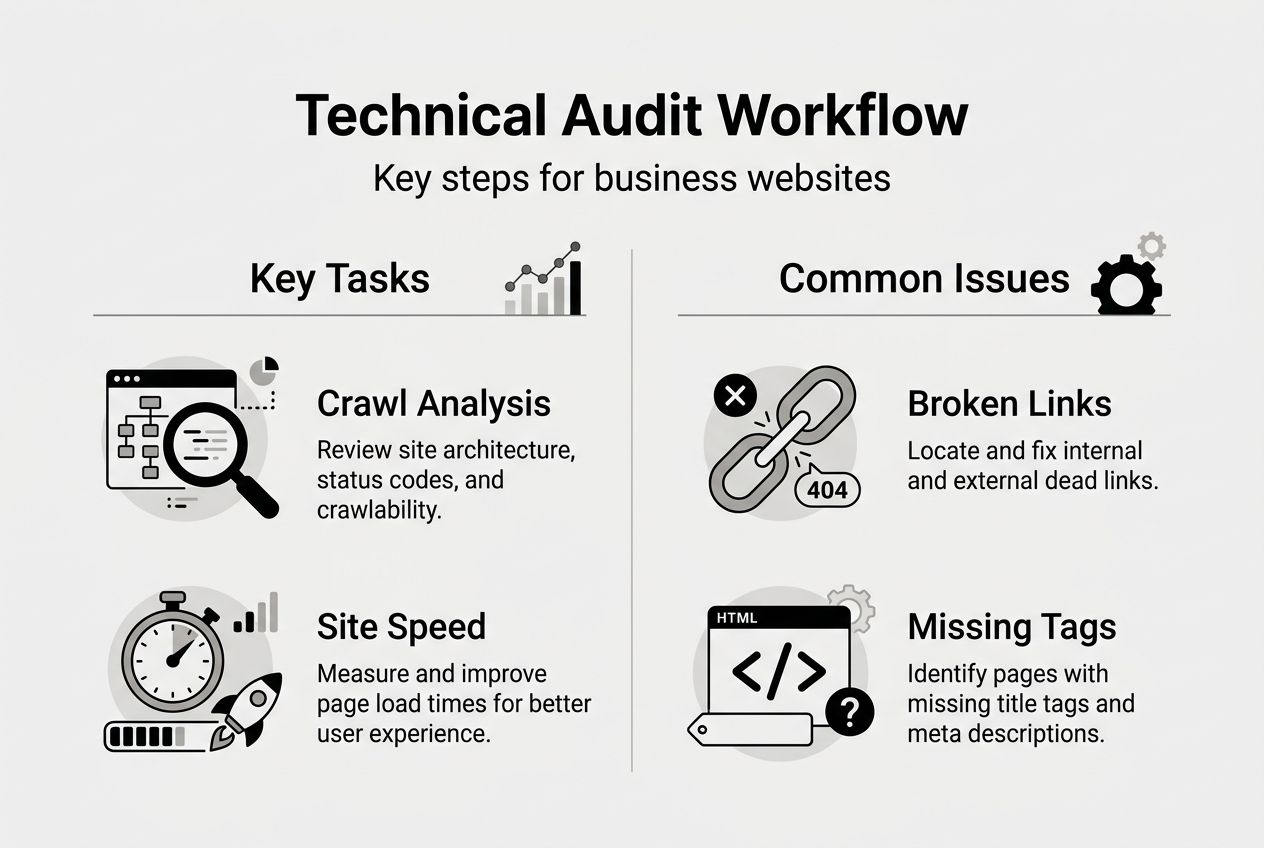
Common technical audit findings and their impact on SEO
Technical audits consistently uncover issues that silently sabotage search performance. These problems waste crawl budget, prevent proper indexing, and stall rankings despite ongoing content efforts. Understanding common findings helps you recognise symptoms and address root causes before they compound.

Common symptoms include unexpected Search Console behaviour, low click-through rates, inefficient crawling, and stagnant rankings despite content updates. These warning signs often indicate deeper technical problems requiring immediate attention.
Typical technical issues discovered during audits include:
-
XML sitemap errors preventing page discovery
-
Duplicate content across multiple URLs
-
Slow server response times exceeding 600ms
-
Missing or incorrect canonical tags
-
Broken internal links creating dead ends
-
Poor mobile usability and viewport configuration
-
Inefficient JavaScript rendering blocking content
-
Missing structured data for rich results
-
Redirect chains wasting crawl budget
-
Orphaned pages lacking internal links
The following table illustrates how technical problems manifest and their business consequences:
| Symptom | Technical Cause | Business Impact | | — | — | | Pages show impressions but zero clicks | Missing meta descriptions or title tag issues | Lost traffic opportunities and poor CTR | | ‘Discovered – not indexed’ status | Crawl budget waste or low-quality signals | Content investment yields no visibility | | Sudden traffic drops | Accidental noindex tags or robots.txt blocks | Revenue loss and ranking disappearance | | High bounce rates on mobile | Slow loading or poor mobile responsiveness | Reduced conversions and user satisfaction | | Garbage URLs in Search Console | Parameter handling errors or infinite crawl spaces | Wasted crawl budget on worthless pages |
Pro Tip: Review your Google Search Console coverage report monthly to spot indexing issues early. Look for increases in excluded pages or new error types, which often signal emerging technical problems before they impact rankings.
Many businesses focus exclusively on content and backlinks whilst technical foundations crumble beneath them. A retail client discovered their site had 847 duplicate product pages due to URL parameter mishandling. Search engines wasted crawl budget on duplicates instead of indexing new inventory. After implementing proper canonicalisation and parameter handling, their indexed product pages increased 156% within three weeks.
The SEO best practices checklist emphasises that technical health forms the foundation for all other optimisation efforts. Without addressing these fundamental issues, content marketing and link building deliver diminished returns.
How to prioritise and fix technical SEO issues effectively
Not every technical issue carries equal weight. Smart businesses focus resources on high-impact fixes that deliver measurable SEO improvements quickly, then address lower-priority items systematically. Prioritising fixes based on their SEO impact is crucial for efficient optimisation, especially when resources are limited.
The following comparison helps distinguish critical issues from minor optimisations:
| Priority Level | Issue Examples | Expected Impact | Timeframe | | — | — | — | | Critical | Noindex tags on key pages, broken XML sitemaps, site-wide redirect errors | Traffic recovery of 50-100%+ | 1-2 weeks | | High | Slow Core Web Vitals, mobile usability problems, duplicate content | Ranking improvements of 10-30 positions | 2-4 weeks | | Medium | Missing structured data, inefficient crawl paths, minor redirect chains | Enhanced visibility and rich results | 4-8 weeks | | Low | Image optimisation, minor HTML validation errors, cosmetic issues | Incremental improvements | Ongoing |
Follow this systematic workflow to transform audit findings into SEO gains:
-
Export your technical audit report and categorise issues by severity and business impact
-
Address critical errors immediately, particularly those blocking indexing or causing site-wide problems
-
Fix high-priority issues affecting Core Web Vitals, mobile experience, and crawl efficiency
-
Implement medium-priority improvements during regular maintenance windows
-
Schedule low-priority optimisations as ongoing enhancement tasks
-
Monitor Search Console and analytics to verify improvements and catch new issues
-
Document fixes and create processes to prevent recurring problems
Pro Tip: Concentrate initial efforts on mobile usability, crawl efficiency, and site speed. These three areas typically deliver the greatest return on investment for small businesses, often improving rankings within weeks whilst enhancing user experience simultaneously.
A manufacturing company’s audit revealed 23 technical issues ranging from critical sitemap errors to minor image optimisation opportunities. Rather than tackling everything simultaneously, they fixed the five critical issues first. Within three weeks, organic traffic increased 45%. They then systematically addressed high and medium-priority items over the following quarter, ultimately achieving 118% traffic growth.
The key is avoiding paralysis. Many businesses see a long audit report and feel overwhelmed, delaying action indefinitely. Instead, focus on the vital few issues causing the most damage. SEO audits for SMEs should provide clear prioritisation guidance, helping you invest time and resources where they’ll generate the greatest business impact.
Remember that technical SEO is iterative, not a one-time project. As your website evolves, new issues emerge. Regular monitoring and prompt fixes prevent small problems from becoming major obstacles.
The business benefits of regular technical audits for SMEs
Regular technical audits deliver measurable advantages that extend far beyond search rankings. They catch emerging problems before they damage visibility, improve marketing efficiency, and create competitive advantages through superior website performance. For resource-conscious small businesses, this proactive approach maximises return on every marketing pound spent.
Small businesses can see traffic gains of up to 116% by addressing technical SEO fixes. These improvements compound over time, as better indexing and crawl efficiency help new content rank faster and existing pages climb search results.
Key business benefits of maintaining regular technical audit schedules include:
-
Greater organic visibility as search engines index more pages accurately and completely
-
Faster indexing of new content, reducing time-to-traffic for blog posts and product pages
-
Improved user experience through faster loading, better mobile performance, and smoother navigation
-
Reduced wasted marketing spend by ensuring paid traffic lands on technically sound, fast-loading pages
-
Competitive advantage from superior site performance whilst competitors struggle with technical debt
-
Enhanced conversion rates as technical improvements reduce friction in the customer journey
-
Better data quality for business decisions when tracking and analytics function properly
-
Increased credibility and trust signals through HTTPS, structured data, and professional technical implementation
Consider this perspective on technical audit value:
Technical audits are preventive maintenance for your digital storefront. Just as you wouldn’t ignore a leaking roof or faulty wiring in a physical shop, you can’t afford to neglect the technical foundation of your online presence. The cost of regular audits pales compared to lost revenue from invisible pages and poor rankings.
A professional services firm conducting quarterly technical audits discovered a gradual decline in mobile usability scores over six months. Proactive fixes prevented a potential mobile ranking penalty that would have cost them an estimated £8,000 monthly in lost leads. The audit investment of £1,200 annually delivered a 67:1 return by avoiding this single issue, not counting other improvements.
Regular website audit business performance reviews also provide valuable benchmarking data. You can track technical health scores over time, measure improvement velocity, and correlate technical fixes with traffic and conversion changes. This data-driven approach helps justify ongoing investment and demonstrates marketing effectiveness to stakeholders.
For small businesses competing against larger enterprises with bigger budgets, technical excellence levels the playing field. Whilst you might not outspend competitors on content or advertising, you can absolutely outperform them technically. Superior crawlability, faster loading, and better mobile experience help smaller sites punch above their weight in search results.
The cumulative effect of consistent technical maintenance creates a virtuous cycle. Better technical health leads to improved rankings, which drives more traffic, generating more engagement signals, which further boosts rankings. Meanwhile, competitors stuck in technical debt struggle to gain traction despite increased content investment.
Improve your website with expert technical audits and development
You now understand how technical barriers silently undermine your marketing efforts and why regular audits are essential for sustainable growth. Taking action on this knowledge separates businesses that thrive online from those that struggle despite significant investment.

Professional SEO audits for SMEs reveal hidden issues faster and more comprehensively than DIY approaches. Expert teams combine technical analysis with strategic prioritisation, focusing on fixes that deliver maximum business impact. They identify problems you didn’t know existed and implement solutions that create lasting competitive advantages.
Our specialists don’t just find problems; we fix them. We combine technical audits with website design and development services that enhance both search visibility and user experience. Whether you need a complete technical overhaul or targeted improvements, we’ll create a roadmap aligned with your business goals and budget.
Staying current with latest web development trends ensures your website maintains technical excellence as standards evolve. Our limited client intake means you receive dedicated attention and customised solutions, not generic templates. Ready to uncover what’s holding your website back? Let’s boost your online presence and drive measurable business growth.
FAQ
What is the difference between a technical audit and a content audit?
A technical audit examines your website’s infrastructure, assessing how well search engines can crawl, index, and rank your pages. It focuses on elements like site speed, mobile usability, XML sitemaps, and crawlability. A content audit evaluates the quality, relevance, and performance of your actual text, images, and multimedia, identifying gaps, outdated material, and engagement opportunities. Both are essential but address different aspects of SEO performance.
How often should small businesses perform a technical audit?
Small businesses should conduct comprehensive technical audits at least twice yearly, with lighter reviews quarterly. Perform additional audits after major website changes, platform migrations, significant traffic drops, or algorithm updates. Regular monitoring through Google Search Console between formal audits helps catch emerging issues promptly. This frequency balances thoroughness with resource constraints whilst preventing technical debt accumulation.
Can I perform a technical audit myself or should I hire professionals?
DIY tools like Google Search Console, Screaming Frog, and PageSpeed Insights provide valuable data, but interpreting results and prioritising fixes requires expertise. Self-audits often miss critical issues or waste time on low-impact items. Professional SEO audits ensure comprehensive analysis, expert prioritisation, and implementation guidance that maximises ROI. Consider your technical knowledge, available time, and business stakes when deciding. For most SMEs, professional audits deliver better outcomes and faster results.
What are the key technical issues that impact mobile SEO?
Mobile SEO suffers primarily from slow loading times, poor responsive design, and blocked resources preventing proper rendering. Issues include oversized images, render-blocking JavaScript, inadequate viewport configuration, intrusive interstitials, and touch elements placed too closely together. Since Google uses mobile-first indexing, these problems directly affect all rankings, not just mobile results. Prioritising mobile optimisation through Core Web Vitals improvements, responsive design, and efficient resource loading delivers substantial ranking and engagement benefits.
Recommended


Book A Discovery Call
Stay Connected