What is structured data? A guide for businesses in 2026

Structured data can boost click-through rates by 30%, yet many small businesses dismiss it as too technical or only for large enterprises. This misconception costs you valuable visibility in search results. Understanding structured data transforms how search engines interpret your website, enabling rich snippets that attract more clicks and customers. This guide explains what structured data is, why it matters for your business in 2026, and practical steps to implement it successfully without needing advanced technical skills.
Table of Contents
- Understanding Structured Data And Why It Matters
- Popular Formats And Schema Types For Businesses
- Common Errors And How To Avoid Them When Using Structured Data
- Measuring Success And Ongoing Optimisation Of Your Structured Data
- Discover Expert Web Development And SEO Services
- Frequently Asked Questions
Key takeaways
| Point | Details |
|---|---|
| Rich snippets boost clicks | Structured data enables rich snippets that increase CTR by 10-30% in organic search results. |
| JSON-LD is simplest | Google recommends JSON-LD as the easiest format to implement and debug for businesses. |
| Errors harm visibility | Incorrect markup can trigger penalties or cause search engines to ignore your data completely. |
| Regular monitoring essential | Validation and updates maintain benefits as your business and search algorithms evolve. |
| Choose relevant schemas | Selecting schema types matching your business goals improves effectiveness and search visibility. |
Understanding structured data and why it matters
Structured data is machine-readable code embedded on your webpages that helps search engines understand your content precisely. Think of it as providing search engines with a detailed instruction manual rather than making them guess what your page contains. This code uses standardised formats to label information like business hours, product prices, article authors, or event dates.
Search engines use this markup to generate rich snippets, those enhanced search results displaying star ratings, images, prices, or FAQs directly in search listings. These eye-catching results stand out from standard blue links, dramatically improving your visibility. Websites with rich snippets experience CTR increases of 10% to 30%, translating directly into more organic traffic without additional advertising spend.
Structured data becomes even more critical in 2026 as AI-powered search engines like Google’s Search Generative Experience rely heavily on structured information. Feeding machine-readable facts reduces AI hallucination and ensures your business appears accurately in AI-generated summaries. This technology isn’t exclusive to tech giants or e-commerce platforms.
Many small business owners believe implementing structured data requires coding expertise or expensive developers. This misconception prevents them from accessing a straightforward SEO advantage. Modern content management systems and plugins make adding schema markup to boost website visibility accessible to non-technical users. Google’s structured data search gallery showcases the variety of rich results available, demonstrating opportunities across industries from local restaurants to professional services.
Pro Tip: Start by viewing your competitors’ search results. If they display rich snippets and you don’t, you’re losing potential customers to better-presented information.
Popular formats and schema types for businesses
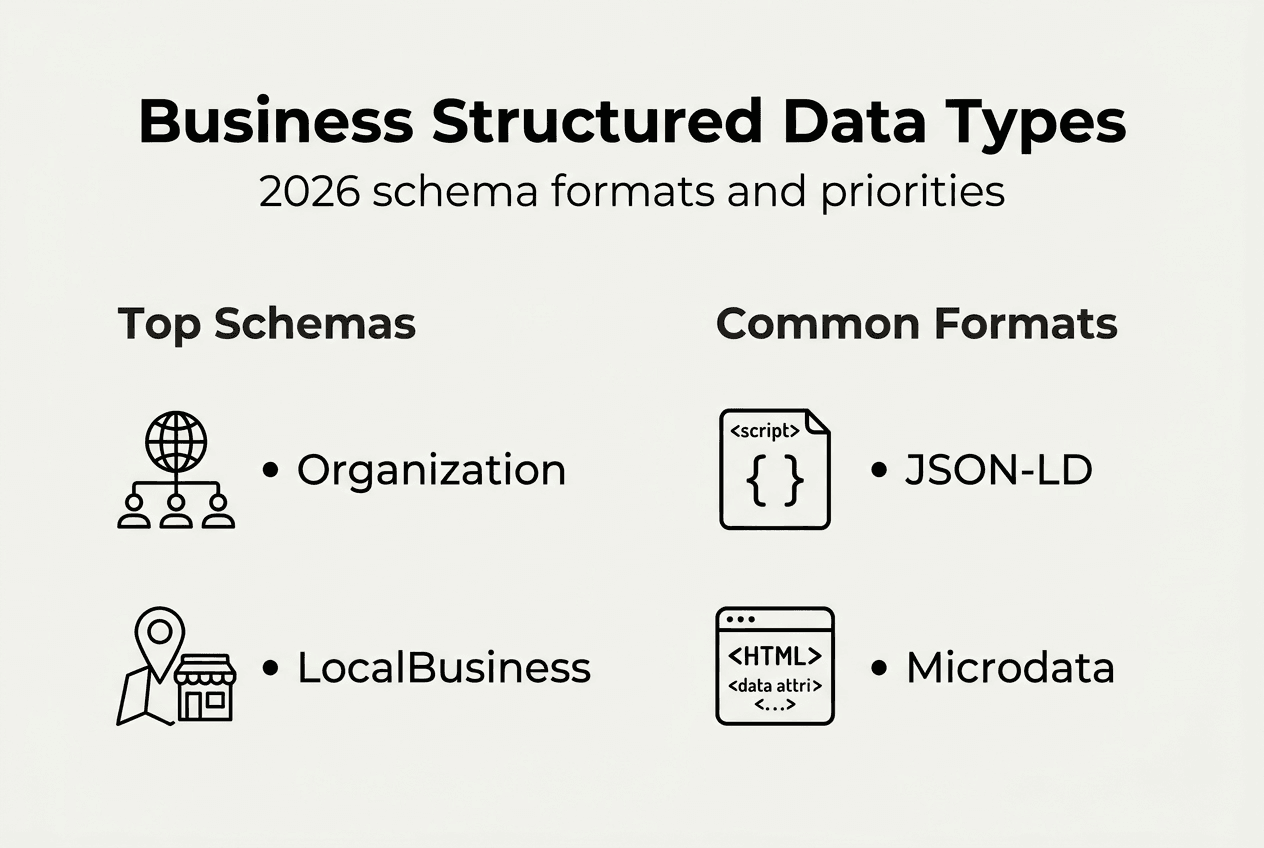
Three main formats exist for implementing structured data: JSON-LD, Microdata, and RDFa. Each has distinct characteristics affecting ease of implementation and maintenance.

| Format | Advantages | Disadvantages |
|---|---|---|
| JSON-LD | Separate from HTML, easy to add/edit, Google’s recommended format | Requires understanding of JSON syntax |
| Microdata | Integrated directly into HTML tags, visible structure | Clutters HTML code, harder to maintain |
| RDFa | Flexible attribute-based approach | Most complex syntax, steeper learning curve |
Google recommends JSON-LD because it separates structured data from your page’s HTML, making it simpler to implement and debug without disrupting your website’s design. You can add JSON-LD in a single script tag, typically in your page header or footer, without touching existing content.
Selecting appropriate schema types depends on your business model and content. These schema types deliver the strongest results for typical small to medium businesses:
- Organization: Establishes your brand identity with logo, contact details, and social profiles
- LocalBusiness: Critical for local search visibility, including address, hours, and service areas
- Product: Showcases prices, availability, reviews, and specifications for e-commerce
- Article: Enhances blog posts and news content with author, publish date, and featured images
- FAQPage: Displays question-and-answer pairs directly in search results
- HowTo: Presents step-by-step instructions with images and estimated time
- BreadcrumbList: Shows navigation paths, improving user experience and site structure understanding
Prioritising schema implementation matters when resources are limited. Begin with your homepage using Organization or LocalBusiness schema, then add Product schema to your best-selling items or Article schema to high-traffic blog posts. This focused approach delivers measurable results faster than attempting to mark up every page simultaneously.
Pro Tip: Map schema types to your business goals. If you want more phone calls, prioritise LocalBusiness schema with your contact number. If you need product sales, focus on Product schema with pricing and reviews.
Common errors and how to avoid them when using structured data
Seven common mistakes cause 89% of structured data errors, yet most are straightforward to fix once identified. Understanding these pitfalls saves you from losing rich snippet eligibility and potential penalties.
-
Missing required properties: Each schema type demands specific properties. Missing required properties always prevents rich results from appearing. Product schema requires name, image, and price. Article schema needs headline, image, and datePublished.
-
Invalid date formats: Search engines expect ISO 8601 format (YYYY-MM-DD). Writing “January 15, 2026” instead of “2026-01-15” causes validation failures.
-
Hidden content markup: Marking up content invisible to users triggers penalties and removes rich snippet eligibility. Only mark up content actually displayed on your page.
-
Incorrect nesting: Placing schema types inside each other improperly confuses search engines. A Product shouldn’t contain an Article schema.
-
Mismatched content: Your structured data must accurately reflect visible page content. Claiming a 5-star rating when you have 3 stars violates guidelines.
-
Multiple conflicting schemas: Adding duplicate or contradictory structured data for the same content element creates confusion and errors.
-
Outdated schema versions: Schema.org regularly updates. Using deprecated properties or outdated syntax reduces effectiveness.
Validating your structured data before publishing prevents these errors from harming your organic search performance. Google’s Rich Results Test provides immediate feedback, highlighting errors with specific fix recommendations. Copy your page URL or paste your code directly into the tool.
Google Search Console’s Enhancements report tracks structured data across your entire website, alerting you to new errors as they appear. This monitoring catches issues introduced during site updates or content changes. Check this report weekly when first implementing structured data, then monthly once stable.
Fixing structured data errors often produces visible improvements within days, not months. Search engines recrawl popular pages frequently, quickly recognising corrected markup.
Pro Tip: Create a structured data testing checklist covering required properties, date formats, and content matching. Run every new page through this checklist before publishing to catch errors early.
Measuring success and ongoing optimisation of your structured data
Tracking structured data impact proves its value and guides optimisation efforts. Monitor these key performance indicators before and after implementation:
- Rich snippet appearance: Check how many of your pages display enhanced results in search
- Click-through rate changes: Compare CTR for pages with and without structured data
- Organic traffic growth: Measure visits from search engines to marked-up pages
- Conversion improvements: Track whether enhanced visibility drives more leads or sales
- AI overview inclusion: Monitor appearances in AI-generated search summaries
Google Search Console provides detailed CTR data by query and page. Filter for pages with structured data to isolate their performance. Typical results show measurable improvements within 2-4 weeks of correct implementation.
| Metric | Before Structured Data | After Structured Data | Improvement |
|---|---|---|---|
| Average CTR | 2.1% | 2.9% | +38% |
| Organic Traffic | 1,200 visits/month | 1,650 visits/month | +37.5% |
| Rich Results | 0 pages | 47 pages | New feature |
Entity linking within structured data represents an advanced optimisation that increases AI overview visibility by nearly 20%. This technique connects your content to established knowledge graph entities, helping AI systems understand relationships between concepts, people, and organisations. Implementing entity linking requires identifying relevant entities in your content and using sameAs properties to link them to authoritative sources like Wikipedia or Wikidata.
Regular validation and monitoring remain essential because structured data requires ongoing maintenance, not one-time setup. Search engine guidelines evolve, new schema types emerge, and your business offerings change. Outdated or incorrect markup gradually loses effectiveness.
Schedule quarterly structured data audits examining:
- Validation status across all marked-up pages
- New schema opportunities matching business growth
- Competitor implementations revealing gaps in your strategy
- Performance metrics identifying top-performing schemas
Pro Tip: Set calendar reminders for quarterly website maintenance reviews specifically checking structured data. Treat it like updating your business hours or contact information.
Discover expert web development and SEO services
Implementing structured data correctly requires attention to detail and ongoing optimisation. Kickass Online specialises in helping small and medium businesses maximise their online visibility through expert technical SEO.

Our comprehensive SEO audits for SMEs identify structured data opportunities and fix existing errors preventing rich snippets. We analyse your competitors’ implementations and develop customised schema strategies matching your business goals. Professional website maintenance services keep your structured data accurate as your offerings evolve, ensuring continued search visibility. Stay ahead of the competition by exploring web development trends that integrate seamlessly with your structured data strategy.
Frequently asked questions
What formats of structured data should I use for my website?
JSON-LD is the best format for most businesses because Google recommends it and it’s easier to implement without disrupting your HTML. Microdata works if you prefer embedding markup directly in your content tags, but it makes maintenance harder. Avoid RDFa unless you have specific technical requirements, as it has the steepest learning curve.
How quickly will I see results after implementing structured data?
Search engines typically recrawl popular pages within days, so you might see rich snippets appearing within one to two weeks. Full impact on click-through rates and organic traffic becomes measurable after four to six weeks. High-traffic pages show results faster than rarely visited pages.
Can I implement structured data myself, or should I hire experts?
Many business owners successfully implement basic structured data using WordPress plugins or website builder tools. Start with simple schemas like Organization or FAQPage on key pages. Hire experts when you need complex implementations, have technical errors you can’t resolve, or want comprehensive schema markup strategies across large websites.
What happens if I make a mistake with structured data markup?
Minor errors usually result in search engines ignoring the incorrect markup without penalties, but you lose the rich snippet benefits. Serious violations like marking up hidden content or misleading information can trigger manual actions removing rich snippet eligibility. Google Search Console alerts you to errors, giving you opportunities to fix problems before they cause significant harm.
How often should I update my structured data?
Update structured data whenever you change the information it describes, such as business hours, product prices, or contact details. Conduct comprehensive reviews quarterly to add new schema types, fix errors, and optimise based on performance data. Treat structured data as living documentation of your business, not a static element.
Recommended


Book A Discovery Call
Stay Connected