What is SEO in digital marketing? A guide for SMEs

TL;DR:
- SEO is essential for improving website visibility in unpaid search results.
- Consistent SEO efforts build long-term, sustainable online growth for small businesses.
- Strategies include optimizing on-page content, building quality backlinks, fixing technical issues, and local SEO.
Having a website does not mean customers will find you. Thousands of businesses launch websites every month, publish a few pages, and then wait. The traffic never comes. The reason is simple: without Search Engine Optimisation, your website is essentially invisible to the people actively searching for what you offer. SEO is the mechanism that connects your business to those searches, and for small and medium-sized enterprises competing in crowded markets, it is not optional. This article breaks down what SEO actually means, how it works in practice, and what steps you can take right now to start building real online visibility.
Table of Contents
- The basics: What SEO means in digital marketing
- How SEO actually works: Key strategies and building blocks
- SEO compared to PPC and other digital channels
- Practical steps: How small businesses can apply SEO today
- Our take: Why SEO is a long game most businesses undervalue
- How we can help your SEO journey
- Frequently asked questions
Key Takeaways
| Point | Details |
|---|---|
| SEO is foundational | Without SEO, your website is likely invisible even if you have a great product or service. |
| It’s a long-term strategy | Results from SEO build up over time, creating lasting value for your business. |
| Simple actions matter | Even basic steps like optimising your Google Business Profile can significantly boost local visibility. |
| SEO and PPC play different roles | SEO compounds traffic and trust over the long term, while PPC provides quick but short-lived bursts. |
The basics: What SEO means in digital marketing
Most business owners have heard the term SEO, but many still confuse it with simply “being on Google.” Having a website indexed by Google is the bare minimum. SEO is the active, ongoing work that determines where you appear in search results and for which searches you show up. As Search Engine Journal explains, SEO improves website visibility in organic search results, meaning the unpaid listings that appear below the ads.
Organic results are fundamentally different from paid advertisements. When someone clicks on an organic result, they are choosing your website based on relevance and trust, not because you paid for that placement. That distinction matters enormously for SMEs because it means SEO builds credibility over time, whereas paid ads stop the moment your budget runs out.
SEO is not a single activity. It is a collection of disciplines that work together:
- On-page SEO: The content, headings, meta titles, and descriptions on each page of your site. This is about making sure your pages clearly communicate their topic to both users and search engines.
- Off-page SEO: Links from other websites pointing to yours, mentions of your brand, and your reputation across the web. These signals tell search engines that other sources trust you.
- Technical SEO: The behind-the-scenes elements including site speed, mobile-friendliness, structured data, and crawlability. A technically sound site is easier for search engines to read and rank.
- Local SEO: Optimising your presence for location-based searches, including your Google Business Profile, which is critical for any business serving a specific area.
“Search engines reward websites that demonstrate expertise, authority, and trustworthiness. For SMEs, building these qualities through consistent SEO effort is the most sustainable path to online growth.”
The benefits of SEO extend well beyond search rankings. A well-optimised website performs better across every digital channel. Your email campaigns drive more conversions when they land on well-structured pages. Your social media posts generate more engagement when they link to content that actually answers questions. Even paid advertising performs better when your landing pages are SEO-optimised. This is why search engine visibility is considered the foundation of the entire digital marketing ecosystem, not just one tactic among many.
Many SMEs make the mistake of believing that simply registering a domain and publishing a few pages is enough. In reality, Google’s algorithm considers hundreds of ranking factors, and without deliberate SEO work, your site will likely sit on page three or beyond, where virtually no one looks.

How SEO actually works: Key strategies and building blocks
Understanding what SEO is gives you the framework. Understanding how it works gives you the power to act on it. The three pillars of SEO each require a different approach, and neglecting any one of them creates gaps that limit your results.
Here is a practical breakdown of how to approach each pillar:
- Audit your on-page content. Review every key page on your site. Does each page have a clear, descriptive title tag? Does the content answer the questions your target customers are actually asking? Use free tools like Google Search Console to identify which search queries are already bringing visitors to your site, then optimise those pages further.
- Build quality off-page signals. Reach out to local business directories, industry associations, and relevant blogs to earn mentions and links. A single link from a respected local news site carries far more weight than dozens of low-quality directory listings.
- Fix technical foundations. Run your site through Google’s PageSpeed Insights tool. If your pages take more than three seconds to load on mobile, you are losing visitors before they even read a word. Address image compression, server response times, and mobile layout issues first.
- Claim and optimise your Google Business Profile. For any SME serving local customers, this is non-negotiable. A fully completed profile with photos, accurate hours, and regular posts can dramatically improve your visibility in local search results.
- Create a content calendar. Consistent, relevant content signals to search engines that your site is active and authoritative. Even one well-researched blog post or FAQ page per month adds up significantly over time.
The SEO optimisation guide we have published goes deeper into each of these areas, but the key principle is that SEO is iterative. As research confirms, patterns matter more than chasing single big changes. You will not see overnight results, but you will see compounding progress if you stay consistent.
One area that catches many new businesses off-guard is the concept of YMYL content, which stands for “Your Money or Your Life.” This refers to pages covering health, finance, legal matters, or anything that could significantly affect someone’s wellbeing. Google holds these pages to a higher standard of authority, meaning businesses in these sectors need to work harder to demonstrate expertise and earn credible links.
Pro Tip: Keep a simple spreadsheet tracking every SEO change you make, including the date and the page affected. Review it monthly alongside your Google Search Console data. Over time, you will start to see which actions produce real ranking improvements for your specific site and audience.
Understanding the role of SEO in growth means accepting that it is a process, not a project. Businesses that treat SEO as a one-off task consistently underperform compared to those that build it into their regular operations.
SEO compared to PPC and other digital channels
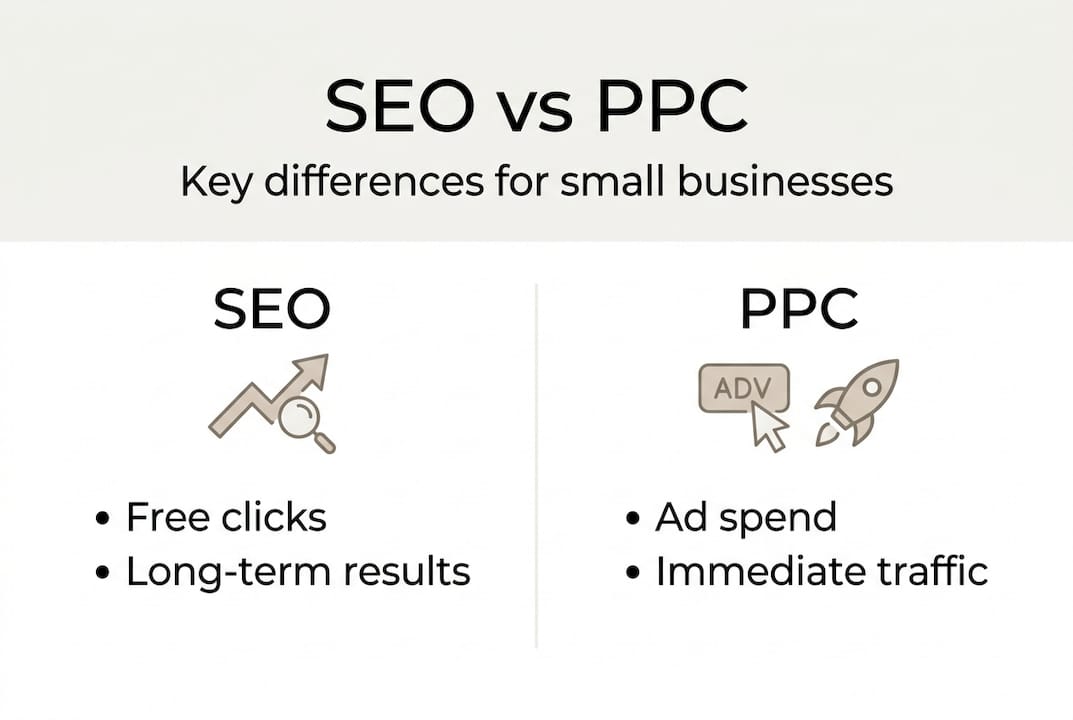
With a clearer picture of how SEO works, it is worth placing it alongside the other digital marketing options available to SMEs. The most common comparison is between SEO and Pay-Per-Click advertising, known as PPC. Both aim to bring traffic from search engines, but they operate very differently.
| Feature | SEO | PPC | Social media |
|---|---|---|---|
| Cost model | Time and effort | Direct ad spend | Time or boosted posts |
| Speed of results | Months | Immediate | Fast but short-lived |
| Long-term ROI | High (compounds) | Low (stops with budget) | Moderate |
| Trust factor | High (organic) | Lower (labelled as ads) | Varies |
| Targeting | Intent-based | Intent and demographic | Interest and demographic |
| Ongoing cost | Decreasing over time | Constant | Constant |
As the research clearly shows, SEO delivers compounding results over time, while PPC delivers immediate but paid traffic that stops the moment your campaign ends. This distinction is critical for SMEs working with limited budgets.
When should you prioritise SEO? Consider these situations:
- You are building a business for the long term and want sustainable traffic without ongoing ad spend.
- Your customers research before buying, meaning they use search engines to compare options before making a decision.
- You want to build trust and authority in your industry or local area.
- Your margins are tight and you need a lower cost per lead over time.
When does PPC or social media advertising make more sense? If you are launching a new product with a short promotional window, running a seasonal campaign, or entering a market where you have no organic presence yet, paid channels can deliver immediate visibility. The two approaches are not mutually exclusive.
Pro Tip: If budget allows, running a small PPC campaign while your SEO builds momentum is a smart move. The PPC data reveals which keywords actually convert for your business, giving you precise targets for your SEO content strategy. Explore SEO and PPC synergy to understand how these channels reinforce each other.
The real cost of SEO is time and consistency. The real cost of PPC is money, every single day. For most SMEs, the question of when to use SEO or PPC comes down to their growth stage and available resources. Early-stage businesses often benefit from a combination, while established businesses with some organic traction should double down on SEO to reduce their dependence on paid traffic.
Practical steps: How small businesses can apply SEO today
Knowing the theory is useful. Having a clear action plan is what actually moves the needle. The good news is that you do not need a large budget or a dedicated marketing team to start making meaningful SEO progress. What you do need is consistency and a willingness to learn as you go.
Here is a straightforward sequence for SMEs starting or improving their SEO:
- Claim your Google Business Profile. If you have not already done this, it is your single highest-priority task. As research confirms, emerging brands benefit most from citations and optimised local profiles. Fill in every field, add photos, and start collecting genuine customer reviews.
- Conduct a basic site audit. Use Google Search Console (free) to check for crawl errors, missing page titles, and pages with no traffic. Fix the most critical issues first.
- Optimise your top five pages. Identify the pages most important to your business, typically your homepage, services pages, and contact page. Ensure each has a clear title tag, a descriptive meta description, and content that directly addresses what your customers are searching for.
- Build local citations. Submit your business details consistently to reputable directories such as Yell, Thomson Local, and industry-specific listings. Consistency in your name, address, and phone number across all listings is essential.
- Start a content schedule. Commit to publishing one piece of useful content per month. Answer a common customer question, explain a service in detail, or share a case study. Over time, this builds topical authority.
| SEO task | Effort required | Expected business impact |
|---|---|---|
| Claim Google Business Profile | Low (1 hour) | High: improved local visibility |
| Fix technical site errors | Medium (ongoing) | High: better crawling and ranking |
| Optimise page titles and meta descriptions | Low (half a day) | Medium: improved click-through rates |
| Build local citations | Medium (2-4 hours) | Medium: stronger local trust signals |
| Publish monthly content | Medium (ongoing) | High: long-term authority growth |
| Earn quality backlinks | High (ongoing) | Very high: significant ranking improvement |
Measuring your progress is just as important as the work itself. Google Search Console shows you which queries bring visitors to your site, how often your pages appear in search results, and whether there are technical issues to address. Review this data every two to four weeks and look for trends rather than daily fluctuations.
On the question of outsourcing versus handling SEO in-house, there is no universal answer. In-house SEO gives you full control and builds internal knowledge, but it requires time that many business owners simply do not have. Outsourcing to a specialist agency delivers faster results and access to expertise, but requires a clear brief and regular communication to ensure the work aligns with your business goals.
The importance of SEO for small businesses becomes most apparent when you compare businesses at the same stage of growth, one with a consistent SEO strategy and one without. Within twelve to eighteen months, the gap in organic traffic is usually stark. For a deeper look at combining these tactics, the digital marketing strategies for SMEs resource covers how SEO fits into a broader growth plan.
Our take: Why SEO is a long game most businesses undervalue
Here is something we see repeatedly when working with SMEs: businesses invest in a website, run a few paid ads, and then wonder why growth has stalled. The missing ingredient is almost always consistent SEO effort over time.
The uncomfortable truth is that SEO rarely delivers dramatic results in the first three months. This makes it easy to deprioritise when cash flow is tight or when a paid campaign delivers a quick spike in traffic. But that quick spike fades. The organic rankings you build through patient, consistent SEO work do not.
A well-optimised page that earns genuine backlinks and ranks for a valuable search term can continue delivering traffic for years without additional spend. That is a fundamentally different return on investment compared to any paid channel. We have seen businesses that committed to business growth through SEO over a two-year period completely transform their cost per acquisition, moving from expensive paid traffic to a steady stream of organic leads.
The businesses that win at SEO are not necessarily the ones with the biggest budgets. They are the ones that show up consistently, fix problems as they arise, and treat their website as a living asset rather than a one-time project.
How we can help your SEO journey
If this article has clarified what SEO can do for your business, the natural next question is where to start and whether you need expert support to get there.
At Kickass Online, we work with a deliberately small number of clients at any one time, which means every business we support gets genuine, focused attention. Whether you need a thorough SEO audit for your SME to identify exactly where you are losing ground, a clear SEO strategies guide to follow independently, or full SEO agency services to handle the heavy lifting for you, we have the expertise to move you forward. Book a consultation and let us show you what consistent, well-executed SEO can do for your business.
Frequently asked questions
What does SEO stand for in digital marketing?
SEO stands for Search Engine Optimisation, the practice of improving your website to appear more prominently in organic search engine results without paying for ad placements.
How long does SEO take to show results?
Most businesses begin to see meaningful SEO progress after three to six months, though the compounding nature of SEO means results continue to grow well beyond that initial period.
Can I do SEO myself or do I need an expert?
You can absolutely start with the basics yourself, such as claiming your Google Business Profile and optimising local citations, but technical SEO and competitive markets often benefit significantly from professional expertise.
Why is SEO better than paid ads for some businesses?
SEO builds sustainable, lower-cost traffic that continues delivering results over time, whereas paid ads stop immediately when your budget runs out, making SEO the stronger long-term investment for most SMEs.
Recommended
- Local SEO for SMEs: Guide to Boost Search Visibility and Drive Local Traffic | Kickass Online
- SEO and social media marketing: boost your business online | Kickass Online
- Effective Digital Marketing Strategies for SMEs: Boost Your Online Performance | Kickass Online
- Guide to SEO Strategies: Boost Online Visibility and Drive Organic Traffic | Kickass Online


Book A Discovery Call
Stay Connected