

Keyword Research: Boosting SME Visibility Online
Keyword research explained for SMEs. Learn core principles, types, key metrics, techniques, and common pitfalls to improve your SEO strategy.

Many british business owners in Milton Keynes are surprised to learn that over 90 percent of all online experiences begin with a search engine query. When your digital presence depends on reaching the right people at the right time, understanding keyword research becomes vital. Smart keyword choices bridge your brand with potential buyers, giving you the edge in a fiercely competitive market and transforming clicks into loyal customers.
Table of Contents
- Defining Keyword Research And Its Role
- Types Of Keywords For Targeted Audiences
- Key Metrics And How Search Intent Works
- Tools And Techniques For Effective Research
- Common Keyword Pitfalls And How To Avoid Them
Key Takeaways
| Point | Details |
|---|---|
| Importance of Keyword Research | Understanding user search terms enhances content relevance and improves online visibility for businesses. |
| Types of Keywords and User Intent | Classifying keywords into informational, navigational, commercial, and transactional aids in targeted marketing strategies. |
| Role of Metrics in Keyword Strategy | Analysing engagement metrics helps align content with user intent, refining digital marketing efforts. |
| Tools for Effective Keyword Research | Utilising advanced tools like Google Keyword Planner and SEMrush provides data-driven insights for keyword selection. |
Defining Keyword Research And Its Role
Keyword research represents a strategic process of identifying and analysing search terms that people enter into search engines, enabling businesses to understand precisely what their target audience seeks online. At its core, keyword research connects the language of potential customers with the content businesses create, bridging communication gaps and improving digital visibility.
In academic and professional contexts, keywords act as critical navigation tools. Precise keyword selection supports comprehensive content discoverability across digital platforms. They function as digital signposts, guiding search engines and readers towards relevant content by matching user queries with appropriate information. Small and medium enterprises can leverage this technique to significantly enhance their online presence, transforming seemingly obscure search terms into powerful marketing opportunities.
Effective keyword research involves understanding search intent, analysing search volume, and evaluating competition levels. Businesses must look beyond simple word matching and dive into the psychological motivations behind search queries. By comprehending why potential customers search for specific terms, organisations can craft content that directly addresses user needs, thereby increasing engagement and conversion potential.
Pro tip: Start your keyword research by brainstorming terms your ideal customers would genuinely use when seeking solutions your business provides, not just technical industry jargon.
Types Of Keywords For Targeted Audiences
Keyword classification enables small and medium enterprises to develop nuanced digital marketing strategies that precisely target different audience segments. Systematic keyword categorisation supports strategic audience engagement by understanding the distinct intentions behind various search queries.
Fundamentally, keywords can be divided into four primary types based on user intent: informational, navigational, commercial, and transactional. Informational keywords represent users seeking knowledge or answers, such as “how to improve business visibility” or “SEO best practices”. Navigational keywords indicate users looking for specific websites or brands, like “Kickass Online digital marketing”. Commercial keywords signal potential buyers researching products, exemplified by phrases like “best digital marketing services in Milton Keynes”. Transactional keywords demonstrate immediate purchase intent, including terms like “hire SEO consultant” or “website design package”.
Beyond intent-based classifications, keywords can also be categorised by length and specificity. Short-tail keywords are broad, generic terms with high search volumes but intense competition, while long-tail keywords are more specific, detailed phrases with lower search volumes but higher conversion potential. Geo-targeted keywords further refine audience reach by incorporating location-specific terms, allowing businesses to target local markets with precision.

Here is a comparison of keyword types and their typical business impact:
| Keyword Type | User Intent | Example Phrase | Business Impact |
|---|---|---|---|
| Informational | Seeking knowledge | How to boost online sales | Builds brand authority, attracts new users |
| Navigational | Finding a specific site | OpenAI homepage | Drives direct website traffic |
| Commercial | Research before purchase | Best marketing tools UK | Generates qualified leads |
| Transactional | Ready to purchase | Buy SEO package Milton Keynes | Increases sales and conversions |
Pro tip: Develop a balanced keyword strategy by combining different keyword types, ensuring you capture audience segments across various stages of their digital journey.
Key Metrics And How Search Intent Works
Understanding search intent represents a critical foundation for effective digital marketing strategies, enabling businesses to align their content with precise user expectations. Comprehensive search intent analysis reveals critical insights into user behaviour and engagement patterns, transforming keyword research from a mechanical process into a strategic communication approach.
Search intent fundamentally categorises user queries into four primary types: informational, navigational, commercial, and transactional. Each type signals a distinct stage in the user’s decision-making journey. Informational intent indicates users seeking knowledge, navigational intent suggests seeking a specific website, commercial intent reveals research before potential purchase, and transactional intent demonstrates immediate purchasing readiness. By mapping these intent categories against key performance metrics like click-through rates, bounce rates, and conversion rates, businesses can develop more targeted and effective content strategies.
Metrics play a crucial role in validating search intent effectiveness. Key indicators include engagement duration, page views, conversion rates, and user interaction patterns. These metrics provide nuanced insights into how well content matches user expectations, helping businesses refine their approach. For instance, a high bounce rate might indicate misalignment between search intent and delivered content, while strong conversion rates suggest precise intent matching. Sophisticated digital marketers combine quantitative metrics with qualitative understanding to create comprehensive, user-centric content strategies.
Pro tip: Regularly analyse your website analytics to track how different content pieces perform against specific search intent categories, allowing continuous refinement of your keyword and content approach.
Tools And Techniques For Effective Research
Advanced keyword research techniques enable small businesses to transform digital marketing strategies through systematic and strategic exploration of search behaviours. Modern digital tools have revolutionised how organisations approach keyword identification, moving beyond traditional guesswork to data-driven precision.
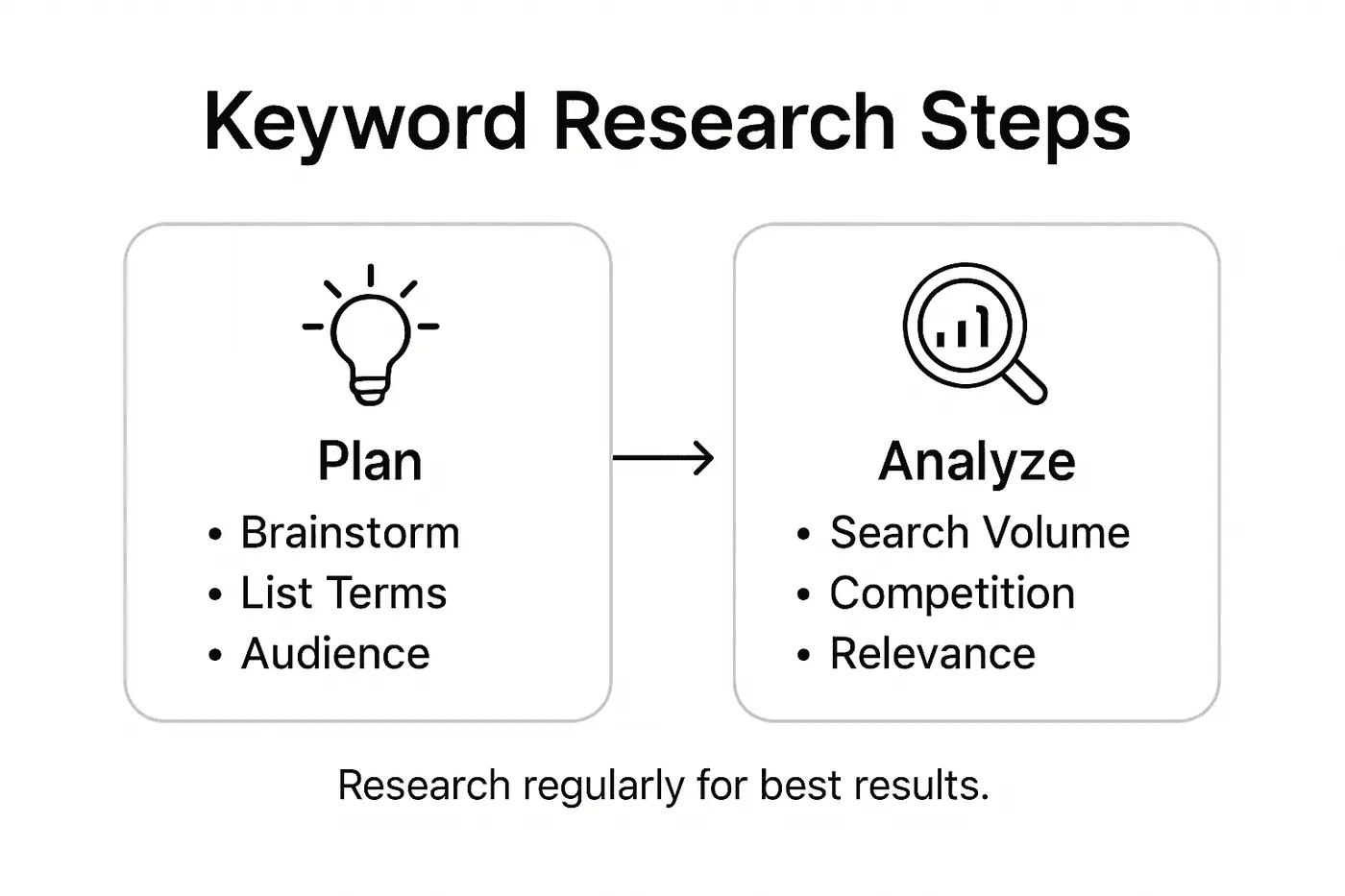
Several sophisticated tools stand out in the keyword research landscape. Google Keyword Planner provides foundational search volume and competition insights, while SEMrush offers comprehensive competitive analysis capabilities. Ahrefs delivers deep keyword difficulty assessments, helping businesses understand the potential challenge of ranking for specific terms. Google Trends enables understanding of seasonal keyword variations, allowing marketers to adapt strategies dynamically. These tools collectively transform keyword research from a speculative exercise into a structured, analytical process.
This table outlines key keyword research tools and their unique strengths:
| Tool Name | Main Functionality | Ideal Use Case |
|---|---|---|
| Google Keyword Planner | Estimates search volume/competition | Researching basic keyword opportunities |
| SEMrush | Competitive keyword analysis | Analysing rival strategies |
| Ahrefs | Keyword difficulty & backlink data | Assessing ranking challenge |
| Google Trends | Tracks keyword popularity over time | Identifying seasonal trends |
Effective keyword research involves multiple complementary techniques. Businesses should start by brainstorming seed keywords directly related to their products or services, then expand using tool-generated suggestions and related search queries. Competitor analysis provides crucial insights, revealing gaps and opportunities in existing keyword strategies. Semantic keyword exploration, identifying conceptually related terms, helps create more comprehensive content that addresses broader user intentions. Long-tail keyword identification allows targeting more specific, potentially less competitive search queries that often demonstrate higher conversion potential.
Pro tip: Create a systematic keyword research workflow that combines multiple tools and techniques, ensuring you capture a holistic view of potential search opportunities.
Common Keyword Pitfalls And How To Avoid Them
Understanding common keyword research mistakes helps businesses develop more sophisticated digital marketing strategies, preventing potential visibility and engagement challenges before they emerge. Keyword research is a nuanced process requiring strategic thinking and careful execution.
One of the most significant pitfalls is keyword stuffing, where businesses unnaturally overload content with repetitive search terms in an attempt to manipulate search rankings. This approach not only diminishes content quality but can also trigger search engine penalties that dramatically reduce online visibility. Another critical mistake involves selecting overly broad or generic keywords that fail to capture specific user intentions. Small businesses must prioritise precise, targeted keywords that reflect genuine user search behaviours and align closely with their unique service offerings.
Effective keyword strategy demands a balanced approach. Businesses should avoid extreme narrowness or excessive broadness, instead developing a strategic mix of short-tail and long-tail keywords that comprehensively represent their offerings. Semantic keyword research becomes crucial, exploring conceptually related terms that provide context and depth. Continuous monitoring and adaptation are essential, as search behaviours evolve rapidly. Regular keyword performance analysis allows businesses to refine their approach, identifying emerging trends and adjusting strategies to maintain optimal online visibility.
Pro tip: Conduct quarterly keyword audits to identify underperforming terms and emerging search trends, ensuring your digital content remains dynamically aligned with target audience behaviours.
Unlock Your SME’s Online Potential with Expert Keyword Strategies
The challenge of mastering keyword research to enhance your SME’s digital visibility is real. You want to move beyond guesswork and effectively connect with your target audience at every stage of their search journey. Whether it is honing in on transactional keywords to boost direct sales or balancing your approach with informational and commercial terms to build lasting engagement, getting this right drives measurable growth. At Kickass Online, we understand these pain points and the importance of a nuanced keyword strategy that makes your business stand out in a crowded marketplace.
Discover how tailored web development solutions combined with precise SEO tactics can amplify your search engine rankings and capture the right leads just when they are ready to act. Our team ensures your website not only attracts qualified traffic but also converts visitors into loyal customers through expertly optimised content and ongoing performance maintenance. Don’t let your SME get lost in digital noise. Visit Kickass Online today and explore our recommendations to start transforming your online presence. Take the next step now and book a consultation with professionals who prioritise your business growth.
Frequently Asked Questions
What is keyword research and why is it important for SMEs?
Keyword research is the process of identifying and analysing search terms that potential customers use in search engines. It is crucial for SMEs as it helps connect their content with what their target audience is searching for, improving online visibility and engagement.
How do I determine the search intent of my keywords?
To determine search intent, categorise keywords into types: informational (seeking knowledge), navigational (looking for specific sites), commercial (researching products), and transactional (ready to purchase). Understanding these intents helps tailor your content to meet user needs.
What are long-tail keywords, and why should they be a part of my strategy?
Long-tail keywords are more specific phrases that typically have lower search volumes but higher conversion potential. They should be included in your strategy as they often target users further along in the buying process, leading to more qualified leads and increased sales.
What tools can I use for effective keyword research?
Key tools for keyword research include Google Keyword Planner, SEMrush, Ahrefs, and Google Trends. Each of these tools provides valuable insights such as search volumes, keyword difficulty, and trends, helping to refine your keyword strategy effectively.
Recommended
- Revamp Your SME’s Online Presence with Effective SEO Strategies | Kickass Online
- Leveraging Social Media Advertising for SMEs: Unlock Untapped Growth | Kickass Online
- Boost Your SME’s Visibility with Expert SEO Strategies | Kickass Online
- Effective Local SEO Strategies for SMEs: Boost Visibility and Dominate Your Market | Kickass Online
Related reading
Build an ecommerce digital marketing strategy: grow sales
Learn how to build an ecommerce digital marketing strategy that drives real growth for UK SMEs, covering SEO, email, social, and how to measure results.
Read article: Build an ecommerce digital marketing strategy: grow salesThe ultimate website redesign checklist for SMBs
Protect your rankings and traffic with our complete website redesign checklist for SMBs. Covering audits, redirects, technical SEO, and post-launch monitoring.
Read article: The ultimate website redesign checklist for SMBsWebsite audit checklist: Boost your business visibility
Follow our step-by-step website audit checklist to fix hidden issues, recover lost traffic, and boost your business visibility online in 2026.
Read article: Website audit checklist: Boost your business visibility



Need help with any of this?
Send the brief and we reply the same day with a price and a date.