
- Small and medium-sized businesses can achieve significant online growth through targeted digital marketing without large budgets.
- Effective campaigns focus on measurable channels like local SEO and paid ads, emphasising revenue outcomes over vanity metrics.
- Integration, tracking, and experimentation are crucial for optimising ROI and building sustainable digital presence.
Many small and medium-sized business owners still believe that serious digital marketing is reserved for companies with enormous budgets and dedicated in-house teams. That assumption is costing them customers. The reality is that SMEs (small and medium-sized enterprises) are increasingly competing and winning online, not because they outspend larger rivals, but because they outthink them. Targeted digital marketing campaigns deliver measurable, trackable results at every budget level. This article walks you through a practical, evidence-based framework for building a campaign that generates real revenue growth, not just impressions.
Table of Contents
- Why digital marketing campaigns matter for SMEs
- Choosing the right digital marketing channels
- Building your campaign: Core elements for success
- Optimising for ROI: Measurement, testing, and AI
- High-ROI free tactics: Make the most of local SEO
- Our take: What most digital marketing guides miss for SMEs
- How Kickass Online helps drive digital marketing success
- Frequently asked questions
Key Takeaways
| Point | Details |
|---|---|
| Digital delivers results | Well-designed campaigns can drive double-digit growth even for modest SME budgets. |
| Channel mix is crucial | Blend organic SEO and paid advertising for the best balance of immediate wins and long-term growth. |
| Track what matters | Focus your measurement on revenue and conversions, not vanity metrics or likes. |
| Leverage free tactics | Local SEO tools like Google Business Profile can boost visibility without major spend. |
Why digital marketing campaigns matter for SMEs
The gap between what SMEs think digital marketing costs and what it actually delivers is striking. Many business owners assume they need a massive budget to see results. The data tells a very different story.
SMBs allocate 7-12% of gross revenue to marketing, with 60-80% of that going to digital channels. More importantly, 70% of SMEs using targeted campaigns saw double-digit growth. That is not a coincidence. It reflects the core advantage of digital marketing: every pound you spend can be tracked, tested, and optimised.
Unlike traditional advertising such as print or radio, digital campaigns let you see exactly which ad, keyword, or email drove a sale. You can pause what is not working and scale what is. For a business watching every pound, that level of control is invaluable.
Here is a quick snapshot of how digital marketing ROI compares across common channels:
| Channel | Average ROI | Time to results | Cost level |
|---|---|---|---|
| SEO (organic) | High (long-term) | 3-6 months | Low to medium |
| Pay-per-click (PPC) | Medium to high | Immediate | Medium to high |
| Email marketing | Very high | Days to weeks | Low |
| Social media ads | Medium | Days | Medium |
| Local SEO | Very high | 1-3 months | Low |
The success strategies for small business that consistently work share one trait: they prioritise channels where results can be measured directly against revenue.
Three mistakes SMEs commonly make when under-investing in digital:
- Spreading budget too thin across too many channels without mastering any single one
- Ignoring tracking setup, meaning there is no way to know which spend is working
- Chasing follower counts and social engagement instead of leads and conversions
Pro Tip: Start with one or two high-leverage channels where your customers already spend time, set up proper tracking from day one, and reinvest gains before expanding.
Choosing the right digital marketing channels
Knowing that digital marketing works is one thing. Knowing where to put your budget is another challenge entirely. The two broad categories you need to understand are organic and paid channels, and the smartest SMEs use both.
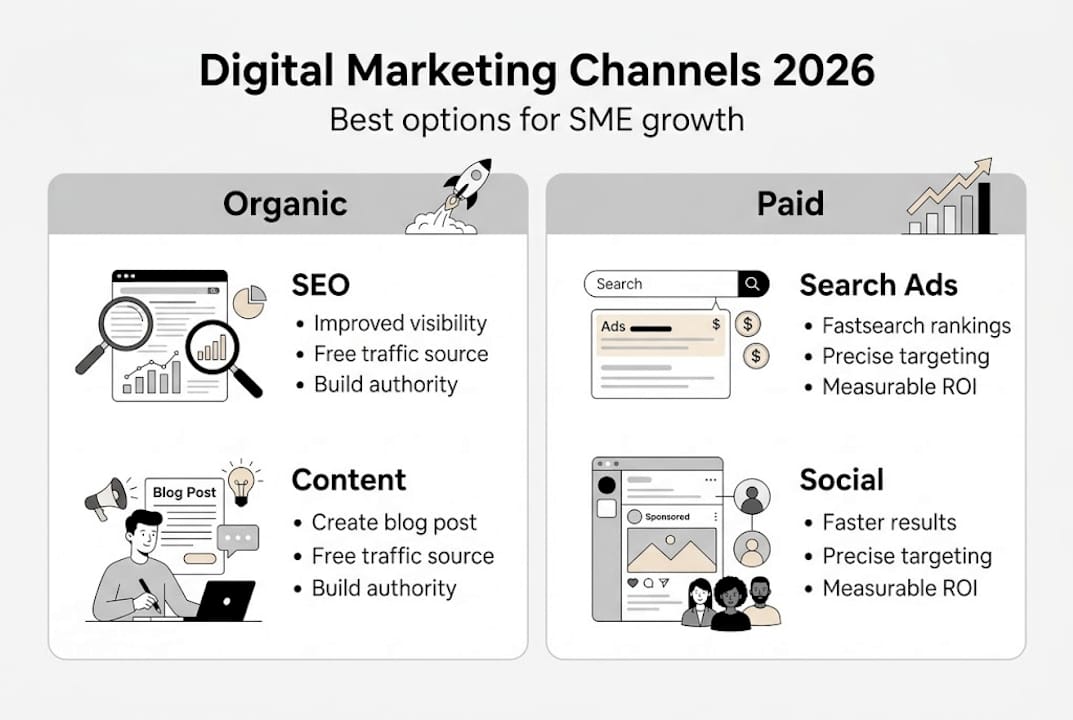
Organic channels include SEO (search engine optimisation) and content marketing. These build your visibility over time without paying for each click. They are slower to show results but deliver compounding returns. Paid channels include PPC (pay-per-click advertising) and social media ads. These generate immediate results for paid campaigns but stop the moment your budget runs out.
Here is how they compare directly:
| Factor | Organic (SEO/content) | Paid (PPC/social ads) |
|---|---|---|
| Speed of results | Slow (months) | Fast (days) |
| Cost per result | Decreases over time | Consistent spend required |
| Longevity | Builds permanently | Stops when budget stops |
| Best for | Long-term growth | Promotions, launches |
| Measurability | Good | Excellent |
“Measuring outcomes, not vanity metrics, is the only way to know whether your marketing investment is actually building your business.”, Digital marketing principle endorsed by leading SME advisors
The most effective approach is integration. Running local SEO channel tactics alongside a targeted PPC campaign, for example, means you capture both immediate buyers and those researching over time. Neither channel alone is as powerful as the two working together.
How to integrate your channels effectively:
- Audit where your customers currently find you (search, social, referrals)
- Identify which channels your competitors are winning on
- Allocate 60-70% of budget to your strongest proven channel
- Use the remaining budget to test one new channel at a time
- Review results monthly and reallocate based on performance data
For a deeper look at building your search presence, the SEO strategies guide covers the technical and content foundations you will need.
Pro Tip: Run A/B tests on your ad copy and landing pages before committing significant budget. Small changes in headline wording can shift conversion rates dramatically.
Building your campaign: Core elements for success
Strategy without execution is just theory. Once you know your channels, you need to build a campaign that actually converts browsers into buyers. This is where many SME campaigns fall apart: the foundations are skipped in favour of going live quickly.
Every effective campaign starts with a crystal-clear picture of your target audience. Who are they? What problem are they trying to solve? What language do they use when searching for your solution? Your value proposition, the reason a customer should choose you over a competitor, must answer those questions directly.
From there, your calls to action (CTAs) need to be specific and outcome-focused. “Learn more” is weak. “Get your free quote today” is far more effective because it tells the reader exactly what happens next.
A five-step campaign planning process that works for SMEs:
- Define your audience using customer data, surveys, and competitor research
- Set measurable objectives such as 50 new leads per month or a 20% increase in online sales
- Choose your channels based on where your audience spends time and your budget
- Build your assets: landing pages, ad creatives, email sequences, and tracking pixels
- Launch, measure, and iterate on a fixed review cycle (weekly for paid, monthly for organic)
Key campaign components you will need:
- Dedicated landing pages for each campaign (not your homepage)
- Email nurture sequences for leads who are not yet ready to buy
- Ad creatives tested in at least two variations
- Analytics dashboards showing real-time performance
- Conversion tracking tied to actual revenue, not just clicks
The framework for building campaigns that deliver consistent results always ties every tactic back to a specific business outcome. According to the latest marketing trends report, 65% of marketers meet or exceed their goals when using AI optimisation tools to test and refine campaign elements.
Pro Tip: Tie every single tactic, every ad, every email, every landing page, to a measurable business outcome before you build it. If you cannot explain how it drives revenue, cut it.
Optimising for ROI: Measurement, testing, and AI
Launching your campaign is the beginning, not the finish line. The businesses that consistently outperform their competitors are the ones that measure relentlessly and act on what the data tells them.
The biggest trap SME owners fall into is tracking vanity metrics. Likes, impressions, and follower counts feel good but rarely correlate with revenue. The metrics that actually matter are the ones tied to business outcomes.
Essential KPIs (key performance indicators) for SME campaigns:
- ROAS (return on ad spend): How much revenue each pound of ad spend generates
- Cost per lead: The total spend divided by the number of new enquiries
- Conversion rate: The percentage of visitors who take your desired action
- Revenue per channel: Which channels are directly attributable to closed sales
- Customer acquisition cost: The total cost to win one new paying customer
A/B testing is the engine of continuous improvement. Test one variable at a time, whether that is a headline, a CTA button colour, or an email subject line, and run each test long enough to gather statistically significant data. Gut instinct is not a strategy.
In 2026, AI marketing automation priorities are reshaping how SMEs optimise campaigns. AI tools can now predict which audience segments are most likely to convert, automate bid adjustments in real time, and personalise email content at scale. The result: 65% of marketers meet goals using AI-driven optimisation. For ROI tracking in SEO, these tools are particularly valuable in identifying which local search terms are driving foot traffic and enquiries.
Pro Tip: Automate your routine analytics reporting using tools like Google Looker Studio. This frees your time for the creative and strategic decisions that AI cannot make for you.
High-ROI free tactics: Make the most of local SEO
For budget-conscious SMEs, local SEO is one of the most powerful tools available, and much of it costs nothing but time. Your Google Business Profile is your single most important free asset online. Keep it fully updated with accurate hours, photos, services, and responses to every review.
The 2025 State of Marketing report confirms that local SEO/Google Business Profile optimisation ranks as the highest ROI free tactic available to small businesses.
Free and low-cost steps you can implement this week:
- Claim and fully complete your Google Business Profile
- Ensure your business name, address, and phone number are identical across all online directories
- Ask satisfied customers to leave Google reviews and respond to every one
- Add location-specific keywords to your website pages and meta descriptions
For a full breakdown of local SEO for SME visibility and the top local SEO tactics worth prioritising, these resources cover the practical steps in detail.
Pro Tip: Consistency is everything in local SEO. A single inconsistency in your business name or address across listings can undermine your rankings. Audit your listings quarterly.
Our take: What most digital marketing guides miss for SMEs
Most digital marketing guides tell you to “be on every channel” and “create great content.” That advice, while not wrong, misses the uncomfortable truth about what actually moves the needle for SMEs.
The biggest mistake we see is businesses chasing the newest platform or trend before they have mastered the fundamentals. TikTok is not your problem if your Google Business Profile is incomplete and your website does not convert visitors.
Revenue focus beats brand purpose every time for an SME. Brand storytelling matters eventually, but not before you have a reliable pipeline of leads and a clear understanding of which channels are generating them. Clear measurement and a relentless focus on revenue will outperform a beautifully crafted brand narrative that no one can attribute to a sale.
AI tools are genuinely useful, but they amplify what you already know about your audience. If you have not tested your offer with real customers and gathered real data, AI will optimise the wrong thing faster. The proven strategies for SMEs that consistently deliver results share one trait: they are built on experimentation and honest measurement, not assumptions.
How Kickass Online helps drive digital marketing success
If you are ready to put these ideas into practice, we can help you move from strategy to results without the guesswork.
At Kickass Online, we build and manage full-spectrum digital marketing strategies for SMEs that cover everything from SEO and paid advertising to local optimisation and campaign analytics. We work with a deliberately limited number of clients so that every business gets the focused attention it deserves. Whether you need a complete campaign built from scratch or a thorough SEO audit for SMEs to identify where you are losing ground, our team of specialists is ready to help. Book a free consultation and let us show you exactly where your biggest growth opportunities lie.
Frequently asked questions
How much should an SME budget for a digital marketing campaign?
SMEs typically invest 7-12% of gross revenue in marketing overall, with 60-80% of that allocated to digital channels. Start at the lower end and scale as you identify which channels deliver the strongest returns.
Which digital marketing channel delivers the best ROI for small businesses?
Local SEO and Google Business Profile are consistently the highest ROI free channels, but a well-integrated mix of paid and organic tactics almost always outperforms either approach on its own.
How can I measure the success of my digital marketing campaign?
Focus on revenue outcomes, not vanity metrics. Track return on ad spend, lead generation volume, conversion rates, and revenue attributed to each individual channel.
What is the fastest way for SMEs to see results with digital marketing?
Paid channels deliver immediate visibility through PPC and social ads, making them ideal for quick wins. Blending paid activity with strong local SEO ensures that growth is sustainable beyond the life of any single campaign.
Recommended
- How to create a digital marketing plan for SMEs in 2026 | Kickass Online
- Digital Marketing Roadmap for SMEs: Online Journey
- Effective Digital Marketing Strategies for SMEs: Boost Your Online Performance | Kickass Online
- Smart digital marketing strategy: grow your SMB in 2026 | Kickass Online
- Digital Marketing Strategy Guide: Small Business Growth
- 10 Paid Search Marketing Campaign Example Blueprints for 2026