Grow your SME with a digital marketing strategist
TL;DR:
- A digital marketing strategist builds a cohesive plan aligned with business goals, not just run tactics.
- SMEs should focus on website quality, measurable goals, and channel prioritization based on data.
- Balancing quick wins from paid channels with long-term growth from organic is key to sustained success.
Grow your SME with a digital marketing strategist
Most small and medium-sized business owners believe the secret to online success is finding the right tool, the hottest platform, or the latest trend. It is a compelling myth, and it costs businesses real money. The truth is that tools without strategy are just expensive noise. A skilled digital marketing strategist does not just run campaigns; they build the architecture that makes every pound you spend work harder. This guide breaks down exactly what that role looks like in practice, which strategic components drive results for SMEs, and how to avoid the pitfalls that quietly drain budgets and stall growth.
Table of Contents
- What does a digital marketing strategist do?
- Key components of an effective SME digital strategy
- Balancing quick wins and long-term growth with channel selection
- Common pitfalls and pro strategies for SMEs
- What most SMEs get wrong about digital marketing strategy
- Level up your digital strategy with expert help
- Frequently asked questions
Key Takeaways
| Point | Details |
|---|---|
| Strategy over tools | Focusing on the right strategy drives better business growth than simply following trends or adopting the latest tools. |
| Balance channels | Combining paid and organic channels provides quick wins while building sustainable long-term results. |
| Consistency wins | Regular strategic action and tracking improvements beat perfectionism and random tactics. |
| Measure what matters | SMEs should prioritise revenue-driving KPIs rather than vanity metrics to assess marketing success. |
What does a digital marketing strategist do?
The title sounds corporate, but the role is deeply practical for small and medium-sized businesses. A digital marketing strategist is not someone who simply posts on social media or tweaks Google Ads. They step back, look at your entire digital footprint, identify gaps, and design a joined-up plan that connects every channel to your actual business goals.
At its core, the role covers several essential responsibilities:
- Auditing your digital presence: analysing your website performance, current traffic sources, content quality, and competitive positioning
- Defining measurable goals: moving beyond vague aims like “get more followers” to revenue-driven targets like cost per acquisition and return on ad spend
- Selecting the right channels: choosing SEO, paid ads, email, or content marketing based on your audience and budget, not guesswork
- Budgeting strategically: allocating spend where evidence suggests the highest return, then adjusting as data comes in
- Tracking the right KPIs: monitoring metrics that tie directly to revenue rather than vanity figures that look impressive but mean little
The distinction between strategy and tactics is one that many SME owners only appreciate after wasting months chasing the wrong numbers. Tactics are what you do. Strategy determines why you do it, when, and in what order.
“For SMBs, start with an audit and goals, focus on one to two channels such as Google Ads, SEO, or email, and measure revenue KPIs rather than vanity metrics. Pair paid for quick wins with organic for sustainability, and apply human judgement over AI hype.”
This is exactly the kind of thinking a strategist brings to your business. Rather than reacting to the algorithm changes of the week, they build a framework that keeps your digital marketing for SME growth on a consistent upward trajectory.
Consider a local tradesperson who built a website and then immediately started paying for social media ads. Twelve months later, they had spent over £8,000 with negligible return. When a strategist audited the situation, the issue was clear: the website converted fewer than 1% of visitors, the ads targeted too broad an audience, and there was no email follow-up in place. A coherent strategy addressing those three elements in sequence would have dramatically changed the outcome from the start.
The strategist’s value is not in doing more. It is in doing the right things in the right order, with evidence at every stage.

Key components of an effective SME digital strategy
With the strategist’s role clear, it helps to understand the specific building blocks that make an SME digital strategy actually work. These are not optional extras. They are the foundation.
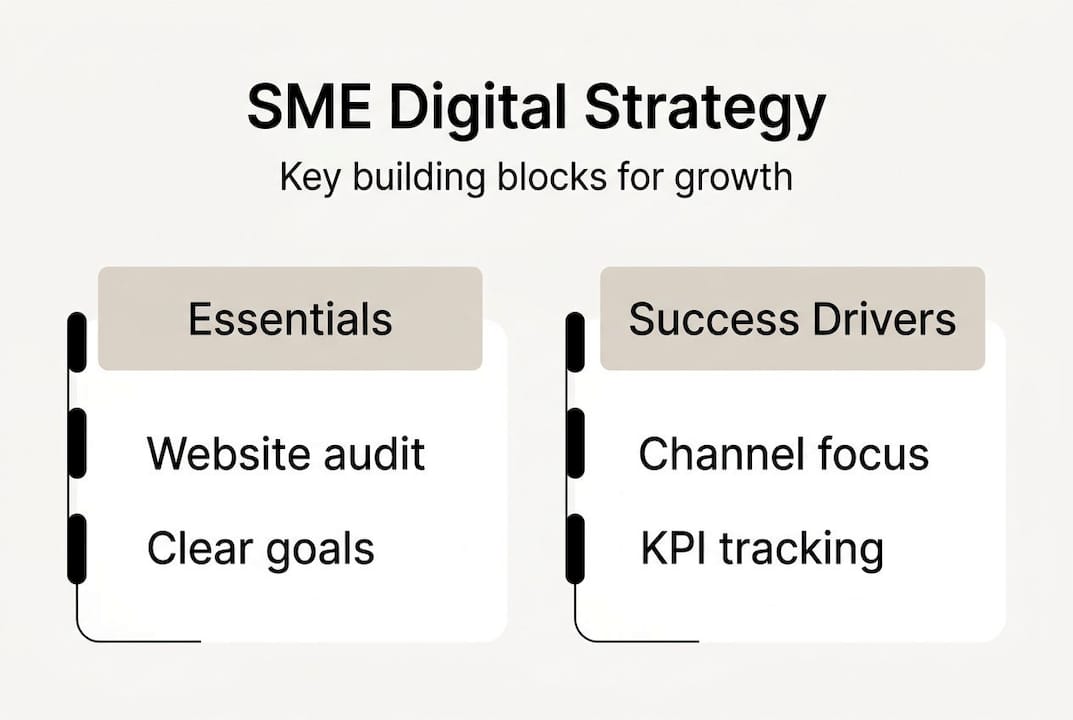
1. Website audit and technical foundations
Before spending a single pound on traffic, your website must be capable of converting visitors. This means fast load times, mobile responsiveness, clear calls to action, and secure hosting. A broken foundation wastes every pound of traffic you send to it.
2. Clear, measurable goal-setting
Objectives must be specific. Instead of “grow the business online,” a strong goal reads: “achieve a 4% website conversion rate within six months” or “generate 30 qualified enquiries per month through organic search.”
3. Channel prioritisation based on data
One of the most common and costly mistakes is trying to be everywhere at once. A strategist narrows focus. SME strategy steps typically begin with identifying where your ideal customers already spend time online, then committing resources to one or two channels before expanding.
4. Revenue-focused KPI tracking
Clicks, impressions, and follower counts are easy to celebrate and nearly meaningless in isolation. Revenue-driving KPIs include conversion rate, cost per lead, customer acquisition cost, and lifetime value.
5. Budget discipline with room for testing
Research shows that SMBs allocate 7 to 10% of revenue to marketing, with between 53% and 72% of that spend directed towards digital channels. Knowing these benchmarks helps you calibrate your own budget and understand where you stand against the market.
Here is a snapshot of key SME performance benchmarks to guide your expectations:
| Channel | Key metric | SMB benchmark |
|---|---|---|
| Google Ads | Click-through rate | 3.2% |
| Google Ads | Conversion rate | 3.8% |
| Google Ads | Return on ad spend | 2.5x to 6x |
| Email marketing | Open rate | 18% to 40% |
| Email marketing | Click-through rate | 1.8% to 5.5% |
| Website overall | Conversion rate | 2.9% to 5% |
| Digital marketing | Average ROI | 5:1 |
These figures from SMB marketing benchmarks 2026 give you a realistic baseline. If your Google Ads conversion rate is sitting at 1%, you know there is substantial room for improvement before adding more spend.
Pro Tip: Once you identify a channel that is performing above benchmark, resist the urge to immediately add new channels. Scale the winner first. Only introduce a new channel when your lead channel is operating consistently well and you have the bandwidth to manage the addition properly.
You can explore detailed guidance on effective SME digital strategies to build on these foundations with confidence.
Balancing quick wins and long-term growth with channel selection
One of the most practical decisions any SME makes is how to split effort and budget between channels that deliver fast results and those that build lasting value. Getting this balance wrong in either direction is expensive.
Paid channels, primarily Google Ads and Meta advertising, can drive qualified traffic within days of launching a campaign. That speed is genuinely valuable when you need leads now, when you are launching a new product, or when you are entering a new market. However, the moment you stop paying, the traffic stops. There is no lasting asset built from paid spend alone.
Organic channels work differently. SEO, content marketing, and email list building require patience, often three to six months before you see meaningful returns. But once established, they deliver traffic and leads at a fraction of the ongoing cost. A well-ranked blog post or a warm email list keeps working for you without a daily budget commitment.
Here is how the two approaches compare in practice:
| Factor | Paid channels | Organic channels |
|---|---|---|
| Time to results | Days to weeks | Three to six months |
| Ongoing cost | High (cost per click) | Low (time and content) |
| Sustainability | Stops when budget stops | Builds over time |
| Best for | Quick wins, launches | Long-term authority |
| Risk | Budget dependency | Requires patience |
The HubSpot marketing guide is clear on this: pair paid for quick wins with organic for sustainability. The most effective SME strategies use paid channels to fund the business while organic channels mature. Once organic starts producing, you can reduce paid dependence and reinvest in growth.
A common trap is over-reliance on a single channel. Contrasting strategic views highlight how some businesses bet everything on paid performance while neglecting brand and audience ownership. When ad costs rise or platforms change their rules, those businesses have nothing to fall back on.
The same applies to AI-driven tools. AI can optimise bidding, generate content drafts, and surface audience insights faster than any human. But AI amplifies whatever strategy is already in place. A weak strategy with AI tools is still a weak strategy, just faster. Human judgement and hands-on oversight remain essential.
Pro Tip: Review your channel mix every quarter. If one channel is consistently outperforming, increase its share of budget. If a channel has been underperforming for three months despite adjustments, redirect that spend towards SMB strategies that work rather than persisting out of hope. Use the data you have on SME SEO strategies to guide long-term organic decisions alongside your paid approach.
Common pitfalls and pro strategies for SMEs
Knowing the theory is one thing. Understanding where SMEs consistently go wrong is where real competitive advantage is found. These are the mistakes we see most often and the strategic fixes that make a measurable difference.
Common mistakes to avoid:
- Chasing vanity metrics: focusing on follower counts, page views, or impressions without connecting them to revenue outcomes
- Spreading budgets too thin: running five channels at 20% effort rather than two channels at full commitment
- Neglecting website UX: sending paid traffic to a slow, confusing, or poorly converting website and wondering why ads do not work
- Jumping on AI shortcuts: using AI-generated content or automated campaigns without a strategic framework underpinning them
- Ignoring attribution properly: treating your tracking data as absolute truth rather than a directional guide
“Consistency outperforms over-optimisation every time. The businesses that win are not the ones with the most sophisticated tools. They are the ones that show up reliably, measure honestly, and adjust methodically.”
Local businesses in particular often overlook one high-impact and low-cost strategy: local SEO. Claiming and optimising your Google Business Profile, building local citations, and earning reviews from satisfied customers can drive significant enquiries without ad spend. Experts recommend that local SMBs treat their Google Business Profile as a primary digital asset, not an afterthought.
On the budget side, research from Bank of America’s business resources suggests that SMEs should test with smaller budgets, identify winning approaches, and scale them with confidence. A three-month minimum commitment gives any channel enough time to generate meaningful data. Shorter experiments often produce misleading results.
Pro Tip: Before increasing any ad budget, audit your website for conversion performance first. Improving website conversion rates from 2% to 4% effectively doubles the value of your existing traffic without spending an extra pound. Use tools like Google Analytics and Google Search Console from day one. Both are free and offer more actionable insight than most paid alternatives. For a deeper look at how to increase website conversions systematically, start with page speed and call-to-action clarity.
Finally, invest in tracking early. Setting up proper goal tracking, understanding where leads come from, and reviewing results monthly creates the feedback loop that allows you to improve steadily. Small, consistent improvements over twelve months compound into significant competitive advantages.
What most SMEs get wrong about digital marketing strategy
After working with many SMEs across different sectors, one pattern is impossible to ignore. Most businesses do not fail online because of a lack of tools or budget. They fail because they mistake activity for strategy.
The temptation to adopt the newest platform or automate everything with AI is understandable. It feels like progress. But the businesses that consistently outperform their competitors are not the ones with the most sophisticated tech stack. They are the ones that have nailed the fundamentals: a well-built, fast website, clear tracking, defined audience targeting, and a digital marketing roadmap that everyone on the team understands and follows.
“The brands winning online in 2026 are boring in the best possible way. They have great websites, clear messaging, consistent follow-up, and they measure what matters. There is nothing flashy about it.”
Attribution data should inform decisions, not dictate them. No analytics platform captures the full customer journey perfectly. AI is a powerful support tool, not a strategist. Human leadership, creative thinking, and genuine understanding of your customer remain irreplaceable. The winning move is always the same: get the foundations right, commit to consistency, then build thoughtfully on what is already working.
Level up your digital strategy with expert help
Putting a solid digital marketing strategy into practice takes clarity, experience, and the right partner by your side. At Kickass Online, we work with a carefully selected group of SMEs who are serious about growing their online presence with purpose.
We offer tailored services to help you transform your digital strategy, from thorough SEO audits for SMEs that uncover hidden opportunities, to professionally built website design services that convert visitors into paying customers. Our team of specialists brings strategic thinking and hands-on execution together, so you stop guessing and start growing. Book a consultation today and let us show you exactly where your biggest digital opportunities lie.
Frequently asked questions
How much should an SME invest in digital marketing strategy?
Most SMEs allocate 7 to 10% of their revenue to marketing, with between 53% and 72% of that directed towards digital channels, making it the largest and most measurable part of a modern marketing budget.
How quickly can an SME see digital marketing results?
Paid ads can generate enquiries within weeks, while SEO and content marketing typically require three to six months to build sustainable momentum, which is why pairing paid with organic from the start is the most resilient approach.
Which digital channels do experts recommend for a small UK business?
Experts consistently suggest starting with one to two channels such as Google Ads, SEO, or email marketing, proving the model before expanding to additional platforms and spreading resources too thin.
What mistakes do SMEs make when hiring a digital strategist?
The most common errors include expecting overnight results, neglecting the website and brand basics before running campaigns, and focusing on trending tools over strategy rather than building a repeatable, evidence-based growth process.
Does my business need AI for digital marketing in 2026?
AI can meaningfully improve efficiency in areas like content drafting and bid optimisation, but it must support rather than replace a strong strategy, because as experts note, consistency and sound judgement will always outperform automation without direction.
Recommended


Book A Discovery Call
Stay Connected