How to start a digital marketing business in 6 steps

TL;DR:
- Focus on a specific niche like SEO or PPC to attract clients and build expertise.
- Conduct thorough market research to identify gaps and differentiate your agency locally.
- Prioritize early client acquisition through personalized outreach and over-delivering for reputation building.
Many small and medium business owners in Milton Keynes know their trade inside out, yet feel invisible online. Building a digital marketing business from scratch can feel equally daunting, whether you are pivoting careers or branching out from an existing role. This guide walks you through every practical step, from choosing your niche and registering the business to landing that first client and refining your delivery. Each section draws on real UK market data and proven frameworks so you leave with a clear, actionable plan rather than a list of vague ambitions.
Table of Contents
- Clarify your digital marketing niche and offering
- Conduct market research and competitor analysis
- Set up the legal and financial foundation
- Create your business plan and online presence
- Acquire your first clients and refine your delivery
- Why most digital marketing startups in Milton Keynes get stuck—and how you can break through
- Boost your digital marketing launch with expert support
- Frequently asked questions
Key Takeaways
| Point | Details |
|---|---|
| Pick a focused niche | Starting with a single, high-demand digital marketing service helps build expertise and trust. |
| Research and differentiate | Understanding your competitor landscape ensures you offer a standout solution. |
| Structure for growth | Proper legal, financial, and planning steps set the foundation for a scalable business. |
| Client acquisition skills | Effective networking, audits and clear processes win clients quickly and build your reputation. |
| Measure and refine | Track key metrics and use real results to improve services and grow sustainably. |
Clarify your digital marketing niche and offering
The single biggest mistake new agencies make is trying to do everything at once. Positioning yourself as a specialist rather than a generalist is not just good advice; it is the difference between winning clients confidently and losing them to agencies with a clearer message. UK agencies average £70k to £150k revenue per team member when they focus on one service like SEO or PPC initially, which illustrates precisely why depth beats breadth at the start.
For Milton Keynes specifically, the market is a blend of logistics firms, retail businesses, tech startups and professional services. Each segment has different needs. An SEO-focused agency works well for businesses chasing long-term organic visibility, whereas a PPC specialist suits companies wanting immediate lead flow. Full-service agencies exist too, but they typically require larger teams and higher overheads before they become profitable.
Before committing to a direction, audit your own strengths honestly. Use these agency setup strategies to frame your thinking around what the market actually needs, not just what you enjoy doing. Consider the key questions for digital marketing agencies that clients commonly ask, because understanding buyer concerns shapes your entire proposition.
Here is a snapshot of popular niches and their typical entry-level revenue potential:
| Niche | Typical monthly retainer | Team size at launch |
|---|---|---|
| SEO | £800 to £2,500 | 1 to 2 people |
| PPC management | £1,000 to £3,000 | 1 person |
| Social media | £500 to £1,500 | 1 person |
| Full-service | £2,500 to £6,000 | 3 to 5 people |
To narrow your niche, consider the following:
- List your three strongest skills before choosing a service area
- Check local demand by searching Milton Keynes business forums and LinkedIn groups
- Assess competitor saturation to find underserved segments
- Match your niche to a clear client outcome, such as more leads or higher search rankings
Pro Tip: Start with one service and one target industry. A focused pitch converts far better than a broad one, and you can always add services once you have established trust and cash flow.
Conduct market research and competitor analysis
Once you have chosen your niche, ensure your offer fits the market with disciplined research. Thorough market research is critical to identify gaps and opportunities before you spend a single pound on branding or tools.
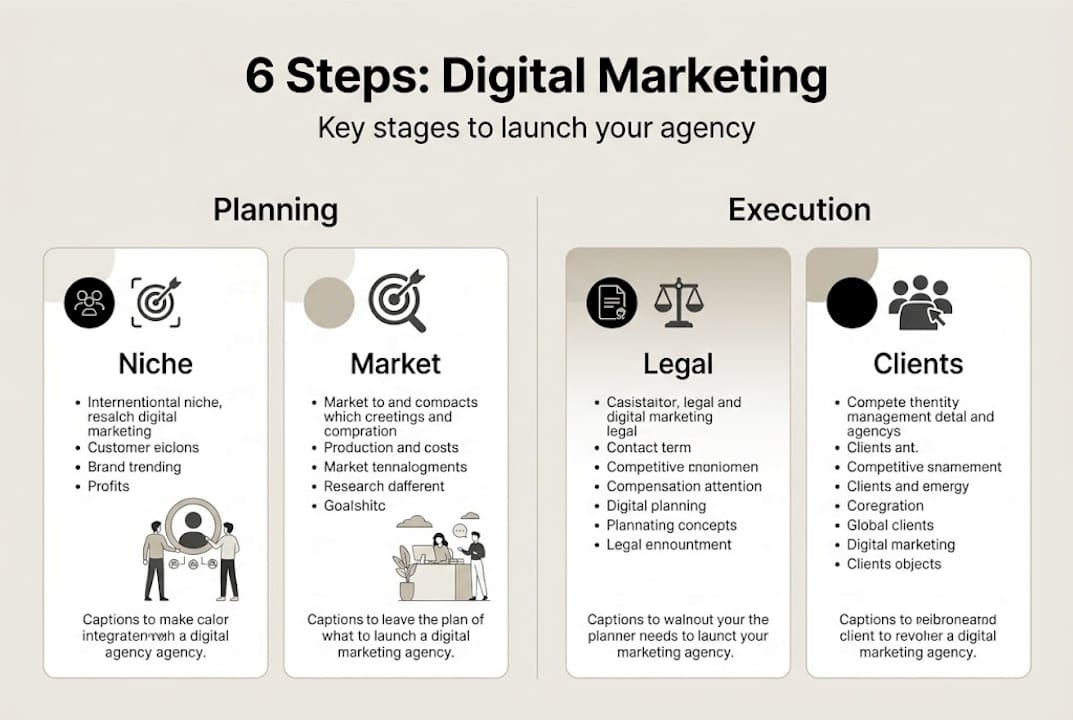
Start by mapping the competitive landscape in Milton Keynes. Search Google for your target service plus location, browse agency websites, and note their messaging, pricing clues, and the types of clients they showcase. Most agencies do not publish prices, but their case studies reveal the size and sector of clients they typically serve.
Follow this research process step by step:
- Search and list at least ten local competitors using Google, Clutch, and LinkedIn
- Review their websites for service pages, testimonials, and case studies
- Check their Google Business profile for reviews and response patterns
- Analyse their social channels to understand content strategy and posting frequency
- Identify gaps by noting which services or sectors appear underserved
A useful framework for this stage is the digital marketing audit process, which covers awareness, consideration, and conversion. Applying it to competitors reveals where they are strong and, more importantly, where they leave clients wanting more.
Here is a simple comparison table to visualise your position:
| Factor | Competitor A | Competitor B | Your agency |
|---|---|---|---|
| SEO specialisation | Yes | No | Yes |
| Local SME focus | No | Yes | Yes |
| Transparent pricing | No | No | Planned |
| Case studies published | Yes | Limited | In progress |
Use insights from this research to shape your SME marketing strategy steps, particularly around positioning and pricing. Your goal is not to copy competitors but to identify the gap only you can fill cleanly.
Set up the legal and financial foundation
With your market position clear, it is time to lay the business foundations. Legal and financial setup is fundamental for long-term sustainability, and cutting corners here creates painful problems later.

First, choose your legal structure. Most new UK agencies begin as sole traders because it is simple and cheap, but a limited company provides personal liability protection and can look more credible to corporate clients. Review the business setup regulations relevant to your chosen structure before committing.
Here are the essential legal and financial steps:
- Register as a sole trader with HMRC or incorporate via Companies House (free to £12)
- Open a dedicated business bank account immediately; mixing personal and business finances is a costly habit
- Arrange professional indemnity insurance; most clients in Milton Keynes expect it before signing contracts
- Set up an invoicing system from day one, even a simple one
- Register for VAT if you expect turnover above £90,000 in 2026; consider voluntary registration for credibility
“Running your finances through a personal account feels manageable at the start. By month six, you cannot tell what is profit and what is overheads. Separate everything immediately.”
Pro Tip: Tools like FreeAgent, QuickBooks or Xero cost under £30 per month and connect directly to your business bank account. Using them from the first invoice means your self-assessment tax return is nearly automatic and your cash flow picture is always clear.
For further context on structuring your early marketing activity alongside these foundations, review the small business step-by-step marketing approach we outline for UK SMEs.
Create your business plan and online presence
Legal setup handled, it is time to craft a compelling business plan and digital footprint. A business plan does not need to be a 40-page document; a focused, realistic one keeps you accountable and impresses potential partners or lenders.
Your plan should cover:
- Goals: revenue targets for months 3, 6, and 12
- SWOT analysis: honest assessment of strengths, weaknesses, opportunities, threats
- Competitive analysis: summarise findings from your research stage
- Service mix: which services you offer, how they are packaged, and what you charge
- Client acquisition channels: networking, cold outreach, referrals, content marketing
On pricing, hybrid pricing models are optimal for new agencies: start clients on a defined project, then transition them to a monthly retainer once trust is built. Small retainers for Milton Keynes SMEs typically sit between £1,000 and £5,000 per month depending on scope, and you can find detailed agency pricing structures to benchmark your rates accurately.
Statistic to note: Agencies using a hybrid project-to-retainer model report up to 40% higher client retention compared to those starting on retainers immediately, because the project phase removes perceived risk for the client.
Your online presence is your shop window. A clean, fast website with a clear service page, one or two case studies and at least three testimonials is enough to open doors. Do not wait for perfection. Use the creating a digital marketing plan framework to align your website content with your business goals from the outset. Also keep a digital marketing checklist handy so nothing critical is missed during the launch phase.
Acquire your first clients and refine your delivery
Now equipped with a business plan and online presence, your focus shifts to generating real client success. Networking and audits are the most reliable routes to acquiring initial clients, particularly in a well-connected local market like Milton Keynes.
Follow these steps to land your first client:
- Identify 20 local businesses in your target sector with visible online weaknesses
- Run a free mini-audit for each, highlighting two or three specific improvements
- Send a personalised outreach message that leads with the audit insight, not your services
- Follow up once after five working days if you receive no reply
- Attend local business networking events, including Milton Keynes Chamber of Commerce meetups and BNI groups
- Convert the first conversation into a small, low-risk project with a clear deliverable and deadline
Use the conducting effective audits methodology to structure your free analysis professionally. A well-presented audit positions you as an expert before you have issued a single invoice.
Once you have a client, over-deliver on the first project. Request a written testimonial the moment results are visible. Refine your onboarding process so the second and third clients experience something even smoother. Read more on what genuinely works in digital marketing for small businesses to benchmark your approach against proven methods.
Pro Tip: Track three metrics from your very first client: customer acquisition cost (CAC), return on ad spend (ROAS), and lifetime value (LTV). These numbers will tell you which acquisition channels deserve more investment and which are quietly draining your time.
Why most digital marketing startups in Milton Keynes get stuck—and how you can break through
Here is what we observe consistently: new agencies spend months perfecting their logo, their website, their pricing page, and their onboarding templates before speaking to a single prospect. Then they wonder why momentum never arrives.
Perfectionism is not a standard; it is a delay tactic dressed up as professionalism. Real growth comes from early, imperfect action, fast feedback, and iterative improvement. The agencies that break through locally are the ones that had an awkward first sales call in week two, not week twenty. They delivered a campaign that was 80% perfect, captured the testimonial, and improved the process for the next client.
Local relationships matter enormously in Milton Keynes. The town has a tight business community where reputation travels fast. Prioritise over-delivering for your first two or three clients above everything else, including winning new ones. Those early clients become your loudest advocates. Metrics matter, but they should inform decisions rather than paralyse them. Use proven digital strategies as your framework, then adapt based on what the data tells you about your specific clients and market.
Boost your digital marketing launch with expert support
Ready to put these steps into practice? Building a digital marketing business takes clarity, consistency, and the right foundations, and you do not have to figure it all out alone.

At Kickass Online, we work with a select number of SMEs and growing agencies in Milton Keynes, offering digital marketing strategies for SMEs that are built around real results rather than vanity metrics. Whether you need a high-converting website aligned with the latest web development trends or a targeted Milton Keynes SEO services plan to accelerate your visibility, we provide the expert support to move faster and smarter. Book a consultation and let us help you build something that lasts.
Frequently asked questions
What is the minimum investment required to start a digital marketing business in the UK?
Startup costs can range from as little as £1,000 for a sole trader setup to £10,000 or more if you plan to hire staff and invest in tools immediately. Legal and financial setup is fundamental to keeping those early costs manageable and compliant.
Should I specialise in one digital marketing service or offer multiple from the start?
Experts recommend focusing on one service such as SEO or PPC initially to build genuine expertise and client trust before expanding your offering.
What is the best pricing model for new digital marketing agencies?
A hybrid model is widely recommended: start clients on a defined project, then transition them to a monthly retainer. Hybrid pricing models offer both stability and flexibility for new agencies finding their footing.
How long does it take to get your first digital marketing client?
With targeted outreach, personalised audits, and local networking, many agencies land their first client within four to eight weeks of launching.
What metrics should I track to ensure my digital marketing business is working?
Track customer acquisition cost, return on ad spend, and lifetime value from the outset. The marketing funnel framework, covering awareness, consideration, and conversion, gives you the structure to interpret those numbers meaningfully.
Recommended


Book A Discovery Call
Stay Connected