What is user journey mapping and how it boosts SMB growth

Companies that actively map customer journeys see 20% higher customer retention rates compared to those that don’t. User journey mapping is a visual framework that tracks every interaction a customer has with your business, from initial awareness through to post-purchase support. For small to medium-sized businesses, this strategic tool reveals hidden friction points and untapped opportunities that directly impact your bottom line. Understanding how customers move through your digital and physical touchpoints allows you to make informed decisions that enhance satisfaction, increase conversions, and build lasting loyalty.
Table of Contents
- Introduction To User Journey Mapping
- Core Stages Of User Journey Mapping
- Business Impact And Metrics Of User Journey Mapping
- Common Misconceptions About User Journey Mapping
- Frameworks And Models For Effective User Journey Mapping
- Best Practices And Data Collection Methods
- Real-World Application And Case Studies
- Implementation And Maintenance Strategies
- Enhance Your Business Growth With Expert Web Solutions
- Frequently Asked Questions
Key takeaways
| Point | Details |
|---|---|
| Visual customer insight | User journey mapping creates a clear visualisation of every touchpoint, helping you spot pain points and opportunities quickly. |
| Structured process | Following a six-stage approach from research to iteration ensures your maps deliver actionable insights tailored to SMB needs. |
| Measurable business gains | Effective journey mapping typically drives 20% higher retention and 15% better conversion rates for small businesses. |
| Cost-effective implementation | Simple maps deliver significant value without requiring large budgets or dedicated teams. |
| Continuous improvement | Regular updates with fresh customer data keep your maps accurate and your business competitive. |
Introduction to user journey mapping
User journey mapping is a strategic visualisation technique that documents every interaction a customer has with your business across all channels. It captures touchpoints from the moment someone discovers your brand through digital advertising, social media, or search engines, to their final purchase decision and ongoing relationship with your company.
Understanding where customers experience friction or delight is vital for SMB success. When you identify the exact moments that cause frustration or create positive emotions, you can prioritise improvements that have the biggest impact on satisfaction and revenue. This insight transforms vague assumptions about customer behaviour into concrete, actionable intelligence.
A typical user journey mapping process involves six stages: research, persona creation, journey mapping, identifying pain points, ideation, and iteration. Each stage builds on the previous one to create a comprehensive picture of your customer’s experience:
- Research phase gathers data from analytics, surveys, and customer interviews to understand actual behaviour
- Persona creation develops detailed profiles representing your key customer segments
- Journey mapping visualises the complete path customers take across all touchpoints
- Pain point identification highlights specific moments where customers struggle or abandon their journey
- Ideation generates practical solutions to address identified problems
- Iteration refines your map continuously as you gather new data and test improvements
Businesses that implement structured journey mapping report significantly improved stakeholder alignment, with teams sharing a common understanding of customer needs and priorities. This clarity enables faster decision-making and ensures marketing, sales, and support teams work towards unified goals. For SMBs with limited resources, this alignment prevents wasted effort on initiatives that don’t address real customer needs.
Your understanding of the customer journey forms the foundation for strategic planning across your entire business. When integrated into your digital marketing roadmap, journey maps ensure every campaign and initiative directly supports the customer experience you want to deliver.
Core stages of user journey mapping
Creating an effective user journey map requires a systematic approach that transforms raw data into actionable insights. Here’s how to build a map that drives real business improvements:
-
Conduct customer research and develop personas. Start by gathering quantitative data from your website analytics, sales records, and email metrics to identify behaviour patterns. Complement this with qualitative insights from customer interviews, support tickets, and feedback surveys to understand motivations, fears, and desires. Create 2-3 detailed personas representing your primary customer segments, including demographics, goals, challenges, and preferred communication channels.
-
Visualise the entire customer journey. Map every touchpoint where customers interact with your business, including digital channels like your website, social media, and email, plus offline interactions such as phone calls, physical locations, or trade shows. Document the sequence of these touchpoints and the typical timeframe for each stage. Include emotional states at each point to identify where customers feel confident, confused, frustrated, or delighted.
-
Identify friction points and moments of delight. Analyse your journey visualisation to pinpoint specific obstacles that slow progress or cause abandonment. Common friction points include confusing navigation, lengthy checkout processes, unclear pricing, or delayed responses to enquiries. Equally important, identify moments where customers experience exceptional value or pleasant surprises, as these represent opportunities to differentiate your business.
-
Ideate practical solutions and prioritise implementation. Generate multiple potential solutions for each identified problem, focusing on changes that your SMB can realistically implement. Evaluate solutions based on expected impact, implementation cost, and resource requirements. Create a prioritised action plan that addresses high-impact, low-effort improvements first to build momentum and demonstrate quick wins.
-
Continuously refine the journey map. Schedule regular review cycles, quarterly or biannually, to update your map with new customer feedback, behaviour data, and market changes. Test your improvements and measure results to validate assumptions. Your map should evolve as your business grows and customer expectations shift.
Pro Tip: Regularly involve cross-team stakeholders when updating maps to increase alignment and ensure everyone understands how their work impacts the customer experience.
The systematic approach to marketing you develop through journey mapping naturally extends to other business areas. When you focus on improving user experience based on journey insights, you create a seamless omnichannel experience that meets customers wherever they engage with your brand.
Business impact and metrics of user journey mapping
User journey mapping delivers quantifiable improvements to key business metrics that directly impact your profitability. SMBs that implement journey mapping typically see a 20% increase in customer retention and 15% improvement in conversion rates within the first year.
These improvements translate to tangible business outcomes:
- Reduced customer churn as you address pain points that previously drove customers to competitors
- Higher customer satisfaction scores reflecting improved experiences across all touchpoints
- Increased average order value when you optimise the purchasing journey
- Accelerated return on investment as targeted improvements yield faster results than broad initiatives
- Enhanced customer lifetime value through better retention and repeat purchases
| Metric | Before Journey Mapping | After Journey Mapping | Improvement |
|---|---|---|---|
| Customer retention rate | 65% | 78% | +20% |
| Conversion rate | 2.8% | 3.2% | +14% |
| Average order value | £85 | £98 | +15% |
| Customer satisfaction score | 7.2/10 | 8.4/10 | +17% |
| Support ticket volume | 145/month | 98/month | -32% |
Customer journey mapping directly leads to better customer experience by ensuring every touchpoint is intentionally designed to support customer goals. This customer-centric approach builds loyalty naturally, as customers appreciate businesses that understand their needs and remove unnecessary obstacles. Repeat business increases because satisfied customers return and recommend your services to others.

The financial impact extends beyond immediate sales. When you retain customers longer, you reduce acquisition costs and increase the efficiency of your marketing spend. Your conversion rate optimisation efforts become more targeted when informed by journey insights, and UX improvements that address real customer needs deliver measurably better results.
Common misconceptions about user journey mapping
Several persistent myths prevent SMB owners from embracing journey mapping, despite its proven benefits. Understanding the reality behind these misconceptions helps you approach mapping with appropriate expectations.
Myth: Journey mapping is too complex and resource-heavy for SMBs. Reality: even basic journey maps created with simple tools like spreadsheets or free templates deliver substantial value. You don’t need expensive software or dedicated personnel to start. A single afternoon spent mapping your primary customer segment’s journey can reveal critical insights that inform months of improvements.
Myth: Only digital interactions matter for online businesses. Truth: offline touchpoints like phone calls, packaging experiences, delivery interactions, and face-to-face meetings significantly impact customer perception. Customers experience your brand holistically, not through isolated channels. Mapping only digital touchpoints creates blind spots that leave problems unaddressed.
Myth: Journey maps are one-time projects. Effective maps require ongoing updates to remain accurate and useful. Customer behaviour evolves, market conditions shift, and your business offerings change. Treating your map as a living document ensures it continues to guide strategic decisions. Most successful SMBs review and update their journey maps quarterly.
Common mistakes that undermine mapping effectiveness include:
- Ignoring emotional dimensions of the customer experience and focusing solely on transactional steps
- Limiting mapping scope to a single channel instead of capturing the complete cross-channel journey
- Creating maps without involving actual customer data or feedback
- Failing to translate journey insights into concrete action plans
- Neglecting to measure the impact of changes made based on mapping insights
Pro Tip: Start small with your most important customer segment and one complete journey, then scale your mapping efforts as you gain confidence and see results.
Your comprehensive digital marketing approach benefits from realistic expectations about what journey mapping requires and delivers. Understanding these realities helps you allocate appropriate resources and achieve meaningful results.
Frameworks and models for effective user journey mapping
Choosing the right journey mapping framework ensures your efforts match your business needs and available resources. Three popular approaches suit different SMB situations.
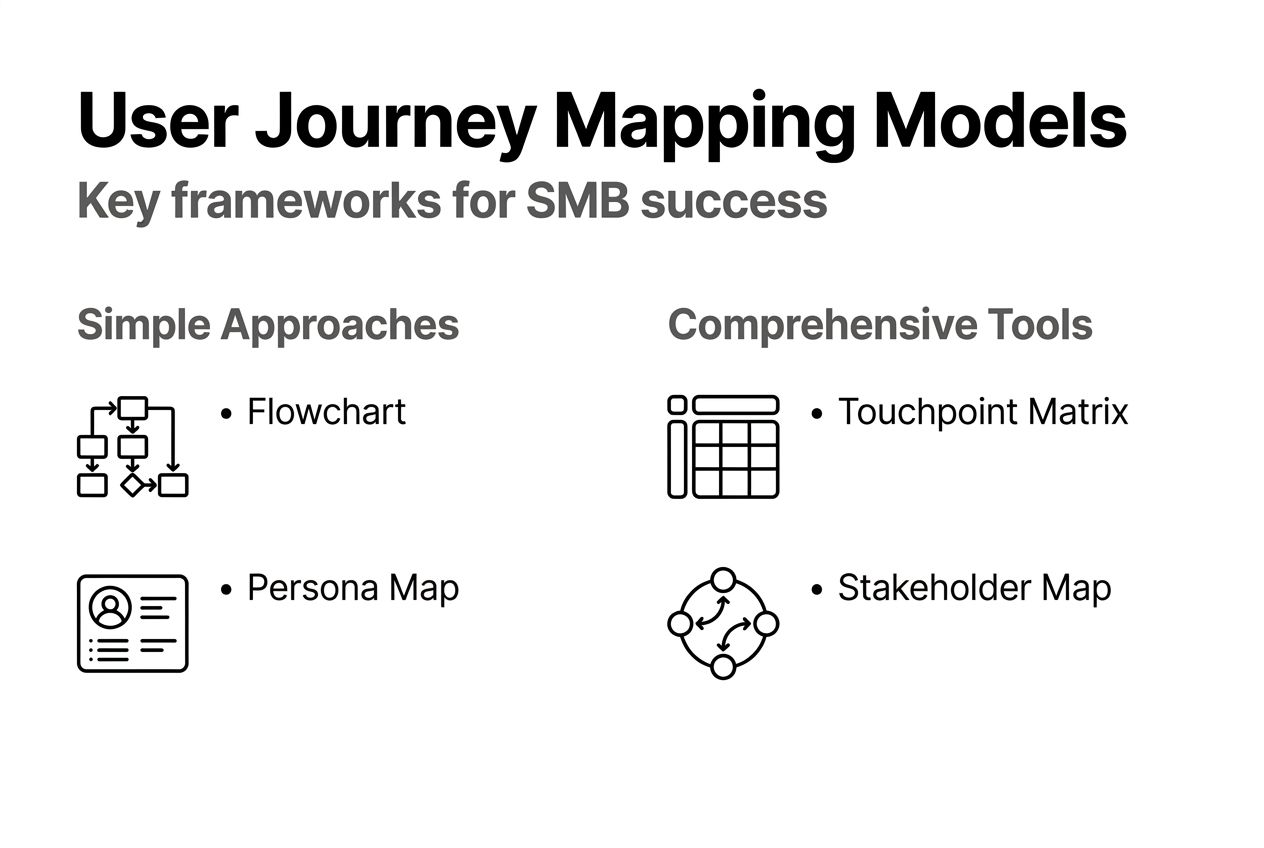
Flowchart-based maps use simple visual diagrams with boxes and arrows to show the sequential steps customers take. This approach emphasises clarity and simplicity, making it ideal for teams new to journey mapping or businesses with straightforward customer paths. Flowchart maps are quick to create and easy to understand, though they may oversimplify complex, non-linear journeys.
Persona-driven maps centre on detailed customer profiles, documenting how different personas experience your business differently. This framework excels at revealing how varied customer motivations require tailored strategies. It’s particularly valuable for SMBs serving distinct customer segments with different needs. The trade-off is increased complexity, as you maintain separate maps for each significant persona.
Touchpoint matrix frameworks create comprehensive grids documenting every interaction point across channels, stages, customer actions, emotions, and opportunities. This detailed approach captures the full complexity of modern multi-channel customer experiences. While time-intensive to create, matrices provide the deepest insights for businesses with sophisticated digital and offline touchpoint ecosystems.
| Framework | Complexity | Resource Requirements | Best For | Key Advantage | Main Limitation |
|---|---|---|---|---|---|
| Flowchart | Low | Minimal | Simple journeys, beginners | Quick creation, easy sharing | May oversimplify |
| Persona-driven | Medium | Moderate | Multiple customer segments | Reveals segment differences | Requires persona research |
| Touchpoint matrix | High | Substantial | Complex omnichannel businesses | Comprehensive detail | Time-intensive to maintain |
For most SMBs, starting with a flowchart approach allows you to gain initial insights quickly, then evolving to persona-driven or matrix formats as your understanding deepens. The best framework balances the depth of insight you need against the time and expertise you can dedicate to mapping and maintenance.
Best practices and data collection methods
Combining qualitative and quantitative data creates journey maps that are both accurate and emotionally resonant. Each data type serves a distinct purpose in building comprehensive customer understanding.
Quantitative data from website analytics, sales figures, email metrics, and customer behaviour tracking reveals patterns and identifies where customers take action or abandon their journey. This numerical evidence shows you what customers do, how many follow specific paths, and where the biggest drop-offs occur. Analytics dashboards provide objective measurements that validate or challenge assumptions about customer behaviour.
Qualitative data from customer interviews, open-ended surveys, social media sentiment analysis, and support interactions captures the why behind customer actions. This rich feedback reveals motivations, frustrations, emotional states, and unmet needs that numbers alone cannot explain. Understanding customer feelings at each journey stage allows you to design experiences that resonate emotionally.
Combined data leads to better identification of pain points because you see both the statistical evidence of problems and the human context explaining why they matter. This dual perspective enables you to prioritise improvements that address real customer needs rather than hypothetical concerns.
Practical data collection methods for SMBs include:
- Post-purchase surveys asking customers to describe their journey and rate satisfaction at key stages
- Website session recordings showing actual navigation patterns and friction points
- Customer interview programmes with 5-10 customers per segment quarterly
- Social media monitoring for unsolicited feedback and sentiment
- Support ticket analysis identifying recurring issues and customer language
- Email campaign metrics showing engagement at different journey stages
Pro Tip: Use simple survey tools and analytics dashboards regularly to maintain up-to-date insights without overwhelming your team or budget.
The insights you gain inform your approach to improving user experience across all digital properties. When you understand what customers actually need, every enhancement decision becomes more confident and effective.
Real-world application and case studies
A boutique e-commerce SMB selling artisan home goods struggled with 68% shopping cart abandonment. After implementing user journey mapping, they identified three critical friction points: unclear delivery costs revealed only at checkout, a mandatory account creation step, and confusing payment options.
They redesigned their checkout journey by displaying shipping costs on product pages, offering guest checkout, and simplifying payment to three clearly labelled options. Within six months, cart abandonment dropped to 42%, and the business achieved a 25% increase in repeat purchase rates as the improved experience encouraged customer loyalty.
The timeline for return on investment was remarkably quick. Initial improvements took three weeks to implement and showed measurable results within the first month. Continued refinement over six months compounded these gains, with sustained growth continuing beyond the initial optimisation period.
Key lessons other SMBs can apply:
- Small changes to high-friction moments deliver disproportionate impact on overall conversion
- Customer feedback often identifies problems invisible to business owners immersed in their own processes
- Testing improvements before full implementation prevents costly mistakes
- Documenting baseline metrics before changes enables accurate measurement of impact
- Celebrating quick wins builds team momentum for ongoing optimisation efforts
This practical application demonstrates how conversion rate optimisation strategies grounded in journey mapping insights deliver measurable business growth. The comprehensive approach to CRO becomes far more effective when informed by actual customer journey data. Similar success stories appear in local business transformations where understanding the customer journey unlocked previously hidden growth potential.
Implementation and maintenance strategies
User journey mapping is not a one-time project but an ongoing practice essential for maintaining competitive advantage. Your initial map provides a snapshot of current customer experience, but that experience must evolve as customer expectations shift and your business grows.
Scheduled updates ensure your journey maps remain accurate and actionable. Most successful SMBs establish quarterly review cycles where they:
- Analyse new customer feedback collected since the last update
- Review analytics data for emerging patterns or changes in behaviour
- Interview recent customers to validate current journey assumptions
- Update maps to reflect new touchpoints, products, or processes
- Identify new opportunities for improvement based on fresh insights
Integrating new customer feedback and data maintains map accuracy. Create systematic processes for capturing ongoing feedback through post-interaction surveys, regular customer interviews, and monitoring of support channels. Feed this intelligence directly into your journey maps rather than treating feedback as isolated incidents.
Periodic review cycles benefit from stakeholder involvement across your business. Include team members from marketing, sales, customer support, and operations to ensure diverse perspectives and complete buy-in. When everyone contributes to mapping updates, they develop shared ownership of the customer experience and naturally align their daily work with customer needs.
Steady customer experience improvements over time translate to increased loyalty and revenue. Small, consistent enhancements compound into significant competitive advantages. Customers notice when businesses continually refine their experience, and this attention to detail builds trust and encourages repeat business.
Pro Tip: Tie journey map updates to regular business reviews to maintain focus and ensure mapping remains a strategic priority rather than a neglected document.
Just as regular website maintenance keeps your digital presence performing optimally, consistent journey map maintenance ensures your customer experience strategy remains effective. Treating website maintenance as an ongoing business practice parallels the continuous improvement mindset required for effective journey mapping.
Enhance your business growth with expert web solutions
The insights you gain from user journey mapping are most powerful when supported by a robust digital infrastructure. Professional web design ensures your website supports the seamless customer journey you’ve mapped, whilst strategic SEO makes certain customers can find you at the critical awareness stage.

Kickass Online specialises in creating customer-centric digital solutions tailored to SMB needs. Our website design and development services transform journey insights into high-converting digital experiences that guide customers naturally towards purchase decisions. We implement the SEO optimisation workflows that ensure your improved customer journey reaches your target audience. Staying current with web development trends ensures your digital presence continues meeting evolving customer expectations.
Frequently asked questions
What is user journey mapping in simple terms?
User journey mapping is creating a visual diagram that shows every step a customer takes when interacting with your business, from discovering your brand to making a purchase and beyond. It helps you see your business through your customer’s eyes, identifying where they struggle and where they have positive experiences.
How can SMBs start user journey mapping with limited resources?
Begin by focusing on your most important customer segment and mapping just one complete journey using free tools like spreadsheets or drawing software. Interview 5-10 customers to understand their experience, review your website analytics for behaviour patterns, and create a simple flowchart documenting each touchpoint. This basic approach requires only a few hours but delivers valuable insights that guide improvement priorities.
How often should journey maps be updated?
Update your journey maps quarterly or whenever you make significant changes to products, services, or customer touchpoints. Regular updates ensure your maps reflect current customer behaviour and market conditions. Schedule brief reviews monthly to identify emerging patterns, with deeper quarterly updates that involve customer research and cross-team input.
What data types are most useful for journey mapping?
Combine quantitative data like website analytics, conversion rates, and sales figures with qualitative insights from customer interviews, surveys, and support tickets. Quantitative data shows what customers do and where they abandon their journey, whilst qualitative data explains why they behave that way and how they feel at each stage. Both types are essential for creating accurate, actionable maps.
What are the most common benefits SMBs realise from journey mapping?
SMBs typically see improved customer retention, higher conversion rates, reduced support costs, and better team alignment around customer needs. Journey mapping reveals quick-win improvements that deliver measurable results within weeks, whilst also guiding long-term strategic planning. The process builds customer empathy across your organisation, leading to better decision-making at all levels.
Recommended


Book A Discovery Call
Stay Connected