- Combining SEO and social media enhances visibility and lowers cost per lead for SMEs.
- Prioritise 1-2 platforms aligned with your audience for consistent, high-impact content.
- Integrate strategies using shared keywords, cross-promotion, and tracking to achieve measurable growth.
Most small and medium-sized businesses (SMEs) are active on social media, yet still struggle to attract meaningful web traffic or qualified leads. The problem is not effort. It is strategy. Running SEO and social media as two separate activities is one of the most common and costly mistakes in digital marketing today. SMEs that focus on 115% higher reach by aligning short-form video and platform focus with their SEO goals see dramatically lower cost per lead. This guide breaks down exactly how to combine both channels into a single, coherent strategy that drives real, measurable growth.
Table of Contents
- Why SEO and social media marketing work better together
- Choosing the right platforms and content mix for your audience
- Optimising social media profiles and content for search
- Integrating SEO and social strategies: a step-by-step blueprint
- A smarter way: what most SMEs get wrong about SEO and social media marketing
- Take your SEO and social media marketing further
- Frequently asked questions
Key Takeaways
| Point | Details |
|---|---|
| Unified approach | Aligning SEO and social media multiplies your reach and reduces overall marketing costs. |
| Platform focus | Choose 1-2 best-fit channels for your audience rather than spreading efforts thin. |
| Profile optimisation | Optimise your social accounts with keywords, alt-text, and location details for improved discoverability. |
| Integrated workflow | Combine keyword planning and content promotion for up to 40% higher blog traffic. |
| Engagement over automation | Quality interactions on social media have greater impact than automated posting or overusing hashtags. |
Why SEO and social media marketing work better together
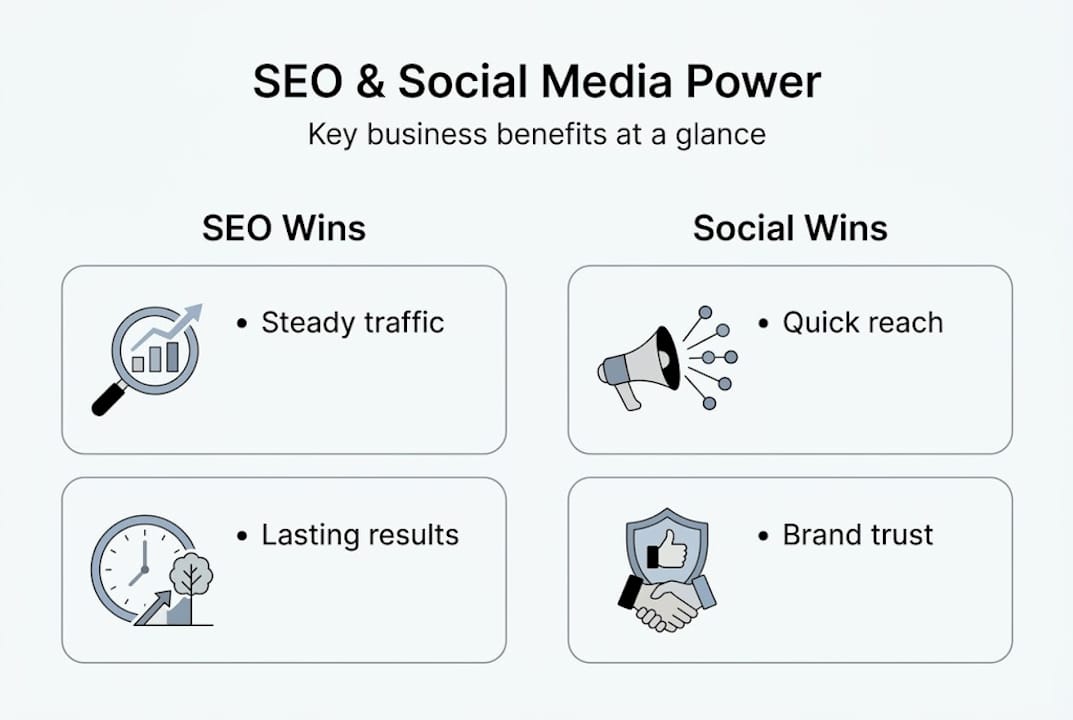
SEO and social media each have distinct superpowers. SEO builds long-term, sustainable search engine visibility by ranking your pages in Google for terms your customers are already searching. Social media, on the other hand, puts your brand in front of people before they even know they need you. One is pull. The other is push. Together, they cover the entire buyer journey.
When your social profiles and posts are optimised with the same keywords driving your SEO, the results compound. 16% of website traffic now comes from social channels when those channels are properly optimised for search. That is not a small number. For a business receiving 5,000 monthly visits, that is 800 visitors arriving via social alone.
This is where the concept of social SEO becomes important. Social SEO simply means applying search optimisation principles such as keywords, alt-text, location tags and profile completeness to your social accounts and content. It makes your brand discoverable both within the social platform and in Google search results.
The numbers behind this alignment are hard to ignore. Social media marketing accounts for 73.2% of SME performance variance, which means how well or poorly you execute social has an enormous bearing on your overall business results.
| SEO | Social media | |
|---|---|---|
| Traffic type | Evergreen, long-term | Real-time, short-term bursts |
| Speed | Months to build | Immediate reach |
| Cost | Lower over time | Can escalate with paid ads |
| Trust signals | Backlinks, domain authority | Likes, shares, comments |
| Best for | Purchase-ready searchers | Awareness and engagement |
The benefits of running both together include improved referral traffic, lower cost per lead, stronger brand trust, and a content pipeline that feeds both channels simultaneously. Explore social marketing strategies tailored to SMEs if you want a deeper look at which tactics work best.
Choosing the right platforms and content mix for your audience
Not every platform deserves your time. Spreading yourself across Facebook, Instagram, LinkedIn, TikTok, Pinterest and X simultaneously is a guaranteed path to burnout and mediocre results. SMEs that prioritise 1-2 platforms with 3-5 weekly posts and short-form video consistently achieve 115% higher reach than those posting sporadically across many channels.
The starting point is understanding where your customers actually spend time. A B2B consultancy will find decision-makers on LinkedIn, not TikTok. A fashion boutique will thrive on Instagram and Pinterest. A restaurant or local trade business benefits from Facebook and Google Business Profile above all else.
Here is a quick guide to platform and audience fit:
- LinkedIn: B2B services, recruitment, professional advice, consulting
- Instagram: Visual brands, food, fashion, beauty, lifestyle, local events
- TikTok: Brands targeting Gen Z or millennial audiences with entertaining or educational video
- Facebook: Community-driven businesses, local services, older demographic reach
- Pinterest: Home décor, fashion, recipes, DIY, anything highly visual
- YouTube: Long-form tutorials, product demos, brand storytelling
Once you pick your platforms, structure your content using a four-pillar mix: 40% educational content that answers real questions, 20% promotional content about your services or products, 20% engagement posts such as polls or questions, and 20% behind-the-scenes content that humanises your brand. This balance keeps your audience interested without feeling like they are being sold to constantly.
Short-form video is the single most powerful format right now. It drives more reach, more saves and more shares than static images or text posts across nearly every platform. Producing engaging social content does not require a professional studio. A phone, good lighting and a clear message are enough to start.
Pro Tip: Before creating your own content plan, study your top three competitors’ best-performing posts. Look at what formats, topics and tones are generating the most engagement. This tells you what your shared audience already responds to, saving you months of guessing.
For businesses ready to invest in paid reach, social media advertising can amplify your top organic posts significantly.
Optimising social media profiles and content for search
Your social profiles are indexed by search engines. That means a well-optimised Instagram bio or LinkedIn company page can appear in Google search results for your business name or even your services. Most SMEs never take advantage of this.
The fundamentals of social SEO start with your profile. Use your primary keyword naturally in your bio or page description. Add your location if you are a local business. Use a recognisable profile image and a clear call to action. Every field you complete increases your chances of appearing in both platform search and Google.
Proper keyword, alt-text, and location tag use leads to 16% of web traffic coming from social channels. For posts, this means writing captions that include relevant phrases your customers actually search for, adding descriptive alt-text to images, and using a focused set of hashtags rather than a scattergun approach.
| Profile element | Best practice |
|---|---|
| Bio/description | Include primary keyword and location |
| Profile image | Clear logo or professional headshot |
| Links | Direct to website or key landing page |
| NAP consistency | Identical name, address, phone across all profiles |
| CTA | Clear action such as “Book a call” or “Visit our site” |
| Alt-text | Descriptive text with keyword for every image |
NAP stands for Name, Address, Phone number. Keeping these identical across every social platform, your website, and directory listings is critical for local SEO. Google uses NAP consistency as a trust signal when determining local rankings.
What most businesses overlook: overusing hashtags actually reduces your content’s reach on many platforms. Instagram’s own data suggests 3-5 focused hashtags outperform 30 generic ones. Automation tools that post on your behalf often strip the human nuance that drives real engagement and can harm your algorithmic performance.
Pro Tip: Use social listening tools such as Mention or BrandWatch to identify trending topics in your industry. These topics become the foundation for SEO content clusters, giving you a pipeline of ideas that your audience is actively discussing right now. Learn more about boosting social discoverability with profile and content improvements.
Integrating SEO and social strategies: a step-by-step blueprint
Knowing the theory is one thing. Putting it into a repeatable workflow is what separates businesses that grow from those that spin their wheels.
Here is a practical integration blueprint you can implement straight away:
- Unified keyword research: Start every content cycle by identifying 5-10 keywords relevant to your services. Use the same keyword list to plan both your blog posts and your social content for the month.
- Consistent messaging: Ensure your brand voice, core messages and offers are identical across your website and all social channels. Mixed signals confuse both algorithms and people.
- Cross-promote every piece of content: Publish a blog post, then repurpose it as a LinkedIn article, a short Instagram carousel, and a 60-second video. Every format reaches a different segment of your audience.
- Test on social first: Use social posts to gauge interest in a topic before investing in a full SEO article. High engagement on a post is a strong signal the topic has search demand too.
- Add UTM tracking to all links: Use UTM parameters (small text tags added to URLs) in every social post that links back to your website. This lets Google Analytics show you exactly which platforms and posts drive traffic and conversions.
- Review and iterate monthly: Compare referral traffic, time on page and lead quality each month. Double down on what works and cut what does not.
“Social signals are not a direct ranking factor for Google, but they drive brand signals, backlinks and topical authority that do influence rankings.” Integrating SEO and social
Unified keyword planning and content promotion can yield 40% blog traffic growth when executed consistently. That is a meaningful gain from process changes rather than additional spend.
Understanding SEO importance for SMEs helps frame why this integration matters at a strategic level. For businesses with a local focus, local SEO for SMEs adds another powerful layer. And if you have not yet invested in video, exploring video for SEO and social is one of the highest-return moves available right now.
Pro Tip: Establish shared KPIs between your SEO and social efforts. Track referral traffic from social to your website, not just follower counts. This single metric reveals whether your integration is actually working.
A smarter way: what most SMEs get wrong about SEO and social media marketing
Here is the uncomfortable truth we see again and again: most SMEs treat SEO and social media as separate departments with separate goals, separate tools and separate reporting. The result is inconsistent brand messaging that confuses both customers and algorithms.
Siloed SEO and social teams lead to inconsistent messaging, automation that kills genuine engagement, and hashtag overuse that dilutes your SEO impact. These are not rare edge cases. They are the default for most growing businesses.
The other trap is chasing vanity metrics. Follower counts and post impressions feel good. They rarely correlate with revenue. Engagement quality, direct messages, website visits and actual enquiries are what matter. A post with 50 comments from your target audience is worth ten times a post with 2,000 likes from random accounts.
Our strongest advice? Resist the urge to automate everything. Tools are useful, but the human element of genuine interaction is what builds the trust that converts followers into clients. Respond to comments. Ask questions. Share real opinions. Algorithms reward authentic engagement because users reward it first.
Explore advanced SME social strategies if you are ready to move beyond the basics and build a strategy grounded in results rather than activity.
Take your SEO and social media marketing further
You now have the framework. The next step is turning it into consistent action that delivers measurable results for your business.
At Kickass Online, we specialise in helping SMEs build integrated digital marketing strategies that combine high-converting websites, search optimisation and social media into one coherent growth engine. Whether you need a structured SEO workflow for growth, a clear SEO strategies guide to sharpen your approach, or fully tailored social media marketing built around your audience, we have the expertise to get you there. We take on a limited number of clients to ensure every business gets the dedicated attention it deserves. Book a consultation and let us build your visibility together.
Frequently asked questions
Is social media activity a direct Google ranking factor?
No, but social signals such as likes and shares indirectly boost rankings by generating traffic, backlinks, branded searches and topical authority that Google does measure.
How do I know which social platform is best for my business?
Assess where your target customers are most active and prioritise 1-2 platforms that match your sector, content strengths and the demographics you are trying to reach.
What is social SEO and why does it matter?
Social SEO means optimising your profiles and posts with keywords, alt-text and location tags so they appear in both search engines and platform search results, driving additional organic traffic without extra paid spend.
How often should I post on social channels for the best results?
SMEs achieve the best outcomes by posting consistently 3-5 times per week on 1-2 priority channels rather than posting erratically across many platforms.
How can I measure if SEO and social media strategies are working together?
Track shared KPIs such as referral traffic from social to your website, lead quality, engagement rate and conversion rate to assess whether the two channels are genuinely reinforcing each other.
Recommended
- Local SEO for SMEs: Guide to Boost Search Visibility and Drive Local Traffic | Kickass Online
- Effective Digital Marketing Strategies for SMEs: Boost Your Online Performance | Kickass Online
- Guide to SEO Strategies: Boost Online Visibility and Drive Organic Traffic | Kickass Online
- Boost Your SME’s Visibility with Expert SEO Strategies | Kickass Online