Role of Content in SEO – Boosting Visibility and Trust

Many Milton Keynes business owners still believe that simply adding more blog posts guarantees better search rankings. In reality, search engines prioritise content quality, clarity, and relevance over sheer volume. Understanding what truly counts as content—from product photos to contact forms—and addressing common myths helps your business connect with real customers. This guide shows how to focus efforts where they matter for genuine online growth.
Table of Contents
- Defining Content In SEO And Common Myths
- Types Of SEO Content For Business Growth
- How Content Improves Rankings And Authority
- Key Elements Of Effective SEO Content
- Mistakes Small Businesses Make With SEO Content
Key Takeaways
| Point | Details |
|---|---|
| Comprehensive Content is Crucial | Content includes text, images, videos, and structure; all elements influence search engine rankings. |
| Quality Over Quantity | Engaging and relevant content addresses user needs better than excessive keyword-stuffed pages. |
| Regular Updates are Necessary | Refreshing content signals activity and trust to search engines, impacting visibility positively. |
| Align Content with User Intent | Focus on actual customer queries to create content that resonates and ranks effectively. |
Defining Content in SEO and Common Myths
Content in SEO means far more than just the words on your page. It’s every meaningful element visitors encounter when they land on your website.
What actually counts as content:
- Text (headlines, body copy, descriptions)
- Images and graphics
- Videos and animations
- Forms and interactive elements
- Navigation structure and page layout
For your Milton Keynes business, this means your entire online presence—from product descriptions to contact pages—plays a role in how search engines understand and rank your site.
Quality beats quantity every single time. Many business owners mistakenly believe that more content automatically means better rankings. That’s simply not true. Search engines favour content that clearly addresses user needs over lengthy pages stuffed with keywords.
Your content must align with what potential customers actually search for. If you run a digital marketing agency in Milton Keynes, your content should match the language and intent of people searching for those services—not generic industry jargon that nobody actually types into Google.
Common SEO Content Myths
These misconceptions waste business owners’ time and money. Let’s address the biggest ones.
Myth 1: Keyword stuffing improves rankings
Duplicate keywords don’t fool modern search engines. In fact, optimising content for genuine clarity works better. Keyword stuffing makes your content read awkwardly and drives visitors away.
Myth 2: Longer content always ranks better
Not necessarily. A concise, well-structured 800-word article beats a rambling 2,000-word piece that loses the reader’s attention. Search engines measure engagement—how long visitors stay, whether they click further, whether they convert.
Myth 3: You only need content once
Your website content needs regular updates. Outdated information damages trust and search rankings. Refreshing content regularly tells search engines your site remains active and reliable.
Myth 4: Technical SEO matters more than content
Both matter equally. A technically perfect website with weak content won’t rank. Strong content on a poorly optimised site won’t either. They work together.
Content quality, clarity, and relevance directly influence whether search engines display your pages to potential customers searching for what you offer.
For a small business in Milton Keynes competing with larger companies, your content advantage lies in specificity and genuine expertise. You can write about what you actually know—your local market, your customers’ specific challenges, your real solutions.
Pro tip: Audit your current website content this week. Identify which pages receive visitors but have high bounce rates. These pages need clarity improvements, not more content.
Here is a comparison of common SEO content myths and the actual reality for businesses:
| Myth | Reality | Impact on Rankings |
|---|---|---|
| Keyword stuffing works | Clear, natural language is favoured | Poor readability reduces ranks |
| Longer content is better | Relevance and engagement matter most | Short, focused content can win |
| One-time content is enough | Regular updates signal trust and relevance | Outdated content is penalised |
| Technical SEO alone is enough | Quality content and technical SEO must work together | Imbalance weakens performance |
Types of SEO Content for Business Growth
Not all content serves the same purpose. Different types work together to attract visitors, build authority, and convert them into customers.
Blog posts remain one of the most effective SEO tools. They target informational searches—people looking for answers before they’re ready to buy. A Milton Keynes plumbing company might publish a post about common boiler problems. That content ranks for searches like “why is my boiler making noise,” attracting potential customers at the earliest stage of their journey.
Product pages do the heavy lifting for conversion. These pages target high-intent searches from people ready to purchase. Multiple content forms working together strengthen your entire SEO campaign and establish credibility with both search engines and visitors.

Landing pages serve specific campaigns or offers. They focus on a single conversion goal—signing up for a consultation, downloading a guide, or requesting a quote. Clean, focused landing pages with minimal distractions typically convert better than generic pages.
Content Types That Drive Results
Case studies and testimonials prove your value. These show real results from real clients. Search engines favour pages that demonstrate genuine expertise and customer satisfaction. A web design agency can rank for “web design Milton Keynes” more effectively with client success stories than generic service descriptions.
Video content increases engagement significantly. People spend longer on pages with videos, which sends positive signals to search engines. Videos also work well for tutorials, product demonstrations, and explaining complex services.
Infographics make complex information digestible. They’re highly shareable, which generates backlinks—a major ranking factor. Strategic content planning combines these formats to meet different user needs throughout their customer journey.
FAQs and how-to guides capture long-tail search traffic. These pages answer specific questions people actually ask. They’re particularly valuable for local businesses answering “how do I…” or “where can I…” searches.
Social media content extends your reach beyond your website. It builds brand awareness and drives traffic back to your owned content. Social signals don’t directly influence rankings, but they amplify your content’s visibility.
Different content types serve different stages of the customer journey. Blogs attract awareness, product pages drive consideration, and case studies seal the deal.
Pro tip: Map your content types to customer journey stages this week. Identify which stages you’re weak in, then create targeted content to fill those gaps.
Below is a summary of SEO content types and their main business advantages:
| Content Type | Main Purpose | Business Advantage |
|---|---|---|
| Blog posts | Attract early-stage visitors | Build authority and visibility |
| Product pages | Drive purchasing decisions | Increase conversions and sales |
| Landing pages | Focus on single goal or offer | Improve lead generation and sign-ups |
| Case studies | Demonstrate expertise and results | Build trust and attract referrals |
| Video content | Boost engagement and dwell time | Enhance rankings and brand recognition |
How Content Improves Rankings and Authority
Search engines don’t rank websites randomly. They rank pages that provide genuine value to searchers and demonstrate authority on their topics.
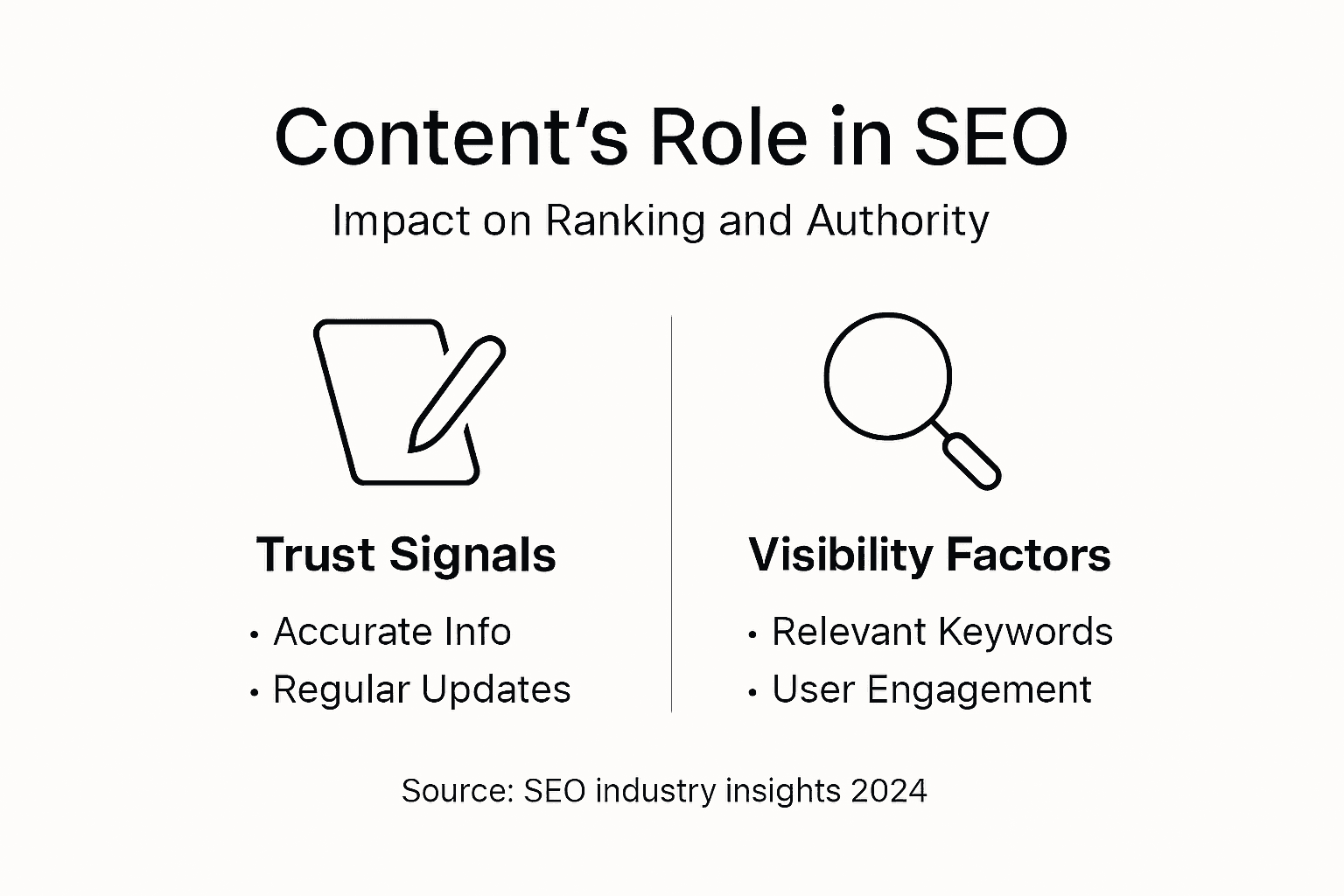
Content is the primary mechanism for proving both. When you publish detailed, accurate information that answers what people actually search for, Google understands your site covers that topic well. This alignment between search intent and your content directly improves your rankings.
The Ranking Mechanism
Quality content signals relevance. When your Milton Keynes digital marketing agency publishes articles about local SEO strategies, web design trends, or paid advertising best practices, you’re providing evidence of expertise. Search engines reward this with higher rankings.
Content quality and keyword integration influence how search engines understand your site’s value. This doesn’t mean keyword stuffing. It means using relevant terms naturally throughout well-written content.
Freshness matters. Outdated content signals your site isn’t actively maintained. Regular updates tell search engines you remain knowledgeable and engaged. A 2015 article about social media marketing tactics may hurt your credibility more than help it.
Engagement metrics prove value. When visitors spend time reading your content, click to other pages, or return repeatedly, that signals genuine usefulness. Search engines track these behaviours and reward engaged audiences with higher rankings.
Building Authority Through Content
Authority develops when others recognise your expertise and link to your content.
Unique, valuable content attracts backlinks naturally. If you publish an original case study showing how your web design approach increased conversion rates by 47%, other agencies might reference it. Those backlinks act like votes of confidence to search engines.
Consistency and quality build trust with both visitors and search engines. A business publishing mediocre content weekly ranks lower than one publishing exceptional content monthly. Quality compounds over time.
Topic authority develops through depth. Publishing 15 articles about digital marketing establishes more authority than publishing 3 surface-level pieces. Search engines recognise when a site comprehensively covers a subject area.
Key authority-building tactics:
- Publish original research or case studies
- Write longer, comprehensive guides (2,000+ words)
- Build internal linking between related topics
- Update and refresh your best-performing content
- Cite credible sources to strengthen claims
Content quality directly determines whether search engines display your pages to potential customers and whether people trust your expertise.
Pro tip: Focus on one topic area this month and create multiple pieces addressing different aspects. This depth signals true authority to search engines far more effectively than scattered content across random topics.
Key Elements of Effective SEO Content
Effective SEO content isn’t complicated, but it does require attention to several interconnected elements. Each one matters. Miss one, and your content underperforms.
Clear, user-focused writing comes first. Write for your actual audience, not for search engines. Avoid jargon unless your readers use it daily. If you’re a plumber in Milton Keynes writing for homeowners, explain what a “thermostatic mixing valve” does rather than assuming they know. Simple language builds trust and keeps visitors reading.
Strategic keyword use guides readers to your content. Proper keyword placement and strategic use ensure search engines understand your topic. This means using relevant terms naturally throughout your content—in headings, opening paragraphs, and key sections—without forcing them awkwardly.
Proper structure matters enormously. Organise your content with clear headings, short paragraphs, and bullet points. This helps both visitors scan content quickly and search engines understand your information hierarchy.
Technical Elements That Support Quality Content
Meta tags communicate content essence. Your page title and meta description are the first things searchers see. Make them compelling and accurate. A title like “Boiler Repairs Milton Keynes | Emergency Services Available” tells searchers exactly what they’ll find.
Accessible, well-formatted content serves everyone better. Use alt text for images so search engines understand them. Include proper heading tags. Ensure your site loads quickly. These technical touches aren’t optional extras—they’re foundations.
Regular updates prove relevance. Outdated content damages credibility. Review your best-performing pages quarterly and refresh statistics, examples, and recommendations.
Accuracy builds authority. Every claim needs support. If you cite statistics, link to sources. If you mention industry standards, reference them clearly. This transparency strengthens trust with both visitors and search engines.
Key content elements checklist:
- Clear, conversational writing in plain language
- Strategic keyword integration (not stuffing)
- Well-organised structure with subheadings
- Accurate, sourced information
- Fast page load speed
- Mobile-friendly design
- Regular content updates
Effective SEO content balances what search engines need to find you with what visitors need to trust you.
Pro tip: Audit one piece of underperforming content this week. Rewrite the opening paragraph for clarity, add current examples, and update any outdated statistics. Republish it—search engines reward refreshed content with improved rankings.
Mistakes Small Businesses Make with SEO Content
Small businesses in Milton Keynes often make the same preventable mistakes that undermine their SEO efforts. These errors cost time, money, and visibility.
Publishing content once and walking away kills momentum. Your website isn’t a brochure you print once. Search engines favour active, regularly updated sites. If your “About Us” page hasn’t changed since 2019, that signals abandonment. Quarterly reviews and updates tell search engines your site remains relevant.
Ignoring what customers actually search for wastes effort. Small businesses frequently miss user intent, writing content about what they think is important rather than what potential customers need. A Milton Keynes accountant writing about “advanced tax efficiency strategies” ranks poorly if locals search “tax returns Milton Keynes.”
Keyword stuffing destroys readability. Cramming keywords into every sentence looks desperate and reads terribly. Search engines penalise this. Write naturally first, then ensure keywords appear in logical places.
Common Content Mistakes
Neglecting mobile optimisation loses half your audience. Many small businesses design for desktop then wonder why mobile visitors bounce instantly. Your content must read well and load quickly on smartphones.
Creating low-quality content to fill pages backfires. Publishing thin, unhelpful articles damages credibility more than publishing nothing. One excellent 2,000-word guide outperforms five mediocre 400-word posts.
Failing to build a coherent content strategy scatters your effort. Without a plan connecting related topics, your content becomes random pieces rather than an authority resource. Duplicate content and unplanned publishing weaken your overall site strength.
Relying entirely on paid advertising instead of organic SEO limits growth. Paid ads stop working the moment you stop paying. Building organic SEO through quality content creates lasting visibility that compounds over time.
Mistakes to avoid immediately:
- Publishing content without researching search terms
- Writing for search engines instead of actual readers
- Ignoring metadata, titles, and descriptions
- Neglecting internal linking between related pages
- Failing to track which content drives visitors
- Using outdated statistics or unverified claims
Small businesses compete against larger companies by publishing better, more specific, more helpful content—not by publishing more of it.
Pro tip: Choose your three worst-performing pages this week. Delete or consolidate weak content rather than leaving it live. Two excellent pages beat ten mediocre ones every time.
Elevate Your Business Visibility with Expert SEO Content Solutions
Mastering the role of content in SEO is crucial for any Milton Keynes business striving to boost online visibility and build genuine trust. The challenge lies in creating clear, relevant, and engaging content that aligns perfectly with what your customers are searching for while maintaining strategic keyword use and regular updates. Many businesses struggle with content that lacks focus, fails to engage visitors, or does not reflect their local expertise. Kickass Online understands these pain points and offers personalised digital marketing and website development services tailored to overcome these exact hurdles.
Take control of your search engine rankings today by partnering with a team that specialises in crafting high-impact, well-structured SEO content designed to capture your target audience at every stage of their journey. Our professional website design and SEO services ensure your content is not only visible but also trusted and acted upon. Don’t let outdated or ineffective content hold your business back—book a consultation now and discover how we can help you transform your online presence into a powerful asset. Start your journey towards higher rankings and increased conversions with Kickass Online, your dedicated partner for comprehensive digital growth.
Frequently Asked Questions
What is the role of content in SEO?
Content in SEO plays a crucial role as it encompasses all meaningful elements that users interact with on a website, including text, images, videos, and more. Quality content is essential for search engines to understand the site’s relevance and improve rankings.
How does content quality influence search engine rankings?
Search engines prioritise content that clearly addresses user needs over poorly written or keyword-stuffed content. High-quality, relevant content enhances user engagement, which positively affects search engine rankings.
Why is it important to regularly update website content?
Regularly updating website content signals to search engines that your site is active and maintains relevant information. Fresh content helps build trust with users and improves rankings.
What types of content can boost SEO performance?
Various types of content can enhance SEO performance, including blog posts, product pages, landing pages, case studies, videos, infographics, and FAQs. Each type addresses different stages of the customer journey and can help attract visitors and convert them into customers.
Recommended
- Boost Your SEO with These Content Optimisation Tips | Kickass Online
- Role of Keywords in SEO: Boosting Online Visibility | Kickass Online
- Revive Old Content: SEO Benefits & How to Do It
- How to Update Website Content for Better SEO Results | Kickass Online
- Role of Video in Music Promotion: Unlocking Reach | Music Video Marketplace Blog


Book A Discovery Call
Stay Connected