Online brand reputation: how to build and improve it

87% of consumers read online reviews before visiting a local business. That single fact should change how you think about every customer interaction, every unanswered complaint, and every star rating sitting on your Google profile right now. Many business owners assume a handful of bad reviews won’t hurt them, but the data tells a very different story. In this article, we’ll break down what online brand reputation actually means, why it has a direct line to your revenue, and the practical steps you can take to build and protect it.
Table of Contents
- What is brand reputation online?
- How does online reputation influence business success?
- Core drivers of online brand reputation
- The science behind reviews and ratings
- Essential steps for managing your online reputation
- Modern misconceptions and best practices in reputation management
- Take your reputation and digital marketing further
- Frequently asked questions
Key Takeaways
| Point | Details |
|---|---|
| Reputation shapes customer choices | Your online reputation strongly influences whether people trust and buy from your business. |
| Active management is essential | Auditing, responding to reviews, and maintaining accurate information drive positive results. |
| Recent reviews matter most | Potential customers prioritise the freshness and authenticity of feedback when making decisions. |
| 4.2-4.8 stars is optimal | Aim for high, but not perfect, ratings to earn trust and avoid suspicion. |
What is brand reputation online?
Your online brand reputation is the collective perception of your business shaped by reviews, social media mentions, search results, and digital content across every platform where your name appears. It’s not a single score or a snapshot in time. It’s a living, breathing asset that shifts every time a customer posts a review, shares a photo, or searches your business name.
Think of it less like a report card and more like a conversation happening about your business whether you’re in the room or not. The components that shape it include:
- Online reviews on Google, Trustpilot, and industry-specific directories
- Social media mentions, shares, and complaints across Facebook, Instagram, and LinkedIn
- Search engine results on page one, including news articles and third-party listings
- Website content, including your blog, testimonials, and case studies
- Third-party directories such as Yell, Yelp, and local business listings
A common misconception is that reputation management is only relevant during a crisis or when a bad review appears. In reality, reputation management explained is an ongoing discipline that builds trust, drives consumer choices, and directly influences your local SEO rankings. Businesses that treat it as a background task tend to lose ground to competitors who treat it as a growth strategy.
How does online reputation influence business success?
The connection between your online reputation and your bottom line is not theoretical. It’s measurable, and the numbers are striking.
“ORM directly boosts small business performance across trust, conversion, and revenue metrics.”
Businesses with 4+ stars receive 94% of all local search clicks. That means if your rating sits below four stars, you’re essentially invisible to the majority of people searching for what you offer. A move from 3.5 to 4.0 stars can boost revenue by as much as 5 to 9%. These are not marginal gains for a small business.
Here’s a comparison of how review ratings affect your visibility and revenue potential:
| Star rating | Local search clicks | Customer trust level | Revenue impact |
|---|---|---|---|
| Below 3.5 | Very low | Poor | Significant loss |
| 3.5 to 3.9 | Below average | Moderate | Flat or declining |
| 4.0 to 4.4 | Above average | Good | Positive growth |
| 4.5 to 4.8 | High | Strong | Strong growth |
| 5.0 (perfect) | Moderate | Suspicious | Mixed results |
Understanding why reputation marketing matters becomes clear when you see these numbers side by side. A single unanswered negative review can deter up to 30 potential customers. Multiply that across several unaddressed complaints and the revenue impact compounds quickly.
The key takeaways for your business:
- Most customers only trust reviews from the past 90 days, so recency matters as much as volume
- Star ratings directly affect your position in Google Maps and local search results
- Responding to reviews, both positive and negative, signals credibility to new visitors
- Effective marketing strategies for brand awareness work best when your reputation supports the message
Core drivers of online brand reputation
Now that you can see the business impact, it helps to know exactly which online areas shape your reputation most. This is your self-assessment checklist.
- Online reviews: Frequency, recency, and tone all matter. A steady stream of recent, genuine reviews outperforms a large volume of old ones every time.
- Social media activity: Mentions, shares, and public complaints spread fast. How you respond publicly defines your brand character more than any marketing copy.
- Third-party directories: Inaccurate business details, wrong phone numbers, or outdated addresses erode trust before a customer even contacts you.
- Search engine results: What appears on page one when someone searches your business name shapes their attitude before they visit your website.
- Website content and responsiveness: A slow, outdated, or hard-to-navigate website undermines every positive review you’ve earned. Your site is part of your reputation.
Your online brand reputation is shaped by all of these touchpoints working together, not just one. Focusing only on Google reviews while ignoring your social media presence or directory listings creates blind spots that competitors can exploit.

Pro Tip: Maintain a consistent brand voice across every platform. The same tone, values, and messaging on your website, social profiles, and review responses builds a coherent identity that customers recognise and trust. Boosting visibility in your community starts with this kind of consistency. Explore effective branding tactics to sharpen your approach.
The science behind reviews and ratings
Reviews work because of a well-documented psychological principle called social proof. When people are uncertain about a decision, they look to the behaviour and opinions of others to guide them. Online reviews are the digital equivalent of asking a trusted friend for a recommendation.
But not all reviews carry equal weight. Recency and response rate matter far more than total volume. A business with 200 reviews but none in the past year looks stagnant. A business with 40 reviews, all recent and responded to, looks active and trustworthy.
| Rating range | Click-through rate | Customer trust | Likely sales outcome |
|---|---|---|---|
| Below 3.5 stars | Low | Weak | Most visitors leave |
| 3.5 to 4.1 stars | Average | Moderate | Some conversions |
| 4.2 to 4.8 stars | High | Strong | Consistent conversions |
| 5.0 stars (perfect) | Moderate | Questionable | Inconsistent results |
The ideal business rating sits between 4.2 and 4.8 stars. A perfect 5.0 can actually raise suspicion, as customers assume reviews have been filtered or fabricated. Authenticity, including the occasional honest 3-star review with a thoughtful response, builds more trust than a flawless score.
One unanswered negative review can deter up to 30 potential customers. That’s not a typo. Each public complaint without a response signals to future visitors that you don’t care about customer experience.
Pro Tip: Build a simple habit of asking for a review at the end of every positive customer interaction. A brief, friendly message sent via email or SMS after a completed job or purchase is all it takes. Optimising your Google Business profile ensures those reviews land where they have the most impact.
Essential steps for managing your online reputation
Knowing the drivers and psychology is useful. Knowing what to do about it is what moves the needle. Here is a proven process you can start implementing today.
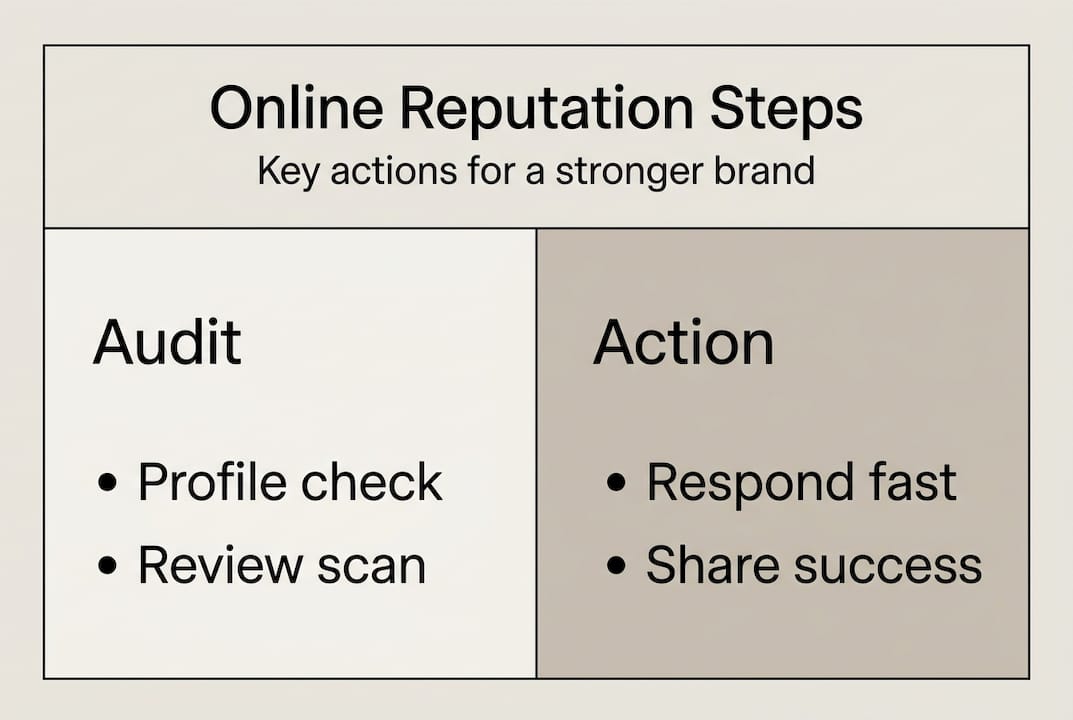
- Audit your online presence: Search your business name on Google, check your listings on major directories, and read every recent review. You can’t fix what you haven’t found.
- Monitor continuously: Set up Google Alerts for your business name and use tools like Mention or ReviewTrackers to catch new mentions in real time.
- Respond to every review: Positive or negative, every review deserves a response. Thank customers for praise and address complaints with empathy and a solution.
- Actively generate new reviews: Ask satisfied customers directly. Make it easy by sending a direct link to your Google review page.
- Keep profiles accurate and updated: Outdated hours, wrong addresses, or missing photos on your Google Business profile quietly damage trust every day.
- Create positive digital content: Blog posts, case studies, and client success stories push positive content up in search results and reinforce your authority.
- Use automation tools: Platforms like Podium or Birdeye can automate review requests and alert you to new feedback without adding to your workload.
The key steps in ORM are audit, monitor, respond, generate reviews, optimise profiles, publish positive content, and use automation. Following this sequence consistently is what separates businesses that grow through reputation from those that merely react to it.
Pro Tip: Treat reputation management as a growth engine, not a fire extinguisher. Businesses that build strong reputations proactively spend far less time and money recovering from reputation damage later. Pair this with local SEO tactics and strategies for harnessing local SEO to amplify the results. You can also explore optimising your online presence for a broader view of how reputation and search work together.
Key tools and habits to build into your routine:
- Weekly: Check new reviews and respond within 24 hours
- Monthly: Audit directory listings for accuracy
- Quarterly: Review your search results and update website content
- Ongoing: Ask for reviews after every positive customer interaction
Modern misconceptions and best practices in reputation management
There’s a persistent myth in small business circles that the best way to manage your online reputation is to remove negative content. It’s understandable, but it’s also outdated and often counterproductive.
Removal-first approaches are outdated and can trigger backlash. Attempting to suppress or delete legitimate reviews can trigger what’s known as the Streisand Effect, where the act of trying to hide something draws far more attention to it than the original complaint ever would have.
Modern best practices look very different:
- Build authority through content: Publish helpful, credible content that ranks well and pushes less favourable results further down the page
- Respond openly to criticism: A well-handled complaint publicly demonstrates your commitment to customer service better than any advertisement
- Learn from negative feedback: Patterns in complaints often reveal genuine service gaps worth fixing
- Use reputation as a growth driver: Businesses that actively manage their reputation see compounding benefits in trust, SEO, and conversion rates
“The most effective reputation strategies focus on building genuine authority and trust, not on controlling or suppressing what customers say.”
Understanding why reputation management matters in this broader sense shifts your mindset from defensive to strategic. The businesses winning on reputation in 2026 are not the ones with zero negative reviews. They’re the ones who respond well, build consistently, and treat every piece of feedback as useful data.
Take your reputation and digital marketing further
Building a strong online reputation is one of the highest-return investments a small or medium-sized business can make. But it works best when it’s part of a broader digital strategy that includes SEO, content, and a website that converts visitors into customers.
At Kickass Online, we work with a select number of SMEs at any one time, which means you get focused, expert attention rather than a generic package. Whether you need help with digital marketing strategies for SMEs or want to explore our SEO agency services, we can help you build the kind of online presence that earns trust and drives real growth. Book a consultation and let’s look at where your reputation stands today and what it could achieve with the right strategy behind it.
Frequently asked questions
What factors most influence my business’s online reputation?
Customer reviews, search visibility, social media mentions, and the accuracy of your business details across directories are the primary drivers of online brand reputation.
How quickly should I respond to negative online reviews?
Respond within 24 hours. Unanswered negative reviews can deter up to 30 potential customers, so a prompt, professional reply is one of the most cost-effective things you can do.
Can I remove bad reviews from my online profiles?
Most platforms won’t remove genuine reviews. Removal-first approaches are outdated; responding openly and building positive feedback is far more effective and far less risky.
What is the ideal review rating for my business?
Ratings between 4.2 and 4.8 are optimal. A perfect 5.0 can appear inauthentic to customers, who tend to trust a slightly imperfect but well-managed score more.
What’s the first step to improving online brand reputation?
Start with an audit of your online presence to identify where and how customers are currently interacting with your brand across search, reviews, and directories.
Recommended


Book A Discovery Call
Stay Connected