
- Content marketing generates three times more leads at 62% less cost than traditional methods.
- A structured strategy with SMART goals and pillar-cluster content builds authority and long-term visibility.
- SMEs should focus on consistency, targeted channels, and measuring key metrics like lead conversions.
Most small and medium-sized businesses pour money into online marketing without a clear plan, posting sporadically, running one-off ads, and hoping something sticks. The result is wasted budget, inconsistent messaging, and a pipeline that never quite fills. There is a better way. Content marketing generates 3x more leads than traditional marketing and costs 62% less, making it one of the most powerful tools available to SMEs with limited resources. This guide walks you through every stage of building a digital marketing content strategy that actually works, from preparation and execution to measurement and refinement.
Table of Contents
- Why every SME needs a digital content strategy
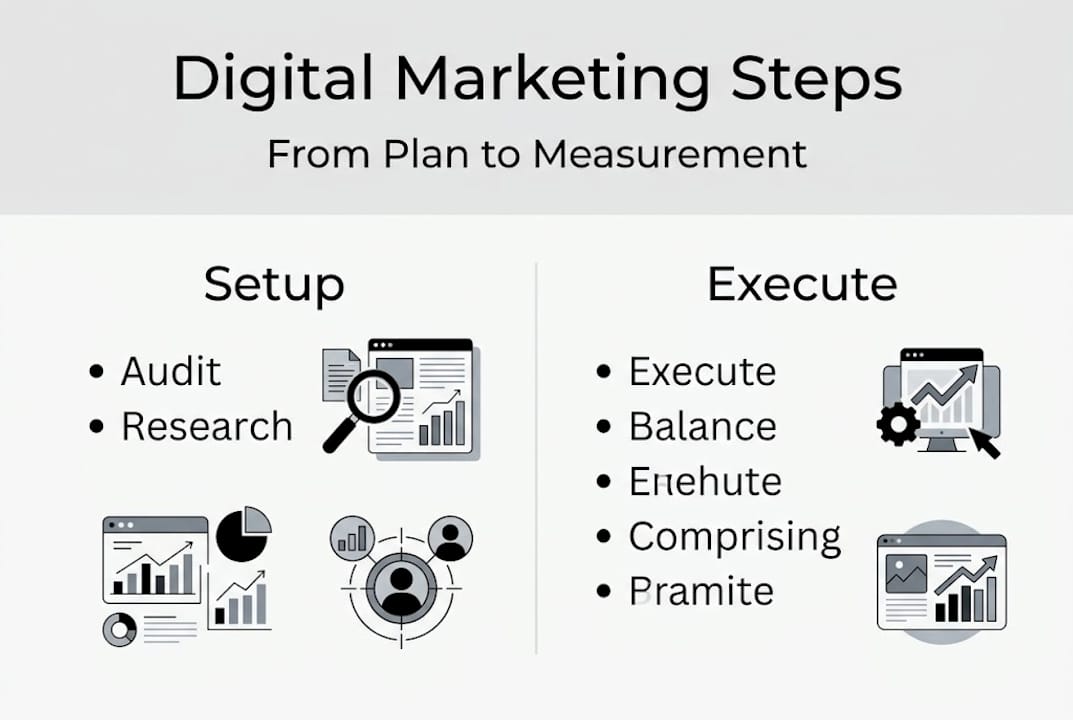
- Setting up for success: preparation steps for your content plan
- Execution: step-by-step digital marketing content strategy
- Measuring, refining and overcoming common pitfalls
- Our take: why the smartest SMEs keep it simple, strategic and sustainable
- Ready to achieve more with less effort?
- Frequently asked questions
Key Takeaways
| Point | Details |
|---|---|
| Strategy beats guesswork | A structured content plan drives more leads and costs less than ad-hoc marketing. |
| Prepare and research first | SMART goals, audits, and keyword targeting are essential for successful execution. |
| Measure what matters | Track leads, conversions, and ROI, not just likes or impressions. |
| Keep it focused | Consistent, quality content in your niche outperforms trendy tactics or automation. |
Why every SME needs a digital content strategy
Random marketing activity is expensive and exhausting. You publish a blog post one week, share a few social updates the next, then go quiet for a month because things get busy. Sound familiar? Without a structured plan, your efforts rarely compound. Each piece of content exists in isolation rather than building towards something meaningful.
A digital content strategy changes that entirely. Instead of reacting, you are planning. Instead of guessing, you are targeting. The contrast is stark:
| Approach | Cost | Lead quality | Long-term value |
|---|---|---|---|
| Ad-hoc marketing | High | Inconsistent | Low |
| Structured content strategy | Lower | Targeted | High |
| Paid ads only | Very high | Variable | None after spend |
SMEs face specific challenges that make strategy even more critical. Budgets are tight, teams are small, and time is scarce. Without a plan, it is easy to fall into the trap of chasing every new platform or trend, spreading yourself thin across channels that do not serve your audience.
The benefits of why content marketing works for structured approaches are well documented:
- Lower cost per lead compared to traditional advertising
- Sustained visibility through search engines over time
- Authority building that makes your brand the trusted option in your niche
- Compounding returns as older content continues to attract traffic
“Content marketing generates 3x more leads than traditional marketing and costs 62% less, making it ideal for SMBs with tight budgets.”
A well-executed website content strategy does not require a large team or a big budget. It requires clarity, consistency, and a willingness to focus on what your audience genuinely needs. That focus is what separates businesses that grow online from those that stagnate.
Setting up for success: preparation steps for your content plan
Before you write a single word of content, you need a solid foundation. Skipping preparation is the single biggest reason SME content strategies fail within the first three months.
Start by setting SMART goals for your content programme. SMART stands for Specific, Measurable, Achievable, Relevant, and Time-bound. Rather than “get more website traffic,” a SMART goal looks like: “Increase organic website visits by 30% within six months by publishing two SEO-optimised blog posts per week.”
Here is a simple framework for your preparation phase:
- Audit your existing content. List every blog post, landing page, and social asset you already have. Identify what performs well, what needs updating, and what should be removed.
- Define your audience clearly. Build a simple profile of your ideal customer, including their main questions, pain points, and the language they use when searching online.
- Research keywords strategically. Focus on low-competition keywords with 100 to 1,000 monthly searches. These are far easier for SMEs to rank for than high-volume terms dominated by large brands.
- Choose your core channels. Pick two or three platforms where your audience actually spends time, rather than trying to be everywhere at once.
- Build a content calendar. A simple spreadsheet or tool like Trello is enough to map out topics, formats, and publishing dates for the next 90 days.
| Preparation step | Tool to use | Time needed |
|---|---|---|
| Content audit | Google Analytics, Screaming Frog | 2 to 4 hours |
| Keyword research | Google Search Console, Ubersuggest | 3 to 5 hours |
| Audience profiling | Customer interviews, surveys | 2 to 3 hours |
| Content calendar | Google Sheets, Trello | 1 to 2 hours |
Pro Tip: When researching keywords, prioritise questions your customers ask you directly in sales calls or emails. These are almost always underserved in search results and represent high-intent traffic.
For a more detailed walkthrough of the planning process, the step-by-step digital marketing guide covers each preparation stage in depth. Getting this groundwork right makes everything that follows far more efficient, particularly for digital marketing for SMEs operating with lean teams.
Execution: step-by-step digital marketing content strategy
With your foundations in place, it is time to produce and distribute content in a way that builds authority systematically. The most effective model for SMEs is the pillar-cluster approach.

A pillar page is a long, authoritative piece of content covering a broad topic in depth. Cluster content consists of shorter, more specific articles that link back to the pillar. This structure signals topical authority to search engines and keeps visitors on your site longer.
Here is how to execute your strategy step by step:
- Identify two or three pillar topics that align with your core services and audience needs.
- Create cluster content around each pillar, targeting the specific questions and keywords you identified during preparation.
- Optimise every piece for SEO by including your target keyword in the title, first paragraph, subheadings, and meta description.
- Distribute via social media by repurposing key points into short posts, carousels, or short-form videos tailored to each platform.
- Send content via email to your subscriber list, as email remains one of the highest-converting distribution channels for SMEs.
- Interlink your content so that each new piece connects logically to related articles and your pillar pages.
For a deeper look at content marketing execution, the full process is broken down into actionable stages. The key principles for SMEs include focusing on niche keywords, building pillar content for authority, and integrating SEO, social, and email into a single coordinated workflow.
- Batch-produce content in dedicated sessions rather than writing reactively
- Repurpose one long-form article into three to five shorter social posts
- Use a consistent brand voice across every channel
- Schedule distribution in advance using tools like Buffer or Later
Pro Tip: AI tools can speed up research and drafting, but always rewrite outputs in your own voice. Generic AI content fails to build trust or rank well. Use it as a starting point, not a finished product, to avoid the generic output pitfall that undermines authority.
Exploring engaging content strategies will help you understand which formats resonate most with SME audiences across different stages of the buying journey.
Measuring, refining and overcoming common pitfalls
Publishing content is only half the work. Without measurement, you are flying blind. The critical mistake many SMEs make is focusing on vanity metrics, such as page views and social likes, rather than the numbers that actually indicate business growth.
The metrics that matter most for SMEs are:
- Organic search traffic growth month over month
- Lead form completions and enquiries generated by content
- Email sign-ups attributed to specific content pieces
- Conversion rate from content visitors to paying customers
- Return on investment calculated by comparing content costs against revenue generated
Tracking leads and ROI rather than surface-level engagement figures gives you a far clearer picture of what is working. Set up goal tracking in Google Analytics so you can attribute conversions directly to specific content pieces.
Pro Tip: Review your top five performing pages every month. Ask yourself why they convert well, then apply those same characteristics (format, topic depth, call to action placement) to underperforming pages.
Common pitfalls to avoid:
- Ignoring conversion data and optimising purely for traffic
- Over-automating distribution to the point where content feels impersonal
- Inconsistent publishing which erodes audience trust and search engine momentum
- Failing to update old content as search intent and information evolve
When a piece of content underperforms, do not delete it immediately. Update it with fresh data, improve the headline, add internal links, and strengthen the call to action. Refreshing existing content is often faster and more effective than creating something new from scratch.
Exploring the 7 essential types of content marketing can help you diversify your formats intelligently, while robust social media strategies will ensure your distribution efforts are as targeted as your creation process.
Our take: why the smartest SMEs keep it simple, strategic and sustainable
Here is something most marketing guides will not tell you: the businesses that achieve the best long-term results from content marketing are rarely the ones doing the most. They are the ones doing the right things consistently.
We see SMEs fall into the same trap repeatedly. They launch a content strategy with enormous enthusiasm, try to maintain five channels simultaneously, chase every algorithm update, and burn out within 90 days. The strategy collapses, and they conclude that content marketing does not work.
It does work. But it works best when you choose two or three core content pillars, publish on a schedule you can actually sustain, and measure results that connect directly to revenue rather than reach. Consistency over six months will outperform intensity over six weeks every single time.
The businesses that grow steadily online are not the ones with the flashiest tools or the largest content teams. They are the ones following proven strategies for SMEs with discipline and patience. Simplicity, focus, and sustainability are not limitations. They are your competitive advantage.
Ready to achieve more with less effort?
A well-built content strategy is only as powerful as the platform it sits on. If your website is slow, hard to navigate, or poorly optimised for search, even the best content will underperform.
At Kickass Online, we help SMEs build websites and SEO workflow for growth that turn content into consistent leads. Whether you need a high-converting website design and development overhaul or a structured plan to amplify your digital marketing strategies, we work with a select number of clients to deliver focused, results-driven solutions. Book a consultation and let us help you build a digital presence that works as hard as you do.
Frequently asked questions
What is a digital marketing content strategy?
It is a coordinated plan for creating, publishing, and promoting content online to achieve specific business objectives. A strong strategy uses SMART goals and keyword research to build topical authority through a pillar-cluster model.
How does a content strategy benefit SMEs?
It generates more leads at a lower cost while building long-term authority and online visibility. Structured content marketing costs 62% less than traditional marketing and produces three times the leads.
What tools should SMEs use for digital content planning?
Start with Google Analytics for performance tracking, Google Search Console or Ubersuggest for keyword research, and a simple content calendar in Google Sheets or Trello to manage your publishing schedule.
How often should SMEs review and update their content strategy?
Review performance monthly and update your strategy at least every quarter to ensure your topics, keywords, and formats remain relevant to your audience and aligned with your business goals.
Can AI help with content creation for my business?
Yes, but use it selectively. AI tools assist with research and drafting, but over-reliance leads to generic output that fails to build trust or rank well in search results.
Recommended
- Boost Your SEO with These Content Optimisation Tips | Kickass Online
- Content Marketing: Succeed with Impactful Content Strategies
- Effective Digital Marketing Strategies for SMEs: Boost Your Online Performance | Kickass Online
- Content Marketing for SMEs: Drive Growth and Conversions
- How to rank your salon on Google Maps for more clients