Build a digital media strategy for UK SME growth

TL;DR:
- Many UK SMEs invest heavily in social media and ads but often lack a strategic plan aligned with business goals, compliance, and measurement. Building a compliant, goal-driven digital media strategy increases visibility, lead generation, trust, and sales while minimizing legal risks. Regular review, correct attribution, and integrating compliance from the start are essential for sustained growth and legal safety.
Many UK business owners pour time and money into social media posts, paid ads, and email campaigns, only to find their efforts produce little more than a handful of likes and zero measurable sales. The real problem is not the channels they choose. It is the absence of a coherent strategy built around business goals, proper compliance, and clear measurement. This guide walks you through every stage of building a digital media strategy that genuinely drives growth and visibility, from setting goals and choosing channels to measuring results and staying on the right side of UK regulations.
Table of Contents
- What is a digital media strategy and why does it matter?
- Building your digital media strategy: Compliance as foundation
- Choosing and optimising channels for UK SME visibility
- Measuring performance: Attribution, conversion and what really matters
- Adapting your digital media strategy for ongoing success
- Our perspective: Most SME digital media strategies miss the compliance edge
- Enhance your online presence with expert support
- Frequently asked questions
Key Takeaways
| Point | Details |
|---|---|
| Compliance first | Starting with compliance—consent, labelling, and ad restrictions—protects your SME and ensures strategy effectiveness. |
| Channel selection matters | Choosing digital channels based on business goals, customer behaviour, and new legal rules is key to growing visibility. |
| Measure what drives sales | Focus on metrics that show real business impact, like CPA and ROI, not just basic clicks or impressions. |
| Adapt proactively | Review and update your digital media strategy regularly to stay ahead of compliance changes and market shifts. |
| Expert support accelerates results | Leveraging expert services for web development and SEO connects strategic vision to practical business outcomes. |
What is a digital media strategy and why does it matter?
A digital media strategy is a planned, measurable approach to reaching your target audience online and converting that attention into business outcomes. It is not a content calendar, a Facebook page, or a weekly newsletter in isolation. It is the overarching plan that connects each of those activities to a specific business goal.
For UK SMEs, the stakes are real. Done well, a strategy increases organic visibility, generates qualified leads, builds trust with buyers, and ultimately lifts sales. Done poorly, it wastes budget and, as we will explore shortly, can create compliance risks that result in fines or reputational damage. Understanding the digital marketing benefits for your specific business type is the first step.
Key business outcomes a strong strategy supports:
- Visibility: Ranking in search results and appearing consistently on relevant social platforms.
- Lead generation: Attracting people who are genuinely interested in what you sell.
- Trust: Demonstrating authority and reliability through consistent, valuable content.
- Sales: Converting interest into revenue through well-designed journeys.
UK-specific essentials also include data protection and marketing compliance, which must be woven into strategy from day one, not bolted on afterwards. Research on effective marketing strategies for small businesses consistently shows that the combination of clear goals, targeted channels, and consistent measurement separates growth businesses from the rest.
Pro Tip: Set SMART goals for every campaign. Specific, Measurable, Achievable, Relevant, and Time-bound objectives give you a clear benchmark and make it far easier to justify marketing investment to stakeholders or a bank manager. Build your strategy step-by-step so that every tactical decision links back to a defined outcome.
Building your digital media strategy: Compliance as foundation
Compliance is not a box-ticking exercise. It is the foundation that determines whether your strategy can actually operate. Ignoring it at the planning stage means you may build campaigns, automations, and workflows that need to be pulled apart and rebuilt later at considerable cost.
‘Non-compliance creates risk that can override channel tactics.’
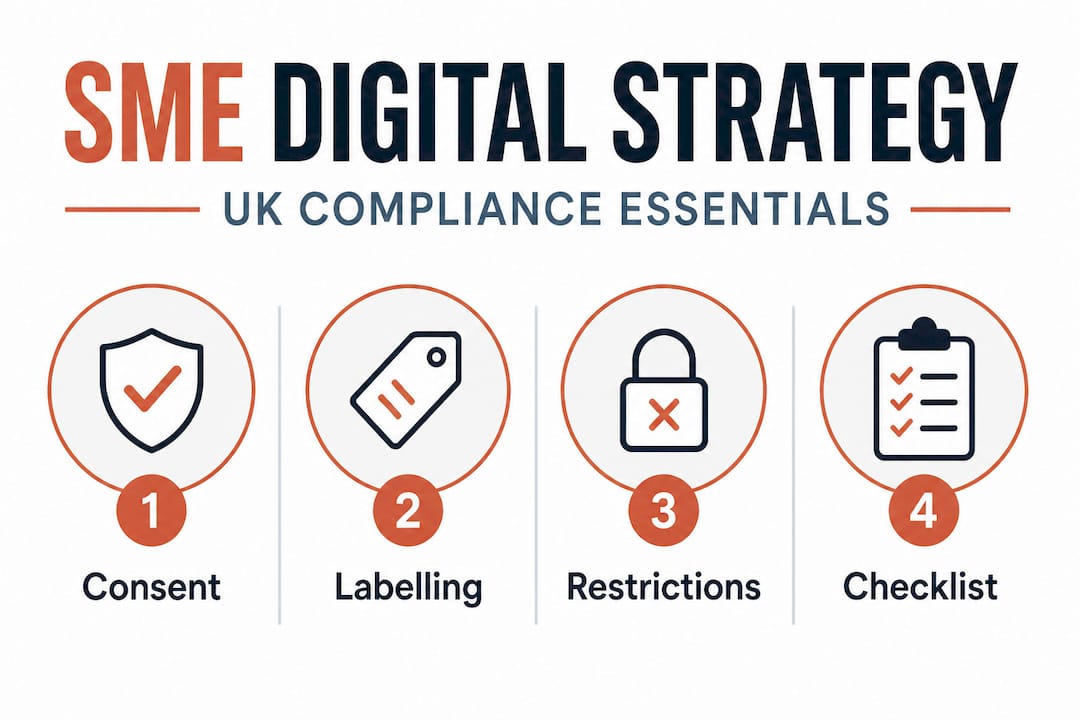
The three main compliance gates for UK SMEs are consent and data protection, endorsement labelling, and category-specific advertising restrictions.
Consent and data protection means you need a lawful basis for every marketing communication. ICO guidance is explicit that UK SMEs must incorporate data protection into their marketing approach, covering how you collect, store, and use personal data. Email lists, retargeting pixels, and CRM data all fall within scope. The soft opt-in rule (explained in the FAQ below) is useful but has firm limits.

Endorsement labelling is an area where many SMEs get caught out. If you pay an influencer, send free products, or offer any incentive in return for a post, that content must be clearly labelled. Social media endorsement rules from the CMA are clear that “Ad”, “Gifted”, or equivalent labels must appear prominently. Vague terms like “collab” or “thanks to…” do not meet the standard.
Food and drink advertising restrictions from 5 January 2026 mean that paid online ads for products classified as less healthy face significant placement restrictions. The ASA guidance sets out the detail, including which platforms and formats are affected. Small businesses below certain revenue and headcount thresholds may qualify for an exemption, but this needs to be verified rather than assumed.
| Channel | Consent requirements | Labelling obligations | Key 2026 restriction |
|---|---|---|---|
| Email marketing | Explicit opt-in or soft opt-in | None (unless gifted) | None specific |
| Social media (organic) | N/A | Ad/gift labelling for endorsements | Less healthy food placement rules |
| Paid social/display ads | Pixel consent via cookie banner | Ad label auto-applied by platform | Less healthy food placement ban |
| Influencer content | Audience consent N/A | Mandatory ad labelling | Platform placement rules apply |
Common compliance pitfalls to avoid:
- Purchasing email lists and assuming consent transfers.
- Sending marketing to existing customers without checking soft opt-in eligibility.
- Using influencer content without written agreements covering labelling.
- Failing to update cookie banners when adding new tracking tools.
- Assuming food and drink ad exemptions apply without checking revenue thresholds.
Pro Tip: Create a one-page compliance checklist and attach it to every campaign brief before sign-off. It takes ten minutes and can save you from a four-figure fine or a regulator’s letter. For more on building compliant channel plans, our practical SEO guide and social media strategy resources are good starting points. You can also explore email marketing strategies tailored to small business growth.
Choosing and optimising channels for UK SME visibility
With compliance built into your planning process, you can select channels based on where your customers actually are and what your budget realistically supports. The temptation for many SMEs is to try every channel at once. That approach dilutes effort and makes performance difficult to read.
Here is how the main digital channels compare for UK SMEs:
| Channel | Typical ROI | Visibility impact | Compliance complexity |
|---|---|---|---|
| SEO (organic search) | High (long-term) | High | Low |
| PPC (paid search) | Medium to high | Immediate | Medium |
| Social media (organic) | Low to medium | Medium | Medium (endorsements) |
| Paid social | Medium | High (targeted) | High (food/drink 2026) |
| Email marketing | High | Direct to subscriber | Medium (consent rules) |
| Content marketing | High (compounding) | High (SEO-driven) | Low |
| Influencer marketing | Variable | High (niche audiences) | High (labelling) |
Steps to selecting the right channel mix for your SME:
- Define your audience. Where does your target customer spend time online? A B2B services firm finds LinkedIn and search more valuable than TikTok. A local food retailer may find Instagram and local SEO most impactful.
- Set a realistic budget. Allocate at least 70% of your budget to two or three channels rather than spreading thinly across six. Focus produces better data.
- Check category restrictions. If your products fall within the less healthy food and drink category, review which paid channels are available to you post-January 2026 before committing budget.
- Audit existing content and assets. Before launching new campaigns, assess what you already have. Repurposing strong blog content for email and social costs far less than creating from scratch.
- Match channel to funnel stage. SEO and content attract people who do not yet know you. Paid retargeting and email convert those who do. Mixing these up wastes money.
For content strategy results that compound over time, a combination of SEO-optimised content and email nurture sequences tends to deliver the strongest return for SMEs with limited paid budgets. Working with a digital marketing strategist can help you build a channel plan that is grounded in data rather than guesswork. Studying ad creative best practices is equally worthwhile before investing in paid channels, since poor creative is one of the most common reasons paid campaigns underperform.
Measuring performance: Attribution, conversion and what really matters
The biggest mistake SME owners make with digital measurement is focusing on the numbers that are easiest to see rather than the ones that tell them whether the business is growing. Follower counts, impressions, and page views feel good. They rarely tell you whether marketing is working.
Attribution is the process of understanding which channel, campaign, or piece of content influenced a sale or lead. It matters because without it, you cannot make intelligent decisions about where to invest more or cut back. Treating attribution as a strategic tool means asking: what metric, when it reaches a certain level, triggers a specific decision?
Key metrics every SME should track:
- CTR (Click-Through Rate): The percentage of people who click your ad or link after seeing it. Useful for assessing creative and copy quality, but not a measure of business success on its own.
- CPA (Cost Per Acquisition): How much you spend to win one customer or lead. This is the number that connects marketing to profit.
- CVR (Conversion Rate): The percentage of visitors or leads who take the desired action. Low CVR often points to a website or landing page problem, not a channel problem.
- ROAS (Return on Ad Spend): Revenue generated for every pound spent on advertising. A ROAS below 3x is generally a signal to review creative, targeting, or landing page experience.
A practical performance marketing guide explains these metrics in more depth, but the principle is simple: measure what moves the business forward. Our resources on measuring digital ROI, SME marketing KPIs, and the broader digital KPI guide provide frameworks for connecting marketing activity to real business numbers.
One important pitfall: optimising purely for visibility will not necessarily grow sales. A campaign with a high impression count but a negligible conversion rate is losing money while looking impressive in a report. Always evaluate CTR together with CPA and CVR.
Adapting your digital media strategy for ongoing success
A strategy is not a document you write once and file away. The digital landscape changes faster than most industries, and UK regulations are evolving alongside it. Businesses that schedule regular strategy reviews outperform those that set and forget.
Steps to keep your strategy relevant and effective:
- Review performance data monthly. Set a recurring calendar appointment. Compare key metrics against your SMART goals and note what has changed.
- Check regulatory updates quarterly. New guidance on data protection and marketing compliance is issued regularly. The food and drink ad changes in January 2026 are a recent example of rules that caught many businesses unprepared.
- Update your channel mix as results emerge. If one channel is consistently delivering strong CPA and another is not, shift budget accordingly. Do not keep funding underperformance out of habit.
- Set new goals for each quarter. Once you hit a SMART goal, replace it with the next logical target. Growth comes from progressive targets, not static ones.
- Scale when signals are clear. Do not scale a campaign before you have evidence it works. A 20% increase in budget on a campaign with proven ROAS makes sense. Scaling an unproven campaign simply multiplies uncertainty.
Pro Tip: Block one hour every quarter specifically for compliance review. Check ICO updates, ASA bulletins, and CMA guidance. Add any new requirements to your campaign checklist before they become a problem. Building a smart digital strategy means treating compliance and performance review as ongoing habits, not one-off tasks.
Our perspective: Most SME digital media strategies miss the compliance edge
Here is something we see repeatedly when working with UK SMEs: businesses invest heavily in content, ads, and social media, only to discover months later that their campaigns were running on shaky legal ground. A consent mechanism was missing. An influencer post was not labelled correctly. A paid ad was placed on a platform that no longer accepts that product category. The financial and reputational cost of unpicking these problems after the fact is always higher than building compliance in from the start.
The uncomfortable truth is that compliance is not a marketing consideration. It is a business risk consideration. Treating it as a creative constraint, something to work around rather than with, is how brands end up in front of regulators.
We also see a persistent attribution problem. SME owners will point to rising social media follower counts as evidence that marketing is working, while their strategy step-by-step plan shows no clear line from those followers to actual revenue. Attribution should serve your business goals, not your marketing team’s confidence. If a metric does not connect to a decision, it is decoration.
The businesses we see grow consistently are those that build compliance gates into every campaign from the outset, measure only what drives decisions, and review both performance and regulations on a fixed schedule. That combination is less exciting than the latest social media trend, but it is what actually compounds over time.
Enhance your online presence with expert support
Building a digital media strategy that genuinely delivers growth requires more than a plan on paper. It demands the right website foundation, search visibility, and ongoing technical performance to turn strategy into results.

At Kickass Online, we work with a carefully selected group of UK SMEs to build high-converting websites, improve search rankings, and maintain site performance so your digital strategy has a solid base to operate from. Whether you are starting from scratch or refining an existing approach, our team can help you align every channel with your business goals. Explore practical web design tips to improve your site’s first impression, request an SEO audit for your SME to find quick wins in search rankings, or learn how website maintenance protects your investment and keeps your digital presence performing month after month.
Frequently asked questions
What is ‘soft opt-in’ and how does it affect SME email marketing in the UK?
Soft opt-in allows certain UK businesses to send marketing emails or texts to existing customers based on a previous purchase or enquiry, but the messages must relate to similar products or services and an easy opt-out must always be offered.
How must paid influencer posts be labelled to meet UK compliance?
Paid endorsements, including gifted products and any other incentive, must be clearly labelled as Ads under CMA guidance, with the label appearing prominently before the audience needs to click or expand the content.
Are all online ads for less healthy food and drink banned in 2026?
No. While most paid online ads for less healthy food and drink face placement restrictions from January 2026, qualifying small brands below certain thresholds are exempt under ASA rules and should verify their eligibility rather than assuming it.
What are the most useful metrics to track digital marketing success?
The most useful metrics for SMEs are CPA, CVR, and ROAS rather than clicks or impressions alone, because they connect directly to revenue and business outcomes rather than marketing activity.
Recommended
- The real benefits of digital marketing for UK SMEs | Kickass Online
- Smart digital marketing strategy: grow your SMB in 2026 | Kickass Online
- Developing a Robust Social Media Strategy for SMEs | Kickass Online
- SME digital marketing strategy: step-by-step guide | Kickass Online
- Effective ways to promote your business locally in the UK


Book A Discovery Call
Stay Connected