Real benefits of digital marketing for small businesses

TL;DR:
- Digital marketing is highly effective for small and medium-sized enterprises, enabling them to compete through skill and strategy rather than budget. It offers measurable, real-time data that improves decision-making, customer engagement, and long-term growth capabilities. Success depends on organizational readiness and building systems like CRM and analytics alongside tactical campaigns.
There is a stubborn myth floating around UK business circles: digital marketing is something only large corporations with six-figure budgets can afford to get right. If you run a small or medium-sized enterprise, you might believe that social media algorithms, search engine rankings, and email automation are luxuries beyond your reach. The truth is the opposite. Digital marketing is arguably more powerful for small businesses than for large ones, precisely because it lets you compete on skill and strategy rather than sheer spending power. This article unpacks the real, measurable benefits and shows you exactly how to harness them.
Table of Contents
- Why digital marketing matters for small businesses
- Measurability and real-time performance: the operational advantage
- Driving customer engagement and loyalty through digital channels
- Enabling innovation and growth through digital capabilities
- Digital advertising: reaching new customers and transforming discovery
- Fresh perspective: why digital marketing success hinges on organisational readiness, not just good campaigns
- Take your next step: enhance your SME’s digital presence
- Frequently asked questions
Key Takeaways
| Point | Details |
|---|---|
| Measurable results | Digital marketing allows UK SMEs to track performance, optimise spending, and see real-time impact. |
| Improved engagement | Email and social media channels help small businesses build direct relationships and loyalty. |
| Organisational innovation | Tools like analytics and CRM drive business innovation, agility, and readiness for growth. |
| Smart advertising | Digital ads help SMEs reach new customers and respond to search-led consumer intent efficiently. |
Why digital marketing matters for small businesses
For decades, small businesses were at a structural disadvantage. Television slots, full-page newspaper spreads, and billboard campaigns required budgets that only larger organisations could justify. Digital marketing changed that equation entirely. With a well-crafted email list, a consistent social media presence, and a properly optimised website, a sole trader or small team can reach thousands of qualified prospects for a fraction of traditional advertising costs.
Think of digital marketing as the great leveller. It does not care whether you have three employees or three thousand. What matters is relevance, consistency, and knowing where your customers spend their attention. As Forbes notes, digital marketing can improve both acquisition and engagement through owned channels like email and through audience interactions on social platforms, giving businesses of any size a direct line to their audience.
The practical advantages for UK SMEs are worth listing clearly:
- Visibility: Search engine optimisation and paid advertising put your business in front of people actively looking for what you offer.
- Engagement: Social platforms allow two-way conversations that build genuine relationships, not just impressions.
- Flexibility: Campaigns can be paused, adjusted, or scaled instantly based on what the data shows.
- Owned audiences: Your email list belongs to you, unlike followers on a social platform that can change its algorithm overnight.
- Geographic targeting: You can reach customers in your local area, nationally, or internationally, all with the same tools.
“Small businesses that invest in digital channels are not just advertising. They are building relationships, understanding customer behaviour, and creating loyal communities that sustain long-term growth.”
Understanding small business growth with digital marketing starts with recognising that the benefits extend well beyond getting more website visits. The deeper value lies in the quality of the connections you build and the clarity you gain about your customers. Exploring the full range of digital marketing benefits for small business is the logical first step before committing to any specific tactic.
Measurability and real-time performance: the operational advantage
Traditional marketing has always had a measurement problem. You run an advertisement in a local magazine, and you might never know how many people saw it, let alone how many came through your door as a result. Digital marketing solves this in a fundamental way. Every click, every email open, every page visit, and every purchase can be tracked, attributed, and analysed in real time.
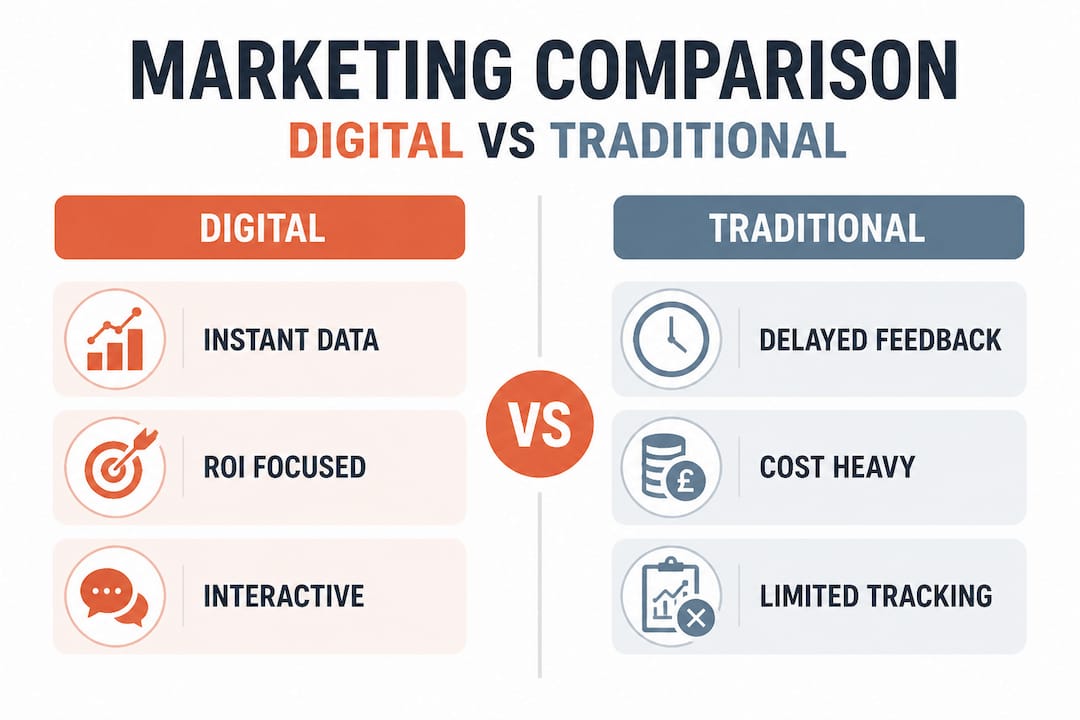
This is not just a nice-to-have feature. It is an operational advantage that transforms how you allocate your budget. Research confirms that a key operational benefit is measurability: digital channels enable tracking of what is working so budgets can be adjusted based on performance. For a small business with limited funds, this means you never have to guess where your money is going.
| Feature | Digital marketing | Traditional marketing |
|---|---|---|
| Real-time data | Yes, instant | No, often weeks or months |
| Cost per lead tracking | Precise | Estimated at best |
| Campaign adjustment | Immediate | Usually requires full restart |
| Audience segmentation | Detailed | Broad and imprecise |
| A/B testing | Simple and fast | Costly and slow |
| Attribution | Multi-channel tracking | Single-channel assumption |
Understanding the right KPIs for digital marketing is the starting point for any SME that wants to make data-driven decisions. Once you know which numbers matter, you can connect them to the activity driving them and optimise accordingly. Learning to measure digital marketing ROI does not require a marketing degree. It requires consistency and the right tools, most of which are free or low-cost.
Pro Tip: Set up Google Analytics 4 on your website today. It is free, connects to Google Search Console, and gives you immediate visibility into where your traffic comes from, which pages convert, and where visitors drop off. Spend 20 minutes each Monday reviewing these three metrics: sessions, conversion rate, and bounce rate. This simple habit will sharpen your decision-making faster than any marketing course.
Tracking digital marketing results consistently over time also reveals seasonal trends, campaign patterns, and customer behaviour shifts that are invisible if you only check in occasionally.
Driving customer engagement and loyalty through digital channels
Winning a new customer is valuable. Keeping that customer is where the real profitability lives. Digital marketing excels at both, but it particularly shines in retention and relationship-building, an area where many SMEs leave significant revenue on the table.

Social media is one of the most underused retention tools for small businesses. Posting content that educates, entertains, or inspires your audience keeps your brand visible between purchases. When customers comment, ask questions, or share your posts, you get direct, unfiltered insight into what they care about. Responding to comments and messages promptly signals that you are a business that listens. That builds trust faster than any advertisement.
Email marketing is arguably even more powerful. A well-segmented email list lets you send the right message to the right person at the right moment. A customer who bought from you six months ago and has gone quiet might respond to a personalised offer. A new subscriber deserves a welcome sequence that builds confidence in your brand. According to Forbes, digital marketing improves both acquisition and engagement through owned channels like email and through audience interactions on social platforms, which means the channels you control directly are your most reliable long-term assets.
Quick wins for boosting customer loyalty online include:
- Ask for reviews via automated post-purchase emails and respond to every single one, positive or negative.
- Share behind-the-scenes content on social media to humanise your brand and make customers feel part of your story.
- Create a loyalty incentive delivered digitally, such as an exclusive discount code sent via email for repeat customers.
- Run polls and Q&As on social platforms to make your audience feel heard and involved in your direction.
Pro Tip: Set up a simple email automation sequence using a tool like Mailchimp or Klaviyo. Even three automated emails triggered by a purchase or sign-up can significantly increase repeat purchases and referrals without requiring ongoing manual effort. Automation means consistent touchpoints without burning out your team.
Building a SME social media strategy that works requires clarity about which platforms your audience actually uses. A robust social media approach focuses on one or two channels done exceptionally well rather than spreading thin across every platform.
Enabling innovation and growth through digital capabilities
Here is where many SMEs stop short. They run a few campaigns, post on social media, and call it digital marketing. The businesses that truly pull ahead are the ones that treat digital marketing as an organisational capability, not just a set of campaigns.
Research published in Nature reveals that for UK SMBs, digital marketing is increasingly tied to innovation and performance through capabilities like marketing analytics, CRM systems, and social media and customer engagement. This is a significant finding. It means the return on digital marketing is not purely from the campaigns themselves. It comes from the systems, processes, and culture you build around them.
Consider what a good CRM system does. It stores customer history, tracks interactions, identifies your highest-value clients, and flags when relationships need attention. For a small business, this is transformational. Instead of relying on memory or spreadsheets, you have a living record of every customer relationship that can be acted upon strategically.
Here is a practical step-by-step guide to upgrading your SME’s digital marketing capabilities:
- Audit your current tools: List every platform and software you currently use for marketing, sales, and customer communication.
- Identify the gaps: Where do you lose track of customers? Where does data get siloed? Where do you repeat manual tasks?
- Choose a CRM: HubSpot offers a free tier that suits most SMEs starting out. Salesforce and Zoho are excellent for businesses ready to scale.
- Connect your analytics: Link your CRM to your website analytics so you can trace the full customer journey from first click to purchase.
- Train your team: Even a brief monthly review meeting focused on data insights builds a culture of measurement and improvement.
- Iterate based on data: Set quarterly goals, review performance against them, and adjust your approach accordingly.
| Capability | Impact on SME performance |
|---|---|
| Marketing analytics | Faster, evidence-based decisions |
| CRM system | Improved retention and customer lifetime value |
| Social media engagement | Stronger brand loyalty and feedback loops |
| Email automation | Consistent communication without extra resource |
| SEO and content | Long-term organic visibility and authority |
A strong digital marketing strategy guide will help you map these capabilities to your specific business goals. And if you want inspiration from what actually works, exploring proven strategies for SMEs gives you a grounded starting point.
Digital advertising: reaching new customers and transforming discovery
Digital advertising is not the same as traditional advertising. A television advert interrupts someone watching a programme they chose. A well-placed search advert appears precisely when someone is asking a question your business can answer. That distinction matters enormously.
Search-led discovery is one of the most powerful shifts digital advertising has introduced. When a potential customer types “best accountant in Manchester” or “emergency plumber Bristol” into Google, they are expressing clear intent. Being visible at that moment is not intrusion. It is genuinely useful. Google’s own research highlights digital advertising’s role in transforming marketing and consumer discovery via answers and the shift to more searchable, query-driven behaviour.
“The consumer no longer finds a brand. The brand must be findable at the exact moment the consumer needs it. That is the fundamental transformation digital advertising has delivered.”
Different digital ad formats serve different purposes, and understanding which to use is part of the skill:
- Pay-per-click search ads: Show up in search results for specific queries. Ideal for capturing high-intent demand.
- Display advertising: Visual banner ads on websites. Best for brand awareness and remarketing to past visitors.
- Social media ads: Targeted by interest, demographics, and behaviour. Excellent for reaching new audiences similar to existing customers.
- Video advertising: Platforms like YouTube allow short-form ads that build trust and explain complex offers.
- Remarketing: Retargets people who visited your site but did not convert. Often the highest ROI ad type for SMEs.
Building a performance-based marketing approach means every pound you spend is accountable to a measurable outcome, whether that is leads, calls, purchases, or sign-ups.
Fresh perspective: why digital marketing success hinges on organisational readiness, not just good campaigns
Most conversations about digital marketing focus on tactics. Which platform? What content? How much to spend? These are legitimate questions, but they are also the wrong starting point.
After working with SMEs across the UK, the pattern is clear: businesses that invest in the right campaigns but neglect the underlying systems consistently underperform compared to businesses that build the capability first. You can run a brilliant Google Ads campaign and lose every lead because your follow-up process is broken. You can post excellent content on Instagram and never convert a follower because your website is slow, confusing, or fails to build trust.
Research from Nature confirms that digital marketing’s performance upside is not just about campaigns, but about organisational capabilities including analytics, CRM and engagement systems, and leadership readiness. This is the insight that most SME owners miss.
The businesses winning at digital marketing are not necessarily running the cleverest campaigns. They are the ones with systems that capture, nurture, and convert interest consistently. They have leaders who review data regularly, act on what it tells them, and create a culture where testing and learning is normal.
Pro Tip: Before you invest more in advertising or content creation, spend a week mapping your current customer journey. Where do people first find you? What happens next? Where do they drop off? Fixing those gaps will deliver more return than any new campaign.
True competitive advantage comes from capability, not tactics. The proven SME digital marketing strategies that work long-term are built on this foundation of organisational readiness, not just the latest platform feature or trending content format.
Take your next step: enhance your SME’s digital presence
Understanding the benefits of digital marketing is one thing. Translating that understanding into a website, content strategy, and campaign structure that actually performs is where many SMEs need a specialist hand.
At Kickass Online, we work exclusively with small and medium-sized businesses across the UK to build digital presences that convert visitors into customers and customers into advocates. Whether you need tips for standout web design to sharpen your first impression, a fully built professional website design that reflects your brand and drives enquiries, or a clear set of SEO strategies for SMEs to help people find you in search, we offer dedicated, personalised support with a limited client intake to ensure every business gets real attention. Book a consultation and let’s build something that works.
Frequently asked questions
How can I measure the success of my digital marketing campaigns?
Success is measured through analytics tools that track metrics like clicks, conversions, and ROI. As research confirms, digital channels enable tracking of what is working so budgets can be adjusted based on real performance data.
What digital channels offer the best results for UK small businesses?
Email, social media, and search advertising are consistently the most accessible and impactful channels for SMEs. Forbes notes these owned and social channels improve both acquisition and engagement simultaneously.
How does digital marketing support business innovation?
Digital marketing builds innovation capacity through analytics, CRM systems, and agile customer engagement. UK SMB research shows it is increasingly tied to performance improvements and organisational readiness, not just campaign outcomes.
Do small businesses need a big budget for effective digital marketing?
No. Digital marketing delivers strong results even on modest budgets by concentrating spend on measurable channels. Because digital tracking shows exactly what is working, you optimise continuously rather than guessing where money is wasted.
Recommended
- The real benefits of digital marketing for UK SMEs | Kickass Online
- Digital marketing for small business growth: what works | Kickass Online
- Proven digital marketing strategies for small business success | Kickass Online
- Key benefits of hiring a digital marketing agency | Kickass Online
- Key benefits of digital marketing for brand growth | AMW Media


Book A Discovery Call
Stay Connected