Build a winning digital marketing strategy for beginners

TL;DR:
- A strong digital marketing strategy connects actions to specific business goals, preventing wasteful efforts. Building a foundational toolkit and focusing on owned assets like websites and SEO creates sustainable growth. Consistently executing a simple, disciplined plan over time yields the best results for small businesses.
Many small business owners pour time and money into digital marketing only to feel like they’re shouting into a void. Without a clear strategy, every post, ad, and email feels like a gamble. The good news is that building a solid foundation does not require a big budget or a marketing degree. Follow a structured, step-by-step approach and you will stop wasting effort on tactics that go nowhere, and start seeing real, measurable growth for your business.
Table of Contents
- Why a digital marketing strategy matters for beginners
- The essential tools and resources you need to get started
- Step-by-step: Creating your first digital marketing strategy
- Avoiding common mistakes and troubleshooting your strategy
- Measuring success: How to track and improve your strategy
- Our view: What most digital marketing guides miss
- Ready to accelerate your digital marketing success?
- Frequently asked questions
Key Takeaways
| Point | Details |
|---|---|
| Start with clear goals | Define what you want to achieve before choosing marketing tactics. |
| Choose the right tools | Invest in basic digital tools that match your business and budget. |
| Follow a step-by-step plan | Break your strategy into simple, manageable actions for best results. |
| Avoid common pitfalls | Stay focused and resist the urge to try every new marketing trend at once. |
| Measure and adjust | Use data to track progress and refine your strategy as you learn what works. |
Why a digital marketing strategy matters for beginners
There is a big difference between digital marketing tactics and an actual strategy. Tactics are the individual actions you take, such as posting on Instagram, sending a newsletter, or running a Google ad. A strategy is the plan that connects all of those actions to a specific business goal. Without one, you are just doing things and hoping something sticks.
When you skip the planning stage, the consequences are real. You might spend three months on TikTok only to discover your customers are not there. You might invest in paid ads before your website is ready to convert visitors. Understanding the role of digital marketing in your overall business plan is what separates businesses that grow online from those that stagnate.
A well-built strategy gives you:
- A clear set of goals tied directly to business outcomes
- A defined audience so you stop talking to everyone and start reaching the right people
- A prioritised list of channels so your energy is focused where it counts
- A way to measure progress so you know what is working and what is not
- A framework for making decisions quickly when things change
A clear strategy focuses your effort and significantly improves your marketing return. This is not a theoretical concept. It is the single biggest differentiator between small businesses that grow online and those that burn through their budget with nothing to show for it.
“Failing to plan is planning to fail. In digital marketing, the cost of that failure is paid in wasted budget, missed leads, and competitors taking your customers.”
If you want to explore proven marketing strategies that actually work for businesses your size, the evidence is clear: structure and consistency consistently outperform random activity.
The essential tools and resources you need to get started
Before you build your plan, you need a basic toolkit. This does not have to be expensive. In fact, most of what you need to get started is either free or very low cost. The goal here is to set up the minimum infrastructure that lets you execute, measure, and improve your marketing.
Foundational tools are crucial for small business digital marketing success, and there are four non-negotiables every beginner should have in place before anything else:
- A professional website: This is your digital shopfront. Everything else sends people here. Without it, you are building on rented land.
- Search engine optimisation (SEO) basics: SEO is the practice of making your website easy to find on Google. Even beginner-level SEO can drive consistent, free traffic over time.
- An email marketing tool: Email remains one of the highest-return channels available. Platforms like Mailchimp or MailerLite have free tiers perfect for beginners.
- At least one active social media channel: You do not need to be everywhere. Pick the platform where your audience spends time and show up consistently there.
| Tool category | Recommended free option | Paid upgrade worth considering |
|---|---|---|
| Website | WordPress.com | WordPress.org with hosting |
| SEO research | Google Search Console | Semrush or Ahrefs |
| Email marketing | Mailchimp (free tier) | ActiveCampaign |
| Social scheduling | Buffer (free tier) | Hootsuite |
| Analytics | Google Analytics 4 | No upgrade needed at the start |
The follow-on question is always: where do I focus first? The answer is almost always your website and SEO. Social media is rented space. Your website is owned space. When you follow a proper SME step-by-step strategy, you build on a foundation that you control and that compounds in value over time.
Pro Tip: Before spending a penny on ads or premium tools, make sure your website loads quickly, is mobile-friendly, and has a clear call to action on every page. A slow, confusing site will waste every marketing pound you spend driving traffic to it.

Step-by-step: Creating your first digital marketing strategy
With your tools in place, it is time to build your actual plan. A simple, stepwise approach is proven to be effective for beginners, and you do not need to overcomplicate it. Here is how to do it:
-
Define your goals. Start with business outcomes, not marketing activities. Do you want more phone enquiries? Online sales? Newsletter sign-ups? Write down one to three specific, measurable goals. For example: “Increase website enquiries by 20% over the next 90 days.”
-
Identify your target audience. Who exactly are you trying to reach? Build a simple profile that includes their age range, location, job role or lifestyle, biggest challenges, and where they spend time online. The more specific you are, the better your marketing will perform.
-
Choose your core channels. Based on where your audience is, pick two or three channels to start with. Resist the urge to be everywhere at once. A local tradesperson might focus on Google Business Profile and Facebook. A B2B consultant might prioritise LinkedIn and email.
-
Set a realistic budget. Even a modest monthly budget, structured well, can generate results. Split it between content creation, basic tools, and a small paid advertising test if your website is ready. Most beginners should allocate at least 60% of their time and budget to organic channels first.
-
Create a content calendar. Decide what you will publish, when, and on which channel. Consistency matters far more than volume. Two high-quality blog posts or social updates per week, published reliably, will outperform ten rushed posts every single time.
-
Launch, monitor, and iterate. Set a 30-day review cycle. Look at your key metrics, compare them to your goals, and adjust one thing at a time. When you grow your SMB sustainably, it is because you build on what works rather than constantly starting over.
| Strategy stage | Time investment | Priority level |
|---|---|---|
| Goal setting | 2 to 3 hours once | Critical |
| Audience research | 3 to 5 hours once | Critical |
| Channel selection | 1 to 2 hours once | High |
| Content planning | 2 hours per month | High |
| Review and adjust | 1 hour per month | Ongoing |
Pro Tip: Write your strategy down, even if it is just one page. Business owners who document their marketing plans are significantly more likely to hit their targets than those who keep the plan only in their heads.
Avoiding common mistakes and troubleshooting your strategy
Not everything will go smoothly the first time around. That is completely normal. What separates beginners who succeed from those who give up is knowing what to watch for and how to recover quickly when things do not go as planned.
Beginners often sabotage results by skipping strategy altogether or mismanaging their channels. The three most common mistakes are:
- Trying every channel at once. Spreading yourself across Facebook, Instagram, LinkedIn, TikTok, Pinterest, and YouTube simultaneously means you do everything poorly. Pick two channels and do them well.
- Setting vague or unmeasurable goals. “Get more customers” is not a goal. “Generate 15 new enquiries per month through the website contact form” is a goal you can actually work towards and track.
- Abandoning the plan too soon. Digital marketing takes time to build momentum. Many beginners quit after four to six weeks because they have not seen instant results. Organic SEO alone can take three to six months to show meaningful movement.
If you are hitting a wall, here is a simple troubleshooting checklist:
- Traffic is low: Review your SEO keywords and make sure your content answers real questions your audience is searching for.
- Traffic is good but no conversions: Your website may have a clarity or trust problem. Check your calls to action and consider adding testimonials or case studies.
- Social posts get no engagement: You may be broadcasting rather than starting conversations. Ask questions, share opinions, and respond to every comment.
- Email open rates are poor: Test your subject lines and make sure you are sending at a consistent frequency rather than disappearing for weeks at a time.
“The businesses that struggle most online are not the ones with the smallest budgets. They are the ones with no plan. A modest budget with a clear direction will always outperform a large budget without one.”
When you need to boost your online performance, the answer is rarely to do more. It is almost always to do the basics more consistently and more intentionally.
Measuring success: How to track and improve your strategy
You cannot improve what you do not measure. This is where many beginners drop the ball, not because they do not care, but because the data feels overwhelming. The secret is to focus on a small number of meaningful metrics rather than trying to track everything at once.
Ongoing measurement helps refine your digital marketing and drives genuine growth over time. Start with these core metrics:
- Website visitors: How many people are landing on your site each week or month, and where are they coming from?
- Bounce rate: What percentage of visitors leave without taking any action? A high bounce rate often signals a relevance or usability issue.
- Leads and enquiries: How many contact forms, calls, or sign-ups are you generating per month?
- Conversion rate: Of all the visitors who land on a key page, what percentage take the desired action?
- Email open and click rates: Are your subscribers engaging with your content or ignoring it?
| Metric | Healthy benchmark for SMEs | What to do if it is low |
|---|---|---|
| Website conversion rate | 2% to 5% | Improve page clarity and calls to action |
| Email open rate | 20% to 30% | Test subject lines and send frequency |
| Organic traffic growth | 10% to 20% month-on-month | Review keyword targeting and content quality |
| Social engagement rate | 1% to 3% | Focus on conversation-starting content |
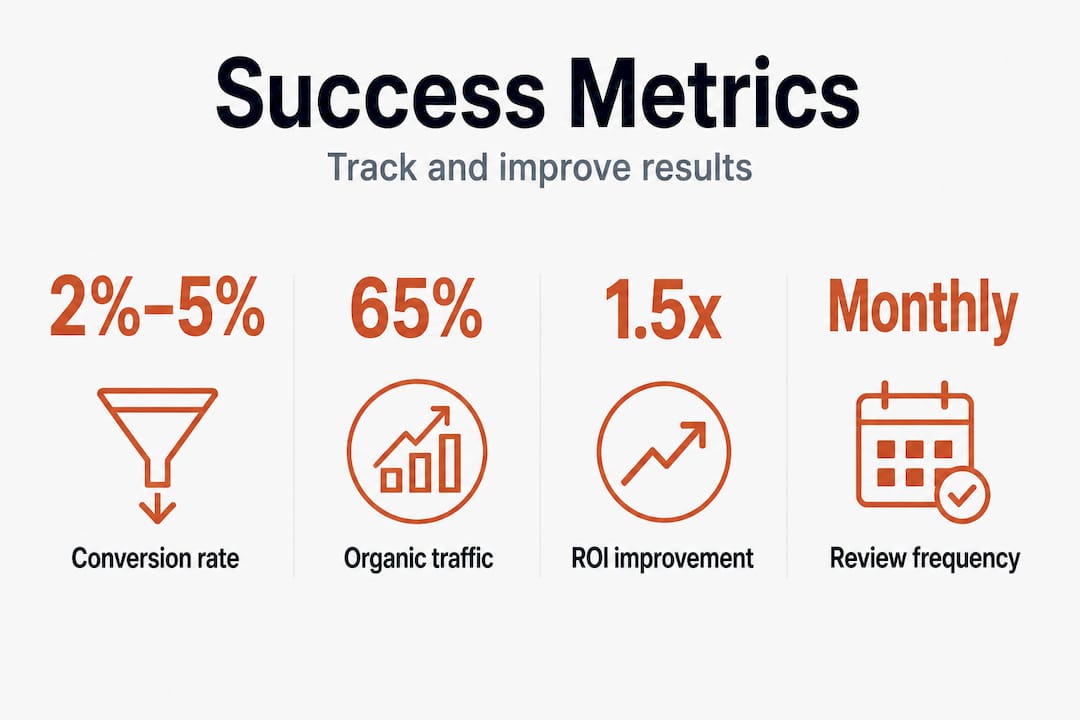
Google Analytics 4 is free and gives you all of this data in one place. Set up a simple monthly review where you look at these four or five numbers and ask: what improved, what did not, and what one change will I test next month?
Pro Tip: Create a simple one-page scorecard in a spreadsheet. Record your key metrics at the end of each month. After three months you will have a clear picture of your trend lines and will know exactly where to focus your energy.
Our view: What most digital marketing guides miss
Most beginner guides will tell you to set up your profiles, post consistently, and measure your results. That advice is not wrong. But there is a deeper truth that rarely gets said plainly: your strategy in the first 12 months should be boring by design.
We see it repeatedly. A new client comes to us having spent six months chasing the latest trends, whether it is a viral video format, a new social platform, or a trendy ad type. They have impressive follower counts and zero enquiries. Meanwhile, a competitor with a plain website, a well-optimised Google profile, and a weekly email newsletter is quietly generating consistent leads every month.
The businesses that win online in their first year are not the ones with the most creative campaigns. They are the ones who resist what we call “shiny object syndrome.” They set up smart marketing for SMBs on a foundation of three or four fundamentals and repeat them with discipline until they compound into real results.
The uncomfortable truth is that most digital marketing fails not because the tactics were wrong, but because the business owner got bored or distracted before the tactics had time to work. SEO takes months. Email lists take months to grow. Trust with an audience takes months to build. None of that is exciting. All of it is effective.
Our strongest advice: do less, but do it every single week without fail. Fewer channels. Tighter focus. Longer commitment. That is what produces the transformative results that look effortless from the outside.
Ready to accelerate your digital marketing success?
If this guide has given you clarity on where to start, you are already ahead of most small business owners. The next step is putting that knowledge into action with the right support behind you.
At Kickass Online, we work with a select number of small and medium-sized businesses at a time, which means you get focused, personalised attention rather than a one-size-fits-all template. Whether you need help building your first strategy, optimising your website for search, or making sense of your results, we bring the expertise to make it happen faster. Explore our digital marketing strategies for SMEs or dig into proven growth strategies that have delivered real results for businesses just like yours. Book a free consultation and let us map out exactly what your next 90 days should look like.
Frequently asked questions
What is the easiest digital marketing channel for beginners?
Setting up and regularly updating a simple website or being active on one social platform is the most accessible starting point, as foundational tools are the backbone of any beginner’s strategy.
How soon should I expect results from my digital marketing efforts?
Most small businesses see initial improvements within three to six months when their strategy is consistent, as ongoing measurement and iteration accelerate results over time.
Do I need to use paid advertising when starting out?
Paid ads can increase visibility quickly, but beginners typically see stronger long-term returns by building organic channels like SEO and social media first before committing ad spend. A clear strategy will show you when the time is right to add paid activity.
What is the biggest mistake to avoid with digital marketing as a beginner?
Attempting too many channels at once, setting vague goals, or abandoning the plan too early are the most common errors, and research confirms that skipping strategy is what most often undermines beginner results.
How do I know if my digital marketing is working?
Track website visitors, leads, and online enquiries monthly against your original goals. Consistent measurement is what turns guesswork into informed decisions that improve your results over time.
Recommended
- SME digital marketing strategy: step-by-step guide | Kickass Online
- Proven digital marketing strategies for small business success | Kickass Online
- Build an ecommerce digital marketing strategy: grow sales | Kickass Online
- Boost results with a digital marketing content strategy | Kickass Online
- Create digital ads faster with AI for better ROI - Palmador Blog


Book A Discovery Call
Stay Connected