How a performance based marketing agency drives SME growth

TL;DR:
- Email marketing offers UK SMEs an ROI of 4.2x to 8.5x, outperforming many channels.
- Performance-based agencies charge only when specific results like sales or leads are achieved.
- Most SMEs undervalue these agencies, often sticking with ineffective partners due to comfort.
Most UK small business owners assume paid social or Google Ads deliver the best marketing returns. The reality is quite different. Email marketing provides an ROI of 4.2x to 8.5x for UK SMEs, outperforming nearly every other channel. Yet many businesses continue pouring budget into tactics that look impressive on paper but fail to move the needle. A performance based marketing agency changes that equation entirely, tying every penny spent to a measurable outcome and giving you the clarity and confidence to grow faster.
Table of Contents
- What is a performance based marketing agency?
- Key performance benchmarks for UK SMEs
- How a performance based marketing agency works with your business
- Best channels for performance marketing and SME success
- How to choose the right performance based marketing agency
- Why most SMEs undervalue performance-based agencies — and what to do instead
- Ready to maximise your results with a performance-focused partner?
- Frequently asked questions
Key Takeaways
| Point | Details |
|---|---|
| Performance over promises | Agencies that tie their fees to your results ensure genuine accountability for SME growth. |
| Email’s unmatched ROI | Email campaigns deliver the best return on investment for UK small businesses. |
| Benchmarks guide strategy | Knowing industry-standard metrics like ROAS and conversion rates helps set realistic goals and evaluate agency performance. |
| Channel choice matters | Selecting the right mix of PPC, SEO, and email is key to maximising returns and sustaining SME growth. |
| Transparent agency selection | Prioritise clear reporting, proven outcomes, and goal alignment when choosing a performance-based partner. |
What is a performance based marketing agency?
Performance based marketing is straightforward in principle: you pay for results, not just services. Instead of handing over a monthly retainer and hoping for the best, you agree on specific outcomes upfront. Those outcomes might be leads generated, sales completed, or clicks that convert. The agency earns its fees only when those outcomes are delivered.
This model stands in sharp contrast to traditional agency arrangements. A traditional agency typically charges for deliverables such as blog posts, ad creatives, or campaign management hours. Whether those deliverables actually grow your business is a separate question. With a performance based agency, that question is the only one that matters.
Common performance based pricing models include:
- Pay per click (PPC): You pay each time a user clicks your ad. Costs are directly tied to traffic volume.
- Pay per acquisition (CPA): You pay only when a visitor completes a defined action, such as a purchase or a form submission.
- Revenue share: The agency takes a percentage of revenue generated through their campaigns, fully aligning their incentive with yours.
- Cost per lead (CPL): You pay a fixed amount for each qualified lead delivered to your sales pipeline.
The key advantage for SMEs is reduced financial risk. You are not funding an agency’s activity. You are funding outcomes. As performance-based fees ensure alignment with business outcomes rather than just activity, this model keeps agencies genuinely motivated to perform.
| Model | What you pay for | Best suited to |
|---|---|---|
| Pay per click | Each ad click | Brand awareness, traffic growth |
| Pay per acquisition | Each completed sale or sign-up | E-commerce, lead generation |
| Revenue share | Percentage of sales | Scaling businesses with strong margins |
| Cost per lead | Each qualified enquiry | Service businesses, B2B |
Pro Tip: Before signing any performance based agreement, define exactly what counts as a “result.” Vague definitions lead to disputes. Agree on specific, measurable targets and track them through your own analytics as well as the agency’s.
Understanding performance marketing strategies in detail will help you ask sharper questions when evaluating potential agency partners.
Key performance benchmarks for UK SMEs
Knowing what results to expect is essential before committing to any marketing investment. Without benchmarks, you cannot tell whether an agency is genuinely delivering or simply presenting data that sounds impressive.
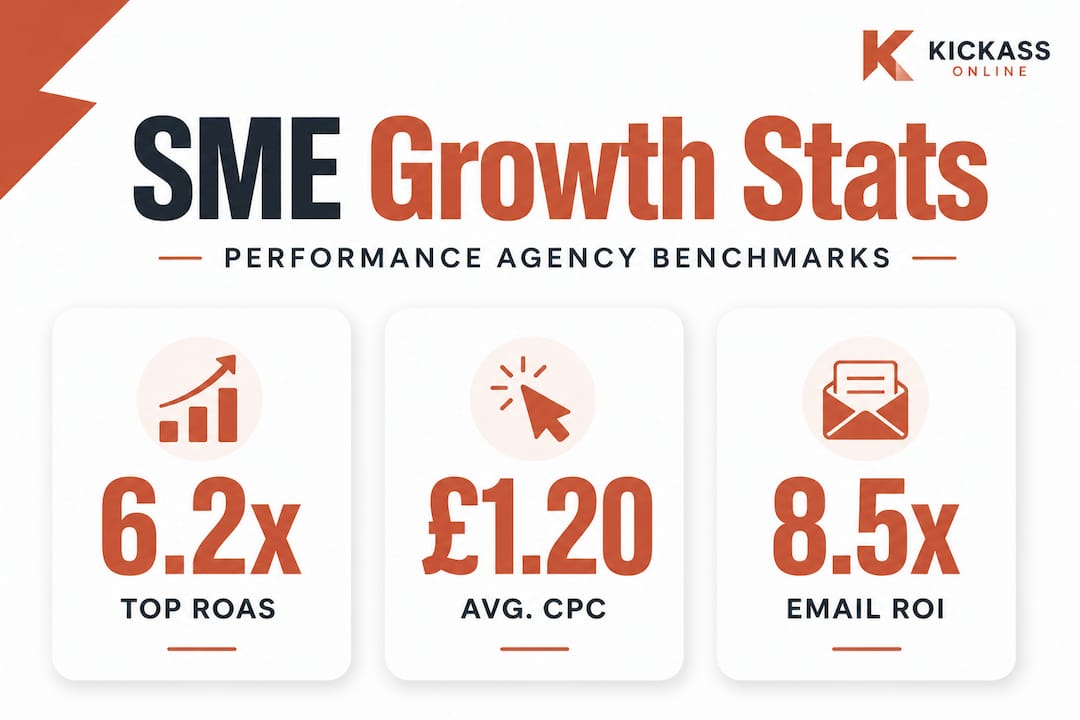
Research into the UK SMB market reveals some clear patterns. Median ROAS ranges from 2.5x to 6.2x across channels, with Google Shopping achieving the highest at 3.8x to 6.2x for e-commerce businesses. That means for every £1 spent on Google Shopping ads, well-optimised SME campaigns return between £3.80 and £6.20 in revenue.
Key UK SME benchmarks to keep in mind:
- Average cost per click (CPC) in the UK sits between £0.65 and £3.93, depending on sector and competition
- Median conversion rates for UK SMEs range from 1.8% to 4.8%
- Email marketing delivers 4.2x to 8.5x ROI, making it the standout performer across all channels
- Social media advertising typically achieves ROAS of 2.5x to 3.5x, solid but trailing email and Google Shopping
| Channel | Typical ROAS | Average CPC | Conversion rate |
|---|---|---|---|
| Google Shopping | 3.8x–6.2x | £0.65–£1.20 | 3.2%–4.8% |
| Google Search | 2.5x–4.5x | £1.50–£3.93 | 2.0%–3.5% |
| Social media ads | 2.5x–3.5x | £0.80–£2.50 | 1.8%–2.8% |
| Email marketing | 4.2x–8.5x | N/A | 2.5%–4.5% |
These figures matter because they give you a realistic baseline. If an agency promises you a 15x ROAS from day one, something does not add up. Understanding ROI benchmarks for SMEs helps you separate genuine expertise from overblown sales pitches.
It is also worth tracking the right important marketing KPIs from the start of any campaign. Metrics like customer acquisition cost (CAC), lifetime value (LTV), and click-through rate (CTR) tell a far richer story than impressions or follower counts ever will.
How a performance based marketing agency works with your business
The process of working with a performance based agency follows a clear arc. Understanding each stage helps you get more from the relationship and ensures you are contributing the right information at the right time.

1. Discovery and goal-setting
The agency begins by understanding your business model, target audience, existing marketing activity, and revenue goals. This is not a box-ticking exercise. The quality of this conversation directly shapes the strategy that follows.
2. Baseline audit
Before launching anything new, a thorough audit of your current digital presence is essential. This covers your website performance, existing ad accounts, email lists, SEO rankings, and analytics setup. The audit reveals where you are losing potential customers right now.
3. Channel selection and strategy
Based on your goals and audit findings, the agency recommends the most appropriate channels. A service business in the Midlands targeting local clients will need a very different mix from an e-commerce brand selling nationally. Agencies continually adjust channel mix for optimal ROAS and conversion rates as campaigns mature.
4. Campaign launch and tracking
Every campaign is set up with robust tracking from day one. This means conversion tracking, goal completions in analytics, and clear attribution so you know exactly which channel drove each result.
5. Regular performance reviews
Transparent, scheduled reporting keeps you informed without overwhelming you with data. Good agencies present results in plain language, explain what is working and what is not, and propose adjustments before problems compound.
6. Ongoing optimisation
Performance marketing is not a set-and-forget activity. Budgets shift, audiences evolve, and competitors react. The agency continuously refines bids, creative, targeting, and landing pages based on real data.
“The best performance based agencies treat your budget as if it were their own. Every decision is justified by data, not habit.”
Pro Tip: Ask any prospective agency to walk you through a real client case study, including what went wrong and how they fixed it. How an agency handles underperformance tells you far more than their success stories.
Improving your PPC optimisation and investing in conversion rate strategies will amplify the results your agency achieves, because better landing pages mean more of that hard-won traffic actually converts.
Best channels for performance marketing and SME success
Not every channel suits every business. A performance based agency’s value lies partly in its ability to match your specific goals and audience to the channels most likely to deliver. Here is how the main options stack up for UK SMEs.
PPC advertising
Pay per click campaigns on Google and Bing deliver fast results. You can be visible in search results within hours of launching. The challenge is cost management. Without careful monitoring, budgets can erode quickly on competitive keywords. PPC works best when paired with strong landing pages and clear conversion goals.
SEO (search engine optimisation)
SEO builds organic visibility over time. It takes longer to see results compared to PPC, but the returns compound. A page that ranks well for a valuable keyword continues driving traffic without ongoing spend. For UK SMEs with a longer planning horizon, SEO often delivers the strongest cost-per-acquisition over twelve months or more. Reviewing SEO best practices for UK businesses is a useful starting point.
Email marketing
Email is consistently the highest-performing channel for UK SMEs. Email marketing produces the highest ROI at 4.2x to 8.5x, which means a well-managed email programme can outperform your entire paid advertising budget combined. The reason is simple: you own your email list. There are no algorithm changes, no rising CPCs, and no platform dependency. Exploring email marketing ROI strategies and email marketing best practices will help you build a programme that genuinely performs.
Social media advertising
Paid social on platforms like Meta and LinkedIn can be highly effective for audience building and retargeting. It works particularly well when combined with a strong email and SEO foundation. As a standalone channel, however, it rarely matches the ROI of email or Google Shopping for most UK SMEs.
How agencies choose the right mix:
- Sector: Retail and e-commerce tend to benefit most from Google Shopping and email
- Audience: B2B businesses often see stronger results from LinkedIn and SEO
- Budget: Smaller budgets favour email and SEO; larger budgets can support PPC alongside these
- Timeline: Short-term goals suit PPC; long-term growth suits SEO and email
Pro Tip: Resist the temptation to spread your budget thinly across every channel. A focused approach on two or three well-chosen channels will almost always outperform a diluted presence across six.
How to choose the right performance based marketing agency
Selecting the right agency is arguably the most important decision in this entire process. The wrong choice wastes time, money, and momentum. The right choice accelerates your growth significantly.
Follow these steps when evaluating agencies:
-
Review case studies from similar UK businesses. Generic success stories are not enough. You want evidence that the agency has delivered results in your sector, at your budget level, for businesses of your size.
-
Scrutinise the fee structure. Ensure fees are tied to outcomes, not activity. If an agency cannot clearly explain what triggers their invoice, that is a warning sign.
-
Ask about reporting frequency and format. You should receive regular, clear reports that you can actually understand. Dashboards full of vanity metrics are not useful. Ask to see a sample report before signing anything.
-
Assess their channel expertise. An agency that claims to be expert in every channel is almost certainly mediocre at most of them. Look for genuine depth in the two or three channels most relevant to your goals.
-
Check for cultural fit. You will be sharing sensitive business data with this agency. You need to trust them. A good working relationship matters as much as technical capability.
Checklist for agency selection:
- Proven UK market experience in your sector
- Clear, outcome-based pricing with no hidden fees
- Transparent reporting with regular scheduled reviews
- Demonstrable expertise in your priority channels
- Strong client references willing to speak openly
- Transparency in reporting and proven benchmarks, which are crucial selection factors
Pro Tip: Run a small paid trial campaign before committing to a long-term contract. A genuine performance based agency will welcome this because they are confident in their ability to deliver results quickly.
Why most SMEs undervalue performance-based agencies — and what to do instead
Here is an uncomfortable truth: most UK SMEs stay with underperforming marketing partners far too long. The reason is not ignorance. It is comfort. A familiar agency, even a mediocre one, feels safer than the uncertainty of switching.
Traditional agencies are skilled at presenting activity as progress. Monthly reports full of impressions, reach figures, and engagement rates create the impression of momentum. But impressions do not pay salaries. Reach does not cover rent. What matters is whether your marketing investment is generating measurable revenue growth.
The shift to a performance-centred approach feels risky at first because it removes the comfortable ambiguity. Suddenly, the results are clear. The agency either delivers or it does not. That accountability cuts both ways. It means you can no longer hide behind vague metrics either. Your conversion rates, your pricing, your website speed, all of these become visible factors in the outcome.
In our experience, the SMEs that grow fastest are the ones willing to embrace that transparency. They treat their marketing partner as a genuine business collaborator, not a supplier. They share revenue data, customer feedback, and sales cycle information. In return, they get strategies built on reality rather than assumptions.
The practical first step is smaller than most business owners expect. Run a single performance based campaign on one channel, set a clear target, and measure the outcome honestly. That single experiment often changes how you think about marketing investment permanently.
Ready to maximise your results with a performance-focused partner?
At Kickass Online, we work with a carefully selected number of UK SMEs to deliver measurable growth through performance-driven digital marketing and professional web development. Our approach is built on accountability, not activity.
Whether you need digital marketing strategies for SMEs that are tied to real outcomes, a high-converting website through our expert web development service, or targeted SEO services that build lasting organic visibility, we bring the expertise and the accountability that growing businesses need. We limit our client intake deliberately, so every business we work with receives focused, dedicated attention. Book a consultation today and find out exactly what performance based marketing can do for your growth.
Frequently asked questions
What is the average return on ad spend (ROAS) for UK SMEs using performance-based marketing?
Median ROAS ranges from 2.5x to 6.2x across channels, with Google Shopping achieving the highest at up to 6.2x for e-commerce SMEs.
Which marketing channel typically delivers the best ROI for UK SMEs?
Email is the top-performing channel, with average ROI of 4.2x to 8.5x for UK small businesses, outperforming paid social and most PPC channels.
How do performance based marketing agencies charge for their services?
They typically bill on results such as sales, leads, or acquisitions generated, meaning fees align with outcomes rather than hours worked or content produced.
What should I look for when choosing a performance based agency?
Prioritise UK market experience, transparent reporting and benchmarks, and a fee structure that is clearly tied to the results you actually care about.
Can web development affect my marketing performance metrics?
Yes, a well-designed, fast-loading website directly improves conversion rates, meaning every pound spent on paid ads, SEO, and email marketing delivers stronger returns.
Recommended
- What a digital marketing agency really does for SMBs | Kickass Online
- Grow your SME with a digital marketing strategist | Kickass Online
- Boost Your SME’s Growth and Revenue with Content Marketing | Kickass Online
- Effective Digital Marketing Strategies for SMEs: Boost Your Online Performance | Kickass Online
- What a Marketing Agency for Small Business Actually Does (and Why You Need One) - City Web Company | Digital Marketing Agency
- Digital marketing for SMEs: essentials to drive growth|BM


Book A Discovery Call
Stay Connected