Build an ecommerce digital marketing strategy: grow sales

TL;DR:
- Multi-channel marketing helps UK SMEs improve visibility and drive consistent sales.
- Focusing on 2-3 effective channels like SEO and social video yields better results.
- Consistent measurement and small incremental improvements sustain ecommerce growth.
Standing out in the UK’s online marketplace is harder than it sounds. With thousands of ecommerce businesses competing for the same customers, a scattered approach to digital marketing simply will not cut it. The good news is that multi-channel marketing gives UK SMEs a proven framework to win visibility and drive consistent sales. In this article, we walk you through every stage of building a results-driven ecommerce digital marketing strategy, from auditing your current position to scaling what actually works. Whether you are just starting out or refining an existing approach, you will leave with a clear, actionable plan.
Table of Contents
- Assessing your business and digital opportunities
- Planning the right mix of ecommerce marketing channels
- Executing your ecommerce digital marketing campaigns
- Measuring, adapting, and scaling your strategy
- What most SME e-commerce strategies overlook
- Get expert help with your ecommerce digital marketing
- Frequently asked questions
Key Takeaways
| Point | Details |
|---|---|
| Know your business | Audit your strengths, weaknesses and customer needs before launching new marketing campaigns. |
| Choose effective channels | Select marketing channels based on where your audience spends time and the ROI potential. |
| Integrate for impact | Combining SEO, PPC, Email and Social gives the best chance of ecommerce growth. |
| Track, adapt, repeat | Measure results regularly and refine your strategy to scale what works. |
Assessing your business and digital opportunities
With an understanding of what’s at stake, you must first know where you stand digitally. Before spending a single penny on ads or content, you need an honest picture of your strengths, weaknesses, and opportunities. This audit stage saves you from wasting budget on channels that do not suit your business or your customers.
Start by clarifying your core business goals. Are you trying to grow revenue, increase repeat purchases, or break into a new UK region? Each goal points to a different set of tactics. Alongside your goals, document your unique selling proposition clearly. What makes you genuinely different from competitors? If you cannot answer that in one sentence, your marketing will struggle to land.
Next, build out your customer personas. Think beyond basic demographics. Consider your customers’ locations across UK regions, their preferred devices, and whether they need multilingual support strategies if you serve diverse communities. Regional nuances matter enormously in the UK, from language preferences in Wales to distinct buying habits in Scotland versus London.
Now audit your current digital assets: your website, social profiles, email list, and content library. Score each one honestly.
| Digital asset | Current state | Priority action |
|---|---|---|
| Website | Slow, not mobile-friendly | Improve speed and UX |
| Email list | Small but engaged | Grow and segment |
| Social profiles | Active on Instagram only | Expand to relevant channels |
| Content library | Blog posts, no video | Add short-form video |
Finally, map out which channels suit your audience. The five core channels in a multi-channel marketing strategy are:
- SEO: Long-term organic traffic from search engines
- PPC: Paid ads for immediate, targeted visibility
- Email: Direct communication with existing and prospective customers
- Social and video: Community building and brand awareness
- Content: Educational material that earns trust and backlinks
Choosing the right two or three channels to start with is far more effective than spreading yourself thin across all five.
Planning the right mix of ecommerce marketing channels
Once you know your baseline and goals, it’s time to select and prepare the right marketing channels. Not every channel will suit every SME, and committing too many resources to the wrong one is a common and costly mistake.
Here is a quick comparison of the five main channels to help you prioritise:
| Channel | Time to results | Typical cost | Best for |
|---|---|---|---|
| SEO | 3 to 6 months | Low to medium | Long-term organic growth |
| PPC | Immediate | Medium to high | Fast visibility, product launches |
| Days to weeks | Low | Retention, promotions | |
| Social and video | Weeks to months | Low to medium | Brand awareness, engagement |
| Content | 1 to 6 months | Low | Trust building, SEO support |
The data is clear: 77% of UK businesses invest in SEO, and short-form social video consistently achieves the highest engagement rates. These two data points alone suggest that SEO and social video should feature in almost every UK SME’s channel mix.
Here is a step-by-step approach to integrating your first two channels:
- Choose your primary channel based on your audience’s habits and your budget. Most SMEs do well starting with SEO.
- Set up tracking before you create any content. Install Google Analytics and Search Console.
- Build your content plan around keywords your customers are actually searching for.
- Select a secondary channel that complements your primary one. Email pairs well with SEO; social video pairs well with PPC.
- Create a content calendar that keeps both channels fed consistently, even at a modest pace.
- Review after 60 days and double down on what shows early traction.
The SEO and PPC combination is particularly powerful for ecommerce launches, where you need quick sales while building organic rankings in the background. For lifestyle or fashion brands, a strong social media strategy paired with video marketing for SMEs tends to generate excellent engagement.
Pro Tip: Record one piece of long-form content each month, then repurpose it into short social clips, a blog post, and an email newsletter. You get four assets from one effort.
Executing your ecommerce digital marketing campaigns
With your channels ready, you’re now set to execute campaigns in a way that maximises impact. Planning is worthless without disciplined execution, and execution fails without clear processes.
Here is how to launch a typical product promotion campaign using email and social:
- Define your campaign goal specifically. “Increase sales of Product X by 20% in 14 days” is actionable. “Boost awareness” is not.
- Create your core assets: product images, short video clips, email copy, and a dedicated landing page.
- Set up your landing page with a clear headline, benefit-led copy, and a single call to action. Remove all distractions.
- Schedule your emails in a sequence: a teaser three days before launch, a launch-day email, and a follow-up for non-openers. Following email marketing best practices at this stage dramatically improves open rates.
- Publish social content to match the email schedule, using short-form video where possible for maximum reach.
- Install conversion tracking so you know exactly which touchpoint drove each sale.
“The brands that win online are not the ones with the biggest budgets. They are the ones that show up consistently, follow up persistently, and measure everything.”
Avoid these common execution mistakes:
- Ignoring your campaign data mid-flight and waiting until the end to review
- Inconsistent branding across email, social, and landing pages
- Failing to follow up with customers after a purchase, which kills repeat revenue
- Overlooking referral marketing tips as a low-cost amplifier
To increase email ROI, segment your list by purchase history and send personalised offers rather than blanket promotions. Email marketing delivers £36 back for every £1 spent, which makes it the single highest-returning channel available to UK SMEs. Pair it with strong video content tips for your social posts and you have a campaign engine that is both high-reach and high-converting.

Pro Tip: Plan your biggest campaigns around the UK retail calendar. Black Friday, January sales, and Bank Holiday weekends are peak buying windows. Schedule campaign assets at least three weeks in advance to avoid last-minute chaos.
Measuring, adapting, and scaling your strategy
Executing campaigns is not the end; continuous measurement and adaptation fuel sustainable growth. Too many UK SMEs launch campaigns, glance at a few numbers, and move on. The businesses that grow consistently treat measurement as an ongoing practice, not a one-off task.
Track these metrics across every active channel:
- Traffic: Total visits, new versus returning, and traffic source breakdown
- Conversions: Add-to-basket rate, checkout completion rate, and overall conversion rate
- Engagement: Email open and click-through rates, social shares, comments, and saves
- ROI per channel: Revenue attributed to each channel divided by its cost
- Customer lifetime value: How much each customer spends over time, not just per transaction
When you spot underperformance, adapt before abandoning. If your email open rate drops, test a new subject line before scrapping the whole sequence. If organic traffic stalls, review your keyword targeting before switching off SEO investment entirely.
Scaling works best when you automate what is already performing well. Use email automation for post-purchase sequences and abandoned basket reminders. Use paid social to amplify organic content that is already gaining traction. Video content consistently sees the highest engagement across platforms, so when a video performs organically, putting modest budget behind it as a paid post is a low-risk way to expand its reach.
For broader growth, consider expanding into new channels once your core two or three are stable. Multi-channel integration becomes easier once you have strong content assets and a reliable measurement process in place. Use a simple test-measure-learn cycle: run a small experiment, measure the result against your baseline, learn what worked, and repeat at scale.
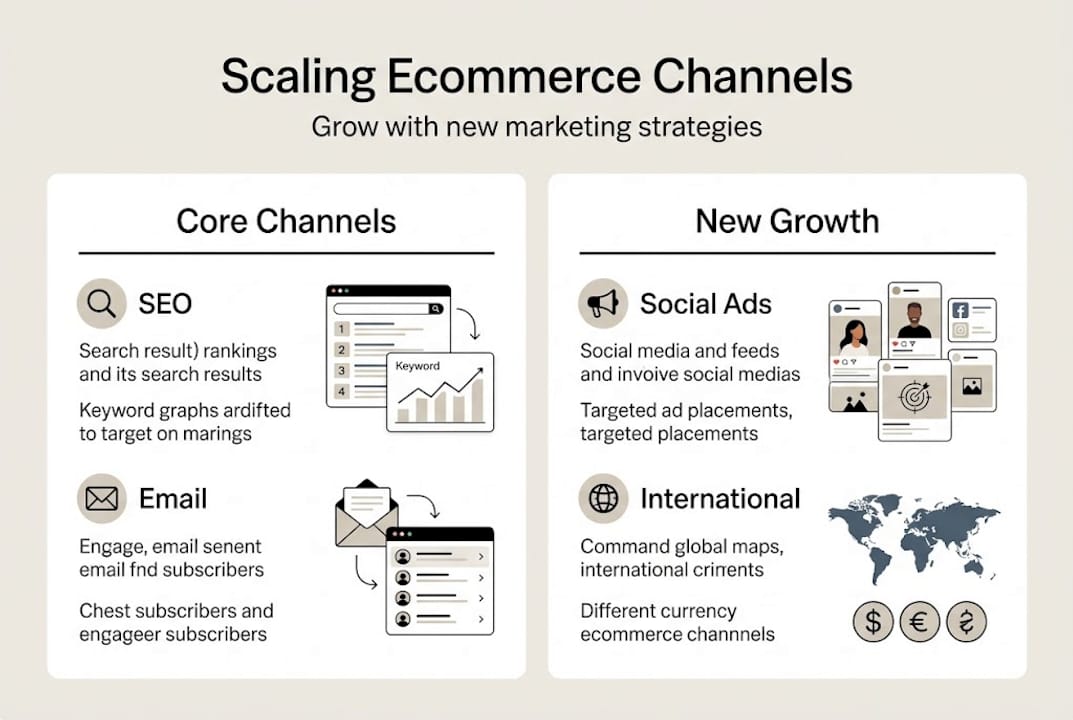
Enhancing customer engagement with multilingual support is also worth exploring if your customer base spans multiple language communities across the UK. It is a genuine differentiator that very few SMEs take advantage of.
What most SME e-commerce strategies overlook
After learning the nuts and bolts, it’s worth considering what really separates successful SMEs from the pack. And honestly, it is rarely the tactics.
Most struggling SMEs are not failing because they picked the wrong channel or wrote poor email copy. They are failing because they keep chasing the next shiny tactic instead of doing the basics brilliantly and repeatedly. We see it constantly: businesses invest in a flashy influencer campaign, get a short spike, then abandon their email list and SEO foundations because the spike felt exciting.
The SMEs that outperform their competitors year after year are almost always the ones running simple, integrated, repeatable systems. They know their numbers. They run small monthly experiments. They make incremental improvements instead of dramatic pivots.
If your strategy feels overwhelming, strip it back. Pick two channels, execute them consistently for six months, measure rigorously, and then add complexity. Sustainable growth in ecommerce is built on compounding small wins, not one-off campaigns. The most powerful thing you can do right now is commit to a simpler strategy and see it through.
Get expert help with your ecommerce digital marketing
If you’re ready to amplify your results with expert support, here’s where to start. Building and maintaining a high-performing ecommerce digital marketing strategy takes time, skill, and consistent attention. For most SME owners, that is time better spent running the business.
At Kickass Online, we work with a select number of UK SMEs at a time, which means every client gets genuine focus and tailored strategy. Whether you need a full review of your digital marketing strategies for SMEs, a targeted set of SEO audits for SMEs, or a brand new website design company in Bucks to build your conversion-ready platform, we have the specialists to deliver it. Book a consultation and let’s build something that actually grows your business.
Frequently asked questions
Which digital marketing channel offers the best ROI for ecommerce?
Email marketing yields the highest ROI, with an average return of £36 for every £1 spent, making it essential for any ecommerce business.
How do I decide which marketing channels my ecommerce business should use?
Base your choice on your customers’ habits, your business goals, and the resources you can realistically commit, as multi-channel integration works best when it matches your actual capacity.
How often should I measure and adapt my ecommerce marketing strategy?
Review your key metrics and adjust your approach at least once a month, or immediately after each campaign ends, to stay responsive to what the data is telling you.
Is SEO still important for UK e-commerce businesses in 2026?
Absolutely. 77% of UK businesses still invest in SEO, and it remains the most reliable source of long-term organic traffic for ecommerce sites.
Recommended
- Digital marketing for small business growth: what works | Kickass Online
- Smart digital marketing strategy: grow your SMB in 2026 | Kickass Online
- Effective Digital Marketing Strategies for SMEs: Boost Your Online Performance | Kickass Online
- Boost Your E-Commerce Sales with These Optimisation Tips | Kickass Online
- Top referral marketing tips to maximize savings and customers


Book A Discovery Call
Stay Connected