Website Uptime – Why Reliability Matters Most

Many e-commerce owners know the frustration when a customer tries to check out, only to find the site unresponsive. For businesses in Milton Keynes, site reliability is not just about avoiding embarrassing moments. It is a key factor that protects sales and reputation. Understanding website uptime provides the foundation for delivering trustworthy shopping experiences and keeping your business accessible when it matters most.
Table of Contents
- Website Uptime Meaning And Common Myths
- Types Of Uptime And Availability Measures
- How Uptime Is Calculated And Monitored
- Risks And Costs Of Low Uptime For Businesses
- Key Strategies To Maximise Website Uptime
- Comparing Uptime Guarantees And Alternatives
Key Takeaways
| Point | Details |
|---|---|
| Importance of Uptime | Website uptime is crucial for business success, as even minimal downtime can lead to significant revenue loss and damage to brand reputation. |
| Metrics Distinction | Understanding the difference between uptime and availability metrics allows organisations to accurately assess performance and service quality. |
| Comprehensive Monitoring | Employing advanced monitoring tools and multiple measurement strategies is essential for proactively managing website performance and minimising downtime. |
| Uptime Guarantees | Assessing uptime service level agreements (SLAs) is critical for ensuring reliable service; even slight differences in availability percentages can have substantial effects on operational continuity. |
Website uptime meaning and common myths
Website uptime represents the percentage of time a website remains fully operational and accessible to users without interruption. Website reliability metrics typically measure continuous availability, calculating the precise duration a site functions correctly versus total monitored time.
Contrary to popular misconceptions, website uptime isn’t simply about being online occasionally. It encompasses consistent performance, rapid response times, and uninterrupted user access. Professional hosting providers often guarantee specific uptime percentages, with top-tier services promising 99.9% availability or higher. These benchmarks translate into critical business metrics - even minutes of downtime can represent substantial revenue losses for digital enterprises.
Common myths surrounding website uptime include believing occasional brief interruptions are insignificant or that manual monitoring suffices. In reality, sophisticated businesses utilise automated monitoring tools that track performance continuously, detecting potential issues before they escalate. Comprehensive uptime tracking helps organisations proactively manage digital infrastructure, ensuring seamless user experiences and maintaining brand reputation.
Pro tip: Invest in robust monitoring solutions that provide real-time alerts and comprehensive performance analytics to minimise potential downtime risks.
Types of uptime and availability measures
Understanding the nuanced differences between uptime and availability is crucial for businesses seeking comprehensive performance insights. Uptime measurement techniques reveal critical distinctions in how system performance is evaluated, with each metric offering unique perspectives on digital infrastructure reliability.
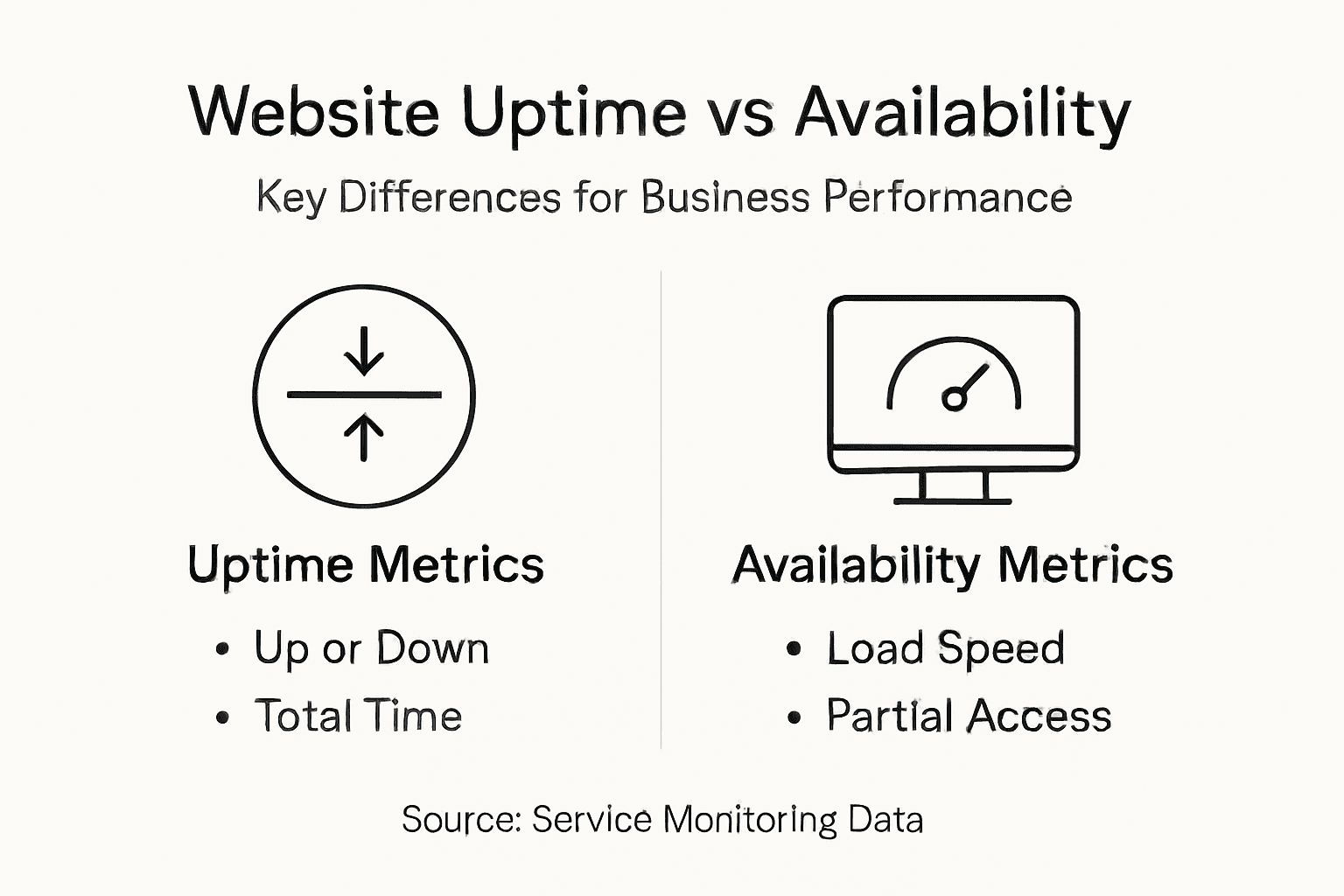
Traditional uptime metrics provide a binary assessment of system operational status - essentially measuring whether a system is functioning or completely offline. This approach offers a straightforward calculation of total operational time versus total downtime. In contrast, availability metrics offer a more sophisticated analysis, capturing the subtleties of system performance beyond simple operational status. These advanced measurements consider factors such as response times, error rates, and partial service degradations that might not trigger a complete system shutdown.
Professional organisations typically employ multiple measurement approaches to gain comprehensive insights. Comprehensive service reliability tracking involves monitoring both pure uptime percentages and more nuanced availability indicators. Some critical measurement types include:
Here’s a summary contrasting uptime and availability metrics commonly used in digital infrastructure:
| Metric Type | What It Measures | Business Relevance |
|---|---|---|
| Uptime Percentage | On/off operational status | Identifies outright outages |
| Performance Availability | Latency and partial issues | Detects slow or degraded service |
| User Experience Availability | Real usability impacts | Reveals customer-facing problems |
| Maintenance Availability | Planned downtime inclusion | Aids in compliance and planning |
- Total Uptime Percentage: Simple calculation of operational hours
- Performance Availability: Includes latency and partial service issues
- User Experience Availability: Measures actual usability from end-user perspective
- Scheduled Maintenance Availability: Accounts for planned system interruptions
Pro tip: Implement multi-layered monitoring strategies that capture both uptime and detailed availability metrics to gain a holistic understanding of your digital infrastructure’s true performance.
How uptime is calculated and monitored
Uptime calculation methods provide critical insights into digital infrastructure reliability by converting operational performance into precise mathematical measurements. The fundamental approach involves tracking a system’s total operational time against its total monitored time, expressed as a percentage that reveals the true consistency of digital services.
The mathematical process involves a straightforward yet precise calculation. Technicians divide the total operational time by the complete monitored period, then multiply by 100 to generate a percentage. Monitoring techniques range from basic interval checks to sophisticated real-time tracking systems that continuously validate system status. These approaches capture nuanced performance data, including brief service interruptions, partial degradations, and complete system outages.
Professional monitoring strategies typically employ multiple verification methods to ensure accuracy. Comprehensive downtime verification involves cross-referencing data from multiple monitoring points, eliminating potential false positive reports. Organisations often utilise advanced tools that:
- Track system status at frequent intervals
- Log detailed performance metrics
- Generate immediate alerts for potential issues
- Provide historical performance analysis
- Create comprehensive reporting dashboards
Pro tip: Implement multi-source monitoring with overlapping verification points to maximise the accuracy of your uptime measurements and quickly identify potential service disruptions.
Risks and costs of low uptime for businesses
Business downtime consequences can be catastrophic, transforming seemingly minor technical interruptions into significant financial and reputational challenges. For small and medium enterprises, even brief website outages represent more than just temporary inconvenience - they can trigger cascading negative impacts that threaten overall business sustainability.

The financial implications of low uptime extend far beyond immediate revenue loss. Downtime costs encompass multiple layers of economic damage, including lost sales opportunities, reduced customer confidence, and increased operational recovery expenses. Large enterprises might face losses reaching thousands of pounds per minute of system unavailability, while smaller businesses can experience proportionally devastating economic disruptions that compromise their competitive positioning.
Beyond direct monetary losses, hidden downtime impacts create long-term challenges for organisational reputation and customer trust. Repeated service interruptions can permanently damage brand perception, leading to customer churn, negative word-of-mouth marketing, and potentially irreparable harm to hard-earned market credibility. Critical business risks include:
- Immediate revenue interruption
- Customer trust erosion
- Increased support and recovery costs
- Potential contractual penalty exposures
- Competitive market disadvantage
Pro tip: Develop a comprehensive incident response plan that outlines precise steps for minimising downtime impact and communicating transparently with customers during service interruptions.
Key strategies to maximise website uptime
Website uptime monitoring strategies require a comprehensive, multi-layered approach that combines technological tools, proactive management, and strategic planning. Successful uptime optimisation goes beyond simple technical interventions, demanding a holistic understanding of potential performance vulnerabilities and systematic risk mitigation techniques.
Technical infrastructure plays a critical role in maintaining consistent website availability. Performance optimization involves selecting robust hosting solutions, implementing content delivery networks, and ensuring server configurations can handle anticipated traffic loads. This approach includes regular performance audits, identifying potential bottlenecks, and upgrading infrastructure components before they become critical failure points.
Scalable monitoring approaches emphasise implementing intelligent alert systems and comprehensive monitoring protocols. Key strategic elements include:
- Utilising multi-location monitoring tools
- Establishing rapid incident response mechanisms
- Configuring automated performance alerts
- Conducting regular infrastructure health checks
- Implementing redundant system architectures
- Maintaining detailed performance documentation
Pro tip: Develop a comprehensive incident response playbook that outlines specific steps for addressing potential downtime scenarios, ensuring your team can react swiftly and efficiently to any technical disruptions.
Comparing uptime guarantees and alternatives
Uptime service level agreements represent critical contractual commitments that define expected operational reliability for digital services. These sophisticated agreements translate technical performance metrics into tangible promises that protect businesses from prolonged service interruptions.
The landscape of uptime guarantees ranges from basic 99% availability to exceptional 99.999% (‘five nines’) reliability standards. Each percentage point represents dramatically different potential downtime durations, with significant implications for business continuity. A seemingly minor difference between 99.9% and 99.99% can translate to hours of potential annual service interruption, making careful evaluation essential for organisations seeking robust digital infrastructure.
Alternative reliability strategies extend beyond simple percentage commitments. Professional organisations increasingly focus on comprehensive approaches that include:
- Redundant system architectures
- Proactive monitoring protocols
- Rapid incident response mechanisms
- Multi-location service distribution
- Automated failover systems
- Detailed performance logging
Typical uptime guarantee tiers include:
To better understand the impact of different uptime levels, see the following business-focused comparison:
| Uptime Level | Annual Downtime | Typical Business Effect |
|---|---|---|
| 99% | 3.65 days | Frequent disruptions, major losses |
| 99.9% | 8.76 hours | Noticeable incidents, revenue risk |
| 99.99% | 52.56 minutes | Minor interruptions, reduced risk |
| 99.999% (‘five nines’) | 5.26 minutes | Near-continuous service, high trust |
- 99% Availability: Approximately 3.65 days of potential annual downtime
- 99.9% Availability: Approximately 8.76 hours of potential annual downtime
- 99.99% Availability: Approximately 52.56 minutes of potential annual downtime
- 99.999% Availability: Approximately 5.26 minutes of potential annual downtime
Pro tip: Always request detailed service level agreement documentation and understand the precise compensation mechanisms for potential service interruptions before committing to any hosting or infrastructure provider.
Ensure Your Website Stays Up and Running Seamlessly with Kickass Online
Website uptime is vital for your business success because every moment offline means lost revenue and eroded customer trust. If you have experienced the frustration of unexpected downtime or struggled to maintain consistent website performance, you are not alone. Our team understands the importance of concepts like uptime guarantees, real-time performance availability, and proactive monitoring that were highlighted in the article. We know that maximising uptime means protecting your brand reputation and avoiding costly disruptions.
Explore practical insights and expert guidance in our Tutorials | Kickass Online to deepen your understanding of website reliability.

Take control of your online presence today by partnering with Kickass Online. We specialise in creating resilient, high-performing websites tailored specifically for small and medium-sized businesses. Our dedicated team focuses on Websites | Kickass Online services combining professional design, robust hosting strategies, and continuous maintenance that ensure exceptional uptime and fast load times. Do not wait until downtime hurts your business reach out now at https://kickassonline.com to book your personalised consultation and secure a website that never lets you down.
Frequently Asked Questions
What does website uptime mean?
Website uptime measures the percentage of time a website is operational and accessible to users without interruptions. It is a critical metric for evaluating website reliability and can impact business performance significantly.
How is website uptime calculated?
Website uptime is calculated by dividing total operational time by the total monitored time, then multiplying by 100 to express it as a percentage. Accurate measurement involves continuous monitoring of performance to capture both downtime and service degradations.
What is the difference between uptime and availability?
While uptime refers to whether a system is operational, availability considers additional factors like response times and service degradations. Availability gives a more nuanced insight into user experience and system performance.
Why does low website uptime matter for businesses?
Low website uptime can lead to significant financial losses, reduced customer trust, and long-term reputational damage. Even brief outages can disrupt sales, negatively affect user experience, and create operational challenges.
Recommended
- Website Maintenance: Why It Matters for SMEs | Kickass Online
- 7 Reasons Why Your Business Needs a Responsive Website | Kickass Online
- Best Website Maintenance Services & Packages in London, UK
- The Importance of Regular Website Maintenance: Keep It Updated | Kickass Online
- Building Authority Through Content: Elevate Trust and Rankings


Book A Discovery Call
Stay Connected