SEO Optimization Workflow for Business Growth Success

Over 90 percent of online experiences begin with a search, yet most sites never reach the first page of results. Strong SEO is the deciding factor between getting noticed or being overlooked in crowded markets. Understanding every crucial step, from setting clear goals to analyzing competitors and tracking your progress, can set your website apart. In this guide, you will discover practical ways to strengthen your digital presence and drive meaningful growth.
Table of Contents
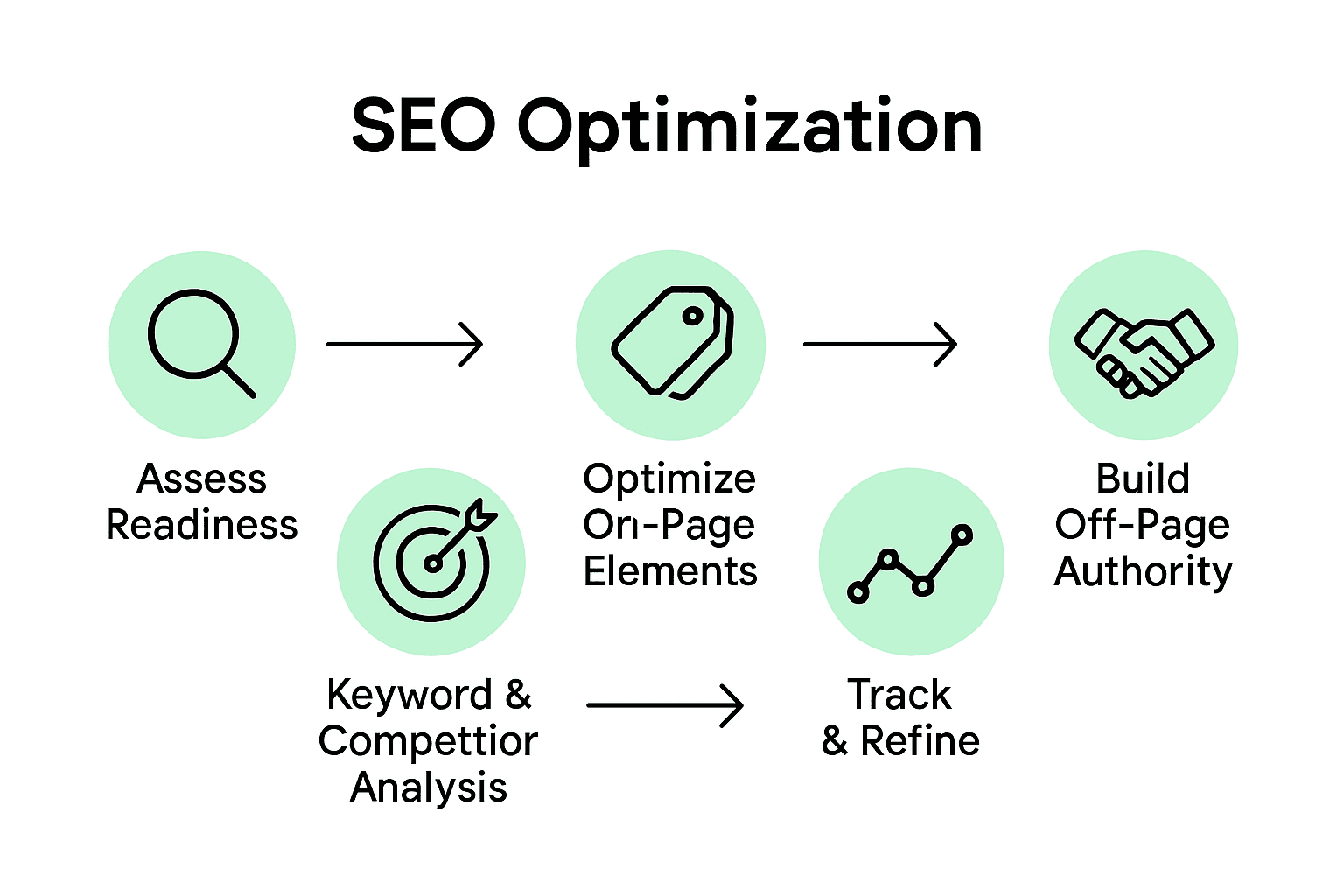
- Step 1: Assess Website Readiness And Set Clear SEO Goals
- Step 2: Conduct In-Depth Keyword And Competitor Analysis
- Step 3: Optimize On-Page Elements For Maximum Visibility
- Step 4: Enhance Off-Page SEO And Build Authority
- Step 5: Track Results And Refine SEO Strategies
Quick Summary
| Key Point | Explanation |
|---|---|
| 1. Assess Website Readiness Thoroughly | Conduct a detailed website audit focusing on loading speed, content relevance, and mobile responsiveness to identify areas for improvement. |
| 2. Perform Comprehensive Keyword Analysis | Identify primary and long-tail keywords that resonate with user intent to enhance strategic visibility and competitive positioning. |
| 3. Optimize On-Page Elements Effectively | Refine title tags, meta descriptions, and content structure to improve search visibility and user engagement through targeted SEO techniques. |
| 4. Enhance Off-Page SEO and Authority | Build high-quality backlinks and authoritative content while engaging with industry influencers to boost credibility and search rankings. |
| 5. Track Results for Continuous Improvement | Implement a robust tracking system to monitor SEO performance metrics, allowing for data-driven adjustments to strategies over time. |
Step 1: Assess Website Readiness and Set Clear SEO Goals
In this critical first stage of SEO optimization, you will systematically evaluate your website’s current performance and establish precise, measurable goals that align with your business growth objectives. According to research from ijarsct, investing in advanced SEO tools and thoroughly understanding your digital landscape is fundamental to success.
To begin, conduct a comprehensive website audit that examines multiple performance dimensions. The 8C model highlighted in arxiv offers an excellent framework for this assessment, focusing on key areas like content quality, user experience, and technical functionality. Start by reviewing your current website through these critical lenses: assess your site’s loading speed, mobile responsiveness, content relevance, keyword optimization, and overall user navigation experience.
Key steps in your website readiness assessment include:
- Perform a technical SEO scan to identify structural issues
- Analyse your current keyword rankings and search visibility
- Review website content for relevance and user engagement
- Check mobile compatibility and page performance metrics
- Benchmark against top competitors in your industry
As you progress, set specific, measurable SEO goals that are realistic and time bound. These might include improving organic search rankings for specific keywords, increasing website traffic by a defined percentage, or reducing bounce rates. By establishing clear objectives, you create a roadmap for strategic SEO improvements that directly support your broader business growth ambitions.
Step 2: Conduct In-Depth Keyword and Competitor Analysis
In this critical stage of SEO optimization, you will dive deep into understanding the keyword landscape and analyzing your competitors strategic positioning. According to research from arxiv, effective keyword analysis goes beyond simple ranking metrics and requires sophisticated extraction techniques that evaluate keyword significance through advanced centrality measures.
Your keyword and competitor analysis should encompass a comprehensive approach that combines multiple strategic elements. Begin by identifying primary and long-tail keywords relevant to your business using tools that provide search volume, competition level, and user intent insights. Using long-tail keywords can offer significant strategic advantages, particularly for businesses targeting specific market segments.
Key steps in your keyword and competitor analysis include:
- Map out your primary industry keywords
- Identify high-value long-tail keyword opportunities
- Analyze competitors keyword strategies
- Evaluate search intent behind each keyword
- Assess keyword difficulty and potential ranking opportunities
Research from arxiv highlights the importance of integrating multiple business aspects into your analytical approach, suggesting that successful keyword strategy requires more than just technical metrics. By combining quantitative data with qualitative insights, you can develop a nuanced understanding of your competitive landscape and create a targeted SEO strategy that drives meaningful business growth.

Step 3: Optimize On-Page Elements for Maximum Visibility
In this crucial stage of SEO optimization, you will transform your website into a search engine magnet by strategically refining every on-page element to boost visibility and user engagement. According to research from iiste, understanding and implementing targeted on-page optimization techniques is fundamental to capturing your desired market segments.
Begin by conducting a comprehensive audit of your website’s core on-page elements. SEO elements play a critical role in effective web design, so focus on optimizing key components such as title tags, meta descriptions, header structures, and content relevance. Ensure each page has a unique, keyword-rich title that accurately describes the content while maintaining natural readability. Craft meta descriptions that not only include target keywords but also entice users to click through from search results.
Key steps in optimizing on-page elements include:
- Perform a detailed content audit
- Optimize title tags with targeted keywords
- Create compelling meta descriptions
- Improve header structure and content hierarchy
- Ensure content matches search intent
- Implement internal linking strategies
- Optimize image alt texts and file names
Research from Wikipedia highlights that superior knowledge of your competitive landscape provides a legitimate advantage. By meticulously optimizing your on-page elements, you can strategically position your website to exploit potential weaknesses in competitors’ approaches, ultimately improving your search engine visibility and user engagement.
Step 4: Enhance Off-Page SEO and Build Authority
In this critical stage of SEO optimization, you will strategically expand your website’s digital influence and establish powerful external signals that boost your search engine credibility. According to research from Similarweb, understanding and implementing a comprehensive off-page SEO strategy is fundamental to building your online authority and outperforming competitors.
Your off-page SEO efforts should focus on creating a robust network of high-quality backlinks and developing authoritative content that attracts natural external references. Understanding the power of high-quality backlinks is crucial for SEO success, so prioritize building relationships with reputable websites in your industry. Start by identifying potential link-building opportunities through guest posting, collaborative content creation, expert interviews, and strategic partnerships that align with your brand’s expertise.
Key steps in enhancing off-page SEO and building authority include:
- Conduct a comprehensive competitor backlink analysis
- Develop exceptional content that naturally attracts links
- Engage in industry forums and professional communities
- Create shareable infographics and original research
- Participate in expert roundups and collaborative projects
- Leverage social media platforms for content distribution
- Build relationships with industry influencers and thought leaders
Research from Yahini emphasizes the importance of identifying content and keyword gaps in your market. By strategically positioning your content to address these gaps and consistently delivering high-value, authoritative information, you can progressively build your website’s reputation and domain authority in your specific industry niche.
Step 5: Track Results and Refine SEO Strategies
In this crucial final stage of SEO optimization, you will transform raw data into actionable insights that continuously improve your digital performance. According to research from Increv, measuring the impact of your content marketing requires a comprehensive approach that goes beyond surface level metrics to understand true business value.
Improving your website’s SEO metrics requires strategic tracking and analysis, so implement a robust monitoring system that captures multiple performance dimensions. Begin by establishing a baseline of key performance indicators including organic traffic, keyword rankings, conversion rates, bounce rates, and average session duration. Utilize advanced analytics tools to create customised dashboards that provide real time insights into your SEO performance.
Key steps in tracking results and refining SEO strategies include:
- Set up comprehensive tracking in Google Analytics and Search Console
- Monitor keyword ranking movements and trends
- Analyse user behaviour and engagement metrics
- Compare performance against initial benchmarks
- Identify top performing and underperforming content
- Track conversion rates and revenue impact
- Conduct regular competitor performance comparisons
Research from Direction highlights the importance of evaluating competitor performance as part of your ongoing SEO refinement process. By continuously measuring, analyzing, and adapting your strategies based on concrete data, you can create a dynamic SEO approach that responds quickly to market changes and maintains your competitive edge.
Unlock Your Business Growth with Expert SEO and Web Solutions
Struggling to turn your SEO efforts into real business growth could leave your website unseen and your goals unmet. This article reveals essential steps like thorough website readiness evaluation, strategic keyword analysis, and building authoritative backlinks that can transform your online presence. You need more than just knowledge—you need tailored action that addresses issues such as poor keyword positioning, weak content relevance, and missed opportunities in off-page SEO.
At Kickass Online, we understand the frustration of navigating complex SEO workflows without clear results. Our focused team specialises in crafting personalised digital strategies that boost search engine visibility and drive measurable traffic growth. From outstanding Websites built for conversions to proven optimisation techniques documented in our Recommendations section, every solution is created with your business goals in mind.

Take control of your digital success today by partnering with Kickass Online. Don’t wait for your competitors to outpace you with better SEO. Visit Kickass Online to explore how our dedicated approach delivers results that matter now. Book a consultation and start turning your SEO optimisation workflow into a powerful growth engine.
Frequently Asked Questions
How do I assess my website readiness for SEO optimization?
Begin by conducting a comprehensive website audit that evaluates content quality, user experience, and technical functionality. Focus on aspects like loading speed, mobile responsiveness, and navigation to identify improvement areas.
What specific SEO goals should I set for my business growth?
Set clear and measurable SEO goals that align with your business objectives, such as improving keyword rankings or increasing website traffic by a specific percentage. Aim for targets like boosting organic search traffic by 25% within six months.
How do I perform in-depth keyword analysis for my SEO strategy?
Conduct a thorough keyword analysis by identifying primary and long-tail keywords relevant to your business and assessing their search volume and competition. Look for long-tail opportunities that can drive more targeted traffic and lead to higher conversion rates.
What on-page elements should I optimize to enhance my site’s SEO?
Focus on optimizing title tags, meta descriptions, header structures, and content relevance to improve on-page SEO. Ensure each page contains unique, keyword-rich titles and engaging meta descriptions that encourage users to click through.
What are effective strategies for building authority through off-page SEO?
Enhance your off-page SEO by creating high-quality backlinks and engaging in content marketing strategies like guest posting or industry partnerships. Regularly produce exceptional content, aiming to gain at least five backlinks from reputable sources within three months.
How can I track and refine my SEO performance over time?
Set up comprehensive tracking using analytics to monitor key performance indicators such as organic traffic and keyword rankings. Regularly review this data to identify areas for improvement and adjust your SEO strategies accordingly, aiming for continuous enhancements every quarter.
Recommended


Book A Discovery Call
Stay Connected