
Most british businesses in Milton Keynes lose valuable customers due to confusing website layouts and poor navigation. When visitors cannot find what they need within seconds, they are quick to leave, impacting sales and reputation. With over 90 percent of users prioritising sites that are easy to browse and search engines favouring well-structured pages, understanding site architecture can be the difference between thriving online and getting lost in the crowd. This guide reveals practical strategies for organising your website, making it both user-friendly and attractive to search engines.
Table of Contents
- Defining Site Architecture And Key Concepts
- Core Types And Structural Approaches
- How Site Architecture Drives SEO Success
- Benefits For User Experience And Conversion
- Mistakes To Avoid With Business Websites
Key Takeaways
| Point | Details |
|---|---|
| Effective Site Architecture is Crucial | A well-structured site enhances user navigation and improves search engine optimisation, leading to higher visibility and user satisfaction. |
| Choose the Right Structure | Depending on your content type, opt for a suitable architectural model that aligns with user journey requirements and content complexity. |
| Regular Audits Are Essential | Conduct periodic reviews of site architecture to streamline navigation and eliminate unnecessary complexity for better user experience. |
| Avoid Common Mistakes | Prevent issues such as complicated navigation and unclear calls to action by prioritising user-centric design in your website’s architecture. |
Defining Site Architecture and Key Concepts
Website architecture represents the strategic planning and organisation of digital spaces, much like an architectural blueprint guides physical construction. Just as architects carefully map building layouts, web designers craft intricate digital environments that enable seamless user navigation and optimal functionality.
At its core, site architecture involves systematically structuring website content, pages, and interconnections to create logical, intuitive pathways for visitors. Effective site design encompasses understanding how different website elements interact, ensuring users can easily find information while search engines efficiently crawl and index content.
The fundamental components of robust site architecture include:
- Site hierarchy: Organising content from broad categories to specific pages
- Navigation structure: Creating clear, predictable menu systems
- Internal linking: Connecting related content strategically
- URL structure: Developing readable, meaningful web addresses
- Information flow: Designing pathways that guide users through content logically
Expert Tip: Regularly audit your website’s architecture to identify and eliminate unnecessary complexity, ensuring users can always find what they need within three clicks.
Core Types and Structural Approaches
Website architecture encompasses several distinct structural approaches, each designed to address specific digital communication and user experience objectives. Understanding these different architectural models helps businesses create more targeted, efficient online platforms that effectively serve their strategic goals.
Linear site architecture represents the most straightforward approach, where pages connect sequentially like chapters in a book. Structural design principles emphasise creating logical progression and predictable navigation paths. This model works exceptionally well for websites with clear, step-by-step content such as tutorials, product guides, or instructional materials.
Alternative structural approaches include:
Here is a comparison of key website architectural models and when they work best:
| Architectural Model | Structure Type | Typical Use Case | Main Advantage |
|---|---|---|---|
| Linear | Sequential | Step-by-step guides, tutorials | Simple navigation flow |
| Hierarchical | Parent-child tree | Corporate or educational websites | Easy content scaling |
| Database-driven | Dynamic content | E-commerce, news sites | Personalised experience |
| Flat | Minimal layers | Small business, landing pages | Quick information access |
| Networked | Interconnected clusters | Large blogs, knowledge bases | Rich cross-referencing |
- Hierarchical architecture: Organising content in parent-child relationships
- Database-driven architecture: Dynamic content generation based on user interactions
- Flat architecture: Minimising navigation depth with direct page access
- Networked architecture: Complex interconnections between multiple content sections
Pro Tip: Choose your website’s structural approach by mapping out user journey requirements and content complexity, ensuring seamless information accessibility.
How Site Architecture Drives SEO Success
Search engine optimisation depends critically on a website’s underlying structural design, with site architecture serving as the fundamental framework that determines online visibility and ranking potential. Strategic site architecture directly influences how search engines discover, crawl, and index website content, making it a pivotal factor in digital marketing success.

The primary mechanism through which site architecture impacts SEO involves creating clear, logical pathways for both search engine crawlers and human visitors. Websites with intuitive navigation, hierarchical content organisation, and strategic internal linking enable search engines to understand content relationships more efficiently. This understanding translates into improved indexing, potentially boosting page rankings and increasing organic search visibility.
Key SEO benefits of robust site architecture include:
The table below summarises how site architecture choices benefit both SEO and user experience:
| Site Architecture Feature | SEO Impact | User Experience Benefit |
|---|---|---|
| Logical navigation | Improved crawlability | Faster content discovery |
| Hierarchical structure | Efficient indexing | Reduced decision fatigue |
| Internal linking | Stronger topic authority | Smoother content exploration |
| Clear URLs | Enhanced search visibility | Predictable page paths |
- Improved crawlability: Enabling search engines to discover content quickly
- Enhanced user experience: Reducing navigation complexity
- Stronger internal linking: Creating topical content clusters
- Efficient indexing: Helping search engines understand content hierarchy
- Reduced bounce rates: Providing intuitive user journeys
Pro Tip: Conduct a quarterly site architecture audit to identify and remove unnecessary complexity, ensuring your website remains search engine friendly and user-centric.
Benefits for User Experience and Conversion
Effective site architecture serves as the backbone of exceptional user experience, directly influencing how visitors interact with and navigate through digital platforms. Information architecture principles demonstrate that thoughtful content organisation can dramatically improve user engagement, reducing frustration and increasing the likelihood of conversion.
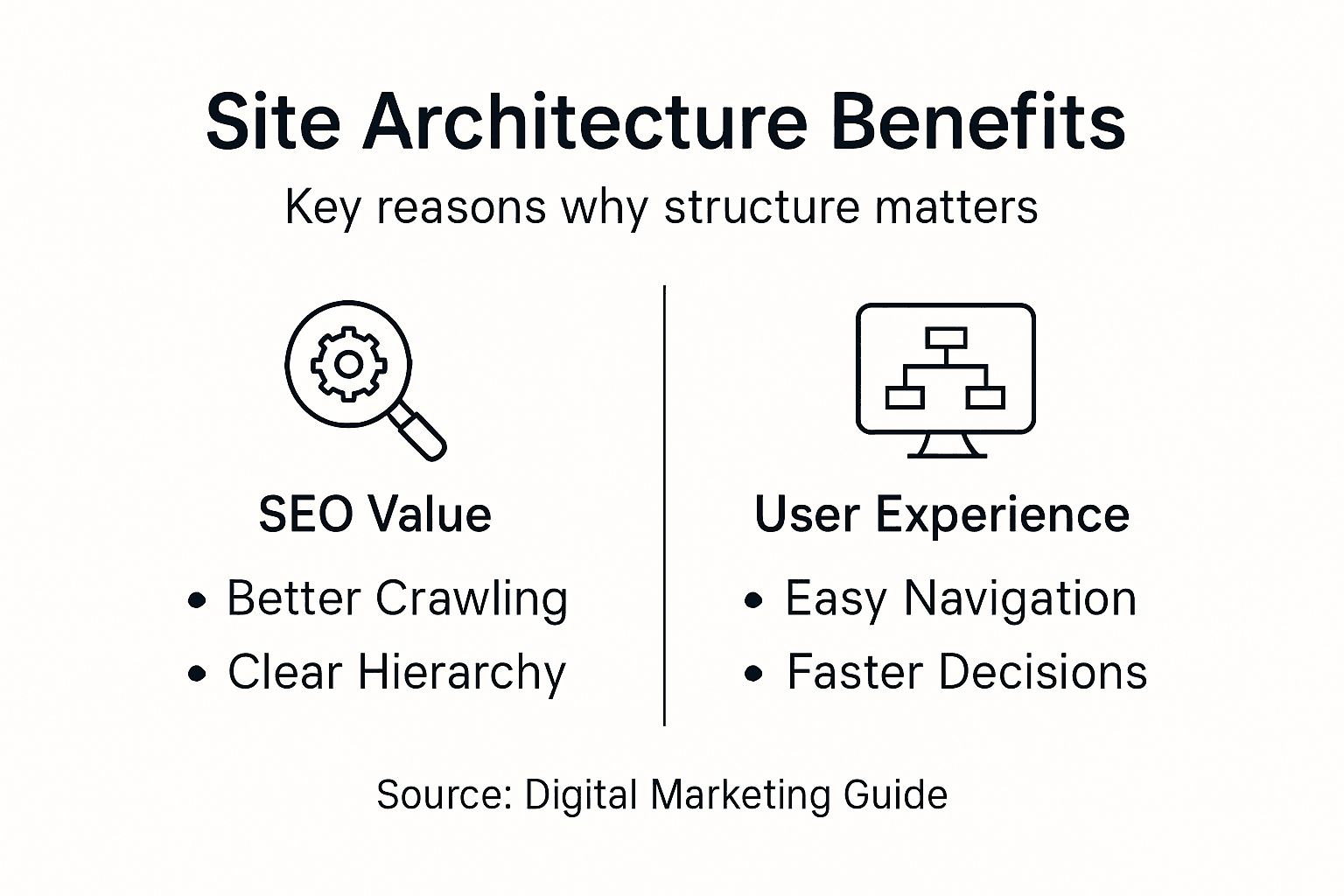
The connection between site architecture and user experience runs deep, impacting everything from initial page load to final conversion moment. Websites with intuitive navigation structures allow users to find information quickly, reducing cognitive load and creating a smoother, more enjoyable browsing experience. This streamlined approach not only keeps visitors on the site longer but also builds trust and credibility, critical factors in converting casual browsers into committed customers.
Key user experience and conversion benefits include:
- Reduced cognitive friction: Minimising user decision-making effort
- Faster information discovery: Enabling quick access to relevant content
- Improved user confidence: Creating predictable and reliable navigation
- Enhanced engagement: Encouraging deeper exploration of website content
- Increased conversion potential: Simplifying user pathways to desired actions
Pro Tip: Regularly map and analyse user journeys to identify and eliminate potential navigation barriers, ensuring your site architecture continuously evolves to meet user needs.
Mistakes to Avoid with Business Websites
Business websites often stumble into critical architectural pitfalls that can significantly undermine their digital presence and potential for customer engagement. Site architecture mistakes can create barriers that prevent potential customers from accessing crucial information, ultimately damaging business credibility and conversion potential.
Common architectural errors frequently stem from a lack of strategic planning and insufficient understanding of user behaviour. Websites that prioritise aesthetic design over functional navigation create frustrating user experiences, leading to high bounce rates and lost opportunities. Complex menu structures, unclear pathways, and inconsistent information organisation can confuse visitors, causing them to abandon the site before completing desired actions.
Key mistakes businesses must avoid include:
- Overcomplicated navigation: Creating multiple layers that obscure key information
- Inconsistent page layouts: Disrupting user expectations and mental models
- Poor mobile responsiveness: Failing to adapt design across different devices
- Slow page loading: Neglecting performance optimisation
- Unclear call-to-action placement: Hiding critical conversion points
Pro Tip: Conduct regular user testing and analyse website analytics to identify and eliminate navigation barriers, ensuring your site architecture remains user-friendly and goal-oriented.
Unlock Your Website’s True Potential with Expert Site Architecture Solutions
Struggling with complex navigation or unclear site structure can frustrate your visitors and lower your search engine rankings. This article highlights the importance of logical site hierarchies, internal linking, and user-friendly navigation to boost SEO and conversion rates. At Kickass Online, we understand these challenges and specialise in crafting tailored digital strategies that create intuitive, high-converting websites for small and medium-sized businesses.

Transform your online presence now by partnering with a team that prioritises clear site architecture and seamless user journeys. Visit Kickass Online to explore our personalised web development services designed to enhance your website’s SEO and user experience. Book a consultation today and let us build a strategic digital foundation that drives growth and keeps your visitors engaged.
Frequently Asked Questions
What is site architecture?
Site architecture refers to the strategic planning and organisation of website content, pages, and interconnections, creating logical pathways for users and search engines to navigate.
Why is site architecture important for SEO?
Robust site architecture significantly impacts SEO by facilitating efficient crawling and indexing by search engines, leading to improved visibility and potentially higher rankings in search results.
How can I improve my website’s architecture for better user experience?
You can enhance your website’s architecture by simplifying navigation, maintaining a clear hierarchy, implementing effective internal linking, and ensuring quick access to information, thus creating a more intuitive experience for users.
What are common mistakes in website architecture that businesses should avoid?
Common mistakes include overcomplicated navigation, inconsistent page layouts, poor mobile responsiveness, slow loading times, and unclear call-to-action placements, all of which can frustrate users and reduce conversion rates.