
- Small businesses can achieve significant revenue growth by partnering with digital marketing agencies. Agencies offer specialised, integrated services that outperform in-house capabilities, especially for SMBs looking for scalable and cost-effective solutions. Measuring success through clear KPIs and strategic collaboration maximises ROI and sustainable growth.
Most small business owners assume digital marketing agencies are reserved for big brands with deep pockets. That assumption is costing them growth. 74% of SMEs see revenue growth within 12 months of working with a digital agency, with an average revenue uplift of 30%. These are not Fortune 500 companies. They are businesses much like yours, running lean teams and competing in crowded markets. This guide breaks down exactly what a digital marketing agency does, how it delivers measurable results, and how you can make the partnership work from day one. No fluff, just the practical detail you need to make a confident decision.
Table of Contents
- What does a digital marketing agency actually do?
- How agencies drive measurable business growth
- Agency vs in-house: What’s best for growing businesses?
- Keys to choosing and maximising your agency partnership
- Why the real value of digital agencies is more than just services
- Unlock your growth with expert digital support
- Frequently asked questions
Key Takeaways
| Point | Details |
|---|---|
| Specialised skills and tools | Agencies grant SMBs access to advanced marketing expertise and technologies without high fixed costs. |
| Proven revenue growth | Partnering with a digital agency typically delivers significant year-on-year business gains, often surpassing in-house efforts. |
| Success needs clear KPIs | Defining objectives and tracking ROI from the start avoids wasted spend and ensures agency partnerships deliver results. |
| Pick the right model | Weigh agency versus in-house based on growth goals, budget, and available expertise for your stage of business. |
What does a digital marketing agency actually do?
A digital marketing agency is not a single service. It is a team of specialists covering multiple disciplines, all working towards one goal: growing your business online. Understanding what is on offer helps you decide which services your business actually needs right now.
The core services agencies provide typically fall into six categories. Search engine optimisation (SEO) improves your visibility in Google search results, bringing in organic traffic without paying for every click. Pay-per-click advertising (PPC) puts your business in front of buyers who are actively searching, with spend you can control precisely. Social media marketing builds brand awareness and community on platforms where your customers spend their time. Content marketing creates useful, trust-building material that attracts and educates your audience over time. Email and SMS automation keeps existing customers engaged and nurtures new leads through personalised sequences. Web design and conversion rate optimisation (CRO) ensures your website turns visitors into paying customers rather than bouncing them away.
Here is a snapshot of what agencies typically deliver for SMBs:
- Monthly SEO audits and keyword strategy updates
- Paid ad campaign management across Google and Meta
- Social content calendars and community management
- Blog posts, landing pages, and lead magnets
- Automated email sequences and list segmentation
- Website redesigns, speed improvements, and A/B testing
The comparison below shows why most SMBs struggle to replicate this in-house:
| Service | In-house capability | Agency capability |
|---|---|---|
| SEO | Limited, often reactive | Proactive, data-driven, specialist-led |
| PPC | Basic setup, high waste | Optimised campaigns, lower cost per click |
| Content | Irregular, low volume | Consistent, strategic, audience-focused |
| Web design/CRO | One-off builds | Ongoing testing and improvement |
| Analytics | Basic reporting | Full attribution and ROI tracking |
The key difference is depth. An in-house generalist can cover the basics, but agencies bring specialists to each discipline. When you explore digital marketing strategies for SMEs, you quickly realise that piecemeal tactics without a joined-up strategy rarely move the needle. Agencies connect the dots between channels, so each service amplifies the others.

How agencies drive measurable business growth
Understanding the services is one thing. Seeing the impact in real numbers is where it gets compelling.
The headline figure is hard to ignore. Businesses working with digital agencies report 347% ROI on local SEO campaigns, and 74% see meaningful revenue increases within a year. These are not cherry-picked outliers. They reflect what happens when a business stops guessing and starts using data to make decisions.
The key metrics agencies use to track progress include:
- Customer acquisition cost (CAC): How much it costs to win one new customer
- Return on investment (ROI): Revenue generated relative to marketing spend
- Conversion rate (CR): The percentage of visitors who take a desired action
- Email open rates: Engagement benchmarks showing list health and content relevance
Here is a simplified before-and-after picture for a typical SMB:
| Metric | Before agency | After 12 months |
|---|---|---|
| Monthly website traffic | 800 visits | 3,200 visits |
| Conversion rate | 1.2% | 3.8% |
| Cost per lead | £45 | £18 |
| Monthly revenue from digital | £4,000 | £14,500 |
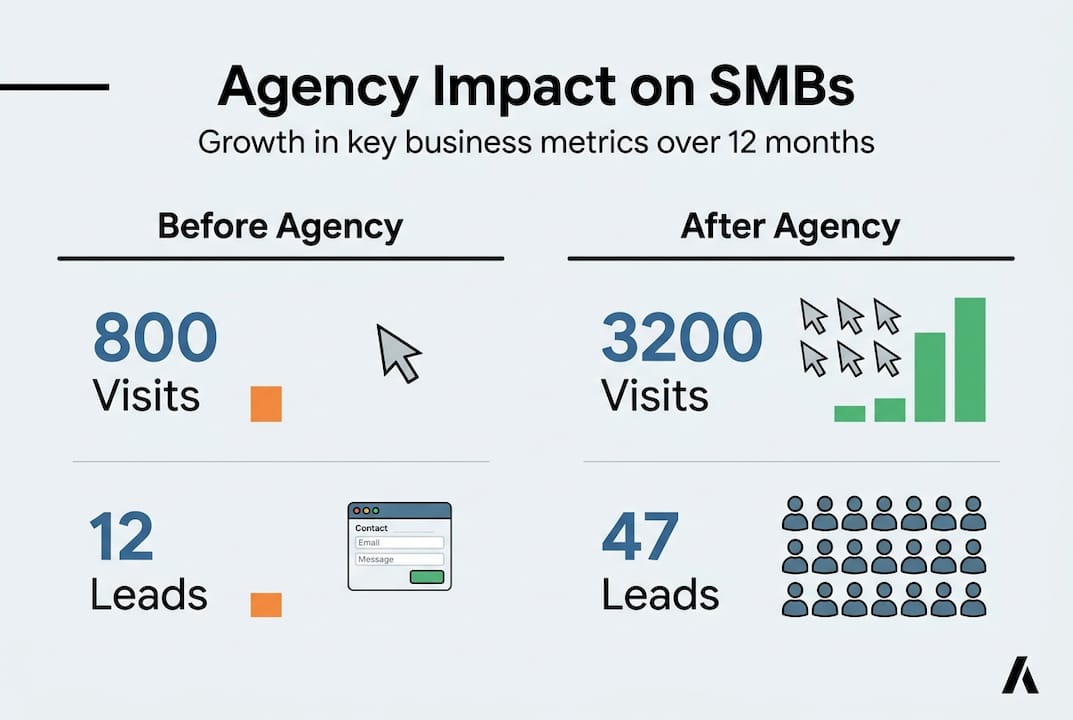
These figures are not guaranteed, but they illustrate what consistent, well-tracked digital marketing can achieve. The difference is almost always measurement. Businesses that track digital marketing ROI from the start make smarter decisions faster.
Here is how to start measuring your own results:
- Set a baseline: record your current traffic, leads, and revenue from digital channels
- Define your KPIs before any campaign launches, not after
- Connect your ad platforms to your CRM so you can track leads to revenue
- Review marketing KPIs for SMEs monthly and adjust based on what the data shows
- Separate vanity metrics (likes, impressions) from business metrics (leads, sales, retention)
The businesses that see the strongest results are not always those with the biggest budgets. They are the ones who treat measurement as a discipline, not an afterthought.
Agency vs in-house: What’s best for growing businesses?
With the value case clear, SMBs face a crucial decision: partner with an agency or build an in-house team?
The cost difference alone is striking. Agencies typically cost £60,000 to £180,000 per year for a full-service retainer, while assembling an equivalent in-house team runs £400,000 to £800,000 when you factor in salaries, tools, training, and management overhead. For most SMBs, that comparison ends the debate quickly.
But cost is not the only consideration. Here is a balanced view:
Agency advantages:
- Immediate access to specialists across SEO, PPC, design, and analytics
- Scalable up or down based on business needs and budget
- No recruitment, onboarding, or HR overhead
- Exposure to cross-industry insights and tested strategies
Agency drawbacks:
- Less embedded in your business culture and day-to-day operations
- Risk of common digital agency pitfalls such as black-box reporting and vanity metrics
- Account manager turnover can disrupt continuity
In-house advantages:
- Deep brand knowledge and faster internal communication
- Full control over strategy and execution
In-house drawbacks:
- High fixed cost regardless of results
- Difficult to maintain specialist depth across all channels
Interestingly, 46% of businesses use a hybrid model, keeping a small in-house team for brand and content while outsourcing technical channels to an agency. This often delivers the best of both worlds.
Pro Tip: If you are scaling quickly and need results within six months, an agency will almost always outperform a newly built in-house team. In-house works better once you have stable processes and enough volume to justify the overhead.
When choosing the right agency, watch out for partners who lead with tactics rather than strategy. The role of digital agencies in business growth is to align marketing activity with your actual business goals, not just to run campaigns.
Keys to choosing and maximising your agency partnership
Once you weigh up the pros and cons, here is how to ensure your agency partnership delivers ongoing value.
Vetting an agency properly takes more than reading their website. The most important signals are industry-specific case studies, clear KPI frameworks, and transparency about who actually works on your account. Success depends on clear KPIs and tracking from day one, not after the first campaign has already run.
Here are the key questions to ask any potential agency partner:
- Can you show results for businesses in my sector or of similar size?
- What KPIs will you track, and how will you report them?
- Who manages my account day-to-day, and what is their experience?
- How do you handle underperforming campaigns?
- What does the onboarding process look like, and when can I expect to see results?
Use the agency vetting checklist to score potential partners objectively before committing. It removes emotion from the decision and highlights red flags early.
Pro Tip: Ask to see a sample monthly report before signing. If the report is full of impressions and follower counts but light on revenue attribution, that is a warning sign. Good agencies report on business outcomes, not activity.
Once you sign, maximise the relationship by staying involved. Share your sales data, customer feedback, and seasonal patterns. The more context your agency has, the sharper their targeting becomes. Review agency hiring tips to avoid coordination mistakes that erode results over time. Set a quarterly review cadence, not just monthly check-ins, to assess whether the strategy still fits your growth stage.
Why the real value of digital agencies is more than just services
Most articles about digital agencies focus on the service list. SEO, PPC, social, content. Tick, tick, tick. But in our experience working with SMBs, the businesses that get the most from agency partnerships are not the ones who bought the most services. They are the ones who found an agency that could think strategically alongside them.
The uncomfortable truth is that many agencies are very good at executing tactics and very poor at asking whether those tactics are solving the right problem. Avoiding vanity metrics and focusing on agile optimisation is not a nice-to-have. It is the difference between a campaign that looks good in a slide deck and one that actually grows your revenue.
What experienced SMB owners learn, often the hard way, is to demand clarity before creativity. Before any campaign launches, the question should be: what business outcome are we measuring, and how will we know if this is working? Agencies that cannot answer that question clearly are not ready to be your growth partner. The real-world agency results that matter most are the ones tied directly to revenue, not reach.
Unlock your growth with expert digital support
If this article has made one thing clear, it is that the right agency partnership is not an expense. It is an investment with a measurable return. At Kickass Online, we work with a carefully selected group of SMBs to deliver exactly that.
We specialise in building effective digital strategies that connect SEO, web design, and content into a single growth engine. Whether you need website design tips to improve conversions or want to explore our SEO agency services to climb the search rankings, we are ready to help. We intentionally limit our client intake so every business gets dedicated, senior-level attention. Book a consultation and find out what focused digital expertise can do for your growth.
Frequently asked questions
What is the main benefit of using a digital marketing agency for my small business?
Agencies give you immediate access to specialist skills and tools that deliver faster, measurable growth at a lower cost than in-house, making them ideal for businesses that need to scale quickly without the overhead of a full team.
How do digital marketing agencies measure success?
Agencies track success using KPIs such as conversion rate, ROI, cost per acquisition, and email engagement, all of which reflect real business outcomes rather than surface-level activity.
What should I look for when choosing a digital agency?
Prioritise agencies with relevant industry case studies, a clear KPI framework, and full transparency about their team, as these factors are the strongest indicators of a trustworthy partner according to agency hiring guidance.
Are agencies more cost-effective than an in-house team?
Yes. Agencies typically cost £60,000 to £180,000 per year, compared to £400,000 to £800,000 for an equivalent in-house team, while also providing broader specialist coverage and greater flexibility.
What are common mistakes when working with agencies?
The most frequent pitfalls are setting unclear KPIs, neglecting proper tracking, and allowing agencies to report on vanity metrics instead of outcomes, all of which can mask poor performance for months before you notice.