
- Small businesses need structured strategies linking goals, tactics, and measurable results.
- Prioritise focused channels like SEO and email for cost-effective growth.
- Regular measurement and iteration are essential for sustainable digital marketing success.
Most small businesses know digital marketing matters, yet 72% rate it high-impact while 40% still fail to optimise their approach. The gap is not effort. It is the absence of a repeatable, structured strategy that connects goals to tactics to measurable results. Too many SME owners jump straight into posting on social media or running paid ads without a clear plan, burning through budget with little to show for it. This guide walks you through a proven, step-by-step framework, with practical examples and real benchmarks, so you can build a digital marketing strategy that actually delivers growth.
Video workflow note: for planning short-form video production, this CapCut video editor features is a useful related reference.
Table of Contents
- Understanding the digital marketing strategy framework
- Setting SMART goals and identifying your target audience
- Choosing the right digital channels and tactics
- Measurement, optimisation, and SME success stories
- Why chasing trends wastes SME budgets, and what actually works
- Level up your digital marketing with tailored SME solutions
- Frequently asked questions
Key Takeaways
| Point | Details |
|---|---|
| Follow a clear framework | A structured 4-7 step strategy boosts your chances of digital marketing success. |
| Align goals with channels | Set measurable objectives and match them to the right audience and marketing channels. |
| Measure and adapt continually | Regularly track your key performance indicators and adjust tactics for steady growth. |
| Prioritise high-ROI tactics | Focus your limited marketing budget on channels proven to deliver leads and conversions efficiently. |
Understanding the digital marketing strategy framework
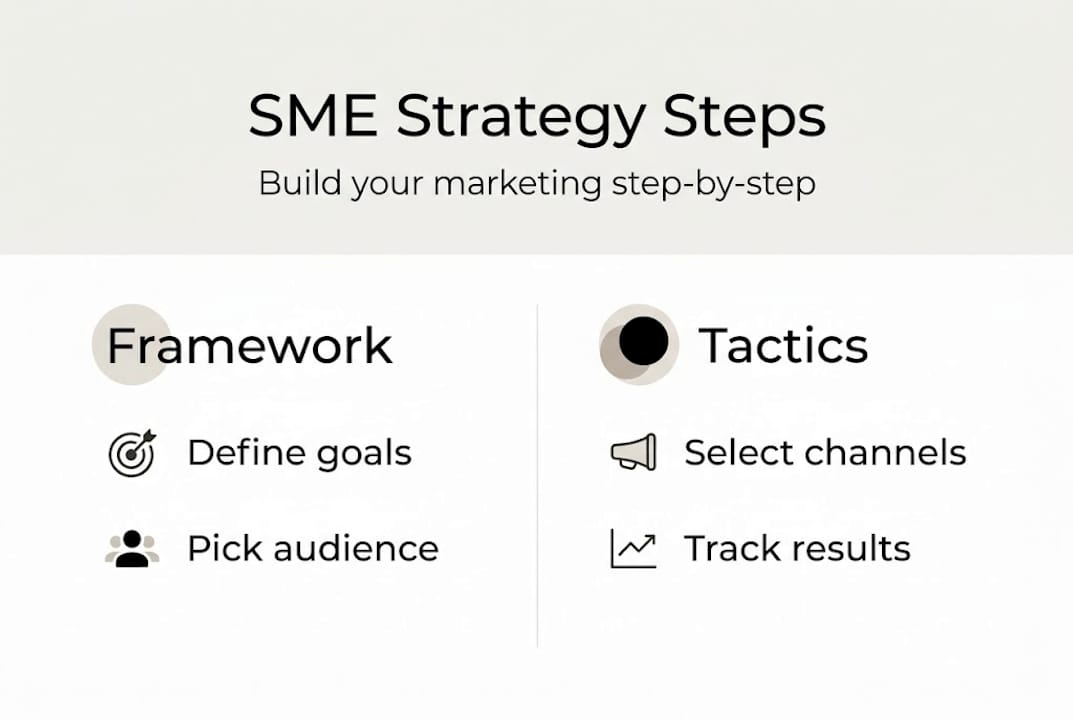
A strategy without structure is just a list of tasks. Before you spend a single pound on ads or content, you need a repeatable process that guides every decision. A standard digital marketing strategy for SMBs follows a 4 to 7 step framework, depending on the complexity and maturity of the business.
Here is how a full 7-step framework breaks down:
- Define your goals — What does success look like in 90 days, 6 months, and 12 months?
- Identify your target audience — Who are you selling to, and what do they care about?
- Clarify your unique selling proposition (USP) — Why should someone choose you over a competitor?
- Analyse competitors — What are they doing well, and where are the gaps you can exploit?
- Select channels and tactics — Which platforms and formats will reach your audience most effectively?
- Set a calendar and budget — When will you execute, and how much will each channel receive?
- Define your KPIs — How will you know if it is working?
Not every business needs all seven steps from day one. A freelancer or micro-business might start with a simplified 4-step version. Here is a quick comparison:
| Approach | Best for | Key focus | Risk |
|---|---|---|---|
| 4-step framework | Early-stage or micro-businesses | Goals, audience, one channel, one KPI | Narrow reach |
| 7-step framework | Established SMEs with multiple channels | Full strategic alignment | Complexity overload |
| Hybrid (5-6 steps) | Growing SMEs scaling from one channel | Balanced depth and agility | Requires regular review |
| Agency-led model | SMEs without in-house expertise | Outsourced execution with oversight | Cost and dependency |
Exploring proven small business strategies can help you decide which approach suits your current stage. The digital strategy framework you choose should match your resources, not your ambitions.
Pro Tip: If you are unsure which framework to use, count your active marketing channels. One or two channels? Start with 4 steps. Three or more? Build out the full 7-step model to avoid strategic drift.
Setting SMART goals and identifying your target audience
Once you understand the framework, the first real task is defining what you want to achieve and who you are trying to reach. These two elements shape every decision that follows.
SMART goals are Specific, Measurable, Achievable, Relevant, and Time-bound. For a small business, that might look like: “Increase website enquiries by 30% within 90 days by improving our Google search ranking for three local keywords.” That is a SMART goal. “Get more leads” is not.
Here is a simple process for building goals that connect to real business outcomes:
- Start with a business objective (e.g. grow revenue by 20% this quarter).
- Translate it into a marketing goal (e.g. generate 50 qualified leads per month).
- Assign a digital KPI to measure it (e.g. form submissions, phone call tracking, email sign-ups).
- Set a realistic timeline based on your current traffic and conversion rates.
- Identify which channel will drive that specific outcome.
Aligning your goals to common digital marketing KPIs from the start prevents the common mistake of measuring vanity metrics like page views instead of actual business impact.
Your audience definition is equally critical. A basic persona template includes: age range, job role or life situation, primary pain points, preferred content formats, and where they spend time online. For example, a local landscaping company might target homeowners aged 35 to 55 who are time-poor, research services on mobile, and respond to before-and-after imagery on Instagram and Google.
“The businesses that grow fastest online are not the ones with the biggest budgets. They are the ones who know exactly who they are talking to and what that person needs to hear.” — Forbes Small Business Marketing
Pro Tip: Before choosing any channel, ask yourself: where does my ideal customer actually spend their time online? Build your channel strategy around their behaviour, not your personal preferences.
Choosing the right digital channels and tactics
With goals and audience defined, the next challenge is selecting which channels will deliver the best return for your budget. This is where many SMEs go wrong, spreading spend too thin across too many platforms.

SMBs prioritise social media (68%), email (41%), and SEO as their top three channels, with most allocating 53 to 72% of their total marketing budget to digital. Here is a practical breakdown of each main channel:
| Channel | Best use case | Average SME cost | Key metric |
|---|---|---|---|
| SEO | Long-term organic traffic and local visibility | £500 to £2,000/month | Organic rankings, traffic |
| Social media | Brand awareness and community engagement | £300 to £1,500/month | Reach, engagement rate |
| Email marketing | Nurturing leads and retaining customers | £100 to £500/month | Open rate, click-through rate |
| PPC (Google Ads) | Fast traffic and direct conversions | £500 to £3,000/month | CPC, ROAS, conversion rate |
For most SMEs with limited budgets, SEO and email marketing offer the lowest cost per acquisition. PPC delivers faster results but requires ongoing spend. Social media builds brand presence but rarely converts cold audiences directly.
To decide which channels to prioritise, ask yourself:
- Where does my target audience search for services like mine?
- Do I need results within 30 days, or can I invest in a 6-month strategy?
- Do I have content assets (photos, videos, written material) to support this channel?
- What is my realistic monthly budget per channel?
Explore social media strategies and our SEO strategy guide for deeper guidance on each. For budget and channel statistics, the data consistently shows that focused investment in two or three channels outperforms scattered spend across five or six.
Quick wins for limited budgets: Claim and optimise your Google Business Profile (free), build an email list from existing customers (low cost), and publish one well-researched blog post per month targeting a local or niche keyword. These three actions alone can meaningfully improve visibility within 60 to 90 days.
Measurement, optimisation, and SME success stories
Running campaigns without measuring them is the equivalent of driving with your eyes closed. Once your channels are active, the work shifts to tracking, interpreting, and improving.
Real businesses are seeing significant results when they commit to measurement. Tracking KPIs like CAC, ROAS, and conversion rates has driven revenue growth ranging from 44% to 320% in documented SME case studies. Here are three examples:
- Tulip Farm (floristry): Focused SEO and Google Ads on seasonal keywords. Achieved a 44% increase in online orders within four months by tracking cost per acquisition weekly and cutting underperforming ad groups.
- Nutrition Clinic: Implemented CRM-integrated email marketing and automated follow-up sequences. Grew client bookings by 180% in six months by measuring email open rates and adjusting subject lines through A/B testing.
- Landscaping company: Combined local SEO with Instagram before-and-after content. Achieved 320% revenue growth over 12 months by tracking which posts generated direct enquiries and doubling down on that format.
A practical measurement framework follows three steps:
- Track — Set up Google Analytics 4, Google Search Console, and conversion tracking for every goal action (form fills, calls, purchases).
- Analyse — Review performance weekly for paid channels and monthly for organic. Look for patterns in what drives conversions, not just traffic.
- Adjust — Reallocate budget from underperforming channels to those with the strongest ROAS. Test one variable at a time.
Automation and AI tools can accelerate this process. Email platforms like Mailchimp or Klaviyo automate follow-up sequences based on user behaviour. Google’s Smart Bidding adjusts PPC bids in real time based on conversion likelihood. These tools reduce manual workload and improve consistency.
“Measurement without action is just data collection. The businesses that grow are the ones that review results and make decisions every single month.”
Pro Tip: Monitor your lifetime value to customer acquisition cost ratio (LTV:CAC). If LTV is less than three times CAC, your strategy needs adjusting before you scale. For deeper guidance, read about measuring digital ROI and essential digital KPIs. For marketing plan budgeting, Harvard Business School’s framework is particularly useful for SMEs allocating across multiple channels.
Why chasing trends wastes SME budgets, and what actually works
Here is the uncomfortable truth most digital marketing content will not tell you: the majority of small businesses that struggle online are not failing because they are using the wrong platform. They are failing because they have no plan at all.
Every few months, a new tactic emerges. Short-form video. AI-generated content. Threads. Influencer micro-campaigns. And every time, SME owners feel pressure to pivot. The result? Budget fragmented across half-finished experiments, no channel given enough time to compound, and no clear data to learn from.
Goal-aligned budget allocation consistently outperforms trend-chasing. The businesses we see succeed long-term are the ones that master two or three channels deeply, review performance monthly, and make incremental improvements based on real data. They are not the ones with the most creative campaigns. They are the ones with the most disciplined process.
The fundamentals, clear goals, defined audience, focused channels, and regular measurement, compound over time in a way that no single viral moment can replicate. Explore effective SME strategies that prioritise this compounding approach over short-term noise.
Level up your digital marketing with tailored SME solutions
Building a strategy from scratch is demanding, especially when you are also running a business. The framework in this guide gives you the foundation, but execution is where most SMEs need support.
At Kickass Online, we work with a carefully selected group of small and medium-sized businesses to build digital strategies that are grounded in data and designed for sustainable growth. From website design for small businesses that converts visitors into enquiries, to SEO strategies for SMEs that build long-term visibility, every solution is tailored to your goals. If you are ready to move from guesswork to a structured approach, explore our SME digital strategies service and book a consultation today.
Frequently asked questions
What is the first step in building a digital marketing strategy for a small business?
Setting SMART goals linked to your desired business outcomes is the essential starting point, whether that means growing leads, increasing online sales, or improving brand visibility.
Which digital marketing channel is most cost-effective for SMEs?
SEO and email marketing typically deliver the lowest cost per acquisition for small businesses, as limited budgets benefit most from low-CAC channels before scaling into paid media.
How can I measure the effectiveness of my digital marketing efforts?
Track KPIs like CAC, ROAS, and conversion rates for each active channel, reviewing paid channels weekly and organic channels monthly to identify what is working.
How much should a small business spend on digital marketing?
Most SMEs invest 7 to 8% of annual revenue on marketing. Forbes data suggests this typically translates to £2,000 to £10,000 per month in digital spend for established small businesses.
What is one common mistake SMEs make in digital marketing?
40% of small businesses fail to optimise their strategy because they launch tactics without aligning them to measurable goals or committing to regular performance reviews.
Recommended
- Digital Marketing Roadmap for SMEs: Online Journey
- How to create a digital marketing plan for SMEs in 2026 | Kickass Online
- Local SEO for SMEs: Guide to Boost Search Visibility and Drive Local Traffic | Kickass Online
- Effective Digital Marketing Strategies for SMEs: Boost Your Online Performance | Kickass Online
- How to rank your salon on Google Maps for more clients