The real benefits of digital marketing for UK SMEs

TL;DR:
- Digital marketing costs 50-70% less and offers measurable, higher customer acquisition for SMEs.
- Success relies on consistent, data-driven strategies rather than shiny tactics or instant results.
- Focus on a few channels, set clear goals, and actively track metrics for sustainable growth.
Most UK small business owners assume digital marketing is either too expensive, too technical, or something only large corporations can do properly. That assumption is costing them customers. Digital marketing costs 50-70% less than traditional methods while boosting customer acquisition by up to 50%, making it one of the most powerful growth tools available to SMEs right now. This guide breaks down exactly why digital marketing works, which channels deliver the strongest returns, and how to implement a practical strategy that generates real, measurable results for your business.
Table of Contents
- Why digital marketing matters for UK businesses
- Cost-effectiveness and measurable growth
- Key digital marketing channels: What works for SMEs
- From strategy to action: Implementing and measuring success
- The truth most SMEs miss about digital marketing
- Ready to see your business grow?
- Frequently asked questions
Key Takeaways
| Point | Details |
|---|---|
| Major cost savings | UK SMEs can cut marketing spend by 50-70% while gaining more customers with digital marketing. |
| High return on investment | Digital campaigns deliver measurable growth that outpaces traditional marketing channels. |
| Proven channels for SMEs | Search and social media give small businesses the best results for the lowest risk. |
| Success needs action and tracking | Clear goals, regular review, and continual tweaks bring the best results. |
Why digital marketing matters for UK businesses
The shift from print advertising and direct mail to digital channels has not been gradual. It has been a complete transformation. A decade ago, a local business might spend thousands on newspaper adverts, leaflet drops, and Yellow Pages listings. Today, those same budgets get far more traction through Google Ads, social media, and email campaigns targeted precisely at the right audience.
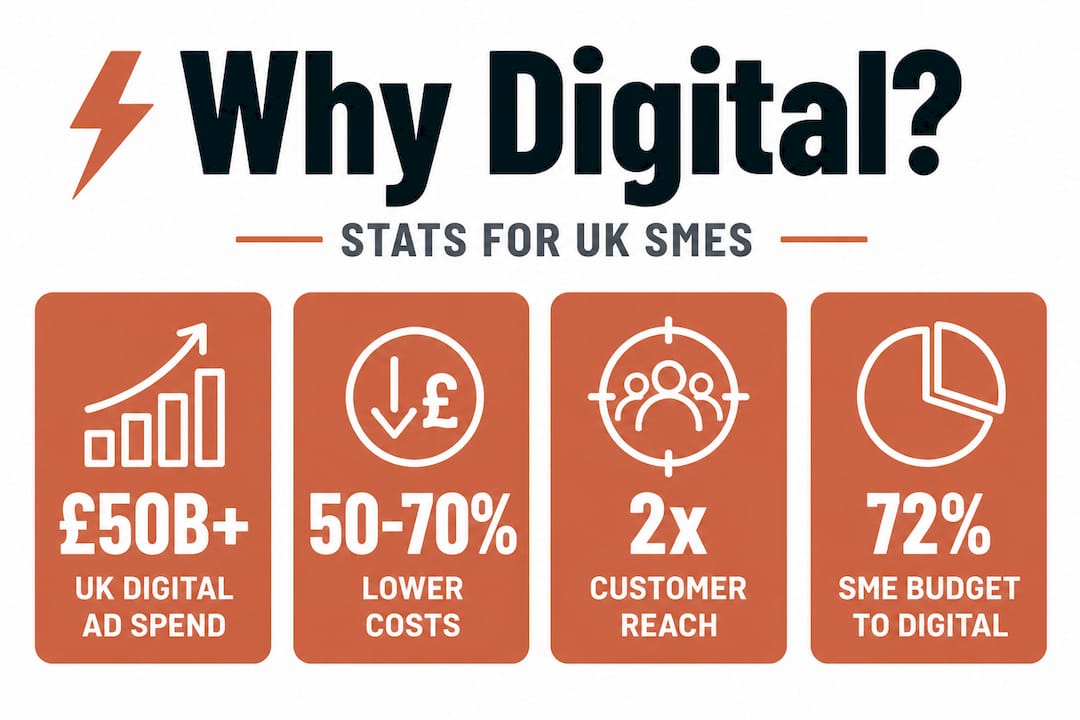
The numbers back this up. UK digital ad spend is forecast to exceed £50 billion in 2026, and SMEs are increasingly driving that investment, with businesses allocating between 5 and 10% of revenue to marketing, rising to an average of 15.6% for companies with revenue under £8 million. Around 72% of that marketing budget is now directed towards digital channels.
What makes this shift so significant for SMEs specifically? Digital marketing acts as a leveller. A well-optimised website combined with a smart content strategy can put a small independent retailer in front of the same audience as a national chain. The playing field is not perfectly even, but it is far closer than it was with traditional media, where big budgets simply bought bigger adverts.
Common barriers still hold many UK SMEs back. Business owners worry about the technical complexity of setting up campaigns, the time required to manage them, and uncertainty about whether they will actually see a return. These concerns are understandable but often overestimated. Building a digital marketing strategy for SMEs does not require a dedicated marketing team or an expensive agency retainer to get started. It requires clarity, consistency, and a willingness to learn what works for your specific customers.
Key misconceptions UK SMEs hold about digital marketing:
- “It only works for B2C businesses” (wrong: B2B lead generation via LinkedIn and content is highly effective)
- “You need a big budget to compete” (wrong: targeted campaigns with £500 per month can outperform poorly managed £5,000 campaigns)
- “Social media followers equal business results” (wrong: vanity metrics rarely translate directly to revenue without a clear conversion strategy)
- “SEO takes too long to be worth it” (wrong: local SEO improvements can show measurable results within weeks)
“Digital marketing is not about having the biggest budget. It is about having the clearest understanding of your customer and putting your message directly in front of them at the right moment.”
Cost-effectiveness and measurable growth
Let us get specific about costs, because this is where the argument for digital marketing becomes undeniable for most SME owners.

Traditional marketing channels such as print adverts, radio spots, and direct mail campaigns are expensive, and they offer limited ability to track whether they actually produced results. You spend the money and hope for the best. Digital marketing fundamentally changes that equation. Digital marketing costs 50-70% less than traditional methods and drives significantly stronger customer acquisition rates.
Here is how the cost comparison typically looks for a UK SME running a three-month campaign:
| Channel | Typical cost (3 months) | Measurability | Avg. customer acquisition cost |
|---|---|---|---|
| Local newspaper advert | £1,800 | Very low | Unknown |
| Direct mail campaign | £2,500 | Low | £45-£90 |
| Google Ads (PPC) | £1,200 | Very high | £15-£40 |
| Facebook and Instagram ads | £900 | High | £10-£35 |
| Email marketing | £300 | Very high | £5-£15 |
| SEO and content | £1,000 | High | £8-£25 (after 6 months) |
The difference is not subtle. Digital channels consistently deliver lower acquisition costs, and critically, they let you see exactly what is working. If a Google Ads campaign is converting well on one keyword but wasting money on another, you can fix that the same day. Traditional campaigns lock you into a fixed spend with no ability to adjust mid-run.
Measuring digital marketing ROI is something every SME owner should understand at a basic level before launching any campaign. The data available through platforms like Google Analytics 4, Meta Ads Manager, and email marketing tools gives you a clear picture of your cost per lead, cost per conversion, and overall return on ad spend.
“Knowing your numbers is not optional. If you cannot tell which campaign generated which customers, you are essentially running your marketing blind.”
Looking at successful digital campaigns for SMEs reveals a consistent pattern: the businesses that see the best results are not those with the largest budgets, but those who track their data closely and make regular adjustments based on what the numbers tell them.
Pro Tip: Focus on three core metrics from day one: cost per click (how much you pay for each website visitor), conversion rate (the percentage who take action), and customer lifetime value (how much a customer spends over time). These three figures tell you almost everything you need to know about whether a campaign is genuinely profitable.
Key digital marketing channels: What works for SMEs
With UK digital ad spend projected beyond £50 billion in 2026, it is clear that the market has fully committed to digital. But not every channel works equally well for every business. Here is a practical breakdown of the main options:
| Channel | Best for | Pros | Cons | Typical monthly cost |
|---|---|---|---|---|
| Search (SEO) | Long-term visibility | High intent traffic, lasting results | Slow to start, requires consistent effort | £500-£1,500 |
| Pay-per-click (PPC) | Immediate leads | Fast results, precise targeting | Costs stop when budget stops | £300-£2,000+ |
| Social media | Brand awareness and community | Wide reach, good for engagement | Organic reach declining, needs content | £200-£800 |
| Email marketing | Retention and repeat sales | Highest ROI of all channels, owned audience | Requires a list, ongoing content | £50-£300 |
| Content marketing | Authority and SEO | Builds trust, supports all other channels | Time-intensive, longer payoff | £300-£1,000 |
Understanding the right channel for your goals is the critical starting point. Here is a simple numbered process to select where to begin:
- Define your primary goal. Are you trying to get new customers immediately, or build long-term brand visibility? Immediate goals point towards PPC. Long-term goals point towards SEO and content.
- Identify where your customers actually spend time online. A B2B accountancy firm will find more traction on LinkedIn than TikTok. A consumer fashion brand is the opposite.
- Be honest about your capacity. Social media requires consistent content creation. Email marketing requires a subscriber list. Start with the channel you can genuinely commit to managing.
- Set a testing budget. Allocate a modest sum (£300 to £500) to test two or three channels for 60 days before committing to a larger spend.
- Review performance against benchmarks. Use industry averages to assess whether your results are competitive, and adjust accordingly.
There are excellent digital marketing examples showing how businesses in similar positions have built sustainable growth through smart channel selection. The most effective approach is almost always multi-channel. Email reinforces your social media messaging. Content improves your SEO. SEO drives down your PPC costs by improving your quality score on Google.
For practical guidance on what works in digital marketing for small businesses specifically, the evidence consistently points to a few core principles. Relevance, consistency, and clear calls to action outperform creativity and novelty every single time.
Pro Tip: Do not try to be everywhere at once. Choose two channels, master them over 90 days, and only then consider expanding your mix. SMEs that spread their budget across six channels from the start rarely see strong results from any of them. For a structured approach to building your channel mix, explore effective digital marketing strategies tailored specifically for SMEs.
From strategy to action: Implementing and measuring success
Understanding digital marketing intellectually is one thing. Actually implementing it consistently is another. This is where most SMEs stall, not because the task is impossible, but because they lack a structured approach.
Start with a clear goal. Not “get more customers” but something specific: “generate 15 qualified enquiries per month from Google Ads within 90 days.” That specificity shapes every decision that follows, from which keywords to target to what the landing page needs to say.
Once your goal is set, follow this practical sequence:
- Choose your primary channel based on your goal and audience (see previous section).
- Set a monthly budget that you can sustain for at least three months without expecting immediate returns.
- Build or optimise a landing page that is specifically designed to convert the traffic you are sending to it.
- Connect your analytics tools before you launch, not afterwards.
- Review performance weekly at a minimum, monthly in detail.
Tracking results does not require expensive software. The tools available to SMEs at low or no cost are genuinely powerful:
- Google Analytics 4 tracks website traffic, user behaviour, and conversion events for free.
- Google Search Console shows which search queries are driving traffic to your site.
- Meta Business Suite provides detailed performance data for Facebook and Instagram campaigns.
- Mailchimp (free tier) tracks email open rates, click-through rates, and conversions.
- Google Ads has built-in conversion tracking that shows exactly which keywords produce enquiries or sales.
Understanding your digital marketing KPIs (key performance indicators) is essential. Without defined KPIs, you are looking at data without knowing what it means. With them, every number tells a story.
Digital marketing costs 50-70% less than traditional alternatives, but only if you manage campaigns actively. A PPC campaign left unchecked for three months will waste money. An email sequence that has not been updated in a year will see declining engagement. Active management is what separates businesses that see results from those that conclude “digital marketing did not work for us.”
Following a clear digital marketing roadmap removes much of the guesswork and helps you allocate resources where they will have the most impact.
Pro Tip: Set a fixed monthly review date in your calendar. Look at your three core metrics, compare them to the previous month, and make one specific change based on what the data tells you. Consistent small improvements compound dramatically over six to twelve months.
The truth most SMEs miss about digital marketing
Here is what we see consistently across businesses that struggle with digital marketing: they treat it like a campaign rather than a system. They launch a Google Ads campaign, run it for a month, do not see instant results, and conclude that it does not work. Or they hire someone to “do their social media” for three months, see modest follower growth, and cancel the contract.
The businesses that achieve lasting results from their SME marketing efforts share a different mindset entirely. They understand that digital marketing is not a tap you turn on for revenue. It is a compounding system that rewards consistency and punishes impatience.
The most common mistake is chasing tactics. Every few months, a new platform or format emerges and promises extraordinary results. Short-form video. AI-generated content. Influencer partnerships. Some of these can work, but businesses that constantly pivot to the next shiny tactic rarely build anything durable.
What actually works is boring but effective: a clear message, a website that converts, consistent content that builds authority in your field, and regular communication with your existing customer base. These fundamentals have not changed meaningfully in fifteen years of digital marketing. The tools evolve but the principles do not.
The other truth few people say out loud is that digital marketing requires genuine patience. SEO takes months. Email lists take time to build. Brand authority is accumulated across hundreds of touchpoints, not one viral post. The businesses that stick with a sensible strategy for twelve months almost always see results. The ones that give up after eight weeks almost never do.
Consistency is a competitive advantage in digital marketing. Not because most businesses lack the knowledge to succeed, but because most lack the discipline to execute the same strategy week after week without instant gratification.
Ready to see your business grow?
Knowing what to do and having the expertise to execute it consistently are two different things. Most SME owners are managing operations, finances, and staff alongside their marketing, which means digital strategy often gets deprioritised precisely when it matters most.
At Kickass Online, we work with a deliberately small number of UK businesses so that every client gets genuine attention rather than a templated solution. From building high-converting websites through our expert website development service, to crafting and executing real-world marketing strategies that drive measurable growth, we handle the technical and strategic heavy lifting so you can focus on running your business. If you want practical guidance on your web presence, our website design tips are a great place to start. When you are ready for a more tailored conversation, book a consultation and let us show you exactly what is possible for your business.
Frequently asked questions
How much should a UK SME spend on digital marketing?
UK SMEs allocate 5-10% of revenue to marketing on average, with approximately 72% of that budget directed towards digital channels. Businesses under £8 million in revenue tend to spend closer to 15.6%.
Is digital marketing really more cost-effective than traditional marketing for SMEs?
Yes. Digital marketing costs 50-70% less than traditional methods and drives up to 50% higher customer acquisition, making it the more efficient choice for most UK SMEs working with limited budgets.
Which digital marketing channel should a small UK business start with?
Search engine marketing and social media advertising are strong starting points, as both offer precise targeting, clear performance data, and scalable budgets. Match your channel choice to where your specific customers are already spending time online.
How can I track digital marketing results for my business?
Use free tools such as Google Analytics 4 and Google Search Console to monitor website traffic and conversions, then set clear KPIs such as cost per lead and conversion rate to understand whether each channel is delivering genuine return on investment.
Recommended
- Digital marketing and SEO: A practical guide for UK SMEs | Kickass Online
- The real benefits of personalised marketing for SMEs | Kickass Online
- What is digital marketing? Key concepts for SME success | Kickass Online
- Digital marketing campaigns that grow your SME in 2026 | Kickass Online
- Video marketing for e-commerce: ROI and strategies 2026 | QuickAdVideo Blog

Book A Discovery Call
Stay Connected