Key benefits of hiring a digital marketing agency

TL;DR:
- Professional digital marketing agencies provide integrated, cross-channel strategies that outperform in-house efforts.
- Agencies offer access to premium tools, expertise, and compliance support crucial for SME growth.
- Long-term partnerships, clear KPIs, and patience are key to realizing measurable digital marketing success.
Many UK small and medium-sized businesses convince themselves that handling digital marketing in-house is the smarter, more budget-conscious choice. In reality, the opposite is often true. Without specialist expertise, integrated tools, and data-driven integration across channels, in-house efforts tend to produce fragmented results, wasted ad spend, and missed opportunities. This article walks you through the genuine, measurable advantages that a professional digital marketing agency delivers, from stronger return on investment and transparent reporting to GDPR compliance and long-term strategic growth that most DIY approaches simply cannot match.
Table of Contents
- Why digital marketing agencies outperform DIY efforts
- Key benefits: From measurable results to compliance
- How to choose the right agency: Evaluating expertise and fit
- Common pitfalls and how to avoid them
- The truth most SMEs miss about digital marketing agency value
- Ready to unlock real marketing growth?
- Frequently asked questions
Key Takeaways
| Point | Details |
|---|---|
| Integrated expertise | Agencies combine cross-channel skills for results SMEs can’t match with in-house efforts. |
| Measurable outcomes | Professional agencies set KPIs, providing ongoing tracking so you know what works. |
| GDPR compliance | UK-focused agencies ensure all your marketing obeys the law and builds consumer trust. |
| Avoid common pitfalls | Choosing based on price or vague promises limits growth; focus on proven evidence instead. |
Why digital marketing agencies outperform DIY efforts
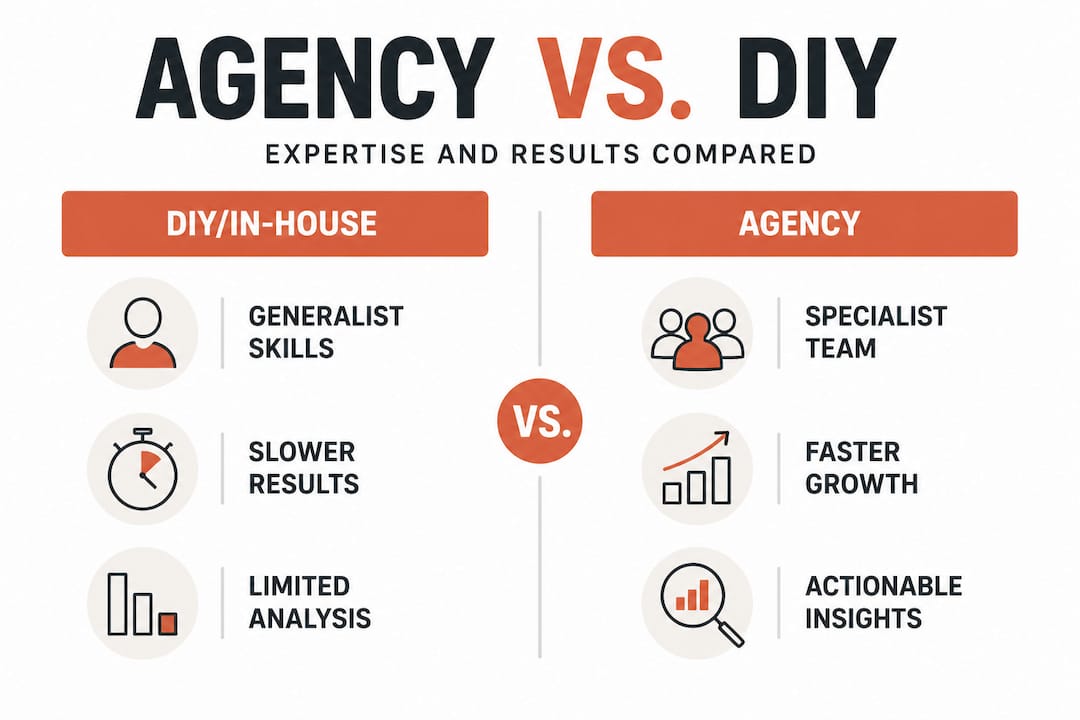
Running a business is already a full-time commitment. Expecting yourself or a generalist member of staff to also master SEO, paid advertising, social media strategy, content creation, and web analytics simultaneously is an enormous ask. The reality is that each of these disciplines has its own learning curve, toolset, and best practices that shift constantly. An agency brings dedicated specialists for every channel, working together under one roof.
Understanding what an agency does for SMEs goes well beyond simple task execution. Agencies build cohesive campaigns where SEO supports content, content supports paid advertising, and paid advertising feeds remarketing audiences. This kind of cross-channel synergy is very difficult to replicate when you are juggling it alongside the demands of running a business.
The agency vs. DIY comparison
| Factor | DIY or in-house | Professional agency |
|---|---|---|
| Specialist expertise | Generalist knowledge | Dedicated channel experts |
| Tool access | Basic or free tools | Enterprise-grade platforms |
| Time investment | High (owner or staff) | Managed externally |
| Campaign integration | Often siloed | Cross-channel and cohesive |
| Reporting | Ad hoc or inconsistent | Regular, structured KPI reporting |
| Compliance (GDPR) | Risk of oversight | Built into processes |
| Scalability | Limited | Flexible and scalable |
The cost comparison is often where business owners get the most surprising news. Hiring a single in-house digital marketing manager in the UK costs roughly £30,000 to £45,000 per year in salary alone, and that person typically cannot cover every specialism. A well-structured agency retainer gives you an entire team of SEOs, content writers, paid media specialists, and analysts for a fraction of that combined cost.
When you are choosing a digital agency, the ability to demonstrate integrated campaign results is one of the strongest indicators of genuine competence. Agencies that show how their SEO efforts boosted organic traffic while their paid campaigns reduced cost-per-acquisition are demonstrating exactly the kind of joined-up thinking that drives real business growth.
Key advantages agencies hold over DIY approaches:
- Access to premium tools such as SEMrush, Ahrefs, HubSpot, and programmatic ad platforms that carry costs far beyond typical SME budgets
- Experience across dozens of industries and campaign types, accelerating the learning curve
- Established relationships with publishers, platforms, and media outlets
- Dedicated account management so nothing falls through the cracks
- Rapid adaptation to algorithm changes and platform policy updates
Pro Tip: When evaluating agencies, ask specifically how they coordinate activity across SEO, paid media, and content. If they cannot clearly explain the integration, their results will likely reflect that gap.
As digital marketing best practices consistently show, success hinges on data-driven integration over siloed channels. Agencies are structurally built to deliver exactly that.
Key benefits: From measurable results to compliance
The true value of a professional agency relationship becomes clearest when you look at the specific, tangible outcomes it produces. These are not abstract benefits. They are improvements you can observe in your monthly reporting, your sales pipeline, and your website analytics.

Typical performance improvements with agency support
| Metric | Average SME without agency | Average SME with agency (12 months) |
|---|---|---|
| Organic web traffic growth | 5 to 10% per year | 30 to 60% per year |
| Lead quality score | Variable and inconsistent | Measurably improved |
| Cost per acquisition | Often unknown | Tracked and reduced over time |
| Conversion rate | Industry average or below | Tested and optimised |
| GDPR compliance confidence | Moderate | High |
Here is how the agency engagement process typically works for a UK SME:
- Discovery and audit - The agency conducts a thorough audit of your existing website, current marketing channels, competitor landscape, and baseline performance metrics.
- Strategy development - Based on the audit, a bespoke strategy is built around your specific business goals, target audience, and budget. Vague goals become specific, trackable digital marketing KPIs.
- Campaign build and launch - The agency creates and launches campaigns across agreed channels, ensuring every element is aligned with your brand identity and messaging.
- Ongoing optimisation - Data flows in from day one, and the team adjusts bids, content, and targeting in real time to improve performance continuously.
- Reporting and accountability - You receive structured monthly reports showing exactly how your investment is performing against the agreed KPIs for SME success.
- Review and scaling - What works gets scaled. What does not gets replaced. This evidence-led cycle is what separates agency partnerships from guesswork.
GDPR compliance deserves particular attention for UK SMEs. Since the UK retained its own version of GDPR post-Brexit, businesses collecting personal data from website visitors, email subscribers, or customers are legally obligated to handle that data correctly. Agencies build compliant consent frameworks, manage cookie policies, and ensure that your marketing activity does not inadvertently expose you to regulatory risk.
“Prioritise agencies with proven UK SMB case studies, clear KPIs, and GDPR compliance for trust-building.” Salesforce Digital Marketing Best Practices
This is not a minor operational detail. Fines under UK GDPR can reach up to £17.5 million or 4% of annual global turnover, whichever is higher. An agency that treats compliance as a core deliverable is protecting your business as much as it is growing it.
How to choose the right agency: Evaluating expertise and fit
Knowing you need an agency is the easy part. Selecting the right one takes a more structured approach, and the criteria you use will significantly affect your results.
When choosing the right agency, resist the temptation to select based on price alone. The cheapest option frequently costs more in the long run through poor performance, high staff turnover, and lack of strategic thinking. The digital agency guide for SMEs points to proven results and transparent communication as the non-negotiables.
Here is the criteria checklist every UK SME owner should use:
- Proven sector experience - Have they worked with businesses in your industry or at your scale? Relevant experience shortens the ramp-up time considerably.
- Transparent reporting - Can they show you exactly what you are paying for and what it is producing? Vague dashboards are a red flag.
- UK SMB case studies - Real results from real businesses at a similar size to yours carry far more weight than glossy testimonials.
- Integration capability - Do their SEO, paid, and content teams actually talk to each other, or are they running separate accounts?
- GDPR compliance - Is compliance built into their processes, or is it treated as an afterthought?
- Clear contracts - Are the deliverables, reporting cadence, and exit terms clearly defined? Ambiguity here leads to disappointment later.
- Communication style - Do they speak plainly and explain things clearly, or do they hide behind jargon to sound impressive?
- Scalability - Can they grow with you? A great agency relationship should evolve as your business develops.
As digital marketing best practices make clear, prioritising agencies with proven UK SMB case studies, clear KPIs, and GDPR compliance is the baseline, not an aspirational standard.
Thinking carefully about web agency selection for business success also means understanding whether the agency can support your website as a marketing asset. Your site is the destination for every campaign you run. If the agency cannot improve or maintain it, you are leaving significant performance gains on the table.
Pro Tip: Before signing anything, ask the agency to walk you through a real client report from a business similar to yours. Their willingness and ability to do this tells you more about their transparency than any sales pitch will.
Common pitfalls and how to avoid them
Even with the best intentions, SME owners frequently make avoidable errors when engaging with digital marketing agencies. Awareness of these pitfalls can save you considerable time, budget, and frustration.
- Choosing on price alone - Selecting the lowest-cost provider is one of the most common and costly mistakes. Quality digital marketing requires skilled people and robust tools, both of which cost money.
- Unclear contracts - Agreeing to work without clearly defined deliverables, timelines, and KPIs leaves you with no basis to assess performance or hold the agency accountable.
- No strategic vision - Asking an agency to “do social media” or “run some Google Ads” without a broader strategy leads to activity that looks busy but produces little.
- Ignoring GDPR obligations - Assuming your agency is handling compliance without confirming it explicitly is a significant risk. Always ask for confirmation that your campaigns meet UK GDPR requirements.
- Failing to vet KPIs upfront - If you do not agree on what success looks like at the start, you have no shared definition of failure either.
- Treating the relationship as transactional - Agencies produce their best work when they deeply understand your business. Withholding information, refusing to share commercial context, or treating every interaction as a vendor transaction limits what they can achieve.
- Not reviewing results regularly - Monthly reporting is standard, but you should also conduct quarterly strategic reviews to ensure the direction remains aligned with your business goals.
The guide to agency-led growth emphasises that long-term partnerships consistently outperform short-term contracts. This is not sentiment. It reflects the time required to properly understand a market, test messaging, and optimise campaigns to peak performance.
“Success with digital agencies depends on evidence of UK SMB results and integration, not just service lists.” Salesforce Digital Marketing Best Practices
Understanding performance marketing for SMEs means recognising that real improvement compounds over time. The SMEs that see the strongest results are those that invest in the relationship, provide clear feedback, and commit to reviewing performance data honestly rather than selectively.
The truth most SMEs miss about digital marketing agency value
Here is something the agency industry rarely admits openly: the first three months of almost any agency engagement are not particularly profitable for the client. Audits, strategy development, campaign builds, and early testing all consume time and budget before significant results emerge. This is not a failure. It is the necessary groundwork for everything that follows.
The mistake many SME owners make is judging agency value too early, then switching providers before the work has had time to produce returns. They end up in a cycle of agency-hopping, restarting the discovery phase every six to twelve months, and never building the momentum that sustained campaigns generate.
The businesses that consistently get the strongest results from agency partnerships share a common characteristic. They treat the agency like a trusted extension of their own team rather than a vendor delivering a service. They share commercial context, competitive intelligence, and honest feedback. They review campaigns together rather than passively receiving reports.
There is also a prevailing myth that digital marketing is something you fix once and move on from. In reality, search algorithms, social media platforms, consumer behaviour, and advertising costs shift constantly. An agency that is actively monitoring these changes and adapting your campaigns accordingly is delivering enormous ongoing value, even when the results look steady from the outside.
Lessons from data-led growth strategies show that the most impactful metric is not impressions or clicks. It is the quality of the business relationships that digital channels help you build. Agencies that understand this distinction are worth investing in.
Ready to unlock real marketing growth?
You have spent the time understanding the genuine advantages of agency partnerships, the KPIs that matter, the pitfalls to avoid, and the qualities to look for in a trusted partner.
At Kickass Online, we work with a deliberately limited number of UK SMEs to ensure every client receives focused, personalised attention rather than a generic package. Our team builds proven digital strategies that combine SEO, web performance, and content marketing into cohesive campaigns designed around your specific goals. If you are serious about making digital growth for your small business a reality rather than a possibility, we would love to show you what that looks like in practice. Book a consultation and let’s map it out together.
Frequently asked questions
What services do digital marketing agencies typically offer?
Most agencies provide integrated SEO, paid search, social media management, content creation, and analytics tailored specifically to SME needs. As digital marketing best practices confirm, success hinges on data-driven integration across all these channels rather than treating each one in isolation.
How do I know if a digital agency is a good fit for my small business?
Look for UK SMB case studies, transparent and structured reporting, genuine sector understanding, and clearly evidenced GDPR compliance. According to digital marketing guidance, prioritising these criteria over price gives you the strongest foundation for a productive partnership.
Are digital marketing agencies worth the investment for SMEs?
Yes; they deliver specialist expertise, integrated campaign management, and real-time ROI tracking that is genuinely difficult to replicate in-house at a comparable cost. Agencies also help SMEs see measurable results while managing compliance obligations that carry real legal risk.
What KPIs should I expect from a digital marketing agency?
Typical KPIs include organic web traffic growth, new leads generated, conversion rate, customer acquisition cost, and return on ad spend. Clear KPIs and transparent reporting are non-negotiable and should be agreed and documented before any campaign launches.
Recommended
- Why Hire a Digital Agency: Complete Expert Guide | Kickass Online
- What a digital marketing agency really does for SMBs | Kickass Online
- What is a digital marketing agency? Guide for SMEs | Kickass Online
- Why Choose a Digital Agency: Complete Guide | Kickass Online
- Social Media Services | Boost Your Social Reach—Get Started Today — King Sixteen
- Innovative event marketing strategies to maximize brand impact


Book A Discovery Call
Stay Connected