What is a marketing agency? Clear answers and key benefits

TL;DR:
- Marketing agencies provide a team-based, strategic approach to drive measurable business results.
- SME owners should consider agencies when current marketing efforts plateau or lack clear ROI.
- Transparency, proven ROI, and results-focused reporting are essential when choosing an effective marketing agency.
Many small and medium-sized business owners pour time and money into marketing without seeing meaningful results. The reason is rarely effort. It is usually confusion about what kind of help they actually need. 54% of SMBs still manage their own marketing, and a significant portion report low perceived impact. This guide cuts through the noise. We will clarify exactly what a marketing agency is, what it does, how it differs from freelancers and software tools, and how to decide whether one is right for your business.
Table of Contents
- What is a marketing agency and what do they actually do?
- Core functions of a marketing agency: What services do they provide?
- Marketing agency versus DIY: When do SMEs need professional help?
- Choosing the right marketing agency: What to look for and questions to ask
- Why marketing agencies must evolve: A real-world take
- Ready to grow? Your next step
- Frequently asked questions
Key Takeaways
| Point | Details |
|---|---|
| Agencies offer accountability | A marketing agency delivers structure, expertise, and results beyond what most single freelancers or tools can achieve. |
| Proven ROI matters | Choosing an agency is about measurable improvements in traffic, leads, and revenue—not just effort. |
| Know when to DIY | Self-management works for simple marketing, but expert help becomes essential as ambitions or complexity grow. |
| Choose wisely | The right agency demonstrates transparency, data-driven results, and readiness to adapt with technology. |
What is a marketing agency and what do they actually do?
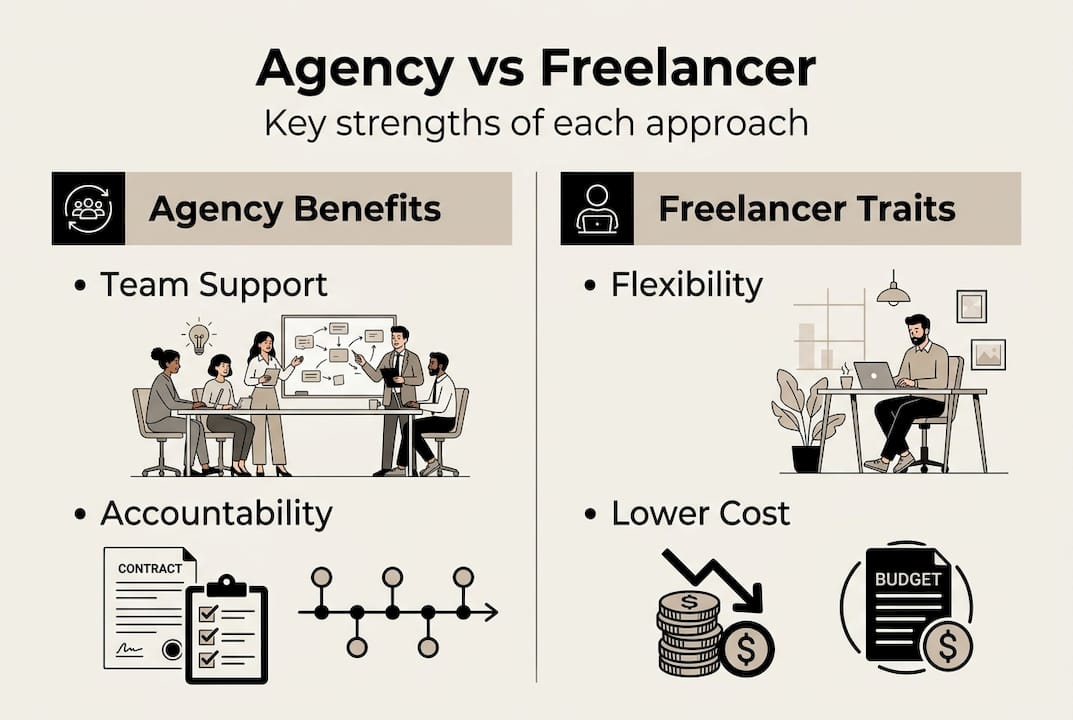
A marketing agency is a professional firm that plans, manages, and executes marketing strategy on behalf of businesses. That sounds straightforward, but the confusion sets in when owners conflate agencies with freelancers or assume a subscription tool does the same job. They do not.
A freelancer is a skilled individual, perhaps a copywriter or a graphic designer, who completes specific tasks. A software tool automates repetitive processes like scheduling social posts or sending emails. A marketing agency brings together a team of specialists, from strategists and SEO experts to paid media buyers and web developers, working under one roof with shared accountability for your results.
Here is a quick comparison to make this concrete:
| Feature | Marketing agency | Freelancer | DIY tool |
|---|---|---|---|
| Team breadth | Multi-disciplinary | Single skill | None |
| Strategic oversight | Yes | Rarely | No |
| Accountability | Contractual | Variable | None |
| Scalability | High | Limited | Moderate |
| Ongoing support | Yes | Project-based | Self-serve |
As research confirms, agencies provide structure and accountability that neither freelancers nor automation tools can replicate. This matters enormously for SMEs who need consistent, measurable progress rather than one-off outputs.
For a deeper look at how this applies to your business, the digital marketing agency guide on our site breaks down every layer in plain terms.
The key services a marketing agency typically handles include:
- Brand strategy and positioning
- Search engine optimisation (SEO)
- Paid advertising (Google Ads, Meta Ads)
- Website design and development
- Content creation and copywriting
- Social media management
- Analytics and performance reporting
When you hire an agency, you are not buying a single deliverable. You are buying a system, a team that works together to move your business forward.
Core functions of a marketing agency: What services do they provide?
Understanding what an agency does in practice helps you decide what you actually need. Most SMEs start with one or two services and expand as results build confidence.
Campaign planning is where strategy takes shape. The agency analyses your market, your competitors, and your goals before deciding where to spend effort. Without this step, even well-executed tactics miss the mark.
SEO is arguably the highest-value long-term service for SMEs. Ranking well on Google means a steady stream of people who are already looking for what you sell. Good marketing agency SEO is not about tricks. It is about building genuine authority through quality content, technical site health, and credible backlinks.
Paid advertising delivers faster results but requires skill to avoid wasted spend. An agency manages bidding strategies, audience targeting, and creative testing so your budget works harder.
Web design is often overlooked as a marketing function, but your website is your most important conversion asset. An agency ensures it loads fast, looks credible, and guides visitors toward action.

Analytics and reporting tie everything together. Understanding your marketing ROI metrics is how you know what is working and what needs to change.
The shift toward data-driven performance is accelerating. Marketing budgets have flatlined and AI is reshaping how agencies deliver results, pushing the best firms to focus on measurable outcomes rather than activity for its own sake.
Pro Tip: When evaluating an agency’s services, ask to see a sample monthly report. If it shows activity (posts published, emails sent) rather than outcomes (leads generated, revenue attributed), treat that as a warning sign.
An integrated approach, where SEO, content, and paid media work together, consistently outperforms single-channel efforts. The whole genuinely is greater than the sum of its parts.
Marketing agency versus DIY: When do SMEs need professional help?
This is the question most business owners wrestle with. The honest answer is that DIY marketing works, until it does not.
If you are a sole trader in the early stages, posting on social media and sending a monthly newsletter is perfectly reasonable. But as your business grows, the opportunity cost of doing it yourself climbs steeply. Every hour you spend on marketing is an hour you are not spending on operations, sales, or product development.
54% of SMBs self-manage their marketing, yet many report low impact and wasted spend. The pattern is consistent: business owners know their product but lack the technical depth to compete online against businesses that have professional support.
Here are the most common signs that professional help is overdue:
- Your website traffic has plateaued or is declining
- You are running ads but cannot tell if they are profitable
- Your competitors consistently outrank you on Google
- You spend more than five hours per week on marketing tasks
- You have no clear way to measure whether your efforts are working
Common SME marketing mistakes include targeting the wrong audience, neglecting mobile performance, and publishing content without any SEO structure. These are not failures of effort. They are failures of expertise.
| Scenario | DIY suitable? | Agency recommended? |
|---|---|---|
| Brand new business, tight budget | Yes | Optional |
| Growing business, time-poor owner | No | Yes |
| Competing in a saturated market | No | Yes |
| Running paid ads without ROI clarity | No | Yes |
| Established business, scaling fast | No | Yes |
Avoiding marketing pitfalls and critical SEO mistakes that cost SMEs dearly is far easier when you have specialists who have seen these problems hundreds of times.
Pro Tip: Calculate your hourly rate and multiply it by the hours you spend on marketing each week. Compare that figure to what an agency would cost. The gap is often smaller than owners expect, and the results are typically far stronger.
Choosing the right marketing agency: What to look for and questions to ask
Not all agencies are equal. The right choice depends on your goals, your budget, and how well the agency can demonstrate genuine results.
Start with these essential questions during any agency evaluation:
- Can you show me case studies from businesses similar to mine?
- How do you measure and report on performance?
- What does your onboarding process look like?
- How do you incorporate AI and data into your service delivery?
- What happens if results are not meeting targets?
Good agencies welcome these questions. Weak ones deflect them.
Watch out for these red flags:
- Guaranteed rankings on Google (no one can guarantee this)
- Vague reporting that focuses on vanity metrics like follower counts
- Long lock-in contracts without performance clauses
- No clear point of contact or account manager
- Resistance to sharing data from your own campaigns
“With flat budgets and rising AI use, agencies are under pressure to prove ROI and adapt their service models.” This Gartner finding reflects a broader shift: marketing budgets have flatlined and SMEs are rightly demanding more evidence of value.
The best agencies are also transparent about how AI in marketing is changing their workflows. AI can accelerate content production and data analysis, but it cannot replace strategic thinking or genuine market understanding. Ask any prospective agency how they balance automation with human expertise.
Finally, insist on knowing how they will measure your agency ROI from day one. Clear KPIs agreed upfront protect both sides and keep the relationship focused on what matters: your growth.
Why marketing agencies must evolve: A real-world take
Here is something the industry does not say loudly enough: many agencies are still selling yesterday’s model. A monthly retainer, a few blog posts, some social content, and a vague promise of brand awareness. That is not good enough anymore.
The agencies worth working with have shifted their entire orientation toward outcomes. Not outputs. Not activity. Outcomes. That means traffic that converts, ads that return measurable revenue, and SEO that builds compounding value over time.
Agencies must now prove ROI, adapting to AI, data, and performance-focused models to remain relevant. The agencies that resist this shift will lose clients to those that embrace it.
For SMEs, this is actually good news. The pressure on agencies to perform means you have more leverage than ever to demand transparency and results. The debate around AI versus human expertise in marketing is ongoing, but the smartest agencies are not choosing sides. They are using both. You should expect the same from any agency you consider.
Ready to grow? Your next step
Understanding what a marketing agency does is the first step. Acting on that understanding is where growth actually begins.
At Kickass Online, we work with a deliberately small number of SME clients so that every business gets the focused attention it deserves. Whether you need a high-converting website, a targeted SEO strategy, or a full digital marketing plan, we build solutions around your specific goals. Explore our website design services or start with one of our SEO audits for SMEs to see exactly where your biggest opportunities lie. Book a consultation and let us show you what results-driven marketing looks like in practice.
Frequently asked questions
What is the main difference between a marketing agency and a freelancer?
A marketing agency offers a multi-disciplinary team with structured processes and contractual accountability, while a freelancer is typically one individual covering a narrower skill set. For sustained results, agencies provide structure that a single freelancer simply cannot replicate.
How do I know if my SME needs a marketing agency?
If your current efforts are not growing your business, or you lack the time and specialist skills to compete online, an agency delivers expert strategy and measurable outcomes. 54% of SMBs self-manage their marketing, yet many see low impact and wasted spend as a result.
What should I look for when selecting a marketing agency?
Prioritise transparent reporting, proven expertise in your area of need, clear evidence of ROI, and a genuine willingness to adapt to new technologies including AI. Avoid agencies that cannot show you real results from comparable clients.
How do marketing agencies prove their value?
The best agencies use analytics to demonstrate real growth in traffic, leads, and revenue, focusing on outcomes rather than activity. Agencies face growing pressure to show tangible ROI using data, which ultimately benefits SMEs who demand accountability.
Recommended


Book A Discovery Call
Stay Connected