Why HTTPS matters for UK businesses in 2026

Many UK business owners believe a professional looking website automatically means a secure one. This misconception leaves countless small businesses vulnerable to data breaches while missing crucial opportunities for improved search visibility. HTTPS provides dual benefits: robust security through encryption and measurable SEO advantages that directly impact your bottom line. This guide explains how switching to HTTPS protects your customers, boosts your rankings, and builds the trust needed to grow your online presence in 2026.
Table of Contents
- Understanding How Https Secures Your Website
- How Https Boosts Your Search Engine Rankings And Online Visibility
- Building Visitor Trust And Improving Engagement With Https
- Performance And Best Practices For Implementing Https Effectively
- How Kickass Online Helps Your Business Implement And Benefit From Https
- Frequently Asked Questions
Key takeaways
| Point | Details |
|---|---|
| Security foundation | HTTPS encrypts sensitive data between browsers and servers, protecting passwords, payment details, and personal information from interception. |
| Search visibility boost | Google confirmed HTTPS as a ranking signal, giving secure websites an advantage over unsecured competitors in search results. |
| Trust and conversions | The padlock icon signals security to visitors, reducing bounce rates and increasing enquiries and sales through enhanced credibility. |
| Modern performance | TLS 1.3 reduces latency by 40% compared to older versions, ensuring security without sacrificing website speed. |
| Implementation essentials | Proper setup requires valid certificates, HSTS enablement, mixed content fixes, and disabling outdated TLS versions. |
Understanding how HTTPS secures your website
HTTPS implementation enhances website security by encrypting data transmitted between the user’s browser and the web server, protecting against eavesdropping and man in the middle attacks. At its core, HTTPS is simply HTTP running over a secure TLS/SSL connection that scrambles data into unreadable code during transmission.
When a visitor accesses your HTTPS site, the TLS handshake occurs in milliseconds. The browser and server negotiate encryption methods, verify your SSL certificate’s authenticity, and establish a secure channel for all subsequent communication. This process happens invisibly to users but provides critical protection.
Encryption prevents attackers from intercepting sensitive information during transmission. Without HTTPS, anyone positioned between your visitor and your server could read every piece of data exchanged. This vulnerability becomes especially dangerous when customers submit:
- Login credentials and account passwords
- Payment card numbers and financial information
- Personal details like addresses and phone numbers
- Business enquiries containing confidential plans or budgets
- Form submissions with customer data
Pro tip: Set calendar reminders three months before your SSL certificate expires to avoid security warnings that immediately damage customer trust. Most certificates last 90 days to one year, and letting them lapse creates the same red warning screens as having no HTTPS at all.
For comprehensive website protection strategies, explore our guide on how to secure website business protection to address additional vulnerabilities beyond HTTPS implementation.
How HTTPS boosts your search engine rankings and online visibility
Google officially confirmed HTTPS as a ranking signal in 2014, giving secure websites preferential treatment in search results. This announcement transformed HTTPS from a security best practice into a competitive necessity for UK businesses fighting for visibility online.
Whilst HTTPS alone won’t catapult your site to the top of search results, it functions as a tiebreaker between otherwise comparable websites. When your content quality, relevance, and other SEO factors match a competitor’s, HTTPS provides the edge that determines which site appears higher. For small businesses competing against established players, every ranking advantage matters.
The SEO benefits extend beyond simple ranking boosts:
- Improved organic click through rates as users recognise the padlock symbol in search results
- Enhanced referral data accuracy since HTTPS to HTTPS traffic preserves full referral information
- Better crawl efficiency as search engines prioritise secure sites for indexing resources
- Positive user experience signals from lower bounce rates on secure pages
- Potential featured snippet advantages as Google favours authoritative, secure sources
Moving to HTTPS typically produces measurable improvements within three to six months. UK SMEs commonly report 5 to 15% increases in organic traffic following proper HTTPS migration, with more competitive industries seeing larger gains. The impact compounds over time as search engines increasingly penalise unsecured sites.

Understanding search engine ranking business impact helps you measure these improvements accurately. Combined with strategic optimisation, HTTPS becomes one pillar in a comprehensive approach detailed in our overview of 5 benefits of SEO for your digital marketing campaign.
Building visitor trust and improving engagement with HTTPS
The padlock icon appearing in browser address bars does more than indicate technical security. HTTPS builds trust with visitors, shown by the padlock icon that signals a secure connection, encouraging interactions and purchases. This visual cue immediately communicates professionalism and safety, particularly crucial for small businesses lacking established brand recognition.
Trust directly influences user behaviour in measurable ways. Visitors spend longer on secure sites, exploring more pages and engaging more deeply with content. They complete contact forms at higher rates, pick up the phone more often, and proceed through checkout processes with less hesitation. Every interaction requiring personal information becomes more likely when that padlock appears.
The conversion impact becomes especially pronounced for transactions involving:
- E commerce purchases where payment details are required
- Service enquiry forms requesting contact information and project details
- Newsletter signups and account registrations
- Document downloads requiring email addresses
- Quote requests involving business sensitive information
“When visitors see a ‘Not Secure’ warning instead of a padlock, 85% will abandon the site immediately rather than risk their information. For small businesses, each abandoned visitor represents lost revenue that competitors with HTTPS will capture instead.”
Beyond preventing abandonment, HTTPS actively enhances credibility. Customers perceive secure websites as more established, professional, and worthy of their business. This perception particularly benefits service based businesses where demonstrating competence before the first conversation proves essential.
For deeper insights into establishing online credibility, explore what constitutes digital trust explained in modern web environments where security forms just one component of comprehensive trust building strategies.
Performance and best practices for implementing HTTPS effectively
A common myth suggests HTTPS slows websites significantly. Modern TLS protocols actually minimise performance impact whilst delivering robust security. TLS 1.3 reduces latency by 40% and CPU usage by 28% compared to TLS 1.2, making security faster than ever.
| Feature | TLS 1.2 | TLS 1.3 |
|---|---|---|
| Handshake speed | 2 round trips | 1 round trip |
| Connection time | ~300ms average | ~180ms average |
| CPU usage | Baseline | 28% reduction |
| Encryption strength | Strong | Stronger |
| Outdated ciphers | Supported | Removed |
Connection reuse and session resumption further minimise any remaining overhead. Once a visitor establishes an initial secure connection, subsequent requests reuse that encrypted channel without repeating the full handshake process. This means only the first page load experiences any latency, with following pages loading at full speed.
Implementing HTTPS correctly requires attention to several best practices:
- Obtain certificates from reputable Certificate Authorities recognised by all major browsers
- Enable HTTP Strict Transport Security (HSTS) to force HTTPS usage automatically
- Update all internal links and resources to use HTTPS URLs
- Implement proper 301 redirects from HTTP to HTTPS versions
- Disable outdated protocols like TLS 1.0 and TLS 1.1 completely
- Configure servers to prefer modern cipher suites
- Monitor certificate expiration dates vigilantly
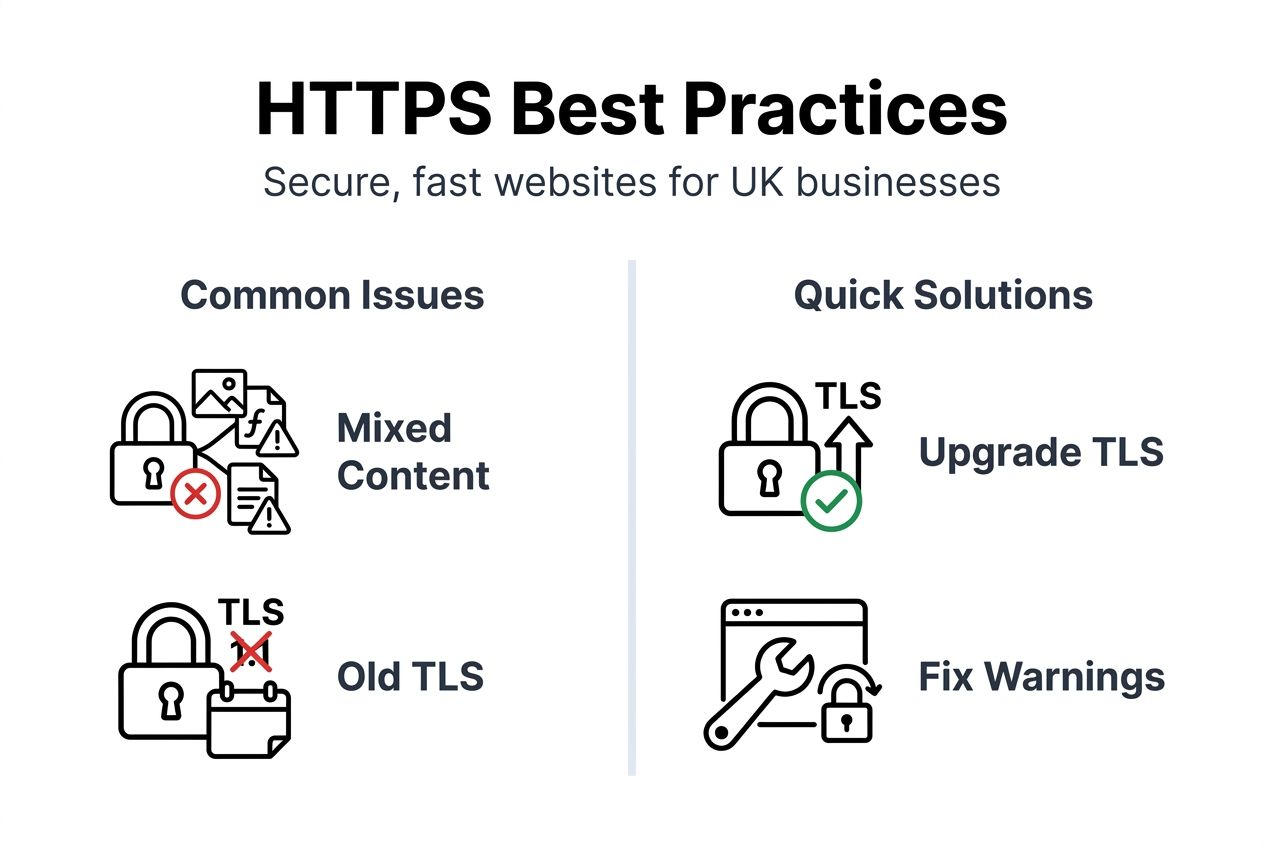
Pro tip: After implementing HTTPS, use browser developer tools to identify mixed content warnings where some page resources still load over HTTP. These warnings undermine security benefits and trigger browser alerts that damage trust.
Common HTTPS problems include misconfigured certificates, mixed content warnings, and outdated TLS versions. Regular security audits catch these issues before they impact visitors. Understanding the full spectrum of benefits of SSL certificates small businesses 2026 helps prioritise implementation efforts.
For businesses concerned about technical complexity, professional implementation eliminates guesswork whilst ensuring optimal configuration. Learn more through our comprehensive resource on how to secure website business protection.
How Kickass Online helps your business implement and benefit from HTTPS
Transitioning to HTTPS shouldn’t feel overwhelming. Kickass Online specialises in secure website design & development that builds HTTPS protection into every project from day one. Our team handles certificate procurement, server configuration, and content migration whilst ensuring zero downtime during the switch.
Beyond initial implementation, we provide ongoing monitoring to catch certificate renewals, security updates, and performance optimisations before they become problems. Our guide to SEO strategies shows how HTTPS forms one component of comprehensive visibility improvements that drive measurable business growth. We work with a limited number of UK SMEs to ensure each client receives dedicated attention throughout their security and SEO journey.
Frequently asked questions
How do I know if my website needs HTTPS?
Every website collecting any user information needs HTTPS, including basic contact forms. If you process payments, store customer data, or want to rank competitively in search results, HTTPS is non negotiable. Check your site by looking for the padlock icon in your browser’s address bar. Its absence means you need HTTPS immediately.
How much do SSL certificates cost for small businesses?
SSL certificate costs range from free options like Let’s Encrypt to £50 to £200 annually for standard certificates. Extended validation certificates cost more but provide the highest trust indicators. Most UK SMEs find standard certificates perfectly adequate for their needs. Implementation costs vary based on technical complexity and whether you handle it yourself or hire professionals.
Will switching to HTTPS break my existing website?
Properly executed HTTPS migration won’t break functionality, but poor implementation can cause issues. Common problems include broken images, mixed content warnings, and redirect chains. Working with experienced developers ensures smooth transitions. Our how to secure website business protection guide covers migration planning to avoid pitfalls.
Does HTTPS slow down my website?
Modern HTTPS implementations add minimal latency, typically under 100 milliseconds for initial connections. TLS 1.3 actually improves performance compared to older protocols. The security and SEO benefits far outweigh any negligible speed impact. Proper configuration with connection reuse eliminates performance concerns entirely.
How long does it take to see SEO improvements after implementing HTTPS?
Most businesses observe ranking improvements within two to four months after HTTPS implementation. Google needs time to recrawl your site and recognise the security upgrade. The timeline varies based on your site’s size, crawl frequency, and existing authority. Combining HTTPS with other SEO improvements accelerates results significantly.
Recommended
- Website Security – Why It Matters for Your Business | Kickass Online
- SEO best practices checklist for UK small businesses 2026 | Kickass Online
- Benefits of SSL certificates for small businesses 2026 | Kickass Online
- Site Security – Why It Matters For Your Business | Kickass Online
- Business Growth in 2025: The Essential Guide - Nomad Excel - Your Entrepreneurial Adventure Starts Here
- 6 Essential Types of Secure WiFi Solutions for SMBs


Book A Discovery Call
Stay Connected