What Is Page Indexing and Why It Matters

Many business owners in Milton Keynes struggle to get their websites noticed, often thinking page indexing is just a technical task that search engines handle automatically. In reality, indexing requires careful human judgement, not simply algorithmic processing, as highlighted by systematic document organisation. Understanding the art behind page indexing unlocks better search visibility and higher traffic. This guide reveals the true process, debunks misconceptions, and offers practical strategies for lasting online success.
Table of Contents
- Page Indexing Defined And Common Myths
- How Search Engines Index Web Pages
- Modern Indexing Methods And Tools
- Why Indexing Impacts Online Visibility
- Common Page Indexing Issues And Solutions
Key Takeaways
| Point | Details |
|---|---|
| Page Indexing is Crucial for Digital Discovery | Effective indexing organises content, enhancing visibility and retrieval efficiency across web pages. |
| Indexing Requires Human Insight | Many believe indexing is purely automated; however, it involves strategic human curation to reflect user search patterns. |
| Modern Indexing is Advanced and Contextual | Current methods leverage AI and machine learning for semantic analysis, improving how content is categorised and retrieved. |
| Optimisation is Key to Visibility | Regular audits and site structure improvements are essential to maximise indexing effectiveness and online visibility. |
Page Indexing Defined and Common Myths
Page indexing represents a systematic process of organising digital content to enhance discoverability and retrieval efficiency. At its core, it’s about creating a strategic map that helps search engines and users quickly locate specific information within web pages and digital documents.
Contrary to popular misconceptions, page indexing is far more nuanced than many realise. Systematic document organisation requires thoughtful curation and human intervention, not just algorithmic processing. It involves carefully selecting and categorising terms that reflect the most likely search patterns and user intentions.
Key characteristics of effective page indexing include:
- Precise selection of meaningful index entries
- Strategic categorisation of content themes
- Adaptability to different document types and user needs
- Balancing comprehensiveness with relevance
Many businesses mistakenly believe page indexing is a purely technical task that can be fully automated. However, navigation and content retrieval actually demand sophisticated decision-making and contextual understanding.
Page indexing is an art as much as a science, requiring intelligent interpretation of content beyond simple keyword matching.
The process involves multiple strategic considerations, such as understanding user search intent, mapping content hierarchies, and ensuring information can be found intuitively. Search engines like Google employ complex algorithms that go far beyond basic keyword indexing, analyzing context, relevance, and user experience signals.
Pro tip: Regularly audit and update your page indexing strategy to ensure your most valuable content remains easily discoverable and aligned with evolving search behaviours.
How Search Engines Index Web Pages
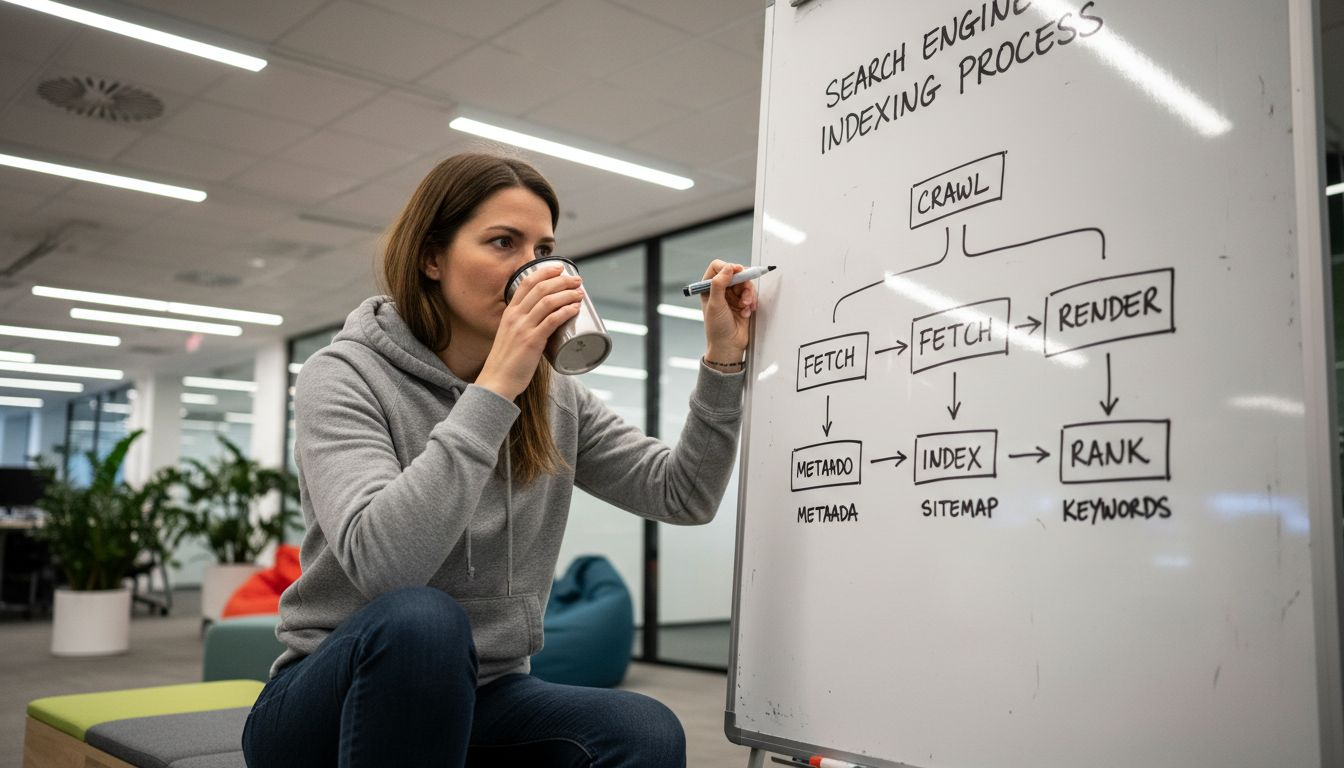
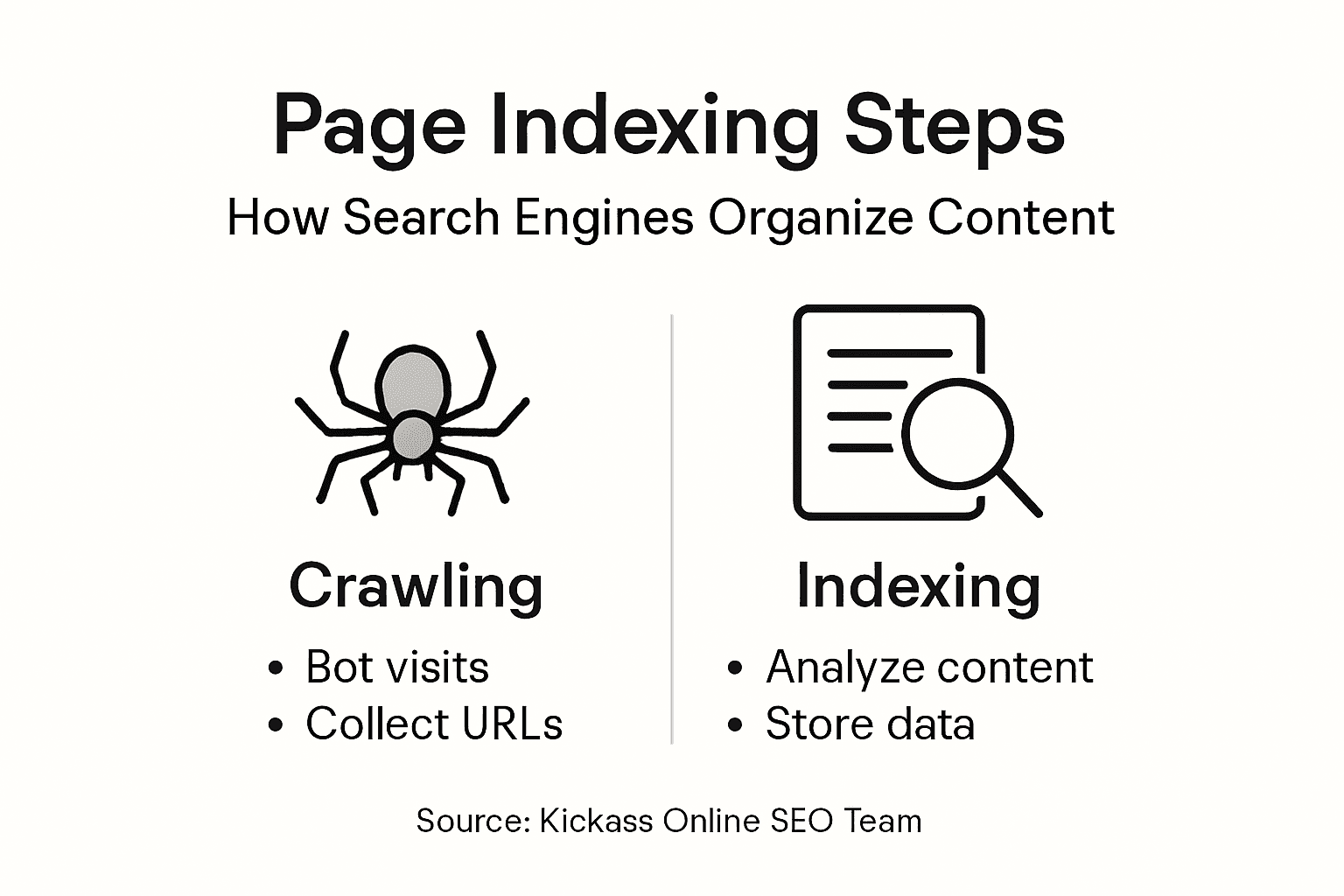
Search engines employ a sophisticated multi-stage process to discover, analyse, and organise digital content across the internet. This complex system begins with web crawling, where automated bots systematically navigate through websites by following hyperlinks and discovering new pages.
Automated crawlers scan distributed web content using intricate algorithms that map the interconnected network of digital information. These digital explorers collect and process vast amounts of data, extracting critical elements such as:
- Page content and text
- Metadata and descriptive tags
- Internal and external link structures
- Site architecture and navigation paths
- Relevance and contextual signals
Once a page is discovered, search engine bots perform an in-depth analysis to understand its context, meaning, and potential value to users. Internet indexing involves comprehensive document organisation that goes beyond simple keyword matching.
Search engine indexing transforms raw web content into a structured, searchable database that enables rapid information retrieval.
The indexing process involves several critical steps, including content parsing, semantic analysis, and relevance scoring. Modern search engines use advanced machine learning techniques to understand not just the words on a page, but their deeper contextual meaning and potential user intent.
Pro tip: Optimise your website’s crawlability by maintaining a clear site structure, using descriptive metadata, and ensuring fast page load speeds to help search engine bots efficiently index your content.
Modern Indexing Methods and Tools
The landscape of digital indexing has dramatically transformed, driven by sophisticated technological advancements that go far beyond traditional keyword-based search mechanisms. Intelligent indexing systems now leverage cutting-edge technologies to deliver increasingly precise and contextually relevant information retrieval.
Citation searching techniques have evolved to complement traditional approaches, incorporating complex algorithmic frameworks that analyse document relationships and semantic connections. These modern methods integrate multiple sophisticated strategies to enhance search precision and comprehensive information discovery.
Key components of contemporary indexing technologies include:
- Advanced machine learning algorithms
- Natural language processing capabilities
- Semantic analysis techniques
- Network-based document relationship mapping
- Multi-layered indexing architectures
Academic indexing systems leverage sophisticated architectures that combine multiple intelligent processing techniques. These systems now employ intricate approaches such as citation network analysis, contextual understanding, and dynamic relevance ranking to manage the exponential growth of digital information.
Modern indexing is not just about finding information, but understanding the complex relationships between different pieces of digital content.
The integration of artificial intelligence and machine learning has fundamentally transformed how digital content is discovered, categorised, and presented. Search technologies now adapt in real-time, learning from user interactions and continuously refining their understanding of context and relevance.
Pro tip: Invest in robust metadata strategies and implement structured data markup to help advanced indexing systems more accurately understand and categorise your digital content.
Here is a comparison of traditional versus modern digital indexing approaches:
| Aspect | Traditional Indexing | Modern Digital Indexing |
|---|---|---|
| Mechanism | Manual curation by humans | Automated algorithms and AI |
| Adaptability | Fixed structure, static updates | Dynamic, learns from users |
| Scale | Limited to individual documents | Handles vast web environments |
| Context Awareness | Keyword-centric, basic context | Semantic and intent analysis |
| Example Application | Printed book indices | Real-time web searching |
Why Indexing Impacts Online Visibility
Indexing serves as the critical backbone of digital visibility, transforming obscure online content into discoverable, searchable resources that can reach global audiences. Digital visibility depends entirely on how effectively search engines can understand, categorise, and present your web content to potential users.
Inclusion in reputable search indexes dramatically increases content credibility and worldwide recognition. When search engines thoroughly index a website, they create multiple pathways for potential visitors to discover its information, significantly expanding the digital footprint and potential audience reach.
Key factors that demonstrate indexing’s impact on online visibility include:
- Enhanced search engine ranking potential
- Increased content discoverability
- Improved semantic understanding of website content
- Broader audience reach
- Higher probability of organic traffic generation
Academic search engines enable global content dissemination by providing sophisticated mechanisms for content categorisation and retrieval. These systems analyse multiple dimensions of digital content, including metadata, context, and relevance, to determine its visibility and accessibility.
Effective indexing transforms digital content from invisible to irresistible, creating pathways for global discovery.
Modern search technologies employ complex algorithms that go beyond simple keyword matching. They assess content quality, user engagement signals, and contextual relevance to determine how prominently a webpage should be displayed in search results.
Pro tip: Continuously optimise your website’s metadata, implement structured data markup, and ensure clean, crawlable site architecture to maximise your chances of comprehensive and high-ranking indexing.
Common Page Indexing Issues and Solutions
Page indexing challenges can significantly hinder a website’s online visibility and search engine performance. Technical indexing barriers represent complex obstacles that prevent search engines from effectively discovering, understanding, and ranking web content.
Delayed indexing and content accessibility are critical issues that website owners must proactively address. These problems can emerge from multiple technical and strategic limitations that restrict search engine crawlers’ ability to interpret and catalogue web pages effectively.
Common page indexing problems include:
- Incorrect metadata configuration
- Unintentional noindex tag implementation
- Poor site structure and navigation
- Duplicate content issues
- Slow page loading speeds
- Complex JavaScript rendering
- Inadequate internal linking
Technical errors preventing page indexing often stem from intricate configuration mistakes that block search engine bots. These challenges require systematic diagnosis and strategic resolution to ensure comprehensive website visibility.
Effective indexing demands a holistic approach that balances technical precision with content quality.
Resolving indexing challenges requires a multi-dimensional strategy that encompasses technical optimization, content refinement, and continuous monitoring. Website owners must develop a proactive approach to identify and mitigate potential barriers that could limit their digital discoverability.
The table below summarises common indexing issues and effective solutions:
| Issue | Impact on Visibility | Recommended Solution |
|---|---|---|
| Incorrect metadata | Content not identified | Audit and correct all meta tags |
| Slow page loading speeds | Crawling is delayed | Optimise images and server response |
| Poor site structure | Pages difficult to index | Simplify navigation, clear hierarchy |
| Duplicate content | Ranking diluted, confusion | Use canonical tags, remove duplicates |
| Complex JavaScript rendering | Content missed by crawlers | Use server-side rendering, test output |
Pro tip: Regularly utilise Google Search Console to diagnose indexing issues, submit updated sitemaps, and monitor your website’s crawl health to ensure maximum search engine visibility.
Enhance Your Online Visibility with Expert Page Indexing
Understanding what page indexing truly involves and why it matters is key to overcoming common challenges like incorrect metadata, poor site structure, and content invisibility discussed in the article. Many businesses struggle with digital discoverability because their websites are not properly organised or efficiently crawled by search engines. At Kickass Online, we specialise in precise website design and SEO optimisation that ensures your content is thoroughly indexed, making your site easier to find and more appealing to search engines.
We go beyond basic keyword strategies by applying advanced indexing methods and improving crawlability alongside fast load speeds and clean site architecture. Our personalised solutions help you avoid technical issues such as duplicate content or complex JavaScript rendering while maximizing your organic traffic potential.
Ready to transform your website into a powerful digital asset that ranks higher and attracts more visitors?

Discover how our expert team at Kickass Online can elevate your site with tailored web development and ongoing SEO services. Take the first step towards boosting your digital footprint by booking a consultation today. Visit our homepage to learn more about our hands-on approach and proven results.
Frequently Asked Questions
What is page indexing?
Page indexing is the process of organising digital content to enhance its discoverability and retrieval efficiency, enabling search engines and users to quickly locate specific information on the internet.
How do search engines index web pages?
Search engines index web pages through a multi-stage process that begins with web crawling, where automated bots navigate websites, discover new pages, and analyse page content, metadata, links, and site architecture to create a searchable database.
Why is indexing important for online visibility?
Indexing is crucial for online visibility as it transforms obscure content into easily discoverable resources, increasing search engine rankings, content discoverability, audience reach, and the likelihood of generating organic traffic.
What common issues can affect page indexing?
Common issues affecting page indexing include incorrect metadata configuration, slow page loading speeds, poor site structure, duplicate content, and complex JavaScript rendering, all of which can hinder a website’s visibility in search results.
Recommended
- Search Engine Ranking: Impact on Business Visibility | Kickass Online
- What Is Google Ranking? Impact On Your Online Growth | Kickass Online
- What Is Search Intent? Unpacking Key SEO Impact | Kickass Online
- Why is SEO important for small businesses? | Kickass Online
- The Good and Bad SEO Implications of No-Index Tag - LSA SEO Agency


Book A Discovery Call
Stay Connected