User Experience – Why It Shapes Online Success

Standing out in the crowded digital space of Milton Keynes means more than just having a smart-looking website. Many business owners quickly discover that confusing navigation or slow-loading pages can lead to lost customers. A solid understanding of user experience can set your website apart by making each interaction feel useful, engaging, and enjoyable. This guide offers practical insights to help you create digital experiences that not only draw in visitors but also turn them into loyal customers.
Table of Contents
- Defining User Experience For Modern Websites
- Different Types Of User Experience Explained
- Core Elements Driving UX In Web Design
- Impact Of UX On Conversions And SEO
- Avoiding Common User Experience Mistakes
Key Takeaways
| Point | Details |
|---|---|
| Understanding User Experience (UX) | UX design is essential for creating meaningful interactions that are intuitive and emotionally engaging. It requires a multidisciplinary approach focusing on user needs and perceptions. |
| Diverse Research Methods | Combining qualitative and quantitative UX research methods provides a comprehensive understanding of user behaviour and preferences, leading to more effective design solutions. |
| Core Elements of Design | Successful web design integrates strategy, structure, and aesthetic elements, ensuring that user experience aligns with both business goals and user satisfaction. |
| Impact on Performance | A well-optimised user experience significantly improves conversion rates and search engine visibility, illustrating the connection between user behaviour and website performance. |
Defining User Experience For Modern Websites
User experience (UX) represents the comprehensive emotional and functional journey a person undergoes when interacting with digital platforms. Modern websites require sophisticated understanding of how users perceive, navigate, and engage with online interfaces.
At its core, UX design is a multidisciplinary approach focused on creating meaningful digital interactions that centre human needs and perceptions. The discipline transcends traditional usability metrics, diving deeper into emotional responses and individual experiences.
Key characteristics of effective user experience include:
- Intuitive navigation pathways
- Clear, accessible information architecture
- Responsive design across multiple devices
- Emotional engagement with the digital interface
- Seamless interaction that feels natural and effortless
Website UX encompasses multiple dimensions beyond visual design. It involves understanding user psychology, anticipating needs, and creating digital environments that feel both functional and enjoyable. Successful UX design requires continuous research, testing, and refinement to align technological capabilities with human expectations.
Pro tip: Conduct regular user testing and gather feedback to continuously improve your website’s user experience and address potential friction points.
Different Types Of User Experience Explained
User experience encompasses a diverse range of interaction types that extend far beyond simple website navigation. Mobile application user experiences represent a particularly complex and dynamic domain, integrating multiple technological and psychological dimensions.
Primary categories of user experience research and design include:
- Qualitative UX: Explores user motivations, emotions, and subjective experiences
- Quantitative UX: Collects numerical data to analyse behavioural patterns
- Attitudinal UX: Focuses on user perceptions and reported beliefs
- Behavioural UX: Examines actual user interactions and engagement
These research approaches provide complementary insights into how users interact with digital platforms. Qualitative methods delve into emotional responses and individual experiences, while quantitative techniques offer measurable, data-driven understanding of user behaviour.
Here’s a quick comparison of qualitative and quantitative UX research approaches:
| Aspect | Qualitative UX | Quantitative UX |
|---|---|---|
| Focus | Explores emotions and motives | Analyses user behaviour patterns |
| Data Type | Descriptive, subjective feedback | Numerical, statistically significant data |
| Methods Used | Interviews, observations, diary studies | Surveys, analytics, A/B testing |
| Outcome | In-depth user insight | Measurable trends and benchmarks |
Different contexts demand unique UX approaches. For instance, e-commerce platforms require different interaction design compared to educational websites or healthcare applications. Successful UX design demands sophisticated understanding of user psychology, technological capabilities, and contextual requirements.

Pro tip: Combine multiple UX research methods to develop a comprehensive understanding of your target audience’s digital interaction preferences.
Core Elements Driving UX In Web Design
Web design has evolved into a sophisticated discipline that balances technical functionality with human-centred experiences. Five critical elements shape modern UX design, creating digital environments that are both intuitive and engaging.
The core components driving exceptional user experience include:
- Strategy: Aligning design objectives with business goals and user needs
- Scope: Defining precise feature sets and functional requirements
- Structure: Organizing content and designing seamless user flow
- Skeleton: Crafting interface layouts and interaction pathways
- Surface: Developing visual aesthetics and emotional design elements
Each element plays a crucial role in creating digital experiences that resonate with users. Strategy ensures the design serves both organisational and user objectives, while structural elements determine how information is accessed and processed. The skeleton of a website determines navigational ease, and surface design creates emotional connections through visual language.
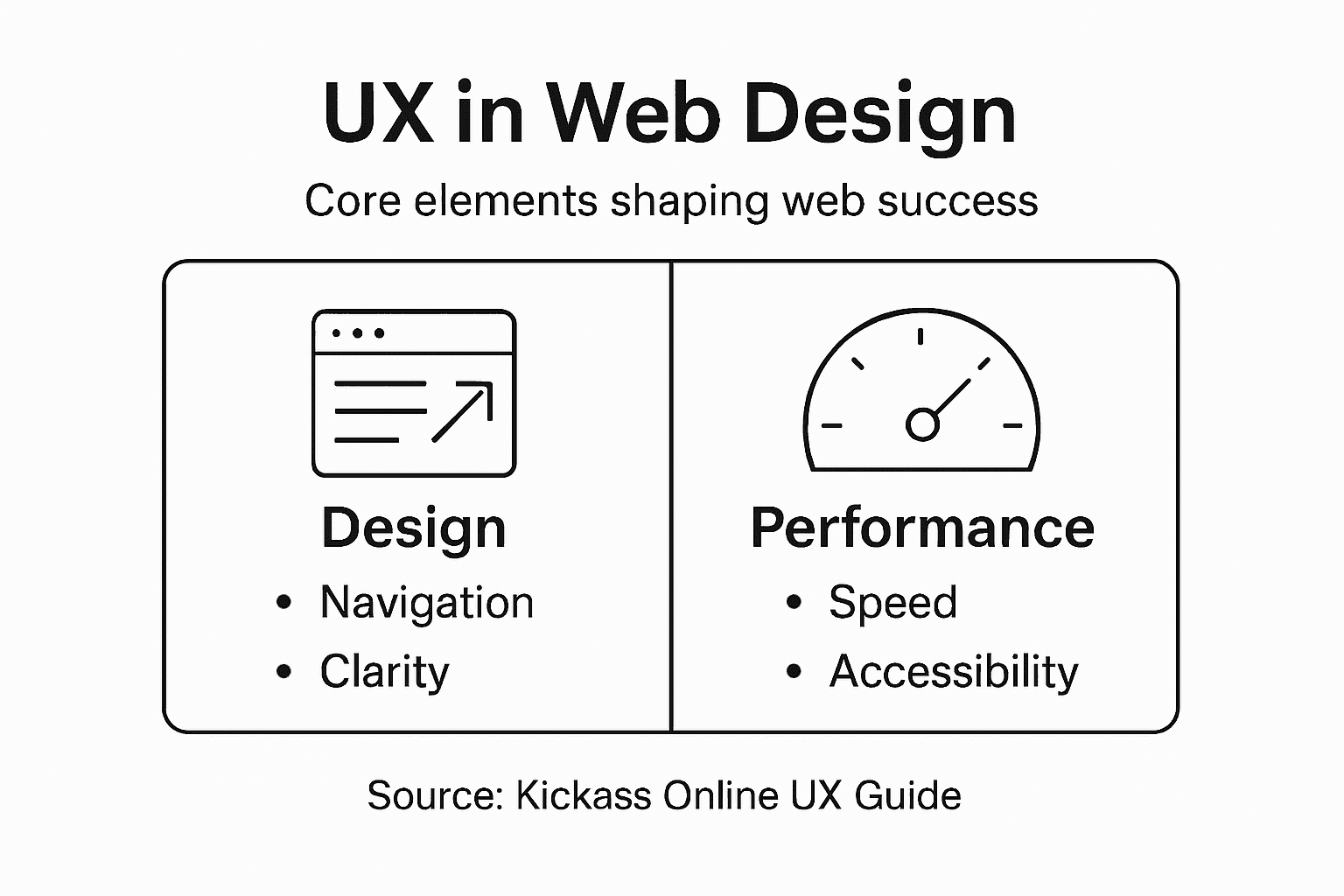
Successful web design requires a holistic approach that integrates technical performance with psychological understanding. Modern websites must balance speed, accessibility, and aesthetic appeal to create meaningful interactions that keep users engaged and satisfied.
Pro tip: Conduct regular user testing to validate how each design element contributes to overall user satisfaction and adjust your approach accordingly.
Impact Of UX On Conversions And SEO
User experience represents a critical intersection between website performance and search engine visibility. UX and SEO are intricately connected, with search engines increasingly using user interaction data to determine ranking algorithms.
Key metrics that demonstrate UX’s impact on conversions and search performance include:
- Click-through rates: Indicating user engagement and content relevance
- Dwell time: Measuring how long users remain on a webpage
- Bounce rates: Revealing user satisfaction with initial content
- Scroll depth: Showing content engagement and information quality
- Navigation patterns: Understanding user interaction with website structure
Search engines analyse these behavioural signals to assess website quality, making UX a fundamental component of organic search success. Websites that provide intuitive navigation, relevant content, and smooth user journeys are more likely to achieve higher search rankings and increased conversion rates.
Designing with both user needs and search engine requirements in mind creates a symbiotic relationship between technical performance and human experience. Successful digital strategies recognise that optimising for users simultaneously optimises for search engines, driving both visibility and engagement.
Pro tip: Regularly analyse user behaviour metrics to continuously refine your website’s user experience and search engine performance.
Avoiding Common User Experience Mistakes
Digital experiences can quickly unravel when designers overlook critical user interaction principles. Common UX design mistakes significantly undermine website effectiveness, creating frustrating barriers between users and their intended goals.
Principal UX mistakes that compromise digital experiences include:
- Cluttered interfaces: Overwhelming users with excessive visual elements
- Confusing navigation: Creating complex, non-intuitive menu structures
- Poor mobile responsiveness: Neglecting cross-device user experiences
- Inconsistent design language: Lacking visual and functional coherence
- Limited user feedback: Failing to provide clear interaction confirmations
Each mistake represents a potential point of user disengagement. Cluttered interfaces increase cognitive load, making users work harder to find information. Confusing navigation creates frustration, prompting users to abandon websites before achieving their objectives. Mobile unresponsiveness alienates a significant portion of digital users who predominantly access content through smartphones.
This table summarises how common UX mistakes affect user engagement and web outcomes:
| Mistake Type | Impact on Users | Business Consequence |
|---|---|---|
| Cluttered design | Increases cognitive overload | Higher abandonment rates |
| Poor mobile support | Frustrates mobile users | Loss of mobile traffic |
| Inconsistent visuals | Reduces trust and clarity | Lower brand credibility |
Successful UX design requires continuous iteration, rigorous testing, and genuine empathy for user needs. Designers must prioritise simplicity, consistency, and intuitive interactions that guide users seamlessly through digital experiences.
Pro tip: Conduct regular user testing with diverse participant groups to identify and address potential UX friction points before they impact user satisfaction.
Elevate Your Website’s User Experience to Drive Success
The article highlights key challenges such as cluttered interfaces, confusing navigation, and poor mobile responsiveness that can hurt your website’s performance and user satisfaction. If your goal is to create an intuitive navigation structure, enhance emotional engagement, and improve metrics like bounce rates and dwell time you need a partner who understands these UX fundamentals and can translate them into effective design and SEO strategies.
At Kickass Online, we specialise in developing high-converting websites tailored to your business objectives while ensuring seamless and engaging user experiences across all devices. Our approach focuses on the five critical elements of UX design discussed in the article from strategy to surface to deliver digital solutions that resonate with your audience and improve your search rankings.

Ready to overcome UX pitfalls and unlock your website’s full potential? Explore how our web development services can transform your online presence. Book a consultation today at Kickass Online and partner with a team dedicated to your long-term digital growth.
Frequently Asked Questions
What is user experience (UX) and why is it important?
User experience (UX) refers to the overall emotional and functional journey users have when interacting with digital platforms. It is important because a positive UX can lead to increased user engagement, satisfaction, and ultimately, conversions on a website.
How does UX design impact website conversions and SEO?
UX design affects website conversions and SEO because search engines use user interaction data, such as click-through rates and bounce rates, to assess website quality. A well-designed UX can improve search engine rankings and enhance the likelihood of users completing desired actions.
What are the main types of user experience research methods?
The main types of UX research methods include qualitative UX, which explores user motivations and emotions; quantitative UX, which uses numerical data to analyse behaviour; attitudinal UX, focusing on user perceptions; and behavioural UX, examining actual user interactions.
What common mistakes should be avoided in UX design?
Common mistakes to avoid in UX design include cluttered interfaces, confusing navigation, poor mobile responsiveness, inconsistent design language, and limited user feedback. These errors can lead to user frustration and decreased engagement.
Recommended


Book A Discovery Call
Stay Connected