What Is Content Hierarchy and Why It Drives Website Success
Struggling to guide visitors smoothly through your website can feel like a constant headache for business owners in Milton Keynes. When content is scattered or hard to find, users quickly lose interest and search engines fail to recognise your site’s value. By mastering a structured information architecture, you set the foundation for a more enjoyable browsing experience and improved online visibility. This article reveals how clear content hierarchy can simplify navigation, strengthen usability, and enhance your search results.
Table of Contents
- Core Content Hierarchy Concepts Explained
- Distinct Types: On-Page And Sitewide Hierarchies
- How Content Hierarchy Optimises Usability And SEO
- Techniques For Structuring Effective Content Flow
- Risks, Missteps, And What To Avoid With Hierarchy
Key Takeaways
| Point | Details |
|---|---|
| Effective Content Hierarchy | A well-structured content hierarchy enhances user navigation and comprehension, leading to improved user engagement. |
| On-Page vs. Sitewide Hierarchies | Understanding the differences between on-page and sitewide hierarchies is crucial for designing intuitive digital experiences. |
| Usability and SEO Integration | A clear content hierarchy not only optimises user experience but also improves search engine visibility and rankings. |
| Avoid Common Pitfalls | Regular audits and usability testing can help prevent common missteps that hinder the effectiveness of content hierarchy. |
Core Content Hierarchy Concepts Explained
Content hierarchy represents a strategic approach to organising digital information that enables users to navigate websites efficiently and intuitively. At its core, this concept transforms complex website structures into logical, easily comprehensible systems that guide visitors through content seamlessly.
The fundamental principles of content hierarchy involve creating a structured information architecture that prioritises user experience. Systematic website organisation helps users understand where specific content resides and how different sections relate to each other. This approach supports cognitive processing by establishing clear pathways and reducing mental effort required to find information.
Key components of an effective content hierarchy include:
- Clear menu and submenu categorisation
- Logical grouping of related topics
- Consistent labelling using familiar terminology
- Visual indicators of content importance
- Intuitive navigation paths
Content categorisation plays a critical role in establishing hierarchy. By systematically breaking down information into meaningful segments, websites can create more accessible and user-friendly experiences. This process involves understanding audience needs, mapping content relationships, and designing intuitive information structures.
Pro tip: Regularly audit and refine your website’s content hierarchy to ensure it remains user-friendly and aligned with your audience’s evolving navigation preferences.
Distinct Types: On-Page and Sitewide Hierarchies
Content hierarchy is not a one-dimensional concept, but rather a multifaceted approach that operates at different levels of a website’s structure. Understanding the nuanced differences between on-page and sitewide hierarchies is crucial for creating comprehensive and user-friendly digital experiences.
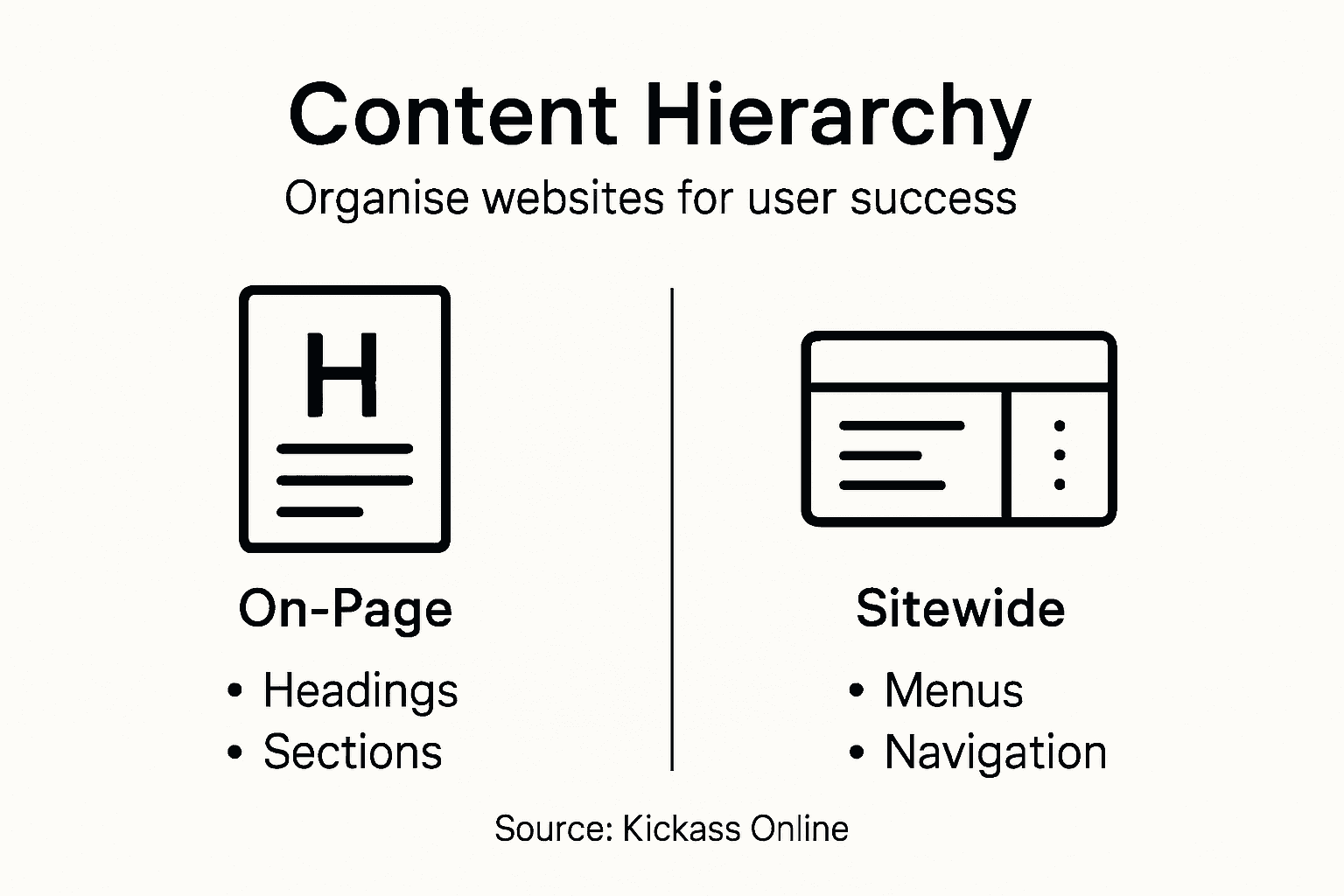
Site structure organisation encompasses two primary dimensions of content hierarchy: on-page and sitewide. Each plays a distinct yet interconnected role in guiding user navigation and comprehension. On-page hierarchy focuses on the internal structure of individual pages, while sitewide hierarchy addresses the broader architectural framework of the entire website.
On-page hierarchy characteristics include:
- Strategic use of heading levels (H1 to H6)
- Clear visual and semantic content segmentation
- Logical flow of information
- Consistent typography and formatting
- Intuitive reading progression
Sitewide hierarchy, by contrast, involves structuring multiple pages into a coherent navigational ecosystem. This broader approach encompasses:
- Main navigation menu design
- Logical categorisation of content sections
- Breadcrumb trails
- Interconnected page relationships
- Consistent information architecture
Effective content hierarchy transforms complex information into an easily digestible and navigable user experience.
The symbiotic relationship between on-page and sitewide hierarchies ensures that users can seamlessly move through a website while maintaining context and understanding. By implementing robust hierarchical structures, websites can significantly enhance user engagement, reduce cognitive load, and improve overall digital accessibility.
Pro tip: Conduct regular user testing to validate and refine your website’s hierarchical structure, ensuring it meets evolving user expectations and navigation preferences.
Here’s a consolidated summary of the differences and advantages of on-page versus sitewide content hierarchy:
| Aspect | On-Page Hierarchy | Sitewide Hierarchy |
|---|---|---|
| Focus | Individual page structure | Whole website architecture |
| User Benefit | Enhanced content clarity | Streamlined site navigation |
| Design Consideration | Effective headings, formatting | Logical menu, cross-page links |
| Impact on Experience | Smooth reading flow per page | Context retention across pages |
How Content Hierarchy Optimises Usability and SEO
Content hierarchy serves as a critical bridge between user experience and search engine performance, transforming complex digital landscapes into navigable, intuitive environments. By strategically organising information, websites can simultaneously enhance user engagement and improve their search engine visibility.

Web design hierarchy plays a pivotal role in reducing cognitive load for users while providing clear signals to search engine algorithms. This dual functionality means that well-structured content simultaneously addresses human comprehension and technological indexing requirements.
Key usability benefits of effective content hierarchy include:
- Reduced user frustration
- Faster information discovery
- Clearer navigation pathways
- Improved cognitive processing
- Enhanced overall user satisfaction
From an SEO perspective, visual hierarchy principles directly impact search engine rankings by:
- Improving website crawlability
- Enhancing keyword relevance
- Creating logical content relationships
- Increasing time-on-site metrics
- Supporting semantic understanding
Intelligent content hierarchy transforms complex information into an easily navigable user experience that search engines can readily interpret.
The symbiotic relationship between usability and SEO becomes evident when websites prioritise clear, logical content structures. By creating intuitive pathways that guide both human users and search engine crawlers, organisations can dramatically improve their digital performance and online visibility.
Pro tip: Conduct quarterly content hierarchy audits to ensure your website’s structure remains optimised for both user experience and search engine performance.
Below is a reference table highlighting how content hierarchy strengthens user experience and SEO:
| Benefit | User Experience Impact | SEO Improvement |
|---|---|---|
| Faster information access | Quick content discovery | Efficient search engine crawling |
| Reduced confusion | Simple, logical navigation | Stronger keyword relationships |
| Greater satisfaction | Intuitive pathways | Improved site relevance |
| Increased engagement | Motivates exploration | Longer user visit times |
Techniques for Structuring Effective Content Flow
Creating a compelling content flow requires strategic planning and deliberate structural choices that guide readers seamlessly through complex information. Successful content structure transforms potentially overwhelming material into an engaging, easily digestible narrative that maintains reader interest and comprehension.
Content strategy principles provide a robust framework for developing coherent communication pathways. By defining clear objectives and understanding audience needs, writers can craft content that systematically addresses user expectations and delivers information with precision and clarity.
Key techniques for optimising content flow include:
- Establishing a logical progression of ideas
- Using clear, descriptive headings
- Creating smooth transitional passages
- Maintaining consistent narrative voice
- Breaking complex concepts into digestible segments
Structural approaches to content organisation involve:
- Chronological sequencing
- Problem-solution frameworks
- Cause-and-effect narrative structures
- Compare-and-contrast methodologies
- Thematic clustering of related information
Effective content flow transforms information from a collection of facts into a compelling, meaningful narrative.
Scientific writing strategies emphasise the importance of systematic information presentation. By adopting structured approaches like the IMRaD format, content creators can ensure logical progression, maintain reader engagement, and communicate complex ideas with remarkable clarity.
Pro tip: Create a detailed content outline before writing to map your narrative flow and ensure coherent information delivery.
Risks, Missteps, and What to Avoid With Hierarchy
Content hierarchy, while powerful, can quickly become a double-edged sword when implemented without strategic consideration. Understanding potential pitfalls is crucial for creating a robust, user-friendly digital experience that supports rather than hinders information navigation.
Website structural vulnerabilities can emerge from seemingly innocuous design choices that dramatically impact user comprehension and site usability. Poorly conceived hierarchical structures create cognitive barriers that frustrate users and undermine the fundamental purpose of digital communication.
Common hierarchy missteps include:
- Overcomplicated menu structures
- Inconsistent labelling across pages
- Buried or hidden critical information
- Lack of visual hierarchy cues
- Excessive nested subcategories
- Ambiguous navigation terminology
Significant risks associated with hierarchy mismanagement involve:
- Reduced user engagement
- Increased bounce rates
- Diminished search engine performance
- Compromised accessibility
- Potential security vulnerabilities
Effective content hierarchy acts as a navigational compass, guiding users seamlessly through complex digital landscapes.
Security configuration challenges underscore the importance of maintaining a well-structured, intentional content approach. Neglecting hierarchy can expose websites to risks beyond mere user frustration, potentially compromising data integrity and user trust.
Pro tip: Conduct regular usability testing and hierarchy audits to identify and rectify potential navigational obstacles before they impact user experience.
Unlock the Power of Clear Content Hierarchy for Your Website Success
Struggling with complex site navigation or unclear content flow can frustrate your visitors and harm your search engine rankings. This article highlights how mastering content hierarchy — from on-page headings to sitewide structure — is key to reducing user confusion and boosting engagement. If your website suffers from hidden information or inconsistent labelling, you are risking lost customers and diminished online visibility.
At Kickass Online, we specialise in designing high-converting websites that implement strategic content hierarchies tailored for your audience. We take the guesswork out of your site’s organisation by creating logical, intuitive navigation pathways and optimised user experiences that engines love.

Ready to transform your website into a clear, user-friendly platform that drives growth? Partner with our dedicated team to get personalised web development, expert SEO, and ongoing site maintenance that keeps you ahead. Visit Kickass Online today and schedule your consultation to start building a website that truly reflects your business potential.
Frequently Asked Questions
What is content hierarchy?
Content hierarchy refers to the structured organisation of information on a website that enhances user navigation and comprehension. It enables users to easily find relevant content by establishing clear pathways and logical groupings.
Why is content hierarchy important for user experience?
Effective content hierarchy improves user experience by reducing cognitive load, facilitating quicker information discovery, and providing straightforward navigation pathways. It helps users understand where to find specific content and encourages engagement with the site.
How does content hierarchy impact SEO?
Content hierarchy optimises SEO by improving website crawlability, enhancing keyword relevance, and creating logical relationships between content. A well-structured hierarchy informs search engines about the content’s importance and relevance, potentially improving rankings.
What common mistakes should be avoided in content hierarchy design?
Common mistakes include overcomplicated menu structures, inconsistent labelling, hidden critical information, and excessive nesting of categories. These pitfalls can lead to user frustration, increased bounce rates, and negatively affect site usability.
Recommended
- What Is Site Architecture and Why It Matters | Kickass Online
- 7 Essential Steps for a Winning Content Marketing Checklist | Kickass Online
- Master the Content Creation Process for Business Growth | Kickass Online
- How to Optimise Website Content for Higher Conversions | Kickass Online
- Blog SEO for Shopify: Drive Traffic and Sales Step-by-Step


Book A Discovery Call
Stay Connected