Duplicate Content and SEO: Impact on Business Websites
Struggling to climb the search engine ranks, many business owners in Milton Keynes find duplicate content lurking behind sluggish website performance. Duplicate content—where matching or very similar text appears across multiple pages—can quietly disrupt your SEO efforts even if it is unintentional. Clearing up common myths and technical causes can help you protect your business against diluted rankings and wasted opportunities, empowering you to make confident decisions that drive growth.
Table of Contents
- Duplicate Content Defined And Common Myths
- Internal Versus External Duplication Explained
- Technical Causes And Real-World Scenarios
- SEO Consequences For Business Websites
- Practical Solutions For Preventing Duplication
Key Takeaways
| Point | Details |
|---|---|
| Understanding Duplicate Content | Duplicate content can arise from various sources and does not necessarily lead to search engine penalties unless it lacks unique value. |
| Managing Internal vs External Duplication | Internal duplication can be easier to control, while external duplication may require negotiation and strategic management. |
| SEO Risks of Duplicate Content | Duplicate content can significantly reduce organic search rankings and diminish website visibility, affecting revenue. |
| Practical Solutions | Implementing canonical tags and conducting regular content audits are effective strategies to prevent duplication issues. |
Duplicate Content Defined and Common Myths
Duplicate content represents a significant challenge for website owners seeking strong search engine performance. At its core, duplicate content occurs when identical or substantially similar text appears across multiple web pages or URLs, either within a single website or across different domains. Semrush research indicates that this similarity must involve noticeable overlap in wording, structure, and lack of additional unique value.
Contrary to widespread misconceptions, not all duplicate content results in automatic search engine penalties. Google’s approach is nuanced: the search engine distinguishes between unintentional content similarity and deliberate manipulation. Backlinko’s analysis reveals that search algorithms typically do not penalise websites for occasional or accidental content duplication. Instead, the primary concern is whether the content provides genuine value to users and appears authentic.
Duplicate content can emerge through various scenarios, including:
- Printer-friendly webpage versions
- Multiple product pages with similar descriptions
- Syndicated articles or blog posts
- E-commerce sites with near-identical product listings
- Multilingual website versions
Pro tip: Regularly audit your website using specialised SEO tools to identify and resolve potential duplicate content issues before they impact your search rankings.
Internal Versus External Duplication Explained
Internal duplicate content occurs within a single website, where similar or identical text appears across multiple pages belonging to the same domain. This phenomenon frequently emerges in scenarios like product catalogues, category pages, or multiple blog posts addressing comparable topics. Web administrators might unintentionally create internal duplications through printer-friendly versions, multiple URL variations, or content syndication within their own site.
By contrast, external duplicate content involves identical or substantially similar text appearing across different websites. This can result from content scraping, syndicated articles, affiliates republishing product descriptions, or legitimate content sharing agreements. External duplication presents more complex challenges, as it involves multiple domains and potentially different intentions behind content replication.
Key distinctions between internal and external duplicate content include:
- Ownership of content (single vs multiple websites)
- Intentionality of duplication
- Potential search engine ranking implications
- Control over content modification
- Complexity of resolution strategies
Understanding these differences helps website owners develop targeted strategies for managing and mitigating potential SEO risks associated with content replication.
Here’s a concise comparison of internal and external duplicate content challenges:
| Aspect | Internal Duplication | External Duplication |
|---|---|---|
| Content Ownership | Single website owner | Multiple website owners |
| Ease of Control | Direct and manageable | Limited, often requires negotiation |
| Typical Causes | Template reuse, site structure issues | Content scraping, syndication |
| SEO Risk Level | Moderate, mostly site-wide | High, may lead to ranking conflicts |
Pro tip: Implement a comprehensive content management strategy that includes regular audits, unique meta descriptions, and canonical tags to effectively manage both internal and external duplicate content risks.
Technical Causes and Real-World Scenarios
Similarweb research highlights numerous technical causes behind duplicate content generation, with URL parameters standing out as a primary culprit. These parameters, typically used for tracking, filtering, or sorting, can inadvertently create multiple versions of the same webpage, each with a distinct URL but essentially identical content. E-commerce websites are particularly vulnerable, where product variations like colour, size, or configuration can spawn numerous near-identical pages.

Moz’s comprehensive analysis reveals additional technical scenarios that trigger duplicate content issues. These include domain variations (such as HTTP versus HTTPS, or www versus non-www versions), session ID tracking, pagination in content archives, and printer-friendly page versions. Each of these technical configurations can generate multiple URLs presenting fundamentally similar content, potentially confusing search engine algorithms about which version should be prioritised.
Real-world duplicate content scenarios manifest across various digital platforms:
- E-commerce sites with multiple product pages
- News websites republishing syndicated articles
- Multilingual websites with similar content translations
- Affiliate marketing platforms with standardised product descriptions
- Academic and research websites sharing similar research summaries
Pro tip: Implement canonical tags and consistent URL structures to help search engines understand your preferred content version and minimise potential ranking complications.
SEO Consequences for Business Websites
Moz’s comprehensive analysis reveals that duplicate content can significantly undermine a business website’s search engine performance. The most immediate and damaging consequence is the reduction of organic search traffic, as search algorithms struggle to determine which page should be prioritised in rankings. This uncertainty leads to diminished visibility, potentially causing substantial revenue losses for businesses relying on online customer acquisition.
Duplicate content creates multiple problematic scenarios for business websites. Search engines become confused about which version of content to index, leading to inefficient crawl budgets where critical pages might receive less frequent or comprehensive indexing. The dilution of inbound link authority means that instead of concentrating link equity on a single, authoritative page, the website’s ranking potential becomes fragmented across multiple similar pages.
The specific SEO consequences for business websites include:
- Reduced organic search rankings
- Decreased website visibility
- Diminished click-through rates
- Inefficient use of search engine crawl resources
- Potential loss of valuable inbound link authority
Pro tip: Conduct regular content audits and implement canonical tags to consolidate page authority and signal your preferred content version to search engines.
Practical Solutions for Preventing Duplication
Search Engine Land highlights several strategic approaches for preventing duplicate content challenges. The most powerful technical solution involves implementing canonical tags, which explicitly signal to search engines the preferred version of a page. This approach allows businesses to consolidate ranking signals and prevent content fragmentation, ensuring that search algorithms understand exactly which page should be prioritised in search results.
Semrush research demonstrates that comprehensive prevention requires a multi-faceted strategy. Beyond canonical tags, website administrators should focus on consistent site architecture, careful URL parameter management, and proactive content creation. Techniques like 301 redirects can consolidate similar pages, while maintaining strict editorial standards helps generate truly unique content that naturally minimises duplication risks.
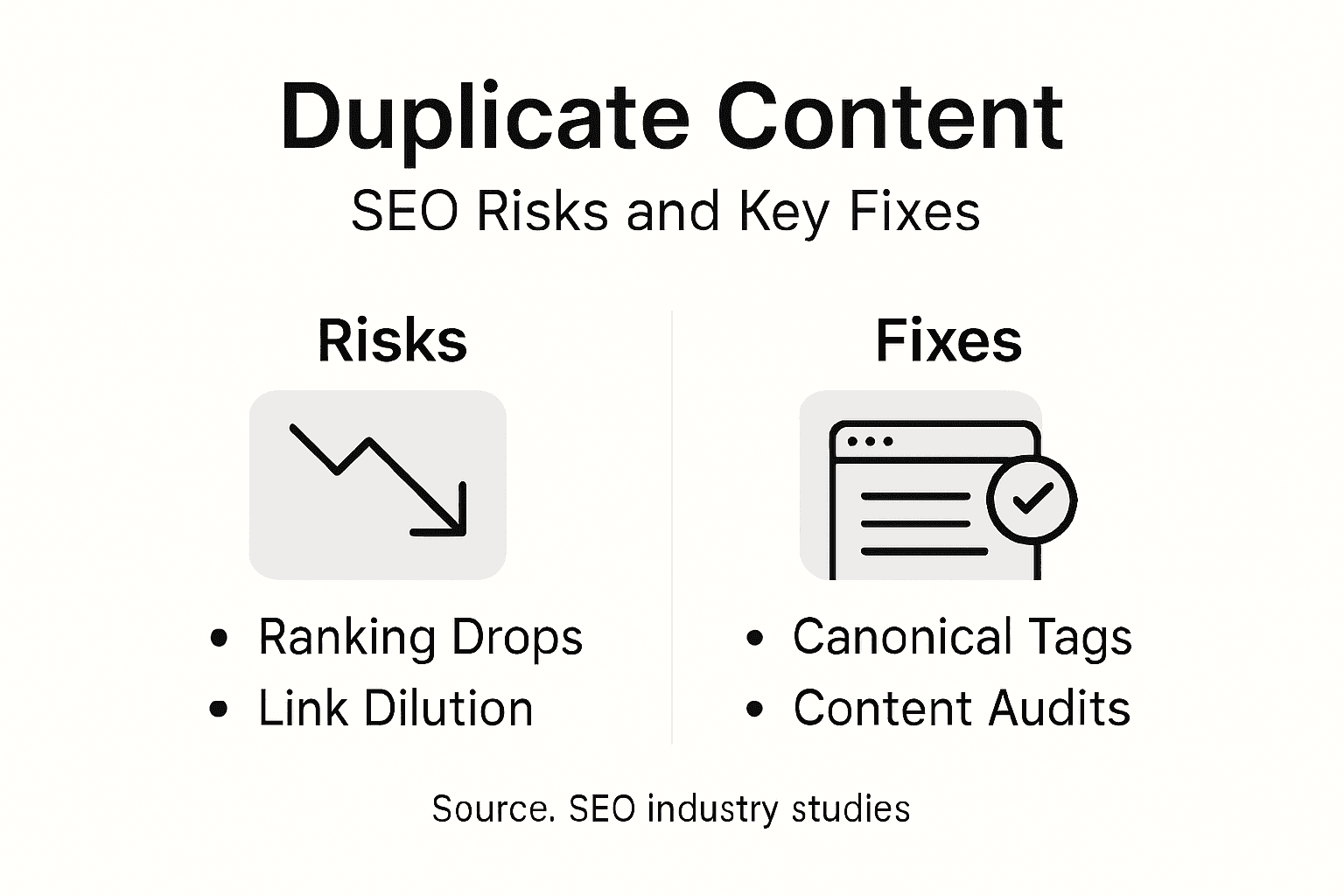
Key practical solutions for preventing duplicate content include:
Below is a summary of technical solutions and their primary benefits:
| Solution | Main Benefit | Ideal Use Case |
|---|---|---|
| Canonical Tags | Consolidates ranking signals | Multiple similar page versions |
| 301 Redirects | Directs visitors to preferred page | Old or merged content |
| URL Parameter Management | Prevents duplicate URLs from indexing | E-commerce/parameter-heavy sites |
| Noindex Tag | Removes low-value pages from search | Duplicate or thin content pages |
- Implementing canonical tags for preferred page versions
- Using 301 redirects to consolidate similar URLs
- Managing URL parameters through Google Search Console
- Creating consistently unique content
- Maintaining uniform site versions (http/https, www/non-www)
- Conducting regular SEO audits
- Noindexing low-value duplicate pages
Pro tip: Develop a systematic content review process that includes monthly technical audits and content originality checks to proactively identify and resolve potential duplication issues before they impact search rankings.
Strengthen Your Website’s SEO by Solving Duplicate Content Problems
Duplicate content is a hidden obstacle that can quietly drain your website’s search engine rankings and reduce valuable traffic. The confusion it creates for search engines leads to lost visibility and fragmented authority for your pages. At Kickass Online, we understand these challenges and offer tailored solutions that tackle issues like internal duplication, URL parameter complexities and technical SEO pitfalls. Our expert team specialises in creating unique, high-converting websites with clean architecture that prevents content duplication and maximises your organic reach.

Don’t let duplicate content hold your business back. Take control of your online presence today by booking a consultation with Kickass Online. Discover how our personalised web development and SEO strategies can improve your search rankings, secure your website’s performance, and enhance your visitor engagement. Learn more about our approach at Kickass Online and start building a stronger, clearer path to digital success now.
Frequently Asked Questions
What is duplicate content in SEO?
Duplicate content in SEO refers to identical or substantially similar text that appears across different web pages or URLs, either within the same website or across various domains. It can cause challenges for search engines trying to determine which page to prioritise in search rankings.
How does duplicate content affect my website’s SEO performance?
Duplicate content can lead to reduced organic search rankings, decreased visibility in search results, and diluted link authority. This can negatively impact the amount of traffic your site receives, potentially leading to significant revenue losses for businesses reliant on online customer acquisition.
What are common causes of duplicate content?
Common causes of duplicate content include printer-friendly versions of pages, multiple product pages with similar descriptions, URL parameters, session ID tracking, and content syndication. E-commerce sites often face duplication issues due to product variations.
How can I prevent duplicate content on my website?
Preventing duplicate content can be achieved by implementing canonical tags to signal preferred pages, using 301 redirects to consolidate similar URLs, and managing URL parameters effectively. Regular content audits and the creation of unique content are also crucial strategies.
Recommended
- White Hat SEO: Building Safe, Sustainable Rankings | Kickass Online
- Search Engine Ranking: Impact on Business Visibility | Kickass Online
- 7 Essential Types of SEO Strategies for Business Growth | Kickass Online
- What Is Organic Search? Impact On Business Growth | Kickass Online
- 7 ventajas de la inteligencia artificial en marketing digital


Book A Discovery Call
Stay Connected