Lead Generation: Fuel Business Growth Online

Chasing new leads in the current UK market can feel like a guessing game, especially when old assumptions keep holding businesses back. Many owners believe more leads mean more sales or that quick fixes like automation will do all the work. The reality is, quality leads and intentional strategies always outperform volume alone. This guide clears up persistent myths and reveals practical steps so you can build a lead generation process that fits your business, delivers real results, and supports lasting growth.
Table of Contents
- Defining Lead Generation And Common Myths
- Inbound Vs Outbound Lead Generation Methods
- Key Steps In An Effective Lead Generation Process
- Essential Tools And Success Metrics Explained
- Typical Challenges And How To Overcome Them
Key Takeaways
| Point | Details |
|---|---|
| Focus on Quality Over Quantity | Generating fewer high-quality leads is more effective than a larger number of unqualified contacts. |
| Understand That Lead Generation Is Ongoing | Consistent efforts are essential as markets and consumer behaviours are continually evolving. |
| Integrate Inbound and Outbound Strategies | A balanced approach utilising both methods optimises lead generation efforts and accelerates sales. |
| Measure and Adapt Using KPIs | Track key performance indicators to gain insights and refine your lead generation process effectively. |
Defining Lead Generation and Common Myths
Lead generation is the process of attracting and converting potential customers into individuals who have expressed interest in your products or services. For small and medium-sized UK businesses, this means identifying people who might benefit from what you offer, then nurturing that interest until they’re ready to make a purchase decision. It’s not about casting the widest net possible; it’s about finding the right people at the right time with the right message.
The confusion around lead generation stems largely from persistent myths that waste time and money. One of the most damaging misconceptions is that more leads guarantee more sales. In reality, ten qualified prospects interested in your specific solution will produce far better results than a hundred lukewarm contacts scraped from a database. Another widespread belief treats lead generation as a one-time campaign rather than an ongoing process. Your competitors aren’t resting, and neither should your lead generation efforts. Markets shift, customer behaviour changes, and what worked three months ago may need adjustment today. Many business owners also fall into the trap of thinking automation solves everything. While tools and systems save considerable time, they require constant monitoring, tweaking, and human judgment to remain effective and compliant with regulations.
Another critical myth worth addressing is the assumption that expensive campaigns automatically deliver better results. A £5,000 paid advertising campaign with poor targeting performs worse than a £1,000 investment in quality-focused strategies paired with genuine sales and marketing alignment. The most successful lead generation combines multiple approaches: some inbound tactics (content marketing, SEO), some outbound efforts (targeted email, direct outreach), and always with proper segmentation. Not every lead deserves the same treatment. A prospect who downloaded your beginner’s guide needs different communication than someone who viewed your pricing page three times. Buying pre-made lead lists often backfires, delivering low-quality contacts with outdated information. Instead, focus on building a sustainable lead generation strategy that combines organic efforts with paid campaigns, ensuring your sales team receives genuinely interested prospects they can actually convert.
Pro tip: Stop measuring success by lead volume alone. Track conversion rates, cost per qualified lead, and pipeline value instead. A business generating 50 high-quality leads monthly beats one that gets 500 weak prospects, every single time.
Here is a comparison of common myths versus the actual realities of lead generation:
| Myth | Reality |
|---|---|
| More leads always bring more sales | Quality beats sheer quantity |
| Lead generation is a single campaign | Success needs ongoing efforts |
| Automation alone solves everything | Human input remains essential |
| Expensive campaigns work best | Targeting and relevance matter more |
| All leads deserve the same treatment | Segmentation improves results |
Inbound vs Outbound Lead Generation Methods
Inbound lead generation works like a magnet. You create valuable content, optimise your website for search engines, and build a presence on social media channels where your ideal customers are already looking. A prospect discovers your blog post about solving a common problem, reads it, finds it genuinely helpful, and decides to download your guide or contact you. They came to you voluntarily. This builds trust naturally because you’ve proven your expertise before asking for anything. The downside is patience. Inbound strategies take time to mature. Your SEO efforts won’t drive substantial traffic for months. Your content library needs consistent feeding. But when it works, the leads that arrive are typically higher quality because prospects have already self-qualified by engaging with your content.

Outbound lead generation takes the opposite approach. You proactively reach out to prospects through cold emails, phone calls, LinkedIn messages, or targeted advertising. You identify a potential customer, research them briefly, craft a personalised message, and hit send. The advantage is speed. You can fill your sales pipeline immediately rather than waiting six months for content to gain traction. You control who you’re contacting, so you can target specific industries, company sizes, or job titles with surgical precision. However, outbound requires ruthless discipline in targeting and messaging quality. A poorly targeted cold email campaign annoys prospects and wastes your team’s time. The interruption-based nature means lower response rates and requires thicker skin when prospects ignore or reject your outreach.
The strongest businesses don’t choose between these methods; they blend them strategically. Start with outbound prospecting to generate immediate pipeline momentum whilst your inbound engine builds. A prospect might not respond to your first cold email, but six months later they could discover your ranking number one in Google for their specific problem and convert. Use inbound to nurture relationships over time and outbound to accelerate deals that need faster closing. Your mix depends on your sales cycle length, budget, and market. A software company with a three month sales cycle might run 70 percent outbound and 30 percent inbound. A service business relying on referrals and reputation might flip that ratio. The key is tracking what actually produces qualified leads for your business, not copying what competitors do.
Pro tip: Start by testing both methods with a small budget. Dedicate two weeks to outbound prospecting using LinkedIn and email, then measure responses and conversions. Simultaneously, create three pieces of content addressing your audience’s top questions and monitor which attracts genuine interest. Your data will reveal which approach resonates with your specific market.
Below is a summary comparing inbound and outbound lead generation methods:
| Aspect | Inbound | Outbound |
|---|---|---|
| Approach | Attracts prospects | Proactively contacts prospects |
| Speed | Slow to build impact | Immediate pipeline results |
| Lead Quality | Typically higher | Varies, needs qualification |
| Main Challenge | Needs patience | Requires precise targeting |
| Best Use Case | Long-term trust building | Quick pipeline filling |
Key Steps in an Effective Lead Generation Process
A structured lead generation process isn’t glamorous, but it works. Without one, your marketing efforts scatter in different directions whilst your sales team chases incomplete information. The foundation starts with defining your ideal customer profile. Who actually benefits most from what you offer? A UK plumbing business might target homeowners in affluent suburbs with properties built before 1990, not every homeowner everywhere. A B2B software company targets specific industries facing particular pain points, not all businesses. Once you know exactly who you’re looking for, everything else becomes easier. Your content speaks directly to them. Your advertising reaches them. Your outreach resonates because you understand their situation.
The next critical component is creating compelling offers that attract these specific prospects. This might be a free guide, a cost analysis tool, a consultation call, or exclusive discounted pricing for new customers. The offer must solve a genuine problem or answer a real question they have right now. A manufacturing company might offer a checklist for supply chain optimisation. A marketing agency might offer an audit of your current website traffic and conversion rates. Once you’ve attracted interest, you need mechanisms to capture it. That’s where landing pages and forms become essential. A well designed landing page removes distractions and makes one clear offer impossible to ignore. Your form should ask only for information you’ll actually use, not every detail under the sun. Asking for phone, email, and company name is sensible. Asking for shoe size isn’t.
Capturing the lead is only the beginning. You now have a name and contact details, but they’re not yet a genuine sales opportunity. This is where nurturing and segmentation separate successful businesses from those that waste leads. Not every lead deserves the same treatment. Someone who downloaded your beginner’s guide needs different communication than someone who requested a formal quote. Someone asking about pricing is closer to buying than someone just exploring options. Automating repetitive tasks whilst maintaining personal touches is essential here. An automated email series can drip relevant content to prospects, but your sales team should personally follow up with the warmest leads. Track everything. Measure which sources produce qualified leads. Measure which offers convert best. Measure which messages resonate. This data reveals what actually works for your business, not what works for someone else’s.
Pro tip: Document your entire process in a simple one-page flowchart showing how a prospect moves from awareness to becoming a customer. Share this with your team and refine it monthly based on real results. A business with a documented, repeatable process outperforms one relying on individual effort every single time.
Essential Tools and Success Metrics Explained
You cannot improve what you do not measure. This applies ruthlessly to lead generation. Many small business owners generate leads, collect contact details, and then have no real idea whether their efforts actually moved the needle. They spend money on advertising, create content, and hope something works. The difference between that approach and a data-driven one is enormous. Key performance indicators (KPIs) give you visibility into what’s actually happening. They reveal which channels produce genuine prospects versus which ones just look busy. They show whether your investment is paying off or bleeding cash silently.
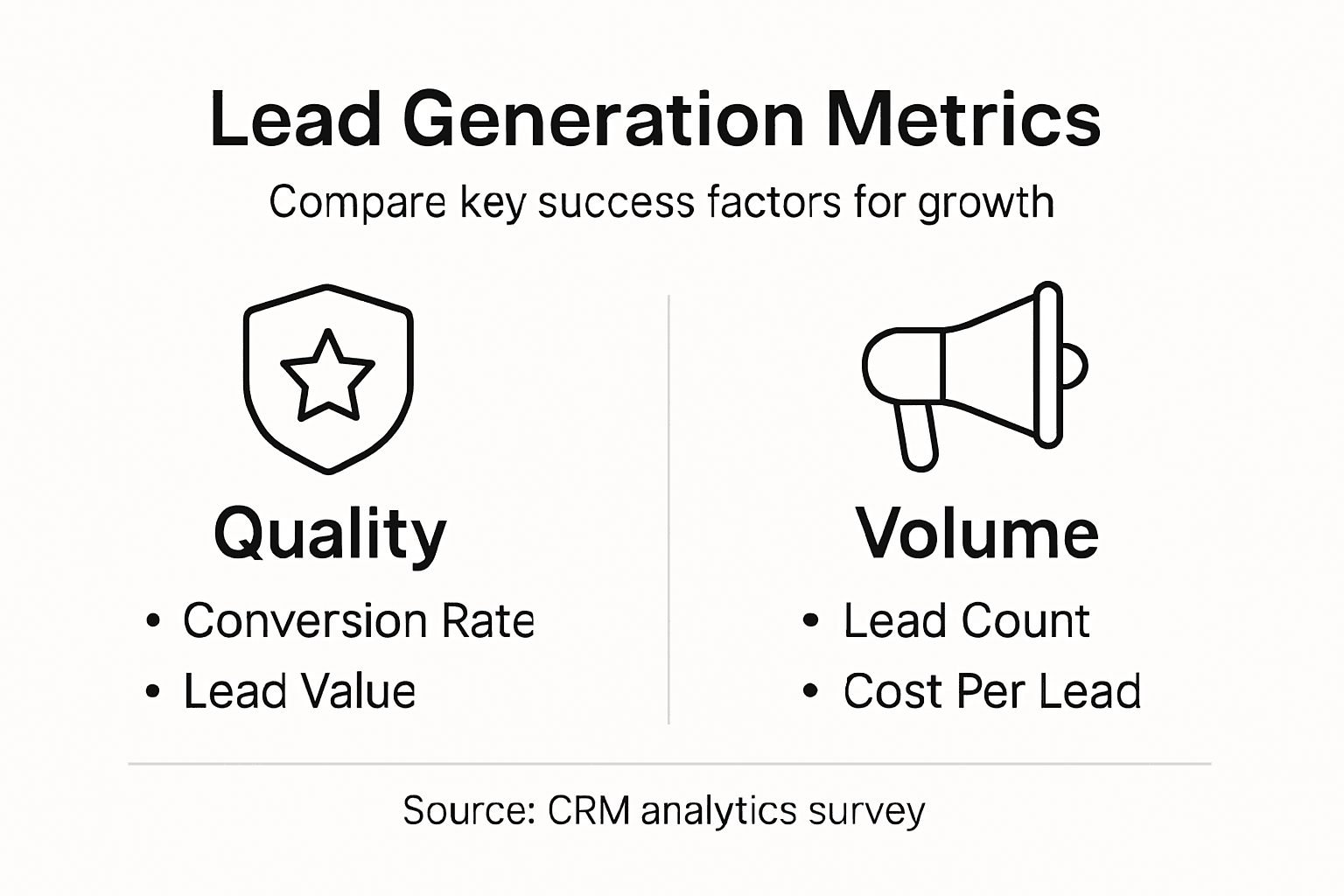
The critical metrics to track depend slightly on your business model, but certain ones matter universally. Lead volume tells you how many prospects you’re attracting. Conversion rate shows what percentage of those prospects become actual customers, which is far more important than volume alone. Cost per lead (CPL) reveals how much you’re spending to acquire each prospect. If your CPL is £50 and your average customer value is £200, that’s excellent. If your CPL is £75, you might be wasting resources. Marketing qualified leads (MQLs) are prospects your marketing team identified as fitting your ideal customer profile. Sales qualified leads (SQLs) are prospects your sales team actually wants to pursue because they’re ready to buy. Not every MQL becomes an SQL, and that gap tells you something important about either your targeting or your sales process. Understanding these KPIs and tracking them consistently reveals exactly where to optimise your efforts.
Actually implementing this measurement requires tools. A basic CRM platform like HubSpot or Pipedrive tracks your leads from first contact through to customer. You input prospect information once, and the system records every interaction, email, call, and conversation. This eliminates the chaos of information scattered across email inboxes and spreadsheets. Web analytics tools like Google Analytics show which pages attract visitors, which ones convert, and where prospects drop off. Marketing automation platforms connect your website forms, email sequences, and tracking into one system. They eliminate manual work and provide data automatically. The good news is that most of these tools have affordable plans for small businesses. You do not need enterprise software costing thousands monthly to start measuring properly.
The real power emerges when you connect the dots. You discover that prospects arriving through LinkedIn ads convert at twice the rate of those from Google Search, so you should shift budget accordingly. You notice that prospects who download your ROI calculator become customers three times faster than those who just read blog posts, so you create more calculators. You find that your sales team closes 40 percent of SQLs but only 8 percent of MQLs, revealing a targeting problem worth fixing. This is actionable intelligence that improves your business. Without measurement, you are essentially flying blind, hoping your lead generation efforts eventually pay off.
Pro tip: Start with just three metrics this month: lead volume, conversion rate, and cost per lead. Track them in a simple spreadsheet if needed. Once you see the patterns clearly, add more sophisticated metrics. Small businesses often fail by trying to measure everything at once instead of focusing ruthlessly on what actually matters for their specific situation.
Typical Challenges and How to Overcome Them
Lead generation sounds straightforward until you actually try it. Then reality hits hard. Most businesses struggle with the same frustrating obstacles that waste time, damage morale, and drain budgets. Understanding these challenges and knowing how to navigate them separates businesses that grow from those that spin their wheels. The first major hurdle is simply generating enough leads in the first place. Your website gets modest traffic. Your email list is small. Your network feels limited. You wonder if lead generation is even possible for a smaller operation competing against established players with huge budgets. The second challenge compounds the first: even when you do generate leads, many are rubbish. They look good on paper, but they are not actually interested, not the right fit, or not ready to buy. This creates frustration with sales teams who waste time chasing unqualified prospects, damaging the relationship between marketing and sales departments.
Another common challenge is timing. You reach out to prospects at the wrong moment in their buying journey. You contact them too early when they are just exploring, so they ignore you. You contact them too late when they have already committed to a competitor. Getting that timing right requires understanding your audience deeply and knowing their specific pain points. You also need accurate contact information. Email addresses change. People switch jobs. Phone numbers get disconnected. Purchasing from a cheap lead list guarantees half your contacts are useless. Many businesses discover this after spending money they cannot recover. Beyond these tactical issues lies a deeper challenge: marketing and sales teams often do not communicate properly. Marketing generates leads but does not understand what sales actually needs. Sales dismisses marketing leads as poor quality without explaining the criteria. This misalignment wastes effort on both sides. The solution requires deliberate collaboration where both teams agree on what constitutes a qualified lead and share feedback on which sources actually convert.
The path forward involves addressing these challenges systematically. Start by developing a clear understanding of who your ideal customer actually is, not who you wish them to be. Research their industry, their challenges, their budget constraints, and their decision-making process. Use this knowledge to create genuinely relevant content and choose the right channels where they actually spend time. Implement proper lead qualification processes so your sales team focuses on prospects truly worth pursuing. Use data validation and multi-channel communication to maintain accurate contact information and reach prospects through their preferred channels. Set up structured communication between marketing and sales where they agree on definitions and review results monthly. Schedule time for your teams to discuss which campaigns worked, which leads converted, and what needs adjusting. Build nurturing processes so prospects who are not ready today stay engaged until they are ready tomorrow. This requires patience but produces far better results than aggressive hard selling to unqualified contacts.
Pro tip: Audit your current lead generation challenges by asking your sales team one simple question: what percentage of leads they receive are actually worth their time? If the answer is below 60 percent, you have a qualification problem. Fix that before adding more leads to the pipeline.
Unlock the Full Potential of Your Lead Generation Strategy
Struggling to turn lead generation myths into measurable growth Understand the challenges of generating qualified leads and nurturing them effectively to boost your business performance. The insights in this article highlight the importance of blending inbound and outbound tactics, focusing on quality not quantity, and tracking key metrics to refine your approach. At Kickass Online, we specialise in transforming these principles into real results through tailored web design, expert SEO, and ongoing website maintenance that strengthens your online visibility and attracts the right prospects.

Take the guesswork out of your lead generation with our personalised digital marketing solutions. Explore proven strategies that align marketing and sales efforts for higher conversion rates. Visit Uncategorized | Kickass Online to start discovering the impact of a comprehensive digital presence. Ready to fuel your business growth right away Book your consultation at Kickass Online and partner with a team dedicated to delivering customised websites and optimisation strategies designed to generate high-quality leads and accelerate your sales pipeline.
Frequently Asked Questions
What is lead generation?
Lead generation is the process of attracting and converting potential customers who have shown interest in your products or services into ready-to-buy leads.
How do inbound and outbound lead generation methods differ?
Inbound lead generation attracts prospects through valuable content, while outbound involves proactively reaching out to potential customers via cold emails, calls, or ads.
Why is it important to measure lead generation success?
Measuring lead generation success helps identify which strategies are effective, enabling businesses to optimise their efforts and budget for higher quality leads.
What are the common challenges businesses face in lead generation?
Common challenges include generating enough qualified leads, poor timing in outreach, inaccurate contact information, and misalignment between marketing and sales teams.
Recommended


Book A Discovery Call
Stay Connected