Website Accessibility: Why It Matters for Businesses

More than 15 percent of the global population relies on accessible websites to interact online, yet misconceptions remain widespread among british and international businesses. Many managers still believe accessibility is either costly or will weaken the overall site design. This article challenges common myths and outlines practical steps proven to support compliance, enhance user experience, and help brands connect with a wider audience while meeting legal standards.
Table of Contents
- Defining Website Accessibility And Common Myths
- Major Types Of Digital Accessibility Needs
- Core Features Of Accessible Web Design
- Legal Standards And Compliance Requirements
- Risks, Costs, And Benefits For Smes
Key Takeaways
| Point | Details |
|---|---|
| Website Accessibility is Essential | Creating inclusive websites is a legal requirement and a critical aspect of digital design that benefits all users, not just those with disabilities. |
| Prioritise Accessibility in Design | Implementing accessibility features can enhance user experience and improve engagement without compromising aesthetics. |
| Legal Compliance is Crucial | Failing to adhere to local accessibility laws can lead to significant legal risks and reputational damage for organisations. |
| Small Businesses Can Benefit Enormously | Investing in accessibility represents a low cost with high returns, including expanded market reach and improved customer loyalty. |
Defining website accessibility and common myths
Website accessibility refers to creating digital experiences that can be used effectively by all individuals, regardless of their physical or cognitive abilities. Researchers have proposed a comprehensive definition emphasising that web accessibility means enabling all people, especially those with disabilities and older adults, to navigate websites using various technologies and contexts.
Contrary to popular misconceptions, web accessibility is not an optional add-on but a fundamental aspect of inclusive digital design. Many businesses mistakenly believe that making websites accessible is prohibitively expensive or will compromise aesthetic quality. However, research consistently demonstrates that accessibility actually benefits a broader audience and improves overall user experience.
The core principles of website accessibility include providing alternative text for images, ensuring keyboard navigation, using sufficient colour contrast, creating clear content structure, and designing interfaces compatible with assistive technologies. These strategies do not require eliminating design elements like images or JavaScript, but instead focus on implementing them in ways that all users can understand and interact with.
Pro tip: Start by conducting a basic accessibility audit of your website using free online tools to identify potential barriers and prioritise improvements for a more inclusive digital experience.
Major types of digital accessibility needs
Digital accessibility encompasses a wide range of user needs that extend far beyond traditional perceptions of disability. Research highlights that accessibility requirements span multiple categories, addressing visual, auditory, motor, mobility, and cognitive challenges experienced by users with diverse abilities.
Visual accessibility needs are perhaps the most recognised, involving support for users with partial or complete vision impairments. This includes implementing screen reader compatibility, providing alternative text descriptions for images, ensuring sufficient colour contrast, and designing interfaces that can be navigated and understood without relying solely on visual cues. Users might use magnification tools, text-to-speech software, or specialised browsers that interpret web content differently.

Beyond visual requirements, digital accessibility also addresses motor and mobility challenges. These needs focus on creating websites that can be fully navigated using keyboard controls, voice commands, or adaptive technologies like switch devices. Cognitive accessibility is equally crucial, involving clear language, predictable navigation structures, and design elements that reduce cognitive load and support users with learning disabilities, attention disorders, or memory challenges.
Pro tip: Consider conducting user testing with individuals representing different accessibility needs to gain genuine insights into potential website interaction barriers.
Here is a summary of digital accessibility needs and the assistive solutions commonly used:
| User Need Category | Common Challenges | Typical Assistive Technology |
|---|---|---|
| Visual | Difficulty seeing content | Screen readers, magnifiers, Braille displays |
| Auditory | Hearing multimedia sounds | Captioning software, transcripts, hearing aids |
| Motor/Mobility | Operating mouse or keyboard | Voice input, switch devices, adaptive keyboards |
| Cognitive | Understanding complex layouts | Simplified content, screen masking tools, text-to-speech |
Core features of accessible web design
Fundamental principles of accessible web design are structured around four critical components: perceivability, operability, understandability, and robustness. These principles ensure that websites can be navigated and comprehended by users with diverse abilities and technological resources.
Perceivability focuses on presenting information in multiple formats that can be understood through different sensory channels. This includes providing alternative text for images, ensuring sufficient colour contrast, creating captions for multimedia content, and designing interfaces that can be interpreted by screen readers and other assistive technologies. Operable design means creating interfaces that can be navigated using multiple input methods, including keyboard controls, voice commands, and adaptive technologies.
Understandability is perhaps the most nuanced principle, requiring clear, straightforward language and predictable navigation structures. Web designers must create interfaces that reduce cognitive load, use consistent layouts, provide clear error messages, and offer simple, logical progression through content. Robust design ensures that websites function across different browsers, devices, and assistive technologies, guaranteeing a consistent experience for all users regardless of their technological setup.
Pro tip: Conduct regular accessibility audits using automated tools and manual testing with users representing different abilities to identify and address potential design barriers.
Legal standards and compliance requirements
Accessibility compliance has become a critical legal requirement across multiple jurisdictions, with legislation designed to protect individuals with disabilities from digital discrimination. Laws such as the Americans with Disabilities Act (ADA) and Section 504 of the Rehabilitation Act mandate that organisations provide equal digital access, transforming website accessibility from a voluntary practice to a legal obligation.
In the United Kingdom, the Equality Act 2010 provides a robust framework for digital accessibility, requiring businesses to make reasonable adjustments to ensure their online platforms are usable by people with disabilities. Similar legislation exists in the European Union through the Web Accessibility Directive, which compels public sector websites and mobile applications to meet specific accessibility standards. These legal frameworks emphasise that digital exclusion is a form of discrimination, placing responsibility on organisations to create inclusive digital experiences.
Compliance involves more than legal risk mitigation. Organisations that proactively implement accessibility standards can unlock significant business advantages, including expanded market reach, improved user experience, and enhanced brand reputation. Potential consequences of non-compliance range from financial penalties and legal action to reputational damage and loss of potential customer segments. Most accessibility standards align with the Web Content Accessibility Guidelines (WCAG), which provide a comprehensive framework for creating universally accessible digital content.
Pro tip: Engage legal and digital accessibility experts to conduct a comprehensive accessibility audit and develop a strategic implementation plan that addresses both compliance requirements and user experience.
The following table compares key legal accessibility standards across regions:
| Region | Main Law/Standard | Business Impact |
|---|---|---|
| United Kingdom | Equality Act 2010 | Mandatory reasonable adjustments |
| United States | ADA & Section 504 | Risk of lawsuits; must ensure access |
| European Union | Web Accessibility Directive | Required for public sector websites |
Risks, costs, and benefits for SMEs
Accessibility implementation presents a strategic opportunity for small and medium enterprises to differentiate themselves in a competitive digital marketplace. Contrary to common misconceptions, investing in website accessibility represents a minimal financial commitment, typically estimated at just 2% of a site’s development budget, with substantial long-term returns.
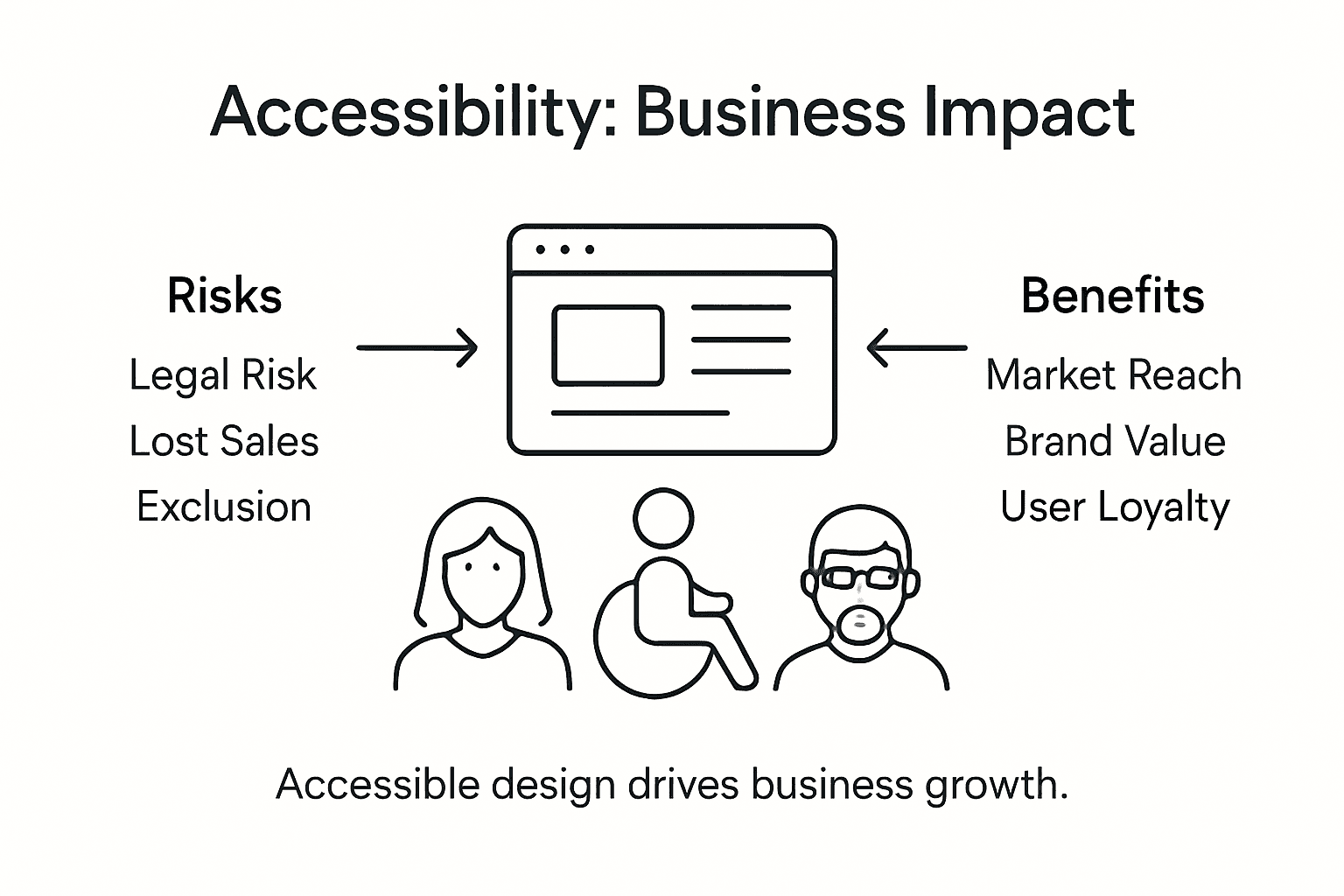
The potential risks of neglecting accessibility are significant and multifaceted. SMEs face substantial legal exposure, including potential discrimination lawsuits, reputational damage, and exclusion from entire market segments. Non-compliant websites not only risk financial penalties but also alienate a substantial customer base comprising individuals with disabilities and their networks. Moreover, inaccessible digital platforms can trigger negative word-of-mouth marketing and diminish brand perception among increasingly socially conscious consumers.
Beyond risk mitigation, accessible websites offer compelling business advantages. Enhanced digital experiences can expand market reach, improve search engine optimisation, and demonstrate corporate social responsibility. Small businesses that prioritise accessibility often discover unexpected benefits, such as improved user experience for all visitors, increased customer loyalty, and a competitive edge in demonstrating inclusive design practices. The marginal upfront investment in accessibility can translate into significant long-term business growth and customer engagement.
Pro tip: Conduct a comprehensive accessibility audit during initial website development to minimise retrofitting costs and integrate inclusive design principles from the outset.
Elevate Your Business with Truly Accessible Website Design
The challenge of making websites accessible for all users is not just a legal obligation but a key opportunity to expand your reach and enhance user experience. This article highlights the critical need to incorporate perceivability, operability, understandability, and robustness into your digital platforms. At Kickass Online, we understand the importance of breaking down barriers by integrating these core accessibility principles into every website we create.
Accessibility is about more than technical compliance It is about connecting with real people who visit your site regardless of ability or device Our team specialises in creating bespoke websites that comply with legal standards while delivering smooth and engaging experiences for everyone. Ready to transform your digital presence and avoid costly pitfalls? Browse our Websites to see how we implement smart accessibility solutions.

Take control of your website’s accessibility now and unlock untapped market potential. Visit us at Kickass Online to book your personalised consultation. Discover tailored strategies and expert guidance in our Tutorials to ensure your business stands out as inclusive and forward-thinking.
Frequently Asked Questions
What is website accessibility?
Website accessibility refers to the practice of creating digital experiences that can be used effectively by all individuals, including those with disabilities or older adults, regardless of their physical or cognitive abilities.
Why is web accessibility important for businesses?
Web accessibility is crucial for businesses because it ensures all users can navigate their websites. This inclusivity not only meets legal requirements but also enhances user experience, expands market reach, and demonstrates corporate social responsibility.
What are some common misconceptions about web accessibility?
Common misconceptions include the belief that accessibility is an expensive add-on or that it compromises design quality. In reality, implementing accessible design can improve overall user experience and benefit a wider audience.
How can businesses improve their website’s accessibility?
Businesses can improve their website’s accessibility by adding alternative text for images, ensuring keyboard navigation, using sufficient colour contrast, structuring content clearly, and conducting regular accessibility audits to identify barriers.
Recommended


Book A Discovery Call
Stay Connected