What Is SEM? Driving Online Business Success
Competing for attention in Milton Keynes is no easy feat when every local business wants to stand out online. Effective search engine marketing puts your brand right in front of customers actively searching for your products or services, combining paid advertising with search engine optimisation for maximum visibility. Discover how precise audience targeting and measurable campaign performance can accelerate your growth and help you reach exactly the right customers at the right moment.
Table of Contents
- SEM Defined: Fundamentals And Main Concepts
- Types Of SEM: PPC, Display, And Others
- How SEM Works In Modern Digital Marketing
- Key Benefits For Small And Medium Businesses
- Common SEM Mistakes And How To Avoid Them
Key Takeaways
| Point | Details |
|---|---|
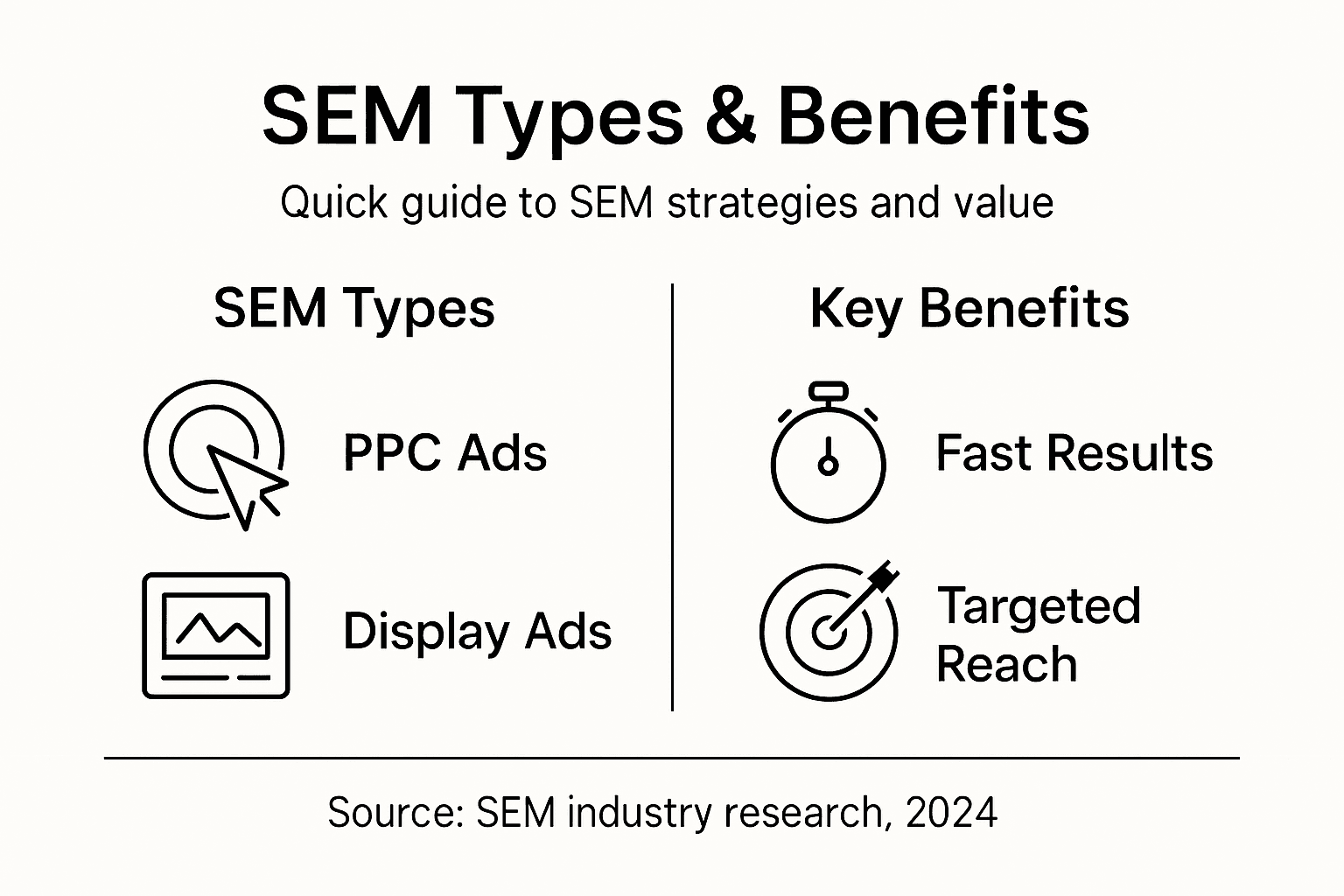
| SEM Strategy | Search Engine Marketing combines paid advertising and organic search techniques to enhance online visibility and drive targeted traffic. |
| Types of SEM | Primary types include Pay-Per-Click (PPC), Display Advertising, and Remarketing, each serving distinct marketing purposes. |
| Common Pitfalls | Avoid mistakes such as broad keyword selection and neglecting conversion tracking to enhance campaign effectiveness. |
| Benefits for SMBs | SEM provides cost-effective advertising, precise audience targeting, and immediate visibility, empowering small businesses to compete effectively. |
SEM Defined: Fundamentals and Main Concepts
Search Engine Marketing (SEM) represents a powerful digital strategy designed to enhance online visibility and drive targeted web traffic. At its core, SEM combines paid advertising techniques and organic search optimisation to help businesses capture consumer attention in digital marketplaces. Search engine marketing strategies involve sophisticated approaches to connect brands with potential customers precisely when they’re seeking relevant information.
The fundamental components of SEM include several critical elements:
- Keyword Research: Identifying specific search terms potential customers use
- Paid Advertising: Creating targeted advertisements on search platforms
- Audience Targeting: Segmenting potential customers based on demographics, interests, and behaviours
- Performance Tracking: Measuring campaign effectiveness through analytics
Understanding SEM requires recognising its dual approach. Marketers utilise both organic search engine optimisation (SEO) techniques and paid advertising strategies to maximise digital visibility. This means businesses can appear prominently in search results through carefully crafted content and strategic ad placements.
SEM transforms digital marketing by allowing businesses to appear exactly where potential customers are searching.
Successful SEM campaigns require continuous optimisation and strategic planning. Marketers must constantly analyse search trends, refine keyword selections, and adjust targeting parameters to maintain competitive positioning. By understanding user intent and crafting precisely targeted content, businesses can significantly improve their online engagement and conversion rates.
Pro tip: Regularly review and update your keyword strategy to stay aligned with evolving search behaviours and emerging digital trends.
Types of SEM: PPC, Display, and Others
Search Engine Marketing (SEM) encompasses multiple sophisticated strategies designed to boost online visibility and drive targeted traffic. The primary types of SEM include Pay-Per-Click (PPC) advertising, display advertising, remarketing, and shopping advertisements, each serving unique marketing objectives. Targeted advertising strategies enable businesses to reach specific audience segments with precision and efficiency.
The main types of SEM can be categorised as follows:
- Pay-Per-Click (PPC) Advertising: Text-based ads appearing alongside search results
- Display Advertising: Visual banner ads across website networks
- Remarketing Campaigns: Targeted ads shown to previous website visitors
- Shopping Advertisements: Product-specific listings with images and pricing
- Video Advertising: Promotional content within video search results
Each SEM type offers distinct advantages for digital marketing strategies. PPC advertising allows immediate visibility by placing advertisements directly in search results, while display advertising provides broader brand exposure across multiple digital platforms. Remarketing campaigns specifically target individuals who have previously interacted with a brand, increasing the likelihood of conversion.

Here’s a comparison of SEM types and their optimal use cases:
| SEM Type | Best For | Typical Format | Business Impact |
|---|---|---|---|
| PPC Advertising | Immediate visibility | Text ads on searches | Quick traffic and conversions |
| Display Advertising | Brand awareness | Visual banners/sites | Wide reach, improved exposure |
| Remarketing | Engaging past visitors | Targeted display ads | Higher conversion potential |
| Shopping Ads | Retail product promotion | Product listings | Boosts e-commerce sales |
| Video Advertising | Storytelling, brand recall | Video content | Strong engagement, trust building |
Successful SEM strategies combine multiple advertising approaches to maximise digital marketing effectiveness.
Understanding the nuanced differences between SEM types enables businesses to craft more intelligent, targeted marketing campaigns. Marketers must carefully select and combine these approaches based on specific business goals, target audience characteristics, and available budget constraints.
Pro tip: Regularly analyse your SEM campaign performance and be prepared to adjust your strategy based on real-time data and audience engagement metrics.
How SEM Works in Modern Digital Marketing
Modern digital marketing relies on sophisticated search engine marketing strategies that combine precision targeting with data-driven insights. Search engine marketing techniques enable businesses to connect with potential customers at the most critical moments of their online journey, transforming how brands communicate and convert digital audiences.
The core mechanics of SEM involve several interconnected processes:
- Keyword Research: Identifying precise search terms customers use
- Ad Creation: Developing compelling, targeted advertising content
- Bid Management: Strategically allocating advertising budget
- Audience Targeting: Segmenting potential customers by demographics
- Performance Tracking: Measuring campaign effectiveness in real-time
Each stage of SEM requires meticulous planning and continuous optimization. Marketers must understand user intent, craft persuasive ad copy, and leverage advanced targeting technologies to ensure maximum return on investment. By analysing real-time data, businesses can rapidly adjust their strategies, focusing resources on the most effective keywords and audience segments.
Successful SEM transforms digital advertising from a scattergun approach to a precision-targeted communication strategy.
The integration of advanced analytics allows marketers to track every stage of the customer journey, from initial search to final conversion. This data-driven approach enables businesses to understand customer behaviour, refine their messaging, and create increasingly sophisticated marketing campaigns that deliver measurable results.
Pro tip: Implement conversion tracking and regularly review performance metrics to continuously refine your SEM strategy and improve campaign effectiveness.
Key Benefits for Small and Medium Businesses
Search Engine Marketing offers transformative advantages specifically tailored for small and medium businesses seeking to compete effectively in digital marketplaces. Search engine marketing strategies provide unprecedented opportunities for growth, enabling businesses to punch well above their weight in competitive online environments.
The key benefits for small and medium enterprises include:
- Cost-Effective Advertising: Pay only for actual clicks received
- Precise Audience Targeting: Reach specific customer demographics
- Immediate Visibility: Appear instantly in search results
- Measurable Performance: Track real-time campaign effectiveness
- Local Market Penetration: Connect with nearby potential customers
- Budget Flexibility: Adjust spending according to business capabilities
Small businesses particularly benefit from SEM’s granular targeting capabilities. Unlike traditional advertising methods, digital marketing allows precise audience segmentation, ensuring marketing budgets are spent efficiently. Entrepreneurs can target specific geographical areas, demographic groups, and even consumer interests with remarkable accuracy.
SEM empowers small businesses to compete with larger competitors by levelling the digital marketing playing field.
The scalability of Search Engine Marketing means businesses can start with modest budgets and incrementally increase investment as they see tangible results. This approach allows for continuous learning and refinement, helping companies understand their market more deeply while generating meaningful customer engagement.
Pro tip: Start with a conservative budget, closely monitor your campaign performance, and progressively adjust your strategy based on measurable insights and conversion rates.
Common SEM Mistakes and How to Avoid Them
Search Engine Marketing success hinges on avoiding critical strategic errors that can drain budgets and undermine campaign effectiveness. Common SEM pitfalls represent significant challenges for digital marketers seeking optimal return on investment.
The most prevalent SEM mistakes include:
- Broad Keyword Selection: Using generic, non-specific search terms
- Insufficient Negative Keyword Management: Failing to exclude irrelevant search queries
- Neglecting Conversion Tracking: Not monitoring actual campaign performance
- Poor Geo-Targeting: Imprecise audience location settings
- Blind Platform Recommendations: Accepting default suggestions without critical evaluation
- Inadequate Campaign Structure: Poorly organised ad groups and targeting
Marketers must approach SEM with strategic precision. Each mistake represents a potential financial drain, requiring meticulous planning and continuous refinement. Understanding how these errors manifest helps businesses develop more sophisticated, cost-effective digital marketing approaches.
For quick reference, here are strategies to avoid common SEM mistakes:
| Mistake | Strategic Solution | Long-term Benefit |
|---|---|---|
| Broad keywords | Use specific, targeted terms | Higher quality traffic |
| Weak negative keywords | Maintain exclusion lists | Reduced wasted spend |
| Poor geo-targeting | Set precise location filters | Local audience relevance |
| Neglecting conversion data | Track performance metrics | Improved ROI and insights |
| Unstructured campaigns | Organise ad groups clearly | Easier optimisation |
Successful SEM demands constant vigilance and data-driven decision-making.
The key to avoiding common SEM mistakes lies in developing a structured, analytical approach. This means conducting thorough keyword research, implementing precise targeting, creating compelling ad copy, and consistently monitoring campaign performance. Businesses should view SEM as an iterative process, continuously learning and adapting their strategies based on empirical insights.
Pro tip: Allocate time each week to review campaign metrics, test different strategies, and ruthlessly eliminate underperforming keywords and advertisements.
Unlock Your Business Potential with Expert SEM Solutions
If you are struggling with driving precise online traffic or making sense of complex SEM strategies like Pay-Per-Click advertising and keyword targeting, you are not alone. Many small and medium businesses face challenges in balancing cost-effective advertising with measurable results. Understanding concepts such as keyword research, audience targeting, and conversion tracking is crucial but can feel overwhelming without a trusted digital partner. At Kickass Online, we specialise in transforming these intricate strategies into personalised action plans that maximise your online visibility and convert visitors into loyal customers.
Discover how our dedicated team of specialists can elevate your business through smart website design, robust SEO tactics, and ongoing website maintenance tailored specifically for your growth goals. Don’t let common SEM mistakes limit your success. Act now to benefit from a focused digital marketing strategy that adapts to evolving search trends and drives tangible results. Book a consultation today at Kickass Online and take the first step to a stronger online presence. You can also explore our comprehensive offerings on professional website design and SEO where customised, high-converting solutions await.
Frequently Asked Questions
What is the main purpose of Search Engine Marketing (SEM)?
Search Engine Marketing (SEM) aims to enhance online visibility and drive targeted web traffic by combining paid advertising techniques with organic search optimisation.
How do I effectively conduct keyword research for SEM?
Effective keyword research involves identifying specific search terms that potential customers use. Tools and analytics can help pinpoint the best keywords to target for improved visibility.
What are the different types of SEM advertising?
The different types of SEM advertising include Pay-Per-Click (PPC) advertising, display advertising, remarketing campaigns, shopping advertisements, and video advertising, each serving unique marketing objectives.
Why is performance tracking important in SEM campaigns?
Performance tracking is crucial in SEM as it allows marketers to measure campaign effectiveness, understand user behaviour, and refine strategies based on real-time data to maximise return on investment.
Recommended
- 7 Essential Types of Online Advertising for SME Growth | Kickass Online
- Leveraging Social Media Advertising for SMEs: Unlock Untapped Growth | Kickass Online
- Effective Digital Marketing Strategies for SMEs: Boost Your Online Performance | Kickass Online
- Boost Your SME’s Visibility with Expert SEO Strategies | Kickass Online
- Partner Up & Get Paid | MyHair


Book A Discovery Call
Stay Connected