Backend engineering note: for building realtime backend features, this Server-Sent Events in Node.js is a useful related reference.
Most small business owners assume digital marketing means running a few Facebook ads or posting on Instagram. That assumption costs them growth. Digital marketing spans search engines, social media, email, websites, mobile apps and far more. It is a connected ecosystem of tools and channels working together to bring your ideal customers closer to your business. This guide cuts through the noise and explains what digital marketing actually covers, which channels matter most for small and medium-sized businesses, and how to build a foundation that delivers real, measurable results rather than vanity metrics.
Table of Contents
- Defining digital marketing for today’s SME
- The essential digital marketing channels explained
- How digital marketing really works: Integration over silos
- Digital marketing pitfalls: Common mistakes and new realities
- Choosing your next steps: Building a digital marketing foundation
- The uncomfortable truth about digital marketing for SMEs
- Ready to boost your online visibility?
- Frequently asked questions
Key Takeaways
| Point | Details |
|---|---|
| Digital marketing basics | It means using online channels to promote your business and build customer relationships. |
| Integrated channel strategy | Combining SEO, content, social, and email increases impact far beyond working in silos. |
| Start with essentials | Focus on the website, then add priority channels based on your type of SME. |
| Avoid common pitfalls | Over-using ads or automating everything can limit growth, human guidance still matters. |
| Measure and refine | Track meaningful results and adapt your strategy for real business growth. |
Defining digital marketing for today’s SME
Digital marketing covers promotion of products or brands via electronic devices and online channels. For a small or medium-sized business owner, that translates into a practical toolkit: your website, your search engine rankings, your email list, your social profiles, and the paid adverts you run across platforms. Each of these is a lever you can pull.
What makes digital marketing so valuable for SMEs is the combination of reach and affordability. A well-optimised blog post can attract customers for years without additional spend. A targeted email campaign can generate sales for pennies per recipient. You are not competing on budget alone; you are competing on relevance and consistency.
Here are the core digital marketing tools most SMEs work with:
- Search engine optimisation (SEO): Getting your website found on Google without paying per click
- Pay-per-click advertising (PPC): Paid adverts on Google, Bing, or social platforms
- Social media marketing: Building community and brand awareness on platforms like Facebook, LinkedIn, and Instagram
- Email marketing: Nurturing leads and retaining customers through direct inbox communication
- Content marketing: Blog posts, videos, and guides that attract and educate your audience
- Local marketing: Google Business Profile, local citations, and map-based visibility
“Digital marketing is not a single tactic. It is a system. When you treat each channel as a separate experiment rather than part of a connected strategy, you leave most of the value on the table.”
Understanding the digital marketing results for SMEs available through integrated approaches is the first step towards using your budget wisely. If you are still unsure where to begin, exploring how digital marketing helps small businesses can give you a clearer starting point.
The essential digital marketing channels explained
Not every channel suits every business. The key is understanding what each one does best, then selecting the right combination for your goals and audience. Key channels include SEO, PPC, social, content, email, and local marketing, and their integration is what drives real results.
Here is a quick reference for how each channel serves SME goals:
| Channel | Best for | Typical timeline |
|---|---|---|
| SEO | Long-term organic traffic | 3 to 6 months |
| PPC | Immediate visibility and leads | Immediate |
| Social media | Brand awareness and engagement | Ongoing |
| Email marketing | Customer retention and nurturing | Short to medium |
| Content marketing | Authority building and SEO support | 3 to 12 months |
| Local marketing | Foot traffic and nearby customers | 1 to 3 months |
When you look at digital marketing channel insights across industries, a pattern emerges: businesses that use three or more integrated channels consistently outperform those relying on just one.
Here is a sensible starting sequence for most SMEs:
- Build or optimise your website so it loads fast, looks professional, and converts visitors
- Set up your Google Business Profile for local search visibility
- Choose one or two social platforms where your customers actually spend time
- Start a simple email list from day one, even if it is small
- Add SEO-focused content regularly to build organic traffic over time
Pro Tip: Resist the urge to be everywhere at once. Two channels executed well will outperform six channels done poorly. Use your digital marketing plan for SMEs to map out a focused, phased approach. You can also explore social media presence strategies to sharpen your platform-specific thinking.
How digital marketing really works: Integration over silos
Here is where most SMEs get stuck. They run ads in one place, post on social in another, and send the occasional email with no connection between them. Each activity feels busy, but nothing compounds. Integration, not silos, drives growth as channels reinforce one another through consistent 90-day cycles of audit to execution.

Think of it this way. A blog post optimised for SEO brings in organic traffic. That traffic is retargeted with a PPC ad. Visitors who sign up receive an email sequence that builds trust. Those subscribers become buyers and then advocates who share your content on social media. Each channel feeds the next.
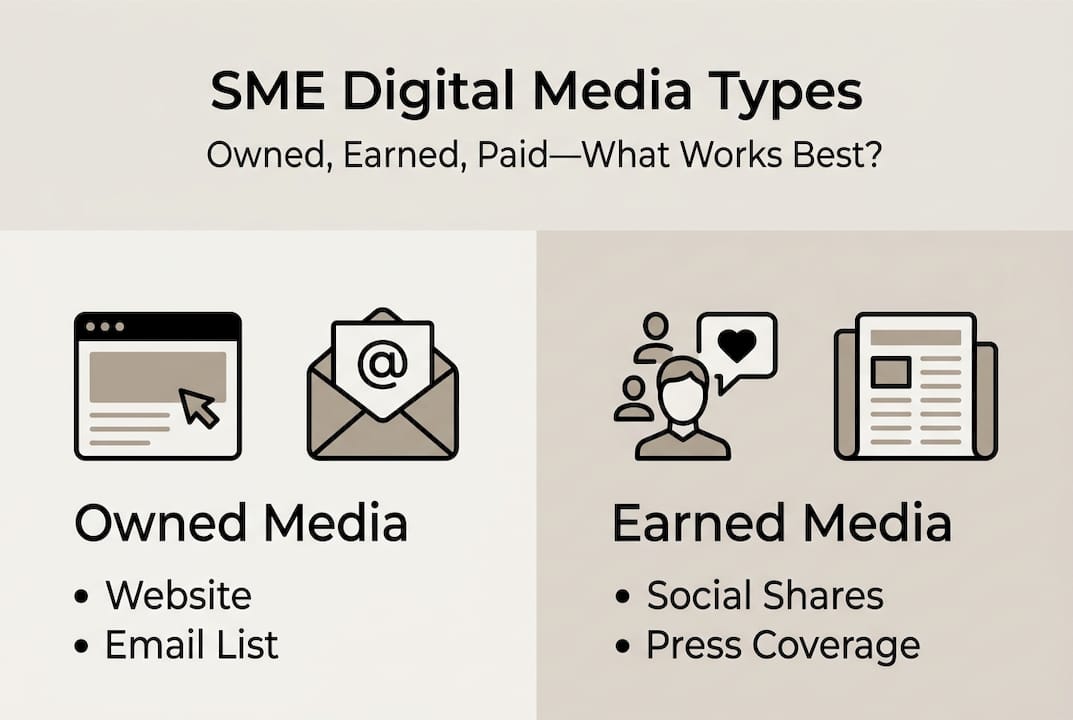
A useful framework for understanding your media is the owned, earned, and paid model:
| Media type | What it is | SME example |
|---|---|---|
| Owned | Channels you control | Website, email list, blog |
| Earned | Visibility others give you | Press mentions, reviews, shares |
| Paid | Adverts you pay for | Google Ads, Facebook Ads |
The strongest SME strategies lean heavily on owned and earned media, using paid to amplify what already works. This reduces long-term costs and builds assets that grow in value over time.
Pro Tip: Run a simple quarterly audit. Ask yourself: which channels are generating leads? Which are consuming budget with no return? Then reallocate. The HubSpot digital marketing guide recommends this iterative approach for businesses at every stage.
For practical guidance on making your content work harder across channels, the SEO content optimisation advice on our site is a strong starting point. Pairing that with a clear SME digital roadmap keeps your efforts aligned and measurable.
Digital marketing pitfalls: Common mistakes and new realities
Even well-intentioned digital marketing efforts can go sideways. Understanding the most common traps will save you time, money, and frustration.
The biggest mistake SMEs make is over-relying on paid advertising. Ads work, but they stop the moment you stop paying. Over-use of ads increases customer acquisition costs, and without a complementary organic strategy, your growth becomes fragile and expensive. Paid should amplify, not replace, your organic efforts.
AI-generated content is another area where SMEs are stumbling in 2026. Tools like ChatGPT can produce content quickly, but generic outputs without human editing tend to feel flat. Audiences notice. Engagement drops. Your brand voice gets diluted. AI is a production tool, not a strategy.
Privacy changes have also shifted the landscape significantly. Third-party cookies are disappearing, and platforms are restricting data sharing. This makes first-party data, the information your customers willingly give you, more valuable than ever.
Watch out for these common pitfalls:
- Chasing vanity metrics: Likes and follower counts feel good but rarely correlate with revenue
- Ignoring mobile users: Over 60% of web traffic now comes from mobile devices
- Skipping measurement: If you are not tracking conversions, you cannot improve
- Copying competitors blindly: What works for a larger brand may not suit your audience or budget
“Your first-party data, your email list, your customer database, your website analytics, is your competitive moat. Protect it, grow it, and use it.”
Exploring AI and automation in marketing can help you use these tools wisely rather than recklessly. And when it comes to knowing whether your efforts are paying off, measuring digital marketing success with the right KPIs is non-negotiable. Understanding why optimisation alone falls short is equally important for long-term thinking.
Choosing your next steps: Building a digital marketing foundation
Knowing the pitfalls is useful. Knowing what to do next is better. Building a solid digital marketing foundation does not require a large budget or a full marketing team. It requires clarity, consistency, and a willingness to iterate.
Start with your website as a base, then layer in local SEO, email, and paid channels aligned to your specific business type. A local service business has different priorities than an e-commerce store or a B2B consultancy.
Here is a practical starting framework:
- Audit your current presence: What do you have? What is working? What is missing?
- Set clear goals: More enquiries? Higher online sales? Better brand recognition? Be specific.
- Choose two or three core channels suited to your business model and audience
- Create a 90-day plan with defined actions, budgets, and success metrics
- Execute consistently for the full period before drawing conclusions
- Review and refine based on real data, not gut feel
For a local business, the winning combination is usually local SEO, Google Business Profile, and email. For e-commerce, SEO, PPC, and social commerce tend to work well together. For B2B, LinkedIn, content marketing, and email are typically the strongest trio.
Pro Tip: Do not wait until everything is perfect before you start. A simple, consistent plan executed today beats a sophisticated strategy that never launches. Use measuring digital marketing ROI frameworks to track progress from the outset, and refer to this digital marketing step-by-step resource when you need a structured reference.
The uncomfortable truth about digital marketing for SMEs
After working with small and medium-sized businesses across many sectors, a pattern becomes clear. The businesses that struggle most with digital marketing are not the ones with the smallest budgets. They are the ones chasing shortcuts.
They jump between tactics, looking for the one hack that will change everything. They buy followers, automate everything, and wonder why nothing feels authentic. They treat digital marketing as a cost rather than an investment, cutting it the moment results are not instant.
AI amplifies good or bad strategy but is not a silver bullet. If your brand story is weak, AI will produce weak content faster. If your website does not convert, more traffic will just reveal the problem at scale.
The businesses that win long-term treat digital marketing as a system. They invest in their brand, build their owned audience, and measure what actually matters. They understand that consistency over 12 months outperforms intensity over two weeks. Explore the SME marketing results that come from this kind of disciplined, integrated approach. The long view is not glamorous. But it works.
Ready to boost your online visibility?
If this guide has helped you see digital marketing in a new light, the next step is putting that understanding into action. Building a strategy that actually fits your business takes more than reading an article; it takes the right support.
At Kickass Online, we work with a select number of SMEs at a time to ensure every client gets focused, personalised attention. Whether you are starting from scratch or looking to sharpen an existing strategy, our team can help. Explore our digital strategy for SMEs resources, compare your options with our digital vs direct marketing guide, or dive into our detailed SEO strategies guide to start building visibility that lasts.
Frequently asked questions
What is the simplest definition of digital marketing for small businesses?
Digital marketing for small businesses means promoting your products or services online using channels such as websites, email, social media, and paid adverts to reach and engage your customers.
Which digital marketing channels should a local business prioritise?
A location-based business should focus on local SEO and Google Business Profile first, then layer in social media to reach nearby customers and build community trust.
How do I measure if my digital marketing is working?
Track key metrics like website traffic, leads, conversions, and social engagement. Digital marketing success is measured with metrics covering reach, engagement, leads, and return on investment.
Does digital marketing cost less than traditional methods?
Digital marketing gives SMEs efficient spend and visibility across suitable channels, making it generally more cost-effective than print or broadcast advertising, with the added benefit of measurable results.
Is AI-generated content enough for effective digital marketing?
AI can speed up content creation, but AI-generated content needs human editing to ensure genuine engagement and brand authenticity. Generic outputs without a human touch risk lower audience connection.
Recommended
- How to create a digital marketing plan for SMEs in 2026 | Kickass Online
- Effective Digital Marketing Strategies for SMEs: Boost Your Online Performance | Kickass Online
- Local SEO for SMEs: Guide to Boost Search Visibility and Drive Local Traffic | Kickass Online
- Digital Marketing KPIs Every SME Needs to Measure for Success | Kickass Online
- Τι είναι digital branding: Κατανόηση και Σημασία - maverix.gr
- Digitale Marketing Trends Duitsland voor Nederlandstalige bedrijven - Duitsewebsite.nl