What Is Conversion Funnel and Why It Matters

Finding ways to turn interest into actual sales can feel challenging for any small or medium-sized business. With online competition growing every day, understanding the conversion funnel gives you clear insight into why customers hesitate and where they drop off. This article explains how each stage shapes buying decisions and reveals key strategies so you can guide more customers to purchase and loyalty, keeping your sales process practical and measurable.
Table of Contents
- Conversion Funnel Explained And Key Concepts
- Stages Of A Conversion Funnel In 2026
- Types Of Conversion Funnels For Smes
- Optimising Each Funnel Stage Effectively
- Common Pitfalls And How To Avoid Them
Key Takeaways
| Point | Details |
|---|---|
| Understanding the Conversion Funnel | The conversion funnel outlines the stages from awareness to purchase, allowing businesses to optimise engagement strategies. |
| Importance of Tailoring Strategies | Each stage in the funnel requires unique marketing approaches to effectively address customer needs and improve conversion rates. |
| Utilising Data for Continuous Improvement | Regular analysis of funnel metrics and customer behaviour is essential for identifying drop-off points and refining marketing efforts. |
| Focus on Personalisation and Engagement | Modern conversion funnels benefit from personalised content and multichannel engagement strategies that cater to sophisticated customer expectations. |
Conversion Funnel Explained and Key Concepts
A conversion funnel represents the strategic journey potential customers undertake from initial product awareness to final purchase. Describing the customer pathway helps businesses understand and optimise their marketing and sales strategies.
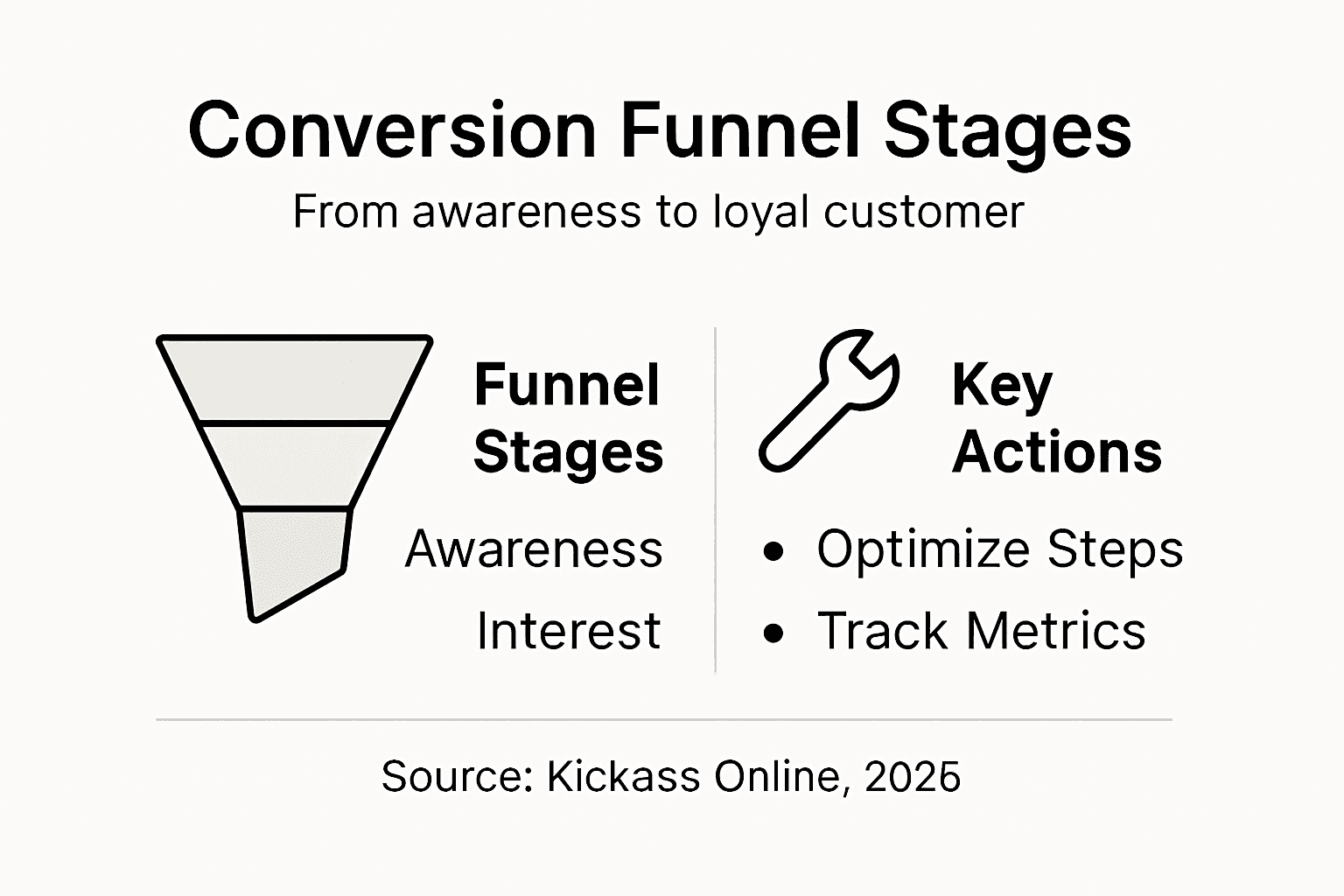
The conversion funnel typically encompasses several critical stages that progressively narrow customer engagement:
- Awareness Stage: Introducing potential customers to your product or service
- Interest/Consideration Stage: Generating curiosity and initial engagement
- Decision Stage: Evaluating options and comparing alternatives
- Action/Conversion Stage: Completing the desired transaction or goal
Businesses utilise the conversion funnel concept to track customer interaction progression and identify potential drop-off points. By understanding how customers move through each stage, organisations can develop targeted interventions that improve overall conversion rates.
The funnel metaphor illustrates how customer numbers naturally decrease at each progression point. Imagine a physical funnel: wide at the top where many potential customers first encounter your offering, progressively narrowing as fewer individuals move closer to making a purchase.
Key insights about conversion funnels include:
- Not all potential customers will complete the entire journey
- Each stage requires unique marketing and communication strategies
- Tracking conversion rates helps identify improvement opportunities
- Different industries might have slightly varied funnel structures
Pro tip: Regularly analyse your conversion funnel metrics to understand where potential customers are losing interest and develop targeted strategies to improve engagement at those specific stages.
Stages of a Conversion Funnel in 2026
In 2026, the conversion funnel has evolved to become a more nuanced and personalised customer journey mapping tool. Funnel stages are increasingly dynamic, reflecting the complex interactions between businesses and potential customers.
The modern conversion funnel typically encompasses four interconnected stages:
- Awareness Stage (TOFU - Top of Funnel)
- Initial customer recognition of product/service
- Building brand visibility and initial interest
- Interest and Consideration Stage (MOFU - Middle of Funnel)
- Detailed information gathering
- Comparing potential solutions
- Decision and Conversion Stage (BOFU - Bottom of Funnel)
- Evaluating specific offerings
- Making final purchasing decisions
- Loyalty and Advocacy Stage
- Post-purchase engagement
- Transforming customers into brand advocates
Customer journey optimization strategies now emphasise understanding each stage’s unique challenges. Businesses must create targeted content that addresses specific customer needs and pain points, recognising that potential customers have increasingly sophisticated expectations.
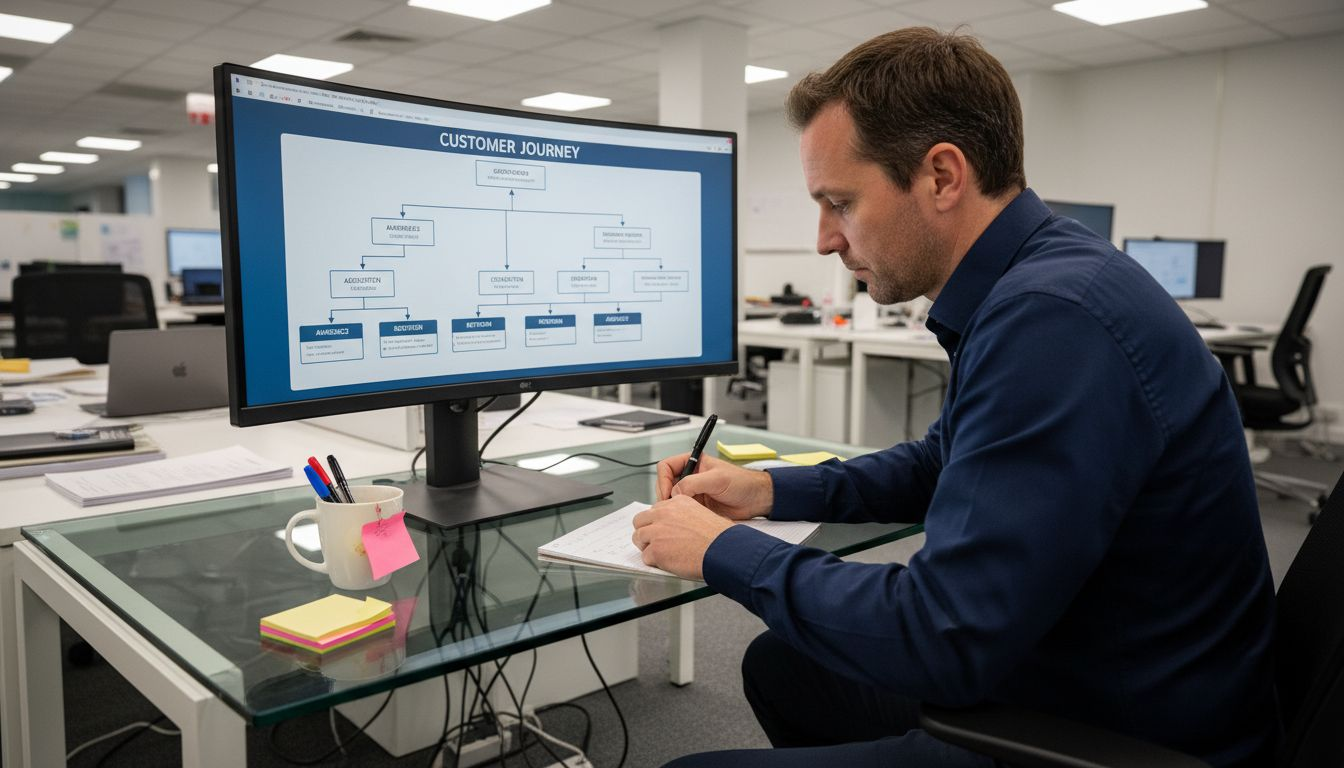
The modern conversion funnel is no longer a linear progression but a dynamic, interconnected ecosystem. Customers might move between stages, revisit previous decision points, and require multiple touchpoints before committing to a purchase.
Here is a comparison of traditional versus modern conversion funnels:
| Aspect | Traditional Funnel | Modern Funnel (2026) |
|---|---|---|
| Progression | Linear, stage by stage | Dynamic, multi-directional |
| Personalisation | Limited, broad messaging | Highly tailored content |
| Data Use | Basic tracking and metrics | AI-driven analytics |
| Customer Touchpoints | Few, mostly single-channel | Multiple, omnichannel |
| Post-purchase Focus | Minimal loyalty strategies | Strong emphasis on advocacy |
Advanced businesses treat the conversion funnel as a continuous learning process, constantly refining their approach based on real-time customer insights and behavioural data.
Key characteristics of 2026 conversion funnels include:
- Increased personalisation
- AI-driven interaction tracking
- Multichannel engagement strategies
- Predictive customer behaviour analysis
- Seamless omnichannel experiences
Pro tip: Implement advanced analytics tools that track customer interactions across multiple touchpoints, enabling you to understand and optimise each stage of your conversion funnel with precision.
Types of Conversion Funnels for SMEs
Conversion funnels play a critical role in helping small and medium enterprises (SMEs) structure their customer acquisition strategies. Marketing funnels for SMEs are designed to be practical, measurable, and specifically tailored to limited resources and targeted growth objectives.
SMEs can leverage several distinct types of conversion funnels to meet their unique business needs:
- Sales Funnel
- Focuses on converting leads into paying customers
- Tracks prospect progression from initial contact to final purchase
- Lead Generation Funnel
- Prioritises capturing and qualifying potential customer information
- Builds a robust pipeline of prospective clients
- E-commerce Funnel
- Specifically designed for online product sales
- Optimises digital purchasing journey
- Content Marketing Funnel
- Uses valuable content to attract and nurture potential customers
- Builds trust and credibility through strategic information sharing
- Email Marketing Funnel
- Nurtures prospects through targeted, personalised email campaigns
- Maintains ongoing communication and relationship building
Conversion funnel strategies for small businesses emphasise creating scalable, manageable processes that founders can easily monitor and continuously improve. Each funnel type offers unique advantages, allowing SMEs to select the most appropriate approach for their specific market and customer base.
Below is a summary of SME conversion funnel types and their primary strategic focus:
| Funnel Type | Main Objective | Best For |
|---|---|---|
| Sales Funnel | Convert leads to customers | Businesses with direct sales |
| Lead Generation | Build prospect database | Service or B2B companies |
| E-commerce Funnel | Streamline online purchases | Online retailers |
| Content Marketing | Nurture through useful content | Educational or trust-based brands |
| Email Funnel | Foster ongoing communication | Relationship-driven strategies |
The most effective conversion funnels for SMEs are those that are simple, actionable, and directly aligned with specific business objectives.
Key considerations when selecting a conversion funnel include:
- Alignment with business model
- Available marketing resources
- Target customer behaviour
- Measurability of results
- Potential for iterative improvement
Pro tip: Start with a simple, focused conversion funnel that matches your primary business goal, and progressively refine your approach as you gather more customer insights and data.
Optimising Each Funnel Stage Effectively
Optimising a conversion funnel requires a strategic approach that addresses the unique challenges of each stage. Conversion funnel optimization strategies focus on creating a seamless, targeted experience that guides potential customers through their purchasing journey.
Effective optimization involves addressing key stages with precision:
- Awareness Stage
- Create compelling, targeted content
- Increase brand visibility
- Generate initial customer interest
- Consideration Stage
- Provide detailed product information
- Address potential customer pain points
- Demonstrate unique value proposition
- Decision Stage
- Remove purchase barriers
- Offer clear value demonstration
- Provide social proof and testimonials
- Conversion Stage
- Simplify purchasing process
- Minimize friction points
- Create urgency and clear calls-to-action
- Retention Stage
- Develop post-purchase engagement strategies
- Create loyalty programmes
- Provide exceptional customer support
Sales funnel optimization techniques emphasise the importance of aligning marketing and sales efforts to create a cohesive customer experience. Each stage requires careful analysis and targeted interventions to improve overall conversion rates.
Successful funnel optimization is a continuous process of measurement, testing, and refinement.
Key optimization strategies include:
- Personalising customer interactions
- Reducing friction in the buying process
- Implementing data-driven improvements
- Conducting regular funnel performance analysis
- Creating targeted content for each stage
Pro tip: Implement A/B testing at each funnel stage to systematically identify and eliminate barriers that prevent potential customers from progressing towards conversion.
Common Pitfalls and How to Avoid Them
Navigating the conversion funnel can be challenging for businesses, with several critical mistakes potentially derailing customer acquisition efforts. Common sales funnel mistakes can significantly impact a company’s ability to convert potential leads into paying customers.
The most prevalent pitfalls in conversion funnels include:
- Poor Audience Targeting
- Failing to understand customer demographics
- Creating generic messaging
- Neglecting customer persona development
- Complex Conversion Processes
- Overly complicated checkout procedures
- Too many form fields
- Unnecessary steps in purchasing journey
- Ineffective Lead Nurturing
- Lack of follow-up communication
- Inconsistent engagement strategies
- Minimal personalisation
- Weak Value Proposition
- Unclear product benefits
- Inadequate differentiation from competitors
- Unconvincing messaging
- Analytics and Testing Gaps
- Ignoring performance metrics
- Minimal A/B testing
- Failure to adapt strategies
Strategies to avoid sales funnel mistakes emphasise the importance of continuous improvement and targeted customer engagement. Understanding and addressing these common pitfalls can dramatically improve conversion rates and overall business performance.
Successful conversion funnels require constant refinement, customer understanding, and strategic adaptation.
Strategies to overcome common conversion funnel challenges:
- Conduct thorough audience research
- Simplify conversion processes
- Implement robust lead nurturing workflows
- Develop clear, compelling value propositions
- Use data-driven analytics for continuous improvement
Pro tip: Regularly conduct comprehensive funnel audits to identify and eliminate friction points, using customer feedback and performance data to guide your optimization efforts.
Empower Your Business with a High-Converting Website
Understanding the conversion funnel and its stages is vital for any business aiming to transform website visitors into loyal customers. If you struggle with complex conversion processes or want to improve personalised engagement across every funnel stage, Kickass Online offers tailored digital marketing solutions designed specifically for small and medium-sized businesses. Our expertise in creating high-converting websites, optimising search engine rankings, and maintaining seamless website performance directly addresses the common challenges highlighted in the article.
Take control of your customer journey today by partnering with Kickass Online. Discover how our personalised approach and dedicated team can help simplify your conversion funnel, reduce friction in the buying process, and boost your online visibility. Don’t let potential customers slip away—visit Kickass Online now to schedule your consultation and start transforming your online presence with proven strategies that work. Learn more about our web development services and SEO solutions to get started.
Frequently Asked Questions
What is a conversion funnel?
A conversion funnel is a model that illustrates the journey potential customers go through from first becoming aware of a product or service to completing a purchase. It helps businesses understand customer interactions and optimise marketing strategies.
Why is the conversion funnel important for businesses?
The conversion funnel is crucial because it allows businesses to identify potential drop-off points during the customer journey. By understanding these stages, organisations can develop targeted strategies to improve conversion rates and enhance customer engagement.
What are the key stages of a conversion funnel?
The key stages of a conversion funnel typically include Awareness, Interest/Consideration, Decision, and Action/Conversion. Some modern funnels also incorporate a Loyalty and Advocacy stage to focus on post-purchase customer engagement.
How can businesses optimise each stage of the conversion funnel?
Businesses can optimise each stage by creating targeted content that speaks to customer needs, simplifying the purchasing process, removing barriers to conversion, and implementing robust follow-up strategies to engage customers post-purchase.
Recommended


Book A Discovery Call
Stay Connected